INTERVENTIONAL PROCEDURE IN
CHILDREN
Dr Rijin Plasis MEM MS ORTHO
MBA (HA)
SR RMCH Kanpur
Contents :
• Central venous access
• Umbilical vein catheterization
• IO access
Central venous access
Introduction :
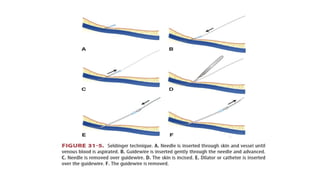
• Percutaneous cannulation of the central vein is an essential technique
for both long term and emergent medical care and access to major
veins allows rapid high volume fluid resuscitation , administration of
concentrated ionic and hemodynamic measurements.
• Central venous access allows for blood products , vasoactive
medications to transvenous cardiac pacing and also should often
undertaken when peripheral line is cannot be obtained
Central venous access in children
• It is safe in all age group as long as proper technique is followed. In
older children , complications are similar to those encountered in
adults.
• Insertion of central venous catheter > 6 French in size in children <1
year old , <10 kg in weight or <75 cm in height is associayted with
high complication rates.
• Typically , 5 French catheter is used for neonates and infants and 3 –
French catheter used in preterm <36 weeks neonates .
Placement of central venous catheters
• The three most common anatomic locations for obtaining central
access in children are subclavian vein , the internal jugular vein and
femoral vein. The anatomic landmarks and insertion technique are
the same in adults and children
• The choice of location is depends on patient / children’s factor as well
as practitioner experience with particular site.
• Multiple attempts [>2] and the subclavian approach are associated
with higher complication rates.
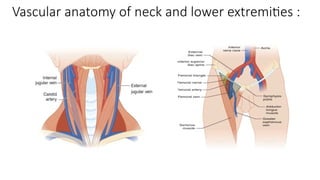
Vascular anatomy of neck and lower extremities :
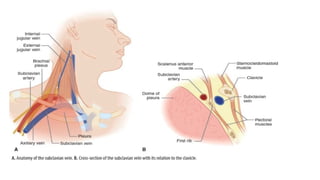
Subclavian vein
• Anatomy of subclavian vein and technique for line placement are similar in
children and adults.
• Location of subclavian vein allows patient mobility and is an excellent choice
for long term use.
• The two traditional approach to the catheterization of subclavian vein are
infraclavicular and supraclavicular approach.
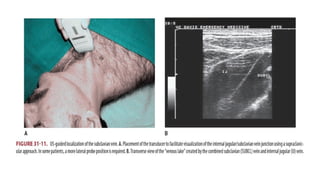
• IC approach to US guided subclavian vein catheter is placed is limited by large
acoustic shadow created by clavicle.
• SC approach allows good sonographic visualization of proximal subclavian
anatomy
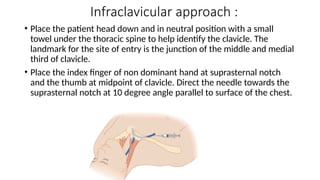
Infraclavicular approach :
• Place the patient head down and in neutral position with a small
towel under the thoracic spine to help identify the clavicle. The
landmark for the site of entry is the junction of the middle and medial
third of clavicle.
• Place the index finger of non dominant hand at suprasternal notch
and the thumb at midpoint of clavicle. Direct the needle towards the
suprasternal notch at 10 degree angle parallel to surface of the chest.
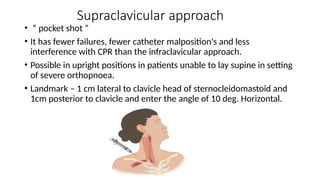
Supraclavicular approach
• “ pocket shot “
• It has fewer failures, fewer catheter malposition's and less
interference with CPR than the infraclavicular approach.
• Possible in upright positions in patients unable to lay supine in setting
of severe orthopnoea.
• Landmark – 1 cm lateral to clavicle head of sternocleidomastoid and
1cm posterior to clavicle and enter the angle of 10 deg. Horizontal.
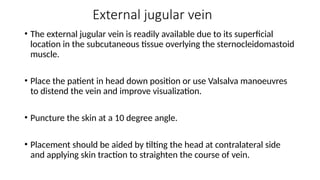
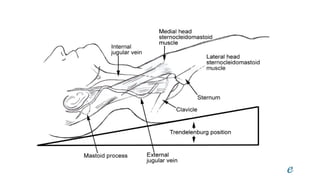
External jugular vein
• The external jugular vein is readily available due to its superficial
location in the subcutaneous tissue overlying the sternocleidomastoid
muscle.
• Place the patient in head down position or use Valsalva manoeuvres
to distend the vein and improve visualization.
• Puncture the skin at a 10 degree angle.
• Placement should be aided by tilting the head at contralateral side
and applying skin traction to straighten the course of vein.
Internal jugular vein
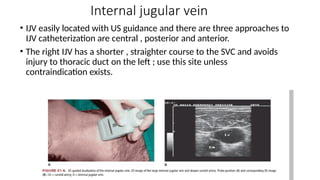
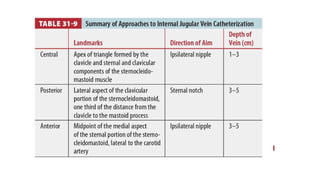
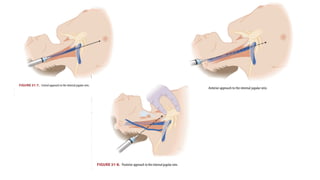
• IJV easily located with US guidance and there are three approaches to
IJV catheterization are central , posterior and anterior.
• The right IJV has a shorter , straighter course to the SVC and avoids
injury to thoracic duct on the left ; use this site unless
contraindication exists.
Femoral vein
• It is the most accessible central accessible site during critical illness ,
notably cardiac arrest or trauma.
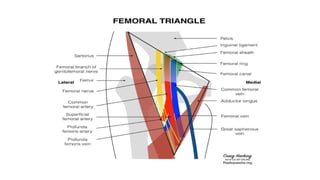
• It travels in the femoral sheath with femoral artery, nerve , lymphatics
deep to the medial third of inguinal ligament.
• Anatomy of femoral structure from lateral to medial : nerve , artery, vein,
empty space , lymphatics.
• Femoral vein can be cannulated with traditional approach , using surface
anatomy and palpation as guide or by US
Surface anatomy approach
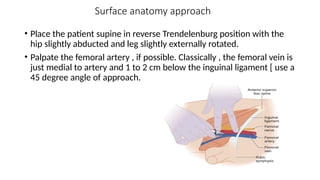
• Place the patient supine in reverse Trendelenburg position with the
hip slightly abducted and leg slightly externally rotated.
• Palpate the femoral artery , if possible. Classically , the femoral vein is
just medial to artery and 1 to 2 cm below the inguinal ligament [ use a
45 degree angle of approach.
• In pulseless arrest , locate the femoral vein using the “ v “ technique.
Place the thumb on pubic tubercle and the index finger on the
anterior superior iliac spine. Femoral vein is typically located at the
interdigital space [ the “ v “ of finger and thumb ] just inferior to
inguinal ligament.
• Always insert the needle below the inguinal ligament , because
vascular injury above the inguinal ligament may cause hemorhage
into retroperitoneal space.
US guided approach
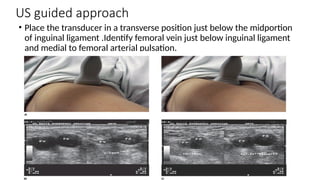
• Place the transducer in a transverse position just below the midportion
of inguinal ligament .Identify femoral vein just below inguinal ligament
and medial to femoral arterial pulsation.
Indications for paediatric central venous access
• Inability to obtain peripheral access
• Need for invasive hemodynamic monitoring
• Administration of caustic or hypertonic solutions
• Need for long term vascular access
• Need for transvenous pacemaker placement
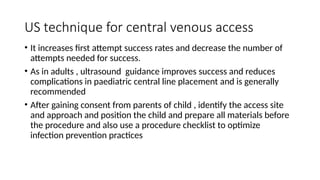
US technique for central venous access
• It increases first attempt success rates and decrease the number of
attempts needed for success.
• As in adults , ultrasound guidance improves success and reduces
complications in paediatric central line placement and is generally
recommended
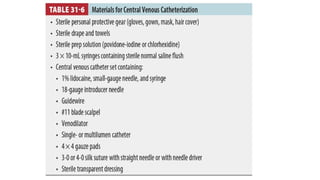
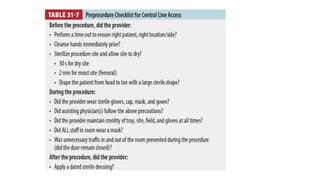
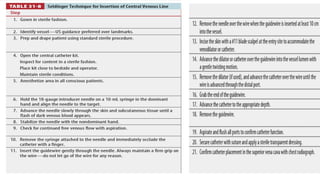
• After gaining consent from parents of child , identify the access site
and approach and position the child and prepare all materials before
the procedure and also use a procedure checklist to optimize
infection prevention practices
Complications of paediatric central venous access
• Pneumothorax / Haemothorax [ subclavian and internal jugular veins
sites]
• Thoracic duct injury [ left sided internal jugular vein]
• Arterial puncture
• Cardiac tamponade
• Air embolism
• Arrythmia
• Incorrect position
• Infections
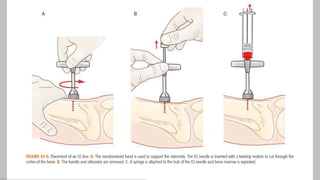
Intraosseous [IO] vascular access
• IO vascular access is possible in patients of all ages when venous access
cannot be quickly and really established during circulatory collapse.
[ emergent need for vascular access ] and also alternative to central
venous access in pt without adequate peripheral access.
• Mechanical IO insertion devices have insertion time of only seconds
with consistently >90 % success rates.
• Insertion device include simple hand twist needles , hand held power
drills , spring loaded devices.
• Most common complication is extravasation at the insertion site.
Anatomy and pathophysiology :
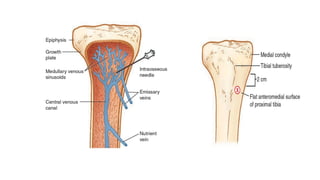
• Long bones are composed of dense outer cortex and inner soft , spongy
[ cancellous ] bone.
• Nutrient artery supplies the bone with rich vascular network. It pierces the
cortex and divides into ascending and descending branches that further divided
into arterioles and capillaries.
• IO needle is inserted through cortex and into bone marrow [medullary] cavity of
a long bone.
• Most traditional site , which is favoured in paediatric patient , is the flat
anteromedial surface of proximal tibia.
Indications :
• Placement of an IO line is indicated when vascular access is rapidly
required for resuscitation of a patient and standard vascular access is
delayed.
• Situations that may require the placement of an IO line are cardiac
arrest , severe dehydration , severe burns and status epilepticus and also
for urgent administration of fluids , blood and medications.
• AHA 2020 guidelines in ACLS recommended IO access if IV access is
unobtained within 90 seconds or two attempts.
• IO access can provide blood samples for lab analysis.
Contraindications to IO placement :
• Overlying infection
• Exposed bone
• underlying fracture
• Structural bone disorder [ eg. Osteogenesis imperfecta ]
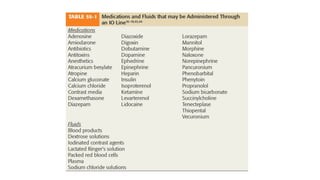
Medications and fluids administrations:
• Paralytics , anticonvulsants , analgesics , benzodiazepines and
vasopressors such as epinephrine have comparable IO and IV infusion
rates.
• Blood and blood products and RSI drugs can be given.
• Principal limitation of IO access hs low maximum flow rate.
• Speed of administration of IO infusions can be improved with pressure
devices.
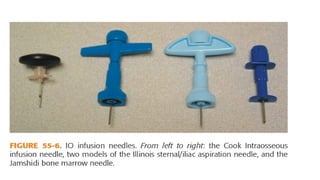
IO cannulation devices :
• Two most common manual insertion devices include cook IO needle and
Jamshidi style IO needle.
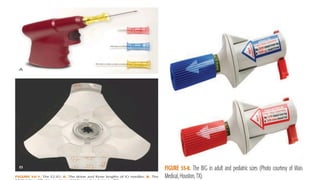
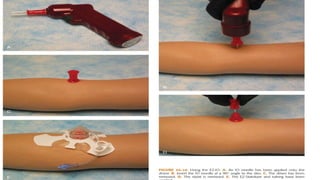
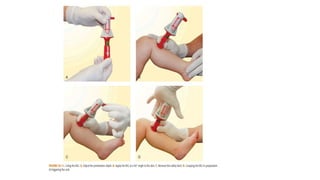
• Powered devices are also available for IO needle insertion : examples are
EZ –IO and the Bone injection gun [ BIG ].
• Generally , powered IO devices in paediatrics are rapid to place with
minimal training , faster than manual devices and also felt to be easier to
use compared to other device.
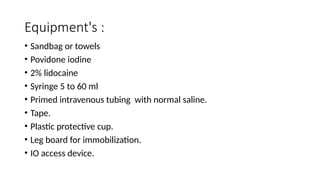
Equipment's :
• Sandbag or towels
• Povidone iodine
• 2% lidocaine
• Syringe 5 to 60 ml
• Primed intravenous tubing with normal saline.
• Tape.
• Plastic protective cup.
• Leg board for immobilization.
• IO access device.
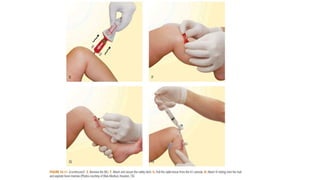
Assessment :
• Assess whether the IO needle is correctly positioned within the
medullary cavity  first aspirate the blood from marrow cavity may
not possible in patient with cardiac arrest [poor circulation ] 
second sign of correct placement to assess whether the IO needle will
stand erect without support  finally flush the IO line confirm
proper placement by ability of fluid to flow without inducing soft
tissue swelling.
• Ultrasonic visualization of flow within medullary cavity using color
doppler also confirm proper placement.
Umbilical vessel catheterization :
• It was first described by diamond in 1947 for an exchange transfusion in
neonate.
• It can be used as reliable method for obtaining rapid vascular access in
neonate.
• Umbilical vessel catheter may be used for fluid resuscitation , blood
transfusion , medicine administration and cardiovascular monitoring.
• However , use of these catheter also carries significant risk of permanent
morbidity and even death.
• Either the umbilical artery or vein may used for vascular access.
• Artery can be accessed within 24 hours of life and it is occasionally
possible to use artery upto 7 days after birth.
• Umbilical vein can be accessed for upto 2 weeks of age.
• Umbilical vessel catheterization can lead to serious complications and
should be reserved for patient in whom peripheral venous access
attempts have been unsuccessful.
Indications:
• It is indicated when frequent arterial blood gas determinations and continuous
monitoring of blood pressure are required in first few days of life in critically ill
neonates.
• It can be used for delivering bloods , fluids , TPN , medications and exchange
transfusions.
• Neonates under 24 hrs of age group can usually catheterized without much difficulty.
• Umbilical vein is easier to perform than artery. In critically ill patients , central venous
pressure can be measured by vein and also perform invasive cardiac procedure
recently.
• Possible in neonate upto 2 weeks of age.
Contraindications :
• In the EMD , should be performed only on severely ill neonates in whom peripheral vascular
attempts have failed.
• Gastroschisis
• Omphalocele
• Omphalitis
• Peritonitis
• signs of infection or round of remnant of umbilical cord.
• Suspicion of necrotizing enterocolitis.
Equipment's :
• Umbilical artery and vein catheters are available in various sizes.
• Available in single or double lumen.
• Use a 5 French venous catheter in neonates wt >1200 grams and 3.5
French for <1200 grams.
• Use a 5 French artery catheter for wt > 3500 grams and 3.5 French for
<3500 grams
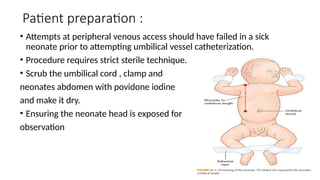
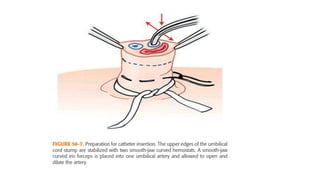
Patient preparation :
• Attempts at peripheral venous access should have failed in a sick
neonate prior to attempting umbilical vessel catheterization.
• Procedure requires strict sterile technique.
• Scrub the umbilical cord , clamp and
neonates abdomen with povidone iodine
and make it dry.
• Ensuring the neonate head is exposed for
observation
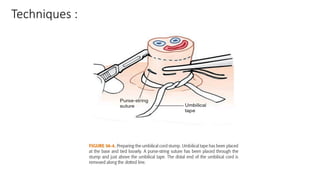
Techniques :
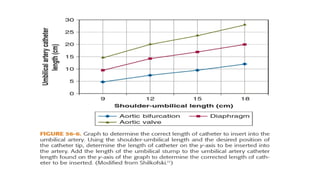
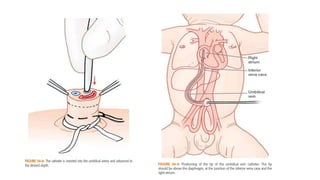
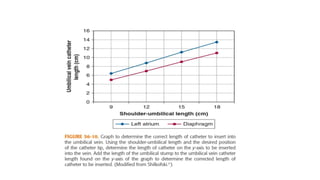
Umbilical artery catheterization
Two possible positions for
umbilical artery catheter tip ,
high or low position : In low
position – catheter tip should
be placed between 3rd
and 5th
lumbar vertebra . A level
corresponding to aortic
bifurcation.
In high position between 6th
and 9th
thoracic vertebra and
level is corresponding or just
above the diaphragm.
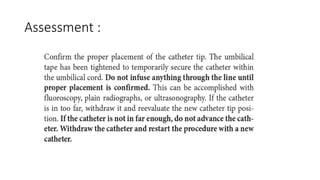
Assessment :
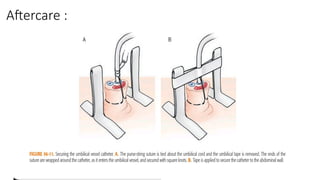
Aftercare :
Complications :
• Significant morbidity can be associated with umbilical artery and vein
catheterization . Prevention of complications requires strict
adherence to sterile technique , flushing of the catheter prior to
insertion , gentle manipulation during insertion and accurate
positioning of catheter.it is essential that no air be allowed to enter
the catheter.
•Thank you

INTERVENTIONAL PROCEDURE IN CHILDREN.pptx

  • 1.
    INTERVENTIONAL PROCEDURE IN CHILDREN DrRijin Plasis MEM MS ORTHO MBA (HA) SR RMCH Kanpur
  • 2.
    Contents : • Centralvenous access • Umbilical vein catheterization • IO access
  • 3.
    Central venous access Introduction: • Percutaneous cannulation of the central vein is an essential technique for both long term and emergent medical care and access to major veins allows rapid high volume fluid resuscitation , administration of concentrated ionic and hemodynamic measurements. • Central venous access allows for blood products , vasoactive medications to transvenous cardiac pacing and also should often undertaken when peripheral line is cannot be obtained
  • 4.
    Central venous accessin children • It is safe in all age group as long as proper technique is followed. In older children , complications are similar to those encountered in adults. • Insertion of central venous catheter > 6 French in size in children <1 year old , <10 kg in weight or <75 cm in height is associayted with high complication rates. • Typically , 5 French catheter is used for neonates and infants and 3 – French catheter used in preterm <36 weeks neonates .
  • 5.
    Placement of centralvenous catheters • The three most common anatomic locations for obtaining central access in children are subclavian vein , the internal jugular vein and femoral vein. The anatomic landmarks and insertion technique are the same in adults and children • The choice of location is depends on patient / children’s factor as well as practitioner experience with particular site. • Multiple attempts [>2] and the subclavian approach are associated with higher complication rates.
  • 6.
    Vascular anatomy ofneck and lower extremities :
  • 7.
    Subclavian vein • Anatomyof subclavian vein and technique for line placement are similar in children and adults. • Location of subclavian vein allows patient mobility and is an excellent choice for long term use. • The two traditional approach to the catheterization of subclavian vein are infraclavicular and supraclavicular approach. • IC approach to US guided subclavian vein catheter is placed is limited by large acoustic shadow created by clavicle. • SC approach allows good sonographic visualization of proximal subclavian anatomy
  • 10.
    Infraclavicular approach : •Place the patient head down and in neutral position with a small towel under the thoracic spine to help identify the clavicle. The landmark for the site of entry is the junction of the middle and medial third of clavicle. • Place the index finger of non dominant hand at suprasternal notch and the thumb at midpoint of clavicle. Direct the needle towards the suprasternal notch at 10 degree angle parallel to surface of the chest.
  • 11.
    Supraclavicular approach • “pocket shot “ • It has fewer failures, fewer catheter malposition's and less interference with CPR than the infraclavicular approach. • Possible in upright positions in patients unable to lay supine in setting of severe orthopnoea. • Landmark – 1 cm lateral to clavicle head of sternocleidomastoid and 1cm posterior to clavicle and enter the angle of 10 deg. Horizontal.
  • 12.
    External jugular vein •The external jugular vein is readily available due to its superficial location in the subcutaneous tissue overlying the sternocleidomastoid muscle. • Place the patient in head down position or use Valsalva manoeuvres to distend the vein and improve visualization. • Puncture the skin at a 10 degree angle. • Placement should be aided by tilting the head at contralateral side and applying skin traction to straighten the course of vein.
  • 14.
    Internal jugular vein •IJV easily located with US guidance and there are three approaches to IJV catheterization are central , posterior and anterior. • The right IJV has a shorter , straighter course to the SVC and avoids injury to thoracic duct on the left ; use this site unless contraindication exists.
  • 17.
    Femoral vein • Itis the most accessible central accessible site during critical illness , notably cardiac arrest or trauma. • It travels in the femoral sheath with femoral artery, nerve , lymphatics deep to the medial third of inguinal ligament. • Anatomy of femoral structure from lateral to medial : nerve , artery, vein, empty space , lymphatics. • Femoral vein can be cannulated with traditional approach , using surface anatomy and palpation as guide or by US
  • 19.
    Surface anatomy approach •Place the patient supine in reverse Trendelenburg position with the hip slightly abducted and leg slightly externally rotated. • Palpate the femoral artery , if possible. Classically , the femoral vein is just medial to artery and 1 to 2 cm below the inguinal ligament [ use a 45 degree angle of approach.
  • 20.
    • In pulselessarrest , locate the femoral vein using the “ v “ technique. Place the thumb on pubic tubercle and the index finger on the anterior superior iliac spine. Femoral vein is typically located at the interdigital space [ the “ v “ of finger and thumb ] just inferior to inguinal ligament. • Always insert the needle below the inguinal ligament , because vascular injury above the inguinal ligament may cause hemorhage into retroperitoneal space.
  • 21.
    US guided approach •Place the transducer in a transverse position just below the midportion of inguinal ligament .Identify femoral vein just below inguinal ligament and medial to femoral arterial pulsation.
  • 22.
    Indications for paediatriccentral venous access • Inability to obtain peripheral access • Need for invasive hemodynamic monitoring • Administration of caustic or hypertonic solutions • Need for long term vascular access • Need for transvenous pacemaker placement
  • 23.
    US technique forcentral venous access • It increases first attempt success rates and decrease the number of attempts needed for success. • As in adults , ultrasound guidance improves success and reduces complications in paediatric central line placement and is generally recommended • After gaining consent from parents of child , identify the access site and approach and position the child and prepare all materials before the procedure and also use a procedure checklist to optimize infection prevention practices
  • 28.
    Complications of paediatriccentral venous access • Pneumothorax / Haemothorax [ subclavian and internal jugular veins sites] • Thoracic duct injury [ left sided internal jugular vein] • Arterial puncture • Cardiac tamponade • Air embolism • Arrythmia • Incorrect position • Infections
  • 29.
    Intraosseous [IO] vascularaccess • IO vascular access is possible in patients of all ages when venous access cannot be quickly and really established during circulatory collapse. [ emergent need for vascular access ] and also alternative to central venous access in pt without adequate peripheral access. • Mechanical IO insertion devices have insertion time of only seconds with consistently >90 % success rates. • Insertion device include simple hand twist needles , hand held power drills , spring loaded devices. • Most common complication is extravasation at the insertion site.
  • 30.
    Anatomy and pathophysiology: • Long bones are composed of dense outer cortex and inner soft , spongy [ cancellous ] bone. • Nutrient artery supplies the bone with rich vascular network. It pierces the cortex and divides into ascending and descending branches that further divided into arterioles and capillaries. • IO needle is inserted through cortex and into bone marrow [medullary] cavity of a long bone. • Most traditional site , which is favoured in paediatric patient , is the flat anteromedial surface of proximal tibia.
  • 32.
    Indications : • Placementof an IO line is indicated when vascular access is rapidly required for resuscitation of a patient and standard vascular access is delayed. • Situations that may require the placement of an IO line are cardiac arrest , severe dehydration , severe burns and status epilepticus and also for urgent administration of fluids , blood and medications. • AHA 2020 guidelines in ACLS recommended IO access if IV access is unobtained within 90 seconds or two attempts. • IO access can provide blood samples for lab analysis.
  • 33.
    Contraindications to IOplacement : • Overlying infection • Exposed bone • underlying fracture • Structural bone disorder [ eg. Osteogenesis imperfecta ]
  • 34.
    Medications and fluidsadministrations: • Paralytics , anticonvulsants , analgesics , benzodiazepines and vasopressors such as epinephrine have comparable IO and IV infusion rates. • Blood and blood products and RSI drugs can be given. • Principal limitation of IO access hs low maximum flow rate. • Speed of administration of IO infusions can be improved with pressure devices.
  • 36.
    IO cannulation devices: • Two most common manual insertion devices include cook IO needle and Jamshidi style IO needle. • Powered devices are also available for IO needle insertion : examples are EZ –IO and the Bone injection gun [ BIG ]. • Generally , powered IO devices in paediatrics are rapid to place with minimal training , faster than manual devices and also felt to be easier to use compared to other device.
  • 37.
    Equipment's : • Sandbagor towels • Povidone iodine • 2% lidocaine • Syringe 5 to 60 ml • Primed intravenous tubing with normal saline. • Tape. • Plastic protective cup. • Leg board for immobilization. • IO access device.
  • 44.
    Assessment : • Assesswhether the IO needle is correctly positioned within the medullary cavity  first aspirate the blood from marrow cavity may not possible in patient with cardiac arrest [poor circulation ]  second sign of correct placement to assess whether the IO needle will stand erect without support  finally flush the IO line confirm proper placement by ability of fluid to flow without inducing soft tissue swelling. • Ultrasonic visualization of flow within medullary cavity using color doppler also confirm proper placement.
  • 45.
    Umbilical vessel catheterization: • It was first described by diamond in 1947 for an exchange transfusion in neonate. • It can be used as reliable method for obtaining rapid vascular access in neonate. • Umbilical vessel catheter may be used for fluid resuscitation , blood transfusion , medicine administration and cardiovascular monitoring. • However , use of these catheter also carries significant risk of permanent morbidity and even death.
  • 46.
    • Either theumbilical artery or vein may used for vascular access. • Artery can be accessed within 24 hours of life and it is occasionally possible to use artery upto 7 days after birth. • Umbilical vein can be accessed for upto 2 weeks of age. • Umbilical vessel catheterization can lead to serious complications and should be reserved for patient in whom peripheral venous access attempts have been unsuccessful.
  • 47.
    Indications: • It isindicated when frequent arterial blood gas determinations and continuous monitoring of blood pressure are required in first few days of life in critically ill neonates. • It can be used for delivering bloods , fluids , TPN , medications and exchange transfusions. • Neonates under 24 hrs of age group can usually catheterized without much difficulty. • Umbilical vein is easier to perform than artery. In critically ill patients , central venous pressure can be measured by vein and also perform invasive cardiac procedure recently. • Possible in neonate upto 2 weeks of age.
  • 48.
    Contraindications : • Inthe EMD , should be performed only on severely ill neonates in whom peripheral vascular attempts have failed. • Gastroschisis • Omphalocele • Omphalitis • Peritonitis • signs of infection or round of remnant of umbilical cord. • Suspicion of necrotizing enterocolitis.
  • 49.
  • 50.
    • Umbilical arteryand vein catheters are available in various sizes. • Available in single or double lumen. • Use a 5 French venous catheter in neonates wt >1200 grams and 3.5 French for <1200 grams. • Use a 5 French artery catheter for wt > 3500 grams and 3.5 French for <3500 grams
  • 51.
    Patient preparation : •Attempts at peripheral venous access should have failed in a sick neonate prior to attempting umbilical vessel catheterization. • Procedure requires strict sterile technique. • Scrub the umbilical cord , clamp and neonates abdomen with povidone iodine and make it dry. • Ensuring the neonate head is exposed for observation
  • 52.
  • 53.
    Umbilical artery catheterization Twopossible positions for umbilical artery catheter tip , high or low position : In low position – catheter tip should be placed between 3rd and 5th lumbar vertebra . A level corresponding to aortic bifurcation. In high position between 6th and 9th thoracic vertebra and level is corresponding or just above the diaphragm.
  • 58.
  • 59.
  • 60.
    Complications : • Significantmorbidity can be associated with umbilical artery and vein catheterization . Prevention of complications requires strict adherence to sterile technique , flushing of the catheter prior to insertion , gentle manipulation during insertion and accurate positioning of catheter.it is essential that no air be allowed to enter the catheter.
  • 61.