FBI MISSION STATEMENT The mission of the FBI is to protect  and defend the United States  against terrorist and foreign  intelligence threats, to uphold and  enforce the criminal laws of the  United States, and to provide  leadership and criminal justice  services to federal, state,  municipal, and international  agencies and partners.
CJIS MISSION STATEMENT Reduce terrorist and criminal activities  by maximizing the ability to provide  timely and relevant criminal justice  information to the FBI and to qualified  law enforcement, criminal justice,  civilian, academic, employment, and  licensing agencies concerning  individuals, stolen property, criminal  organizations and activities, and other  law enforcement related data.
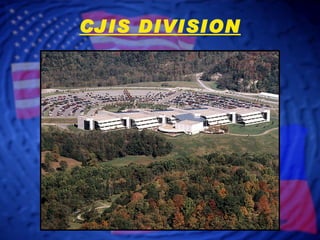
CJIS DIVISION
---------------------------------------------------------------------------------------------------------------------------------------------------------------------------------------------- FINGERPRINT PATTERN  RECOGNITION ----------------------------------------------------------------------------------------------------------------------------------------------------------------------------------------------
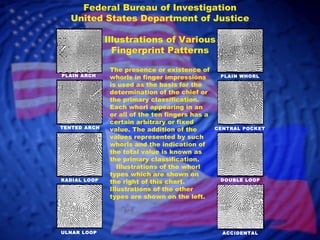
Federal Bureau of Investigation United States Department of Justice Illustrations of Various Fingerprint Patterns The presence or existence of whorls in finger impressions is used as the basis for the determination of the chief or the primary classification. Each whorl appearing in an or all of the ten fingers has a certain arbitrary or fixed value. The addition of the values represented by such whorls and the indication of the total value is known as the primary classification.    Illustrations of the whorl types which are shown on the right of this chart.  Illustrations of the other types are shown on the left. PLAIN ARCH TENTED ARCH RADIAL LOOP ULNAR LOOP PLAIN WHORL CENTRAL POCKET DOUBLE LOOP ACCIDENTAL
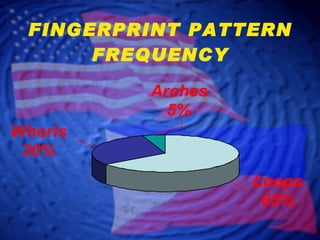
FINGERPRINT PATTERN FREQUENCY


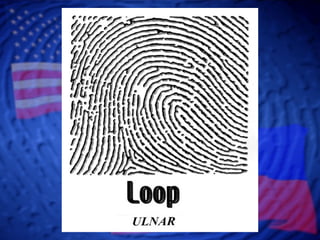
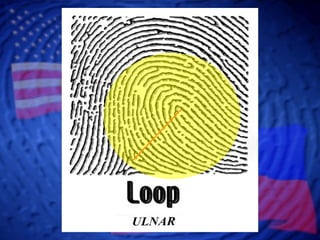
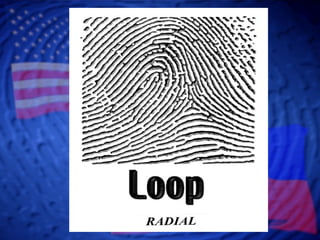
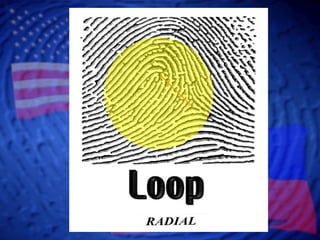
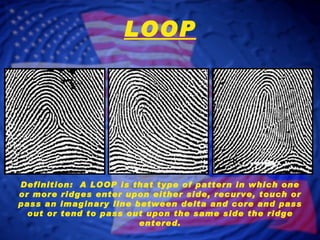
LOOP Definition:  A LOOP is that type of pattern in which one or more ridges enter upon either side, recurve, touch or pass an imaginary line between delta and core and pass out or tend to pass out upon the same side the ridge entered.
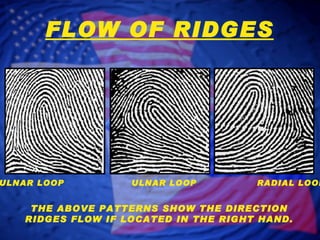
FLOW OF RIDGES ULNAR LOOP  ULNAR LOOP  RADIAL LOOP THE ABOVE PATTERNS SHOW THE DIRECTION RIDGES FLOW IF LOCATED IN THE RIGHT HAND.
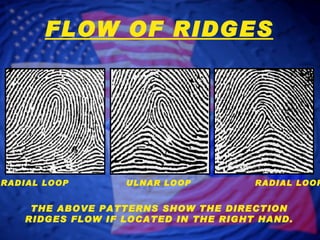
RADIAL LOOP  ULNAR LOOP  RADIAL LOOP FLOW OF RIDGES THE ABOVE PATTERNS SHOW THE DIRECTION RIDGES FLOW IF LOCATED IN THE RIGHT HAND.
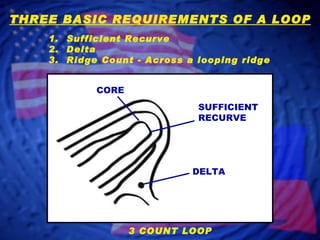
1.  Sufficient Recurve 2.  Delta 3.  Ridge Count - Across a looping ridge THREE BASIC REQUIREMENTS OF A LOOP 3 COUNT LOOP CORE SUFFICIENT RECURVE DELTA
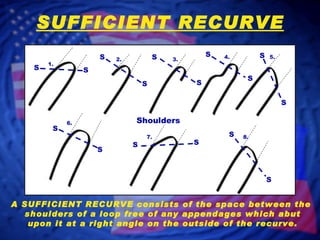
SUFFICIENT RECURVE A SUFFICIENT RECURVE consists of the space between the  shoulders of a loop free of any appendages which abut upon it at a right angle on the outside of the recurve. 1. 2. 3. 4. 5. 6. 8. 7. S S S S S S S S S S S S S S S S Shoulders
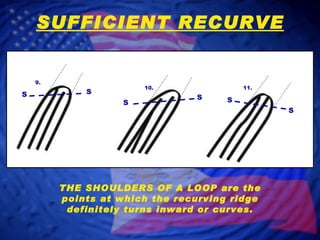
SUFFICIENT RECURVE THE SHOULDERS OF A LOOP are the points at which the recurving ridge definitely turns inward or curves. S S S S S S 9. 10. 11.
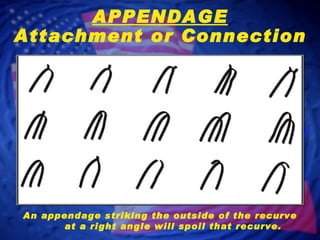
APPENDAGE Attachment or Connection An appendage striking the outside of the recurve at a right angle will spoil that recurve.
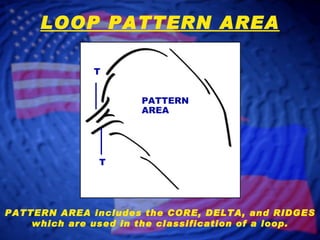
LOOP PATTERN AREA PATTERN AREA includes the CORE, DELTA, and RIDGES which are used in the classification of a loop. T T PATTERN AREA
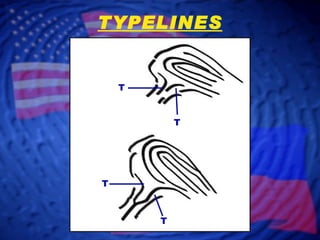
TYPELINES T T T T
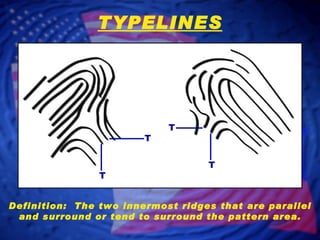
Definition:  The two innermost ridges that are parallel and surround or tend to surround the pattern area. T T T T TYPELINES
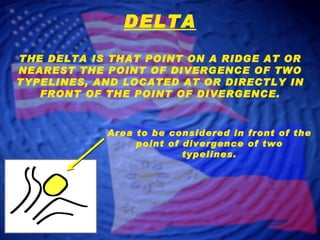
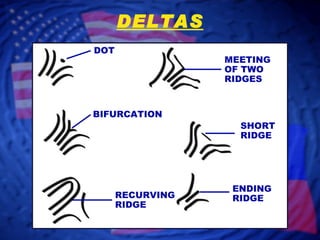
DELTA THE DELTA IS THAT POINT ON A RIDGE AT OR NEAREST THE POINT OF DIVERGENCE OF TWO TYPELINES, AND LOCATED AT OR DIRECTLY IN FRONT OF THE POINT OF DIVERGENCE. Area to be considered in front of the point of divergence of two typelines.
DOT BIFURCATION MEETING OF TWO RIDGES SHORT RIDGE RECURVING RIDGE ENDING RIDGE DELTAS
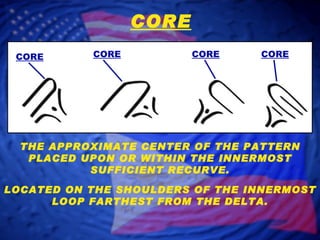
CORE THE APPROXIMATE CENTER OF THE PATTERN PLACED UPON OR WITHIN THE INNERMOST SUFFICIENT RECURVE. LOCATED ON THE SHOULDERS OF THE INNERMOST LOOP FARTHEST FROM THE DELTA. CORE CORE CORE CORE
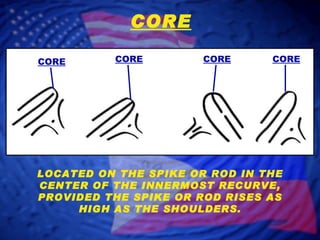
LOCATED ON THE SPIKE OR ROD IN THE CENTER OF THE INNERMOST RECURVE, PROVIDED THE SPIKE OR ROD RISES AS HIGH AS THE SHOULDERS. CORE CORE CORE CORE CORE
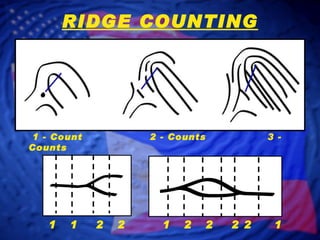
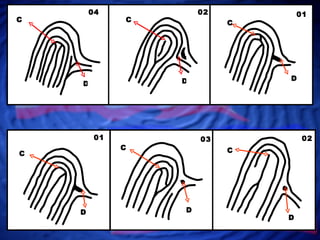
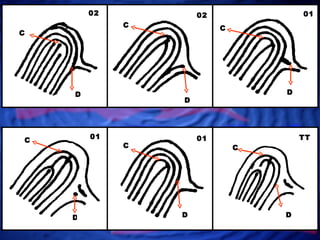
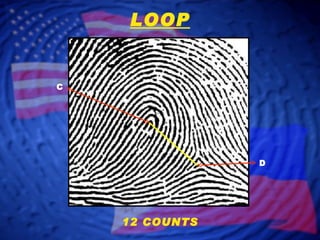
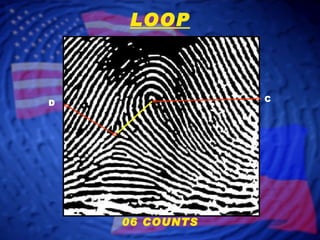
RIDGE COUNTING 1 - Count  2 - Counts    3 - Counts 1  1  2  2 1  2  2  2 2  1
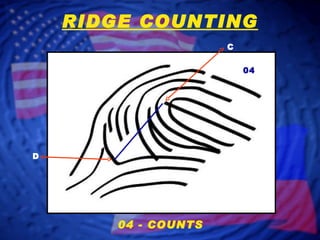
04 - COUNTS C D 04 RIDGE COUNTING
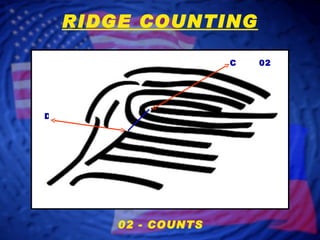
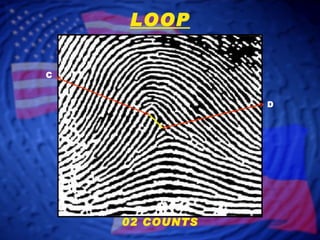
C D 02 RIDGE COUNTING 02 - COUNTS
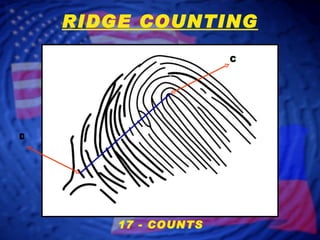
C D RIDGE COUNTING 17 - COUNTS
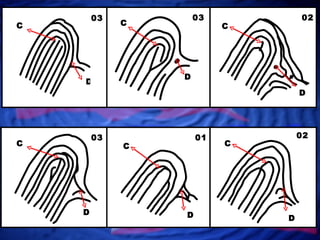
D C D 03 C 03 D C D 02 C D 03 C D 01 D C 02
D C D C 03 02 C D 04 C D 02 C D 01 C D 01
D C D C D C D C D C D 02 02 01 01 01 TT C
LOOP 12 COUNTS C D
C D LOOP 06 COUNTS
D C LOOP 02 COUNTS
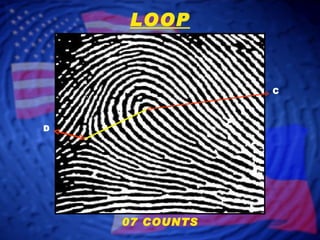
C D LOOP 07 COUNTS
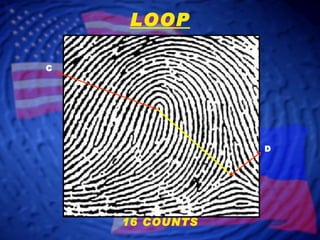
D C LOOP 16 COUNTS
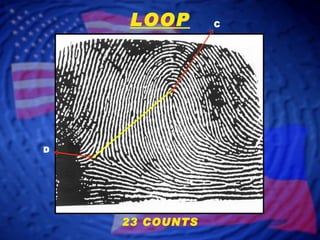
C D LOOP 23 COUNTS
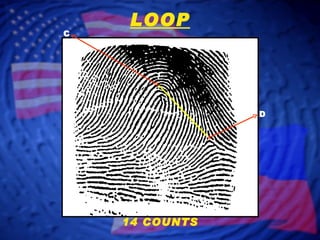
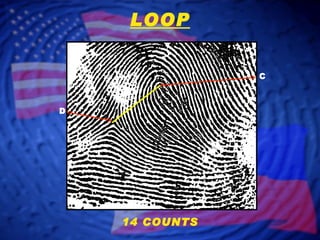
D C LOOP 14 COUNTS
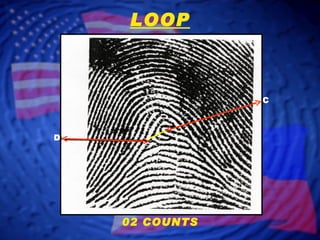
D C LOOP 02 COUNTS
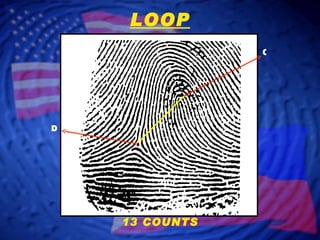
D C LOOP 13 COUNTS
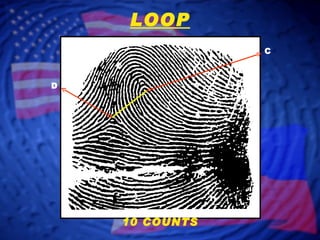
D C LOOP 10 COUNTS
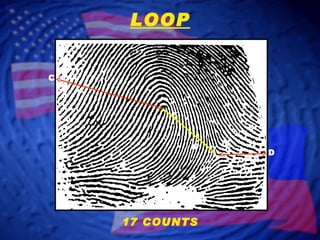
D C LOOP 17 COUNTS
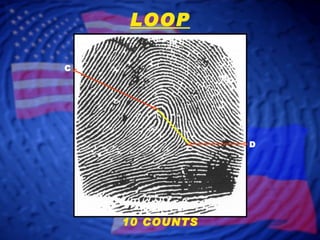
D C LOOP 10 COUNTS
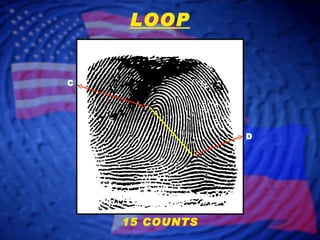
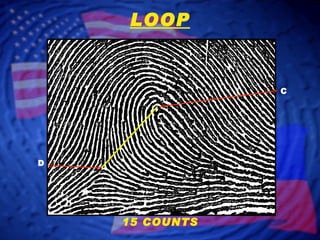
D C LOOP 15 COUNTS
D C LOOP 14 COUNTS
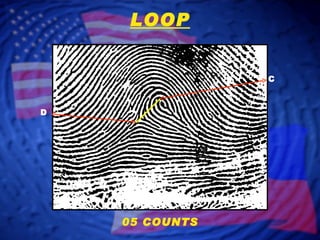
D C LOOP 05 COUNTS
D C LOOP 15 COUNTS
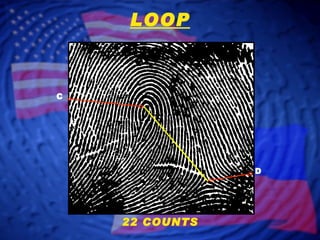
D C LOOP 22 COUNTS
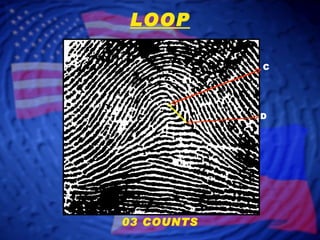
D C LOOP 03 COUNTS
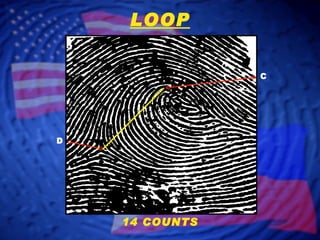
D C LOOP 14 COUNTS
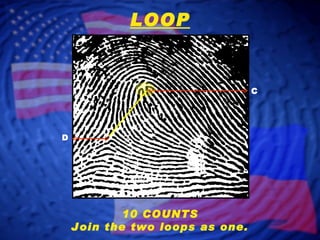
D C LOOP 10 COUNTS Join the two loops as one.
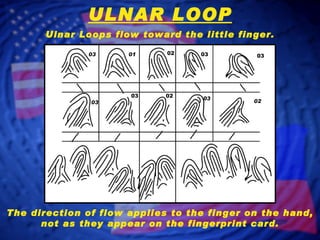
ULNAR LOOP Ulnar Loops flow toward the little finger. 03 01 02 03 03 03 03 02 03 02 The direction of flow applies to the finger on the hand, not as they appear on the fingerprint card.
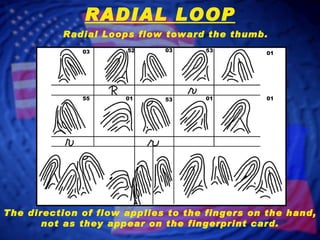
RADIAL LOOP Radial Loops flow toward the thumb. 03 52 03 53 01 55 01 53 01 01 The direction of flow applies to the fingers on the hand, not as they appear on the fingerprint card.
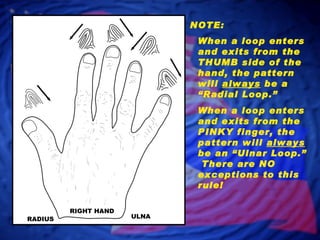
NOTE: RADIUS RIGHT HAND ULNA When a loop enters and exits from the THUMB side of the hand, the pattern will  always  be a “Radial Loop.” When a loop enters and exits from the PINKY finger, the pattern will  always  be an “Ulnar Loop.”  There are NO exceptions to this rule!
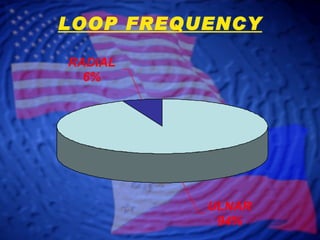
LOOP FREQUENCY
Questions?

Fingerprint Classification- slide 1

  • 1.
  • 2.
    FBI MISSION STATEMENTThe mission of the FBI is to protect and defend the United States against terrorist and foreign intelligence threats, to uphold and enforce the criminal laws of the United States, and to provide leadership and criminal justice services to federal, state, municipal, and international agencies and partners.
  • 3.
    CJIS MISSION STATEMENTReduce terrorist and criminal activities by maximizing the ability to provide timely and relevant criminal justice information to the FBI and to qualified law enforcement, criminal justice, civilian, academic, employment, and licensing agencies concerning individuals, stolen property, criminal organizations and activities, and other law enforcement related data.
  • 4.
  • 5.
    ---------------------------------------------------------------------------------------------------------------------------------------------------------------------------------------------- FINGERPRINT PATTERN RECOGNITION ----------------------------------------------------------------------------------------------------------------------------------------------------------------------------------------------
  • 6.
    Federal Bureau ofInvestigation United States Department of Justice Illustrations of Various Fingerprint Patterns The presence or existence of whorls in finger impressions is used as the basis for the determination of the chief or the primary classification. Each whorl appearing in an or all of the ten fingers has a certain arbitrary or fixed value. The addition of the values represented by such whorls and the indication of the total value is known as the primary classification. Illustrations of the whorl types which are shown on the right of this chart. Illustrations of the other types are shown on the left. PLAIN ARCH TENTED ARCH RADIAL LOOP ULNAR LOOP PLAIN WHORL CENTRAL POCKET DOUBLE LOOP ACCIDENTAL
  • 7.
  • 8.
  • 9.
  • 10.
  • 11.
  • 12.
  • 13.
    LOOP Definition: A LOOP is that type of pattern in which one or more ridges enter upon either side, recurve, touch or pass an imaginary line between delta and core and pass out or tend to pass out upon the same side the ridge entered.
  • 14.
    FLOW OF RIDGESULNAR LOOP ULNAR LOOP RADIAL LOOP THE ABOVE PATTERNS SHOW THE DIRECTION RIDGES FLOW IF LOCATED IN THE RIGHT HAND.
  • 15.
    RADIAL LOOP ULNAR LOOP RADIAL LOOP FLOW OF RIDGES THE ABOVE PATTERNS SHOW THE DIRECTION RIDGES FLOW IF LOCATED IN THE RIGHT HAND.
  • 16.
    1. SufficientRecurve 2. Delta 3. Ridge Count - Across a looping ridge THREE BASIC REQUIREMENTS OF A LOOP 3 COUNT LOOP CORE SUFFICIENT RECURVE DELTA
  • 17.
    SUFFICIENT RECURVE ASUFFICIENT RECURVE consists of the space between the shoulders of a loop free of any appendages which abut upon it at a right angle on the outside of the recurve. 1. 2. 3. 4. 5. 6. 8. 7. S S S S S S S S S S S S S S S S Shoulders
  • 18.
    SUFFICIENT RECURVE THESHOULDERS OF A LOOP are the points at which the recurving ridge definitely turns inward or curves. S S S S S S 9. 10. 11.
  • 19.
    APPENDAGE Attachment orConnection An appendage striking the outside of the recurve at a right angle will spoil that recurve.
  • 20.
    LOOP PATTERN AREAPATTERN AREA includes the CORE, DELTA, and RIDGES which are used in the classification of a loop. T T PATTERN AREA
  • 21.
  • 22.
    Definition: Thetwo innermost ridges that are parallel and surround or tend to surround the pattern area. T T T T TYPELINES
  • 23.
    DELTA THE DELTAIS THAT POINT ON A RIDGE AT OR NEAREST THE POINT OF DIVERGENCE OF TWO TYPELINES, AND LOCATED AT OR DIRECTLY IN FRONT OF THE POINT OF DIVERGENCE. Area to be considered in front of the point of divergence of two typelines.
  • 24.
    DOT BIFURCATION MEETINGOF TWO RIDGES SHORT RIDGE RECURVING RIDGE ENDING RIDGE DELTAS
  • 25.
    CORE THE APPROXIMATECENTER OF THE PATTERN PLACED UPON OR WITHIN THE INNERMOST SUFFICIENT RECURVE. LOCATED ON THE SHOULDERS OF THE INNERMOST LOOP FARTHEST FROM THE DELTA. CORE CORE CORE CORE
  • 26.
    LOCATED ON THESPIKE OR ROD IN THE CENTER OF THE INNERMOST RECURVE, PROVIDED THE SPIKE OR ROD RISES AS HIGH AS THE SHOULDERS. CORE CORE CORE CORE CORE
  • 27.
    RIDGE COUNTING 1- Count 2 - Counts 3 - Counts 1 1 2 2 1 2 2 2 2 1
  • 28.
    04 - COUNTSC D 04 RIDGE COUNTING
  • 29.
    C D 02RIDGE COUNTING 02 - COUNTS
  • 30.
    C D RIDGECOUNTING 17 - COUNTS
  • 31.
    D C D03 C 03 D C D 02 C D 03 C D 01 D C 02
  • 32.
    D C DC 03 02 C D 04 C D 02 C D 01 C D 01
  • 33.
    D C DC D C D C D C D 02 02 01 01 01 TT C
  • 34.
  • 35.
    C D LOOP06 COUNTS
  • 36.
    D C LOOP02 COUNTS
  • 37.
    C D LOOP07 COUNTS
  • 38.
    D C LOOP16 COUNTS
  • 39.
    C D LOOP23 COUNTS
  • 40.
    D C LOOP14 COUNTS
  • 41.
    D C LOOP02 COUNTS
  • 42.
    D C LOOP13 COUNTS
  • 43.
    D C LOOP10 COUNTS
  • 44.
    D C LOOP17 COUNTS
  • 45.
    D C LOOP10 COUNTS
  • 46.
    D C LOOP15 COUNTS
  • 47.
    D C LOOP14 COUNTS
  • 48.
    D C LOOP05 COUNTS
  • 49.
    D C LOOP15 COUNTS
  • 50.
    D C LOOP22 COUNTS
  • 51.
    D C LOOP03 COUNTS
  • 52.
    D C LOOP14 COUNTS
  • 53.
    D C LOOP10 COUNTS Join the two loops as one.
  • 54.
    ULNAR LOOP UlnarLoops flow toward the little finger. 03 01 02 03 03 03 03 02 03 02 The direction of flow applies to the finger on the hand, not as they appear on the fingerprint card.
  • 55.
    RADIAL LOOP RadialLoops flow toward the thumb. 03 52 03 53 01 55 01 53 01 01 The direction of flow applies to the fingers on the hand, not as they appear on the fingerprint card.
  • 56.
    NOTE: RADIUS RIGHTHAND ULNA When a loop enters and exits from the THUMB side of the hand, the pattern will always be a “Radial Loop.” When a loop enters and exits from the PINKY finger, the pattern will always be an “Ulnar Loop.” There are NO exceptions to this rule!
  • 57.
  • 58.

Editor's Notes

  • #4 Our mission is to provide you the highest quality identification and other criminal history related information in a timely manner.
  • #8 INFORMATION TAKEN FROM THE SCIENCE OF FINGERPRINTS BOOK UPDATED PERIODICALLY FROM INFORMATION RECEIVED FROM THE RESOURCE MANAGEMENT SECTION RMS