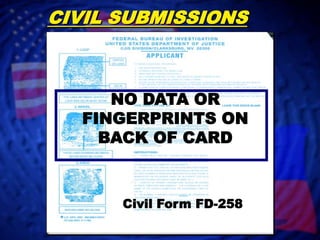
TAKING LEGIBLE FINGERPRINTS
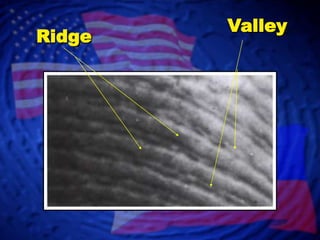
WHAT ARE FINGERPRINTS?Fingerprints are ridges and valleys found on the hand of every person.  In the fingers and thumbs, these ridges form patterns of loops, whorls and arches.
THE FINGERPRINT PATTERNThe pattern is the unique characteristics of the ridges (lines) and valleys that make up the print.  It is defined by the spatial relationship of lines with each other, their beginning and terminating points, and the unique pattern they make.
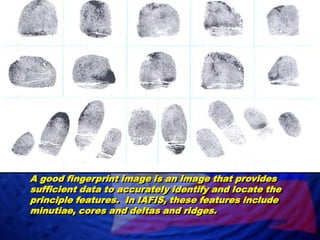
A good fingerprint image is an image that provides sufficient data to accurately identify and locate the principle features.  In IAFIS, these features include minutiae, cores and deltas and ridges.
ValleyRidge
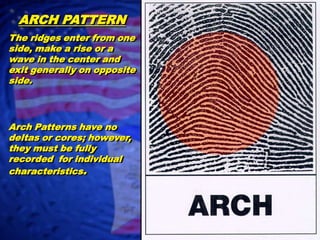
ARCH PATTERN The ridges enter from one side, make a rise or a wave in the center and exit generally on opposite side.Arch Patterns have no deltas or cores; however, they must be fully recorded  for individual  characteristics.
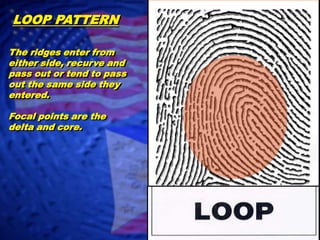
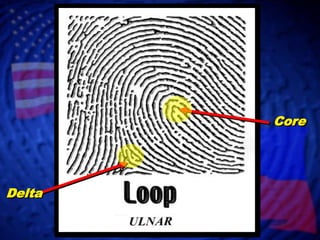
LOOP PATTERNThe ridges enter from either side, recurve andpass out or tend to passout the same side they entered.Focal points are the delta and core.
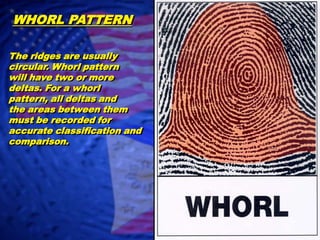
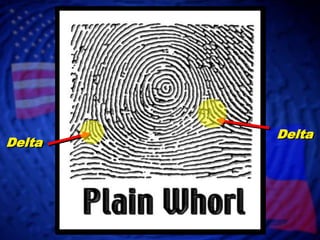
WHORL PATTERNThe ridges are usually circular. Whorl patternwill have two or moredeltas. For a whorl pattern, all deltas and the areas between themmust be recorded for accurate classification and comparison.
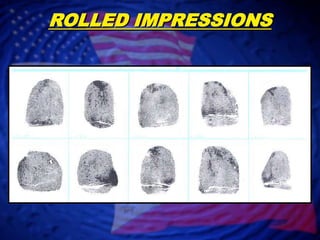
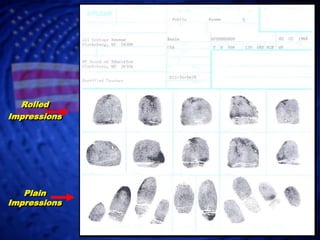
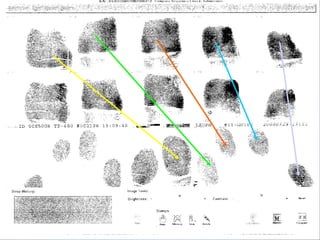
FINGERPRINT IMPRESSION TYPESTwo Types of Impressions“Rolled” impressions are the upper ten impressions taken individually, which are the thumb, index, middle, ring and little fingers of each hand.  These are referred to as “rolled” impressions because the fingers are rolled nail to nail in order to obtain all available ridge detail.
ROLLED IMPRESSIONS
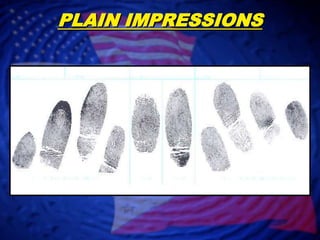
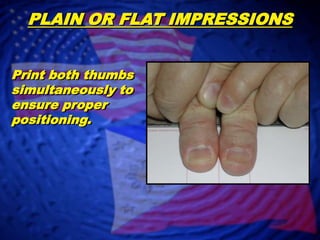
FINGERPRINT IMPRESSION TYPES“Plain” impressions are the impressions at the bottom of the card taken simultaneously without rolling. The fingers of each hand are printed at a forty-five degree angle. The thumbs are printed simultaneously to ensure proper positioning.  These are referred to as the “plain,” slapped,” or “flat impressions.	Plain impressions are used to verify the sequence and accuracy of the rolled impressions.
PLAIN IMPRESSIONS
BASIC FINGERPRINTING EQUIPMENT
FINGERPRINTS CAN BE RECORDED WITH ANY OF THE FOLLOWING MATERIALS:
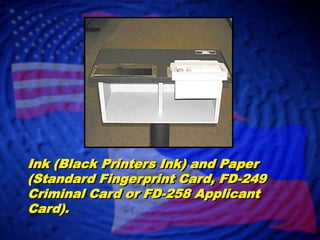
Ink (Black Printers Ink) and Paper (Standard Fingerprint Card, FD-249 Criminal Card or FD-258 Applicant Card).
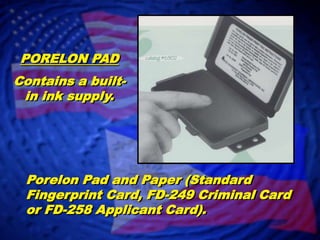
PORELON PADContains a built-in ink supply.Porelon Pad and Paper (Standard Fingerprint Card, FD-249 Criminal Card or FD-258 Applicant Card).
DIGIT 10Chemical Method Prints asred inkand changes to black ink upon processing (apply regular pressure when fingerprinting or fingerprints may be smeared)
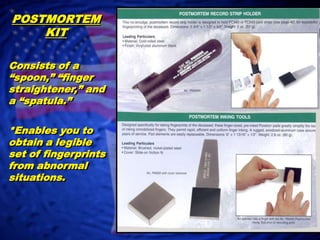
POSTMORTEM KITConsists of a “spoon,” “finger straightener,” and a “spatula.”  *Enables you to obtain a legible set of fingerprints from abnormal situations.
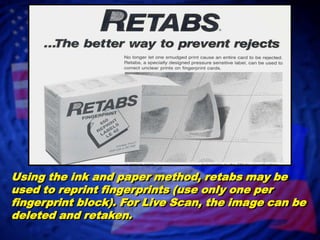
Using the ink and paper method, retabs may be used to reprint fingerprints (use only one per fingerprint block). For Live Scan, the image can be deleted and retaken.
SUGGESTIONS FOR TAKING LEGIBLE FINGERPRINTSRecommended height for fingerprinting is thirty-nine inches from floor.Fingers to be printed must be clean and dry.  Wiping the individual’s fingers with an alcohol swab and then drying them should prevent perspiration from being a problem.  Individual’s occupation may have caused a wearing down or rough surface on the fingerprints.  Use a softening agent or ridge builder to enhance the ridge detail.
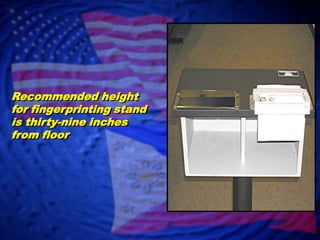
Recommended height for fingerprinting stand is thirty-nine inches from floor
COMMON PROBLEMS:Sweaty HandsSOLUTIONS:Individually wipe each finger with alcohol.
COMMON PROBLEMS:Occupational HandsSolutions:  Apply Less Pressure
  Softening Agents
  Ridge Builder
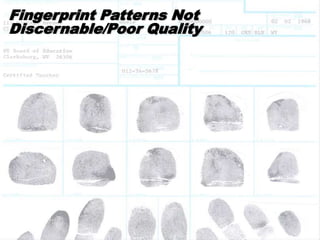
  Milk the fingersFingerprint Patterns Not Discernable/Poor Quality
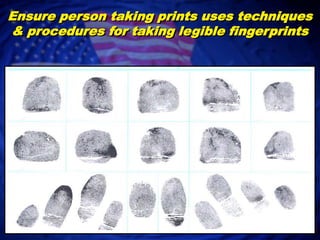
Ensure person taking prints uses techniques & procedures for taking legible fingerprints
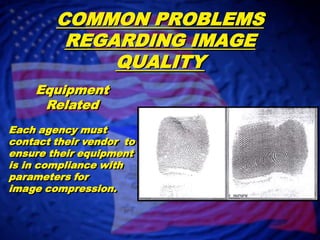
COMMON PROBLEMS REGARDING IMAGE QUALITYEquipment RelatedEach agency must   contact their vendor  to ensure their equipment is in compliance with parameters for image compression.
STEPS FOR FINGERPRINTING
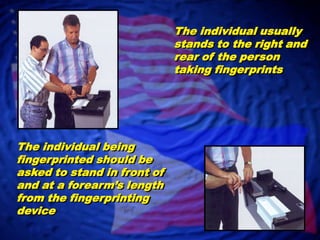
The individual usually stands to the right and rear of the person taking fingerprintsThe individual being fingerprinted should be asked to stand in front of and at a forearm’s length from the fingerprinting device
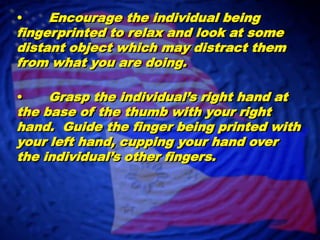
	Encourage the individual being fingerprinted to relax and look at some distant object which may distract them from what you are doing.
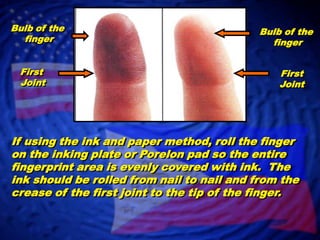
	Grasp the individual’s right hand at the base of the thumb with your right hand.  Guide the finger being printed with your left hand, cupping your hand over the individual’s other fingers.Bulb of the fingerBulb of the fingerFirst JointFirst JointIf using the ink and paper method, roll the finger on the inking plate or Porelon pad so the entire fingerprint area is evenly covered with ink.  The ink should be rolled from nail to nail and from the crease of the first joint to the tip of the finger.
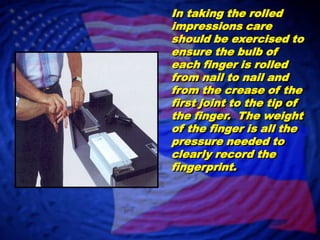
In taking the rolled impressions care should be exercised to ensure the bulb of each finger is rolled from nail to nail and from the crease of the first joint to the tip of the finger.  The weight of the finger is all the pressure needed to clearly record the fingerprint.
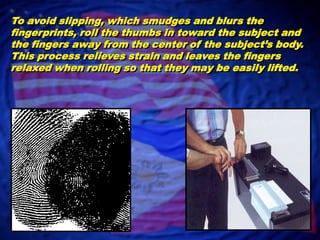
To avoid slipping, which smudges and blurs the fingerprints, roll the thumbs in toward the subject and the fingers away from the center of the subject’s body. This process relieves strain and leaves the fingers relaxed when rolling so that they may be easily lifted.
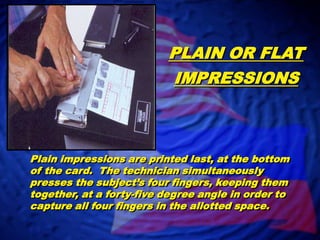
PLAIN OR FLAT IMPRESSIONSPlain impressions are printed last, at the bottom of the card.  The technician simultaneously presses the subject’s four fingers, keeping them together, at a forty-five degree angle in order to capture all four fingers in the allotted space.
PLAIN OR FLAT IMPRESSIONSPrint both thumbs simultaneously to ensure proper positioning.
ABNORMALITIESSPECIAL SITUATIONSPROBLEMS ANDSOLUTIONS
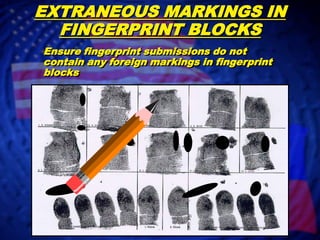
EXTRANEOUS MARKINGS INFINGERPRINT BLOCKSEnsure fingerprint submissions do not contain any foreign markings in fingerprint blocks
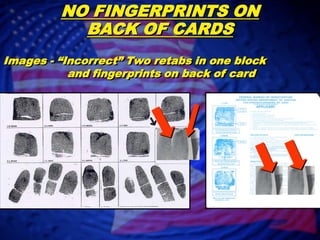
NO FINGERPRINTS ON BACK OF CARDSImages - “Incorrect” Two retabs in one block 		and fingerprints on back of card
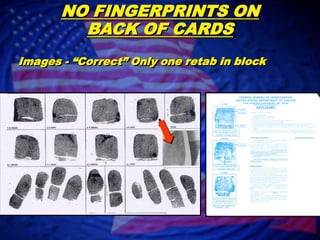
NO FINGERPRINTS ON BACK OF CARDSImages - “Correct” Only one retab in block
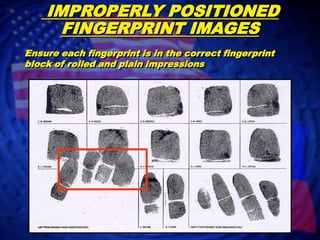
IMPROPERLY POSITIONED FINGERPRINT IMAGESEnsure each fingerprint is in the correct fingerprint block of rolled and plain impressions
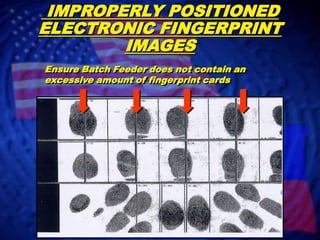
IMPROPERLY POSITIONED ELECTRONIC FINGERPRINT IMAGESEnsure Batch Feeder does not contain anexcessive amount of fingerprint cards
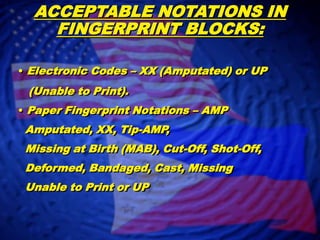
ACCEPTABLE NOTATIONS IN FINGERPRINT BLOCKS: Electronic Codes – XX (Amputated) or UP                (Unable to Print).	 Paper Fingerprint Notations – AMP   Amputated, XX, Tip-AMP, 	  Missing at Birth (MAB), Cut-Off, Shot-Off,            Deformed, Bandaged, Cast, Missing  Unable to Print or UP
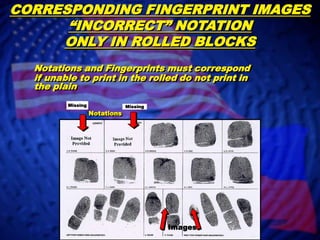
CORRESPONDING FINGERPRINT IMAGES “INCORRECT” NOTATION ONLY IN ROLLED BLOCKSNotations and Fingerprints must correspond if unable to print in the rolled do not print in the plainMissingMissingNotations  Images
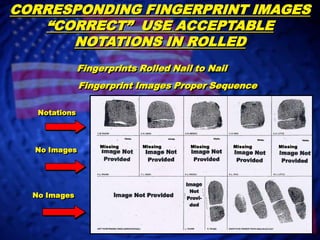
CORRESPONDING FINGERPRINT IMAGES “CORRECT”  USE ACCEPTABLE NOTATIONS IN ROLLEDFingerprints Rolled Nail to NailFingerprint Images Proper SequenceNotationsNo ImagesMissingMissingMissingMissingMissingNo Images
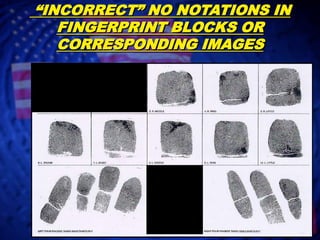
 “INCORRECT” NO NOTATIONS IN FINGERPRINT BLOCKS OR CORRESPONDING IMAGES
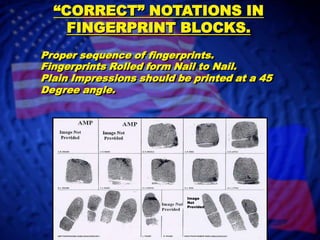
“CORRECT” NOTATIONS IN FINGERPRINT BLOCKS.Proper sequence of fingerprints.Fingerprints Rolled form Nail to Nail. Plain Impressions should be printed at a 45 Degree angle.Image NotProvided
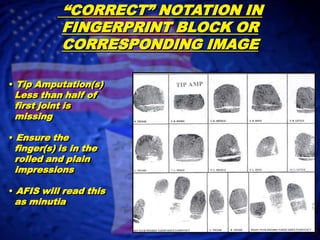
 “CORRECT” NOTATION IN FINGERPRINT BLOCK OR CORRESPONDING IMAGE  Tip Amputation(s)   Less than half of   first joint is     missing Ensure the   finger(s) is in the   rolled and plain     impressions AFIS will read this    as minutia
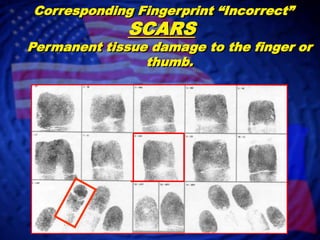
Corresponding Fingerprint “Incorrect” SCARSPermanent tissue damage to the finger or thumb.
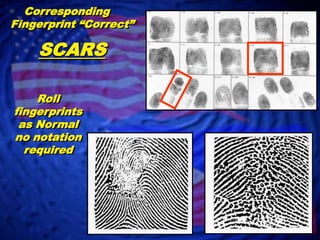
Corresponding    Fingerprint “Correct” SCARSRoll fingerprints as Normalno notation required
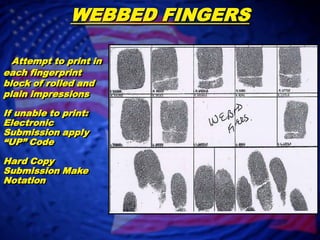
WEBBED FINGERSAttempt to print in each fingerprint block of rolled and plain impressionsIf unable to print:Electronic Submission apply “UP” CodeHard Copy Submission Make Notation
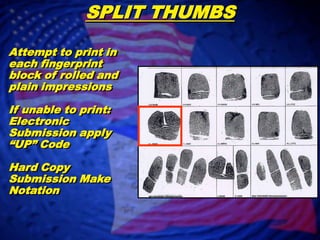
SPLIT THUMBSAttempt to print in    each fingerprint block of rolled and plain impressionsIf unable to print:Electronic Submission apply “UP” CodeHard Copy Submission Make Notation
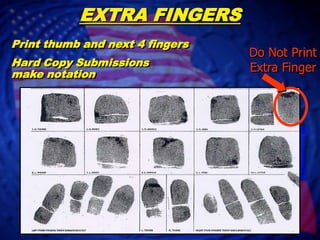
EXTRA FINGERSPrint thumb and next 4 fingers Hard Copy Submissions make notationDo Not PrintExtra Finger
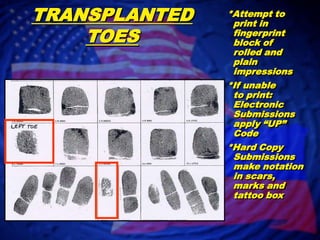
TRANSPLANTED TOES*Attempt to     print in   fingerprint   block of   rolled and   plain   impressions*If unable   to print:  Electronic   Submissions  apply “UP”   Code*Hard Copy   Submissions   make notation   in scars,   marks and   tattoo box
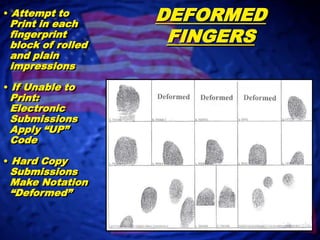
DEFORMED FINGERS Attempt to    Print in each  fingerprint   block of rolled  and plain   impressions If Unable to   Print:  Electronic   Submissions  Apply “UP”   Code Hard Copy   Submissions  Make Notation   “Deformed”
QUALITY REVIEW CHECKAfter taking the fingerprint impressions, there is alwaysthe question of whether the fingerprint impressions meet the requirements of the FBI.  This quality check list has been devised in order that the fingerprints may be checked for possible discrepancies.
QUALITY REVIEW CHECK  Is there a fingerprint      impression in each rolled       and plain impression block?
RolledImpressionsPlainImpressions
QUALITY REVIEW CHECK2.  Are the fingerprints rolled       completely, from nail to nail?
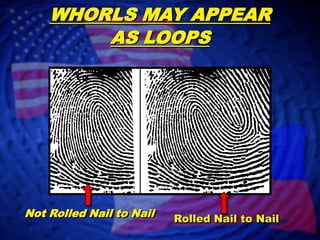
WHORLS MAY APPEAR AS LOOPSNot Rolled Nail to NailRolled Nail to Nail
QUALITY REVIEW CHECK  If the fingerprint impression       is a loop, is the delta and     core present?
CoreDelta
QUALITY REVIEW CHECK  If the fingerprint impression      is a whorl, are all deltas      present?
DeltaDelta
QUALITY REVIEW CHECK  Are the fingerprint      impressions clear and      distinct?
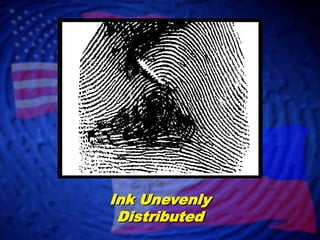
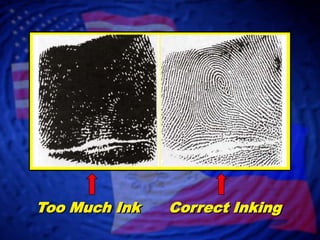
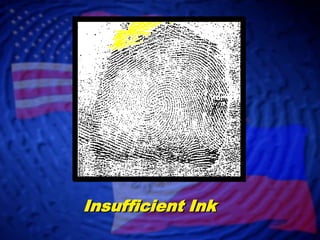
QUALITY REVIEW CHECK  Are the fingerprint        impressions uniform in     tone and not too dark     or light?
Ink Unevenly Distributed
Too Much InkCorrect Inking
Insufficient Ink
QUALITY REVIEW CHECK  Are the rolled fingerprint      impressions in the correct      finger blocks when      compared to the plain      impressions?
QUALITY REVIEW CHECKIf there are missing fingerprint impressions,     is there a reason noted in the finger     block(s)?    The following reasons noted are acceptable:Amputation, AMP, XX, Cut-Off, Shot-Off, Missing at Birth or MAB
Tip-Amp
Unable to Print or UP
Bandaged, Cut or Injured
Deformed or Crippled
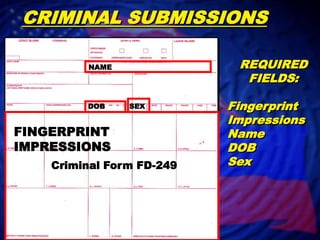
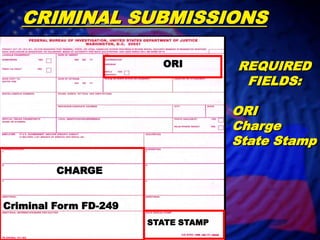
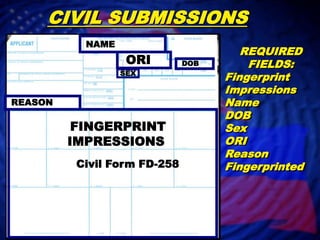
Missing	(Missing is no longer interpreted as an amputation) QUALITY REVIEW CHECK  In addition to the legible        fingerprint check list, ensure     the appropriate data fields are      completed prior to submission      of fingerprints. If any of the      required fields are left blank,      the submission is rejected      without further processing.
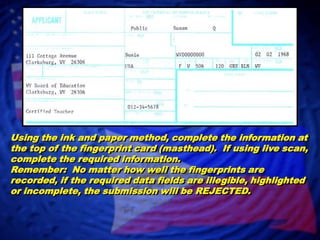
Using the ink and paper method, complete the information at the top of the fingerprint card (masthead).  If using live scan, complete the required information.Remember:  No matter how well the fingerprints are recorded, if the required data fields are illegible, highlighted or incomplete, the submission will be REJECTED.

Taking Legible Fingerprints

  • 1.
  • 2.
    WHAT ARE FINGERPRINTS?Fingerprintsare ridges and valleys found on the hand of every person. In the fingers and thumbs, these ridges form patterns of loops, whorls and arches.
  • 3.
    THE FINGERPRINT PATTERNThepattern is the unique characteristics of the ridges (lines) and valleys that make up the print. It is defined by the spatial relationship of lines with each other, their beginning and terminating points, and the unique pattern they make.
  • 4.
    A good fingerprintimage is an image that provides sufficient data to accurately identify and locate the principle features. In IAFIS, these features include minutiae, cores and deltas and ridges.
  • 5.
  • 6.
    ARCH PATTERN Theridges enter from one side, make a rise or a wave in the center and exit generally on opposite side.Arch Patterns have no deltas or cores; however, they must be fully recorded for individual characteristics.
  • 7.
    LOOP PATTERNThe ridgesenter from either side, recurve andpass out or tend to passout the same side they entered.Focal points are the delta and core.
  • 8.
    WHORL PATTERNThe ridgesare usually circular. Whorl patternwill have two or moredeltas. For a whorl pattern, all deltas and the areas between themmust be recorded for accurate classification and comparison.
  • 9.
    FINGERPRINT IMPRESSION TYPESTwoTypes of Impressions“Rolled” impressions are the upper ten impressions taken individually, which are the thumb, index, middle, ring and little fingers of each hand. These are referred to as “rolled” impressions because the fingers are rolled nail to nail in order to obtain all available ridge detail.
  • 10.
  • 11.
    FINGERPRINT IMPRESSION TYPES“Plain”impressions are the impressions at the bottom of the card taken simultaneously without rolling. The fingers of each hand are printed at a forty-five degree angle. The thumbs are printed simultaneously to ensure proper positioning. These are referred to as the “plain,” slapped,” or “flat impressions. Plain impressions are used to verify the sequence and accuracy of the rolled impressions.
  • 12.
  • 13.
  • 14.
    FINGERPRINTS CAN BERECORDED WITH ANY OF THE FOLLOWING MATERIALS:
  • 15.
    Ink (Black PrintersInk) and Paper (Standard Fingerprint Card, FD-249 Criminal Card or FD-258 Applicant Card).
  • 16.
    PORELON PADContains abuilt-in ink supply.Porelon Pad and Paper (Standard Fingerprint Card, FD-249 Criminal Card or FD-258 Applicant Card).
  • 17.
    DIGIT 10Chemical MethodPrints asred inkand changes to black ink upon processing (apply regular pressure when fingerprinting or fingerprints may be smeared)
  • 18.
    POSTMORTEM KITConsists ofa “spoon,” “finger straightener,” and a “spatula.” *Enables you to obtain a legible set of fingerprints from abnormal situations.
  • 19.
    Using the inkand paper method, retabs may be used to reprint fingerprints (use only one per fingerprint block). For Live Scan, the image can be deleted and retaken.
  • 20.
    SUGGESTIONS FOR TAKINGLEGIBLE FINGERPRINTSRecommended height for fingerprinting is thirty-nine inches from floor.Fingers to be printed must be clean and dry. Wiping the individual’s fingers with an alcohol swab and then drying them should prevent perspiration from being a problem. Individual’s occupation may have caused a wearing down or rough surface on the fingerprints. Use a softening agent or ridge builder to enhance the ridge detail.
  • 21.
    Recommended height forfingerprinting stand is thirty-nine inches from floor
  • 22.
  • 23.
  • 24.
  • 25.
    RidgeBuilder
  • 26.
    Milkthe fingersFingerprint Patterns Not Discernable/Poor Quality
  • 27.
    Ensure person takingprints uses techniques & procedures for taking legible fingerprints
  • 28.
    COMMON PROBLEMS REGARDINGIMAGE QUALITYEquipment RelatedEach agency must contact their vendor to ensure their equipment is in compliance with parameters for image compression.
  • 29.
  • 30.
    The individual usuallystands to the right and rear of the person taking fingerprintsThe individual being fingerprinted should be asked to stand in front of and at a forearm’s length from the fingerprinting device
  • 31.
    Encourage the individualbeing fingerprinted to relax and look at some distant object which may distract them from what you are doing.
  • 32.
    Grasp the individual’sright hand at the base of the thumb with your right hand. Guide the finger being printed with your left hand, cupping your hand over the individual’s other fingers.Bulb of the fingerBulb of the fingerFirst JointFirst JointIf using the ink and paper method, roll the finger on the inking plate or Porelon pad so the entire fingerprint area is evenly covered with ink. The ink should be rolled from nail to nail and from the crease of the first joint to the tip of the finger.
  • 33.
    In taking therolled impressions care should be exercised to ensure the bulb of each finger is rolled from nail to nail and from the crease of the first joint to the tip of the finger. The weight of the finger is all the pressure needed to clearly record the fingerprint.
  • 34.
    To avoid slipping,which smudges and blurs the fingerprints, roll the thumbs in toward the subject and the fingers away from the center of the subject’s body. This process relieves strain and leaves the fingers relaxed when rolling so that they may be easily lifted.
  • 35.
    PLAIN OR FLATIMPRESSIONSPlain impressions are printed last, at the bottom of the card. The technician simultaneously presses the subject’s four fingers, keeping them together, at a forty-five degree angle in order to capture all four fingers in the allotted space.
  • 36.
    PLAIN OR FLATIMPRESSIONSPrint both thumbs simultaneously to ensure proper positioning.
  • 37.
  • 38.
    EXTRANEOUS MARKINGS INFINGERPRINTBLOCKSEnsure fingerprint submissions do not contain any foreign markings in fingerprint blocks
  • 39.
    NO FINGERPRINTS ONBACK OF CARDSImages - “Incorrect” Two retabs in one block and fingerprints on back of card
  • 40.
    NO FINGERPRINTS ONBACK OF CARDSImages - “Correct” Only one retab in block
  • 41.
    IMPROPERLY POSITIONED FINGERPRINTIMAGESEnsure each fingerprint is in the correct fingerprint block of rolled and plain impressions
  • 42.
    IMPROPERLY POSITIONED ELECTRONICFINGERPRINT IMAGESEnsure Batch Feeder does not contain anexcessive amount of fingerprint cards
  • 43.
    ACCEPTABLE NOTATIONS INFINGERPRINT BLOCKS: Electronic Codes – XX (Amputated) or UP (Unable to Print). Paper Fingerprint Notations – AMP Amputated, XX, Tip-AMP, Missing at Birth (MAB), Cut-Off, Shot-Off, Deformed, Bandaged, Cast, Missing Unable to Print or UP
  • 44.
    CORRESPONDING FINGERPRINT IMAGES“INCORRECT” NOTATION ONLY IN ROLLED BLOCKSNotations and Fingerprints must correspond if unable to print in the rolled do not print in the plainMissingMissingNotations Images
  • 45.
    CORRESPONDING FINGERPRINT IMAGES“CORRECT” USE ACCEPTABLE NOTATIONS IN ROLLEDFingerprints Rolled Nail to NailFingerprint Images Proper SequenceNotationsNo ImagesMissingMissingMissingMissingMissingNo Images
  • 46.
    “INCORRECT” NONOTATIONS IN FINGERPRINT BLOCKS OR CORRESPONDING IMAGES
  • 47.
    “CORRECT” NOTATIONS INFINGERPRINT BLOCKS.Proper sequence of fingerprints.Fingerprints Rolled form Nail to Nail. Plain Impressions should be printed at a 45 Degree angle.Image NotProvided
  • 48.
    “CORRECT” NOTATIONIN FINGERPRINT BLOCK OR CORRESPONDING IMAGE Tip Amputation(s) Less than half of first joint is missing Ensure the finger(s) is in the rolled and plain impressions AFIS will read this as minutia
  • 49.
    Corresponding Fingerprint “Incorrect”SCARSPermanent tissue damage to the finger or thumb.
  • 50.
    Corresponding Fingerprint “Correct” SCARSRoll fingerprints as Normalno notation required
  • 51.
    WEBBED FINGERSAttempt toprint in each fingerprint block of rolled and plain impressionsIf unable to print:Electronic Submission apply “UP” CodeHard Copy Submission Make Notation
  • 52.
    SPLIT THUMBSAttempt toprint in each fingerprint block of rolled and plain impressionsIf unable to print:Electronic Submission apply “UP” CodeHard Copy Submission Make Notation
  • 53.
    EXTRA FINGERSPrint thumband next 4 fingers Hard Copy Submissions make notationDo Not PrintExtra Finger
  • 54.
    TRANSPLANTED TOES*Attempt to print in fingerprint block of rolled and plain impressions*If unable to print: Electronic Submissions apply “UP” Code*Hard Copy Submissions make notation in scars, marks and tattoo box
  • 55.
    DEFORMED FINGERS Attemptto Print in each fingerprint block of rolled and plain impressions If Unable to Print: Electronic Submissions Apply “UP” Code Hard Copy Submissions Make Notation “Deformed”
  • 56.
    QUALITY REVIEW CHECKAftertaking the fingerprint impressions, there is alwaysthe question of whether the fingerprint impressions meet the requirements of the FBI. This quality check list has been devised in order that the fingerprints may be checked for possible discrepancies.
  • 57.
    QUALITY REVIEW CHECK Is there a fingerprint impression in each rolled and plain impression block?
  • 58.
  • 59.
    QUALITY REVIEW CHECK2. Are the fingerprints rolled completely, from nail to nail?
  • 60.
    WHORLS MAY APPEARAS LOOPSNot Rolled Nail to NailRolled Nail to Nail
  • 61.
    QUALITY REVIEW CHECK If the fingerprint impression is a loop, is the delta and core present?
  • 62.
  • 63.
    QUALITY REVIEW CHECK If the fingerprint impression is a whorl, are all deltas present?
  • 64.
  • 65.
    QUALITY REVIEW CHECK Are the fingerprint impressions clear and distinct?
  • 67.
    QUALITY REVIEW CHECK Are the fingerprint impressions uniform in tone and not too dark or light?
  • 68.
  • 69.
  • 70.
  • 71.
    QUALITY REVIEW CHECK Are the rolled fingerprint impressions in the correct finger blocks when compared to the plain impressions?
  • 73.
    QUALITY REVIEW CHECKIfthere are missing fingerprint impressions, is there a reason noted in the finger block(s)? The following reasons noted are acceptable:Amputation, AMP, XX, Cut-Off, Shot-Off, Missing at Birth or MAB
  • 74.
  • 75.
  • 76.
  • 77.
  • 78.
    Missing (Missing is nolonger interpreted as an amputation) QUALITY REVIEW CHECK In addition to the legible fingerprint check list, ensure the appropriate data fields are completed prior to submission of fingerprints. If any of the required fields are left blank, the submission is rejected without further processing.
  • 79.
    Using the inkand paper method, complete the information at the top of the fingerprint card (masthead). If using live scan, complete the required information.Remember: No matter how well the fingerprints are recorded, if the required data fields are illegible, highlighted or incomplete, the submission will be REJECTED.