Networking 
Workloads on Intel 
Architecture 
Communications, Storage and 
Infrastructure Group 
September 2014
TRANSFORMING NETWORKING & STORAGE 
2 
DPDK 
Legal Disclaimer 
INFORMATION IN THIS DOCUMENT IS PROVIDED IN CONNECTION WITH INTEL PRODUCTS. NO LICENSE, EXPRESS OR IMPLIED, BY ESTOPPEL OR OTHERWISE, TO ANY INTELLECTUAL PROPERTY RIGHTS IS GRANTED BY THIS DOCUMENT. EXCEPT AS PROVIDED IN INTEL'S TERMS AND CONDITIONS OF SALE FOR SUCH PRODUCTS, INTEL ASSUMES NO LIABILITY WHATSOEVER AND INTEL DISCLAIMS ANY EXPRESS OR IMPLIED WARRANTY, RELATING TO SALE AND/OR USE OF INTEL PRODUCTS INCLUDING LIABILITY OR WARRANTIES RELATING TO FITNESS FOR A PARTICULAR PURPOSE, MERCHANTABILITY, OR INFRINGEMENT OF ANY PATENT, COPYRIGHT OR OTHER INTELLECTUAL PROPERTY RIGHT. A "Mission Critical Application" is any application in which failure of the Intel Product could result, directly or indirectly, in personal injury or death. SHOULD YOU PURCHASE OR USE INTEL'S PRODUCTS FOR ANY SUCH MISSION CRITICAL APPLICATION, YOU SHALL INDEMNIFY AND HOLD INTEL AND ITS SUBSIDIARIES, SUBCONTRACTORS AND AFFILIATES, AND THE DIRECTORS, OFFICERS, AND EMPLOYEES OF EACH, HARMLESS AGAINST ALL CLAIMS COSTS, DAMAGES, AND EXPENSES AND REASONABLE ATTORNEYS' FEES ARISING OUT OF, DIRECTLY OR INDIRECTLY, ANY CLAIM OF PRODUCT LIABILITY, PERSONAL INJURY, OR DEATH ARISING IN ANY WAY OUT OF SUCH MISSION CRITICAL APPLICATION, WHETHER OR NOT INTEL OR ITS SUBCONTRACTOR WAS NEGLIGENT IN THE DESIGN, MANUFACTURE, OR WARNING OF THE INTEL PRODUCT OR ANY OF ITS PARTS. Intel may make changes to specifications and product descriptions at any time, without notice. Designers must not rely on the absence or characteristics of any features or instructions marked "reserved" or "undefined". Intel reserves these for future definition and shall have no responsibility whatsoever for conflicts or incompatibilities arising from future changes to them. The information here is subject to change without notice. Do not finalize a design with this information. The products described in this document may contain design defects or errors known as errata which may cause the product to deviate from published specifications. Current characterized errata are available on request. Contact your local Intel sales office or your distributor to obtain the latest specifications and before placing your product order. Copies of documents which have an order number and are referenced in this document, or other Intel literature, may be obtained by calling 1-800-548-4725, or go to: http://www.intel.com/design/literature.htm%20 Performance tests and ratings are measured using specific computer systems and/or components and reflect the approximate performance of Intel products as measured by those tests. Any difference in system hardware or software design or configuration may affect actual performance. Buyers should consult other sources of information to evaluate the performance of systems or components they are considering purchasing. For more information on performance tests and on the performance of Intel products, visit Intel Performance Benchmark Limitations All products, computer systems, dates and figures specified are preliminary based on current expectations, and are subject to change without notice. Celeron, Intel, Intel logo, Intel Core, Intel Inside, Intel Inside logo, Intel. Leap ahead., Intel. Leap ahead. logo, Intel NetBurst, Intel SpeedStep, Intel XScale, Itanium, Pentium, Pentium Inside, VTune, Xeon, and Xeon Inside are trademarks or registered trademarks of Intel Corporation or its subsidiaries in the United States and other countries. Intel® Active Management Technology requires the platform to have an Intel® AMT-enabled chipset, network hardware and software, as well as connection with a power source and a corporate network connection. With regard to notebooks, Intel AMT may not be available or certain capabilities may be limited over a host OS-based VPN or when connecting wirelessly, on battery power, sleeping, hibernating or powered off. For more information, see http://www.intel.com/technology/iamt. 64-bit computing on Intel architecture requires a computer system with a processor, chipset, BIOS, operating system, device drivers and applications enabled for Intel® 64 architecture. Performance will vary depending on your hardware and software configurations. Consult with your system vendor for more information. No computer system can provide absolute security under all conditions. Intel® Trusted Execution Technology is a security technology under development by Intel and requires for operation a computer system with Intel® Virtualization Technology, an Intel Trusted Execution Technology- enabled processor, chipset, BIOS, Authenticated Code Modules, and an Intel or other compatible measured virtual machine monitor. In addition, Intel Trusted Execution Technology requires the system to contain a TPMv1.2 as defined by the Trusted Computing Group and specific software for some uses. See http://www.intel.com/technology/security/ for more information. †Hyper-Threading Technology (HT Technology) requires a computer system with an Intel® Pentium® 4 Processor supporting HT Technology and an HT Technology-enabled chipset, BIOS, and operating system. Performance will vary depending on the specific hardware and software you use. See www.intel.com/products/ht/hyperthreading_more.htm for more information including details on which processors support HT Technology. Intel® Virtualization Technology requires a computer system with an enabled Intel® processor, BIOS, virtual machine monitor (VMM) and, for some uses, certain platform software enabled for it. Functionality, performance or other benefits will vary depending on hardware and software configurations and may require a BIOS update. Software applications may not be compatible with all operating systems. Please check with your application vendor. * Other names and brands may be claimed as the property of others. Other vendors are listed by Intel as a convenience to Intel's general customer base, but Intel does not make any representations or warranties whatsoever regarding quality, reliability, functionality, or compatibility of these devices. This list and/or these devices may be subject to change without notice. 
Copyright © 2013, Intel Corporation. All rights reserved.
TRANSFORMING NETWORKING & STORAGE 
3 
DPDK 
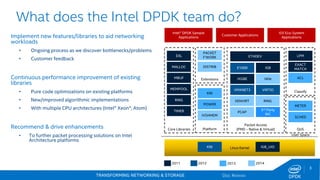
What does the Intel DPDK team do? 
Implement new features/libraries to aid networking workloads 
•Ongoing process as we discover bottlenecks/problems 
•Customer feedback Continuous performance improvement of existing libraries 
•Pure code optimizations on existing platforms 
•New/improved algorithmic implementations 
•With multiple CPU architectures (Intel® Xeon®, Atom) Recommend & drive enhancements 
•To further packet processing solutions on Intel Architecture platforms 
Doc #xxxxx 
EAL 
MALLOC 
MBUF 
MEMPOOL 
RING 
TIMER 
Core Libraries 
KNI 
POWER 
IVSHMEM 
Platform 
LPM 
EXACT MATCH 
ACL 
Classify 
E1000 
IXGBE 
VMXNET3 
IGB 
I40e 
VIRTIO 
Packet Access (PMD – Native & Virtual) 
ETHDEV 
XENVIRT 
PCAP 
RING 
PACKET F’WORK 
Extensions 
Intel® DPDK Sample Applications 
Linux Kernel 
User Space 
KNI 
IGB_UIO 
Customer Applications 
ISV Eco-System Applications 
3rd Party NIC 
QoS 
METER 
SCHED 
DISTRIB 
2012 
2013 
2011 
2014
TRANSFORMING NETWORKING & STORAGE 
4 
DPDK 
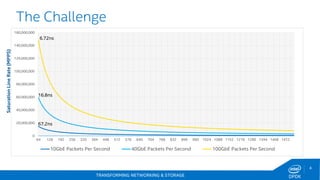
The Challenge 
0 
20,000,000 
40,000,000 
60,000,000 
80,000,000 
100,000,000 
120,000,000 
140,000,000 
160,000,000 
64 
128 
192 
256 
320 
384 
448 
512 
576 
640 
704 
768 
832 
896 
960 
1024 
1088 
1152 
1216 
1280 
1344 
1408 
1472 
10GbE Packets Per Second 
40GbE Packets Per Second 
100GbE Packets Per Second 
6.72ns 
16.8ns 
67.2ns 
Saturation Line Rate (MPPS)
TRANSFORMING NETWORKING & STORAGE 
5 
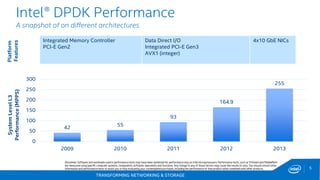
42 
55 
93 
164.9 
255 
0 
50 
100 
150 
200 
250 
300 
2009 
2010 
2011 
2012 
2013 
System Level L3 Performance (MPPS) 
* Other names and brands may be claimed as the property of others. 
Disclaimer: Software and workloads used in performance tests may have been optimized for performance only on Intel microprocessors. Performance tests, such as SYSmark and MobileMark, are measured using specific computer systems, components, software, operations and functions. Any change to any of those factors may cause the results to vary. You should consult other information and performance tests to assist you in fully evaluating your contemplated purchases, including the performance of that product when combined with other products. 
Intel® DPDK Performance A snapshot of on different architectures 
Integrated Memory Controller 
PCI-E Gen2 
Data Direct I/O 
Integrated PCI-E Gen3 
AVX1 (integer) 
4x10 GbE NICs 
Platform 
Features
TRANSFORMING NETWORKING & STORAGE 
6 
DPDK 
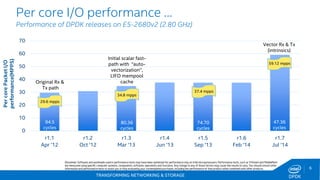
Per core I/O performance … Performance of DPDK releases on E5-2680v2 (2.80 GHz) 
0 
10 
20 
30 
40 
50 
60 
70 
r1.1 
Apr '12 
r1.2 
Oct '12 
r1.3 
Mar '13 
r1.4 
Jun '13 
r1.5 
Sep '13 
r1.6 
Feb '14 
r1.7 
Jul '14 
37.4 mpps 
59.12 mpps 
Vector Rx & Tx 
(intrinsics) 
Initial scalar fast- path with “auto- vectorization”, LIFO mempool cache 
Disclaimer: Software and workloads used in performance tests may have been optimized for performance only on Intel microprocessors. Performance tests, such as SYSmark and MobileMark, are measured using specific computer systems, components, software, operations and functions. Any change to any of those factors may cause the results to vary. You should consult other information and performance tests to assist you in fully evaluating your contemplated purchases, including the performance of that product when combined with other products. 
Original Rx & 
Tx path 
94.5 
cycles 
80.36 
cycles 
74.70 
cycles 
47.36 
cycles 
29.6 mpps 
34.8 mpps 
Per core Packet I/O performance(MPPS)
TRANSFORMING NETWORKING & STORAGE 
7 
DPDK 
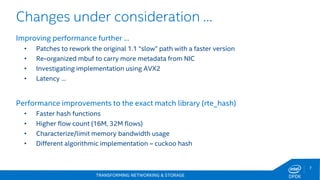
Changes under consideration … 
Improving performance further … 
•Patches to rework the original 1.1 “slow” path with a faster version 
•Re-organized mbuf to carry more metadata from NIC 
•Investigating implementation using AVX2 
•Latency … Performance improvements to the exact match library (rte_hash) 
•Faster hash functions 
•Higher flow count (16M, 32M flows) 
•Characterize/limit memory bandwidth usage 
•Different algorithmic implementation – cuckoo hash
TRANSFORMING NETWORKING & STORAGE 
8 
DPDK 
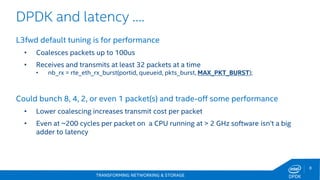
DPDK and latency …. 
L3fwd default tuning is for performance 
•Coalesces packets up to 100us 
•Receives and transmits at least 32 packets at a time 
•nb_rx = rte_eth_rx_burst(portid, queueid, pkts_burst, MAX_PKT_BURST); Could bunch 8, 4, 2, or even 1 packet(s) and trade-off some performance 
•Lower coalescing increases transmit cost per packet 
•Even at ~200 cycles per packet on a CPU running at > 2 GHz software isn’t a big adder to latency
TRANSFORMING NETWORKING & STORAGE 
9 
DPDK 
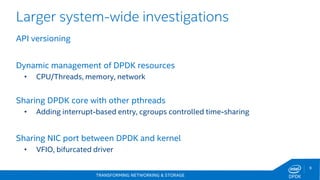
Larger system-wide investigations 
API versioning Dynamic management of DPDK resources 
•CPU/Threads, memory, network Sharing DPDK core with other pthreads 
•Adding interrupt-based entry, cgroups controlled time-sharing Sharing NIC port between DPDK and kernel 
•VFIO, bifurcated driver
TRANSFORMING NETWORKING & STORAGE 
10 
DPDK 
Core 
Core 
Core 
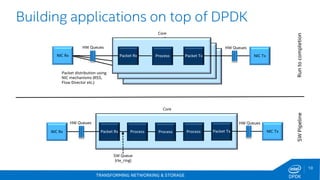
Building applications on top of DPDK 
Core 
Packet Rx 
NIC Rx 
Process 
Packet Tx 
NIC Tx 
Packet distribution using NIC mechanisms (RSS, Flow Director etc.) 
Packet Rx 
NIC Rx 
Process 
Packet Tx 
NIC Tx 
Process 
Process 
HW Queues 
HW Queues 
SW Queue (rte_ring) 
HW Queues 
HW Queues 
Run to completion 
SW Pipeline
TRANSFORMING NETWORKING & STORAGE 
11 
DPDK 
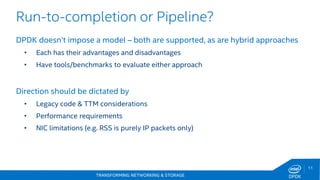
Run-to-completion or Pipeline? 
DPDK doesn’t impose a model – both are supported, as are hybrid approaches 
•Each has their advantages and disadvantages 
•Have tools/benchmarks to evaluate either approach Direction should be dictated by 
•Legacy code & TTM considerations 
•Performance requirements 
•NIC limitations (e.g. RSS is purely IP packets only)
TRANSFORMING NETWORKING & STORAGE 
12 
DPDK 
Assessing basic performance 
app/test: Implements unit-tests and micro-benchmarks 
•Micro-benchmarks exist for a number of libraries – labeled *_perf_autotest – mempool, hash, ring, timer, memcpy, distributor [adding nic in 1.8?] app/testpmd: NIC I/O benchmark 
•Benchmarks the network I/O pipe (NIC hardware + PMD) examples/l3fwd: An example L3 forwarder 
•Increased CPU processing – NIC hardware + PMD + hash/lpm examples/load_balance: a simple load balancer in software examples/ip_pipeline: Using the packet framework to build a pipeline 
Intel uses these micro-benchmarks to drive performance
TRANSFORMING NETWORKING & STORAGE 
13 
DPDK 
Summary 
Multiple areas of improvement in the pipeline 
•Focus is on performance, functionality, usability Looking for community input/participation 
•What are the problems that we need to solve? Let’s discuss …
TRANSFORMING NETWORKING & STORAGE 
14 
Backup
TRANSFORMING NETWORKING & STORAGE 
15 
DPDK 
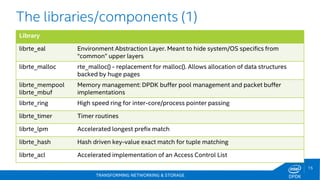
The libraries/components (1) 
Library 
librte_eal 
Environment Abstraction Layer. Meant to hide system/OS specifics from “common” upper layers 
librte_malloc 
rte_malloc() - replacement for malloc(). Allows allocation of data structures backed by huge pages 
librte_mempool 
librte_mbuf 
Memory management: DPDK buffer pool management and packet buffer implementations 
librte_ring 
High speed ring for inter-core/process pointer passing 
librte_timer 
Timer routines 
librte_lpm 
Accelerated longest prefix match 
librte_hash 
Hash driven key-value exact match for tuple matching 
librte_acl 
Accelerated implementation of an Access Control List
TRANSFORMING NETWORKING & STORAGE 
16 
DPDK 
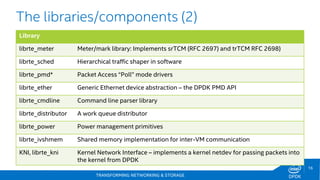
The libraries/components (2) 
Library 
librte_meter 
Meter/mark library: Implements srTCM (RFC 2697) and trTCM RFC 2698) 
librte_sched 
Hierarchical traffic shaper in software 
librte_pmd* 
Packet Access “Poll” mode drivers 
librte_ether 
Generic Ethernet device abstraction – the DPDK PMD API 
librte_cmdline 
Command line parser library 
librte_distributor 
A work queue distributor 
librte_power 
Power management primitives 
librte_ivshmem 
Shared memory implementation for inter-VM communication 
KNI, librte_kni 
Kernel Network Interface – implements a kernel netdev for passing packets into the kernel from DPDK
DPDK Summit - 08 Sept 2014 - Intel - Networking Workloads on Intel Architecture

DPDK Summit - 08 Sept 2014 - Intel - Networking Workloads on Intel Architecture

  • 1.
    Networking Workloads onIntel Architecture Communications, Storage and Infrastructure Group September 2014
  • 2.
    TRANSFORMING NETWORKING &STORAGE 2 DPDK Legal Disclaimer INFORMATION IN THIS DOCUMENT IS PROVIDED IN CONNECTION WITH INTEL PRODUCTS. NO LICENSE, EXPRESS OR IMPLIED, BY ESTOPPEL OR OTHERWISE, TO ANY INTELLECTUAL PROPERTY RIGHTS IS GRANTED BY THIS DOCUMENT. EXCEPT AS PROVIDED IN INTEL'S TERMS AND CONDITIONS OF SALE FOR SUCH PRODUCTS, INTEL ASSUMES NO LIABILITY WHATSOEVER AND INTEL DISCLAIMS ANY EXPRESS OR IMPLIED WARRANTY, RELATING TO SALE AND/OR USE OF INTEL PRODUCTS INCLUDING LIABILITY OR WARRANTIES RELATING TO FITNESS FOR A PARTICULAR PURPOSE, MERCHANTABILITY, OR INFRINGEMENT OF ANY PATENT, COPYRIGHT OR OTHER INTELLECTUAL PROPERTY RIGHT. A "Mission Critical Application" is any application in which failure of the Intel Product could result, directly or indirectly, in personal injury or death. SHOULD YOU PURCHASE OR USE INTEL'S PRODUCTS FOR ANY SUCH MISSION CRITICAL APPLICATION, YOU SHALL INDEMNIFY AND HOLD INTEL AND ITS SUBSIDIARIES, SUBCONTRACTORS AND AFFILIATES, AND THE DIRECTORS, OFFICERS, AND EMPLOYEES OF EACH, HARMLESS AGAINST ALL CLAIMS COSTS, DAMAGES, AND EXPENSES AND REASONABLE ATTORNEYS' FEES ARISING OUT OF, DIRECTLY OR INDIRECTLY, ANY CLAIM OF PRODUCT LIABILITY, PERSONAL INJURY, OR DEATH ARISING IN ANY WAY OUT OF SUCH MISSION CRITICAL APPLICATION, WHETHER OR NOT INTEL OR ITS SUBCONTRACTOR WAS NEGLIGENT IN THE DESIGN, MANUFACTURE, OR WARNING OF THE INTEL PRODUCT OR ANY OF ITS PARTS. Intel may make changes to specifications and product descriptions at any time, without notice. Designers must not rely on the absence or characteristics of any features or instructions marked "reserved" or "undefined". Intel reserves these for future definition and shall have no responsibility whatsoever for conflicts or incompatibilities arising from future changes to them. The information here is subject to change without notice. Do not finalize a design with this information. The products described in this document may contain design defects or errors known as errata which may cause the product to deviate from published specifications. Current characterized errata are available on request. Contact your local Intel sales office or your distributor to obtain the latest specifications and before placing your product order. Copies of documents which have an order number and are referenced in this document, or other Intel literature, may be obtained by calling 1-800-548-4725, or go to: http://www.intel.com/design/literature.htm%20 Performance tests and ratings are measured using specific computer systems and/or components and reflect the approximate performance of Intel products as measured by those tests. Any difference in system hardware or software design or configuration may affect actual performance. Buyers should consult other sources of information to evaluate the performance of systems or components they are considering purchasing. For more information on performance tests and on the performance of Intel products, visit Intel Performance Benchmark Limitations All products, computer systems, dates and figures specified are preliminary based on current expectations, and are subject to change without notice. Celeron, Intel, Intel logo, Intel Core, Intel Inside, Intel Inside logo, Intel. Leap ahead., Intel. Leap ahead. logo, Intel NetBurst, Intel SpeedStep, Intel XScale, Itanium, Pentium, Pentium Inside, VTune, Xeon, and Xeon Inside are trademarks or registered trademarks of Intel Corporation or its subsidiaries in the United States and other countries. Intel® Active Management Technology requires the platform to have an Intel® AMT-enabled chipset, network hardware and software, as well as connection with a power source and a corporate network connection. With regard to notebooks, Intel AMT may not be available or certain capabilities may be limited over a host OS-based VPN or when connecting wirelessly, on battery power, sleeping, hibernating or powered off. For more information, see http://www.intel.com/technology/iamt. 64-bit computing on Intel architecture requires a computer system with a processor, chipset, BIOS, operating system, device drivers and applications enabled for Intel® 64 architecture. Performance will vary depending on your hardware and software configurations. Consult with your system vendor for more information. No computer system can provide absolute security under all conditions. Intel® Trusted Execution Technology is a security technology under development by Intel and requires for operation a computer system with Intel® Virtualization Technology, an Intel Trusted Execution Technology- enabled processor, chipset, BIOS, Authenticated Code Modules, and an Intel or other compatible measured virtual machine monitor. In addition, Intel Trusted Execution Technology requires the system to contain a TPMv1.2 as defined by the Trusted Computing Group and specific software for some uses. See http://www.intel.com/technology/security/ for more information. †Hyper-Threading Technology (HT Technology) requires a computer system with an Intel® Pentium® 4 Processor supporting HT Technology and an HT Technology-enabled chipset, BIOS, and operating system. Performance will vary depending on the specific hardware and software you use. See www.intel.com/products/ht/hyperthreading_more.htm for more information including details on which processors support HT Technology. Intel® Virtualization Technology requires a computer system with an enabled Intel® processor, BIOS, virtual machine monitor (VMM) and, for some uses, certain platform software enabled for it. Functionality, performance or other benefits will vary depending on hardware and software configurations and may require a BIOS update. Software applications may not be compatible with all operating systems. Please check with your application vendor. * Other names and brands may be claimed as the property of others. Other vendors are listed by Intel as a convenience to Intel's general customer base, but Intel does not make any representations or warranties whatsoever regarding quality, reliability, functionality, or compatibility of these devices. This list and/or these devices may be subject to change without notice. Copyright © 2013, Intel Corporation. All rights reserved.
  • 3.
    TRANSFORMING NETWORKING &STORAGE 3 DPDK What does the Intel DPDK team do? Implement new features/libraries to aid networking workloads •Ongoing process as we discover bottlenecks/problems •Customer feedback Continuous performance improvement of existing libraries •Pure code optimizations on existing platforms •New/improved algorithmic implementations •With multiple CPU architectures (Intel® Xeon®, Atom) Recommend & drive enhancements •To further packet processing solutions on Intel Architecture platforms Doc #xxxxx EAL MALLOC MBUF MEMPOOL RING TIMER Core Libraries KNI POWER IVSHMEM Platform LPM EXACT MATCH ACL Classify E1000 IXGBE VMXNET3 IGB I40e VIRTIO Packet Access (PMD – Native & Virtual) ETHDEV XENVIRT PCAP RING PACKET F’WORK Extensions Intel® DPDK Sample Applications Linux Kernel User Space KNI IGB_UIO Customer Applications ISV Eco-System Applications 3rd Party NIC QoS METER SCHED DISTRIB 2012 2013 2011 2014
  • 4.
    TRANSFORMING NETWORKING &STORAGE 4 DPDK The Challenge 0 20,000,000 40,000,000 60,000,000 80,000,000 100,000,000 120,000,000 140,000,000 160,000,000 64 128 192 256 320 384 448 512 576 640 704 768 832 896 960 1024 1088 1152 1216 1280 1344 1408 1472 10GbE Packets Per Second 40GbE Packets Per Second 100GbE Packets Per Second 6.72ns 16.8ns 67.2ns Saturation Line Rate (MPPS)
  • 5.
    TRANSFORMING NETWORKING &STORAGE 5 42 55 93 164.9 255 0 50 100 150 200 250 300 2009 2010 2011 2012 2013 System Level L3 Performance (MPPS) * Other names and brands may be claimed as the property of others. Disclaimer: Software and workloads used in performance tests may have been optimized for performance only on Intel microprocessors. Performance tests, such as SYSmark and MobileMark, are measured using specific computer systems, components, software, operations and functions. Any change to any of those factors may cause the results to vary. You should consult other information and performance tests to assist you in fully evaluating your contemplated purchases, including the performance of that product when combined with other products. Intel® DPDK Performance A snapshot of on different architectures Integrated Memory Controller PCI-E Gen2 Data Direct I/O Integrated PCI-E Gen3 AVX1 (integer) 4x10 GbE NICs Platform Features
  • 6.
    TRANSFORMING NETWORKING &STORAGE 6 DPDK Per core I/O performance … Performance of DPDK releases on E5-2680v2 (2.80 GHz) 0 10 20 30 40 50 60 70 r1.1 Apr '12 r1.2 Oct '12 r1.3 Mar '13 r1.4 Jun '13 r1.5 Sep '13 r1.6 Feb '14 r1.7 Jul '14 37.4 mpps 59.12 mpps Vector Rx & Tx (intrinsics) Initial scalar fast- path with “auto- vectorization”, LIFO mempool cache Disclaimer: Software and workloads used in performance tests may have been optimized for performance only on Intel microprocessors. Performance tests, such as SYSmark and MobileMark, are measured using specific computer systems, components, software, operations and functions. Any change to any of those factors may cause the results to vary. You should consult other information and performance tests to assist you in fully evaluating your contemplated purchases, including the performance of that product when combined with other products. Original Rx & Tx path 94.5 cycles 80.36 cycles 74.70 cycles 47.36 cycles 29.6 mpps 34.8 mpps Per core Packet I/O performance(MPPS)
  • 7.
    TRANSFORMING NETWORKING &STORAGE 7 DPDK Changes under consideration … Improving performance further … •Patches to rework the original 1.1 “slow” path with a faster version •Re-organized mbuf to carry more metadata from NIC •Investigating implementation using AVX2 •Latency … Performance improvements to the exact match library (rte_hash) •Faster hash functions •Higher flow count (16M, 32M flows) •Characterize/limit memory bandwidth usage •Different algorithmic implementation – cuckoo hash
  • 8.
    TRANSFORMING NETWORKING &STORAGE 8 DPDK DPDK and latency …. L3fwd default tuning is for performance •Coalesces packets up to 100us •Receives and transmits at least 32 packets at a time •nb_rx = rte_eth_rx_burst(portid, queueid, pkts_burst, MAX_PKT_BURST); Could bunch 8, 4, 2, or even 1 packet(s) and trade-off some performance •Lower coalescing increases transmit cost per packet •Even at ~200 cycles per packet on a CPU running at > 2 GHz software isn’t a big adder to latency
  • 9.
    TRANSFORMING NETWORKING &STORAGE 9 DPDK Larger system-wide investigations API versioning Dynamic management of DPDK resources •CPU/Threads, memory, network Sharing DPDK core with other pthreads •Adding interrupt-based entry, cgroups controlled time-sharing Sharing NIC port between DPDK and kernel •VFIO, bifurcated driver
  • 10.
    TRANSFORMING NETWORKING &STORAGE 10 DPDK Core Core Core Building applications on top of DPDK Core Packet Rx NIC Rx Process Packet Tx NIC Tx Packet distribution using NIC mechanisms (RSS, Flow Director etc.) Packet Rx NIC Rx Process Packet Tx NIC Tx Process Process HW Queues HW Queues SW Queue (rte_ring) HW Queues HW Queues Run to completion SW Pipeline
  • 11.
    TRANSFORMING NETWORKING &STORAGE 11 DPDK Run-to-completion or Pipeline? DPDK doesn’t impose a model – both are supported, as are hybrid approaches •Each has their advantages and disadvantages •Have tools/benchmarks to evaluate either approach Direction should be dictated by •Legacy code & TTM considerations •Performance requirements •NIC limitations (e.g. RSS is purely IP packets only)
  • 12.
    TRANSFORMING NETWORKING &STORAGE 12 DPDK Assessing basic performance app/test: Implements unit-tests and micro-benchmarks •Micro-benchmarks exist for a number of libraries – labeled *_perf_autotest – mempool, hash, ring, timer, memcpy, distributor [adding nic in 1.8?] app/testpmd: NIC I/O benchmark •Benchmarks the network I/O pipe (NIC hardware + PMD) examples/l3fwd: An example L3 forwarder •Increased CPU processing – NIC hardware + PMD + hash/lpm examples/load_balance: a simple load balancer in software examples/ip_pipeline: Using the packet framework to build a pipeline Intel uses these micro-benchmarks to drive performance
  • 13.
    TRANSFORMING NETWORKING &STORAGE 13 DPDK Summary Multiple areas of improvement in the pipeline •Focus is on performance, functionality, usability Looking for community input/participation •What are the problems that we need to solve? Let’s discuss …
  • 14.
    TRANSFORMING NETWORKING &STORAGE 14 Backup
  • 15.
    TRANSFORMING NETWORKING &STORAGE 15 DPDK The libraries/components (1) Library librte_eal Environment Abstraction Layer. Meant to hide system/OS specifics from “common” upper layers librte_malloc rte_malloc() - replacement for malloc(). Allows allocation of data structures backed by huge pages librte_mempool librte_mbuf Memory management: DPDK buffer pool management and packet buffer implementations librte_ring High speed ring for inter-core/process pointer passing librte_timer Timer routines librte_lpm Accelerated longest prefix match librte_hash Hash driven key-value exact match for tuple matching librte_acl Accelerated implementation of an Access Control List
  • 16.
    TRANSFORMING NETWORKING &STORAGE 16 DPDK The libraries/components (2) Library librte_meter Meter/mark library: Implements srTCM (RFC 2697) and trTCM RFC 2698) librte_sched Hierarchical traffic shaper in software librte_pmd* Packet Access “Poll” mode drivers librte_ether Generic Ethernet device abstraction – the DPDK PMD API librte_cmdline Command line parser library librte_distributor A work queue distributor librte_power Power management primitives librte_ivshmem Shared memory implementation for inter-VM communication KNI, librte_kni Kernel Network Interface – implements a kernel netdev for passing packets into the kernel from DPDK