
The Script Process for Animation 
Josue Contreras 
@josuerockdrigo
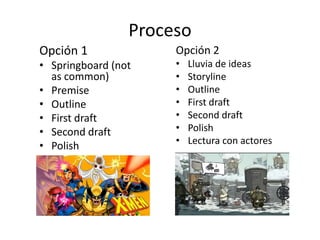
Proceso 
Opción 1 
• Springboard (not 
as common) 
• Premise 
• Outline 
• First draft 
• Second draft 
• Polish 
Opción 2 
• Lluvia de ideas 
• Storyline 
• Outline 
• First draft 
• Second draft 
• Polish 
• Lectura con actores
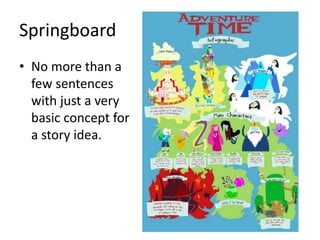
Springboard 
• No more than a 
few sentences 
with just a very 
basic concept for 
a story idea.
The Premise 
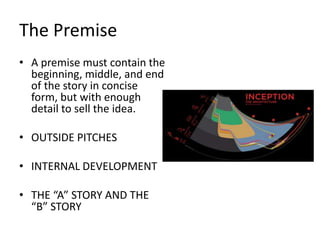
• A premise must contain the 
beginning, middle, and end 
of the story in concise 
form, but with enough 
detail to sell the idea. 
• OUTSIDE PITCHES 
• INTERNAL DEVELOPMENT 
• THE “A” STORY AND THE 
“B” STORY
The Outline (escaleta) 
• An outline is usually a beat-by-beat description of the 
script, broken into the necessary number of acts, with 
the major sluglines (interiors and exteriors) indicated. 
• Be sure you cover all the action beats, the essence of 
what the characters are saying to one another, the 
humor beats (if any), the emotional beats, and 
whatever else is crucial to conveying what will be in the 
script.
The Script Format 
• There is no one single, absolute, unvarying script format for 
either animation or live action. However, there are some 
basic rules. The key things you need to know are how to lay 
out the page (margins, spacing, indents) and how to use 
the five basic elements from which every script is built: 
• SLUGLINES / SCENE HEADINGS 
• ACTION DESCRIPTION 
• DIALOGUE 
• PARENTHETICALS 
• TRANSITIONS
The Differences (Live action-Animation) 
Difference No. 2: Dialogue and the Lip-Synch Factor 
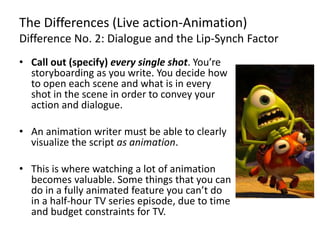
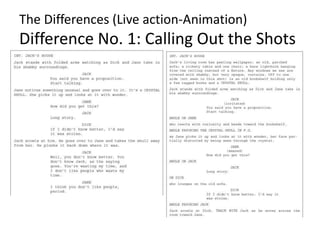
• Call out (specify) every single shot. You’re 
storyboarding as you write. You decide how 
to open each scene and what is in every 
shot in the scene in order to convey your 
action and dialogue. 
• An animation writer must be able to clearly 
visualize the script as animation. 
• This is where watching a lot of animation 
becomes valuable. Some things that you can 
do in a fully animated feature you can’t do 
in a half-hour TV series episode, due to time 
and budget constraints for TV.
The Differences (Live action-Animation) 
Difference No. 1: Calling Out the Shots
Difference No. 2: Dialogue and the Lip-Synch 
Factor 
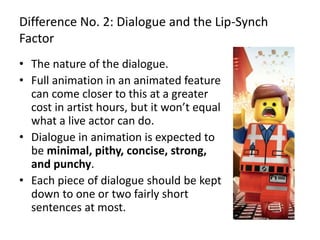
• The nature of the dialogue. 
• Full animation in an animated feature 
can come closer to this at a greater 
cost in artist hours, but it won’t equal 
what a live actor can do. 
• Dialogue in animation is expected to 
be minimal, pithy, concise, strong, 
and punchy. 
• Each piece of dialogue should be kept 
down to one or two fairly short 
sentences at most.
Difference No. 3: Script Length 
• LIVE ACTION: one minute = one page 
• ANIMATION: one minute = one and a half pages 
Theoretically, then: 
• A twenty-two-minute live-action script would be 
twenty-two pages. 
• A Twenty-two-minute animation script would be 
thirty-three pages.
• Josue Contreras 
• @josuerockdrigo

The Script Process for Animation

  • 1.
    The Script Processfor Animation Josue Contreras @josuerockdrigo
  • 2.
    Proceso Opción 1 • Springboard (not as common) • Premise • Outline • First draft • Second draft • Polish Opción 2 • Lluvia de ideas • Storyline • Outline • First draft • Second draft • Polish • Lectura con actores
  • 3.
    Springboard • Nomore than a few sentences with just a very basic concept for a story idea.
  • 4.
    The Premise •A premise must contain the beginning, middle, and end of the story in concise form, but with enough detail to sell the idea. • OUTSIDE PITCHES • INTERNAL DEVELOPMENT • THE “A” STORY AND THE “B” STORY
  • 5.
    The Outline (escaleta) • An outline is usually a beat-by-beat description of the script, broken into the necessary number of acts, with the major sluglines (interiors and exteriors) indicated. • Be sure you cover all the action beats, the essence of what the characters are saying to one another, the humor beats (if any), the emotional beats, and whatever else is crucial to conveying what will be in the script.
  • 6.
    The Script Format • There is no one single, absolute, unvarying script format for either animation or live action. However, there are some basic rules. The key things you need to know are how to lay out the page (margins, spacing, indents) and how to use the five basic elements from which every script is built: • SLUGLINES / SCENE HEADINGS • ACTION DESCRIPTION • DIALOGUE • PARENTHETICALS • TRANSITIONS
  • 7.
    The Differences (Liveaction-Animation) Difference No. 2: Dialogue and the Lip-Synch Factor • Call out (specify) every single shot. You’re storyboarding as you write. You decide how to open each scene and what is in every shot in the scene in order to convey your action and dialogue. • An animation writer must be able to clearly visualize the script as animation. • This is where watching a lot of animation becomes valuable. Some things that you can do in a fully animated feature you can’t do in a half-hour TV series episode, due to time and budget constraints for TV.
  • 8.
    The Differences (Liveaction-Animation) Difference No. 1: Calling Out the Shots
  • 9.
    Difference No. 2:Dialogue and the Lip-Synch Factor • The nature of the dialogue. • Full animation in an animated feature can come closer to this at a greater cost in artist hours, but it won’t equal what a live actor can do. • Dialogue in animation is expected to be minimal, pithy, concise, strong, and punchy. • Each piece of dialogue should be kept down to one or two fairly short sentences at most.
  • 10.
    Difference No. 3:Script Length • LIVE ACTION: one minute = one page • ANIMATION: one minute = one and a half pages Theoretically, then: • A twenty-two-minute live-action script would be twenty-two pages. • A Twenty-two-minute animation script would be thirty-three pages.
  • 12.
    • Josue Contreras • @josuerockdrigo