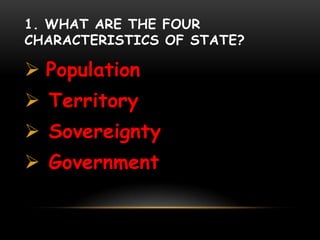
1. WHAT ARE THE FOUR
CHARACTERISTICS OF STATE?
 Population
 Territory
 Sovereignty
 Government
2. WHAT ARE THE FOUR THEORIES
OF THE ORIGINS OF A STATE?
 Force Theory
 Evolutionary Theory
 Devine Right Theory
 Social Contract Theory
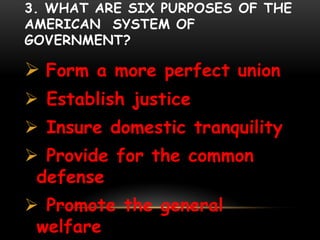
3. WHAT ARE SIX PURPOSES OF THE
AMERICAN SYSTEM OF
GOVERNMENT?
 Form a more perfect union
 Establish justice
 Insure domestic tranquility
 Provide for the common
defense
 Promote the general
welfare
4. GOVERNMENT
 The institution through
which a society makes and
enforces its public
policies.
5. PUBLIC POLICY
 Something the
government decides to do
about a certain issue.
6. LEGISLATIVE POWER
 The power to make laws.
7. EXECUTIVE POWER
 The power to enforce
and administer laws.
8. JUDICIAL POWER
 The power to interpret
laws and settle disputes.
9. CONSTITUTION
 A body of fundamental
laws that sets out the
principles, structures, and
processes of government.
10. DICTATORSHIP
 Government in which
those who rule are not
responsible to will of the
people.
11. DEMOCRACY
 Government in which
power rests with the
people.
12. STATE
 A body of people living in
a defined area who have a
government and the power
to make and enforce laws
without the consent of a
higher authority.
13. SOVEREIGN
 Having supreme and
absolute power.

Government%20 chapter%201.1[1]

  • 1.
    1. WHAT ARETHE FOUR CHARACTERISTICS OF STATE?  Population  Territory  Sovereignty  Government
  • 2.
    2. WHAT ARETHE FOUR THEORIES OF THE ORIGINS OF A STATE?  Force Theory  Evolutionary Theory  Devine Right Theory  Social Contract Theory
  • 3.
    3. WHAT ARESIX PURPOSES OF THE AMERICAN SYSTEM OF GOVERNMENT?  Form a more perfect union  Establish justice  Insure domestic tranquility  Provide for the common defense  Promote the general welfare
  • 4.
    4. GOVERNMENT  Theinstitution through which a society makes and enforces its public policies.
  • 5.
    5. PUBLIC POLICY Something the government decides to do about a certain issue.
  • 6.
    6. LEGISLATIVE POWER The power to make laws.
  • 7.
    7. EXECUTIVE POWER The power to enforce and administer laws.
  • 8.
    8. JUDICIAL POWER The power to interpret laws and settle disputes.
  • 9.
    9. CONSTITUTION  Abody of fundamental laws that sets out the principles, structures, and processes of government.
  • 10.
    10. DICTATORSHIP  Governmentin which those who rule are not responsible to will of the people.
  • 11.
    11. DEMOCRACY  Governmentin which power rests with the people.
  • 12.
    12. STATE  Abody of people living in a defined area who have a government and the power to make and enforce laws without the consent of a higher authority.
  • 13.
    13. SOVEREIGN  Havingsupreme and absolute power.