Manchester & Differential
Manchester
Line Coding: Polar Biphase Encoding Techniques
CMS-A-CC-4-8
Lockdown Talk Series: DCNIT-LDTalks-6
Arunabha Saha
Department of Computer Science, Vidyasagar College
University of Calcutta
May 2020
Outline
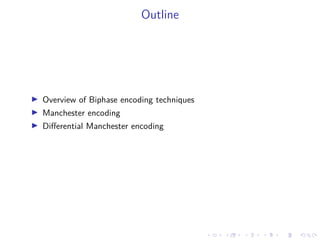
Overview of Biphase encoding techniques
Manchester encoding
Differential Manchester encoding
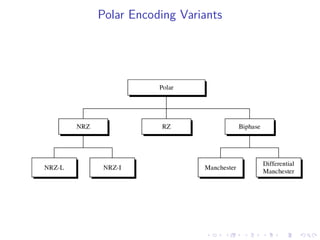
Polar Encoding Variants
Biphase Encoding
It solves the synchronization problem
The transition of state in signal happens in the middle of the bit;
does not returns to zero
Two variants:
Manchester Encoding (ME)
Differential Manchester Encoding (DME)
Manchester Encoding(ME)(1)
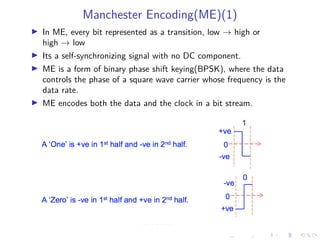
In ME, every bit represented as a transition, low → high or
high → low
Its a self-synchronizing signal with no DC component.
ME is a form of binary phase shift keying(BPSK), where the data
controls the phase of a square wave carrier whose frequency is the
data rate.
ME encodes both the data and the clock in a bit stream.
ME(2)
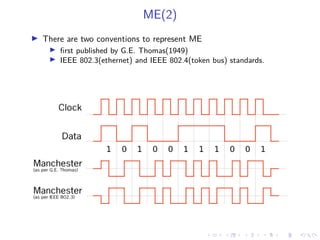
There are two conventions to represent ME
first published by G.E. Thomas(1949)
IEEE 802.3(ethernet) and IEEE 802.4(token bus) standards.
ME(3)
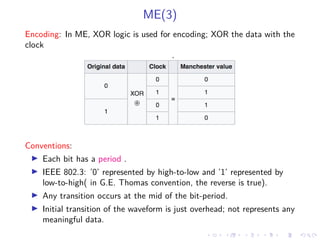
Encoding: In ME, XOR logic is used for encoding; XOR the data with the
clock
Conventions:
Each bit has a period .
IEEE 802.3: ’0’ represented by high-to-low and ’1’ represented by
low-to-high( in G.E. Thomas convention, the reverse is true).
Any transition occurs at the mid of the bit-period.
Initial transition of the waveform is just overhead; not represents any
meaningful data.
ME(4)
Applications:
ME used is early ethernet physical layer.
Its in use for IR protocols, RFID and NFC systems.
this widely used in LAN such as Ethernet(IEEE 802.3) and token
bus(IEEE 802.4).
Pros:
No DC component
No signal drooping issue
Ease of synchronization
ME is transparent
Cons:
Because of larger number of transitions occupies larger bandwidth.
Lacks error detection capability.
Differential Manchester Encoding(DME)(1)
Also known as Biphase Mark Code, Conditioned diphase , etc.
In DME, data and clock are combined to form singel 2-level
synchronizing data stream.
Presence or absence of transitions indicates logical value.
Its not important to know the exact polarity of the signal because
the data encoded as the change of state.
It makes synchronization easier
In DME, the transition in the middle of the bit-period used for
synchronization
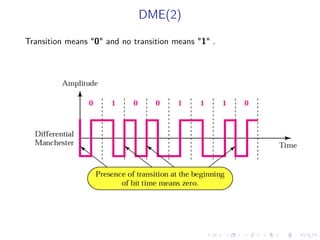
DME(2)
Transition means "0" and no transition means "1" .
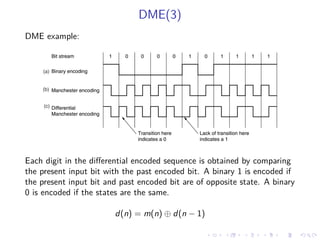
DME(3)
DME example:
Each digit in the differential encoded sequence is obtained by comparing
the present input bit with the past encoded bit. A binary 1 is encoded if
the present input bit and past encoded bit are of opposite state. A binary
0 is encoded if the states are the same.
d(n) = m(n) ⊕ d(n − 1)
DME(4)
Differential Manchester encoding has the following advantages over some
other line codes: 1
For every bit there is a transition is guaranteed.
In noisy environment, detecting transitions is less erroneous than
comparing agaisnt a threshold.
Unlike ME, here(in DME) presence of transitions is important, not
the polarity.
If the magnitude of high and low signal levels are same but of
different poalrity, it makes the average 0; (theoretically, 0 DC bias).
1 https://en.wikipedia.org/wiki/Differential_Manchester_encoding
Thank You
Image source: Google Images
all materials and codes are copyright protected under GNU GPL and Creative Commons(cc) license. Anyone can share or redistribute for
non-commercial purpose only. Usage of any lecture materials or(and) codes by any individual or institution for commercial benefits or
advancement without permission is strictly prohibited.

Manchester & Differential Manchester encoding scheme

  • 1.
    Manchester & Differential Manchester LineCoding: Polar Biphase Encoding Techniques CMS-A-CC-4-8 Lockdown Talk Series: DCNIT-LDTalks-6 Arunabha Saha Department of Computer Science, Vidyasagar College University of Calcutta May 2020
  • 2.
    Outline Overview of Biphaseencoding techniques Manchester encoding Differential Manchester encoding
  • 3.
  • 4.
    Biphase Encoding It solvesthe synchronization problem The transition of state in signal happens in the middle of the bit; does not returns to zero Two variants: Manchester Encoding (ME) Differential Manchester Encoding (DME)
  • 5.
    Manchester Encoding(ME)(1) In ME,every bit represented as a transition, low → high or high → low Its a self-synchronizing signal with no DC component. ME is a form of binary phase shift keying(BPSK), where the data controls the phase of a square wave carrier whose frequency is the data rate. ME encodes both the data and the clock in a bit stream.
  • 6.
    ME(2) There are twoconventions to represent ME first published by G.E. Thomas(1949) IEEE 802.3(ethernet) and IEEE 802.4(token bus) standards.
  • 7.
    ME(3) Encoding: In ME,XOR logic is used for encoding; XOR the data with the clock Conventions: Each bit has a period . IEEE 802.3: ’0’ represented by high-to-low and ’1’ represented by low-to-high( in G.E. Thomas convention, the reverse is true). Any transition occurs at the mid of the bit-period. Initial transition of the waveform is just overhead; not represents any meaningful data.
  • 8.
    ME(4) Applications: ME used isearly ethernet physical layer. Its in use for IR protocols, RFID and NFC systems. this widely used in LAN such as Ethernet(IEEE 802.3) and token bus(IEEE 802.4). Pros: No DC component No signal drooping issue Ease of synchronization ME is transparent Cons: Because of larger number of transitions occupies larger bandwidth. Lacks error detection capability.
  • 9.
    Differential Manchester Encoding(DME)(1) Alsoknown as Biphase Mark Code, Conditioned diphase , etc. In DME, data and clock are combined to form singel 2-level synchronizing data stream. Presence or absence of transitions indicates logical value. Its not important to know the exact polarity of the signal because the data encoded as the change of state. It makes synchronization easier In DME, the transition in the middle of the bit-period used for synchronization
  • 10.
    DME(2) Transition means "0"and no transition means "1" .
  • 11.
    DME(3) DME example: Each digitin the differential encoded sequence is obtained by comparing the present input bit with the past encoded bit. A binary 1 is encoded if the present input bit and past encoded bit are of opposite state. A binary 0 is encoded if the states are the same. d(n) = m(n) ⊕ d(n − 1)
  • 12.
    DME(4) Differential Manchester encodinghas the following advantages over some other line codes: 1 For every bit there is a transition is guaranteed. In noisy environment, detecting transitions is less erroneous than comparing agaisnt a threshold. Unlike ME, here(in DME) presence of transitions is important, not the polarity. If the magnitude of high and low signal levels are same but of different poalrity, it makes the average 0; (theoretically, 0 DC bias). 1 https://en.wikipedia.org/wiki/Differential_Manchester_encoding
  • 13.
    Thank You Image source:Google Images all materials and codes are copyright protected under GNU GPL and Creative Commons(cc) license. Anyone can share or redistribute for non-commercial purpose only. Usage of any lecture materials or(and) codes by any individual or institution for commercial benefits or advancement without permission is strictly prohibited.