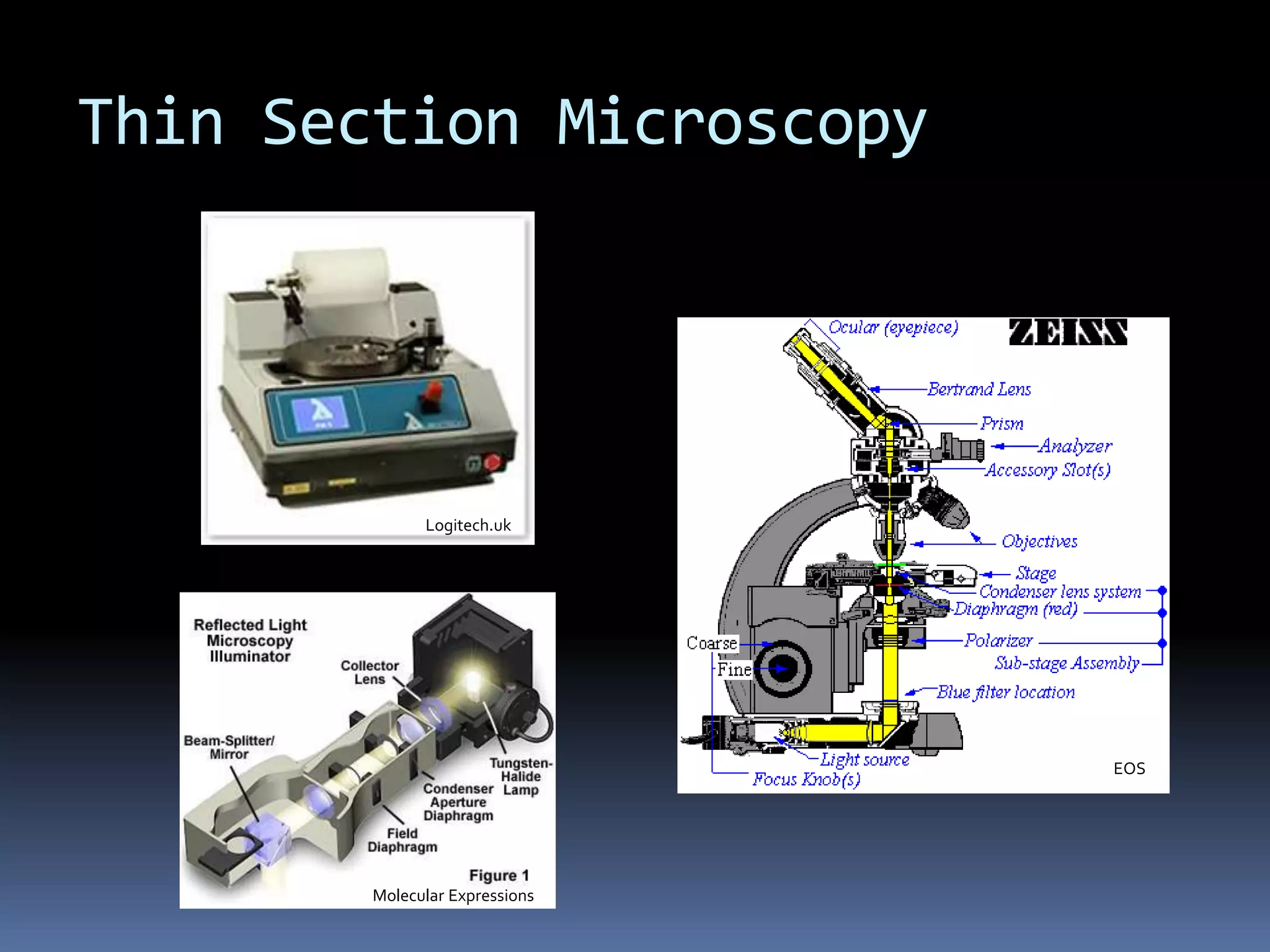
This document summarizes a student project on meteorite classification and trajectory modeling. It describes the three main types of meteorites - stony, iron, and stony iron. It discusses techniques for analyzing meteorites like thin section microscopy. The document outlines equations of motion and initial conditions used to model meteorite trajectories. Plots of orbital paths are generated and future work is proposed to model meteorite impacts or deflections off Earth.
Meteorite Classification andtrajectory modelingJessie MillerOhio Wesleyan UniversityDepartment of Physics and AstronomyFaculty Advisors: Barbara Andereck and Karen Fryer
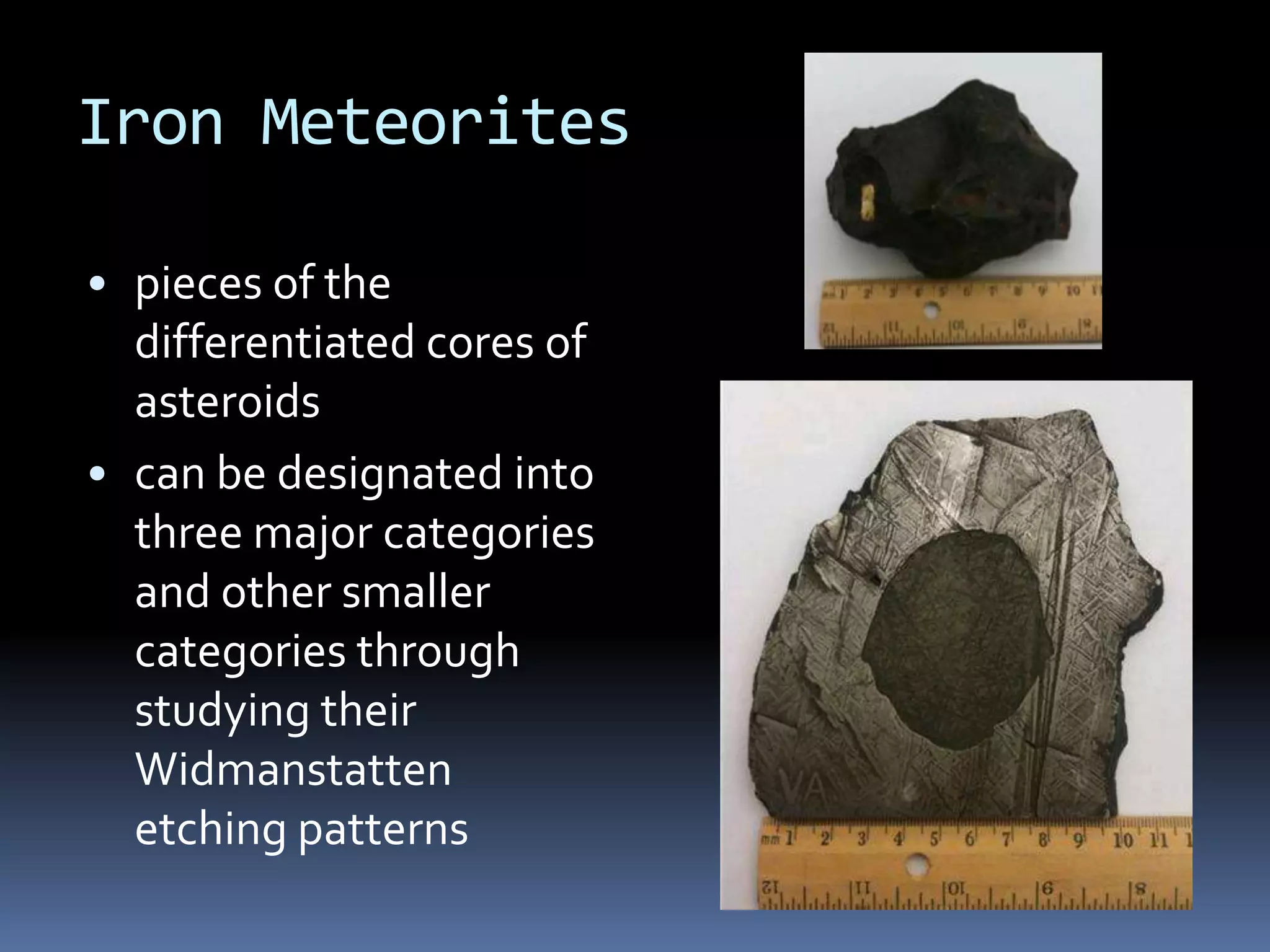
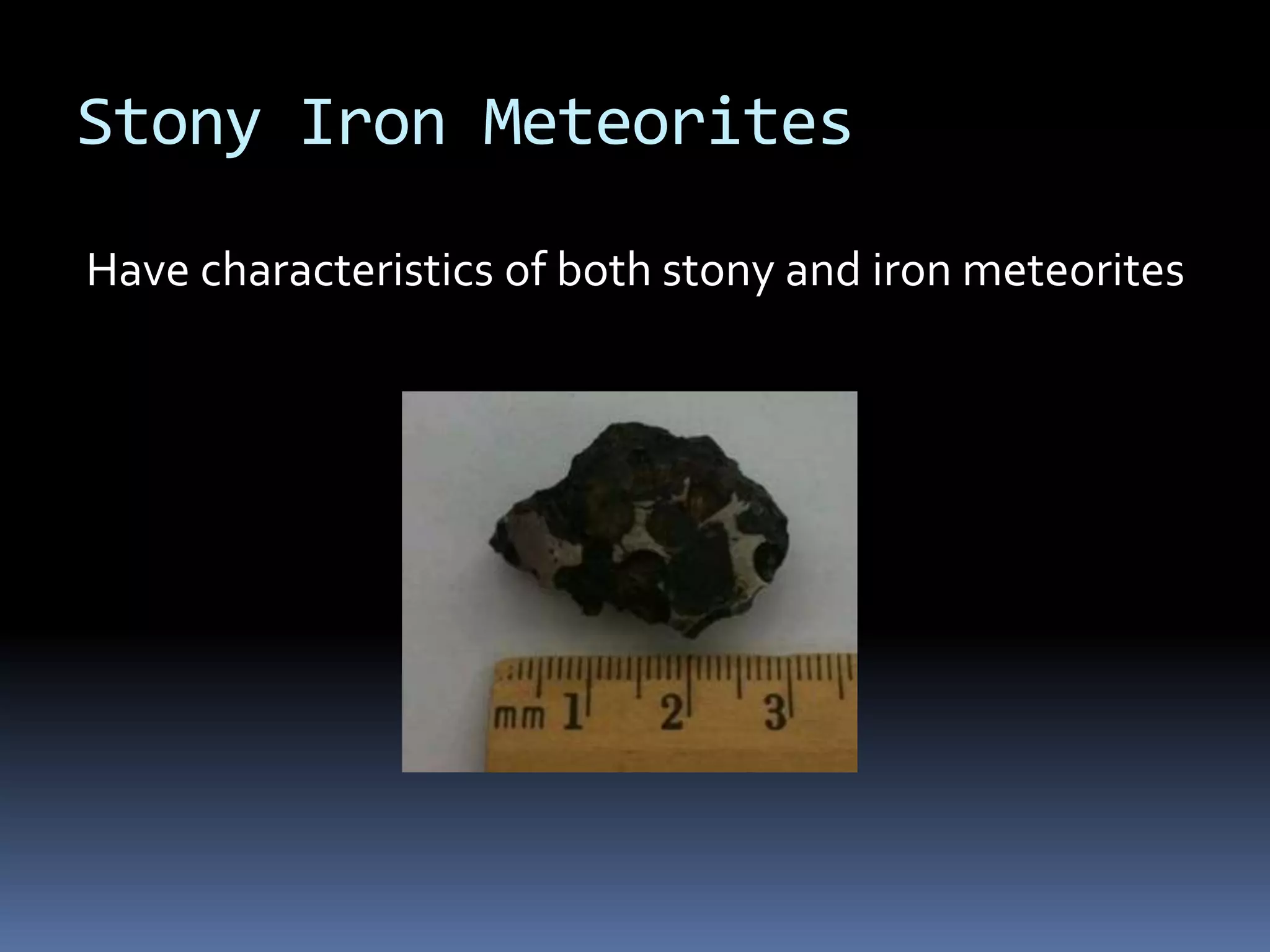
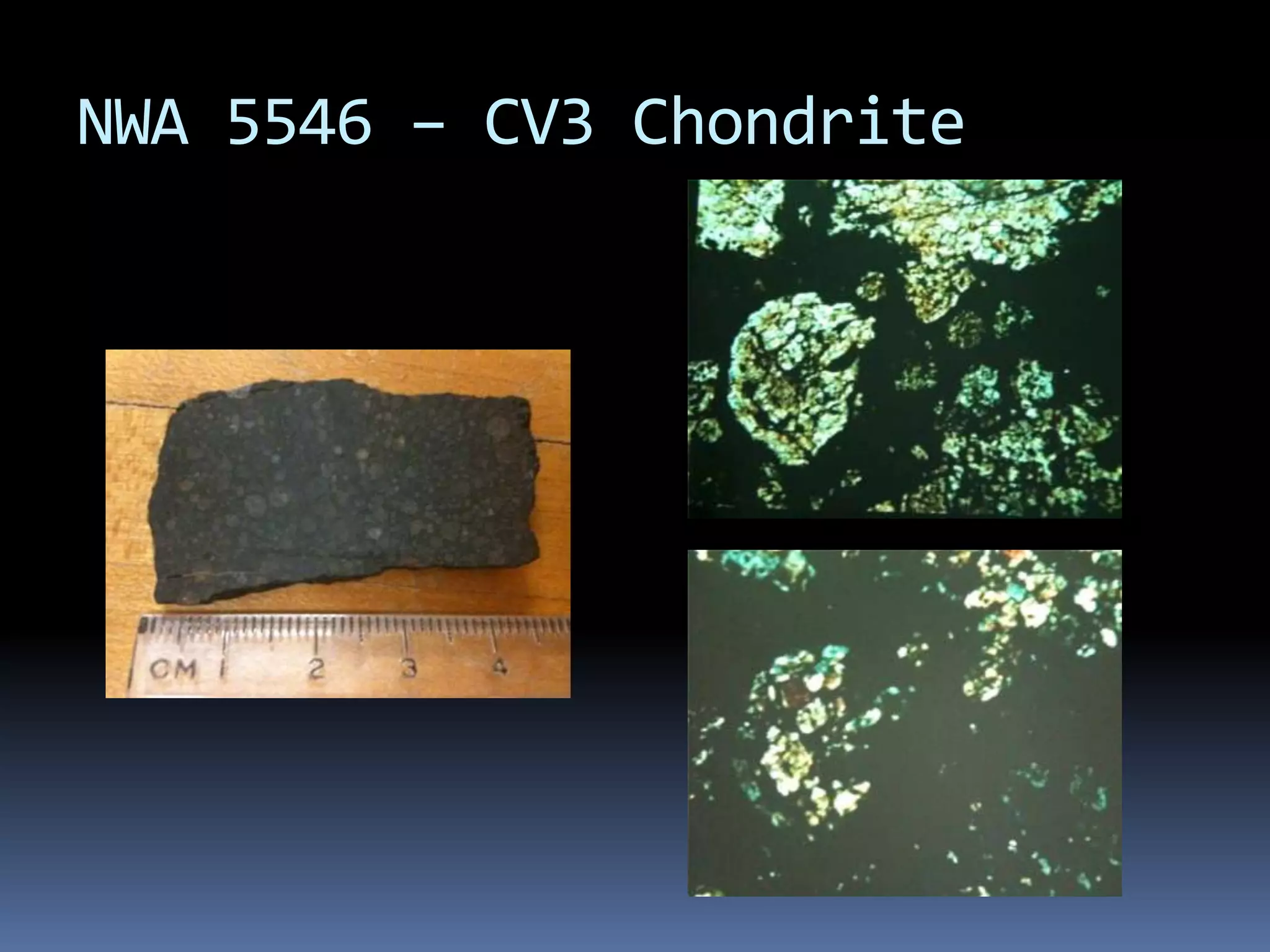
can be designatedinto three major categories and other smaller categories through studying their Widmanstatten etching patternsStony Iron MeteoritesHave characteristics of both stony and iron meteorites
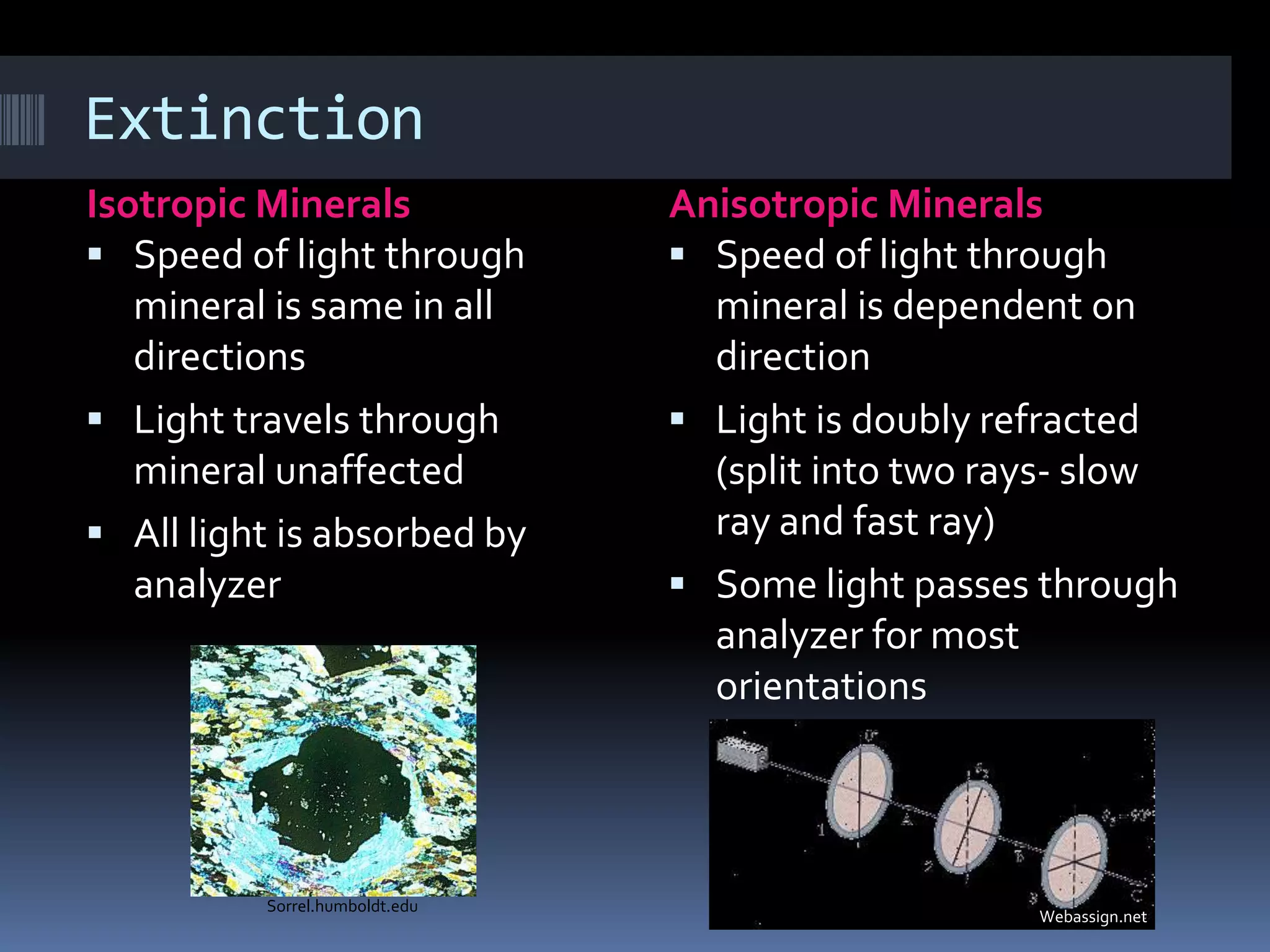
ExtinctionIsotropic MineralsAnisotropic MineralsSpeedof light through mineral is same in all directionsLight travels through mineral unaffectedAll light is absorbed by analyzerSpeed of light through mineral is dependent on directionLight is doubly refracted (split into two rays- slow ray and fast ray)Some light passes through analyzer for most orientationsSorrel.humboldt.eduWebassign.net
12.
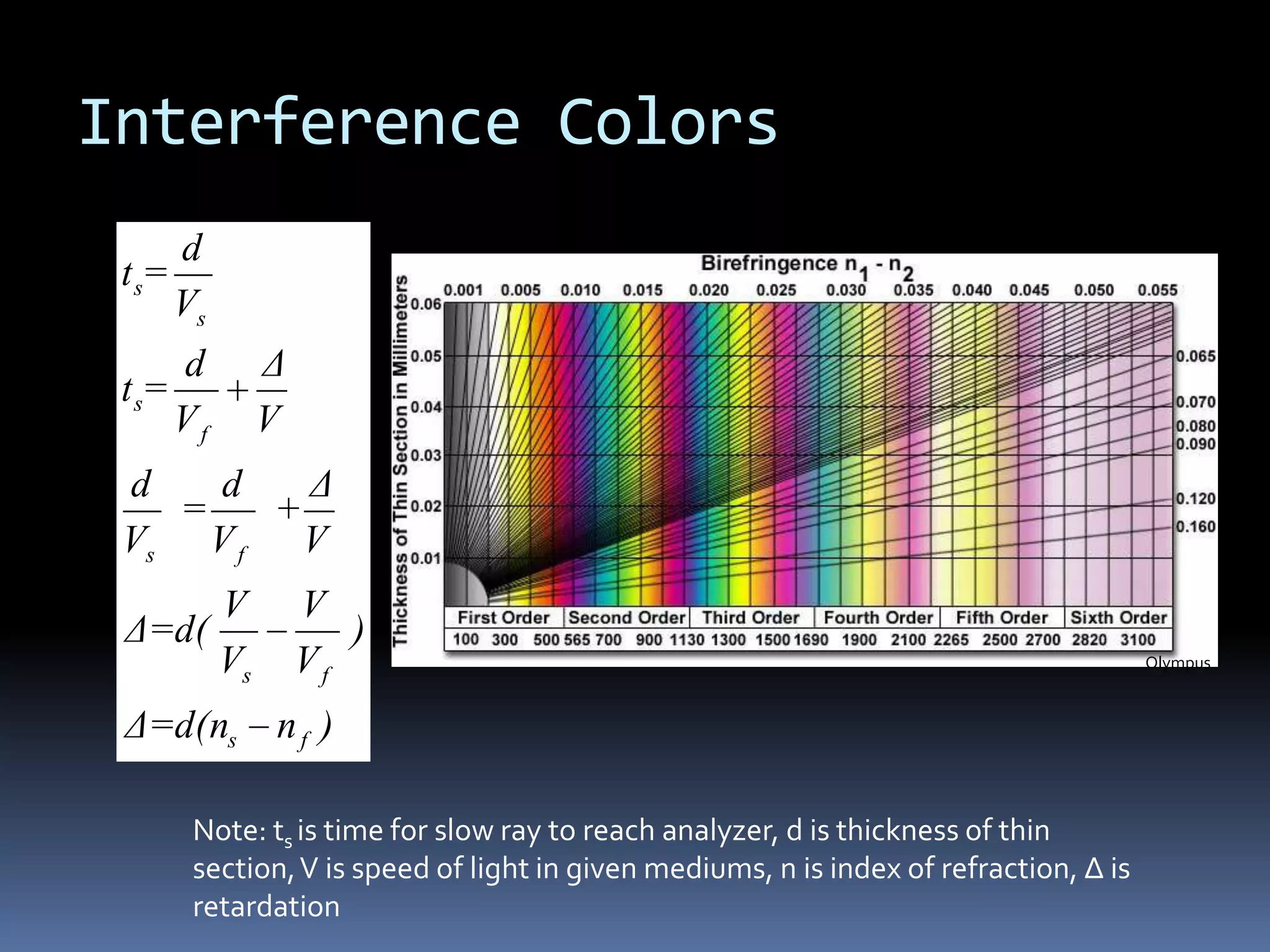
Interference ColorsOlympusNote: tsistime for slow ray to reach analyzer, d is thickness of thin section, V is speed of light in given mediums, n is index of refraction, Δ is retardation
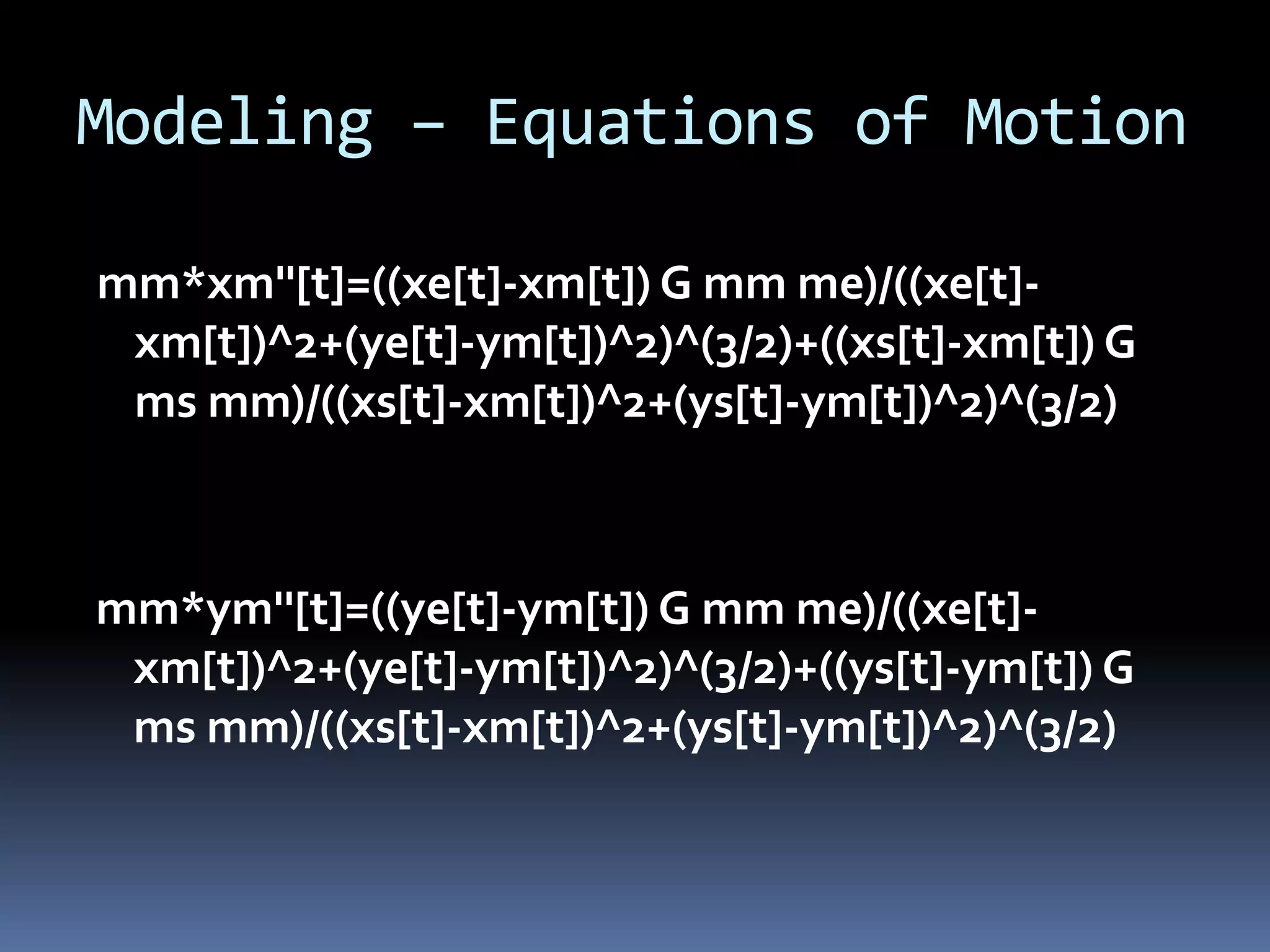
Modeling – Equationsof Motion mm*xm''[t]=((xe[t]-xm[t]) G mm me)/((xe[t]-xm[t])^2+(ye[t]-ym[t])^2)^(3/2)+((xs[t]-xm[t]) G ms mm)/((xs[t]-xm[t])^2+(ys[t]-ym[t])^2)^(3/2) mm*ym''[t]=((ye[t]-ym[t]) G mm me)/((xe[t]-xm[t])^2+(ye[t]-ym[t])^2)^(3/2)+((ys[t]-ym[t]) G ms mm)/((xs[t]-xm[t])^2+(ys[t]-ym[t])^2)^(3/2)
16.
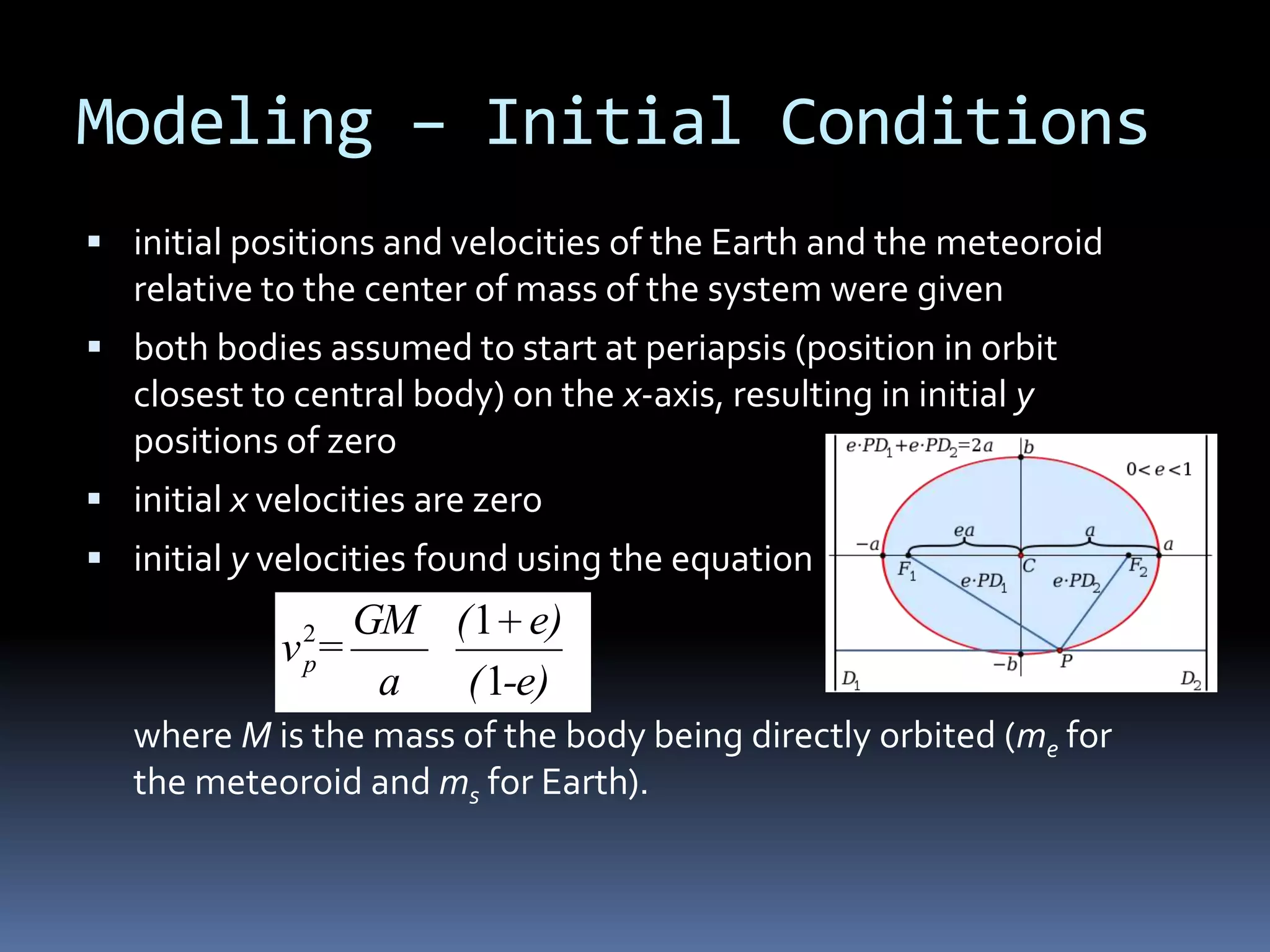
Modeling – InitialConditionsinitial positions and velocities of the Earth and the meteoroid relative to the center of mass of the system were givenboth bodies assumed to start at periapsis (position in orbit closest to central body) on the x-axis, resulting in initial y positions of zeroinitial x velocities are zeroinitial y velocities found using the equation where M is the mass of the body being directly orbited (mefor the meteoroid and ms for Earth).
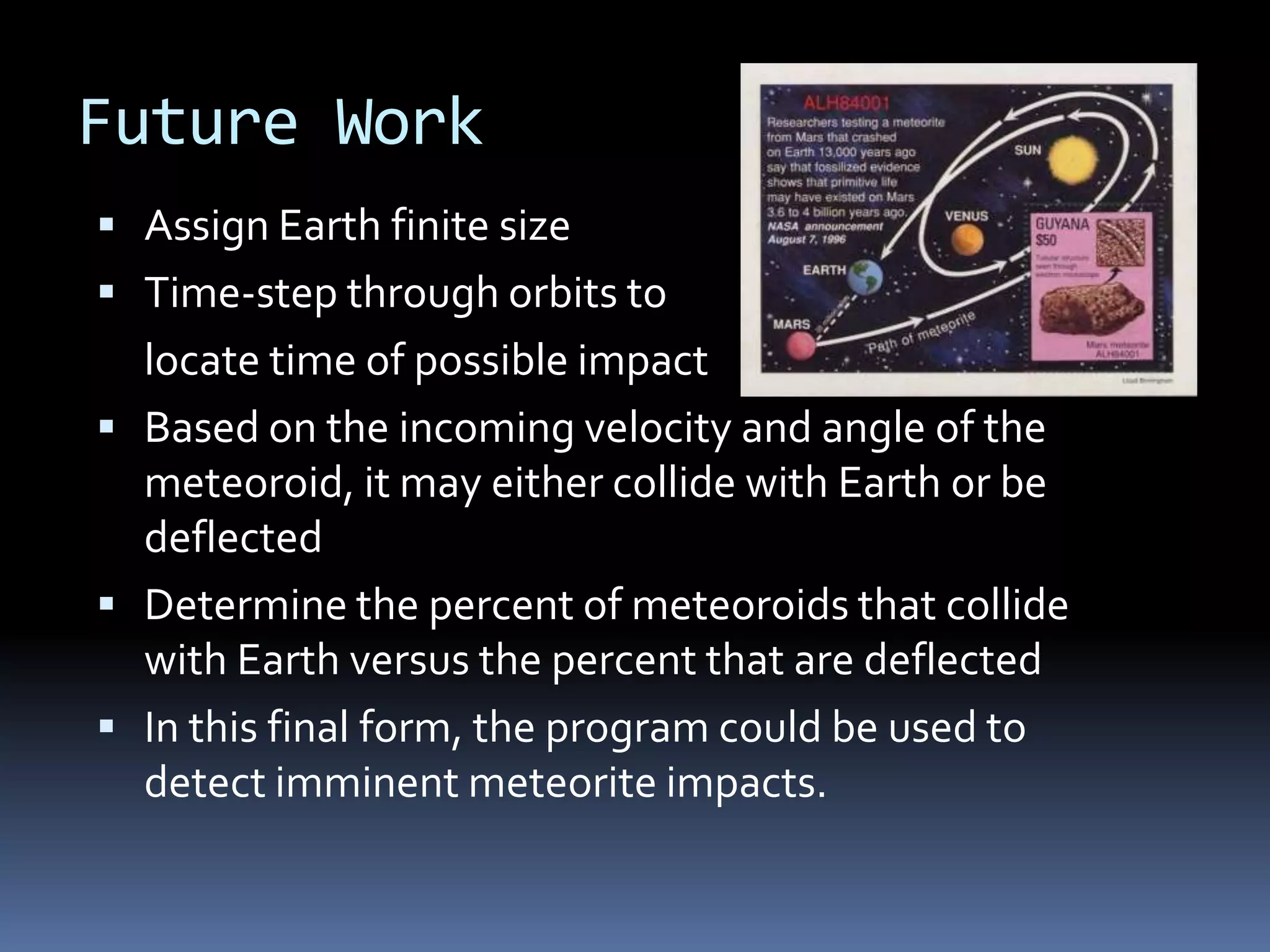
Future WorkAssign Earthfinite sizeTime-step through orbits to locate time of possible impact Based on the incoming velocity and angle of the meteoroid, it may either collide with Earth or be deflectedDetermine the percent of meteoroids that collide with Earth versus the percent that are deflectedIn this final form, the program could be used to detect imminent meteorite impacts.
![Modeling – Equations of Motion mm*xm''[t]=((xe[t]-xm[t]) G mm me)/((xe[t]-xm[t])^2+(ye[t]-ym[t])^2)^(3/2)+((xs[t]-xm[t]) G ms mm)/((xs[t]-xm[t])^2+(ys[t]-ym[t])^2)^(3/2) mm*ym''[t]=((ye[t]-ym[t]) G mm me)/((xe[t]-xm[t])^2+(ye[t]-ym[t])^2)^(3/2)+((ys[t]-ym[t]) G ms mm)/((xs[t]-xm[t])^2+(ys[t]-ym[t])^2)^(3/2)](https://image.slidesharecdn.com/jmresearch-110808201417-phpapp01/75/Meteorite-Classification-and-Trajectory-Modeling-15-2048.jpg)