
Filling in the Blanks:
Capturing Dynamically
  Generated Content
                   Justin F. Brunelle
           Old Dominion University
      Advisor: Dr. Michael L. Nelson

      JCDL ‘12 Doctoral Consortium
                        06/10/2012


                                        1
2
3
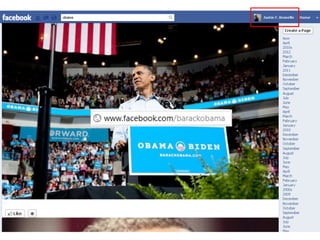
Problem!
• Which exists in the archive?
  – Probably the unauthenticated version, right?
• What factors created “my” representation?
  – Can I archive “my” representation?
• Am I seeing undead resources?
  – Mix of live and archived content?
• How can we capture, share, and
  archive user experiences?

                                                   4
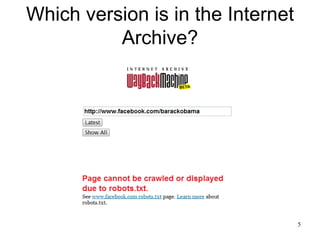
Which version is in the Internet
          Archive?


                                   5
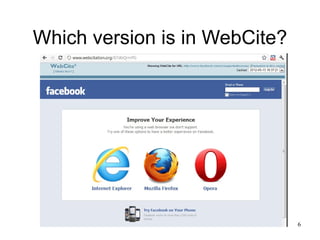
Which version is in WebCite?


                               6
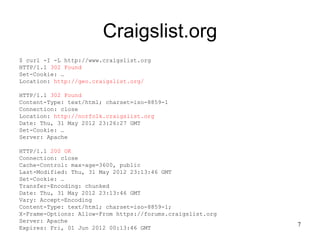
Craigslist.org
$ curl -I -L http://www.craigslist.org
HTTP/1.1 302 Found
Set-Cookie: …
Location: http://geo.craigslist.org/

HTTP/1.1 302 Found
Content-Type: text/html; charset=iso-8859-1
Connection: close
Location: http://norfolk.craigslist.org
Date: Thu, 31 May 2012 23:26:27 GMT
Set-Cookie: …
Server: Apache

HTTP/1.1 200 OK
Connection: close
Cache-Control: max-age=3600, public
Last-Modified: Thu, 31 May 2012 23:13:46 GMT
Set-Cookie: …
Transfer-Encoding: chunked
Date: Thu, 31 May 2012 23:13:46 GMT
Vary: Accept-Encoding
Content-Type: text/html; charset=iso-8859-1;
X-Frame-Options: Allow-From https://forums.craigslist.org
Server: Apache
                                                            7
Expires: Fri, 01 Jun 2012 00:13:46 GMT
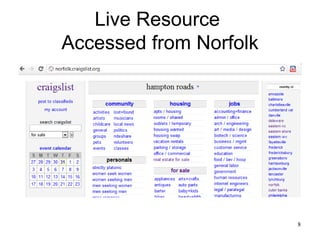
Live Resource
Accessed from Norfolk


                        8
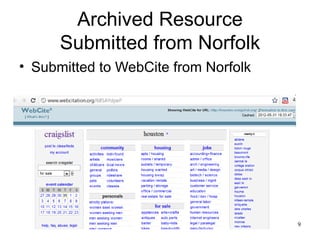
Archived Resource
      Submitted from Norfolk
• Submitted to WebCite from Norfolk


                                      9
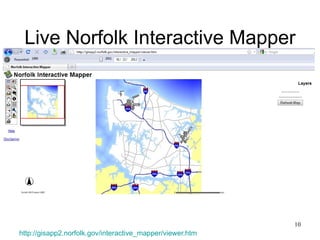
Live Norfolk Interactive Mapper


                                                           10
http://gisapp2.norfolk.gov/interactive_mapper/viewer.htm
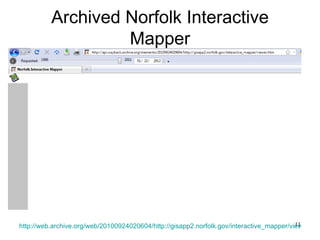
Archived Norfolk Interactive
                   Mapper


                                                                                          11
http://web.archive.org/web/20100924020604/http://gisapp2.norfolk.gov/interactive_mapper/viewer.htm
Web 2.0
• Crawlers aren’t enough
• Relies on interaction/personalization
• Users may want to archive personal
  content
• How do we capture user experiences?
  – Justin’s vs. Dr. Nelson’s experience? Both?
• What about sharing browsing sessions?

                                                  12
Things are better
          (but really worse)
• Better UI, worse archiving
• HTML5
• JavaScript
  – document.write
• Cookies
• User Interaction
• GeoIP

                               13
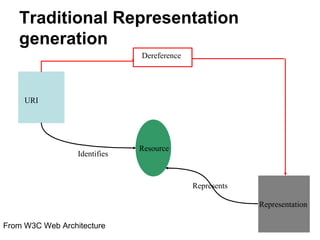
Traditional Representation
   generation
                               Dereference


     URI


                               Resource
                  Identifies


                                             Represents

                                                          Representation

From W3C Web Architecture                                           14
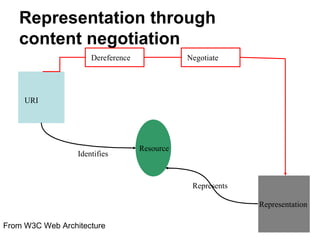
Representation through
   content negotiation
                      Dereference              Negotiate


     URI


                                    Resource
                  Identifies


                                                Represents

                                                             Representation

From W3C Web Architecture                                              15
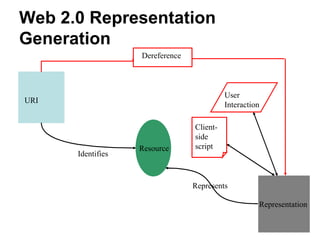
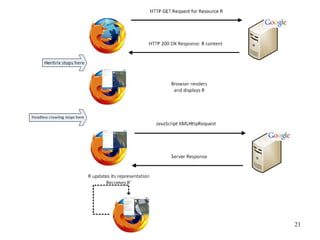
Web 2.0 Representation
Generation
                   Dereference


                                           User
URI
                                           Interaction

                                 Client-
                                 side
                   Resource      script
      Identifies


                                 Represents

                                                     Representation

                                                               16
Prior Work
• Capture for Debugging and Security
  – Mickens, 2010; Livshits, 2007, 2009, 2010; Dhawan, 2009
• Crawlers
  – Mesbah, 2008; Duda, 2008; Lowet, 2009
• Caching dynamic content
  – Benson, 2010; Karri, 2009; Boulos, 2010; Periyapatna,
    2009; Sivasubramanian, 2007
• Walden’s paths
  – http://www.csdl.tamu.edu/walden/
• IIPC Workshop 2012: Archiving the Future Web
  – http://blog.dshr.org/2012/05/harvesting-and-preserving-future-web.html
                                                                         17
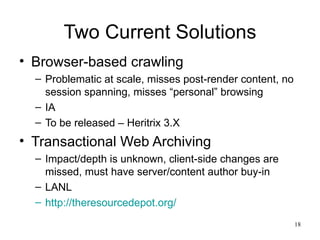
Two Current Solutions
• Browser-based crawling
  – Problematic at scale, misses post-render content, no
    session spanning, misses “personal” browsing
  – IA
  – To be released – Heritrix 3.X
• Transactional Web Archiving
  – Impact/depth is unknown, client-side changes are
    missed, must have server/content author buy-in
  – LANL
  – http://theresourcedepot.org/
                                                           18
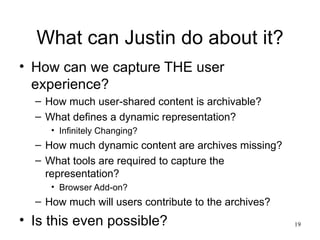
What can Justin do about it?
• How can we capture THE user
  experience?
  – How much user-shared content is archivable?
  – What defines a dynamic representation?
     • Infinitely Changing?
  – How much dynamic content are archives missing?
  – What tools are required to capture the
    representation?
     • Browser Add-on?
  – How much will users contribute to the archives?
• Is this even possible?                              19
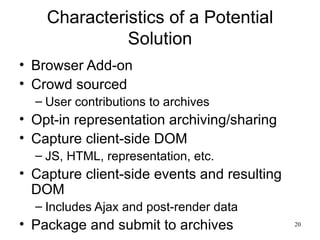
Characteristics of a Potential
              Solution
• Browser Add-on
• Crowd sourced
  – User contributions to archives
• Opt-in representation archiving/sharing
• Capture client-side DOM
  – JS, HTML, representation, etc.
• Capture client-side events and resulting
  DOM
  – Includes Ajax and post-render data
• Package and submit to archives             20
21
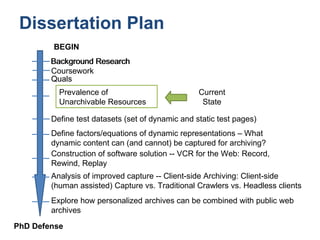
Dissertation Plan
        BEGIN
        Background Research
        Coursework
        Quals
          Prevalence of                           Current
          Unarchivable Resources                   State

        Define test datasets (set of dynamic and static test pages)
        Define factors/equations of dynamic representations – What
        dynamic content can (and cannot) be captured for archiving?
        Construction of software solution -- VCR for the Web: Record,
        Rewind, Replay
        Analysis of improved capture -- Client-side Archiving: Client-side
        (human assisted) Capture vs. Traditional Crawlers vs. Headless clients
        Explore how personalized archives can be combined with public web
        archives
PhD Defense
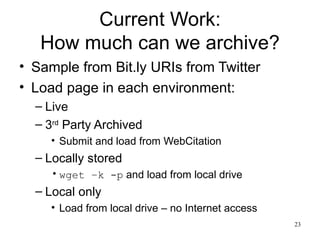
Current Work:
   How much can we archive?
• Sample from Bit.ly URIs from Twitter
• Load page in each environment:
  – Live
  – 3rd Party Archived
     • Submit and load from WebCitation
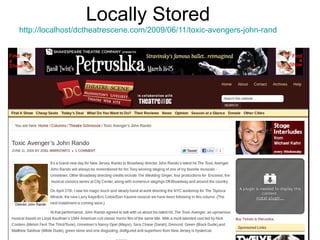
  – Locally stored
     • wget –k -p and load from local drive
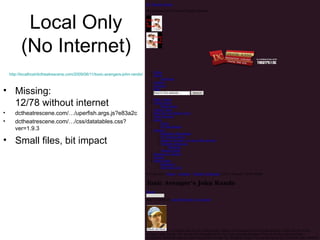
  – Local only
     • Load from local drive – no Internet access
                                                    23
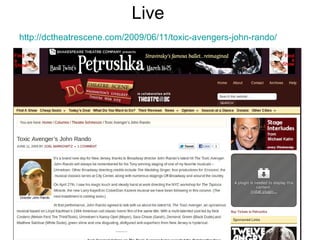
Live
http://dctheatrescene.com/2009/06/11/toxic-avengers-john-rando/


                                                                  24
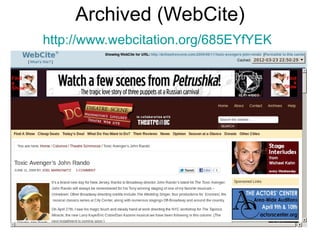
Archived (WebCite)
http://www.webcitation.org/685EYfYEK


                                       25
Locally Stored
http://localhost/dctheatrescene.com/2009/06/11/toxic-avengers-john-rando/


                                                                            26
Local Only
          (No Internet)
    http://localhost/dctheatrescene.com/2009/06/11/toxic-avengers-john-rando/


• Missing:
  12/78 without internet
•      dctheatrescene.com/…/uperfish.args.js?e83a2c
•      dctheatrescene.com/…/css/datatables.css?
       ver=1.9.3

• Small files, bit impact


                                                                                27
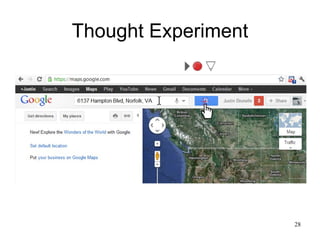
Thought Experiment


                     28
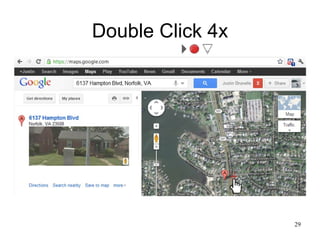
Double Click 4x


                  29
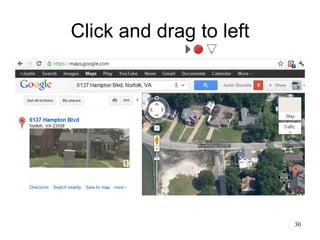
Click and drag to left


                         30
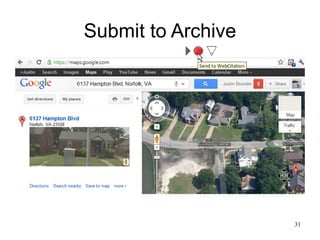
Submit to Archive


                    31
Future Research Questions
• What dynamism can (and cannot) be
  captured for archiving?
• Client-side Archiving: Client-side Capture vs.
  Traditional Crawlers
• Client-side contributions to Web Archives:
  Archiving User Experiences


                                                   32
Conclusion
• Is dynamic content
  archivable?
• How much are we
  missing?
• Can you archive
  your experience?
    • For the betterment
      of archives
    • For personal
      capture
                               33
Backups


          34
References
•   J. Mickens, J. Elson, and J. Howell. Mugshot: deterministic capture and replay for
    JavaScript applications. In Proceedings of the 7th USENIX conference on Networked
    systems design and implementation, NSDI'10, pages 11-11, Berkeley, CA, USA, 2010.
    USENIX Association.
•   K.Vikram, A. Prateek, and B. Livshits. Ripley: Automatically securing web 2.0 applications
    through replicated execution. In Proceedings of the Conference on Computer and
    Communications Security, November 2009.
•   E. Kiciman and B. Livshits. Ajaxscope: A platform for remotely monitoring the client-side
    behavior of web 2.0 applications. In the 21st ACM Symposium on Operating Systems
    Principles (SOSP'07), SOSP '07, 2007.
•   B. Livshits and S. Guarnieri. Gulfstream: Incremental static analysis for streaming
    JavaScript applications. Technical Report MSR-TR-2010-4, Microsoft, January 2010.
•   M. Dhawan and V. Ganapathy. Analyzing information flow in JavaScript-based browser
    extensions. Annual Computer Security Applications Conference, pages 382 - 391, 2009.
•   A. Mesbah, E. Bozdag, and A. van Deursen. Crawling Ajax by inferring user interface state
    changes. In Web Engineering, 2008. ICWE '08. Eighth International Conference on, pages
    122-134, July 2008.
•   C. Duda, G. Frey, D. Kossmann, and C. Zhou. AjaxSearch: crawling, indexing and
    searching Web 2.0 applications. Proc. VLDB Endow., 1:1440-1443, August 2008.              35
•   D. Lowet and D. Goergen. Co-browsing dynamic web pages. In WWW, pages 941-950,
References
•   S. Chakrabarti, S. Srivastava, M. Subramanyam, and M. Tiwari. Memex: A browsing
    assistant for collaborative archiving and mining of surf trails. In Proceedings of the 26th
    VLDB Conference, 26th VLDB, 2000.
•   R. Karri. Client-side page element web-caching, 2009.
•   E. Benson, A. M. 0002, D. R. Karger, and S. Madden. Sync kit: a persistent client-side
    database caching toolkit for data intensive websites. In WWW, pages 121{130, 2010.
•   M. N. K. Boulos, J. Gong, P. Yue, and J. Y. Warren. Web gis in practice viii: Html5 and the
    canvas element for interactive online mapping. International journal of health geographics,
    March 2010.
•   S. Periyapatna. Total recall for Ajax applications firefox extension, 2009.
•   S. Sivasubramanian, G. Pierre, M. van Steen, and G. Alonso. Analysis of caching and
    replication strategies for web applications. IEEE Internet Computing, 11:60-66, 2007.


                                                                                             36
Web Archives
• “Web archiving is the process of
  collecting portions of the World Wide
  Web and ensuring the collection
  is preserved … for future researchers,
  historians, and the public. “
  -- http://
  en.wikipedia.org/wiki/Web_archiving


                                           37
What does this have to do with
                 DLs?
•   Improved coverage
•   NARA regulation
•   Improved “memory”
•   Gathers missing User Experiences
    – Or at least an adequate sub-sample


                                           38
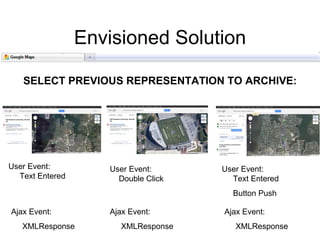
Envisioned Solution

   SELECT PREVIOUS REPRESENTATION TO ARCHIVE:


User Event:         User Event:      User Event:
  Text Entered        Double Click     Text Entered
                                       Button Push

Ajax Event:         Ajax Event:      Ajax Event:
   XMLResponse         XMLResponse      XMLResponse   39
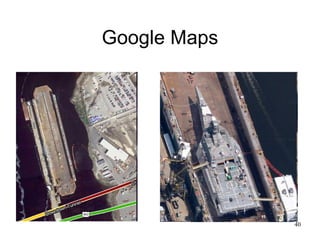
Google Maps


              40
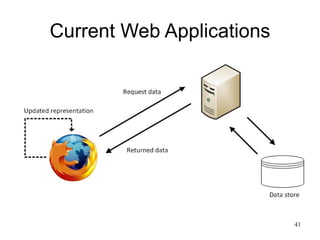
Current Web Applications


                           41
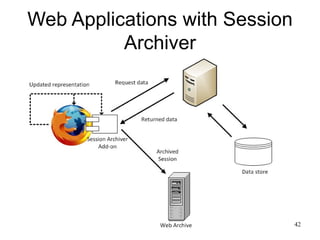
Web Applications with Session
          Archiver


                                42

Filling in the Blanks: Capturing Dynamically Generated Content

  • 1.
    Filling in theBlanks: Capturing Dynamically Generated Content Justin F. Brunelle Old Dominion University Advisor: Dr. Michael L. Nelson JCDL ‘12 Doctoral Consortium 06/10/2012 1
  • 2.
  • 3.
  • 4.
    Problem! • Which existsin the archive? – Probably the unauthenticated version, right? • What factors created “my” representation? – Can I archive “my” representation? • Am I seeing undead resources? – Mix of live and archived content? • How can we capture, share, and archive user experiences? 4
  • 5.
    Which version isin the Internet Archive? 5
  • 6.
    Which version isin WebCite? 6
  • 7.
    Craigslist.org $ curl -I-L http://www.craigslist.org HTTP/1.1 302 Found Set-Cookie: … Location: http://geo.craigslist.org/ HTTP/1.1 302 Found Content-Type: text/html; charset=iso-8859-1 Connection: close Location: http://norfolk.craigslist.org Date: Thu, 31 May 2012 23:26:27 GMT Set-Cookie: … Server: Apache HTTP/1.1 200 OK Connection: close Cache-Control: max-age=3600, public Last-Modified: Thu, 31 May 2012 23:13:46 GMT Set-Cookie: … Transfer-Encoding: chunked Date: Thu, 31 May 2012 23:13:46 GMT Vary: Accept-Encoding Content-Type: text/html; charset=iso-8859-1; X-Frame-Options: Allow-From https://forums.craigslist.org Server: Apache 7 Expires: Fri, 01 Jun 2012 00:13:46 GMT
  • 8.
  • 9.
    Archived Resource Submitted from Norfolk • Submitted to WebCite from Norfolk 9
  • 10.
    Live Norfolk InteractiveMapper 10 http://gisapp2.norfolk.gov/interactive_mapper/viewer.htm
  • 11.
    Archived Norfolk Interactive Mapper 11 http://web.archive.org/web/20100924020604/http://gisapp2.norfolk.gov/interactive_mapper/viewer.htm
  • 12.
    Web 2.0 • Crawlersaren’t enough • Relies on interaction/personalization • Users may want to archive personal content • How do we capture user experiences? – Justin’s vs. Dr. Nelson’s experience? Both? • What about sharing browsing sessions? 12
  • 13.
    Things are better (but really worse) • Better UI, worse archiving • HTML5 • JavaScript – document.write • Cookies • User Interaction • GeoIP 13
  • 14.
    Traditional Representation generation Dereference URI Resource Identifies Represents Representation From W3C Web Architecture 14
  • 15.
    Representation through content negotiation Dereference Negotiate URI Resource Identifies Represents Representation From W3C Web Architecture 15
  • 16.
    Web 2.0 Representation Generation Dereference User URI Interaction Client- side Resource script Identifies Represents Representation 16
  • 17.
    Prior Work • Capturefor Debugging and Security – Mickens, 2010; Livshits, 2007, 2009, 2010; Dhawan, 2009 • Crawlers – Mesbah, 2008; Duda, 2008; Lowet, 2009 • Caching dynamic content – Benson, 2010; Karri, 2009; Boulos, 2010; Periyapatna, 2009; Sivasubramanian, 2007 • Walden’s paths – http://www.csdl.tamu.edu/walden/ • IIPC Workshop 2012: Archiving the Future Web – http://blog.dshr.org/2012/05/harvesting-and-preserving-future-web.html 17
  • 18.
    Two Current Solutions •Browser-based crawling – Problematic at scale, misses post-render content, no session spanning, misses “personal” browsing – IA – To be released – Heritrix 3.X • Transactional Web Archiving – Impact/depth is unknown, client-side changes are missed, must have server/content author buy-in – LANL – http://theresourcedepot.org/ 18
  • 19.
    What can Justindo about it? • How can we capture THE user experience? – How much user-shared content is archivable? – What defines a dynamic representation? • Infinitely Changing? – How much dynamic content are archives missing? – What tools are required to capture the representation? • Browser Add-on? – How much will users contribute to the archives? • Is this even possible? 19
  • 20.
    Characteristics of aPotential Solution • Browser Add-on • Crowd sourced – User contributions to archives • Opt-in representation archiving/sharing • Capture client-side DOM – JS, HTML, representation, etc. • Capture client-side events and resulting DOM – Includes Ajax and post-render data • Package and submit to archives 20
  • 21.
  • 22.
    Dissertation Plan BEGIN Background Research Coursework Quals Prevalence of Current Unarchivable Resources State Define test datasets (set of dynamic and static test pages) Define factors/equations of dynamic representations – What dynamic content can (and cannot) be captured for archiving? Construction of software solution -- VCR for the Web: Record, Rewind, Replay Analysis of improved capture -- Client-side Archiving: Client-side (human assisted) Capture vs. Traditional Crawlers vs. Headless clients Explore how personalized archives can be combined with public web archives PhD Defense
  • 23.
    Current Work: How much can we archive? • Sample from Bit.ly URIs from Twitter • Load page in each environment: – Live – 3rd Party Archived • Submit and load from WebCitation – Locally stored • wget –k -p and load from local drive – Local only • Load from local drive – no Internet access 23
  • 24.
  • 25.
  • 26.
  • 27.
    Local Only (No Internet) http://localhost/dctheatrescene.com/2009/06/11/toxic-avengers-john-rando/ • Missing: 12/78 without internet • dctheatrescene.com/…/uperfish.args.js?e83a2c • dctheatrescene.com/…/css/datatables.css? ver=1.9.3 • Small files, bit impact 27
  • 28.
  • 29.
  • 30.
    Click and dragto left 30
  • 31.
  • 32.
    Future Research Questions •What dynamism can (and cannot) be captured for archiving? • Client-side Archiving: Client-side Capture vs. Traditional Crawlers • Client-side contributions to Web Archives: Archiving User Experiences 32
  • 33.
    Conclusion • Is dynamiccontent archivable? • How much are we missing? • Can you archive your experience? • For the betterment of archives • For personal capture 33
  • 34.
  • 35.
    References • J. Mickens, J. Elson, and J. Howell. Mugshot: deterministic capture and replay for JavaScript applications. In Proceedings of the 7th USENIX conference on Networked systems design and implementation, NSDI'10, pages 11-11, Berkeley, CA, USA, 2010. USENIX Association. • K.Vikram, A. Prateek, and B. Livshits. Ripley: Automatically securing web 2.0 applications through replicated execution. In Proceedings of the Conference on Computer and Communications Security, November 2009. • E. Kiciman and B. Livshits. Ajaxscope: A platform for remotely monitoring the client-side behavior of web 2.0 applications. In the 21st ACM Symposium on Operating Systems Principles (SOSP'07), SOSP '07, 2007. • B. Livshits and S. Guarnieri. Gulfstream: Incremental static analysis for streaming JavaScript applications. Technical Report MSR-TR-2010-4, Microsoft, January 2010. • M. Dhawan and V. Ganapathy. Analyzing information flow in JavaScript-based browser extensions. Annual Computer Security Applications Conference, pages 382 - 391, 2009. • A. Mesbah, E. Bozdag, and A. van Deursen. Crawling Ajax by inferring user interface state changes. In Web Engineering, 2008. ICWE '08. Eighth International Conference on, pages 122-134, July 2008. • C. Duda, G. Frey, D. Kossmann, and C. Zhou. AjaxSearch: crawling, indexing and searching Web 2.0 applications. Proc. VLDB Endow., 1:1440-1443, August 2008. 35 • D. Lowet and D. Goergen. Co-browsing dynamic web pages. In WWW, pages 941-950,
  • 36.
    References • S. Chakrabarti, S. Srivastava, M. Subramanyam, and M. Tiwari. Memex: A browsing assistant for collaborative archiving and mining of surf trails. In Proceedings of the 26th VLDB Conference, 26th VLDB, 2000. • R. Karri. Client-side page element web-caching, 2009. • E. Benson, A. M. 0002, D. R. Karger, and S. Madden. Sync kit: a persistent client-side database caching toolkit for data intensive websites. In WWW, pages 121{130, 2010. • M. N. K. Boulos, J. Gong, P. Yue, and J. Y. Warren. Web gis in practice viii: Html5 and the canvas element for interactive online mapping. International journal of health geographics, March 2010. • S. Periyapatna. Total recall for Ajax applications firefox extension, 2009. • S. Sivasubramanian, G. Pierre, M. van Steen, and G. Alonso. Analysis of caching and replication strategies for web applications. IEEE Internet Computing, 11:60-66, 2007. 36
  • 37.
    Web Archives • “Webarchiving is the process of collecting portions of the World Wide Web and ensuring the collection is preserved … for future researchers, historians, and the public. “ -- http:// en.wikipedia.org/wiki/Web_archiving 37
  • 38.
    What does thishave to do with DLs? • Improved coverage • NARA regulation • Improved “memory” • Gathers missing User Experiences – Or at least an adequate sub-sample 38
  • 39.
    Envisioned Solution SELECT PREVIOUS REPRESENTATION TO ARCHIVE: User Event: User Event: User Event: Text Entered Double Click Text Entered Button Push Ajax Event: Ajax Event: Ajax Event: XMLResponse XMLResponse XMLResponse 39
  • 40.
  • 41.
  • 42.
    Web Applications withSession Archiver 42

Editor's Notes

  • #25 Live, local, WC, local no internet