Rethinking the library catalogue: making search work for the library user Sally Chambers  The European Library [email_address] http://twitter.com/schambers3
Challenges for library search To survive the future, a library catalogue has to offer the same user experience as a library user’s favourite search engine How can libraries harness web technologies to provide a search engine like experience for their users? I hope to outline the challenges faced by librarians to transform the traditional library catalogue into a search-engine like user experience
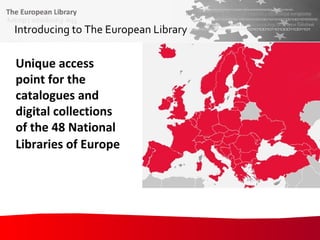
Introducing to The European Library Unique access point for the catalogues and digital collections of the 48 National Libraries of Europe
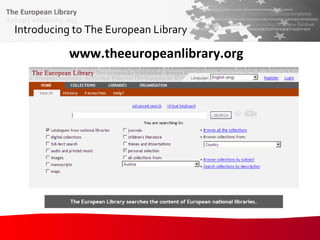
Introducing to The European Library www.theeuropeanlibrary.org
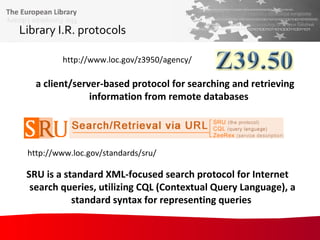
Library I.R. protocols   a client/server-based protocol for searching and retrieving information from remote databases   http://www.loc.gov/z3950/agency/ http://www.loc.gov/standards/sru/ SRU is a standard XML-focused search protocol for Internet search queries, utilizing CQL (Contextual Query Language), a standard syntax for representing queries
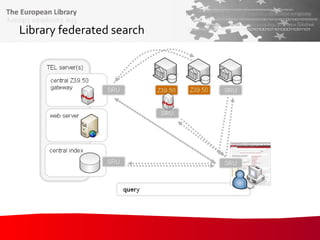
Library federated search
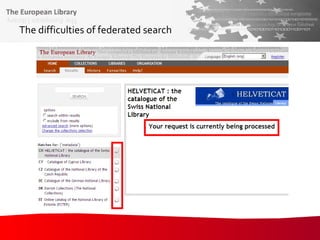
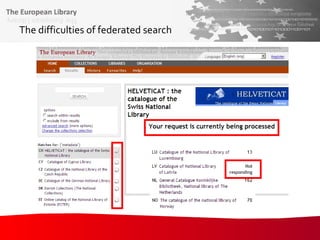
The difficulties of federated search
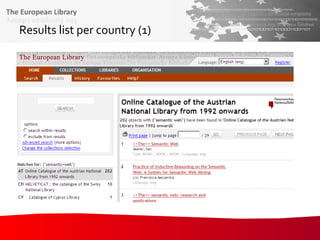
Results list per country (1)
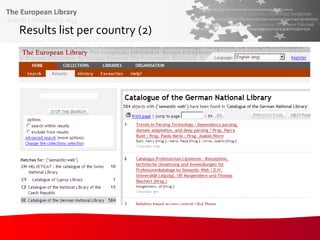
Results list per country (2)
Issues with federated search Speed of return of results not up to current user expectations Search is dependent on individual services outside the library’s control  (‘not responding’) Results are returned independently and therefore difficult to integrate into a single result list Ranking of results is not core functionality of federated search protocols
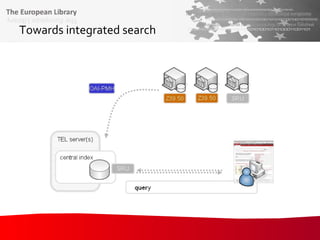
Towards integrated search   The Open Archives Initiative Protocol for Metadata Harvesting (OAI-PMH) is a low-barrier mechanism for repository interoperability.  Data Providers  are repositories that expose structured metadata via OAI-PMH.  Service Providers  then make OAI-PMH service requests to harvest that metadata. OAI-PMH is a set of six verbs or services that are invoked within HTTP.   http://www.openarchives.org/pmh/
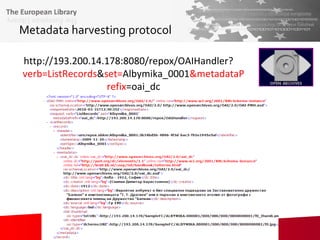
Metadata harvesting protocol   http://193.200.14.178:8080/repox/OAIHandler? verb=ListRecords & set= Albymika_0001 &metadataPrefix =oai_dc
Towards integrated search
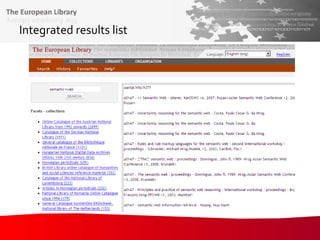
Integrated results list
Integrated results list Metadata is harvested and indexed in advance – no need to rely on real time federated search Availability of search is determined by the library, without needing to rely on remote servers As the metadata is in one place it is easier to present an integrated result list Ranking search results becomes possible ... but  how?
Relevancy ranking in libraries? Users ‘used to good relevancy ranking’, e.g. in web search engines  and can’t understand why  user experience  is generally inferior in libraries Ranking needed for results list which contain large amounts of data  (for libraries) - estimated 180 million records in  The European Library  - but not web-scale Dealing with a diversity of library materials In many different languages see:  Lewandowski (2009)
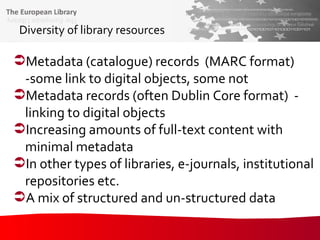
Diversity of library resources Metadata (catalogue) records  (MARC format) -some link to digital objects, some not Metadata records (often Dublin Core format)  - linking to digital objects Increasing amounts of full-text content with minimal metadata In other types of libraries, e-journals, institutional repositories etc. A mix of structured and un-structured data
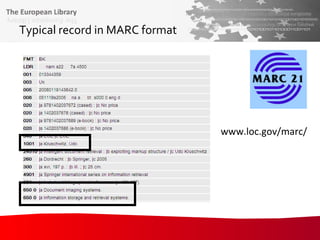
Typical record in MARC format www.loc.gov/marc/
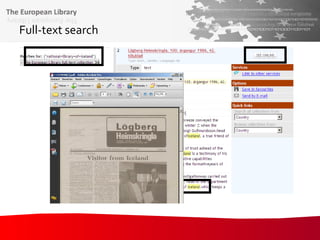
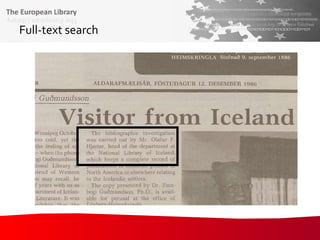
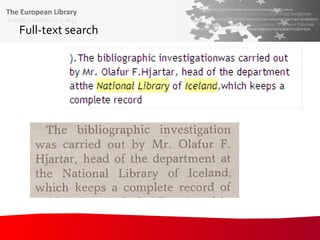
Full-text search www.ifla.org/publications/functional-requirements-for-bibliographic-records
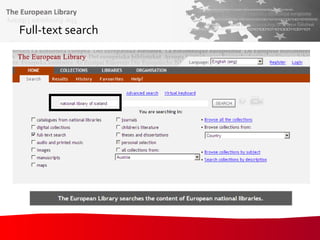
Full-text search
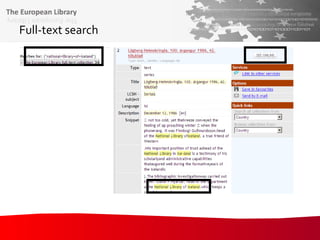
Full-text search
Full-text search
Full-text search
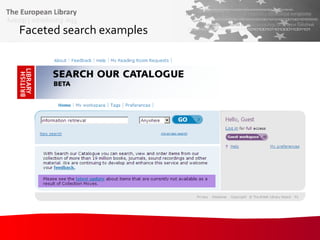
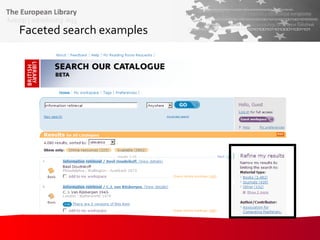
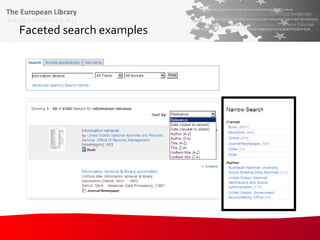
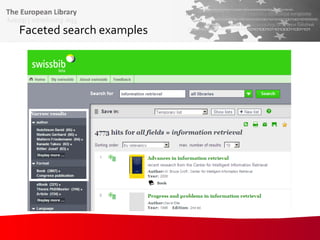
Faceted search examples
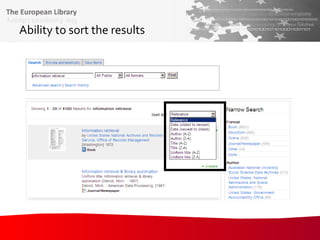
Ability to sort the results
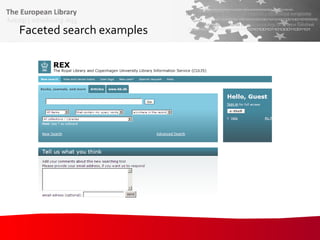
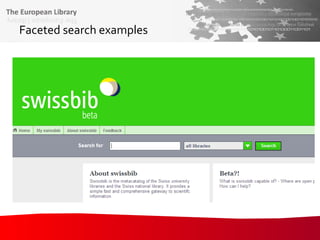
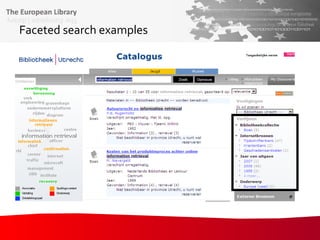
Faceted search examples
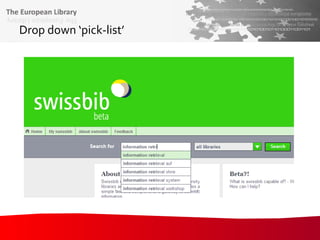
Drop down ‘pick-list’
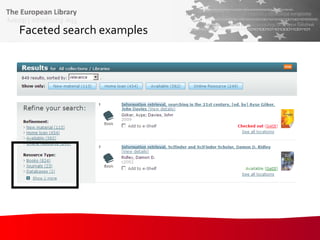
Faceted search examples
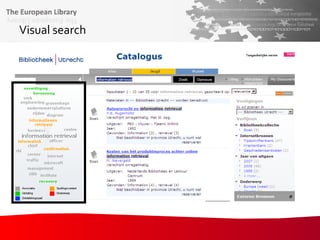
Visual search
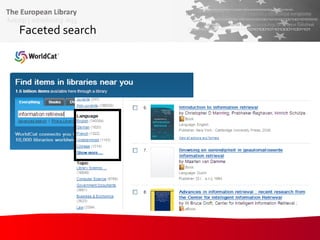
Faceted search
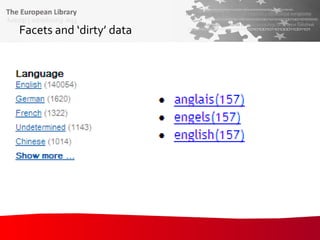
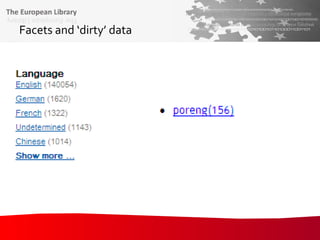
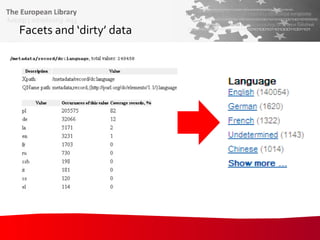
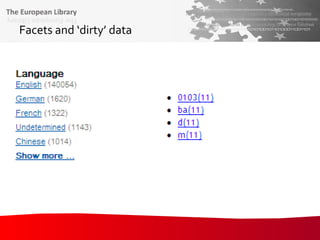
Facets and ‘dirty’ data
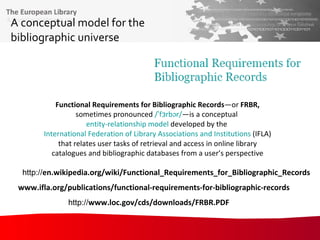
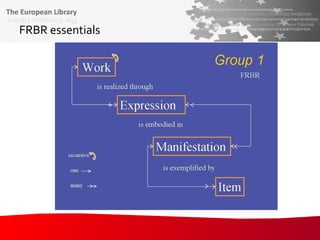
A conceptual model for the  bibliographic universe www.ifla.org/publications/functional-requirements-for-bibliographic-records http:// www.loc.gov/cds/downloads/FRBR.PDF Functional Requirements for Bibliographic Records —or  FRBR,  sometimes pronounced  /ˈfɜrbər/ —is a conceptual  entity-relationship model  developed by the  International Federation of Library Associations and Institutions  (IFLA) that relates user tasks of retrieval and access in online library catalogues and bibliographic databases from a user’s perspective http:// en.wikipedia.org/wiki/Functional_Requirements_for_Bibliographic_Records
FRBR essentials
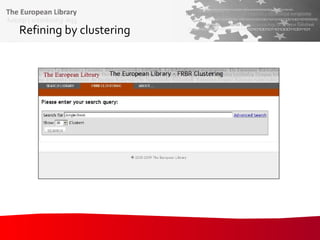
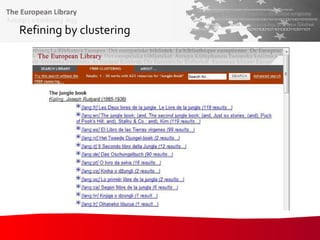
Refining by clustering
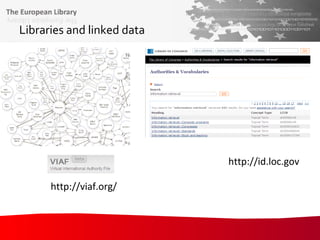
Libraries and linked data http://id.loc.gov http://viaf.org/
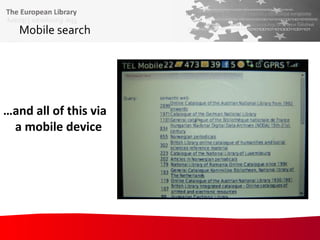
Mobile search … and all of this via a mobile device
References Lewandowski, D (2009) Ranking library materials  (Pre-print version) www.bui.haw-hamburg.de/fileadmin/user_upload/lewandowski/doc/LHT2009_preprint.pdf Karen G. Schneider (2006) How OPACS suck, ALA TechSource How OPACs Suck, Part 1: Relevance Rank (Or the Lack of It) www.alatechsource.org/blog/2006/03/how-opacs-suck-part-1-relevance-rank-or-the-lack-of-it.html How OPACs Suck, Part 2: The Checklist of Shame www.alatechsource.org/blog/2006/04/how-opacs-suck-part-2-the-checklist-of-shame.html  How OPACs Suck, Part 3: The Big Picture www.alatechsource.org/blog/2006/05/how-opacs-suck-part-3-the-big-picture.html
Thank you! Sally Chambers  The European Library [email_address] http://twitter.com/schambers3

Rethinking the library catalogue: making search work for the library user

  • 1.
    Rethinking the librarycatalogue: making search work for the library user Sally Chambers The European Library [email_address] http://twitter.com/schambers3
  • 2.
    Challenges for librarysearch To survive the future, a library catalogue has to offer the same user experience as a library user’s favourite search engine How can libraries harness web technologies to provide a search engine like experience for their users? I hope to outline the challenges faced by librarians to transform the traditional library catalogue into a search-engine like user experience
  • 3.
    Introducing to TheEuropean Library Unique access point for the catalogues and digital collections of the 48 National Libraries of Europe
  • 4.
    Introducing to TheEuropean Library www.theeuropeanlibrary.org
  • 5.
    Library I.R. protocols a client/server-based protocol for searching and retrieving information from remote databases http://www.loc.gov/z3950/agency/ http://www.loc.gov/standards/sru/ SRU is a standard XML-focused search protocol for Internet search queries, utilizing CQL (Contextual Query Language), a standard syntax for representing queries
  • 6.
  • 7.
    The difficulties offederated search
  • 8.
    The difficulties offederated search
  • 9.
    Results list percountry (1)
  • 10.
    Results list percountry (2)
  • 11.
    Issues with federatedsearch Speed of return of results not up to current user expectations Search is dependent on individual services outside the library’s control (‘not responding’) Results are returned independently and therefore difficult to integrate into a single result list Ranking of results is not core functionality of federated search protocols
  • 12.
    Towards integrated search The Open Archives Initiative Protocol for Metadata Harvesting (OAI-PMH) is a low-barrier mechanism for repository interoperability. Data Providers are repositories that expose structured metadata via OAI-PMH. Service Providers then make OAI-PMH service requests to harvest that metadata. OAI-PMH is a set of six verbs or services that are invoked within HTTP. http://www.openarchives.org/pmh/
  • 13.
    Metadata harvesting protocol http://193.200.14.178:8080/repox/OAIHandler? verb=ListRecords & set= Albymika_0001 &metadataPrefix =oai_dc
  • 14.
  • 15.
  • 16.
    Integrated results listMetadata is harvested and indexed in advance – no need to rely on real time federated search Availability of search is determined by the library, without needing to rely on remote servers As the metadata is in one place it is easier to present an integrated result list Ranking search results becomes possible ... but how?
  • 17.
    Relevancy ranking inlibraries? Users ‘used to good relevancy ranking’, e.g. in web search engines and can’t understand why user experience is generally inferior in libraries Ranking needed for results list which contain large amounts of data (for libraries) - estimated 180 million records in The European Library - but not web-scale Dealing with a diversity of library materials In many different languages see: Lewandowski (2009)
  • 18.
    Diversity of libraryresources Metadata (catalogue) records (MARC format) -some link to digital objects, some not Metadata records (often Dublin Core format) - linking to digital objects Increasing amounts of full-text content with minimal metadata In other types of libraries, e-journals, institutional repositories etc. A mix of structured and un-structured data
  • 19.
    Typical record inMARC format www.loc.gov/marc/
  • 20.
  • 21.
  • 22.
  • 23.
  • 24.
  • 25.
  • 26.
  • 27.
  • 28.
  • 29.
  • 30.
  • 31.
    Ability to sortthe results
  • 32.
  • 33.
  • 34.
  • 35.
  • 36.
  • 37.
  • 38.
  • 39.
  • 40.
  • 41.
  • 42.
    A conceptual modelfor the bibliographic universe www.ifla.org/publications/functional-requirements-for-bibliographic-records http:// www.loc.gov/cds/downloads/FRBR.PDF Functional Requirements for Bibliographic Records —or FRBR, sometimes pronounced /ˈfɜrbər/ —is a conceptual entity-relationship model developed by the International Federation of Library Associations and Institutions (IFLA) that relates user tasks of retrieval and access in online library catalogues and bibliographic databases from a user’s perspective http:// en.wikipedia.org/wiki/Functional_Requirements_for_Bibliographic_Records
  • 43.
  • 44.
  • 45.
  • 46.
    Libraries and linkeddata http://id.loc.gov http://viaf.org/
  • 47.
    Mobile search …and all of this via a mobile device
  • 48.
    References Lewandowski, D(2009) Ranking library materials (Pre-print version) www.bui.haw-hamburg.de/fileadmin/user_upload/lewandowski/doc/LHT2009_preprint.pdf Karen G. Schneider (2006) How OPACS suck, ALA TechSource How OPACs Suck, Part 1: Relevance Rank (Or the Lack of It) www.alatechsource.org/blog/2006/03/how-opacs-suck-part-1-relevance-rank-or-the-lack-of-it.html How OPACs Suck, Part 2: The Checklist of Shame www.alatechsource.org/blog/2006/04/how-opacs-suck-part-2-the-checklist-of-shame.html How OPACs Suck, Part 3: The Big Picture www.alatechsource.org/blog/2006/05/how-opacs-suck-part-3-the-big-picture.html
  • 49.
    Thank you! SallyChambers The European Library [email_address] http://twitter.com/schambers3