TECHNICAL COMMUNICATION


          -Ishank Ranjan
           H.C.S.T, Mathura(U.P.)
Introduction
 The exchange of information, ideas and knowledge
  between sender and receiver through an accepted code
  of symbols.
 Two way process
 The term ‘communication’, derived from a Latin term
  ‘communicare’.
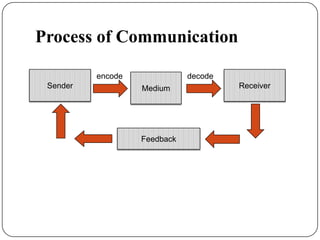
 Sender-Encoding-Mediums-Decoding-Receiver-
  Feedback
Meaning of Communication
 Language employs a combination of words to
  communicate ideas in a meaningful way.
 By changing the word order in a sentence, you can
  change it’s meaning, and make it meaningless.

 E.g.: I eat rice only.
 I only eat rice.
Process of Communication

          encode              decode
 Sender            Medium              Receiver


                   Feedback
What is Technical Communication?

     Applied communication designed to accomplish specific
     tasks or to help solve problems, such as:
      Informing users about an update in computer software
      Instructing assembly line workers to produce a new
       product
      Warning customers about unsafe ways to operate a
       machine
      Instructing buyers how to assemble a bicycle


5
What is Technical Communication?
     Communication that conveys complex information in an
     easy-to-understand manner, often to inexperienced
     users, on topics such as:
         Repairing a copy machine
         Selecting a home computer
         Operating a digital camera
         Creating handmade ceramics
         Assembling a kite


6
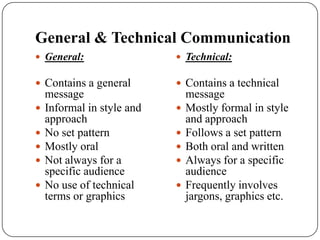
General & Technical Communication
 General:                   Technical:

 Contains a general         Contains a technical
    message                     message
   Informal in style and      Mostly formal in style
    approach                    and approach
   No set pattern             Follows a set pattern
   Mostly oral                Both oral and written
   Not always for a           Always for a specific
    specific audience           audience
   No use of technical        Frequently involves
    terms or graphics           jargons, graphics etc.
The Five C’s of Technical Communication

  Clear

  Correct

  Concise

  Consistent

  Comprehensive
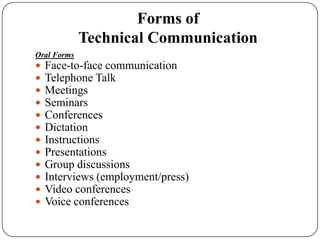
Forms of
             Technical Communication
Oral Forms
   Face-to-face communication
   Telephone Talk
   Meetings
   Seminars
   Conferences
   Dictation
   Instructions
   Presentations
   Group discussions
   Interviews (employment/press)
   Video conferences
   Voice conferences
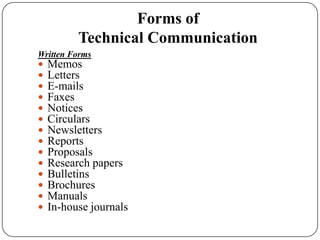
Forms of
          Technical Communication
Written Forms
   Memos
   Letters
   E-mails
   Faxes
   Notices
   Circulars
   Newsletters
   Reports
   Proposals
   Research papers
   Bulletins
   Brochures
   Manuals
   In-house journals
Levels of Communication
 Extra personal
 Intra personal
 Inter personal
 Organizational (-internal operational-external
  operational-personal)
 Mass (large reach-impersonal-presence of a
  gatekeeper)
Conclusion
 Your communication skills can make a difference
 between being hired and fired.

 Will will find a way….


 Practice makes a man perfect…


                           *****
Thank you…

Technical Communication

  • 1.
    TECHNICAL COMMUNICATION -Ishank Ranjan H.C.S.T, Mathura(U.P.)
  • 2.
    Introduction  The exchangeof information, ideas and knowledge between sender and receiver through an accepted code of symbols.  Two way process  The term ‘communication’, derived from a Latin term ‘communicare’.  Sender-Encoding-Mediums-Decoding-Receiver- Feedback
  • 3.
    Meaning of Communication Language employs a combination of words to communicate ideas in a meaningful way.  By changing the word order in a sentence, you can change it’s meaning, and make it meaningless.  E.g.: I eat rice only.  I only eat rice.
  • 4.
    Process of Communication encode decode Sender Medium Receiver Feedback
  • 5.
    What is TechnicalCommunication?  Applied communication designed to accomplish specific tasks or to help solve problems, such as:  Informing users about an update in computer software  Instructing assembly line workers to produce a new product  Warning customers about unsafe ways to operate a machine  Instructing buyers how to assemble a bicycle 5
  • 6.
    What is TechnicalCommunication?  Communication that conveys complex information in an easy-to-understand manner, often to inexperienced users, on topics such as:  Repairing a copy machine  Selecting a home computer  Operating a digital camera  Creating handmade ceramics  Assembling a kite 6
  • 7.
    General & TechnicalCommunication  General:  Technical:  Contains a general  Contains a technical message message  Informal in style and  Mostly formal in style approach and approach  No set pattern  Follows a set pattern  Mostly oral  Both oral and written  Not always for a  Always for a specific specific audience audience  No use of technical  Frequently involves terms or graphics jargons, graphics etc.
  • 8.
    The Five C’sof Technical Communication  Clear  Correct  Concise  Consistent  Comprehensive
  • 9.
    Forms of Technical Communication Oral Forms  Face-to-face communication  Telephone Talk  Meetings  Seminars  Conferences  Dictation  Instructions  Presentations  Group discussions  Interviews (employment/press)  Video conferences  Voice conferences
  • 10.
    Forms of Technical Communication Written Forms  Memos  Letters  E-mails  Faxes  Notices  Circulars  Newsletters  Reports  Proposals  Research papers  Bulletins  Brochures  Manuals  In-house journals
  • 11.
    Levels of Communication Extra personal  Intra personal  Inter personal  Organizational (-internal operational-external operational-personal)  Mass (large reach-impersonal-presence of a gatekeeper)
  • 12.
    Conclusion  Your communicationskills can make a difference between being hired and fired.  Will will find a way….  Practice makes a man perfect… *****
  • 13.