Reimagining global
         democracy


                        Joe Mitchell
               MA Global Governance research paper
  Balsillie School of International Affairs, University of Waterloo
a quick
summary in three
slides...
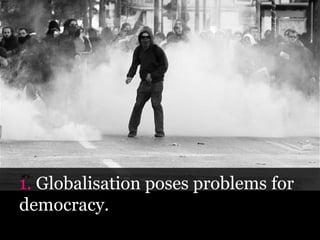
Globalisation poses problems for
democracy.
The World Parliament response to
this would struggle to be effective or
legitimate.
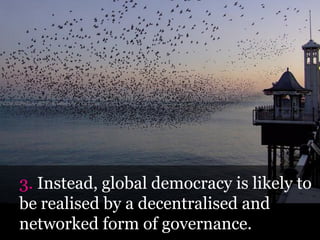
Instead, global democracy is likely to
be realised by a decentralised and
networked form of governance.
A thirty-second
history of global
democracy
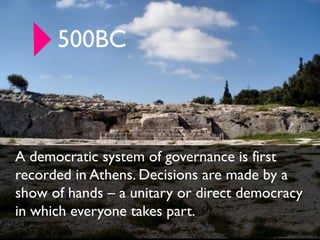
500BC


A democratic system of governance is first
recorded in Athens. Decisions are made by a
show of hands – a unitary or direct democracy
in which everyone takes part.
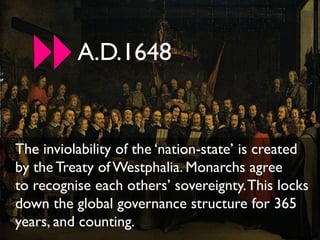
A.D.1648


The inviolability of the ‘nation-state’ is created
by the Treaty of Westphalia. Monarchs agree
to recognise each others’ sovereignty. This locks
down the global governance structure for 365
years, and counting.
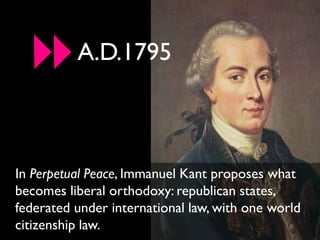
A.D.1795


In Perpetual Peace, Immanuel Kant proposes what
becomes liberal orthodoxy: republican states,
federated under international law, with one world
citizenship law.
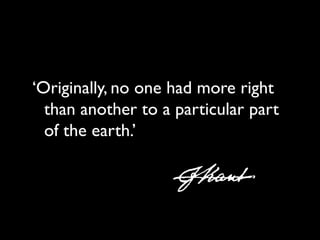
‘Originally, no one had more right
  than another to a particular part
  of the earth.’
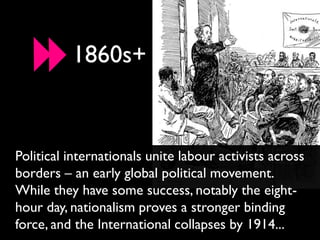
1860s+


Political internationals unite labour activists across
borders – an early global political movement.
While they have some success, notably the eight-
hour day, nationalism proves a stronger binding
force, and the International collapses by 1914...
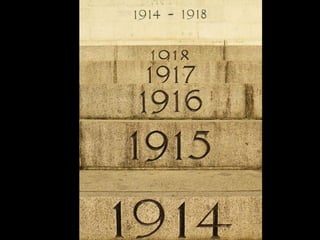
1918.
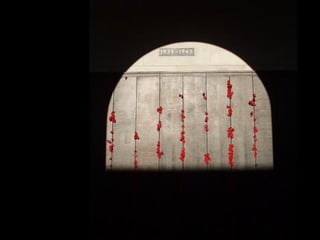
    1945.

The world wars are followed by grand
changes to the international governance
structure - always in the form of new
institutions.
1945


‘We the peoples of the United Nations...’
   [not nations]
         Preamble to the United Nations Charter
Postwar period
The objective of world peace drives
idealistic thinkers to consider world
federalism. In the US, a ‘Sense of Congress’
motion is passed for ‘strengthening the UN
and seeking its development into a world
federation’.
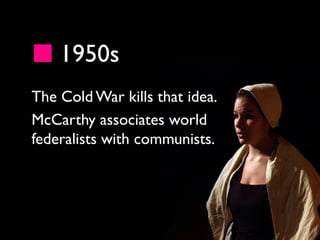
1950s
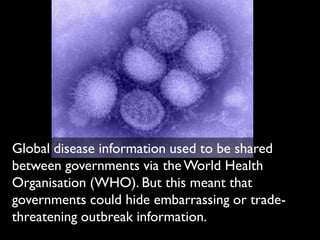
The Cold War kills that idea.
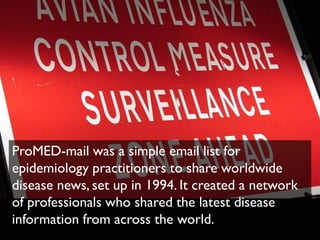
McCarthy associates world
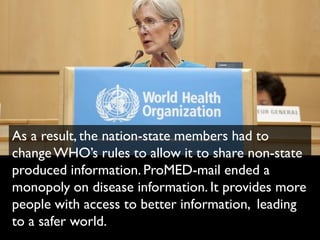
federalists with communists.
60s, 70s, 80s
So world federalism fails. But globalisation takes
off: neoliberal economic ideas and powerful
multinationals open up the world to market
forces, encouraged by international financial
institutions.
60s, 70s, 80s
In three decades, the world sees the
invention of satellite TV, Eurobonds, oil
crises, special economic zones, booms in jet
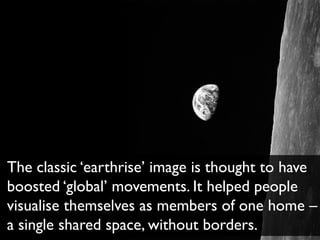
flights, international finance, shipping, and
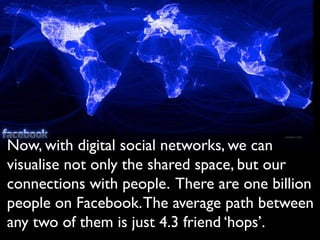
growing cultural hegemony...
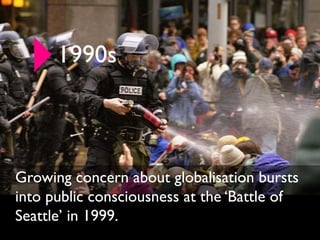
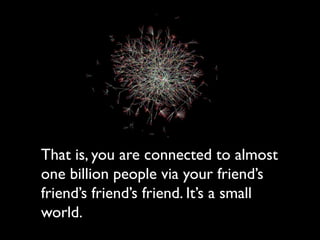
1990s


Growing concern about globalisation bursts
into public consciousness at the ‘Battle of
Seattle’ in 1999.
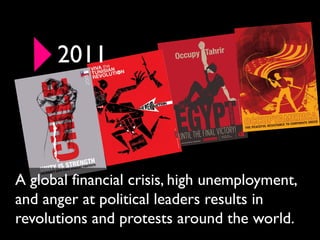
2011


A global financial crisis, high unemployment,
and anger at political leaders results in
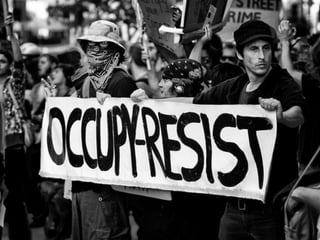
revolutions and protests around the world.
What is the
problem?
In the 21st century, policies must be sought to
deal with climate change, economic shocks,
pandemics, terrorism, financial risks, trade
barriers, transnational crime (human trafficking,
drug trafficking, money laundering), poverty and
inequality.

The success and democratic nature of those
policies can no longer be guaranteed by national
institutions. Too many variables lie outside the
scope of the nation state.
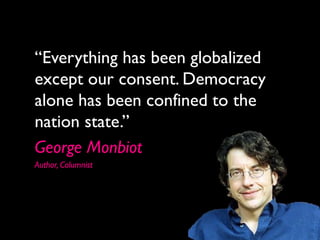
“Everything has been globalized
except our consent. Democracy
alone has been confined to the
nation state.”
George Monbiot
Author, Columnist
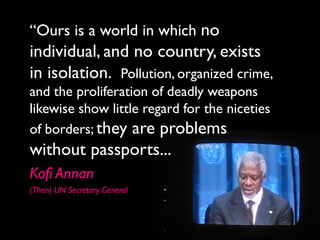
“Ours is a world in which no
individual, and no country, exists
in isolation. Pollution, organized crime,
and the proliferation of deadly weapons
likewise show little regard for the niceties
of borders; they are problems
without passports...
Kofi Annan
(Then) UN Secretary General
“designing effective and
legitimate institutions is [the]
crucial problem of political
design for the twenty-first
century”
 Joe Nye and Bob Keohane
             Professors at Harvard and Princeton
What is the
answer?
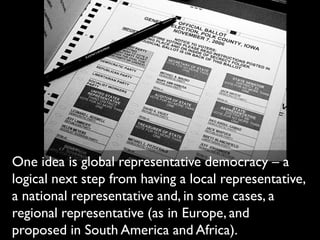
One idea is global representative democracy – a
logical next step from having a local representative,
a national representative and, in some cases, a
regional representative (as in Europe, and
proposed in South America and Africa).
There’s already a Campaign for
a UN Parliamentary
Assembly – and the idea has
support from the European and
African Parliaments.
But could a system of
representatives really be
democratic for 7bn
people?
1. How would such an assembly be
elected? A location-based constituency,
repeating the national system? Party lists?
Global political parties?
2.    How could such a parliament remain close
to the people? How could it deal with the
complexity of global policy? How could it
possibly represent all views?
3.   Is a hierarchical structure – in which
votes flow upwards and decisions flow
downwards - best for global democracy?
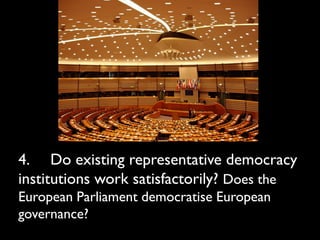
4. Do existing representative democracy
institutions work satisfactorily? Does the
European Parliament democratise European
governance?
Advocates of global democracy
should abandon domestic
analogies. Instead, they should
imagine a ‘non-centralised, non-
territorial, non-exclusive
system’ of governance.
          Heikki Patomaki (adapted)
                 Professor of World Politics, Helsinki
What delivers such a
‘non-centralised,
non-territorial,
non-exclusive system’
of governance?

Digital democracy.
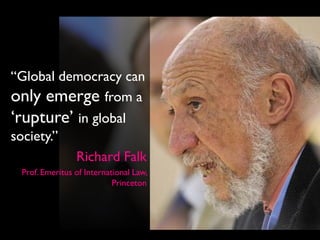
“Global democracy can
only emerge from a
‘rupture’ in global
society.”
          Richard Falk
 Prof. Emeritus of International Law,
                           Princeton
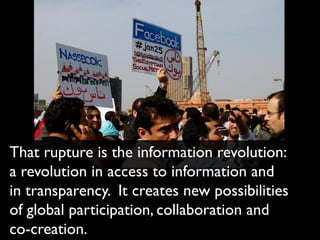
That rupture is the information revolution:
a revolution in access to information and
in transparency. It creates new possibilities
of global participation, collaboration and
co-creation.
Global digital democracy doesn’t need a top
down institution. Instead, it benefits from a
flexible distribution of power.
It’s global peer-to-peer governance.
What do we
talk about
when we
talk about
democracy?
Three foundations:

1.   Free and open discussion and deliberation
2.   Free and open participation in political
     processes
3.   Political community – the ‘demos’

The Internet creates these at global level.
1. Internet as open
global deliberation
space
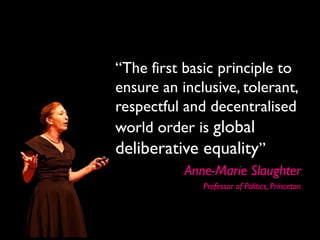
“The first basic principle to
ensure an inclusive, tolerant,
respectful and decentralised
world order is global
deliberative equality”
           Anne-Marie Slaughter
              Professor of Politics, Princeton
“Democracy is about communication as
well as voting - about social learning as
well as decision making. It is the
communicative aspects that for the
moment can most straightforwardly be
pursued in the international system.”
                                   John Dryzek
                          Professor of Social Theory and Political Theory,
                                           Australian National University
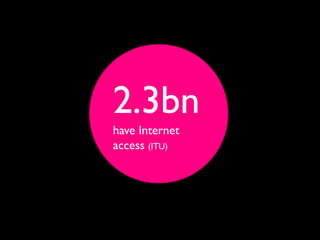
2.3bn
have Internet
access (ITU)
3G will cover 85% of
the world’s population
by 2017
(Ericsson)
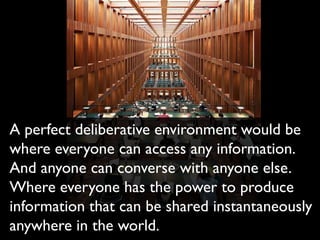
A perfect deliberative environment would be
where everyone can access any information.
And anyone can converse with anyone else.
Where everyone has the power to produce
information that can be shared instantaneously
anywhere in the world.
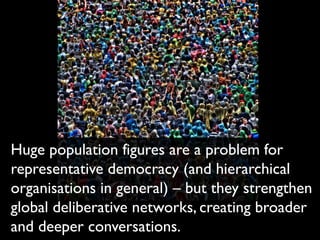
Huge population figures are a problem for
representative democracy (and hierarchical
organisations in general) – but they strengthen
global deliberative networks, creating broader
and deeper conversations.
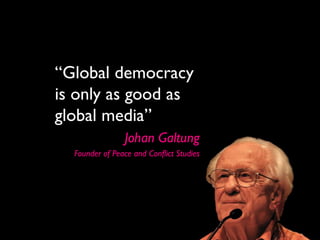
“Global democracy
is only as good as
global media”
                Johan Galtung
  Founder of Peace and Conflict Studies
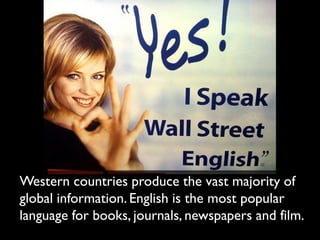
Western countries produce the vast majority of
global information. English is the most popular
language for books, journals, newspapers and film.
As the Internet opens publishing,
this is changing. Global information
production is becoming broader.
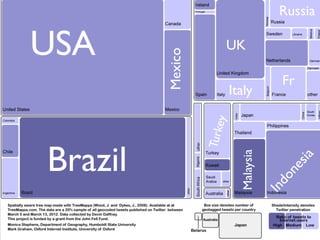
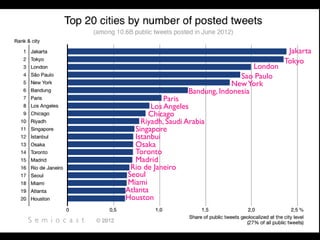
The microblogging platform
Twitter shows examples of this.

The next slide shows shows the
location of tweets during one week
of 2012.
Russia

USA               UK


         Mexico
                               Fr
                  Italy


Brazil

                    Malaysia
Jakarta
                                               Tokyo
                                      London
                                  Sao Paulo
                                New York
                   Bandung, Indonesia
            Paris
        Los Angeles
       Chicago
     Riyadh, Saudi Arabia
   Singapore
   Istanbui
   Osaka
   Toronto
   Madrid
 Rio de Janeiro
Seoul
Miami
Atlanta
Houston
In their idealised* form, microblogs
spread information meritocratically
(with varying understandings of
merit).

Everyone has the same format to
use, the same ability to mention
others or repost others’ posts.

                    *problems discussed later
2. Internet as open
global participative
space
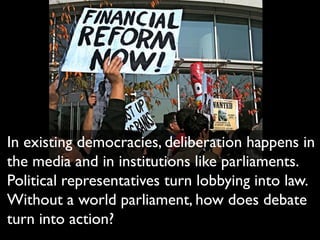
In existing democracies, deliberation happens in
the media and in institutions like parliaments.
Political representatives turn lobbying into law.
Without a world parliament, how does debate
turn into action?
With no global government,
global democracy has to be
truly participative: people
must collaborate digitally to
deliver the projects they
want to see.

Three examples:
ProMED-mail
Global disease information used to be shared
between governments via the World Health
Organisation (WHO). But this meant that
governments could hide embarrassing or trade-
threatening outbreak information.
ProMED-mail was a simple email list for
epidemiology practitioners to share worldwide
disease news, set up in 1994. It created a network
of professionals who shared the latest disease
information from across the world.
As a result, the nation-state members had to
change WHO’s rules to allow it to share non-state
produced information. ProMED-mail ended a
monopoly on disease information. It provides more
people with access to better information, leading
to a safer world.
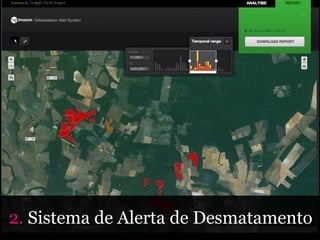
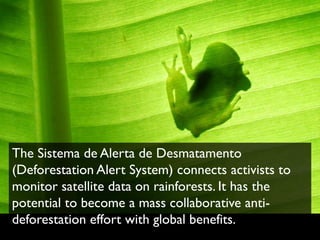
Sistema de Alerta de Desmatamento
The Sistema de Alerta de Desmatamento
(Deforestation Alert System) connects activists to
monitor satellite data on rainforests. It has the
potential to become a mass collaborative anti-
deforestation effort with global benefits.
The project was created by Imazon, a Brazilian
NGO, now supported by Google. As Google’s lead
mapper said: “a collaborative monitoring
community, powered by the internet, [has] never
been possible before.”
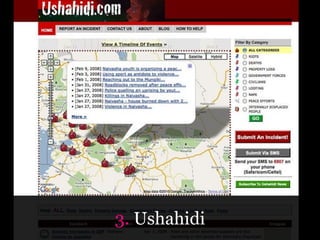
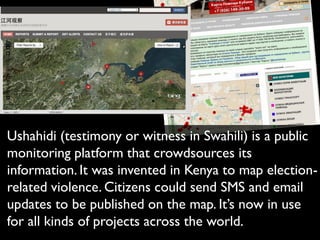
Ushahidi
Ushahidi (testimony or witness in Swahili) is a public
monitoring platform that crowdsources its
information. It was invented in Kenya to map election-
related violence. Citizens could send SMS and email
updates to be published on the map. It’s now in use
for all kinds of projects across the world.
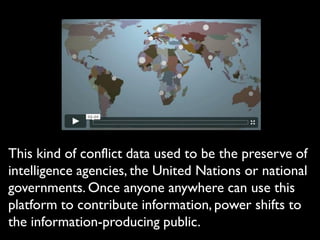
This kind of conflict data used to be the preserve of
intelligence agencies, the United Nations or national
governments. Once anyone anywhere can use this
platform to contribute information, power shifts to
the information-producing public.
All three examples are really about participative
creation of knowledge. If knowledge is power, this
matters. But what if you wanted to act on that
knowledge? How does digital democracy result in
participative solutions or service delivery?

For example, the activists monitoring
deforestation can’t actually do anything about its
increase, right? Because digital collaboration
doesn’t create enforcement mechanisms...
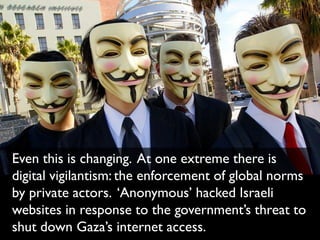
Even this is changing. At one extreme there is
digital vigilantism: the enforcement of global norms
by private actors. ‘Anonymous’ hacked Israeli
websites in response to the government’s threat to
shut down Gaza’s internet access.
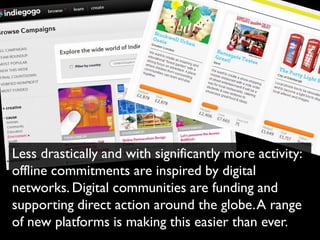
Less drastically and with significantly more activity:
offline commitments are inspired by digital
networks. Digital communities are funding and
supporting direct action around the globe. A range
of new platforms is making this easier than ever.
3. Internet as
creator of global
democratic
community:
The classic ‘earthrise’ image is thought to have
boosted ‘global’ movements. It helped people
visualise themselves as members of one home –
a single shared space, without borders.
Now, with digital social networks, we can
visualise not only the shared space, but our
connections with people. There are one billion
people on Facebook. The average path between
any two of them is just 4.3 friend ‘hops’.
That is, you are connected to almost
one billion people via your friend’s
friend’s friend’s friend. It’s a small
world.
Nice examples. But
isn’t this far too
utopian?
Take three problems:
• existing power structures,
• tyrannies of those who
  show up,
• a global digital divide.
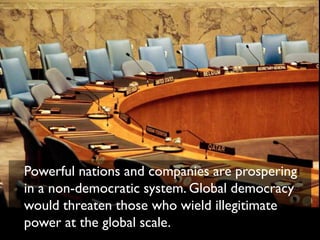
Powerful nations and companies are prospering
in a non-democratic system. Global democracy
would threaten those who wield illegitimate
power at the global scale.
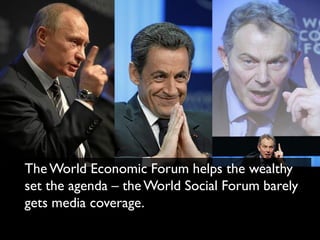
The World Economic Forum helps the wealthy
set the agenda – the World Social Forum barely
gets media coverage.
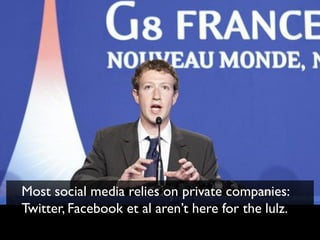
Most social media relies on private companies:
Twitter, Facebook et al aren’t here for the lulz.
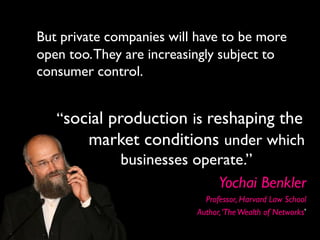
But private companies will have to be more
open too. They are increasingly subject to
consumer control.


   “social production is reshaping the
       market conditions under which
             businesses operate.”
                           Yochai Benkler
                            Professor, Harvard Law School
                          Author, ‘The Wealth of Networks’
Digital democracy might suffer from a tyranny of
those who show up. Who really has the time
and energy for this stuff? Is Wikipedia a
democratic information platform when only
0.13% write it?
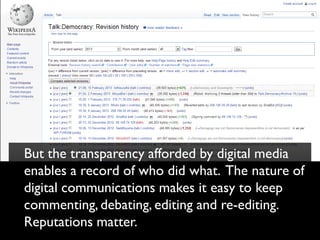
But the transparency afforded by digital media
enables a record of who did what. The nature of
digital communications makes it easy to keep
commenting, debating, editing and re-editing.
Reputations matter.
Two global digital divides:

        1. poverty
      2. censorship
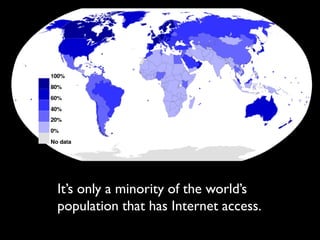
It’s only a minority of the world’s
population that has Internet access.
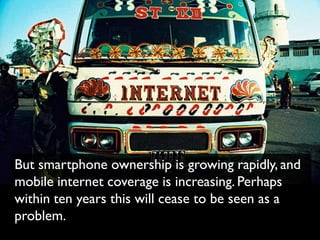
But smartphone ownership is growing rapidly, and
mobile internet coverage is increasing. Perhaps
within ten years this will cease to be seen as a
problem.
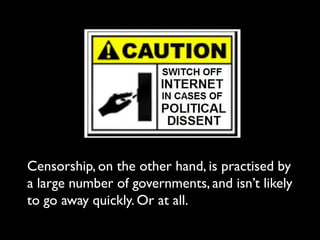
Censorship, on the other hand, is practised by
a large number of governments, and isn’t likely
to go away quickly. Or at all.
But smart users can get around censorship using
proxy servers. And ‘netizens’ will develop simple
acts of ‘everyday resistance’ – vocabularies of
dissent, codewords and underground discussions.
There have been, and always will be, ways to
escape censors.
Ultimately, it’s the numbers. China might call in the
army to monitor microblogs, but they’ll still never
control hundreds of millions of internet users. In
the long run, the people win.
So be optimistic.
And do more
research...
Do notions of solidarity or allegiance change in
 the digital space? Do digital social networks
   reduce a sense of otherness and boost
             cosmopolitan identity?
Do notions of solidarity or allegiance change in
 the digital space? Do digital social networks
   reduce a sense of otherness and boost
             cosmopolitan identity?

How are all languages and cultures engaged in a
 global deliberation and participation space?
Do notions of solidarity or allegiance change in
 the digital space? Do digital social networks
   reduce a sense of otherness and boost
             cosmopolitan identity?

How are all languages and cultures engaged in a
 global deliberation and participation space?

Can open internet access, literacy and a robust
   digital infrastructure be ensured for all?
Think about how
far we’ve come.
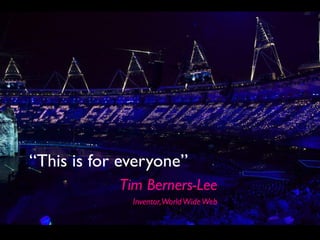
“This is for everyone”
            Tim Berners-Lee
              Inventor,World Wide Web
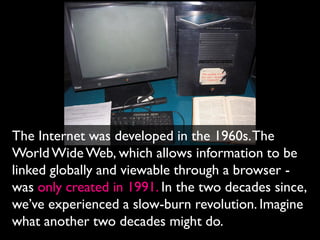
The Internet was developed in the 1960s. The
World Wide Web, which allows information to be
linked globally and viewable through a browser -
was only created in 1991. In the two decades since,
we’ve experienced a slow-burn revolution. Imagine
what another two decades might do.
Where do we go
next?
Thanks for reading.

Want references? Fewer pictures, more
 words? Something missing? Go here.
Earth sunrise/Moon earthrise: NASA     Tahrir Facebook: rouelshimi           Imazon screenshot: Google
Protestor: murplejane                  All-seeing eye: cobalt123             Frog silouhette: ggalice
UNPA emblem: UNPA                      Notepad: melstampz                    Amazon rainforest: CIFUR
Starlings: Elsie Esq.                  Chain link fence: Thomas Hawk         Network: sjcockell
Stopwatch: wwarby                      Euro Parliament: Xaf                  Security Council: riacale
Athens/Pnyz: : qwqchris                Mathematical shape: Melisande         World Economic Forum: WEF
Westphalia: Gerard Ter Borch           Napster: pasa47                       Yochai Benkler: arcticpenguin
Kant portrait: v Wikipedia             A-M Slaughter: personaldemocracy      LazyCat: Nicola Albertini
The Crucible: drurydrama               H1N1 Virus: AJCann (CDC)              Internet World Map: Jeff Ogden
1914-1918: yeowatzup                   Avian Flu Sign: Incessant Flux        Internet truck: ALEMUSH
1939-1945: Kaptain Kobold              WHO speaker: US Missn Gva             Internet switch: Mike Licht
UN Charter: UN Photo                   Facebook world; Facebook via dullhunk
1999 Battle in Seattle: Steve Kaiser   Love(Heart)Peace: israellovesiran.com Number on wall: Pink Sherbert
Posters: Freestylee                    Library: 96dpi                        Incoming tide: Tim Donnelly
OccupyResist: Devon Shaw               Crowd: Alex Kess                      Olympic Stadium: Nick Webb
George Monbiot: v Wikipedia            Lobby: SEIU International             CERN NeXT: coolcaesar
Annan TV: Dark Inertia                 Johan Galtung: Manipulating Light
Joe Nye: dsearls                       Wall St English: futureshape
Richard Falk: UN Geneva

Global digital democracy

  • 1.
    Reimagining global democracy Joe Mitchell MA Global Governance research paper Balsillie School of International Affairs, University of Waterloo
  • 2.
    a quick summary inthree slides...
  • 3.
  • 4.
    The World Parliamentresponse to this would struggle to be effective or legitimate.
  • 5.
    Instead, global democracyis likely to be realised by a decentralised and networked form of governance.
  • 6.
  • 7.
    500BC A democratic systemof governance is first recorded in Athens. Decisions are made by a show of hands – a unitary or direct democracy in which everyone takes part.
  • 8.
    A.D.1648 The inviolability ofthe ‘nation-state’ is created by the Treaty of Westphalia. Monarchs agree to recognise each others’ sovereignty. This locks down the global governance structure for 365 years, and counting.
  • 9.
    A.D.1795 In Perpetual Peace,Immanuel Kant proposes what becomes liberal orthodoxy: republican states, federated under international law, with one world citizenship law.
  • 10.
    ‘Originally, no onehad more right than another to a particular part of the earth.’
  • 11.
    1860s+ Political internationals unitelabour activists across borders – an early global political movement. While they have some success, notably the eight- hour day, nationalism proves a stronger binding force, and the International collapses by 1914...
  • 14.
    1918. 1945. The world wars are followed by grand changes to the international governance structure - always in the form of new institutions.
  • 15.
    1945 ‘We the peoplesof the United Nations...’ [not nations] Preamble to the United Nations Charter
  • 16.
    Postwar period The objectiveof world peace drives idealistic thinkers to consider world federalism. In the US, a ‘Sense of Congress’ motion is passed for ‘strengthening the UN and seeking its development into a world federation’.
  • 17.
    1950s The Cold Warkills that idea. McCarthy associates world federalists with communists.
  • 18.
    60s, 70s, 80s Soworld federalism fails. But globalisation takes off: neoliberal economic ideas and powerful multinationals open up the world to market forces, encouraged by international financial institutions.
  • 19.
    60s, 70s, 80s Inthree decades, the world sees the invention of satellite TV, Eurobonds, oil crises, special economic zones, booms in jet flights, international finance, shipping, and growing cultural hegemony...
  • 20.
    1990s Growing concern aboutglobalisation bursts into public consciousness at the ‘Battle of Seattle’ in 1999.
  • 21.
    2011 A global financialcrisis, high unemployment, and anger at political leaders results in revolutions and protests around the world.
  • 22.
  • 23.
    In the 21stcentury, policies must be sought to deal with climate change, economic shocks, pandemics, terrorism, financial risks, trade barriers, transnational crime (human trafficking, drug trafficking, money laundering), poverty and inequality. The success and democratic nature of those policies can no longer be guaranteed by national institutions. Too many variables lie outside the scope of the nation state.
  • 25.
    “Everything has beenglobalized except our consent. Democracy alone has been confined to the nation state.” George Monbiot Author, Columnist
  • 26.
    “Ours is aworld in which no individual, and no country, exists in isolation. Pollution, organized crime, and the proliferation of deadly weapons likewise show little regard for the niceties of borders; they are problems without passports... Kofi Annan (Then) UN Secretary General
  • 27.
    “designing effective and legitimateinstitutions is [the] crucial problem of political design for the twenty-first century” Joe Nye and Bob Keohane Professors at Harvard and Princeton
  • 28.
  • 29.
    One idea isglobal representative democracy – a logical next step from having a local representative, a national representative and, in some cases, a regional representative (as in Europe, and proposed in South America and Africa).
  • 30.
    There’s already aCampaign for a UN Parliamentary Assembly – and the idea has support from the European and African Parliaments.
  • 31.
    But could asystem of representatives really be democratic for 7bn people?
  • 32.
    1. How wouldsuch an assembly be elected? A location-based constituency, repeating the national system? Party lists? Global political parties?
  • 33.
    2. How could such a parliament remain close to the people? How could it deal with the complexity of global policy? How could it possibly represent all views?
  • 34.
    3. Is a hierarchical structure – in which votes flow upwards and decisions flow downwards - best for global democracy?
  • 35.
    4. Do existingrepresentative democracy institutions work satisfactorily? Does the European Parliament democratise European governance?
  • 36.
    Advocates of globaldemocracy should abandon domestic analogies. Instead, they should imagine a ‘non-centralised, non- territorial, non-exclusive system’ of governance. Heikki Patomaki (adapted) Professor of World Politics, Helsinki
  • 37.
    What delivers sucha ‘non-centralised, non-territorial, non-exclusive system’ of governance? Digital democracy.
  • 38.
    “Global democracy can onlyemerge from a ‘rupture’ in global society.” Richard Falk Prof. Emeritus of International Law, Princeton
  • 39.
    That rupture isthe information revolution: a revolution in access to information and in transparency. It creates new possibilities of global participation, collaboration and co-creation.
  • 40.
    Global digital democracydoesn’t need a top down institution. Instead, it benefits from a flexible distribution of power.
  • 41.
  • 42.
    What do we talkabout when we talk about democracy?
  • 43.
    Three foundations: 1. Free and open discussion and deliberation 2. Free and open participation in political processes 3. Political community – the ‘demos’ The Internet creates these at global level.
  • 44.
    1. Internet asopen global deliberation space
  • 45.
    “The first basicprinciple to ensure an inclusive, tolerant, respectful and decentralised world order is global deliberative equality” Anne-Marie Slaughter Professor of Politics, Princeton
  • 46.
    “Democracy is aboutcommunication as well as voting - about social learning as well as decision making. It is the communicative aspects that for the moment can most straightforwardly be pursued in the international system.” John Dryzek Professor of Social Theory and Political Theory, Australian National University
  • 47.
  • 48.
    3G will cover85% of the world’s population by 2017 (Ericsson)
  • 49.
    A perfect deliberativeenvironment would be where everyone can access any information. And anyone can converse with anyone else. Where everyone has the power to produce information that can be shared instantaneously anywhere in the world.
  • 50.
    Huge population figuresare a problem for representative democracy (and hierarchical organisations in general) – but they strengthen global deliberative networks, creating broader and deeper conversations.
  • 51.
    “Global democracy is onlyas good as global media” Johan Galtung Founder of Peace and Conflict Studies
  • 52.
    Western countries producethe vast majority of global information. English is the most popular language for books, journals, newspapers and film.
  • 53.
    As the Internetopens publishing, this is changing. Global information production is becoming broader.
  • 54.
    The microblogging platform Twittershows examples of this. The next slide shows shows the location of tweets during one week of 2012.
  • 55.
    Russia USA UK Mexico Fr Italy Brazil Malaysia
  • 56.
    Jakarta Tokyo London Sao Paulo New York Bandung, Indonesia Paris Los Angeles Chicago Riyadh, Saudi Arabia Singapore Istanbui Osaka Toronto Madrid Rio de Janeiro Seoul Miami Atlanta Houston
  • 57.
    In their idealised*form, microblogs spread information meritocratically (with varying understandings of merit). Everyone has the same format to use, the same ability to mention others or repost others’ posts. *problems discussed later
  • 58.
    2. Internet asopen global participative space
  • 59.
    In existing democracies,deliberation happens in the media and in institutions like parliaments. Political representatives turn lobbying into law. Without a world parliament, how does debate turn into action?
  • 60.
    With no globalgovernment, global democracy has to be truly participative: people must collaborate digitally to deliver the projects they want to see. Three examples:
  • 61.
  • 62.
    Global disease informationused to be shared between governments via the World Health Organisation (WHO). But this meant that governments could hide embarrassing or trade- threatening outbreak information.
  • 63.
    ProMED-mail was asimple email list for epidemiology practitioners to share worldwide disease news, set up in 1994. It created a network of professionals who shared the latest disease information from across the world.
  • 64.
    As a result,the nation-state members had to change WHO’s rules to allow it to share non-state produced information. ProMED-mail ended a monopoly on disease information. It provides more people with access to better information, leading to a safer world.
  • 65.
    Sistema de Alertade Desmatamento
  • 66.
    The Sistema deAlerta de Desmatamento (Deforestation Alert System) connects activists to monitor satellite data on rainforests. It has the potential to become a mass collaborative anti- deforestation effort with global benefits.
  • 67.
    The project wascreated by Imazon, a Brazilian NGO, now supported by Google. As Google’s lead mapper said: “a collaborative monitoring community, powered by the internet, [has] never been possible before.”
  • 68.
  • 69.
    Ushahidi (testimony orwitness in Swahili) is a public monitoring platform that crowdsources its information. It was invented in Kenya to map election- related violence. Citizens could send SMS and email updates to be published on the map. It’s now in use for all kinds of projects across the world.
  • 70.
    This kind ofconflict data used to be the preserve of intelligence agencies, the United Nations or national governments. Once anyone anywhere can use this platform to contribute information, power shifts to the information-producing public.
  • 71.
    All three examplesare really about participative creation of knowledge. If knowledge is power, this matters. But what if you wanted to act on that knowledge? How does digital democracy result in participative solutions or service delivery? For example, the activists monitoring deforestation can’t actually do anything about its increase, right? Because digital collaboration doesn’t create enforcement mechanisms...
  • 72.
    Even this ischanging. At one extreme there is digital vigilantism: the enforcement of global norms by private actors. ‘Anonymous’ hacked Israeli websites in response to the government’s threat to shut down Gaza’s internet access.
  • 73.
    Less drastically andwith significantly more activity: offline commitments are inspired by digital networks. Digital communities are funding and supporting direct action around the globe. A range of new platforms is making this easier than ever.
  • 74.
    3. Internet as creatorof global democratic community:
  • 75.
    The classic ‘earthrise’image is thought to have boosted ‘global’ movements. It helped people visualise themselves as members of one home – a single shared space, without borders.
  • 76.
    Now, with digitalsocial networks, we can visualise not only the shared space, but our connections with people. There are one billion people on Facebook. The average path between any two of them is just 4.3 friend ‘hops’.
  • 77.
    That is, youare connected to almost one billion people via your friend’s friend’s friend’s friend. It’s a small world.
  • 79.
    Nice examples. But isn’tthis far too utopian?
  • 80.
    Take three problems: •existing power structures, • tyrannies of those who show up, • a global digital divide.
  • 82.
    Powerful nations andcompanies are prospering in a non-democratic system. Global democracy would threaten those who wield illegitimate power at the global scale.
  • 83.
    The World EconomicForum helps the wealthy set the agenda – the World Social Forum barely gets media coverage.
  • 84.
    Most social mediarelies on private companies: Twitter, Facebook et al aren’t here for the lulz.
  • 85.
    But private companieswill have to be more open too. They are increasingly subject to consumer control. “social production is reshaping the market conditions under which businesses operate.” Yochai Benkler Professor, Harvard Law School Author, ‘The Wealth of Networks’
  • 87.
    Digital democracy mightsuffer from a tyranny of those who show up. Who really has the time and energy for this stuff? Is Wikipedia a democratic information platform when only 0.13% write it?
  • 88.
    But the transparencyafforded by digital media enables a record of who did what. The nature of digital communications makes it easy to keep commenting, debating, editing and re-editing. Reputations matter.
  • 89.
    Two global digitaldivides: 1. poverty 2. censorship
  • 90.
    It’s only aminority of the world’s population that has Internet access.
  • 91.
    But smartphone ownershipis growing rapidly, and mobile internet coverage is increasing. Perhaps within ten years this will cease to be seen as a problem.
  • 92.
    Censorship, on theother hand, is practised by a large number of governments, and isn’t likely to go away quickly. Or at all.
  • 93.
    But smart userscan get around censorship using proxy servers. And ‘netizens’ will develop simple acts of ‘everyday resistance’ – vocabularies of dissent, codewords and underground discussions. There have been, and always will be, ways to escape censors.
  • 94.
    Ultimately, it’s thenumbers. China might call in the army to monitor microblogs, but they’ll still never control hundreds of millions of internet users. In the long run, the people win.
  • 95.
    So be optimistic. Anddo more research...
  • 96.
    Do notions ofsolidarity or allegiance change in the digital space? Do digital social networks reduce a sense of otherness and boost cosmopolitan identity?
  • 97.
    Do notions ofsolidarity or allegiance change in the digital space? Do digital social networks reduce a sense of otherness and boost cosmopolitan identity? How are all languages and cultures engaged in a global deliberation and participation space?
  • 98.
    Do notions ofsolidarity or allegiance change in the digital space? Do digital social networks reduce a sense of otherness and boost cosmopolitan identity? How are all languages and cultures engaged in a global deliberation and participation space? Can open internet access, literacy and a robust digital infrastructure be ensured for all?
  • 99.
    Think about how farwe’ve come.
  • 100.
    “This is foreveryone” Tim Berners-Lee Inventor,World Wide Web
  • 101.
    The Internet wasdeveloped in the 1960s. The World Wide Web, which allows information to be linked globally and viewable through a browser - was only created in 1991. In the two decades since, we’ve experienced a slow-burn revolution. Imagine what another two decades might do.
  • 102.
    Where do wego next?
  • 103.
    Thanks for reading. Wantreferences? Fewer pictures, more words? Something missing? Go here.
  • 104.
    Earth sunrise/Moon earthrise:NASA Tahrir Facebook: rouelshimi Imazon screenshot: Google Protestor: murplejane All-seeing eye: cobalt123 Frog silouhette: ggalice UNPA emblem: UNPA Notepad: melstampz Amazon rainforest: CIFUR Starlings: Elsie Esq. Chain link fence: Thomas Hawk Network: sjcockell Stopwatch: wwarby Euro Parliament: Xaf Security Council: riacale Athens/Pnyz: : qwqchris Mathematical shape: Melisande World Economic Forum: WEF Westphalia: Gerard Ter Borch Napster: pasa47 Yochai Benkler: arcticpenguin Kant portrait: v Wikipedia A-M Slaughter: personaldemocracy LazyCat: Nicola Albertini The Crucible: drurydrama H1N1 Virus: AJCann (CDC) Internet World Map: Jeff Ogden 1914-1918: yeowatzup Avian Flu Sign: Incessant Flux Internet truck: ALEMUSH 1939-1945: Kaptain Kobold WHO speaker: US Missn Gva Internet switch: Mike Licht UN Charter: UN Photo Facebook world; Facebook via dullhunk 1999 Battle in Seattle: Steve Kaiser Love(Heart)Peace: israellovesiran.com Number on wall: Pink Sherbert Posters: Freestylee Library: 96dpi Incoming tide: Tim Donnelly OccupyResist: Devon Shaw Crowd: Alex Kess Olympic Stadium: Nick Webb George Monbiot: v Wikipedia Lobby: SEIU International CERN NeXT: coolcaesar Annan TV: Dark Inertia Johan Galtung: Manipulating Light Joe Nye: dsearls Wall St English: futureshape Richard Falk: UN Geneva