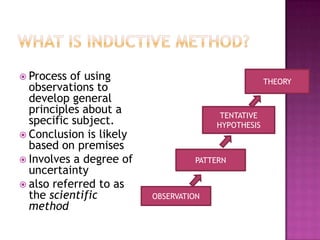
 Process of using                                  THEORY
  observations to
  develop general
  principles about a                    TENTATIVE
  specific subject.                    HYPOTHESIS
 Conclusion is likely
  based on premises
 Involves a degree of            PATTERN
  uncertainty
 also referred to as
  the scientific         OBSERVATION
  method
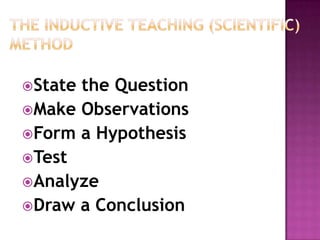
Statethe Question
Make Observations
Form a Hypothesis
Test
Analyze
Draw a Conclusion
 any instruction that begins with a challenge
  and accomplish the desired learning in the
  process of responding to it
 challenge may come in the form of a
  question that needs an answer, observation
  or data set to be interpreted, or hypotheses
  to be tested
 students  are presented with a challenge and
  left to work out the solution on their own
 uses trial and error
 guided discovery
 students    are confronted with an ill-
  structured, authentic (real-world) problem
  to solve
 usually in teams
 emphasis not on a correct answer but on
  investigative process
 Students are presented with an assignment
 that requires that they design or produce a
 deliverable. The final product may be a
 formal written or oral presentation of their
 processes and outcomes. Project-based
 learning can be assigned to individuals or
 teams. Unlike problem-based learning, this
 style of inductive learning provides the
 student with the necessary background
 knowledge and is focused more on the
 solution.
   Students are presented with real-life scenarios,
    or cases, in which they hypothetically assume
    various roles. The cases tend to be very well
    structured filled with elaborate details to
    incorporate many of the variables real-life
    problems contain. Students learn to apply
    material that has already been covered in class
    and is somewhat familiar. Case-based learning
    can be assigned to individual students or to
    teams. Studies have shown that case-based
    instruction   significantly   improves    student
    retention, reasoning and problem-solving skills
    and higher-order skills on Bloom's taxonomy.
 Students  are presented with conceptual
 questions at the beginning of class. These
 questions are usually done in an electronic or
 web-based mode so they can be accessed
 immediately. The teacher then uses the
 findings of that exam to adjust the lesson
 and address misconceptions the students may
 have about the subject content. This method
 is classified as inductive because the
 students are being asked questions about
 material they have not yet studied. This
 method is used primarily in higher education.
 The  learners are more engaged in the
  teaching-learning process with our
  facilitating skills, the learners formulate the
  generalization.
 Learning becomes more interesting at the
  outset because we begin with what they
  know
 It helps the development of our learner’s
  higher-order-thinking-skills (HOTS). To see
  and analyze the same in order to arrive at
  generalizations requires analytical thinking.
 Itrequires more time and so less
  subject matter will be covered. It
  needs much time to lead students to
  the formulation of generalizations.

 Itdemands expert facilitating skills
  on part of the teacher. He/she needs
  to ask the right questions and
  organize answers.
 Usingthe inductive method, the teacher
 presents the students with a specific
 challenge or problem, such as an experiment
 that needs to be interpreted, or a real-world
 problem that needs to be solved. The
 students must then use their base-knowledge
 to investigate, test, analyze and come to
 their own conclusion or solution. The
 inductive method, which is commonly
 interpreted in schools as the scientific
 method is widely used as a guide for
 observation and inquiry based learning.
 The   inductive method is an extremely
  effective process for obtaining general,
  observation-based information about the
  world.
 The inductive method is one of the most
  common and natural forms of making logical
  assumptions about what we observe.
 It allows us to gather ideas about an infinite
  number of events or phenomena in real life.
 It guide students through critical thinking,
  awareness, evaluation of what they observe,
  and the drawing of logical conclusions.
REFERENCES:
http://wik.ed.uiuc.edu/index.php/Inductive_
  methods
www.drburney.net
Inductive Method

Inductive Method

  • 2.
     Process ofusing THEORY observations to develop general principles about a TENTATIVE specific subject. HYPOTHESIS  Conclusion is likely based on premises  Involves a degree of PATTERN uncertainty  also referred to as the scientific OBSERVATION method
  • 3.
    Statethe Question Make Observations Forma Hypothesis Test Analyze Draw a Conclusion
  • 5.
     any instructionthat begins with a challenge and accomplish the desired learning in the process of responding to it  challenge may come in the form of a question that needs an answer, observation or data set to be interpreted, or hypotheses to be tested
  • 6.
     students are presented with a challenge and left to work out the solution on their own  uses trial and error  guided discovery
  • 7.
     students are confronted with an ill- structured, authentic (real-world) problem to solve  usually in teams  emphasis not on a correct answer but on investigative process
  • 8.
     Students arepresented with an assignment that requires that they design or produce a deliverable. The final product may be a formal written or oral presentation of their processes and outcomes. Project-based learning can be assigned to individuals or teams. Unlike problem-based learning, this style of inductive learning provides the student with the necessary background knowledge and is focused more on the solution.
  • 9.
    Students are presented with real-life scenarios, or cases, in which they hypothetically assume various roles. The cases tend to be very well structured filled with elaborate details to incorporate many of the variables real-life problems contain. Students learn to apply material that has already been covered in class and is somewhat familiar. Case-based learning can be assigned to individual students or to teams. Studies have shown that case-based instruction significantly improves student retention, reasoning and problem-solving skills and higher-order skills on Bloom's taxonomy.
  • 10.
     Students are presented with conceptual questions at the beginning of class. These questions are usually done in an electronic or web-based mode so they can be accessed immediately. The teacher then uses the findings of that exam to adjust the lesson and address misconceptions the students may have about the subject content. This method is classified as inductive because the students are being asked questions about material they have not yet studied. This method is used primarily in higher education.
  • 11.
     The learners are more engaged in the teaching-learning process with our facilitating skills, the learners formulate the generalization.  Learning becomes more interesting at the outset because we begin with what they know  It helps the development of our learner’s higher-order-thinking-skills (HOTS). To see and analyze the same in order to arrive at generalizations requires analytical thinking.
  • 12.
     Itrequires moretime and so less subject matter will be covered. It needs much time to lead students to the formulation of generalizations.  Itdemands expert facilitating skills on part of the teacher. He/she needs to ask the right questions and organize answers.
  • 13.
     Usingthe inductivemethod, the teacher presents the students with a specific challenge or problem, such as an experiment that needs to be interpreted, or a real-world problem that needs to be solved. The students must then use their base-knowledge to investigate, test, analyze and come to their own conclusion or solution. The inductive method, which is commonly interpreted in schools as the scientific method is widely used as a guide for observation and inquiry based learning.
  • 14.
     The inductive method is an extremely effective process for obtaining general, observation-based information about the world.  The inductive method is one of the most common and natural forms of making logical assumptions about what we observe.  It allows us to gather ideas about an infinite number of events or phenomena in real life.  It guide students through critical thinking, awareness, evaluation of what they observe, and the drawing of logical conclusions.
  • 15.