Welcome
to our
presentation
MD MAJHARUL ISLAM
BTE00505254
ROBOTICS APPLICATIONS
Introduction
• A real or imaginary machine that is controlled
by a computer and is often made to look like a
human or animal.
• A machine that can do the work of a person
and that works automatically or is controlled
by a computer.
Laws of robotics
• A robot may not injure a human being or
through inaction, allow a human being to
come to harm.
• A robot must obey the orders given it by
human beings except where such orders
would conflict with the fast law.
• A robot must protect it’s own existence as
long as such protection doesn’t conflict with
the first or second laws.
Uses of robotics
 Agriculture
 Automobile
 Construction
 Entertainment
 Health care: hospitals, patient-care, surgery , research, etc.
 Household purposes
 Laboratories: science, engineering , etc.
 Manufacturing
 Military: demining, surveillance, attack, etc.
 Mining, excavation and exploration
 Transportation: air, ground, rail, space, etc.
 Utilities: gas, water and electricity
 Warehouses.
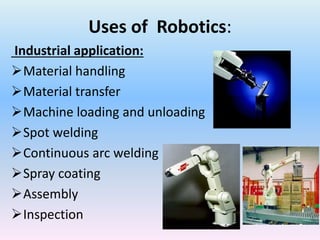
Uses of Robotics:
Industrial application:
Material handling
Material transfer
Machine loading and unloading
Spot welding
Continuous arc welding
Spray coating
Assembly
Inspection
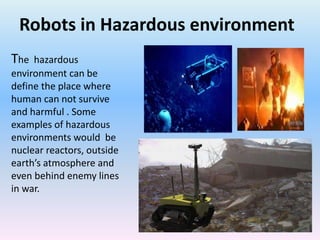
Robots in Hazardous environment
The hazardous
environment can be
define the place where
human can not survive
and harmful . Some
examples of hazardous
environments would be
nuclear reactors, outside
earth’s atmosphere and
even behind enemy lines
in war.
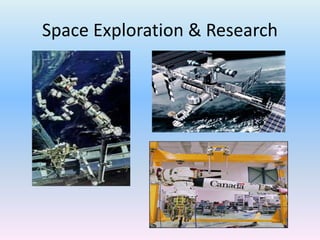
Space Exploration & Research
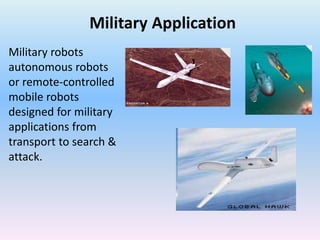
Military Application
Military robots
autonomous robots
or remote-controlled
mobile robots
designed for military
applications from
transport to search &
attack.
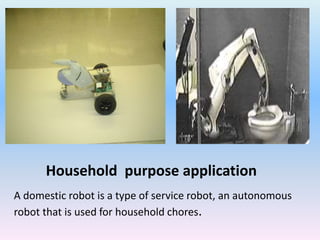
Household purpose application
A domestic robot is a type of service robot, an autonomous
robot that is used for household chores.
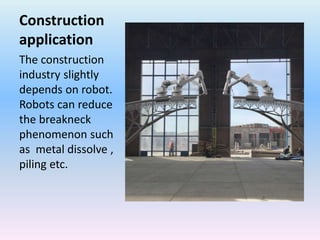
Construction
application
The construction
industry slightly
depends on robot.
Robots can reduce
the breakneck
phenomenon such
as metal dissolve ,
piling etc.
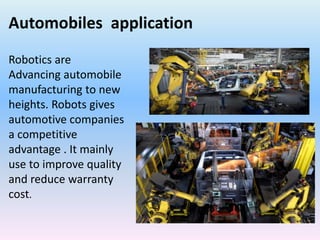
Automobiles application
Robotics are
Advancing automobile
manufacturing to new
heights. Robots gives
automotive companies
a competitive
advantage . It mainly
use to improve quality
and reduce warranty
cost.
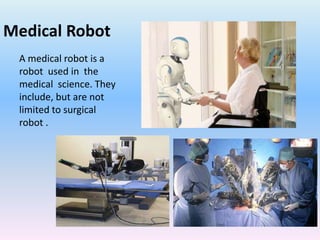
Medical Robot
A medical robot is a
robot used in the
medical science. They
include, but are not
limited to surgical
robot .
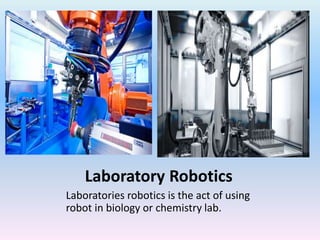
Laboratory Robotics
Laboratories robotics is the act of using
robot in biology or chemistry lab.
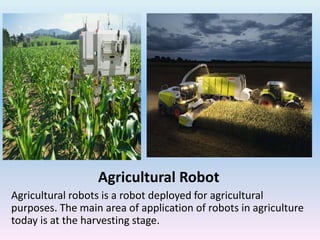
Agricultural Robot
Agricultural robots is a robot deployed for agricultural
purposes. The main area of application of robots in agriculture
today is at the harvesting stage.
CONCLUSION
Today we find most robots working for people in industries,
factories, warehouses, and laboratories. Robots are
useful in many ways. For instance, it boosts economy
because businesses need to be efficient to keep up with
the industry competition. Therefore, having robots helps
business owners to be competitive, because robots can
do jobs better and faster than humans can, e.g. robot can
built, assemble a car. Yet robots cannot perform every
job; today robots roles include assisting research and
industry. Finally, as the technology improves, there will
be new ways to use robots which will bring new hopes
and new potentials.
Robotics applications

Robotics applications

  • 1.
  • 2.
  • 3.
  • 4.
    Introduction • A realor imaginary machine that is controlled by a computer and is often made to look like a human or animal. • A machine that can do the work of a person and that works automatically or is controlled by a computer.
  • 5.
    Laws of robotics •A robot may not injure a human being or through inaction, allow a human being to come to harm. • A robot must obey the orders given it by human beings except where such orders would conflict with the fast law. • A robot must protect it’s own existence as long as such protection doesn’t conflict with the first or second laws.
  • 6.
    Uses of robotics Agriculture  Automobile  Construction  Entertainment  Health care: hospitals, patient-care, surgery , research, etc.  Household purposes  Laboratories: science, engineering , etc.  Manufacturing  Military: demining, surveillance, attack, etc.  Mining, excavation and exploration  Transportation: air, ground, rail, space, etc.  Utilities: gas, water and electricity  Warehouses.
  • 7.
    Uses of Robotics: Industrialapplication: Material handling Material transfer Machine loading and unloading Spot welding Continuous arc welding Spray coating Assembly Inspection
  • 8.
    Robots in Hazardousenvironment The hazardous environment can be define the place where human can not survive and harmful . Some examples of hazardous environments would be nuclear reactors, outside earth’s atmosphere and even behind enemy lines in war.
  • 9.
  • 10.
    Military Application Military robots autonomousrobots or remote-controlled mobile robots designed for military applications from transport to search & attack.
  • 11.
    Household purpose application Adomestic robot is a type of service robot, an autonomous robot that is used for household chores.
  • 12.
    Construction application The construction industry slightly dependson robot. Robots can reduce the breakneck phenomenon such as metal dissolve , piling etc.
  • 13.
    Automobiles application Robotics are Advancingautomobile manufacturing to new heights. Robots gives automotive companies a competitive advantage . It mainly use to improve quality and reduce warranty cost.
  • 14.
    Medical Robot A medicalrobot is a robot used in the medical science. They include, but are not limited to surgical robot .
  • 15.
    Laboratory Robotics Laboratories roboticsis the act of using robot in biology or chemistry lab.
  • 16.
    Agricultural Robot Agricultural robotsis a robot deployed for agricultural purposes. The main area of application of robots in agriculture today is at the harvesting stage.
  • 17.
    CONCLUSION Today we findmost robots working for people in industries, factories, warehouses, and laboratories. Robots are useful in many ways. For instance, it boosts economy because businesses need to be efficient to keep up with the industry competition. Therefore, having robots helps business owners to be competitive, because robots can do jobs better and faster than humans can, e.g. robot can built, assemble a car. Yet robots cannot perform every job; today robots roles include assisting research and industry. Finally, as the technology improves, there will be new ways to use robots which will bring new hopes and new potentials.