LINGUISTIC FACTORSCross – LinguisticInfluence and learnerlanguage
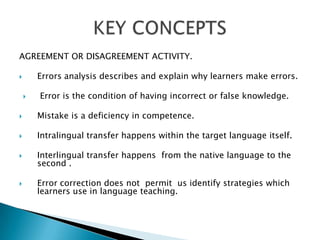
AGREEMENT OR DISAGREEMENT ACTIVITY. Errorsanalysis describes and explainwhylearnersmakeerrors.      Error isthecondition of havingincorrector false knowledge. Mistakeis a deficiency in competence.Intralingual transfer happenswithinthe target languageitself.Interlingual transfer happensfromthenativelanguagetothesecond .Error correctiondoesnotpermitusidentifystrategieswhichlearners use in languageteaching. KEY CONCEPTS
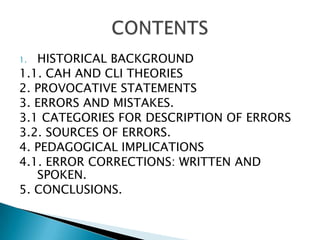
HISTORICAL BACKGROUND1.1. CAH AND CLI THEORIES2. PROVOCATIVE STATEMENTS3. ERRORS AND MISTAKES.3.1 CATEGORIES FOR DESCRIPTION OF ERRORS3.2. SOURCES OF ERRORS.4. PEDAGOGICAL IMPLICATIONS4.1. ERROR CORRECTIONS: WRITTEN AND SPOKEN.5. CONCLUSIONS. CONTENTS
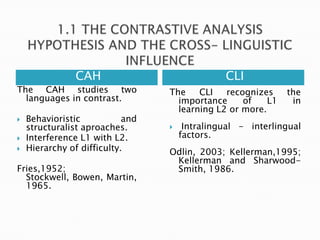
1.1 THE CONTRASTIVE ANALYSIS HYPOTHESIS AND THE CROSS- LINGUISTIC INFLUENCECAHCLIThe CAH studiestwolanguages in contrast.Behavioristic and structuralistaproaches.Interference L1 with L2.Hierarchy of difficulty.Fries,1952; Stockwell, Bowen, Martin,1965.The CLI recognizestheimportance of L1 in learning L2 or more. Intralingual - interlingual factors.Odlin, 2003; Kellerman,1995; Kellerman and Sharwood- Smith, 1986.
PROVOCATIVE STATEMENTSLET’S THINK ABOUT THE PAST!!!Do yourememberwhenyoulearnedto…SwimSkateRide a motorcycleDrive a car
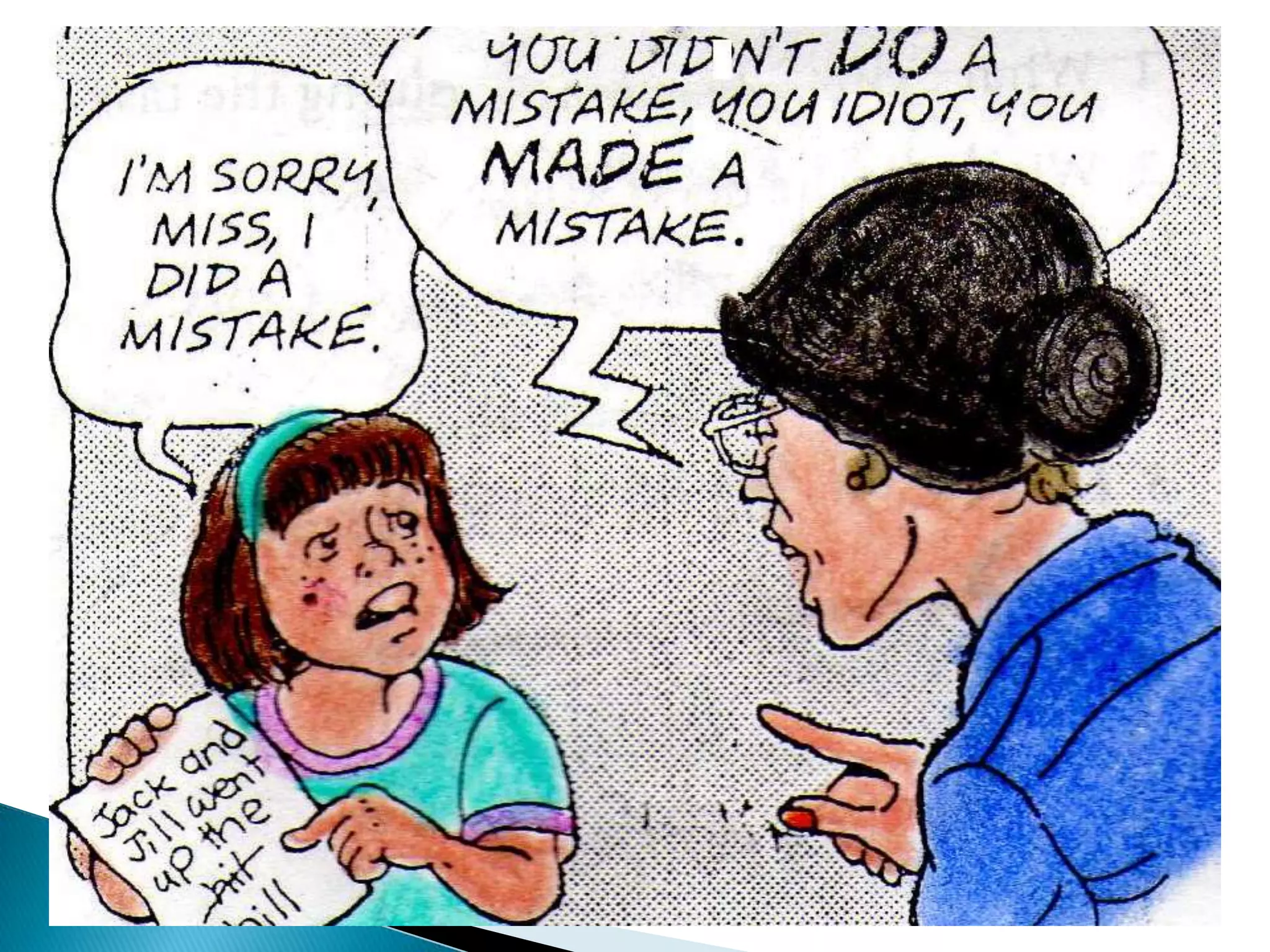
“ Learningisfundamentally a processthatinvolvesthemaking of mistakes” Brown, H.D (2004)
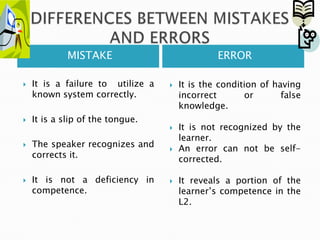
DIFFERENCES BETWEEN MISTAKES AND ERRORSMISTAKEERRORItis a failuretoutilize a knownsystemcorrectly.Itis a slip of thetongue.  The speaker recognizes and correctsit. Itisnot a deficiency in competence.Itisthecondition of havingincorrector false knowledge. Itisnotrecognizedbythelearner. An error can notbeself-corrected. Itreveals a portion of thelearner’scompetence in the L2.
AUDIO
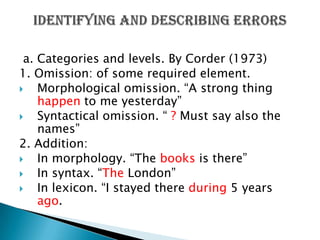
a. Categories and levels. ByCorder (1973)1. Omission: of somerequiredelement. Morphologicalomission. “A strongthinghappento me yesterday”Syntacticalomission. “ ? Mustsayalsothenames”2. Addition:In morphology. “Thebooksisthere”In syntax. “The London”In lexicon. “I stayedthereduring 5 yearsago. Identifying and describingerrors
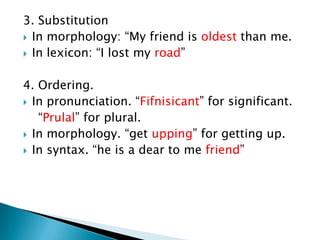
3. SubstitutionIn morphology: “My friendisoldestthan me.In lexicon: “I lost my road”4. Ordering. In pronunciation. “Fifnisicant” forsignificant.     “Prulal” for plural.In morphology. “getupping” forgetting up. In syntax. “he is a dearto me friend”
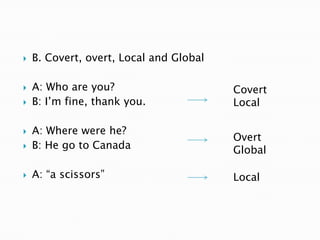
B. Covert, overt, Local and GlobalA: Who are you?  B: I’m fine, thankyou.                      A: Wherewere he?B: He gotoCanadaA: “a scissors” Covert Local Overt Global Local
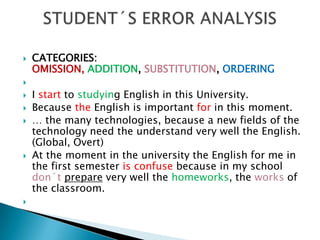
CATEGORIES:OMISSION, ADDITION, SUBSTITUTION, ORDERING I start to studying English in this University.Because the English is important for in this moment.… the many technologies, because a new fields of the technology need the understand very well the English.  (Global, Overt) At the moment in the university the English for me in the first semester is confuse because in my school don´tprepare very well the homeworks, the works of the classroom.  STUDENT´S ERROR ANALYSIS
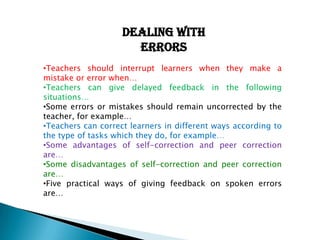
DEALING WITH ERRORSTeachersshouldinterruptlearnerswhentheymake a mistakeor error when…
Teachers can givedelayedfeedback in thefollowingsituations…
Someerrorsormistakesshouldremainuncorrectedbytheteacher, forexample…

Linguistic Factors Presentation [Autoguardado]

  • 2.
    LINGUISTIC FACTORSCross –LinguisticInfluence and learnerlanguage
  • 3.
    AGREEMENT OR DISAGREEMENTACTIVITY. Errorsanalysis describes and explainwhylearnersmakeerrors. Error isthecondition of havingincorrector false knowledge. Mistakeis a deficiency in competence.Intralingual transfer happenswithinthe target languageitself.Interlingual transfer happensfromthenativelanguagetothesecond .Error correctiondoesnotpermitusidentifystrategieswhichlearners use in languageteaching. KEY CONCEPTS
  • 4.
    HISTORICAL BACKGROUND1.1. CAHAND CLI THEORIES2. PROVOCATIVE STATEMENTS3. ERRORS AND MISTAKES.3.1 CATEGORIES FOR DESCRIPTION OF ERRORS3.2. SOURCES OF ERRORS.4. PEDAGOGICAL IMPLICATIONS4.1. ERROR CORRECTIONS: WRITTEN AND SPOKEN.5. CONCLUSIONS. CONTENTS
  • 5.
    1.1 THE CONTRASTIVEANALYSIS HYPOTHESIS AND THE CROSS- LINGUISTIC INFLUENCECAHCLIThe CAH studiestwolanguages in contrast.Behavioristic and structuralistaproaches.Interference L1 with L2.Hierarchy of difficulty.Fries,1952; Stockwell, Bowen, Martin,1965.The CLI recognizestheimportance of L1 in learning L2 or more. Intralingual - interlingual factors.Odlin, 2003; Kellerman,1995; Kellerman and Sharwood- Smith, 1986.
  • 6.
    PROVOCATIVE STATEMENTSLET’S THINKABOUT THE PAST!!!Do yourememberwhenyoulearnedto…SwimSkateRide a motorcycleDrive a car
  • 7.
    “ Learningisfundamentally aprocessthatinvolvesthemaking of mistakes” Brown, H.D (2004)
  • 8.
    DIFFERENCES BETWEEN MISTAKESAND ERRORSMISTAKEERRORItis a failuretoutilize a knownsystemcorrectly.Itis a slip of thetongue. The speaker recognizes and correctsit. Itisnot a deficiency in competence.Itisthecondition of havingincorrector false knowledge. Itisnotrecognizedbythelearner. An error can notbeself-corrected. Itreveals a portion of thelearner’scompetence in the L2.
  • 9.
  • 10.
    a. Categories andlevels. ByCorder (1973)1. Omission: of somerequiredelement. Morphologicalomission. “A strongthinghappento me yesterday”Syntacticalomission. “ ? Mustsayalsothenames”2. Addition:In morphology. “Thebooksisthere”In syntax. “The London”In lexicon. “I stayedthereduring 5 yearsago. Identifying and describingerrors
  • 11.
    3. SubstitutionIn morphology:“My friendisoldestthan me.In lexicon: “I lost my road”4. Ordering. In pronunciation. “Fifnisicant” forsignificant. “Prulal” for plural.In morphology. “getupping” forgetting up. In syntax. “he is a dearto me friend”
  • 12.
    B. Covert, overt,Local and GlobalA: Who are you? B: I’m fine, thankyou. A: Wherewere he?B: He gotoCanadaA: “a scissors” Covert Local Overt Global Local
  • 13.
    CATEGORIES:OMISSION, ADDITION, SUBSTITUTION,ORDERING I start to studying English in this University.Because the English is important for in this moment.… the many technologies, because a new fields of the technology need the understand very well the English. (Global, Overt) At the moment in the university the English for me in the first semester is confuse because in my school don´tprepare very well the homeworks, the works of the classroom.  STUDENT´S ERROR ANALYSIS
  • 14.
  • 15.
    Teachers can givedelayedfeedbackin thefollowingsituations…
  • 16.