Download to read offline
![International Research Journal of Engineering and Technology (IRJET) e-ISSN: 2395-0056
Volume: 04 Issue: 11 | Nov -2017 www.irjet.net p-ISSN: 2395-0072
© 2017, IRJET | Impact Factor value: 6.171 | ISO 9001:2008 Certified Journal | Page 1524
CONICAL FLUIDIZED BEDS - CASE STUDY FOR A GAS SOLID SYSTEM
INVOLVING WHEAT FLOUR AND ADDITIVE
Rajesh Katiyar
Associate Professor, Chemical Engineering Department, Harcourt Butler Technical University, Kanpur, India
---------------------------------------------------------------------***---------------------------------------------------------------------
Abstract - Conical or tapered fluidized beds inherit certain
valuable properties in comparison to columnar fluidizedbeds.
They can handle particles of broad size distribution and also
manage the particles which exhibit cohesive nature. The
existence of higher gas velocity over the inlet grid would
minimize the chances of bed getting de-fluidized, and withthe
comparative lower velocity at the outlet of the bed reduces
elutriation of the solid particles during operation. Present
investigation utilized two-dimensional conical bed with cone
angle of 20.5°. Air has been used as the fluidizing medium.
Solids taken for fluidization were commercial flour and
mixture of crushed wheat with flour. Commercialflourof wide
particle size range (1-355 µm) was used for experiments
having certain degree of cohesivity. Particlesizeanalysisofthe
commercial flour for the undersize of 63 µm was done bylaser
particle size analyzer of Galai, Israel. Crushed wheat used was
of size range 495 to 1520 µm. Size determinations of crushed
wheat particles was carried out by sieve analysis using
standard screens. Studies were done towards estimating that
how the fluidization of flour which is cohesive in nature, is
improved by the addition of crushed wheat particles in
different ratio.
Key Words: Conical fluidized bed, wheat flour, cone
angle, pressure drop, fixed bed, fluidization velocity,
Ergun equation, particle size, initial bed height,
cohesivity.
1. INTRODUCTION
During fluidization operation in a columnar bed with
uniform particles, the drag force is constant at any position.
This drag force decreases in the upward direction in a
conical bed accompanied by the reduction in the superficial
velocity of the fluid. Hence, particles of the lower partsofthe
bed would first be fluidized upon an increase in the flow
rate, whereas the particles at the upper part of the bed tend
to remain static. Thus the problems associated with
conventional (cylindrical) fluidized beds are overcome by
using conical fluidized beds. These problems faced by
conventional columnar beds are possible in fluidization of
wider size range of particles, entrainment of particles and
limitation of fluidization velocity. Important fluidization
operations of process industries handle particles of non-
uniform size due to size reduction duringchemical reactions
(combustion or gasification) and attrition. Reduction in
particle size would result in entrainment and non-uniform
fluidization during operations in columnar beds. Conical
beds help in these issues in which thereisa gradual decrease
in the superficial gas velocity withincreasingcross-sectional
area and height. Thus conical beds have found important
application in the areas of incineration of waste materials,
coating of nuclear fuel particles, crystallization, fuel
combustion and gasification, roasting of ores, waste heat
recovery and food processing areas [1,2,3]. The application
of tapered fluidized beds for biochemical reactions and
biological treatment of waste water have been emphasized
and elaborated along with the advantages of the tapered
beds over the columnar beds [4].
The voidage in a tapered fluidizedbedoflargeapex(cone)
angle is smaller and its dependence on velocity is less than
that for a columnar (cylindrical) fluidized bed. Also, an
intense exothermic reaction can be handled properly in a
conical bed and the operations of conical bed are smooth
without any instability. With existenceofvelocitygradientin
the axial direction, unique hydrodynamic characteristics are
established. The tapered angles of the conicalbedshavebeen
found to affect the hydrodynamic characteristics of the bed
unit [5,6]. Geldart group C particles showingcohesivenature
may lead to plug flow and channeling during fluidization
operation.Inter-particleadhesiveforcescauseagglomeration
and bridging between agglomerates in these particles of
pigments, flour, starch granules, etc. Attempts involving
different techniques have been made in improving the
fluidization quality of the cohesiveparticlesbyusingexternal
forces, by modifying the surface of particles or by addition of
other particles [7,8].
Thehydrodynamicscharacteristicsforaconicalbedwith
three different cone angles havebeenstudiedexperimentally
for a Geldart-D powder. The results observe three different
flow regimes which are fixed bed, partially fluidized bed and
fully fluidized bed (or spouting bed). These regimes depend
on superficial gas velocity and regimerangesdependoncone
angle and stagnant bed height[9].Fineparticles(ofGeldart-A
zone) forfluidizationcharacteristicsingas-solidconicalbeds
were studied forflow regimes and transition conditionswith
three different cone angles. Fixed bed and spouting bed
regimes were observed successively in experimentswiththe
increase of superficial gas velocity. In comparison with
coarse particles (Geldart-D), in fine particles fluidization, the
partially fluidized bed regime disappears, as an important
observation [10].
2. Hydrodynamics and modeling
Development of a model for maximum pressure drop at
incipient fluidization condition of a conical fluidized bed has
been carried on the basis of Ergun equation [4]. Theoretical](https://image.slidesharecdn.com/irjet-v4i11278-171213071547/85/Conical-Fluidized-Beds-Case-Study-for-a-Gas-Solid-System-Involving-Wheat-Flour-and-Additive-1-320.jpg)
![International Research Journal of Engineering and Technology (IRJET) e-ISSN: 2395-0056
Volume: 04 Issue: 11 | Nov -2017 www.irjet.net p-ISSN: 2395-0072
© 2017, IRJET | Impact Factor value: 6.171 | ISO 9001:2008 Certified Journal | Page 1524
CONICAL FLUIDIZED BEDS - CASE STUDY FOR A GAS SOLID SYSTEM
INVOLVING WHEAT FLOUR AND ADDITIVE
Rajesh Katiyar
Associate Professor, Chemical Engineering Department, Harcourt Butler Technical University, Kanpur, India
---------------------------------------------------------------------***---------------------------------------------------------------------
Abstract - Conical or tapered fluidized beds inherit certain
valuable properties in comparison to columnar fluidizedbeds.
They can handle particles of broad size distribution and also
manage the particles which exhibit cohesive nature. The
existence of higher gas velocity over the inlet grid would
minimize the chances of bed getting de-fluidized, and withthe
comparative lower velocity at the outlet of the bed reduces
elutriation of the solid particles during operation. Present
investigation utilized two-dimensional conical bed with cone
angle of 20.5°. Air has been used as the fluidizing medium.
Solids taken for fluidization were commercial flour and
mixture of crushed wheat with flour. Commercialflourof wide
particle size range (1-355 µm) was used for experiments
having certain degree of cohesivity. Particlesizeanalysisofthe
commercial flour for the undersize of 63 µm was done bylaser
particle size analyzer of Galai, Israel. Crushed wheat used was
of size range 495 to 1520 µm. Size determinations of crushed
wheat particles was carried out by sieve analysis using
standard screens. Studies were done towards estimating that
how the fluidization of flour which is cohesive in nature, is
improved by the addition of crushed wheat particles in
different ratio.
Key Words: Conical fluidized bed, wheat flour, cone
angle, pressure drop, fixed bed, fluidization velocity,
Ergun equation, particle size, initial bed height,
cohesivity.
1. INTRODUCTION
During fluidization operation in a columnar bed with
uniform particles, the drag force is constant at any position.
This drag force decreases in the upward direction in a
conical bed accompanied by the reduction in the superficial
velocity of the fluid. Hence, particles of the lower partsofthe
bed would first be fluidized upon an increase in the flow
rate, whereas the particles at the upper part of the bed tend
to remain static. Thus the problems associated with
conventional (cylindrical) fluidized beds are overcome by
using conical fluidized beds. These problems faced by
conventional columnar beds are possible in fluidization of
wider size range of particles, entrainment of particles and
limitation of fluidization velocity. Important fluidization
operations of process industries handle particles of non-
uniform size due to size reduction duringchemical reactions
(combustion or gasification) and attrition. Reduction in
particle size would result in entrainment and non-uniform
fluidization during operations in columnar beds. Conical
beds help in these issues in which thereisa gradual decrease
in the superficial gas velocity withincreasingcross-sectional
area and height. Thus conical beds have found important
application in the areas of incineration of waste materials,
coating of nuclear fuel particles, crystallization, fuel
combustion and gasification, roasting of ores, waste heat
recovery and food processing areas [1,2,3]. The application
of tapered fluidized beds for biochemical reactions and
biological treatment of waste water have been emphasized
and elaborated along with the advantages of the tapered
beds over the columnar beds [4].
The voidage in a tapered fluidizedbedoflargeapex(cone)
angle is smaller and its dependence on velocity is less than
that for a columnar (cylindrical) fluidized bed. Also, an
intense exothermic reaction can be handled properly in a
conical bed and the operations of conical bed are smooth
without any instability. With existenceofvelocitygradientin
the axial direction, unique hydrodynamic characteristics are
established. The tapered angles of the conicalbedshavebeen
found to affect the hydrodynamic characteristics of the bed
unit [5,6]. Geldart group C particles showingcohesivenature
may lead to plug flow and channeling during fluidization
operation.Inter-particleadhesiveforcescauseagglomeration
and bridging between agglomerates in these particles of
pigments, flour, starch granules, etc. Attempts involving
different techniques have been made in improving the
fluidization quality of the cohesiveparticlesbyusingexternal
forces, by modifying the surface of particles or by addition of
other particles [7,8].
Thehydrodynamicscharacteristicsforaconicalbedwith
three different cone angles havebeenstudiedexperimentally
for a Geldart-D powder. The results observe three different
flow regimes which are fixed bed, partially fluidized bed and
fully fluidized bed (or spouting bed). These regimes depend
on superficial gas velocity and regimerangesdependoncone
angle and stagnant bed height[9].Fineparticles(ofGeldart-A
zone) forfluidizationcharacteristicsingas-solidconicalbeds
were studied forflow regimes and transition conditionswith
three different cone angles. Fixed bed and spouting bed
regimes were observed successively in experimentswiththe
increase of superficial gas velocity. In comparison with
coarse particles (Geldart-D), in fine particles fluidization, the
partially fluidized bed regime disappears, as an important
observation [10].
2. Hydrodynamics and modeling
Development of a model for maximum pressure drop at
incipient fluidization condition of a conical fluidized bed has
been carried on the basis of Ergun equation [4]. Theoretical](https://image.slidesharecdn.com/irjet-v4i11278-171213071547/75/Conical-Fluidized-Beds-Case-Study-for-a-Gas-Solid-System-Involving-Wheat-Flour-and-Additive-1-2048.jpg)
![International Research Journal of Engineering and Technology (IRJET) e-ISSN: 2395-0056
Volume: 04 Issue: 11 | Nov -2017 www.irjet.net p-ISSN: 2395-0072
© 2017, IRJET | Impact Factor value: 6.171 | ISO 9001:2008 Certified Journal | Page 1525
model for minimum fluidization velocity and pressure drop
in a packed bed of spherical particlesforgas-solidsystems in
a conical vessel has been developed bytheauthors[3]. Solid-
liquid fluidization characteristics in a conical bed were
studied and theoretical models for the prediction of
minimum fluidization velocity and maximum pressure drop
have been formulated for the spherical particles[1]. With the
studies carried out on conical fluidized beds, models were
developed for gas-solid systems for spherical coarse
particles and spherical fine particles [9,10].
Researchers have determined the factors affecting
minimum fluidization velocity and maximumpressuredrop.
Investigations have been carried out regarding fixed bed
pressure drop calculations, flowregimes,incipientcondition
of fluidization, void distribution and bed expansion
calculations. An empirical dimensionless correlation has
been developed for predicting the minimum fluidization
velocity and maximum pressure drop for regular and
irregular particles in gas-solid systems. Parameters taken
into consideration are particle diameter, particle density,
tapered angle, porosity and sphericity. Bed height has not
been considered and authors have compared the
applicability of the model developed with existing models
from literature [6].
3. Materials and methods
3.1 Experimental set-up
Experimental set-up and procedure are similar as has been
described in earlier communication [11]. Details of set-up
and experimental procedure are provided here as well. The
fluidization columns were fabricated from perpex material
sheet to allow visual observations of the fluidization. The
experiments were performed with two-dimensional column
having tapering angle of 20.5°. The thickness was1.7cmand
height was 0.5 m. The cross-section at bottom of the column
was 2.75 x 1.7 cm.
To measure the pressure drop through bed, pressure tap
was installed on the wall along the centerline of the column
immediately above the distributor. The tapping was
connected to U tube manometer. Gas distributor was a
polymer type mesh. Air was supplied by a blower whose
speed was varied by a variable voltage supplier. Gas flow
rate was determined by means of venturi-meter which was
connected to the U tube manometer. Provision of measuring
the bed height was through a graduated scale. The materials
utilized for fluidization were commercial flour and crushed
wheat. Their properties were studied as described later.
Crushed wheat has been used as an additive.
3.2 Material used for fluidization
Commercial flour was taken anditsparticlesizeanalysiswas
done. Flour was first sieved and undersize fraction of 63 µm
was analyzed by laser particle size analyzer of Galai, Israel,
which is a suspension type particle analyzer working on
diffraction principle. The oversize of 63 µm was analyzed by
sieve analysis. Hausner’s ratio (HR) was determined for
complete flour as well as for flour of undersize of 63 µm. For
complete flour the average value of the HR was 1.4047 for
four estimations. The average value of HR for flour of
undersize of 63 µm was foundas1.6487forfour estimations.
Crushed wheat which was used as additive was analyzed by
sieve analysis. Volume surface mean diameters were
determined and for complete flour it was found to be 70.73
µm, whereas for crushed wheat it was 868 µm.
3.3 Experimental procedure
The experiments werecarriedoutunderambientconditions.
For conducting experiments, the conical bed was charged
with material to a fixed bed height. Initially the bed wasfully
fluidized by increasing the flow rate of air and subsequently
the flow rate was gradually reduced to zero to a stage where
the material was settled to form a fixed bed. This was the
initial fixed bed height and the procedure wasusedtoobtain
reproducible results.
During the performance of an experimental run, the flow
rate of air through the column was increased incrementally.
When a stable state was established after each increment,
records were made of the readings on the manometers. An
experimental run was initiated by increasingtheflowrateto
fluidize the bed and then by decreasing the flow rate to
defluidize it. Visual observations were made during the
experiments in addition to the pressure drop and flow rate
measurements. Gas velocity has been expressedonthe basis
of inlet area of the bed and manometer readings
corresponding to bed pressure drops have been plotted
against corresponding superficial velocities at the inlet.
4. Results and discussion
Fluidization behavior of pure flour was studied in conical
bed at different stagnant heights. Theexperimental pressure
drop versus velocity data obtained from the two-
dimensional tapered fluidized bed with cone angle of 20.5°
follows the pattern as shown in plots 1, 2 and 3. These plots
show the fluidization as well asde-fluidizationbehaviorfora
stagnant bed height of 5 cm, with approximate weight of
flour amounting to 20 gram. It is important to note that in 5
runs among the total 14 runs which were performed, the
material fluidized properly. Fluidization was notproper and
channeling took place at low superficial gas velocity in 9
experimental trials. In the increasing fluid velocity cycle,the
pressure drop reacheda maximumvalueandthendecreases,
approaching a nearly constant value. In the decreasing fluid
velocity cycle, however, the pressure drop decreases almost
continuously and the peak is not recovered.](https://image.slidesharecdn.com/irjet-v4i11278-171213071547/85/Conical-Fluidized-Beds-Case-Study-for-a-Gas-Solid-System-Involving-Wheat-Flour-and-Additive-2-320.jpg)
![International Research Journal of Engineering and Technology (IRJET) e-ISSN: 2395-0056
Volume: 04 Issue: 11 | Nov -2017 www.irjet.net p-ISSN: 2395-0072
© 2017, IRJET | Impact Factor value: 6.171 | ISO 9001:2008 Certified Journal | Page 1526
0 20 40 60 80 100 120
0
500
1000
1500
2000
2500
3000
3500
Fluidization
Defluidization
Press.drop(dyne/cm²)
Ugo(cm/s)
Plot -1: Effect of superficial gas velocity on pressure drop
in conical bed for flour
0 20 40 60 80 100
0
500
1000
1500
2000
2500
3000
3500
Fluidization
Defluidization
Press.drop(dyne/cm²)
Ugo(cm/s)
Plot -2: Effect of superficial gas velocity on pressure drop
in conical bed for flour
In the coarse particle fluidization, three distinct regimes
were observed in the increasing fluid velocity cycle [11].
These regimes are of fixed bed, partially fluidized bed and
fully fluidized bed. In the case of fluidization of flour, for the
cases where it could be fluidized, the regime of partial
fluidization has not been identified and observed. Thus
during increasing fluid velocity cycle, after the fixed bed
regime the initiation of fullyfluidizedbedregimetakesplace.
0 20 40 60 80 100
0
500
1000
1500
2000
2500
3000
3500
4000
Fluidization
Defluidization
Press.drop(dyne/cm²)
Ugo(cm/s)
Plot -3: Effect of superficial gas velocity on pressure drop
in conical bed for flour
0 20 40 60 80 100 120
0
1000
2000
3000
4000
5000
Fluidization
Defluidization
Press.drop(dyne/cm²)
Ugo(cm/s)
Plot -4: Effect of superficial gas velocity on pressure drop
in conical bed for flour (bed height of 6 cm)
Plot 4 is showing the fluidization behavior as well as the
de-fluidization behavior for a stagnant bed height of 6 cm
and approximate weight of flour amounting to 25 gram. It
was observed that difficulty of fluidization increased with
increased bed height and proper fluidization could be
achieved even with more less number of times. When height
of the flour bed was increased from 5 cm to 6 cm, pressure
drop as well as minimum fluidization velocity increased.
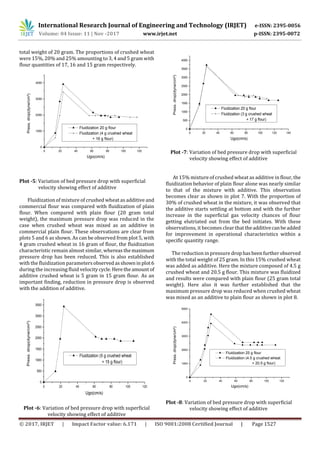
For smooth fluidizationof flour,crushed wheatwasadded
to it in different ratios. Observation was made regarding the
settling of crushed wheat at bottom along with the value of
superficial gas velocity. Any entrainment of flour out from
the bed was also noticed for these ratios. After these
preliminary runs, crushed wheat was added in three
different proportions for stagnant bed height of 5 cm and](https://image.slidesharecdn.com/irjet-v4i11278-171213071547/85/Conical-Fluidized-Beds-Case-Study-for-a-Gas-Solid-System-Involving-Wheat-Flour-and-Additive-3-320.jpg)
![International Research Journal of Engineering and Technology (IRJET) e-ISSN: 2395-0056
Volume: 04 Issue: 11 | Nov -2017 www.irjet.net p-ISSN: 2395-0072
© 2017, IRJET | Impact Factor value: 6.171 | ISO 9001:2008 Certified Journal | Page 1528
5. CONCLUSIONS
For the coarse particlesfluidization,the experimental results
have shown that the bed cone angle and the particle bed
height are the main factors influencingtheregimetransition.
Three different flow regimes that areobservedarefixedbed,
partially fluidized bed and fully fluidized bed in the
increasing fluid velocitycycle.Inthedecreasingfluidvelocity
cycle the pressure drop decreases continuously. The results
have been already elaborated by the author [11]. For the
case of fluidization of flour, when the runs were carried out
for plain flour alone, it was observed that properfluidization
was achieved at nearly 40% of the total runs carried out
including preliminary trials. In the cases where proper
fluidization was not achieved, there was plug formation,bed
disruption with subsequentfluidization,orinitial channeling
and pressure drop fluctuations.
Under the cases when flour fluidized smoothly, the
regimes which were observed were fixed bed and fluidized
bed. Partially fluidized bed regime disappeared in these
cases. The fluidization of flour was smooth and there was
decrease in pressure drop when crushed wheat was added
to it in the proportions ranging from 15% to 25%. It was
observed that the circulation in beds of the mixture along
with additive was more extensive and more rapid and it
appeared to offer less resistance to flow than flour alone.
Thus additive has improved the fluidization characteristics
of somewhat cohesive and fine character material.
Studies can also be carried out at different cone angles of
the two-dimensional tapered bed. A comparative study can
also be carried out in a three dimensional bed. With the
useful results obtained the set-up can be scaled up for
detailed analysis and further results in terms of application.
The material produced by first break grinding, the first step
in flour milling can be taken up for fluidization and
entrainment studies.
ACKNOWLEDGEMENT
Technical suggestions received from Prof. D. Subba Rao and
Prof. B. P. Mani, who have been with IIT, Delhi are
acknowledged herewith. Co-operation receivedfromstaff of
fluid flow lab as well as powder technology lab of chemical
Engineering Department, IIT, Delhi is duly acknowledged.
REFERENCES
[1] Y. Peng, L. T. Fan, "Hydrodynamics characteristics of
fluidization in liquid-solid tapered beds", Chem. Engg.
Science, vol. 53(3), 1997, 2277-2290.
[2] D. C. Sau, S. Mohanty, K. C. Biswal, "Prediction of critical
fluidization velocity and maximum bed pressure drop
for binary mixture of regular particles in gas-solid
tapered fluidized beds", Chemical Engg. and Processing,
vol. 47, 2008, 2114-2120.
[3] K. C. Biswal, T. Bhowmik, G.K. Roy, "Prediction of
pressure drop for a conical fixed bed of spherical
particles in gas-solid systems", The Chem.Engg.Journal,
vol. 29, 1984, 47-50.
[4] Y. F. Shi, Y. S. Yu, L. T. Fan, "Incipient fluidization
condition for a tapered fluidized bed", Ind. Engg. Chem.
Fundam., vol. 23, 1984, 484-489.
[5] K. Ridgway, "The tapered fluidized bed- a new
processing tool", Chem. Process Engg., vol. 6, 1965,317-
321.
[6] D. C. Sau, S. Mohanty, K. C. Biswal,"Minimumfluidization
velocities and maximum bed pressure drops for gas-
solid tapered fluidized beds", Chemical Engg. Journal,
vol. 132, 2007, 151-157.
[7] T. Zhou, H. Li, "Force balance modeling for
agglomerating fluidization of cohesive particles",
Powder Tech., vol. 111, 2000, 60
[8] T. Zhou, H. Li, "Effect of adding differentsizeparticleson
fluidization of cohesive particles", Powder Tech., vol.
102, 1999, 215
[9] S. Jing, Q. Hu, J. Wang, Y. Jin, "Fluidization of coarse
particles in gas-solid conical beds", Chem. Engg. and
Processing, vol. 39, 2000, 379-387.
[10] S. Jing, C. Guobin, M. Fan, B. Yu, J. Wang, Y. Jin,
"Fluidization of fine particles in conical beds", Powder
Tech., vol. 118, 2001, 271-274.
[11] R. Katiyar, “Conical fluidized beds – Case study for a gas
solid system involving coarse particles”, International
Research Journal of Engg. and Tech., vol. 4(10), 2017,
864-869.
BIOGRAPHY
Author is M.Tech. and PhD from IIT,
Delhi, India. His research areas are
focused on product development,
particle processing, natural products
extraction and towards up-gradation
of material and compositeproperties.](https://image.slidesharecdn.com/irjet-v4i11278-171213071547/85/Conical-Fluidized-Beds-Case-Study-for-a-Gas-Solid-System-Involving-Wheat-Flour-and-Additive-5-320.jpg)

This document summarizes a study on fluidization of wheat flour and additive particles in a conical fluidized bed. Key points: - Conical fluidized beds can handle particles of varying sizes and cohesive particles better than traditional cylindrical beds due to varying gas velocity. - An experiment was conducted using a two-dimensional conical bed with a 20.5° cone angle. Wheat flour and crushed wheat were used as particles. - Pressure drop and fluidization properties were measured for beds containing various ratios of flour and crushed wheat additive. The study aimed to improve fluidization of cohesive flour using the crushed wheat additive.


![CHEE_220_Lecture_Fluidization_2021[1].pptx](https://cdn.slidesharecdn.com/ss_thumbnails/chee220lecturefluidization20211-230329153950-84712558-thumbnail.jpg?width=640&height=640&fit=bounds)


