Hydrodynamic Study of Cold Model
  Bubbling Fluidized Bed System Using
  Bubble Caps

                                                  By
   Mandeep Sharma                                                    Dinanath Akela
(Project Assistant, CMERI Durgapur)                                  (Engineer, THERMAX Pune)


         Central Mechanical Engineering Research Institute, Durgapur 713209, West Bengal, India
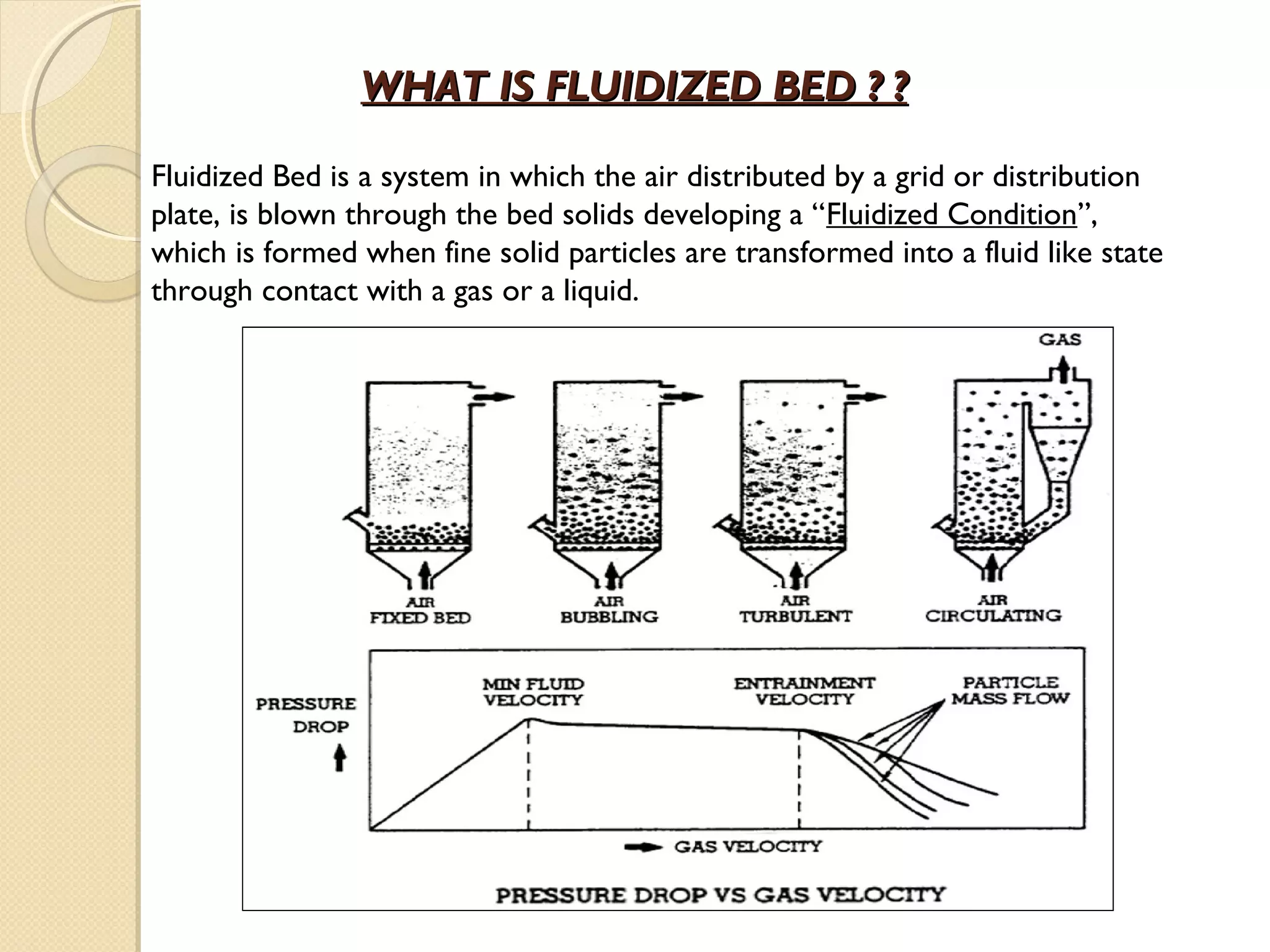
WHAT IS FLUIDIZED BED ? ?

Fluidized Bed is a system in which the air distributed by a grid or distribution
plate, is blown through the bed solids developing a “Fluidized Condition”,
which is formed when fine solid particles are transformed into a fluid like state
through contact with a gas or a liquid.
CHARACTERISTICS OF FLUIDIZED BED
Fluidized beds display a number of liquid-like properties:
 Lighter objects float on top of the bed (i.e., objects less dense than the bulk density
 of the bed),
 The surface stays horizontal even in tilted beds,
 The solids can flow through an opening in the vessel just like a liquid,
 The beds have a “static” pressure head due to gravity, given by ρ0gh,
 Levels between two similar fluidized beds equalize their static pressure heads.

ADVANTAGES OF FLUIDIZED BED

 Rapid mixing of solids, uniform temperature and concentrations.
 Applicable for large or small scale operations.
 Heat and mass transfer rates between gas and particles are high as compared to
  other modes of contacting.
 There is no moving part and hence a fluidized bed reactor is not mechanically agitated
  reactor. So, maintenance cost can be low.
 The reactor is mounted vertically and save space.

APPLICATIONS

 Reactors for Cracking hydrocarbons, Coal gasification, Carbonization, Calcination.
 Heat exchangers, Drying operations, Coating (example, metals with polymer)
 Solidification/Granulation, Adsorption/desorption, Bio-fuel generation
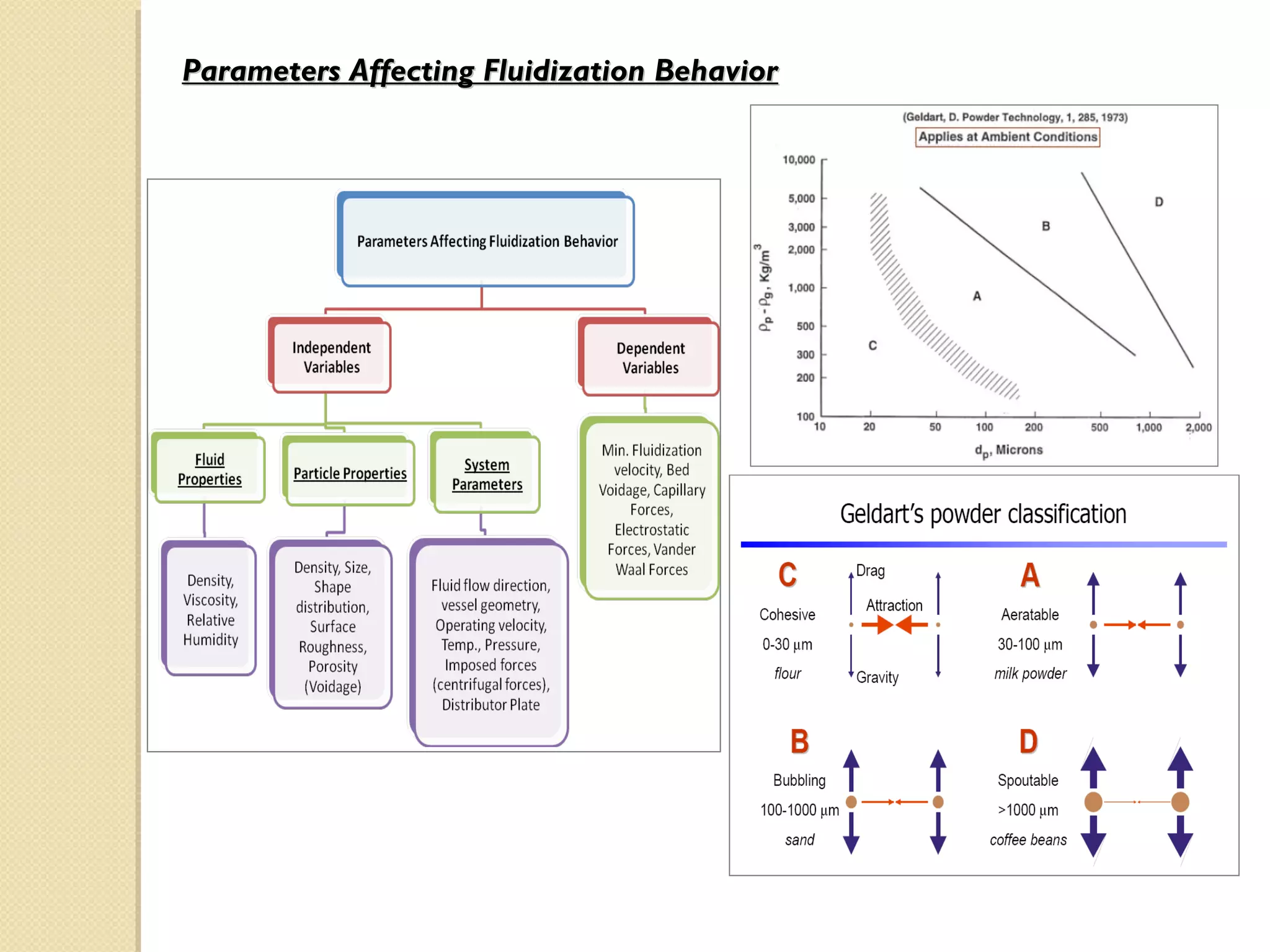
Parameters Affecting Fluidization Behavior
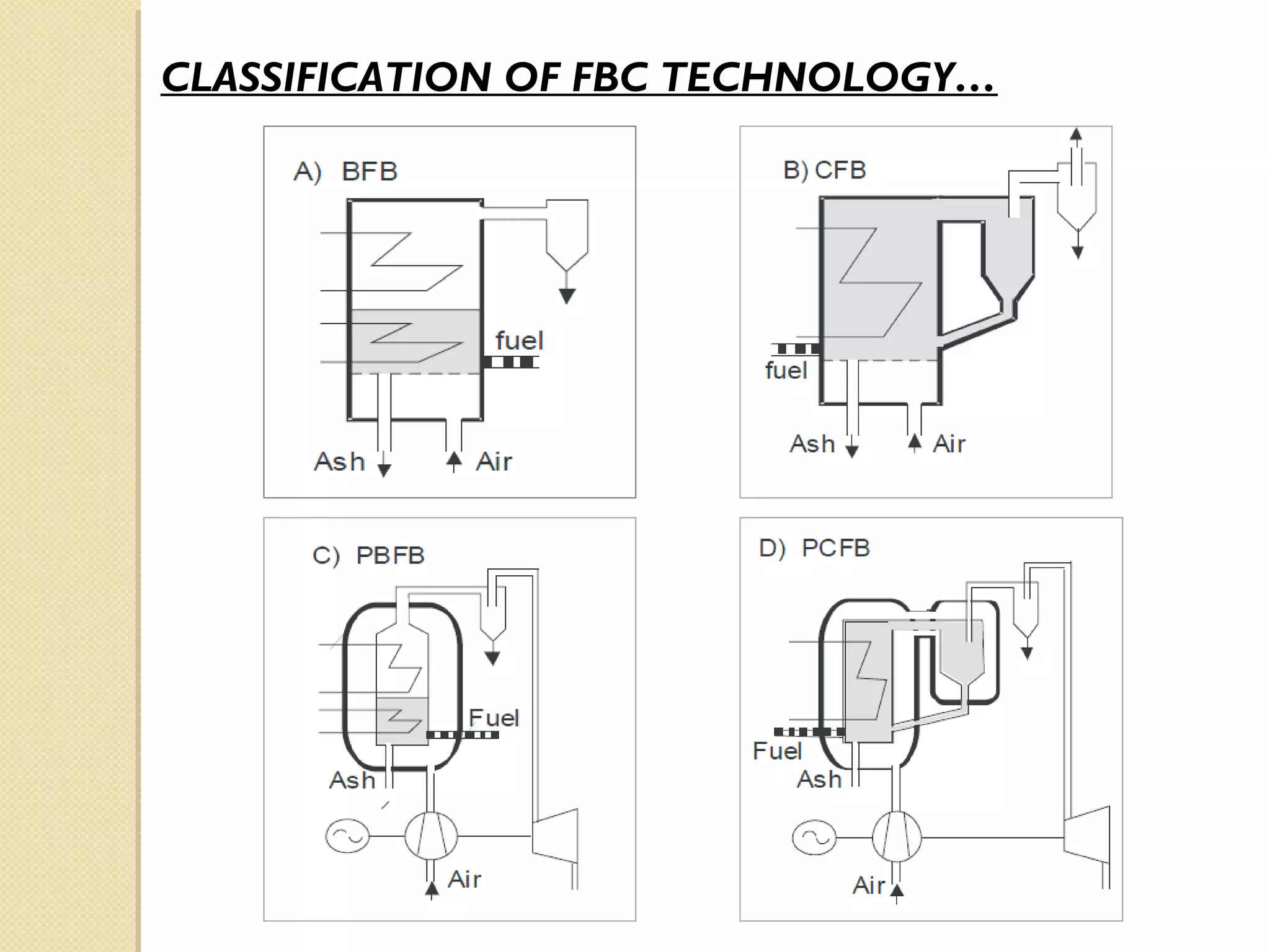
CLASSIFICATION OF FBC TECHNOLOGY…
Bubbling Fluidized Bed
 Gas-solid bubbling fluidized bed (BFB) system is an efficient energy
  conversion method for combustion and gasification of solid fuels.

 The combustion gas velocity is equal to “the minimum fluidization velocity”,
  bubbles are gas voids with very little or no solids, the upward flow rate for
  air/combustion gases is typically 2 - 3 m/s, the bed heights for BFBC plants
  are 0.5 to 1.5 m, gas residence time within the bed are between 1 and 2
  seconds.

 Chemical and thermal behavior of BFB combustors is greatly influenced
  by the fundamental hydrodynamics of bed material, fluidizing medium
  and bubble behavior.

 In actual BFB systems, it is very difficult to study these hydrodynamic
  parameters due to very high temperature and pressure conditions.
  Therefore, the objective of the present study is to investigate the
  hydrodynamic parameters by conducting experiments on laboratory
  scale BFB cold model at atmospheric conditions.
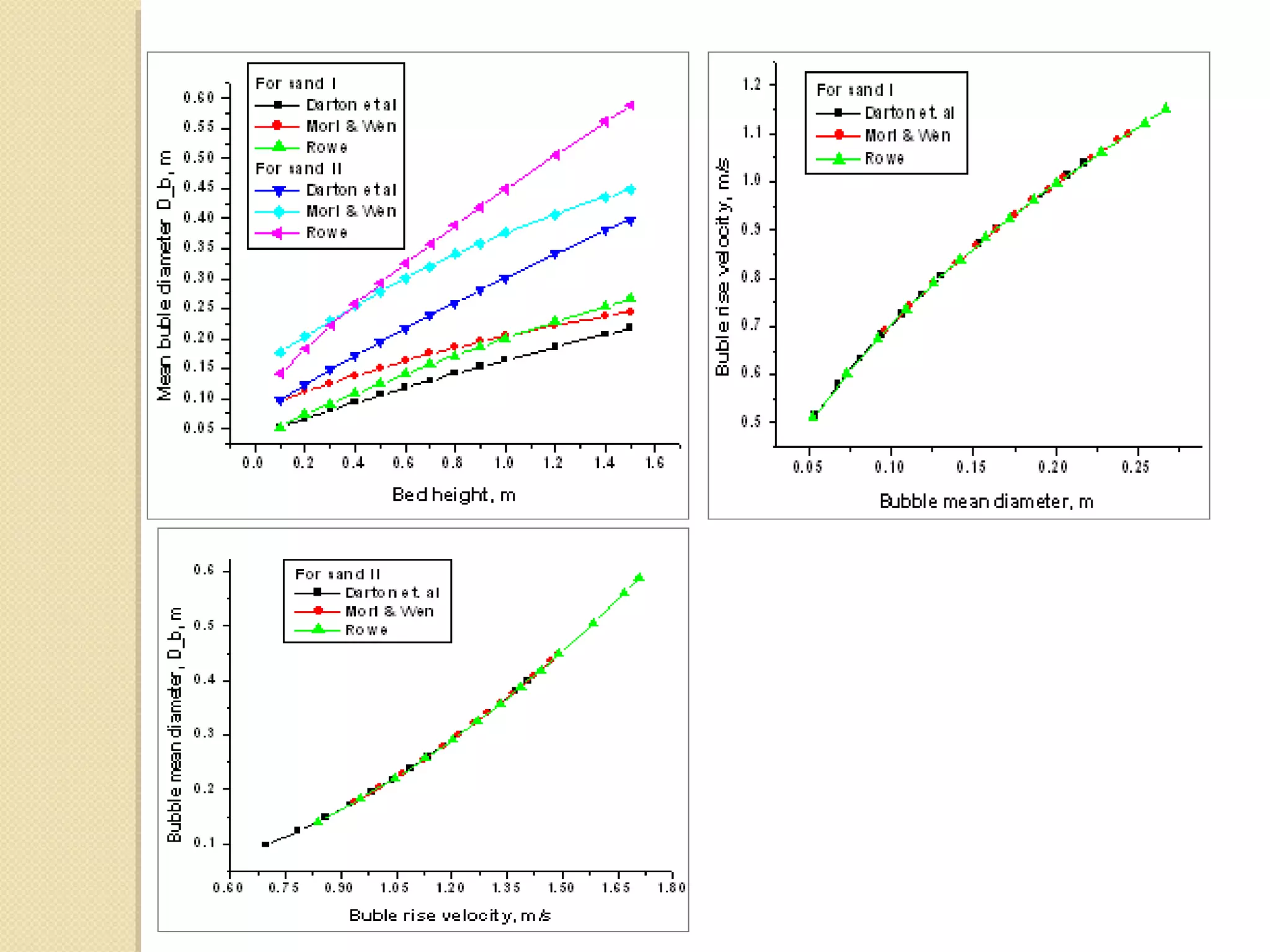
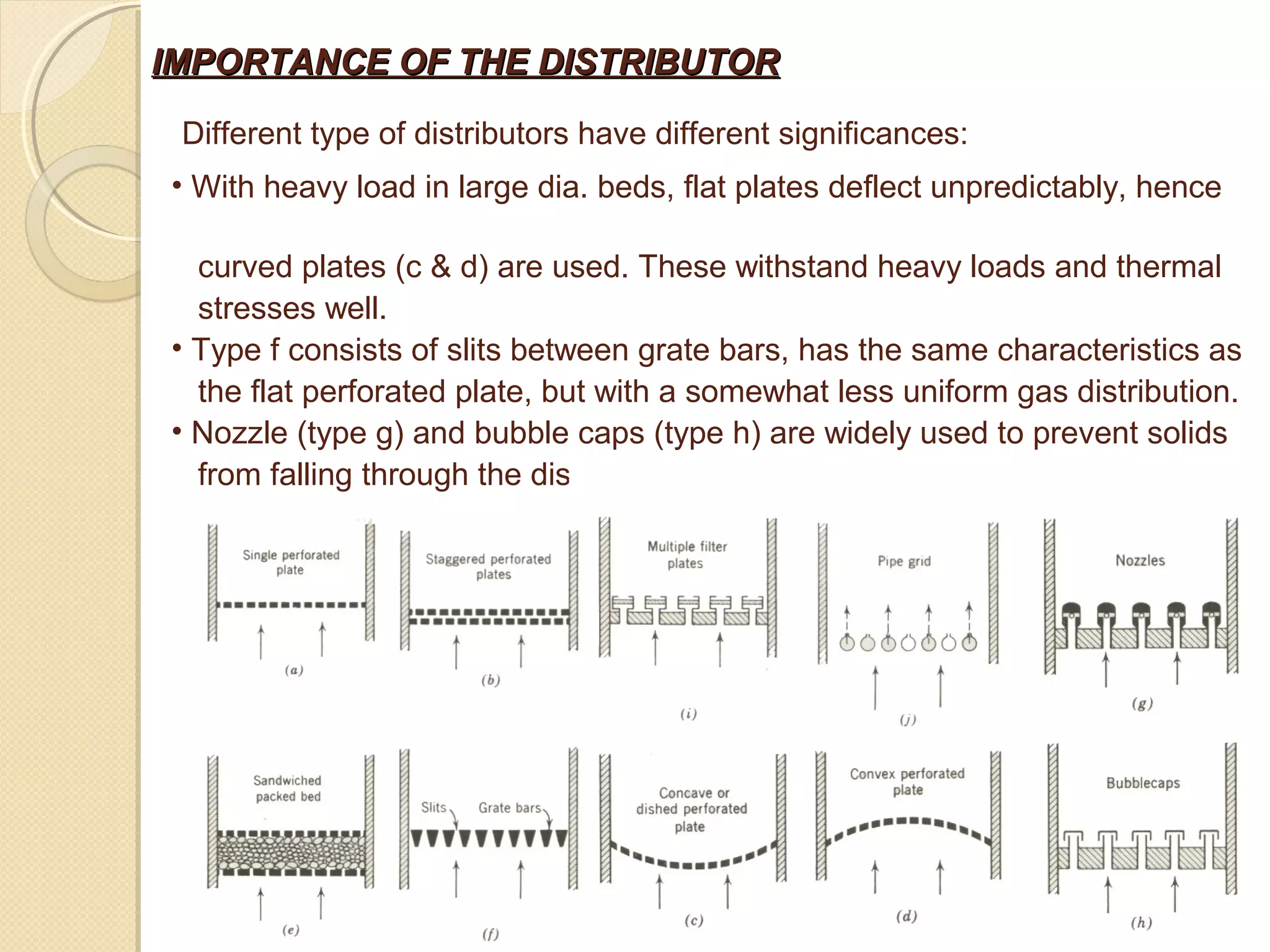
IMPORTANCE OF THE DISTRIBUTOR

 Different type of distributors have different significances:
• With heavy load in large dia. beds, flat plates deflect unpredictably, hence

  curved plates (c & d) are used. These withstand heavy loads and thermal
  stresses well.
• Type f consists of slits between grate bars, has the same characteristics as
  the flat perforated plate, but with a somewhat less uniform gas distribution.
• Nozzle (type g) and bubble caps (type h) are widely used to prevent solids
  from falling through the distributor.
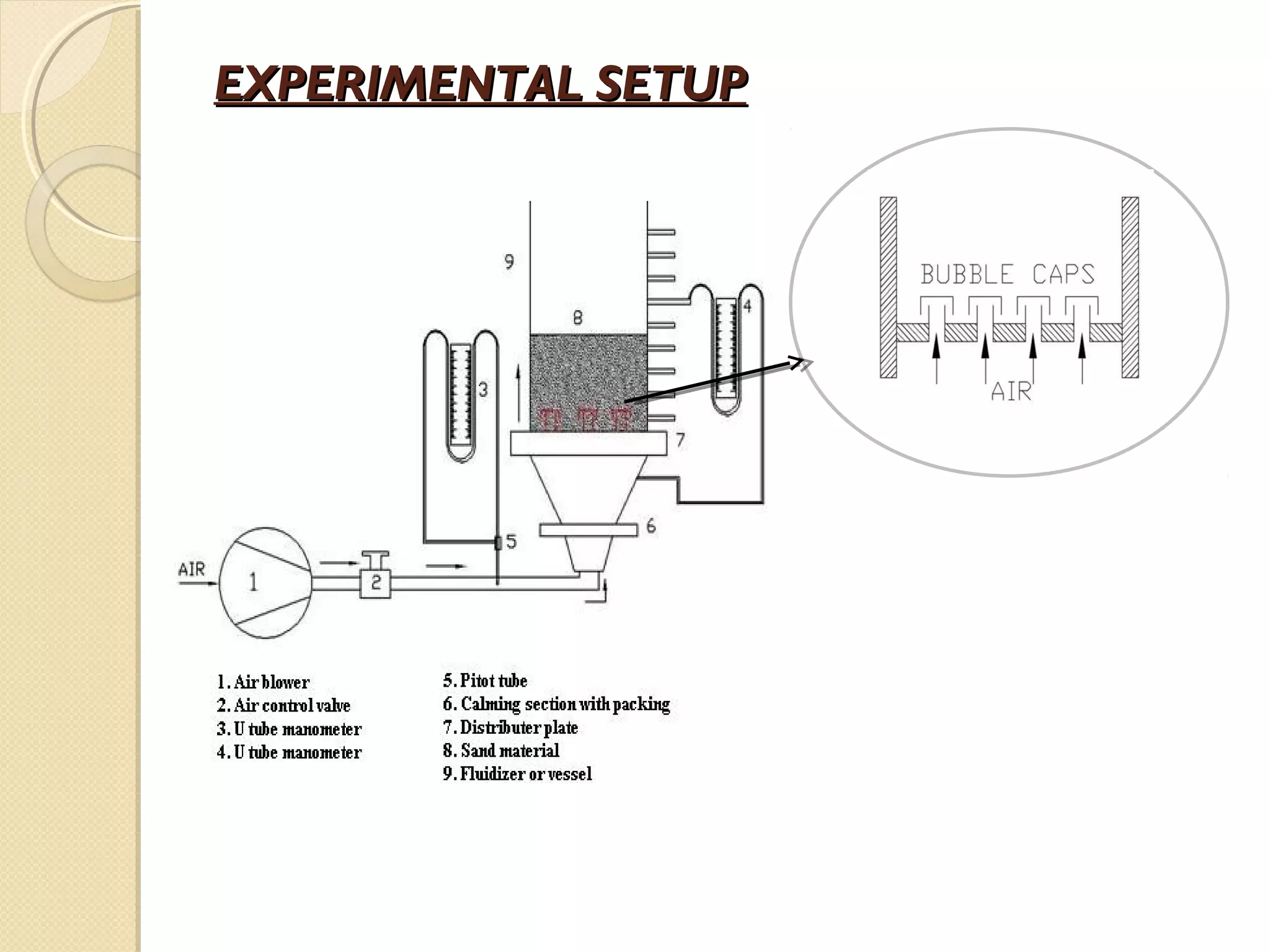
EXPERIMENTAL SETUP
Min. Fluidization Velocity
The pressure drop through fixed beds of has been correlated by Ergun[13] using the
equation:                                                          2
           ∆P           (1 − ε m ) 2 µ g uo         1 − ε m ρ g uo
              g c = 150                       + 1.75 3               ………………….. (1)
                   L           3
                                    εm    (φ s d p )
                                            2
                                                           εm   φsd p
The minimum fluidization occurs when
(drag force by upward moving gas ) = (weight of particles)
or (∆P bed) (Area bed) = (Volume bed) (Fraction of solids) (specific weight of solids)
                                                           g 
or        ∆P. Abed = ( Abed Lmf )(1 − ε mf ) ( ρ s − ρ g )     ………………….. (2)
                                                           gc 
Umf , the superficial velocity of gas at minimum fluidization conditions, is found by
combining eqn. (1) and eqn.(2):
   1.75  d p umf ρ g  150(1 − ε mf )  d p umf ρ g  d p ρ g ( ρ s − ρ g ) g
                        2                                 3
          
        3 
                       +                           =                        ..........................(3)
  φsε mf     µg        φs ε mf
                             2    3     µ                     µg
                                                                    2
                                              g     
The equation (3) can also be written as:
                                                                        1

               d p u mf ρ g                       d p ρg (ρs − ρg )g 
                                                       3                2
                              = ( 33.7 ) + 0.0408
                                         2
     Re mf =                                                           − 33.7   …………………..(4)
                   µg           
                                                         µg
                                                             2
                                                                      
                                                                      
Terminal Velocity of Sand Particles
 The gas flow rate through a fluidized bed is limited on one hand by u mf and on the other by entrainment of
 solids by the gas. When entrainment occurs these solids must be recycled or replaced by fresh material to
 maintain steady-state operations. This upper limit to the gas flow rate is approximated by the terminal or
 free-fall velocity of the particles [14], which can be estimated from fluid mechanics by:
          4 gd p ( ρs − ρg )  2
                                         1

     ut =                     …..…(5)
          
              3ρg C d        
                              
Where Cd is the experimentally determined drag coefficient.
                              10
     C d , spherical =             12
                                        , 0.4<Rep<500 …..…(6)
                            Re p
   The expression for terminal velocity [14] is also given as
below:
                        (      )
                             1
                     4 ρ s − ρ g 2 d p2  2
 U t , spherical   =                     d , 0.4<Rep<500 …..…(7)
                     225    ρ gµ g       p
                                        
Terminal velocity(non-spherical),Ut’=Kt .Ut (spherical) ……... (8)

The correlation factor Kt is obtained by [15] :

                      ϕ 
  K t = 0.843 log 10         For Re <0.2, …... (9)
                      0.065 
        4( ρp − ρg ) gd v 
                                             0. 5

  Kt =                      For Re<1000, …... (10)
       3ρg ( 5.31 −4.88 ϕ) 
                           

 Experimentally, terminal velocity of type sand I and sand II is find out by visual observations i.e. when the inlet air
 flow rate is increased beyond the flow rate at which entrainment of sand particles is started, the pressure drop across
 the bed is decreasing and at certain stage this pressure drop almost tend to zero when there is almost negligible sand
 material in the bed. At this stage, terminal velocity for both sand materials is obtained.
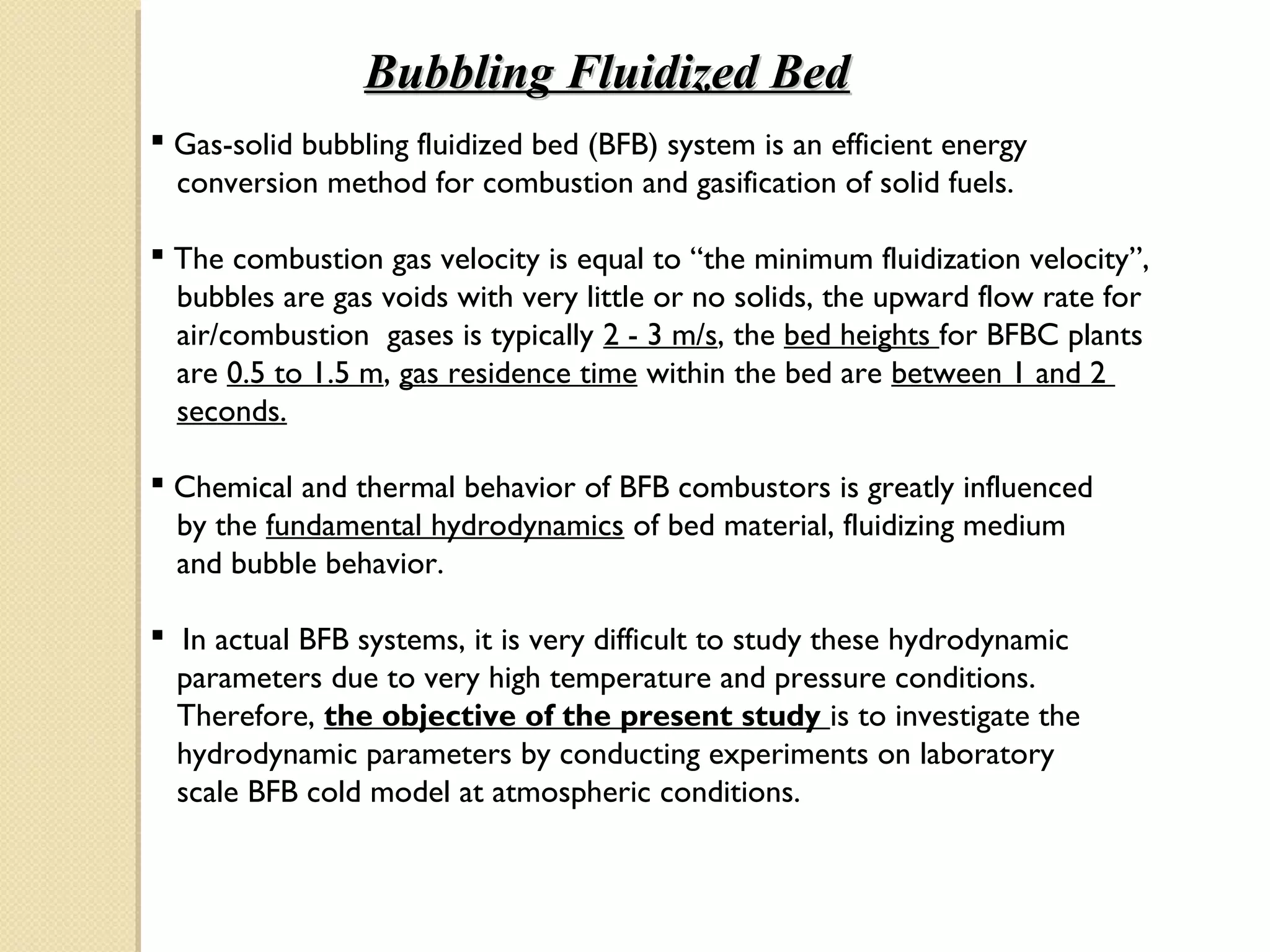
Parameter                         Value     Material Parameters                   Sand I      Sand II
                                          0.00001   Size Range, µm                        150 – 300   212- 600
Viscosity of air, µg, (kg/m.s)                      Sand Mean Diameter, µm                233         518
                                          88
                                                    Particles Density,Kg/m  3
                                                                                          2650        2650
                                                    Bulk Density , Kg/m   3
                                                                                          1431        1378
Diameter of fluidizer/vessel, Dv, (m)     0.5
                                                    Bed Voidage ε                         0.46        0.47
                                                    Min. Fluidization Velocity(Umf)       0.045       0.205
Height of fluidizer/vessel, Hv, (m)       1.5
                                                    Terminal Velocity (Ut)                1.900       4.218
Diameter of inlet air pipe, Dp, (m)       0.084
                                                    Reynolds Number at min. fluidization 2.274        22.983
Diameter of bubble caps, Dbc, (m)         0.013     Reynolds Number at terminal           27.440      135.407
Height of bubble caps, Hbc, (m)           0.075     velocity
Number of bubble caps, Nbc                          Archimedes Number                     1083        11904
                                          85
                                                    Geldart's Classification Group        Group B     Group B
                 Geometric parameters                                          Operating Parameters


                 Theoretical and Experimental Comparison of Umf & Ut for both sand materials
Bubble Behavior
 A.          Minimum Bubbling Velocity (Umb):
 Fluidized systems with a small density difference between fluid and particles expand uniformly, while those
with a large density difference are generally unstable and produce bubbling. The lowest gas velocity at which
bubbling occurs is called the minimum bubbling velocity. There are two correlations are presented to find u mb:
   1) The correlation to find umb is given by Broadhurst and Becker [16] :
                                                                   
                                                                   
                  d pU mb ρ g                      Ar              
        Re mb   =            =                                          …………… (11)
                      µg                                     0.22  
                                9.8 × 10⁴ Ar − 0.82  ρ s  + 35.4 
                                                      ρ 
                               
                                                         g       
                                                                    
     2) Geldart[17] suggested a correlation for minimum bubbling velocity as:
         U mb = K mb ×d p …………… (12)
 Where Kmb is a constant whose value is 100 in cgs system. Davison & Harrison observed that the interval
 between minimum bubbling velocity and minimum fluidization velocity represents the stable uniform
 fluidization, which shrinks rapidly as the size of the particles increases.

  B.        Bubble size
  There are several methods of observing bubbles in gas-solid fluidized beds:
  1)        Simple methods like visual observation if vessel is transparent,
  2)        still or cine photography,
  3)        using probes,
  4)        using two dimensional beds,
  5)        X-ray observation,
  6)        observation of particle movement,
  7)        observation of single isolated bubble.
The major advance in the study of fluid beds came with the investigations of single, isolated bubbles. The
Davison model remains useful as a first approximation. An isolated bubble in a fluid bed takes the form of an
indented sphere. The leading spherical surface is called the roof and the apex is the nose. The solids filling the
indentation are transported with the bubble for natural sand from 100 to 600 µm the wake fraction was from
0.22 to 0.28. The rise in velocity of an isolated bubble [18] depends on its size, given as:

                     1
 U b = 0.79 gVb          2       = 0.711 gDb            …………… (13)


 C.         Bubble growth and coalescence
 After detachment from the distributor, bubbles interact as they rise in the bed. The coalescence of a pair of
 bubbles has been investigated by Clift and Grace [19,20] and by Toei and Matsuno[21]. There are several
 characteristics of the coalescence process. The leading bubble spreads horizontally as the trailing bubble
 elongates and accelerates into the wake of the leader. The volume of two bubbles increases by 20-30%
 during coalescence, followed by a 10% decrease during consolidation after wake entry, giving a net volume
 increase of 10-20%. There is increased gas flow through the emulsion phase between the bubbles. The
 following relation finds the maximum size:


                             (          )
                                                 0. 4
                Dbed 2 U 0 − U mf           
  D b∞   = 2.35                                       …………… (14)
               
                                           g
                                             
Bubble growth and splitting lead to a distribution of bubble size in the bed. Agarwal used a population balance to calculate the
bubble distribution. Three correlations have been found to be reliable for mean bubble size.

1) Mori & Wen [22] use the initial and maximum bubble sizes with first order growth rate (as it is the
   most popular equation for calculation). With distributor plate having Bubble cap,


 Db ( H ) = Db∞ − ( Db∞ − Db 0 ) exp  − 0.3H
                                     
                                                   .............(15)
                                             Dbed 
                                                   
2) Darton [23] has suggested another correlation for bubble size and the same is represented as:
                                                                                        0 .8
                                                                                     
                   0.54(u −u mf             )                              Abed
                                                0 .4
                                                       H + 4                         
                                                                          N or       
     Db ( H ) =                                                                               …………….. (16)
                                                       0 .2
                                                 g
3) Rowe [24] proposed a correlation to predict bubble size in a gas-solid fluidized bed (when size is
               not
   restricted by the column dimension) as:

                  (U 0 −U mf ) 12 ( H + H 0 ) 3 4
     Db ( H ) =                     1
                                                                        …………….. (17)
                                g       4

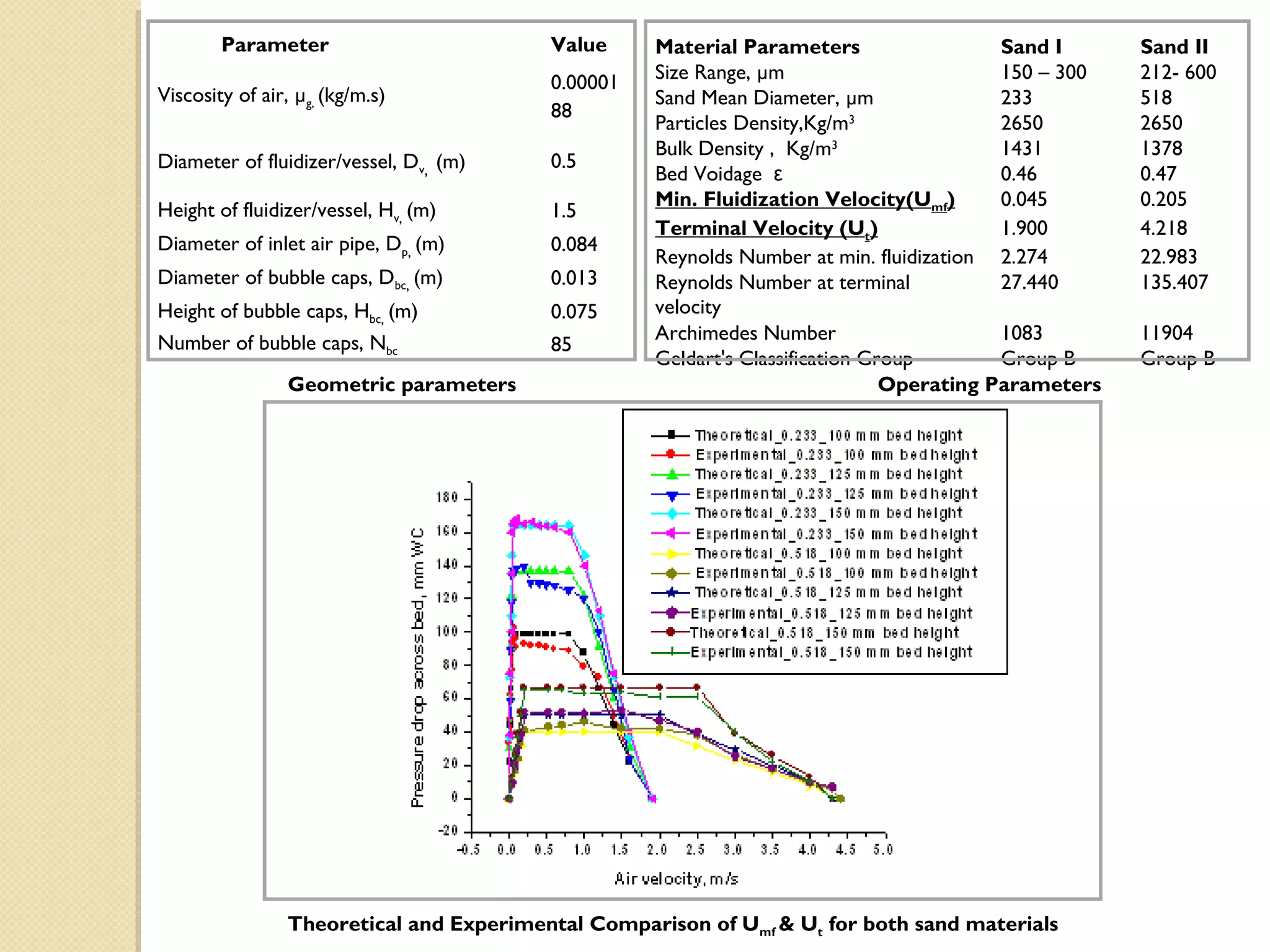
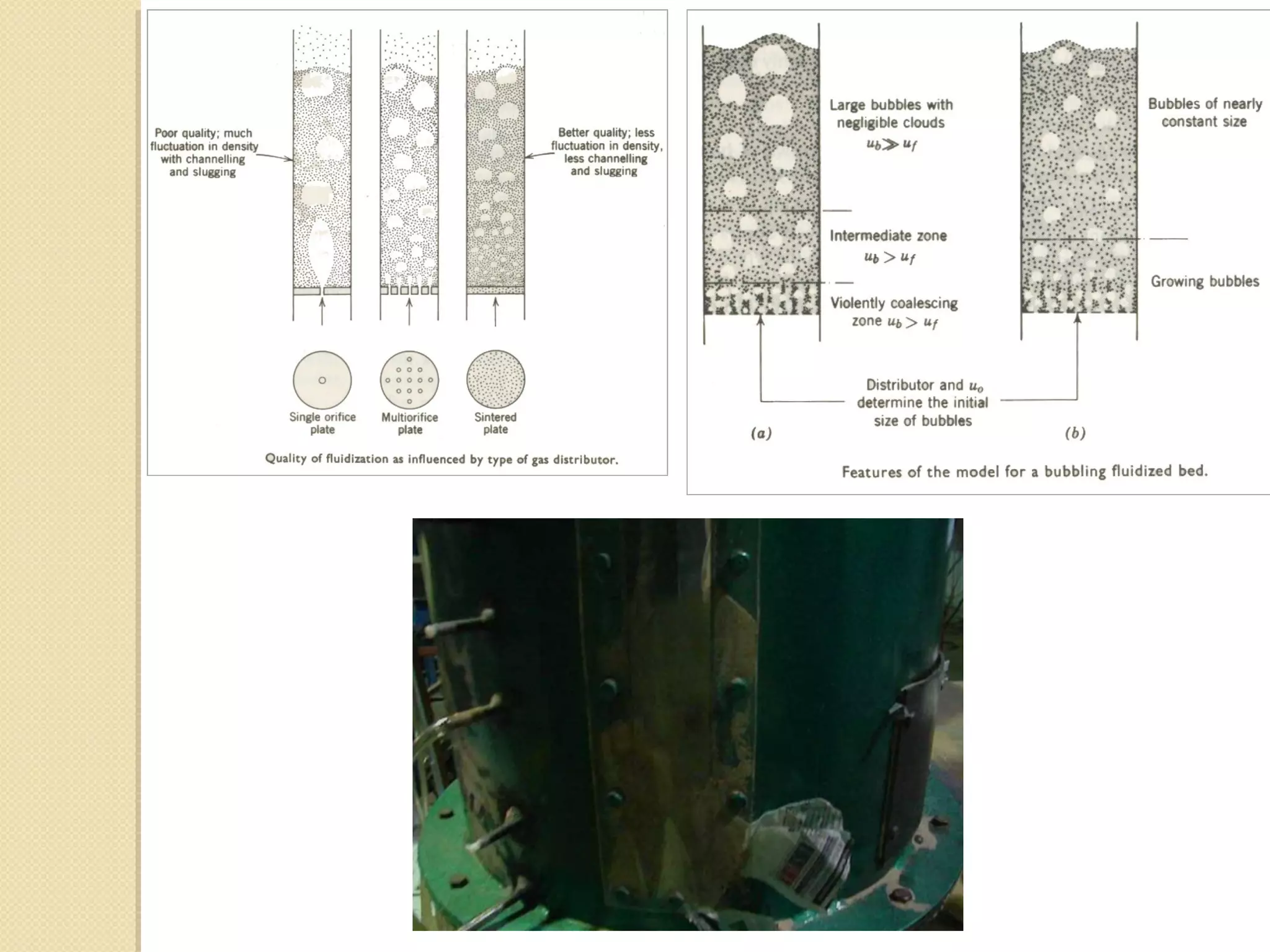
 Table . Comparisons between bubble size for both sand materials:

       Ref.             Darton [23]                                    Mori [22]                          Rowe [24]
                   Sand I         Sand II                     Sand I               Sand II         Sand I          Sand II
        Uo     0.158         0.718                     -                    -                  0.158          0.718
       Umf     0.045         0.205                     0.045                0.205              0.045          0.205
        H      0.1-1.5       0.1-1.5                   0.1-1.5              0.1-1.5            0.1-1.5        0.1-1.5
       Dbed    0.5           0.5                       0.5                  0.5                0.5            0.5
       Abed    0.196         0.196                     0.196                0.196              0.196          0.196
       Nor     85            85                        85                   85                 85             85
       Dmax.   0.357         0.654                     0.357                0.654              0.357          0.654
       Dmin.   0.080         0.147                     0.080                0.147              0.080          0.147
        Db     0.053-0.217   0.098-0.399               0.096-0.244          0.176-0.448        0.052-0.267    0.142-0.588
        Ub     0.514-1.038   0.697-1.406               0.691-1.101          0.936-1.491        0.509-1.151    0.838-1.708
Results & Conclusion
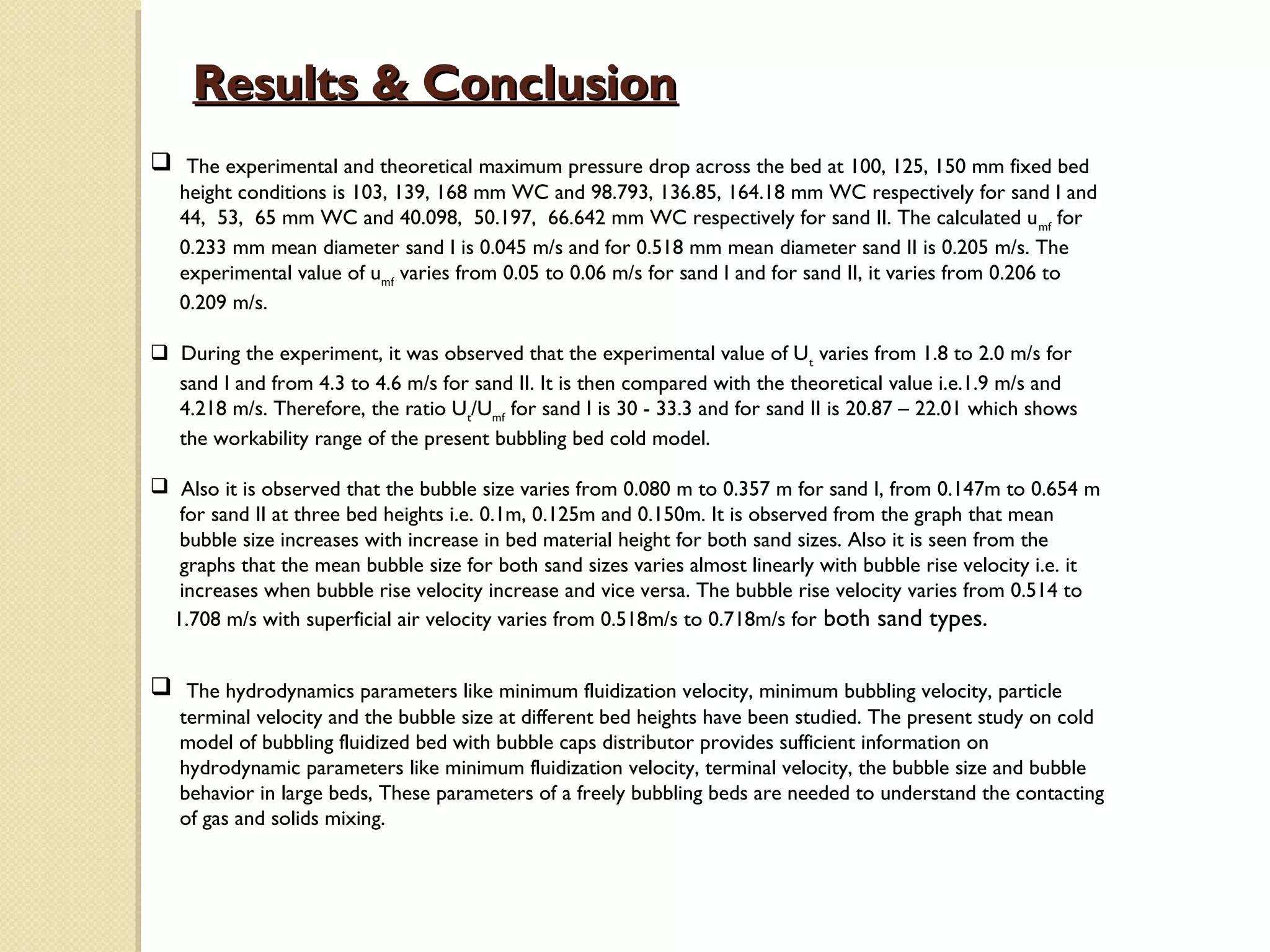
 The experimental and theoretical maximum pressure drop across the bed at 100, 125, 150 mm fixed bed
   height conditions is 103, 139, 168 mm WC and 98.793, 136.85, 164.18 mm WC respectively for sand I and
   44, 53, 65 mm WC and 40.098, 50.197, 66.642 mm WC respectively for sand II. The calculated u mf for
   0.233 mm mean diameter sand I is 0.045 m/s and for 0.518 mm mean diameter sand II is 0.205 m/s. The
   experimental value of umf varies from 0.05 to 0.06 m/s for sand I and for sand II, it varies from 0.206 to
   0.209 m/s.

 During the experiment, it was observed that the experimental value of U t varies from 1.8 to 2.0 m/s for
  sand I and from 4.3 to 4.6 m/s for sand II. It is then compared with the theoretical value i.e.1.9 m/s and
  4.218 m/s. Therefore, the ratio Ut/Umf for sand I is 30 - 33.3 and for sand II is 20.87 – 22.01 which shows
  the workability range of the present bubbling bed cold model.

 Also it is observed that the bubble size varies from 0.080 m to 0.357 m for sand I, from 0.147m to 0.654 m
  for sand II at three bed heights i.e. 0.1m, 0.125m and 0.150m. It is observed from the graph that mean
  bubble size increases with increase in bed material height for both sand sizes. Also it is seen from the
  graphs that the mean bubble size for both sand sizes varies almost linearly with bubble rise velocity i.e. it
  increases when bubble rise velocity increase and vice versa. The bubble rise velocity varies from 0.514 to
 1.708 m/s with superficial air velocity varies from 0.518m/s to 0.718m/s for both sand types.


 The hydrodynamics parameters like minimum fluidization velocity, minimum bubbling velocity, particle
   terminal velocity and the bubble size at different bed heights have been studied. The present study on cold
   model of bubbling fluidized bed with bubble caps distributor provides sufficient information on
   hydrodynamic parameters like minimum fluidization velocity, terminal velocity, the bubble size and bubble
   behavior in large beds, These parameters of a freely bubbling beds are needed to understand the contacting
   of gas and solids mixing.
Future Work
Results   will be used in hot model
 bubbling fluidized bed gasifier for
 generation of hydrogen from the biomass
 gasification of rice husk.
A CFD analysis will be done.
Hydrodynamic study bfb ieee_bangalore

Hydrodynamic study bfb ieee_bangalore

  • 1.
    Hydrodynamic Study ofCold Model Bubbling Fluidized Bed System Using Bubble Caps By Mandeep Sharma Dinanath Akela (Project Assistant, CMERI Durgapur) (Engineer, THERMAX Pune) Central Mechanical Engineering Research Institute, Durgapur 713209, West Bengal, India
  • 2.
    WHAT IS FLUIDIZEDBED ? ? Fluidized Bed is a system in which the air distributed by a grid or distribution plate, is blown through the bed solids developing a “Fluidized Condition”, which is formed when fine solid particles are transformed into a fluid like state through contact with a gas or a liquid.
  • 3.
    CHARACTERISTICS OF FLUIDIZEDBED Fluidized beds display a number of liquid-like properties:  Lighter objects float on top of the bed (i.e., objects less dense than the bulk density of the bed),  The surface stays horizontal even in tilted beds,  The solids can flow through an opening in the vessel just like a liquid,  The beds have a “static” pressure head due to gravity, given by ρ0gh,  Levels between two similar fluidized beds equalize their static pressure heads. ADVANTAGES OF FLUIDIZED BED  Rapid mixing of solids, uniform temperature and concentrations.  Applicable for large or small scale operations.  Heat and mass transfer rates between gas and particles are high as compared to other modes of contacting.  There is no moving part and hence a fluidized bed reactor is not mechanically agitated reactor. So, maintenance cost can be low.  The reactor is mounted vertically and save space. APPLICATIONS  Reactors for Cracking hydrocarbons, Coal gasification, Carbonization, Calcination.  Heat exchangers, Drying operations, Coating (example, metals with polymer)  Solidification/Granulation, Adsorption/desorption, Bio-fuel generation
  • 4.
  • 5.
    CLASSIFICATION OF FBCTECHNOLOGY…
  • 6.
    Bubbling Fluidized Bed Gas-solid bubbling fluidized bed (BFB) system is an efficient energy conversion method for combustion and gasification of solid fuels.  The combustion gas velocity is equal to “the minimum fluidization velocity”, bubbles are gas voids with very little or no solids, the upward flow rate for air/combustion gases is typically 2 - 3 m/s, the bed heights for BFBC plants are 0.5 to 1.5 m, gas residence time within the bed are between 1 and 2 seconds.  Chemical and thermal behavior of BFB combustors is greatly influenced by the fundamental hydrodynamics of bed material, fluidizing medium and bubble behavior.  In actual BFB systems, it is very difficult to study these hydrodynamic parameters due to very high temperature and pressure conditions. Therefore, the objective of the present study is to investigate the hydrodynamic parameters by conducting experiments on laboratory scale BFB cold model at atmospheric conditions.
  • 7.
    IMPORTANCE OF THEDISTRIBUTOR Different type of distributors have different significances: • With heavy load in large dia. beds, flat plates deflect unpredictably, hence curved plates (c & d) are used. These withstand heavy loads and thermal stresses well. • Type f consists of slits between grate bars, has the same characteristics as the flat perforated plate, but with a somewhat less uniform gas distribution. • Nozzle (type g) and bubble caps (type h) are widely used to prevent solids from falling through the distributor.
  • 8.
  • 9.
    Min. Fluidization Velocity Thepressure drop through fixed beds of has been correlated by Ergun[13] using the equation: 2 ∆P (1 − ε m ) 2 µ g uo 1 − ε m ρ g uo g c = 150 + 1.75 3 ………………….. (1) L 3 εm (φ s d p ) 2 εm φsd p The minimum fluidization occurs when (drag force by upward moving gas ) = (weight of particles) or (∆P bed) (Area bed) = (Volume bed) (Fraction of solids) (specific weight of solids)  g  or ∆P. Abed = ( Abed Lmf )(1 − ε mf ) ( ρ s − ρ g )  ………………….. (2)  gc  Umf , the superficial velocity of gas at minimum fluidization conditions, is found by combining eqn. (1) and eqn.(2): 1.75  d p umf ρ g  150(1 − ε mf )  d p umf ρ g  d p ρ g ( ρ s − ρ g ) g 2 3  3   +  = ..........................(3) φsε mf  µg   φs ε mf 2 3  µ  µg 2  g  The equation (3) can also be written as: 1 d p u mf ρ g  d p ρg (ρs − ρg )g  3 2 = ( 33.7 ) + 0.0408 2 Re mf =  − 33.7 …………………..(4) µg   µg 2  
  • 10.
    Terminal Velocity ofSand Particles The gas flow rate through a fluidized bed is limited on one hand by u mf and on the other by entrainment of solids by the gas. When entrainment occurs these solids must be recycled or replaced by fresh material to maintain steady-state operations. This upper limit to the gas flow rate is approximated by the terminal or free-fall velocity of the particles [14], which can be estimated from fluid mechanics by: 4 gd p ( ρs − ρg )  2 1 ut =   …..…(5)   3ρg C d   Where Cd is the experimentally determined drag coefficient. 10 C d , spherical = 12 , 0.4<Rep<500 …..…(6) Re p The expression for terminal velocity [14] is also given as below: ( ) 1  4 ρ s − ρ g 2 d p2  2 U t , spherical =  d , 0.4<Rep<500 …..…(7)  225 ρ gµ g  p   Terminal velocity(non-spherical),Ut’=Kt .Ut (spherical) ……... (8) The correlation factor Kt is obtained by [15] :  ϕ  K t = 0.843 log 10   For Re <0.2, …... (9)  0.065   4( ρp − ρg ) gd v  0. 5 Kt =   For Re<1000, …... (10) 3ρg ( 5.31 −4.88 ϕ)    Experimentally, terminal velocity of type sand I and sand II is find out by visual observations i.e. when the inlet air flow rate is increased beyond the flow rate at which entrainment of sand particles is started, the pressure drop across the bed is decreasing and at certain stage this pressure drop almost tend to zero when there is almost negligible sand material in the bed. At this stage, terminal velocity for both sand materials is obtained.
  • 11.
    Parameter Value Material Parameters Sand I Sand II 0.00001 Size Range, µm 150 – 300 212- 600 Viscosity of air, µg, (kg/m.s) Sand Mean Diameter, µm 233 518 88 Particles Density,Kg/m 3 2650 2650 Bulk Density , Kg/m 3 1431 1378 Diameter of fluidizer/vessel, Dv, (m) 0.5 Bed Voidage ε 0.46 0.47 Min. Fluidization Velocity(Umf) 0.045 0.205 Height of fluidizer/vessel, Hv, (m) 1.5 Terminal Velocity (Ut) 1.900 4.218 Diameter of inlet air pipe, Dp, (m) 0.084 Reynolds Number at min. fluidization 2.274 22.983 Diameter of bubble caps, Dbc, (m) 0.013 Reynolds Number at terminal 27.440 135.407 Height of bubble caps, Hbc, (m) 0.075 velocity Number of bubble caps, Nbc Archimedes Number 1083 11904 85 Geldart's Classification Group Group B Group B Geometric parameters Operating Parameters Theoretical and Experimental Comparison of Umf & Ut for both sand materials
  • 12.
    Bubble Behavior A. Minimum Bubbling Velocity (Umb): Fluidized systems with a small density difference between fluid and particles expand uniformly, while those with a large density difference are generally unstable and produce bubbling. The lowest gas velocity at which bubbling occurs is called the minimum bubbling velocity. There are two correlations are presented to find u mb: 1) The correlation to find umb is given by Broadhurst and Becker [16] :     d pU mb ρ g  Ar  Re mb = = …………… (11) µg  0.22   9.8 × 10⁴ Ar − 0.82  ρ s  + 35.4   ρ     g   2) Geldart[17] suggested a correlation for minimum bubbling velocity as: U mb = K mb ×d p …………… (12) Where Kmb is a constant whose value is 100 in cgs system. Davison & Harrison observed that the interval between minimum bubbling velocity and minimum fluidization velocity represents the stable uniform fluidization, which shrinks rapidly as the size of the particles increases. B. Bubble size There are several methods of observing bubbles in gas-solid fluidized beds: 1) Simple methods like visual observation if vessel is transparent, 2) still or cine photography, 3) using probes, 4) using two dimensional beds, 5) X-ray observation, 6) observation of particle movement, 7) observation of single isolated bubble.
  • 13.
    The major advancein the study of fluid beds came with the investigations of single, isolated bubbles. The Davison model remains useful as a first approximation. An isolated bubble in a fluid bed takes the form of an indented sphere. The leading spherical surface is called the roof and the apex is the nose. The solids filling the indentation are transported with the bubble for natural sand from 100 to 600 µm the wake fraction was from 0.22 to 0.28. The rise in velocity of an isolated bubble [18] depends on its size, given as: 1 U b = 0.79 gVb 2 = 0.711 gDb …………… (13) C. Bubble growth and coalescence After detachment from the distributor, bubbles interact as they rise in the bed. The coalescence of a pair of bubbles has been investigated by Clift and Grace [19,20] and by Toei and Matsuno[21]. There are several characteristics of the coalescence process. The leading bubble spreads horizontally as the trailing bubble elongates and accelerates into the wake of the leader. The volume of two bubbles increases by 20-30% during coalescence, followed by a 10% decrease during consolidation after wake entry, giving a net volume increase of 10-20%. There is increased gas flow through the emulsion phase between the bubbles. The following relation finds the maximum size: ( ) 0. 4  Dbed 2 U 0 − U mf  D b∞ = 2.35  …………… (14)   g  Bubble growth and splitting lead to a distribution of bubble size in the bed. Agarwal used a population balance to calculate the bubble distribution. Three correlations have been found to be reliable for mean bubble size. 1) Mori & Wen [22] use the initial and maximum bubble sizes with first order growth rate (as it is the most popular equation for calculation). With distributor plate having Bubble cap, Db ( H ) = Db∞ − ( Db∞ − Db 0 ) exp  − 0.3H  .............(15)  Dbed  
  • 14.
    2) Darton [23]has suggested another correlation for bubble size and the same is represented as: 0 .8   0.54(u −u mf ) Abed 0 .4 H + 4   N or  Db ( H ) =   …………….. (16) 0 .2 g 3) Rowe [24] proposed a correlation to predict bubble size in a gas-solid fluidized bed (when size is not restricted by the column dimension) as: (U 0 −U mf ) 12 ( H + H 0 ) 3 4 Db ( H ) = 1 …………….. (17) g 4 Table . Comparisons between bubble size for both sand materials: Ref. Darton [23] Mori [22] Rowe [24] Sand I Sand II Sand I Sand II Sand I Sand II Uo 0.158 0.718 - - 0.158 0.718 Umf 0.045 0.205 0.045 0.205 0.045 0.205 H 0.1-1.5 0.1-1.5 0.1-1.5 0.1-1.5 0.1-1.5 0.1-1.5 Dbed 0.5 0.5 0.5 0.5 0.5 0.5 Abed 0.196 0.196 0.196 0.196 0.196 0.196 Nor 85 85 85 85 85 85 Dmax. 0.357 0.654 0.357 0.654 0.357 0.654 Dmin. 0.080 0.147 0.080 0.147 0.080 0.147 Db 0.053-0.217 0.098-0.399 0.096-0.244 0.176-0.448 0.052-0.267 0.142-0.588 Ub 0.514-1.038 0.697-1.406 0.691-1.101 0.936-1.491 0.509-1.151 0.838-1.708
  • 17.
    Results & Conclusion The experimental and theoretical maximum pressure drop across the bed at 100, 125, 150 mm fixed bed height conditions is 103, 139, 168 mm WC and 98.793, 136.85, 164.18 mm WC respectively for sand I and 44, 53, 65 mm WC and 40.098, 50.197, 66.642 mm WC respectively for sand II. The calculated u mf for 0.233 mm mean diameter sand I is 0.045 m/s and for 0.518 mm mean diameter sand II is 0.205 m/s. The experimental value of umf varies from 0.05 to 0.06 m/s for sand I and for sand II, it varies from 0.206 to 0.209 m/s.  During the experiment, it was observed that the experimental value of U t varies from 1.8 to 2.0 m/s for sand I and from 4.3 to 4.6 m/s for sand II. It is then compared with the theoretical value i.e.1.9 m/s and 4.218 m/s. Therefore, the ratio Ut/Umf for sand I is 30 - 33.3 and for sand II is 20.87 – 22.01 which shows the workability range of the present bubbling bed cold model.  Also it is observed that the bubble size varies from 0.080 m to 0.357 m for sand I, from 0.147m to 0.654 m for sand II at three bed heights i.e. 0.1m, 0.125m and 0.150m. It is observed from the graph that mean bubble size increases with increase in bed material height for both sand sizes. Also it is seen from the graphs that the mean bubble size for both sand sizes varies almost linearly with bubble rise velocity i.e. it increases when bubble rise velocity increase and vice versa. The bubble rise velocity varies from 0.514 to 1.708 m/s with superficial air velocity varies from 0.518m/s to 0.718m/s for both sand types.  The hydrodynamics parameters like minimum fluidization velocity, minimum bubbling velocity, particle terminal velocity and the bubble size at different bed heights have been studied. The present study on cold model of bubbling fluidized bed with bubble caps distributor provides sufficient information on hydrodynamic parameters like minimum fluidization velocity, terminal velocity, the bubble size and bubble behavior in large beds, These parameters of a freely bubbling beds are needed to understand the contacting of gas and solids mixing.
  • 18.
    Future Work Results will be used in hot model bubbling fluidized bed gasifier for generation of hydrogen from the biomass gasification of rice husk. A CFD analysis will be done.