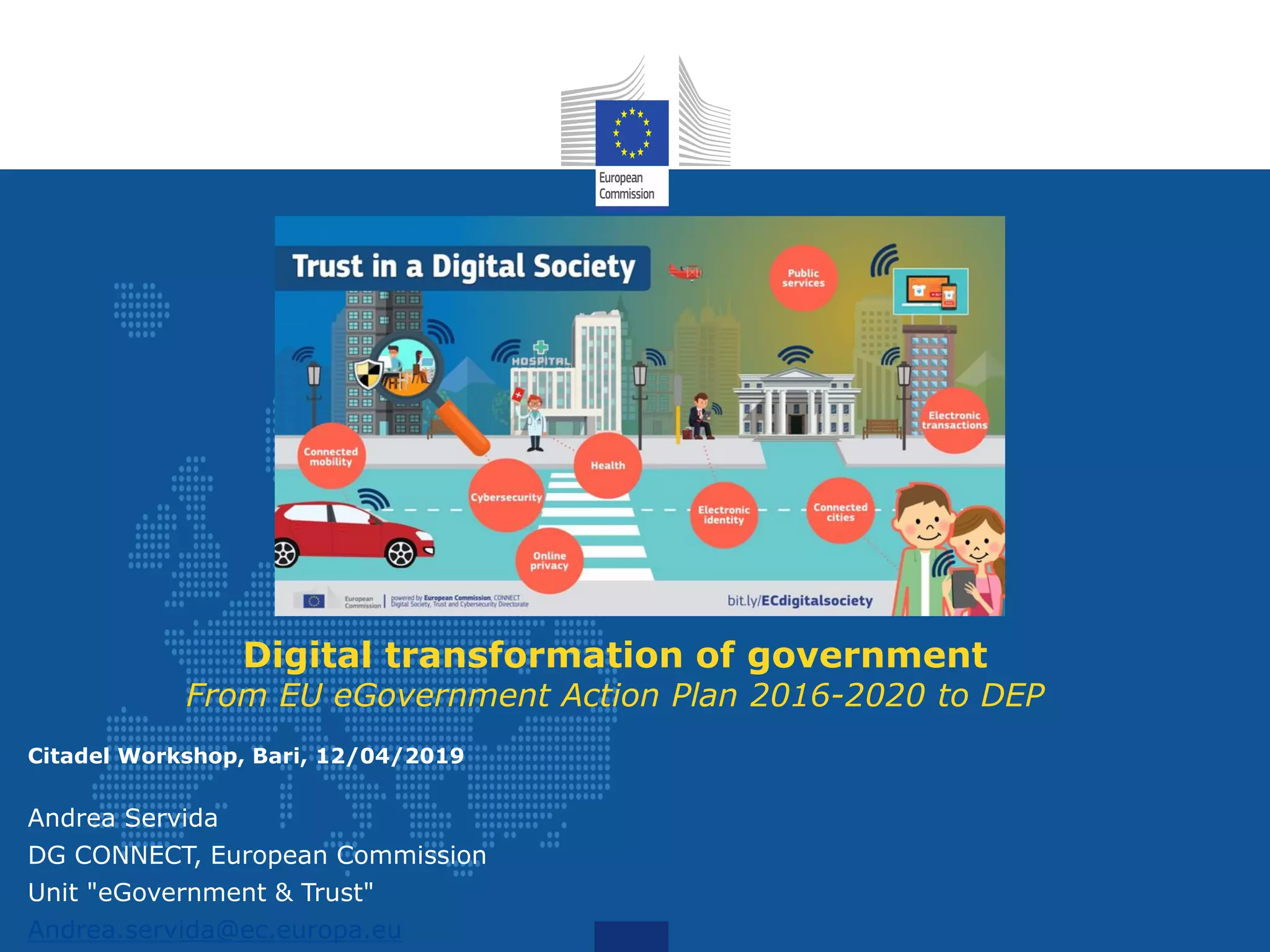
Digital transformation of government
From EU eGovernment Action Plan 2016-2020 to DEP
Citadel Workshop, Bari, 12/04/2019
Andrea Servida
DG CONNECT, European Commission
Unit "eGovernment & Trust"
Andrea.servida@ec.europa.eu
A new Action Plan to make:
• digital public services reduce administrative burden on
businesses and citizens by making their interactions with
public administrations faster and efficient, more
convenient and transparent, and less costly
• seamless cross-border and digital public services contribute
to competitiveness and make the EU a more attractive
place to invest and live in
• public administrations and public institutions in the EU
be open, efficient and inclusive, providing borderless,
personalised, user-friendly, end-to-end digital public services
to all citizens and businesses in the EU
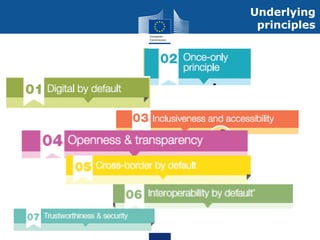
Underlying
principles
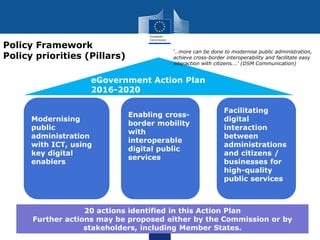
Modernising
public
administration
with ICT, using
key digital
enablers
Enabling cross-
border mobility
with
interoperable
digital public
services
Facilitating
digital
interaction
between
administrations
and citizens /
businesses for
high-quality
public services
eGovernment Action Plan
2016-2020
'…more can be done to modernise public administration,
achieve cross-border interoperability and facilitate easy
interaction with citizens….' (DSM Communication)
Policy Framework
Policy priorities (Pillars)
20 actions identified in this Action Plan
Further actions may be proposed either by the Commission or by
stakeholders, including Member States.
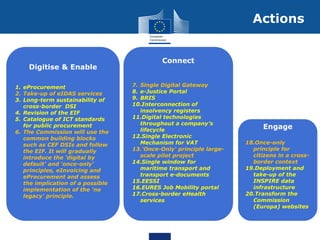
Digitise & Enable
1. eProcurement
2. Take-up of eIDAS services
3. Long-term sustainability of
cross-border DSI
4. Revision of the EIF
5. Catalogue of ICT standards
for public procurement
6. The Commission will use the
common building blocks
such as CEF DSIs and follow
the EIF. It will gradually
introduce the 'digital by
default' and 'once-only'
principles, eInvoicing and
eProcurement and assess
the implication of a possible
implementation of the 'no
legacy' principle.
Connect
7. Single Digital Gateway
8. e-Justice Portal
9. BRIS
10.Interconnection of
insolvency registers
11.Digital technologies
throughout a company’s
lifecycle
12.Single Electronic
Mechanism for VAT
13.'Once-Only' principle large-
scale pilot project
14.Single window for
maritime transport and
transport e-documents
15.EESSI
16.EURES Job Mobility portal
17.Cross-border eHealth
services
Engage
18.Once-only
principle for
citizens in a cross-
border context
19.Deployment and
take-up of the
INSPIRE data
infrastructure
20.Transform the
Commission
(Europa) websites
Actions
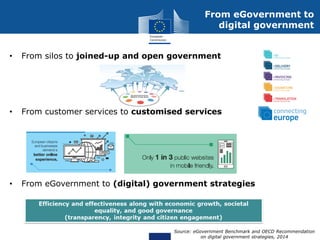
• From silos to joined-up and open government
• From customer services to customised services
• From eGovernment to (digital) government strategies
From eGovernment to
digital government
Source: eGovernment Benchmark and OECD Recommendation
on digital government strategies, 2014
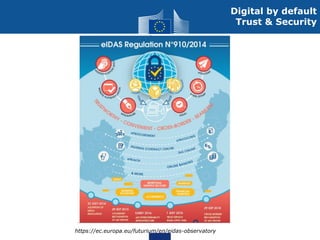
Digital by default
Trust & Security
https://ec.europa.eu/futurium/en/eidas-observatory
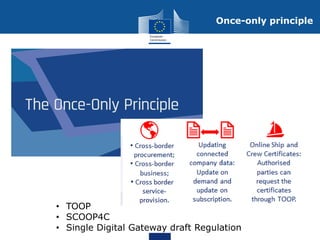
Once-only principle
• TOOP
• SCOOP4C
• Single Digital Gateway draft Regulation
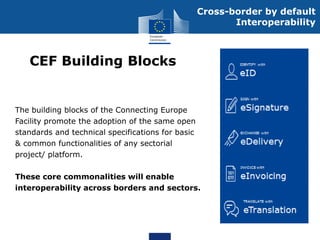
CEF Building Blocks
The building blocks of the Connecting Europe
Facility promote the adoption of the same open
standards and technical specifications for basic
& common functionalities of any sectorial
project/ platform.
These core commonalities will enable
interoperability across borders and sectors.
Cross-border by default
Interoperability
Incentives
We will in our countries: commit to expand and deepen the exchange and sharing
of good eGovernment practices and to speed up the digital transformation at all
levels of government
We will in the next five years (2018-2022) take steps […] in our public
administrations
Tallinn Ministerial Declaration on eGovernment
6 October 2017
https://ec.europa.eu/digital-single-market/en/news/ministerial-
declaration-egovernment-tallinn-declaration
eGovernment Action Plan 2016-2020 serves 'as a catalyst to
coordinate public sector modernisation efforts' across the EU
COM (2016)179 final
• Speeding up the implementation of the eIDAS regulation, including the
notification of electronic identity schemes
• Making digital public services secure and identifiable by using the eIDAS
framework for qualified electronic trust services
• Introducing once-only options in digital public services by collaboration
and data exchange, including with other countries
• Re-use of the Digital Service Infrastructures developed under the
Connecting Europe Facility
Tallinn Declaration
on eGovernment
• enabling users to digitally interact with public
administrations;
• making these services easy to understand;
• requesting citizens and businesses only once the
same information, respecting data protection and
privacy;
• engaging citizens in the creation of public services
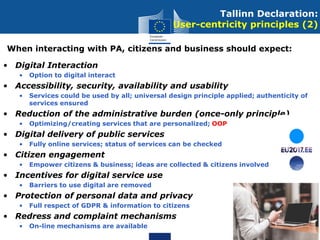
Tallinn Declaration:
User-centricity principles
With these principles Member States commit to:
• Digital Interaction
• Option to digital interact
• Accessibility, security, availability and usability
• Services could be used by all; universal design principle applied; authenticity of
services ensured
• Reduction of the administrative burden (once-only principle)
• Optimizing/creating services that are personalized; OOP
• Digital delivery of public services
• Fully online services; status of services can be checked
• Citizen engagement
• Empower citizens & business; ideas are collected & citizens involved
• Incentives for digital service use
• Barriers to use digital are removed
• Protection of personal data and privacy
• Full respect of GDPR & information to citizens
• Redress and complaint mechanisms
• On-line mechanisms are available
Tallinn Declaration:
User-centricity principles (2)
When interacting with PA, citizens and business should expect:
OVERVIEW –
DIGITAL IN MFF 2021-2027
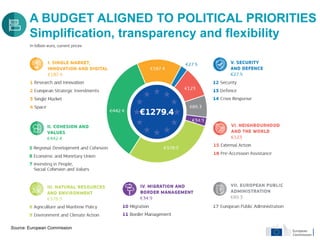
A BUDGET ALIGNED TO POLITICAL PRIORITIES
Simplification, transparency and flexibility
Source: European Commission
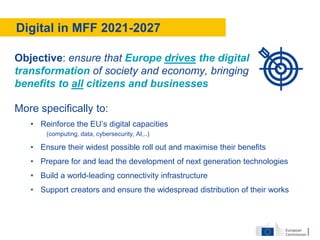
More specifically to:
• Reinforce the EU’s digital capacities
(computing, data, cybersecurity, AI,..)
• Ensure their widest possible roll out and maximise their benefits
• Prepare for and lead the development of next generation technologies
• Build a world-leading connectivity infrastructure
• Support creators and ensure the widespread distribution of their works
Objective: ensure that Europe drives the digital
transformation of society and economy, bringing
benefits to all citizens and businesses
Digital in MFF 2021-2027
Invest EU
Research, innovation & digitisation
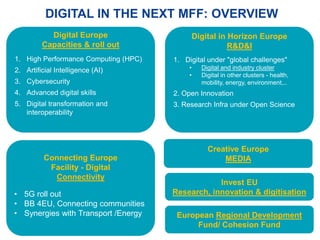
DIGITAL IN THE NEXT MFF: OVERVIEW
Digital Europe
Capacities & roll out
1. High Performance Computing (HPC)
2. Artificial Intelligence (AI)
3. Cybersecurity
4. Advanced digital skills
5. Digital transformation and
interoperability
Digital in Horizon Europe
R&D&I
1. Digital under "global challenges"
• Digital and industry cluster
• Digital in other clusters - health,
mobility, energy, environment,..
2. Open Innovation
3. Research Infra under Open Science
Connecting Europe
Facility - Digital
Connectivity
• 5G roll out
• BB 4EU, Connecting communities
• Synergies with Transport /Energy
Creative Europe
MEDIA
European Regional Development
Fund/ Cohesion Fund
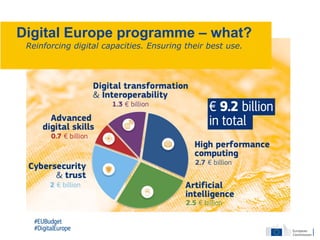
DIGITAL EUROPE
Digital Europe programme – what?
Reinforcing digital capacities. Ensuring their best use.
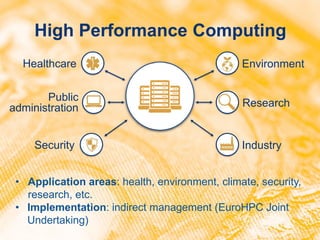
Environment
IndustrySecurity
Healthcare
Public
administration Research
High Performance Computing
• Application areas: health, environment, climate, security,
research, etc.
• Implementation: indirect management (EuroHPC Joint
Undertaking)
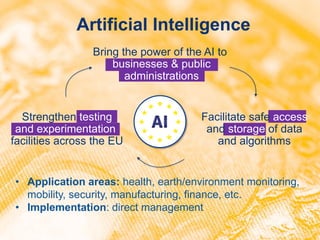
Bring the power of the AI to
businesses & public
administrations
Strengthen testing
and experimentation
facilities across the EU
Facilitate safe access
and storage of data
and algorithms
Artificial Intelligence
• Application areas: health, earth/environment monitoring,
mobility, security, manufacturing, finance, etc.
• Implementation: direct management
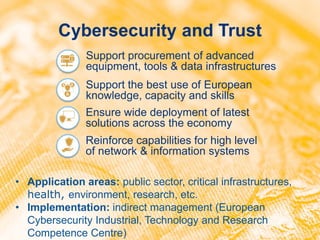
Support procurement of advanced
equipment, tools & data infrastructures
Support the best use of European
knowledge, capacity and skills
Ensure wide deployment of latest
solutions across the economy
Reinforce capabilities for high level
of network & information systems
Cybersecurity and Trust
• Application areas: public sector, critical infrastructures,
health, environment, research, etc.
• Implementation: indirect management (European
Cybersecurity Industrial, Technology and Research
Competence Centre)
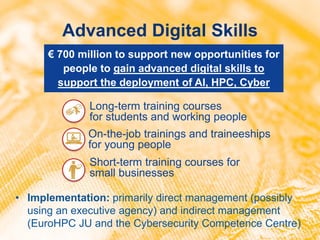
€ 700 million to support new opportunities for
people to gain advanced digital skills to
support the deployment of AI, HPC, Cyber
Long-term training courses
for students and working people
On-the-job trainings and traineeships
for young people
Short-term training courses for
small businesses
Advanced Digital Skills
• Implementation: primarily direct management (possibly
using an executive agency) and indirect management
(EuroHPC JU and the Cybersecurity Competence Centre)
Deployment, use of digital capacities and
interoperability
Support digital transformation of
areas of public interest
Support digital transformation of industry
Uptake of new Technologies and ensure continuous
capacity to adapt to fast evolving trends
• Application areas: public administrations, health and care,
education, judiciary, transport, energy, environment, culture
and creative sectors, etc.
• Implementation: direct management (partially with
Executive Agency)
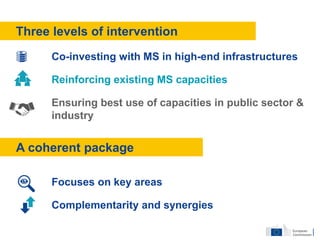
Co-investing with MS in high-end infrastructures
Reinforcing existing MS capacities
Ensuring best use of capacities in public sector &
industry
Focuses on key areas
Complementarity and synergies
A coherent package
Three levels of intervention
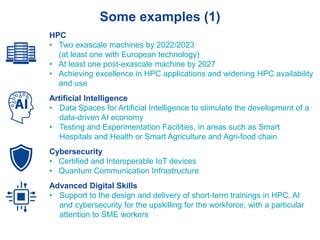
Some examples (1)
HPC
• Two exascale machines by 2022/2023
(at least one with European technology)
• At least one post-exascale machine by 2027
• Achieving excellence in HPC applications and widening HPC availability
and use
Artificial Intelligence
• Data Spaces for Artificial Intelligence to stimulate the development of a
data-driven AI economy
• Testing and Experimentation Facilities, in areas such as Smart
Hospitals and Health or Smart Agriculture and Agri-food chain
Cybersecurity
• Certified and Interoperable IoT devices
• Quantum Communication Infrastructure
Advanced Digital Skills
• Support to the design and delivery of short-term trainings in HPC, AI
and cybersecurity for the upskilling for the workforce, with a particular
attention to SME workers
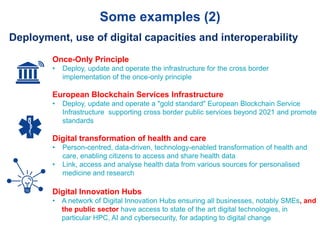
Once-Only Principle
• Deploy, update and operate the infrastructure for the cross border
implementation of the once-only principle
European Blockchain Services Infrastructure
• Deploy, update and operate a "gold standard" European Blockchain Service
Infrastructure supporting cross border public services beyond 2021 and promote
standards
Digital transformation of health and care
• Person-centred, data-driven, technology-enabled transformation of health and
care, enabling citizens to access and share health data
• Link, access and analyse health data from various sources for personalised
medicine and research
Digital Innovation Hubs
• A network of Digital Innovation Hubs ensuring all businesses, notably SMEs, and
the public sector have access to state of the art digital technologies, in
particular HPC, AI and cybersecurity, for adapting to digital change
Some examples (2)
Deployment, use of digital capacities and interoperability
Find out more about digital in MFF
Twitter
@DSMeu
@GabrielMariya
@Ansip_EU
EU budget for the future
http://ec.europa.eu/budget/mff/index_en.cfm
Facebook
Digital Single Market
#EUBudget
#DigitalEurope
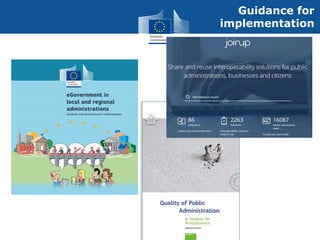
Guidance for
implementation
Thank you!
Follow us on @EU_eGov EU_Public Services
eGovernment & Digital Public Services
https://ec.europa.eu/digital-single-market/en/public-services-
egovernment
eGovernment Action Plan 2016-2020
https://ec.europa.eu/digital-single-market/en/news/communication-
eu-egovernment-action-plan-2016-2020-accelerating-digital-
transformation
Tallinn Ministerial Declaration on eGovernment
https://ec.europa.eu/digital-single-market/en/news/ministerial-
declaration-egovernment-tallinn-declaration
Stakeholder engagement platform
https://ec.europa.eu/futurium/en/egovernment4eu
Contact:
CNECT-EGOVERNMENT4EU@ec.europa.eu

EC - Digital Europe Programme

  • 1.
    Digital transformation ofgovernment From EU eGovernment Action Plan 2016-2020 to DEP Citadel Workshop, Bari, 12/04/2019 Andrea Servida DG CONNECT, European Commission Unit "eGovernment & Trust" Andrea.servida@ec.europa.eu
  • 2.
    A new ActionPlan to make: • digital public services reduce administrative burden on businesses and citizens by making their interactions with public administrations faster and efficient, more convenient and transparent, and less costly • seamless cross-border and digital public services contribute to competitiveness and make the EU a more attractive place to invest and live in • public administrations and public institutions in the EU be open, efficient and inclusive, providing borderless, personalised, user-friendly, end-to-end digital public services to all citizens and businesses in the EU
  • 3.
  • 4.
    Modernising public administration with ICT, using keydigital enablers Enabling cross- border mobility with interoperable digital public services Facilitating digital interaction between administrations and citizens / businesses for high-quality public services eGovernment Action Plan 2016-2020 '…more can be done to modernise public administration, achieve cross-border interoperability and facilitate easy interaction with citizens….' (DSM Communication) Policy Framework Policy priorities (Pillars) 20 actions identified in this Action Plan Further actions may be proposed either by the Commission or by stakeholders, including Member States.
  • 5.
    Digitise & Enable 1.eProcurement 2. Take-up of eIDAS services 3. Long-term sustainability of cross-border DSI 4. Revision of the EIF 5. Catalogue of ICT standards for public procurement 6. The Commission will use the common building blocks such as CEF DSIs and follow the EIF. It will gradually introduce the 'digital by default' and 'once-only' principles, eInvoicing and eProcurement and assess the implication of a possible implementation of the 'no legacy' principle. Connect 7. Single Digital Gateway 8. e-Justice Portal 9. BRIS 10.Interconnection of insolvency registers 11.Digital technologies throughout a company’s lifecycle 12.Single Electronic Mechanism for VAT 13.'Once-Only' principle large- scale pilot project 14.Single window for maritime transport and transport e-documents 15.EESSI 16.EURES Job Mobility portal 17.Cross-border eHealth services Engage 18.Once-only principle for citizens in a cross- border context 19.Deployment and take-up of the INSPIRE data infrastructure 20.Transform the Commission (Europa) websites Actions
  • 6.
    • From silosto joined-up and open government • From customer services to customised services • From eGovernment to (digital) government strategies From eGovernment to digital government Source: eGovernment Benchmark and OECD Recommendation on digital government strategies, 2014
  • 7.
    Digital by default Trust& Security https://ec.europa.eu/futurium/en/eidas-observatory
  • 8.
    Once-only principle • TOOP •SCOOP4C • Single Digital Gateway draft Regulation
  • 9.
    CEF Building Blocks Thebuilding blocks of the Connecting Europe Facility promote the adoption of the same open standards and technical specifications for basic & common functionalities of any sectorial project/ platform. These core commonalities will enable interoperability across borders and sectors. Cross-border by default Interoperability
  • 10.
    Incentives We will inour countries: commit to expand and deepen the exchange and sharing of good eGovernment practices and to speed up the digital transformation at all levels of government We will in the next five years (2018-2022) take steps […] in our public administrations Tallinn Ministerial Declaration on eGovernment 6 October 2017 https://ec.europa.eu/digital-single-market/en/news/ministerial- declaration-egovernment-tallinn-declaration eGovernment Action Plan 2016-2020 serves 'as a catalyst to coordinate public sector modernisation efforts' across the EU COM (2016)179 final
  • 11.
    • Speeding upthe implementation of the eIDAS regulation, including the notification of electronic identity schemes • Making digital public services secure and identifiable by using the eIDAS framework for qualified electronic trust services • Introducing once-only options in digital public services by collaboration and data exchange, including with other countries • Re-use of the Digital Service Infrastructures developed under the Connecting Europe Facility Tallinn Declaration on eGovernment
  • 12.
    • enabling usersto digitally interact with public administrations; • making these services easy to understand; • requesting citizens and businesses only once the same information, respecting data protection and privacy; • engaging citizens in the creation of public services Tallinn Declaration: User-centricity principles With these principles Member States commit to:
  • 13.
    • Digital Interaction •Option to digital interact • Accessibility, security, availability and usability • Services could be used by all; universal design principle applied; authenticity of services ensured • Reduction of the administrative burden (once-only principle) • Optimizing/creating services that are personalized; OOP • Digital delivery of public services • Fully online services; status of services can be checked • Citizen engagement • Empower citizens & business; ideas are collected & citizens involved • Incentives for digital service use • Barriers to use digital are removed • Protection of personal data and privacy • Full respect of GDPR & information to citizens • Redress and complaint mechanisms • On-line mechanisms are available Tallinn Declaration: User-centricity principles (2) When interacting with PA, citizens and business should expect:
  • 14.
  • 15.
    A BUDGET ALIGNEDTO POLITICAL PRIORITIES Simplification, transparency and flexibility Source: European Commission
  • 16.
    More specifically to: •Reinforce the EU’s digital capacities (computing, data, cybersecurity, AI,..) • Ensure their widest possible roll out and maximise their benefits • Prepare for and lead the development of next generation technologies • Build a world-leading connectivity infrastructure • Support creators and ensure the widespread distribution of their works Objective: ensure that Europe drives the digital transformation of society and economy, bringing benefits to all citizens and businesses Digital in MFF 2021-2027
  • 17.
    Invest EU Research, innovation& digitisation DIGITAL IN THE NEXT MFF: OVERVIEW Digital Europe Capacities & roll out 1. High Performance Computing (HPC) 2. Artificial Intelligence (AI) 3. Cybersecurity 4. Advanced digital skills 5. Digital transformation and interoperability Digital in Horizon Europe R&D&I 1. Digital under "global challenges" • Digital and industry cluster • Digital in other clusters - health, mobility, energy, environment,.. 2. Open Innovation 3. Research Infra under Open Science Connecting Europe Facility - Digital Connectivity • 5G roll out • BB 4EU, Connecting communities • Synergies with Transport /Energy Creative Europe MEDIA European Regional Development Fund/ Cohesion Fund
  • 18.
  • 19.
    Digital Europe programme– what? Reinforcing digital capacities. Ensuring their best use.
  • 20.
    Environment IndustrySecurity Healthcare Public administration Research High PerformanceComputing • Application areas: health, environment, climate, security, research, etc. • Implementation: indirect management (EuroHPC Joint Undertaking)
  • 21.
    Bring the powerof the AI to businesses & public administrations Strengthen testing and experimentation facilities across the EU Facilitate safe access and storage of data and algorithms Artificial Intelligence • Application areas: health, earth/environment monitoring, mobility, security, manufacturing, finance, etc. • Implementation: direct management
  • 22.
    Support procurement ofadvanced equipment, tools & data infrastructures Support the best use of European knowledge, capacity and skills Ensure wide deployment of latest solutions across the economy Reinforce capabilities for high level of network & information systems Cybersecurity and Trust • Application areas: public sector, critical infrastructures, health, environment, research, etc. • Implementation: indirect management (European Cybersecurity Industrial, Technology and Research Competence Centre)
  • 23.
    € 700 millionto support new opportunities for people to gain advanced digital skills to support the deployment of AI, HPC, Cyber Long-term training courses for students and working people On-the-job trainings and traineeships for young people Short-term training courses for small businesses Advanced Digital Skills • Implementation: primarily direct management (possibly using an executive agency) and indirect management (EuroHPC JU and the Cybersecurity Competence Centre)
  • 24.
    Deployment, use ofdigital capacities and interoperability Support digital transformation of areas of public interest Support digital transformation of industry Uptake of new Technologies and ensure continuous capacity to adapt to fast evolving trends • Application areas: public administrations, health and care, education, judiciary, transport, energy, environment, culture and creative sectors, etc. • Implementation: direct management (partially with Executive Agency)
  • 25.
    Co-investing with MSin high-end infrastructures Reinforcing existing MS capacities Ensuring best use of capacities in public sector & industry Focuses on key areas Complementarity and synergies A coherent package Three levels of intervention
  • 26.
    Some examples (1) HPC •Two exascale machines by 2022/2023 (at least one with European technology) • At least one post-exascale machine by 2027 • Achieving excellence in HPC applications and widening HPC availability and use Artificial Intelligence • Data Spaces for Artificial Intelligence to stimulate the development of a data-driven AI economy • Testing and Experimentation Facilities, in areas such as Smart Hospitals and Health or Smart Agriculture and Agri-food chain Cybersecurity • Certified and Interoperable IoT devices • Quantum Communication Infrastructure Advanced Digital Skills • Support to the design and delivery of short-term trainings in HPC, AI and cybersecurity for the upskilling for the workforce, with a particular attention to SME workers
  • 27.
    Once-Only Principle • Deploy,update and operate the infrastructure for the cross border implementation of the once-only principle European Blockchain Services Infrastructure • Deploy, update and operate a "gold standard" European Blockchain Service Infrastructure supporting cross border public services beyond 2021 and promote standards Digital transformation of health and care • Person-centred, data-driven, technology-enabled transformation of health and care, enabling citizens to access and share health data • Link, access and analyse health data from various sources for personalised medicine and research Digital Innovation Hubs • A network of Digital Innovation Hubs ensuring all businesses, notably SMEs, and the public sector have access to state of the art digital technologies, in particular HPC, AI and cybersecurity, for adapting to digital change Some examples (2) Deployment, use of digital capacities and interoperability
  • 28.
    Find out moreabout digital in MFF Twitter @DSMeu @GabrielMariya @Ansip_EU EU budget for the future http://ec.europa.eu/budget/mff/index_en.cfm Facebook Digital Single Market #EUBudget #DigitalEurope
  • 29.
  • 30.
    Thank you! Follow uson @EU_eGov EU_Public Services eGovernment & Digital Public Services https://ec.europa.eu/digital-single-market/en/public-services- egovernment eGovernment Action Plan 2016-2020 https://ec.europa.eu/digital-single-market/en/news/communication- eu-egovernment-action-plan-2016-2020-accelerating-digital- transformation Tallinn Ministerial Declaration on eGovernment https://ec.europa.eu/digital-single-market/en/news/ministerial- declaration-egovernment-tallinn-declaration Stakeholder engagement platform https://ec.europa.eu/futurium/en/egovernment4eu Contact: CNECT-EGOVERNMENT4EU@ec.europa.eu