Learning
Communication with

Neural Networks
Sosuke Kobayashi

Preferred Networks, Inc.

PFN Seminar 2017/03/09
Highlights
● Neural Networks learn communication with multi-agents

● only through reward of consequent tasks

● with continuous vectors

or with discrete symbols (bits or one-hot vectors)

using, in training,

● REINFORCE, Straight Through Estimator,

Discrete/Regularized Unit, Gumbel-softmax

● Interpret NN’s symbols

● My experiment and analysis
2
Note
● I do not mention

● Electronic communications

● Distributed Learning

● Human communication study

● Dialogue system, ChatBot
3
Why Communication?
● Share loads or experiences (I do not mention this)

● Distributed learning; e.g., ChainerMN, …

● Share partial observations

● Sending Information itself

● Merged Information is more useful for a task

● Plan actions collaboratively

● When two cars are crossing,

one should go and the other should stop

● Just experiment to analyze “communication”
4
Examples
● Communication of continuous vectors

(In other words, multi-agents can be seen just one NN)

● Merge and return total information

● Each agent outputs an action a

● Learning by REINFORCE; reward*log(p(a))
5
Connecting Neural Models
Anonymous Author(s)
Affiliation
Address
email
Abstract
ke two contributions. First, we simplify and extend the graph neural network
cond, we show how this architecture can be used to control groups of cooperating
f the model consists of multilayer neural networks fi
that take as input vectors
a vector hi+1
. The model takes as input a set of vectors {h0
1, h0
2, ..., h0
m}, and
hi+1
j = fi
(hi
j, ci
j)
ci+1
j =
X
j06=j
hi+1
j0 ;
onnecting Neural Models
Anonymous Author(s)
Affiliation
Address
email
Abstract
ontributions. First, we simplify and extend the graph neural network
show how this architecture can be used to control groups of cooperating
el consists of multilayer neural networks fi
that take as input vectors
hi+1
. The model takes as input a set of vectors {h0
1, h0
2, ..., h0
m}, and
hi+1
j = fi
(hi
j, ci
j)
ci+1
j =
X
j06=j
hi+1
j0 ;
Anonymous Author(s)
Affiliation
Address
email
Abstract
bstract
oduction
rk we make two contributions. First, we simplify and extend the graph neural network
re of ??. Second, we show how this architecture can be used to control groups of cooperating
del
est form of the model consists of multilayer neural networks fi
that take as input vectors
and output a vector hi+1
. The model takes as input a set of vectors {h0
1, h0
2, ..., h0
m}, and
hi+1
j = fi
(hi
j, ci
j)
ci+1
j =
X
j06=j
hi+1
j0 ;
= 0 for all j, and i 2 {0, .., K} (we will call K the number of hops in the network).
, we can take the final hK
j and output them directly, so that the model outputs a vector
ding to each input vector, or we can feed them into another network to get a single vector or
put.
is a simple linear layer followed by a nonlinearity :
i+1 i i i i
mean
contribution. In this setting, there is no difference between each agent having its own c36
viewing them as pieces of a larger model controlling all agents. Taking the latter pers37
controller is a large feed-forward neural network that maps inputs for all agents to their a38
agent occupying a subset of units. A specific connectivity structure between layers (a) ins39
broadcast communication channel between agents and (b) propagates the agent state in th40
an RNN.41
Because the agents will receive reward, but not necessarily supervision for each action, re42
learning is used to maximize expected future reward. We explore two forms of communic43
the controller: (i) discrete and (ii) continuous. In the former case, communication is an44
will be treated as such by the reinforcement learning. In the continuous case, the sig45
between agents are no different than hidden states in a neural network; thus credit assign46
communication can be performed using standard backpropagation (within the outer RL47
We use policy gradient [33] with a state specific baseline for delivering a gradient to48
Denote the states in an episode by s(1), ..., s(T), and the actions taken at each of49
as a(1), ..., a(T), where T is the length of the episode. The baseline is a scalar fun50
states b(s, ✓), computed via an extra head on the model producing the action probabili51
maximizing the expected reward with policy gradient, the models are also trained to m52
distance between the baseline value and actual reward. Thus, after finishing an episode53
the model parameters ✓ by54
✓ =
TX
t=1
log p(a(t)|s(t), ✓)
✓
TX
i=t
r(i) b(s(t), ✓)
✓
TX
i=t
r(i) b(s(t)
Here r(t) is reward given at time t, and the hyperparameter is for balancing the rew55
baseline objectives, set to 0.03 in all experiments.56
3 Model57
We now describe the model used to compute p(a(t)|s(t), ✓) at a given time t (ommiti58
index for brevity). Let sj be the jth agent’s view of the state of the environment. The59
controller is the concatenation of all state-views s = {s1, ..., sJ }, and the controller i60
a = (s), where the output a is a concatenation of discrete actions a = {a1, ..., aJ } for61
Note that this single controller encompasses the individual controllers for each agent62
the communication between agents.63
learning is used to maximize expected future reward. We explore two forms of communication within43
the controller: (i) discrete and (ii) continuous. In the former case, communication is an action, and44
will be treated as such by the reinforcement learning. In the continuous case, the signals passed45
between agents are no different than hidden states in a neural network; thus credit assignment for the46
communication can be performed using standard backpropagation (within the outer RL loop).47
We use policy gradient [33] with a state specific baseline for delivering a gradient to the model.48
Denote the states in an episode by s(1), ..., s(T), and the actions taken at each of those states49
as a(1), ..., a(T), where T is the length of the episode. The baseline is a scalar function of the50
states b(s, ✓), computed via an extra head on the model producing the action probabilities. Beside51
maximizing the expected reward with policy gradient, the models are also trained to minimize the52
distance between the baseline value and actual reward. Thus, after finishing an episode, we update53
the model parameters ✓ by54
✓ =
TX
t=1
log p(a(t)|s(t), ✓)
✓
TX
i=t
r(i) b(s(t), ✓)
✓
TX
i=t
r(i) b(s(t), ✓)
2
.
Here r(t) is reward given at time t, and the hyperparameter is for balancing the reward and the55
baseline objectives, set to 0.03 in all experiments.56
3 Model57
We now describe the model used to compute p(a(t)|s(t), ✓) at a given time t (ommiting the time58
index for brevity). Let sj be the jth agent’s view of the state of the environment. The input to the59
controller is the concatenation of all state-views s = {s1, ..., sJ }, and the controller is a mapping60
a = (s), where the output a is a concatenation of discrete actions a = {a1, ..., aJ } for each agent.61
Note that this single controller encompasses the individual controllers for each agents, as well as62
the communication between agents.63
One obvious choice for is a fully-connected multi-layer neural network, which could extract64
features h from s and use them to predict good actions with our RL framework. This model would65
allow agents to communicate with each other and share views of the environment. However, it66
is inflexible with respect to the composition and number of agents it controls; cannot deal well67
with agents joining and leaving the group and even the order of the agents must be fixed. On the68
other hand, if no communication is used then we can write a = { (s1), ..., (sJ )}, where is a69
per-agent controller applied independently. This communication-free model satisfies the flexibility70
requirements1
, but is not able to coordinate their actions.71
, and computes:
hi+1
j = fi
(hi
j, ci
j) (1)
ci+1
j =
1
J 1
X
j06=j
hi+1
j0 . (2)
a single linear layer followed by a nonlinearity , we have: hi+1
j = (Hi
hi
j +
can be viewed as a feedforward network with layers hi+1
= (Ti
hi
) where hi
of all hi
j and T takes the block form:
Ti
=
Hi
Ci
Ci
... Ci
Ci
Hi
Ci
... Ci
Ci
Ci
Hi
... Ci
...
...
...
...
...
Ci
Ci
Ci
... Hi
,
eural Models
Author(s)
tion
ess
il
ract
e simplify and extend the graph neural network
cture can be used to control groups of cooperating
ral Models
thor(s)
mplify and extend the graph neural network
odels
extend the graph neural network
g Neural Models
ymous Author(s)
Affiliation
Address
email
Abstract
rst, we simplify and extend the graph neural network
architecture can be used to control groups of cooperating
multilayer neural networks fi
that take as input vectors
0 0 0
2 Problem Formulation33
We consider the setting where we have M agents, all cooperating to maximize reward R in some34
environment. We make the simplifying assumption that each agent receives R, independent of their35
contribution. In this setting, there is no difference between each agent having its own controller, or36
viewing them as pieces of a larger model controlling all agents. Taking the latter perspective, our37
controller is a large feed-forward neural network that maps inputs for all agents to their actions, each38
agent occupying a subset of units. A specific connectivity structure between layers (a) instantiates the39
broadcast communication channel between agents and (b) propagates the agent state in the manner of40
an RNN.41
Because the agents will receive reward, but not necessarily supervision for each action, reinforcement42
learning is used to maximize expected future reward. We explore two forms of communication within43
the controller: (i) discrete and (ii) continuous. In the former case, communication is an action, and44
will be treated as such by the reinforcement learning. In the continuous case, the signals passed45
between agents are no different than hidden states in a neural network; thus credit assignment for the46
communication can be performed using standard backpropagation (within the outer RL loop).47
We use policy gradient [33] with a state specific baseline for delivering a gradient to the model.48
Denote the states in an episode by s(1), ..., s(T), and the actions taken at each of those states49
as a(1), ..., a(T), where T is the length of the episode. The baseline is a scalar function of the50
states b(s, ✓), computed via an extra head on the model producing the action probabilities. Beside51
maximizing the expected reward with policy gradient, the models are also trained to minimize the52
distance between the baseline value and actual reward. Thus, after finishing an episode, we update53
the model parameters ✓ by54
TX log p(a(t)|s(t), ✓)
TX TX
2
Problem Formulation
consider the setting where we have M agents, all cooperating to maximize reward R in some
ironment. We make the simplifying assumption that each agent receives R, independent of their
tribution. In this setting, there is no difference between each agent having its own controller, or
wing them as pieces of a larger model controlling all agents. Taking the latter perspective, our
troller is a large feed-forward neural network that maps inputs for all agents to their actions, each
nt occupying a subset of units. A specific connectivity structure between layers (a) instantiates the
adcast communication channel between agents and (b) propagates the agent state in the manner of
RNN.
ause the agents will receive reward, but not necessarily supervision for each action, reinforcement
ning is used to maximize expected future reward. We explore two forms of communication within
controller: (i) discrete and (ii) continuous. In the former case, communication is an action, and
be treated as such by the reinforcement learning. In the continuous case, the signals passed
ween agents are no different than hidden states in a neural network; thus credit assignment for the
mmunication can be performed using standard backpropagation (within the outer RL loop).
use policy gradient [33] with a state specific baseline for delivering a gradient to the model.
note the states in an episode by s(1), ..., s(T), and the actions taken at each of those states
a(1), ..., a(T), where T is the length of the episode. The baseline is a scalar function of the
es b(s, ✓), computed via an extra head on the model producing the action probabilities. Beside
ximizing the expected reward with policy gradient, the models are also trained to minimize the
ance between the baseline value and actual reward. Thus, after finishing an episode, we update
model parameters ✓ by
✓ =
TX
t=1
log p(a(t)|s(t), ✓)
✓
TX
i=t
r(i) b(s(t), ✓)
✓
TX
i=t
r(i) b(s(t), ✓)
2
.
e r(t) is reward given at time t, and the hyperparameter is for balancing the reward and the
eline objectives, set to 0.03 in all experiments.
Model
, ..., h0
J ], and computes:
hi+1
j = fi
(hi
j, ci
j) (1)
ci+1
j =
1
J 1
X
j06=j
hi+1
j0 . (2)
at fi
is a single linear layer followed by a nonlinearity , we have: hi+1
j = (Hi
hi
j +
e model can be viewed as a feedforward network with layers hi+1
= (Ti
hi
) where hi
enation of all hi
j and T takes the block form:
Ti
=
Hi
Ci
Ci
... Ci
Ci
Hi
Ci
... Ci
Ci
Ci
Hi
... Ci
...
...
...
...
...
Ci
Ci
Ci
... Hi
,
g Neural Models
mous Author(s)
Affiliation
Address
email
Abstract
rst, we simplify and extend the graph neural network
rchitecture can be used to control groups of cooperating
Neural Models
ous Author(s)
filiation
ddress
mail
stract
we simplify and extend the graph neural network
hitecture can be used to control groups of cooperating
al Models
or(s)
lify and extend the graph neural network
an be used to control groups of cooperating
ecting Neural Models
Anonymous Author(s)
Affiliation
Address
email
Abstract
ions. First, we simplify and extend the graph neural network
how this architecture can be used to control groups of cooperating
sists of multilayer neural networks fi
that take as input vectors
The model takes as input a set of vectors {h0
1, h0
2, ..., h0
m}, and
2 Problem Formulation33
We consider the setting where we have M agents, all cooperating to maximize reward R in some34
environment. We make the simplifying assumption that each agent receives R, independent of their35
contribution. In this setting, there is no difference between each agent having its own controller, or36
viewing them as pieces of a larger model controlling all agents. Taking the latter perspective, our37
controller is a large feed-forward neural network that maps inputs for all agents to their actions, each38
agent occupying a subset of units. A specific connectivity structure between layers (a) instantiates the39
broadcast communication channel between agents and (b) propagates the agent state in the manner of40
an RNN.41
Because the agents will receive reward, but not necessarily supervision for each action, reinforcement42
learning is used to maximize expected future reward. We explore two forms of communication within43
the controller: (i) discrete and (ii) continuous. In the former case, communication is an action, and44
will be treated as such by the reinforcement learning. In the continuous case, the signals passed45
between agents are no different than hidden states in a neural network; thus credit assignment for the46
communication can be performed using standard backpropagation (within the outer RL loop).47
We use policy gradient [33] with a state specific baseline for delivering a gradient to the model.48
Denote the states in an episode by s(1), ..., s(T), and the actions taken at each of those states49
as a(1), ..., a(T), where T is the length of the episode. The baseline is a scalar function of the50
states b(s, ✓), computed via an extra head on the model producing the action probabilities. Beside51
maximizing the expected reward with policy gradient, the models are also trained to minimize the52
distance between the baseline value and actual reward. Thus, after finishing an episode, we update53
the model parameters ✓ by54
✓ =
TX log p(a(t)|s(t), ✓)
✓
TX
r(i) b(s(t), ✓)
✓
TX
r(i) b(s(t), ✓)
2
.
2 Problem Formulation33
We consider the setting where we have M agents, all cooperating to maximize reward R in some34
environment. We make the simplifying assumption that each agent receives R, independent of their35
contribution. In this setting, there is no difference between each agent having its own controller, or36
viewing them as pieces of a larger model controlling all agents. Taking the latter perspective, our37
controller is a large feed-forward neural network that maps inputs for all agents to their actions, each38
agent occupying a subset of units. A specific connectivity structure between layers (a) instantiates the39
broadcast communication channel between agents and (b) propagates the agent state in the manner of40
an RNN.41
Because the agents will receive reward, but not necessarily supervision for each action, reinforcement42
learning is used to maximize expected future reward. We explore two forms of communication within43
the controller: (i) discrete and (ii) continuous. In the former case, communication is an action, and44
will be treated as such by the reinforcement learning. In the continuous case, the signals passed45
between agents are no different than hidden states in a neural network; thus credit assignment for the46
communication can be performed using standard backpropagation (within the outer RL loop).47
We use policy gradient [33] with a state specific baseline for delivering a gradient to the model.48
Denote the states in an episode by s(1), ..., s(T), and the actions taken at each of those states49
as a(1), ..., a(T), where T is the length of the episode. The baseline is a scalar function of the50
states b(s, ✓), computed via an extra head on the model producing the action probabilities. Beside51
maximizing the expected reward with policy gradient, the models are also trained to minimize the52
distance between the baseline value and actual reward. Thus, after finishing an episode, we update53
the model parameters ✓ by54
✓ =
TX
t=1
log p(a(t)|s(t), ✓)
✓
TX
i=t
r(i) b(s(t), ✓)
✓
TX
i=t
r(i) b(s(t), ✓)
2
.
Here r(t) is reward given at time t, and the hyperparameter is for balancing the reward and the55
baseline objectives, set to 0.03 in all experiments.56
3 Model57
We now describe the model used to compute p(a(t)|s(t), ✓) at a given time t (ommiting the time58
index for brevity). Let sj be the jth agent’s view of the state of the environment. The input to the59
tanh
email
Abstract
abstract
roduction
ork we make two contributions. First, we simplify and extend the graph neural network
ure of ??. Second, we show how this architecture can be used to control groups of cooperating
del
lest form of the model consists of multilayer neural networks fi
that take as input vectors
and output a vector hi+1
. The model takes as input a set of vectors {h0
1, h0
2, ..., h0
m}, and
s
hi+1
j = fi
(hi
j, ci
j)
ci+1
j =
X
j06=j
hi+1
j0 ;
0
j = 0 for all j, and i 2 {0, .., K} (we will call K the number of hops in the network).
d, we can take the final hK
j and output them directly, so that the model outputs a vector
nding to each input vector, or we can feed them into another network to get a single vector or
tput.
CommNet modelth communication stepModule for agent
email
Abstract
abstract
Introduction
n this work we make two contributions. First, we simplify and extend the graph neural network
rchitecture of ??. Second, we show how this architecture can be used to control groups of cooperating
gents.
Model
he simplest form of the model consists of multilayer neural networks fi
that take as input vectors
i
and ci
and output a vector hi+1
. The model takes as input a set of vectors {h0
1, h0
2, ..., h0
m}, and
omputes
hi+1
j = fi
(hi
j, ci
j)
ci+1
j =
X
j06=j
hi+1
j0 ;
We set c0
j = 0 for all j, and i 2 {0, .., K} (we will call K the number of hops in the network).
desired, we can take the final hK
j and output them directly, so that the model outputs a vector
orresponding to each input vector, or we can feed them into another network to get a single vector or
calar output.
email
Abstract
abstract1
1 Introduction2
In this work we make two contributions. First, we simplify and extend the graph neural network3
architecture of ??. Second, we show how this architecture can be used to control groups of cooperating4
agents.5
2 Model6
The simplest form of the model consists of multilayer neural networks fi
that take as input vectors7
hi
and ci
and output a vector hi+1
. The model takes as input a set of vectors {h0
1, h0
2, ..., h0
m}, and8
computes9
hi+1
j = fi
(hi
j, ci
j)
10
ci+1
j =
X
j06=j
hi+1
j0 ;
We set c0
j = 0 for all j, and i 2 {0, .., K} (we will call K the number of hops in the network).11
If desired, we can take the final hK
j and output them directly, so that the model outputs a vector12
corresponding to each input vector, or we can feed them into another network to get a single vector or13
scalar output.14
email
Abstract
abstract1
1 Introduction2
In this work we make two contributions. First, we simplify and extend the graph neural n3
architecture of ??. Second, we show how this architecture can be used to control groups of coop4
agents.5
2 Model6
The simplest form of the model consists of multilayer neural networks fi
that take as input7
hi
and ci
and output a vector hi+1
. The model takes as input a set of vectors {h0
1, h0
2, ..., h0
m8
computes9
hi+1
j = fi
(hi
j, ci
j)
10
ci+1
j =
X
j06=j
hi+1
j0 ;
We set c0
j = 0 for all j, and i 2 {0, .., K} (we will call K the number of hops in the ne11
If desired, we can take the final hK
j and output them directly, so that the model outputs a12
corresponding to each input vector, or we can feed them into another network to get a single v13
scalar output.14
their actions, each agent occupying a subset of units. A specific connectivity structure between layers
(a) instantiates the broadcast communication channel between agents and (b) propagates the agent
state.
3 Communication Model
We now describe the model used to compute p(a(t)|s(t), ✓) at a given time t (omitting the time
index for brevity). Let sj be the jth agent’s view of the state of the environment. The input to the
controller is the concatenation of all state-views s = {s1, ..., sJ }, and the controller is a mapping
a = (s), where the output a is a concatenation of discrete actions a = {a1, ..., aJ } for each agent.
Note that this single controller encompasses the individual controllers for each agents, as well as
the communication between agents.
3.1 Controller Structure
We now detail our architecture for that allows communication without losing modularity. is built
from modules fi
, which take the form of multilayer neural networks. Here i 2 {0, .., K}, where K
is the number of communication steps in the network.
Each fi
takes two input vectors for each agent j: the hidden state hi
j and the communication ci
j,
and outputs a vector hi+1
j . The main body of the model then takes as input the concatenated vectors
h0
= [h0
1, h0
2, ..., h0
J ], and computes:
Connecting Neural Models
Anonymous Author(s)
Affiliation
Address
2 Problem Formulation33
We consider the setting where we have M agents, all cooperating to maximize rewa34
environment. We make the simplifying assumption that each agent receives R, indepe35
contribution. In this setting, there is no difference between each agent having its own36
viewing them as pieces of a larger model controlling all agents. Taking the latter pe37
controller is a large feed-forward neural network that maps inputs for all agents to thei38
agent occupying a subset of units. A specific connectivity structure between layers (a) i39
2 Problem Formulation33
We consider the setting where we have M agents, all cooperating to maximize reward R in some34
environment. We make the simplifying assumption that each agent receives R, independent of their35
contribution. In this setting, there is no difference between each agent having its own controller, or36
viewing them as pieces of a larger model controlling all agents. Taking the latter perspective, our37
controller is a large feed-forward neural network that maps inputs for all agents to their actions, each38
agent occupying a subset of units. A specific connectivity structure between layers (a) instantiates the39
broadcast communication channel between agents and (b) propagates the agent state in the manner of40
an RNN.41
Because the agents will receive reward, but not necessarily supervision for each action, reinforcement42
learning is used to maximize expected future reward. We explore two forms of communication within43
the controller: (i) discrete and (ii) continuous. In the former case, communication is an action, and44
will be treated as such by the reinforcement learning. In the continuous case, the signals passed45
between agents are no different than hidden states in a neural network; thus credit assignment for the46
ecting Neural Models2 Problem Formulation33
We consider the setting where we have M agents, all cooperating to maximize reward R in some34
onnecting Neural Models2 Problem Formulation33
We consider the setting where we have M agents, all cooperating to maximize reward R in some34
Connecting Neural Models
Anonymous Author(s)
Affiliation
Address
email
Connecting Neural Models
Anonymous Author(s)
Affiliation
Address
email
Connecting Neural Models
Anonymous Author(s)
Affiliation
Address
email
Connecting Neural Models
Anonymous Author(s)
Affiliation
Address
email
Figure 1: An overview of our CommNet model. Left: view of module fi
for a single agent j. Note
Learning Multiagent Communication with Backpropagation,
Sainbayar Sukhbaatar, Arthur Szlam, Rob Fergus, NIPS 2016
Examples
6
Learning Multiagent Communication with Backpropagation,
Sainbayar Sukhbaatar, Arthur Szlam, Rob Fergus, NIPS 2016
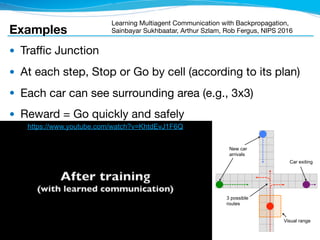
● Traffic Junction

● At each step, Stop or Go by cell (according to its plan)

● Each car can see surrounding area (e.g., 3x3)

● Reward = Go quickly and safely
3 possible
routes
New car
arrivals
Car exiting
Visual range
https://www.youtube.com/watch?v=KhtdEvJ1F6Q
7
● Lever Pulling Task

● One step game (not multi-step)

● 5 agents are drawn at random from total 500 agents

● They must choose and pull one lever simultaneously

● Reward = #_of_distinct_levers

● Each agent has each ID (and its embedding vector)

● Task needs communicating their (5 agents’) IDs

and choosing levers based on a sort of IDs

● e.g., ascending order of IDs
Examples
Learning Multiagent Communication with Backpropagation,
Sainbayar Sukhbaatar, Arthur Szlam, Rob Fergus, NIPS 2016
8
● In my opinion,

neural networks (or machines, more generally)

can communicate/copy with continuous values

● What are the advantages of discrete communication?

● Compressibility

● Noise immunity, Robustness

● Regularization, Generalization, Abstraction

● Interpretability, Connection to other discrete ones

● Suggestive for other (real) communication study
Advantages of Discrete Communication
Discrete Com.
● Communication of (discrete) binary sequences

● Each agent outputs an action a after com. steps

● DQN. In training,

● (a) RIAL uses binary com.

● (b) DIAL uses noisy continuous com. = DRU
9
Learning to Communicate with Deep Multi-Agent Reinforcement Learning, Jakob
N. Foerster, Yannis M. Assael, Nando de Freitas, Shimon Whiteson, NIPS 2016
Q-network represents Qa
(oa
t , ma
t 1, ha
t 1, ua
), which conditions on that agent’s individual hidden
state ha
t 1 and observation oa
t as well as messages from other agents ma0
t 1.
To avoid needing a network with |U||M| outputs, we split the network into Qa
u and Qa
m, the Q-values
for the environment and communication actions, respectively. Similarly to [18], the action selector
separately picks ua
t and ma
t from Qu and Qm, using an ✏-greedy policy. Hence, the network requires
only |U| + |M| outputs and action selection requires maximising over U and then over M, but not
maximising over U ⇥ M.
Both Qu and Qm are trained using DQN with the following two modifications, which were found to be
essential for performance. First, we disable experience replay to account for the non-stationarity that
occurs when multiple agents learn concurrently, as it can render experience obsolete and misleading.
Second, to account for partial observability, we feed in the actions u and m taken by each agent
as inputs on the next time-step. Figure 1(a) shows how information flows between agents and the
environment, and how Q-values are processed by the action selector in order to produce the action,
ua
t , and message ma
t . Since this approach treats agents as independent networks, the learning phase is
not centralised, even though our problem setting allows it to be. Consequently, the agents are treated
exactly the same way during decentralised execution as during learning.
ot
1
ut+1
2
Q-Net
ut
1
Q-Net
Action
Select
mt
1
mt+1
2
Agent1Agent2
ot+1
2
Action
Select
mt-1
2
Environment
Q-Net
Action
Select
Q-Net
Action
Select
t+1t
(a) RIAL - RL based communication
ot
1
ut+1
2
C-Net
ut
1
C-Net
Action
Select
DRU
mt
1
mt+1
2
Agent1Agent2
ot+1
2
Action
Select
Environment
C-Net
Action
Select
C-Net
Action
Select
DRU
t+1t
(b) DIAL - Differentiable communication
Discrete Com.
● Multi-Step MNIST; Two players with each MNIST image

● Each sends each image’s number (0-9)

by binary x 4 steps (= 4bit = can represent 16 patterns)

● Reward = prediction

● Learned to represent 0-9 by 4bit →
10
Learning to Communicate with Deep Multi-Agent Reinforcement Learning, Jakob
N. Foerster, Yannis M. Assael, Nando de Freitas, Shimon Whiteson, NIPS 2016
y outperforming the NoComm baseline. DIAL with param-
e substantially faster than RIAL. Furthermore, parameter
b) shows results for n = 4 agents. DIAL with parameter
ods. In this setting, RIAL without parameter sharing was
se results illustrate how difficult it is for agents to learn the
ameter sharing can be crucial for learning to communicate.
dicating that the gradient provides a richer and more robust
he communication protocol discovered by DIAL for n = 3
re 4(c) shows a decision tree corresponding to an optimal
rogation room after day two, there are only two options:
ted the room before. If three prisoners had been, the third
The other options can be encoded via the “On” and “Off”
d on the well known MNIST digit classification dataset [25].
u1
2
m1 m2 m3 m4
u1
1
u5
1
u5
2
… … …
… … …
… … …
Agent1Agent2
m1
…
…
u1
2
u1
1
u2
2
u2
1
Agent1Agent2
Figure 5: MNIST games architectures.
r
e
n
d
s
c
-
e
e
g
a) Evaluation of Multi-Step (b) Evaluation of Colour-Digit
1 2 3 4
6teS
0
1
2
3
4
5
6
7
8
9
7rueDigit(c) Protocol of Multi-Step
10N 20N 30N 40N 50N
# (SRchs
0.0
0.2
0.4
0.6
0.8
1.0
1Rrm.R(2StLmDO)
DIAL
DIAL-16
5IAL
5IAL-16
1RCRmm
2rDcOe
(a) Evaluation of Multi-Step (b) Evaluation of Colour-Digit (c) P
Figure 6: MNIST Games: (a,b) Performance of DIAL and RIAL, with and with
-NS: no parameter sharing
Discrete Com.
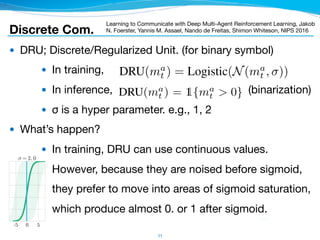
● DRU; Discrete/Regularized Unit. (for binary symbol)

● In training,

● In inference, (binarization)

● σ is a hyper parameter. e.g., 1, 2

● What’s happen?

● In training, DRU can use continuous values.

However, because they are noised before sigmoid,

they prefer to move into areas of sigmoid saturation,
which produce almost 0. or 1 after sigmoid.
11
Learning to Communicate with Deep Multi-Agent Reinforcement Learning, Jakob
N. Foerster, Yannis M. Assael, Nando de Freitas, Shimon Whiteson, NIPS 2016
gradients can be passed back along the channel, allowing end-
In particular, the network, which we call a C-Net, outputs tw
Figure 1(b), a) Q(·), the Q-values for the environment action
and b) ma
t , the real-valued vector message to other agents, w
is instead processed by the discretise/regularise unit (DRU(
centralised learning, DRU(ma
t ) = Logistic(N(ma
t , )), where
added to the channel, and discretises it during decentralised
Figure 1 shows how gradients flow differently in RIAL and
RIAL and Q, in DIAL, are based on the DQN loss. However,
backpropagated error from the recipient of the message to the
for training provides a richer training signal than the DQN l
error is nonzero only for the selected message, the incoming
that can contain more information. It also allows the network
minimise the downstream DQN loss, reducing the need for tria
While we limit our analysis to discrete messages, DIAL natura
as they are used anyway during centralised learning. At the sa
discrete message spaces, since it learns binary encodings inst
messages function as any other network activation,
allowing end-to-end backpropagation across agents.
et, outputs two distinct types of values, as shown in
onment actions, which are fed to the action selector,
ther agents, which bypasses the action selector and
e unit (DRU(ma
t )). The DRU regularises it during
ma
t , )), where is the standard deviation of the noise
decentralised execution, DRU(ma
t ) = 1{ma
t > 0}.
in RIAL and DIAL. The gradient chains for Qu, in
ss. However, in DIAL the gradient term for m is the
message to the sender. Using this inter-agent gradient
an the DQN loss for Qm in RIAL. While the DQN
the incoming gradient is a |m|-dimensional vector
s the network to directly adjust messages in order to
he need for trial and error learning of good protocols.
, DIAL naturally handles continuous message spaces,
ning. At the same time, DIAL can also scale to large
encodings instead of the one-hot encoding in RIAL,
the gradient is a function of the action
different +1/ 1 outcomes the gradient
s2
, m1
, a2
)
@
@✓
m1
(s1
)
<s2,a2>
. (4)
eeds to be set, it is useful to understand
ugh the channel. A first intuition can be
ecodable range of the logistic function
0.99, an initial estimate for the range is
dard deviations apart, with = 2, only
understanding of the required we can
nction and the Gaussian noise. To do so,
bution of outgoing messages, ˆm, given
log( 1
ˆm 1)
2
2
!
. (5)
the channel. Two m values m1 and m2
mall probability of overlapping. Given a
able when the highest value ˆm1 that m1
is likely to produce. An approximation
= (min ˆm s.t.P( ˆm|m2) > ✏). Figure 1
ly two options can be reliably encoded
ts only one bit of information.
Discrete Com.
● Multi-Step MNIST; Two players with each MNIST image

● Each sends each image’s number (0-9)

by binary x 4 steps (= 4bit = can represent 16 patterns)

● Reward = prediction

● Learned to represent 0-9 by 4bit →
12
Learning to Communicate with Deep Multi-Agent Reinforcement Learning, Jakob
N. Foerster, Yannis M. Assael, Nando de Freitas, Shimon Whiteson, NIPS 2016
y outperforming the NoComm baseline. DIAL with param-
e substantially faster than RIAL. Furthermore, parameter
b) shows results for n = 4 agents. DIAL with parameter
ods. In this setting, RIAL without parameter sharing was
se results illustrate how difficult it is for agents to learn the
ameter sharing can be crucial for learning to communicate.
dicating that the gradient provides a richer and more robust
he communication protocol discovered by DIAL for n = 3
re 4(c) shows a decision tree corresponding to an optimal
rogation room after day two, there are only two options:
ted the room before. If three prisoners had been, the third
The other options can be encoded via the “On” and “Off”
d on the well known MNIST digit classification dataset [25].
u1
2
m1 m2 m3 m4
u1
1
u5
1
u5
2
… … …
… … …
… … …
Agent1Agent2
m1
…
…
u1
2
u1
1
u2
2
u2
1
Agent1Agent2
Figure 5: MNIST games architectures.
r
e
n
d
s
c
-
e
e
g
a) Evaluation of Multi-Step (b) Evaluation of Colour-Digit
1 2 3 4
6teS
0
1
2
3
4
5
6
7
8
9
7rueDigit(c) Protocol of Multi-Step
10N 20N 30N 40N 50N
# (SRchs
0.0
0.2
0.4
0.6
0.8
1.0
1Rrm.R(2StLmDO)
DIAL
DIAL-16
5IAL
5IAL-16
1RCRmm
2rDcOe
(a) Evaluation of Multi-Step (b) Evaluation of Colour-Digit (c) P
Figure 6: MNIST Games: (a,b) Performance of DIAL and RIAL, with and with
-NS: no parameter sharing
● Switch Riddle

● One of n prisoners enters

the switch-room at random,

and sees a switch (On/Off).

● Then, do either

1. set On/Off

or 2. say “Everyone has entered”

● Reward = correct or (incorrect or several days end)

● Created a walkthrough protocol
13
[128, 128](za
t , ha
1,t 1), which is used to approximate the agent’s action-observation history.
ly, the output ha
2,t of the top GRU layer, is passed through a 2-layer MLP Qa
t , ma
t =
[128, 128, (|U| + |M|)](ha
2,t).
Switch Riddle
Day 1
3 2 3 1
Off
On
Off
On
Off
On
Day 2 Day 3 Day 4
Switch:
Action: On None None Tell
Off
On
Prisoner
in IR
:
Figure 3: Switch: Every day one pris-
oner gets sent to the interrogation room
where he sees the switch and chooses
from “On”, “Off”, “Tell” and “None”.
first task is inspired by a well-known riddle described
llows: “One hundred prisoners have been newly
red into prison. The warden tells them that starting
rrow, each of them will be placed in an isolated cell,
le to communicate amongst each other. Each day,
warden will choose one of the prisoners uniformly
ndom with replacement, and place him in a central
rogation room containing only a light bulb with a
e switch. The prisoner will be able to observe the
nt state of the light bulb. If he wishes, he can toggle
ght bulb. He also has the option of announcing that he believes all prisoners have visited the
rogation room at some point in time. If this announcement is true, then all prisoners are set free,
it is false, all prisoners are executed[...]” [24].
itecture. In our formalisation, at time-step t, agent a observes oa
t 2 {0, 1}, which indicates if
gent is in the interrogation room. Since the switch has two positions, it can be modelled as a
message, ma
t . If agent a is in the interrogation room, then its actions are ua
t 2 {“None”,“Tell”};
wise the only action is “None”. The episode ends when an agent chooses “Tell” or when the
mum time-step, T, is reached. The reward rt is 0 unless an agent chooses “Tell”, in which
it is 1 if all agents have been to the interrogation room and 1 otherwise. Following the riddle
ition, in this experiment ma
is available only to the agent a in the interrogation room. Finally,
ion of n = 3 (b) Evaluation of n = 4
Off
Has Been?
On
Yes
No
None
Has Been?
Yes
No Switch?
On
On
Off
Tell
On
Day
1
2
3+
(c) Protocol of n = 3
h: (a-b) Performance of DIAL and RIAL, with and without ( -NS) parameter sharing,
Discrete Com.
Learning to Communicate with Deep Multi-Agent Reinforcement Learning, Jakob
N. Foerster, Yannis M. Assael, Nando de Freitas, Shimon Whiteson, NIPS 2016
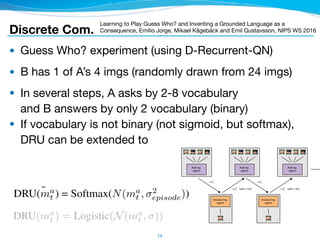
● Guess Who? experiment (using D-Recurrent-QN)

● B has 1 of A’s 4 imgs (randomly drawn from 24 imgs)

● In several steps, A asks by 2-8 vocabulary

and B answers by only 2 vocabulary (binary)

● If vocabulary is not binary (not sigmoid, but softmax),

DRU can be extended to
14
Figure 1: Schematic illustration of our version of the Guess Who? game
Discrete Com.
Learning to Play Guess Who? and Inventing a Grounded Language as a
Consequence, Emilio Jorge, Mikael Kågebäck and Emil Gustavsson, NIPS WS 2016
ture of the model. The time dimension (question-answer rounds in the gam
m top to bottom. The green boxes illustrate the internal state of the network
an perspective since we communicate through words which are non-binar
ssed through a variant of DRU as described in section 2.3 to generate a o
t
a =DRU(ma
t ) = Softmax(N(ma
t , 2
episode)) in the training case where N(
onal normal distribution. During evaluation ˆmt
a(i) = {1 if i = argmax
instead.
and interest. RIAL lacks this feedback mechanism, which is intuitively im
munication protocols.
mitation, we propose differentiable inter-agent learning (DIAL). The main
hat the combination of centralised learning and Q-networks makes it poss
ameters but to push gradients from one agent to another through the commu
while RIAL is end-to-end trainable within each agent, DIAL is end-to-end t
etting gradients flow from one agent to another gives them richer feedback,
unt of learning by trial and error, and easing the discovery of effective pro
ollows: during centralised learning, communication actions are replaced wi
ween the output of one agent’s network and the input of another’s. Thu
communication to discrete messages, during learning the agents are free
ages to each other. Since these messages function as any other network ac
passed back along the channel, allowing end-to-end backpropagation acros
network, which we call a C-Net, outputs two distinct types of values, as s
Q(·), the Q-values for the environment actions, which are fed to the action
eal-valued vector message to other agents, which bypasses the action sele
sed by the discretise/regularise unit (DRU(ma
t )). The DRU regularises i
ng, DRU(ma
t ) = Logistic(N(ma
t , )), where is the standard deviation of
nnel, and discretises it during decentralised execution, DRU(ma
t ) = 1{m
● (This is my opinion, not the authors’ one.)

● This

is similar to Gumbel-softmax.

● Two noise distributions are also similar?
15
Discrete Com.
Learning to Play Guess Who? and Inventing a Grounded Language as a
Consequence, Emilio Jorge, Mikael Kågebäck and Emil Gustavsson, NIPS WS 2016
oes from top to bottom. The green boxes illustrate the internal state of the
a human perspective since we communicate through words which are no
ma
t is passed through a variant of DRU as described in section 2.3 to gene
using ˆmt
a =DRU(ma
t ) = Softmax(N(ma
t , 2
episode)) in the training case w
dimensional normal distribution. During evaluation ˆmt
a(i) = {1 if i =
is used instead.
malization (see, [7]) is performed in the MLP for the image embedding and o
ma0
t 1. During testing non-stochastic versions of batch normalization is used
g averages of values observed during training are used instead of those fro
the parameters of the network are performed as described in section 2.3 wi
n [2, Appendix A].
easing noise
y curriculum learning described in [8], where Bengio et al. show that gradu
Categorical Reparameterization with Gumbel-Softmax, Eric Jang, Shixiang Gu, Ben Poole, ICLR 2017
The Concrete Distribution: A Continuous Relaxation of Discrete Random Variables, Chris J. Maddison,
Andriy Mnih, Yee Whye Teh, ICLR 2017
RIVING THE DENSITY OF THE GUMBEL-SOFTMAX DI
derive the probability density function of the Gumbel-Softmax d
1, ..., ⇡k and temperature ⌧. We first define the logits xi = log ⇡
, where gi ⇠ Gumbel(0, 1). A sample from the Gumbel-Softmax c
yi =
exp ((xi + gi)/⌧)
Pk
j=1 exp ((xj + gj)/⌧)
for i = 1, ..., k
ENTERED GUMBEL DENSITY
ping from the Gumbel samples g to the Gumbel-Softmax sample y
ation of the softmax operation removes one degree of freedom. To
equivalent sampling process that subtracts off the last element, (
B DERIVING THE DENSITY
Here we derive the probability dens
bilities ⇡1, ..., ⇡k and temperature ⌧
g1, ..., gk, where gi ⇠ Gumbel(0, 1).
yi =
exp
Pk
j=1
B.1 CENTERED GUMBEL DENSIT
The mapping from the Gumbel samp
2.1 GUMBEL-SOFTMAX ESTIMATOR
The Gumbel-Softmax distribution is smooth, an
respect to their parameters ⇡. Thus, by replacing
we can use backpropagation to compute gradien
replacing non-differentiable categorical samples
as the Gumbel-Softmax estimator.
1
The Gumbel(0, 1) distribution can be sampled
Uniform(0, 1) and computing g = log( log(u)).
egorical random
expected value
Softmax distrib
temperatures, G
2.1 GUMBEL
The Gumbel-S
respect to their
we can use ba
replacing non-
as the Gumbel
1
The Gumbe
Uniform(0, 1) a
o samples from a categorical distribution as ⌧ ! 0. At higher
ples are no longer one-hot, and become uniform as ⌧ ! 1.
TOR
s smooth, and therefore has a well-defined gradient @y/@⇡, with
by replacing categorical samples with Gumbel-Softmax samples
mpute gradients (see Section 3.1). We denote this procedure of
ical samples with a differentiable approximation during training
n be sampled using inverse transform sampling by drawing u ⇠
g( log(u)).
2
For Real Images
● SENDER Sends 1 symbol from 10~100 vocabulary

and RECEIVER chooses 1 of 2 imgs

● 2 imgs have different label (in 100 labels)

● Use pretrained VGGNet

● Succeeded to discriminate.

But, some models made strange com.

using only 2 symbols
16
Under review as a conference paper at ICLR 2017
informed senderagnostic sender receiver
symbol
1
symbol
2
symbol
3
symbol
1
symbol
2
symbol
3
left
image
right
image
Under review as a conference paper at ICLR 2017
0.00
0.03
0.06
0.09
2 10152025 38 100
Singular Value Position
NormalizedSpectrum
Figure 2: Left: Communication success as a function of training iterations for the configurations
using fc visual representations. The plots report performance on 1/10 of the test set. Right: Singular
values of symbols used by the informed sender (configuration as in row 2 of Table 1).
id sender vis voc used comm purity (%) obs-chance
rep size symbols success (%) purity (%)
1 informed sm 100 58 100 46 0.27
2 informed fc 100 38 100 41 0.23
3 informed sm 10 10 100 35 0.18
4 informed fc 10 10 100 32 0.17
5 agnostic sm 100 2 99 21 0.15
6 agnostic fc 10 2 99 21 0.15
7 agnostic sm 10 2 99 20 0.15
8 agnostic fc 100 2 99 19 0.15
Multi-Agent Cooperation and the Emergence of (Natural) Language, Angeliki
Lazaridou, Alexander Peysakhovich, Marco Baroni, ICLR 2017
Under review as a conference p
agnostic sender
symbol
1
symbol
2
symbol
3
F
the symbol and image embedd
better denoted by the symbol.
temperature ⌧) and the receive
General Training Details W
mensionality of all embedding
sender: 20, temperature of all
100 symbols. The sender and
the game. The only supervisio
at the right referent. This setup
1998). As outlined in Section
policy r(iL, iR, s(✓S(iL, iR, t)
IE˜r[R(˜r)] where R is the rew
are updated through the Reinfo
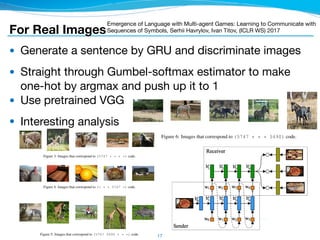
● Generate a sentence by GRU and discriminate images

● Straight through Gumbel-softmax estimator to make
one-hot by argmax and push up it to 1

● Use pretrained VGG

● Interesting analysis
17
Workshop track - ICLR 2017
5.2 MODEL SPECIFICATION
We set the following hyperparameters without tuning: embedding dimensionality is 256, the dimen-
sionality of LSTM layer is 512, vocabulary size is 10000, Gumbel-softmax distribution temperature
is 1.0, the number of distracting images is 127, batch size is 128. We used Adam (Kingma & Ba,
2014) as an optimizer, with default hyperparameters and a learning rate of 0.001.
5.3 QUALITATIVE ANALYSIS OF THE LEARNED LANGUAGE
To understand better the nature of the learned language, we inspected a small subset of sentences
that were produced by the model with maximum possible message length equal to 5. Figure 3 shows
some samples from MSCOCO 2014 validation set that correspond to (5747 * * * *) code3
.
Images in this subset depict mainly animals. On the other hand, it seems that samples on figure 4
do not correspond to any predefined category. This observation suggests that word order is crucial
in the developed language and particularly word 5747 on the first position encodes presence of an
animal on the image. Considering figure 5, we can conclude that adding word 5490 on the second
position reduces the possible content of the image just to zebras, giraffes and sometimes horses.
When we move token 5490 to the end of the message, we end up just with zebras on the images
(figure 6). Figure 7 shows that message (5747 5747 7125 * *) corresponds to particular type
of bears. This information suggests to hypothesise that developed language implements some kind
of hierarchical coding. This is interesting by itself because the model was not constrained explicitly
to use such hierarchical encoding scheme.
Figure 3: Images that correspond to (5747 * * * *) code.
Figure 4: Images that correspond to (* * * 5747 *) code.
Figure 5: Images that correspond to (5747 5490 * * *) code.
Workshop track - ICLR 2017
Figure 6: Images that correspond to (5747 * * * 5490) code.
For Real Images
Emergence of Language with Multi-agent Games: Learning to Communicate with
Sequences of Symbols, Serhii Havrylov, Ivan Titov, (ICLR WS) 2017
Discriminative Captioning
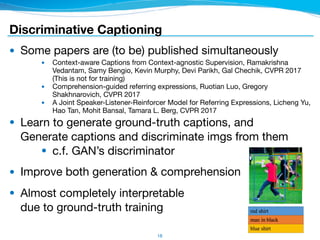
● Some papers are (to be) published simultaneously

● Context-aware Captions from Context-agnostic Supervision, Ramakrishna
Vedantam, Samy Bengio, Kevin Murphy, Devi Parikh, Gal Chechik, CVPR 2017
(This is not for training)

● Comprehension-guided referring expressions, Ruotian Luo, Gregory
Shakhnarovich, CVPR 2017

● A Joint Speaker-Listener-Reinforcer Model for Referring Expressions, Licheng Yu,
Hao Tan, Mohit Bansal, Tamara L. Berg, CVPR 2017

● Learn to generate ground-truth captions, and

Generate captions and discriminate imgs from them

● c.f. GAN’s discriminator

● Improve both generation & comprehension

● Almost completely interpretable

due to ground-truth training
18
My Experiments
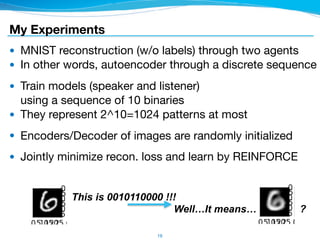
● MNIST reconstruction (w/o labels) through two agents

● In other words, autoencoder through a discrete sequence

● Train models (speaker and listener)

using a sequence of 10 binaries

● They represent 2^10=1024 patterns at most

● Encoders/Decoder of images are randomly initialized

● Jointly minimize recon. loss and learn by REINFORCE
19
This is 0010110000 !!!

Well…It means… ? ?
My Experiments - Result
● Reconstructed Image (Top)

● Raw Image (Bottom)

● Sent sentences

● 0 [1111001011] 6 [0111110101] 9 [0010110011] 0 [1111001101]

1 [0000000100] 5 [1110010010] 9 [0101101111] 7 [0000011110]

3 [1110000101] 4 [0011011010]

● Almost succeed to send image by 10 bits

● with some confusion. 3 or 5, 9 or 4, 0 or 8
20
My Experiments - Result
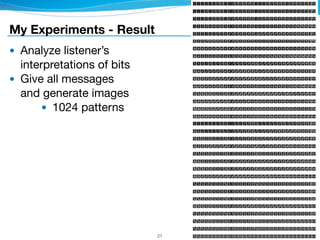
● Analyze listener’s

interpretations of bits

● Give all messages

and generate images

● 1024 patterns
21
My Experiments - Result
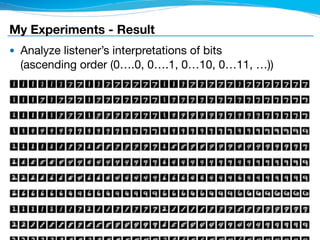
● Analyze listener’s interpretations of bits

(ascending order (0….0, 0….1, 0…10, 0…11, …))

22
My Experiments - Result
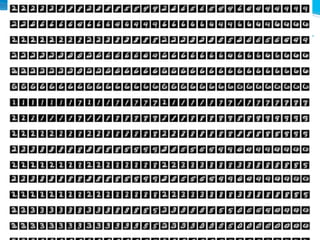
● Analyze listener’s interpretations of bits

(ascending order (0….0, 0….1, 0…10, 0…11, …))

23
My Experiments - Result
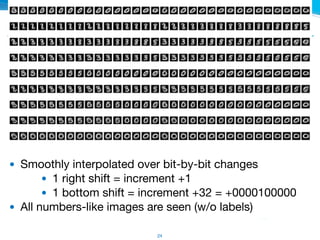
● Analyze listener’s interpretations of bits

(ascending order (0….0, 0….1, 0…10, 0…11, …))

● Smoothly interpolated over bit-by-bit changes

● 1 right shift = increment +1

● 1 bottom shift = increment +32 = +0000100000

● All numbers-like images are seen (w/o labels)
24
My Experiments - Result
● Analyze

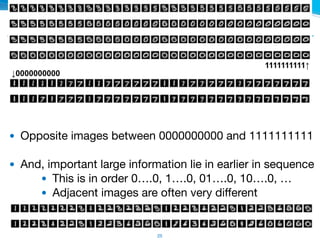
● Opposite images between 0000000000 and 1111111111

● And, important large information lie in earlier in sequence

● This is in order 0….0, 1….0, 01….0, 10….0, …

● Adjacent images are often very different
25
↓0000000000
1111111111↑

Learning Communication with Neural Networks

  • 1.
    Learning Communication with
 Neural Networks SosukeKobayashi Preferred Networks, Inc.
 PFN Seminar 2017/03/09
  • 2.
    Highlights ● Neural Networkslearn communication with multi-agents ● only through reward of consequent tasks ● with continuous vectors
 or with discrete symbols (bits or one-hot vectors)
 using, in training, ● REINFORCE, Straight Through Estimator,
 Discrete/Regularized Unit, Gumbel-softmax ● Interpret NN’s symbols ● My experiment and analysis 2
  • 3.
    Note ● I donot mention ● Electronic communications ● Distributed Learning ● Human communication study ● Dialogue system, ChatBot 3
  • 4.
    Why Communication? ● Shareloads or experiences (I do not mention this) ● Distributed learning; e.g., ChainerMN, … ● Share partial observations ● Sending Information itself ● Merged Information is more useful for a task ● Plan actions collaboratively ● When two cars are crossing,
 one should go and the other should stop ● Just experiment to analyze “communication” 4
  • 5.
    Examples ● Communication ofcontinuous vectors
 (In other words, multi-agents can be seen just one NN) ● Merge and return total information ● Each agent outputs an action a ● Learning by REINFORCE; reward*log(p(a)) 5 Connecting Neural Models Anonymous Author(s) Affiliation Address email Abstract ke two contributions. First, we simplify and extend the graph neural network cond, we show how this architecture can be used to control groups of cooperating f the model consists of multilayer neural networks fi that take as input vectors a vector hi+1 . The model takes as input a set of vectors {h0 1, h0 2, ..., h0 m}, and hi+1 j = fi (hi j, ci j) ci+1 j = X j06=j hi+1 j0 ; onnecting Neural Models Anonymous Author(s) Affiliation Address email Abstract ontributions. First, we simplify and extend the graph neural network show how this architecture can be used to control groups of cooperating el consists of multilayer neural networks fi that take as input vectors hi+1 . The model takes as input a set of vectors {h0 1, h0 2, ..., h0 m}, and hi+1 j = fi (hi j, ci j) ci+1 j = X j06=j hi+1 j0 ; Anonymous Author(s) Affiliation Address email Abstract bstract oduction rk we make two contributions. First, we simplify and extend the graph neural network re of ??. Second, we show how this architecture can be used to control groups of cooperating del est form of the model consists of multilayer neural networks fi that take as input vectors and output a vector hi+1 . The model takes as input a set of vectors {h0 1, h0 2, ..., h0 m}, and hi+1 j = fi (hi j, ci j) ci+1 j = X j06=j hi+1 j0 ; = 0 for all j, and i 2 {0, .., K} (we will call K the number of hops in the network). , we can take the final hK j and output them directly, so that the model outputs a vector ding to each input vector, or we can feed them into another network to get a single vector or put. is a simple linear layer followed by a nonlinearity : i+1 i i i i mean contribution. In this setting, there is no difference between each agent having its own c36 viewing them as pieces of a larger model controlling all agents. Taking the latter pers37 controller is a large feed-forward neural network that maps inputs for all agents to their a38 agent occupying a subset of units. A specific connectivity structure between layers (a) ins39 broadcast communication channel between agents and (b) propagates the agent state in th40 an RNN.41 Because the agents will receive reward, but not necessarily supervision for each action, re42 learning is used to maximize expected future reward. We explore two forms of communic43 the controller: (i) discrete and (ii) continuous. In the former case, communication is an44 will be treated as such by the reinforcement learning. In the continuous case, the sig45 between agents are no different than hidden states in a neural network; thus credit assign46 communication can be performed using standard backpropagation (within the outer RL47 We use policy gradient [33] with a state specific baseline for delivering a gradient to48 Denote the states in an episode by s(1), ..., s(T), and the actions taken at each of49 as a(1), ..., a(T), where T is the length of the episode. The baseline is a scalar fun50 states b(s, ✓), computed via an extra head on the model producing the action probabili51 maximizing the expected reward with policy gradient, the models are also trained to m52 distance between the baseline value and actual reward. Thus, after finishing an episode53 the model parameters ✓ by54 ✓ = TX t=1 log p(a(t)|s(t), ✓) ✓ TX i=t r(i) b(s(t), ✓) ✓ TX i=t r(i) b(s(t) Here r(t) is reward given at time t, and the hyperparameter is for balancing the rew55 baseline objectives, set to 0.03 in all experiments.56 3 Model57 We now describe the model used to compute p(a(t)|s(t), ✓) at a given time t (ommiti58 index for brevity). Let sj be the jth agent’s view of the state of the environment. The59 controller is the concatenation of all state-views s = {s1, ..., sJ }, and the controller i60 a = (s), where the output a is a concatenation of discrete actions a = {a1, ..., aJ } for61 Note that this single controller encompasses the individual controllers for each agent62 the communication between agents.63 learning is used to maximize expected future reward. We explore two forms of communication within43 the controller: (i) discrete and (ii) continuous. In the former case, communication is an action, and44 will be treated as such by the reinforcement learning. In the continuous case, the signals passed45 between agents are no different than hidden states in a neural network; thus credit assignment for the46 communication can be performed using standard backpropagation (within the outer RL loop).47 We use policy gradient [33] with a state specific baseline for delivering a gradient to the model.48 Denote the states in an episode by s(1), ..., s(T), and the actions taken at each of those states49 as a(1), ..., a(T), where T is the length of the episode. The baseline is a scalar function of the50 states b(s, ✓), computed via an extra head on the model producing the action probabilities. Beside51 maximizing the expected reward with policy gradient, the models are also trained to minimize the52 distance between the baseline value and actual reward. Thus, after finishing an episode, we update53 the model parameters ✓ by54 ✓ = TX t=1 log p(a(t)|s(t), ✓) ✓ TX i=t r(i) b(s(t), ✓) ✓ TX i=t r(i) b(s(t), ✓) 2 . Here r(t) is reward given at time t, and the hyperparameter is for balancing the reward and the55 baseline objectives, set to 0.03 in all experiments.56 3 Model57 We now describe the model used to compute p(a(t)|s(t), ✓) at a given time t (ommiting the time58 index for brevity). Let sj be the jth agent’s view of the state of the environment. The input to the59 controller is the concatenation of all state-views s = {s1, ..., sJ }, and the controller is a mapping60 a = (s), where the output a is a concatenation of discrete actions a = {a1, ..., aJ } for each agent.61 Note that this single controller encompasses the individual controllers for each agents, as well as62 the communication between agents.63 One obvious choice for is a fully-connected multi-layer neural network, which could extract64 features h from s and use them to predict good actions with our RL framework. This model would65 allow agents to communicate with each other and share views of the environment. However, it66 is inflexible with respect to the composition and number of agents it controls; cannot deal well67 with agents joining and leaving the group and even the order of the agents must be fixed. On the68 other hand, if no communication is used then we can write a = { (s1), ..., (sJ )}, where is a69 per-agent controller applied independently. This communication-free model satisfies the flexibility70 requirements1 , but is not able to coordinate their actions.71 , and computes: hi+1 j = fi (hi j, ci j) (1) ci+1 j = 1 J 1 X j06=j hi+1 j0 . (2) a single linear layer followed by a nonlinearity , we have: hi+1 j = (Hi hi j + can be viewed as a feedforward network with layers hi+1 = (Ti hi ) where hi of all hi j and T takes the block form: Ti = Hi Ci Ci ... Ci Ci Hi Ci ... Ci Ci Ci Hi ... Ci ... ... ... ... ... Ci Ci Ci ... Hi , eural Models Author(s) tion ess il ract e simplify and extend the graph neural network cture can be used to control groups of cooperating ral Models thor(s) mplify and extend the graph neural network odels extend the graph neural network g Neural Models ymous Author(s) Affiliation Address email Abstract rst, we simplify and extend the graph neural network architecture can be used to control groups of cooperating multilayer neural networks fi that take as input vectors 0 0 0 2 Problem Formulation33 We consider the setting where we have M agents, all cooperating to maximize reward R in some34 environment. We make the simplifying assumption that each agent receives R, independent of their35 contribution. In this setting, there is no difference between each agent having its own controller, or36 viewing them as pieces of a larger model controlling all agents. Taking the latter perspective, our37 controller is a large feed-forward neural network that maps inputs for all agents to their actions, each38 agent occupying a subset of units. A specific connectivity structure between layers (a) instantiates the39 broadcast communication channel between agents and (b) propagates the agent state in the manner of40 an RNN.41 Because the agents will receive reward, but not necessarily supervision for each action, reinforcement42 learning is used to maximize expected future reward. We explore two forms of communication within43 the controller: (i) discrete and (ii) continuous. In the former case, communication is an action, and44 will be treated as such by the reinforcement learning. In the continuous case, the signals passed45 between agents are no different than hidden states in a neural network; thus credit assignment for the46 communication can be performed using standard backpropagation (within the outer RL loop).47 We use policy gradient [33] with a state specific baseline for delivering a gradient to the model.48 Denote the states in an episode by s(1), ..., s(T), and the actions taken at each of those states49 as a(1), ..., a(T), where T is the length of the episode. The baseline is a scalar function of the50 states b(s, ✓), computed via an extra head on the model producing the action probabilities. Beside51 maximizing the expected reward with policy gradient, the models are also trained to minimize the52 distance between the baseline value and actual reward. Thus, after finishing an episode, we update53 the model parameters ✓ by54 TX log p(a(t)|s(t), ✓) TX TX 2 Problem Formulation consider the setting where we have M agents, all cooperating to maximize reward R in some ironment. We make the simplifying assumption that each agent receives R, independent of their tribution. In this setting, there is no difference between each agent having its own controller, or wing them as pieces of a larger model controlling all agents. Taking the latter perspective, our troller is a large feed-forward neural network that maps inputs for all agents to their actions, each nt occupying a subset of units. A specific connectivity structure between layers (a) instantiates the adcast communication channel between agents and (b) propagates the agent state in the manner of RNN. ause the agents will receive reward, but not necessarily supervision for each action, reinforcement ning is used to maximize expected future reward. We explore two forms of communication within controller: (i) discrete and (ii) continuous. In the former case, communication is an action, and be treated as such by the reinforcement learning. In the continuous case, the signals passed ween agents are no different than hidden states in a neural network; thus credit assignment for the mmunication can be performed using standard backpropagation (within the outer RL loop). use policy gradient [33] with a state specific baseline for delivering a gradient to the model. note the states in an episode by s(1), ..., s(T), and the actions taken at each of those states a(1), ..., a(T), where T is the length of the episode. The baseline is a scalar function of the es b(s, ✓), computed via an extra head on the model producing the action probabilities. Beside ximizing the expected reward with policy gradient, the models are also trained to minimize the ance between the baseline value and actual reward. Thus, after finishing an episode, we update model parameters ✓ by ✓ = TX t=1 log p(a(t)|s(t), ✓) ✓ TX i=t r(i) b(s(t), ✓) ✓ TX i=t r(i) b(s(t), ✓) 2 . e r(t) is reward given at time t, and the hyperparameter is for balancing the reward and the eline objectives, set to 0.03 in all experiments. Model , ..., h0 J ], and computes: hi+1 j = fi (hi j, ci j) (1) ci+1 j = 1 J 1 X j06=j hi+1 j0 . (2) at fi is a single linear layer followed by a nonlinearity , we have: hi+1 j = (Hi hi j + e model can be viewed as a feedforward network with layers hi+1 = (Ti hi ) where hi enation of all hi j and T takes the block form: Ti = Hi Ci Ci ... Ci Ci Hi Ci ... Ci Ci Ci Hi ... Ci ... ... ... ... ... Ci Ci Ci ... Hi , g Neural Models mous Author(s) Affiliation Address email Abstract rst, we simplify and extend the graph neural network rchitecture can be used to control groups of cooperating Neural Models ous Author(s) filiation ddress mail stract we simplify and extend the graph neural network hitecture can be used to control groups of cooperating al Models or(s) lify and extend the graph neural network an be used to control groups of cooperating ecting Neural Models Anonymous Author(s) Affiliation Address email Abstract ions. First, we simplify and extend the graph neural network how this architecture can be used to control groups of cooperating sists of multilayer neural networks fi that take as input vectors The model takes as input a set of vectors {h0 1, h0 2, ..., h0 m}, and 2 Problem Formulation33 We consider the setting where we have M agents, all cooperating to maximize reward R in some34 environment. We make the simplifying assumption that each agent receives R, independent of their35 contribution. In this setting, there is no difference between each agent having its own controller, or36 viewing them as pieces of a larger model controlling all agents. Taking the latter perspective, our37 controller is a large feed-forward neural network that maps inputs for all agents to their actions, each38 agent occupying a subset of units. A specific connectivity structure between layers (a) instantiates the39 broadcast communication channel between agents and (b) propagates the agent state in the manner of40 an RNN.41 Because the agents will receive reward, but not necessarily supervision for each action, reinforcement42 learning is used to maximize expected future reward. We explore two forms of communication within43 the controller: (i) discrete and (ii) continuous. In the former case, communication is an action, and44 will be treated as such by the reinforcement learning. In the continuous case, the signals passed45 between agents are no different than hidden states in a neural network; thus credit assignment for the46 communication can be performed using standard backpropagation (within the outer RL loop).47 We use policy gradient [33] with a state specific baseline for delivering a gradient to the model.48 Denote the states in an episode by s(1), ..., s(T), and the actions taken at each of those states49 as a(1), ..., a(T), where T is the length of the episode. The baseline is a scalar function of the50 states b(s, ✓), computed via an extra head on the model producing the action probabilities. Beside51 maximizing the expected reward with policy gradient, the models are also trained to minimize the52 distance between the baseline value and actual reward. Thus, after finishing an episode, we update53 the model parameters ✓ by54 ✓ = TX log p(a(t)|s(t), ✓) ✓ TX r(i) b(s(t), ✓) ✓ TX r(i) b(s(t), ✓) 2 . 2 Problem Formulation33 We consider the setting where we have M agents, all cooperating to maximize reward R in some34 environment. We make the simplifying assumption that each agent receives R, independent of their35 contribution. In this setting, there is no difference between each agent having its own controller, or36 viewing them as pieces of a larger model controlling all agents. Taking the latter perspective, our37 controller is a large feed-forward neural network that maps inputs for all agents to their actions, each38 agent occupying a subset of units. A specific connectivity structure between layers (a) instantiates the39 broadcast communication channel between agents and (b) propagates the agent state in the manner of40 an RNN.41 Because the agents will receive reward, but not necessarily supervision for each action, reinforcement42 learning is used to maximize expected future reward. We explore two forms of communication within43 the controller: (i) discrete and (ii) continuous. In the former case, communication is an action, and44 will be treated as such by the reinforcement learning. In the continuous case, the signals passed45 between agents are no different than hidden states in a neural network; thus credit assignment for the46 communication can be performed using standard backpropagation (within the outer RL loop).47 We use policy gradient [33] with a state specific baseline for delivering a gradient to the model.48 Denote the states in an episode by s(1), ..., s(T), and the actions taken at each of those states49 as a(1), ..., a(T), where T is the length of the episode. The baseline is a scalar function of the50 states b(s, ✓), computed via an extra head on the model producing the action probabilities. Beside51 maximizing the expected reward with policy gradient, the models are also trained to minimize the52 distance between the baseline value and actual reward. Thus, after finishing an episode, we update53 the model parameters ✓ by54 ✓ = TX t=1 log p(a(t)|s(t), ✓) ✓ TX i=t r(i) b(s(t), ✓) ✓ TX i=t r(i) b(s(t), ✓) 2 . Here r(t) is reward given at time t, and the hyperparameter is for balancing the reward and the55 baseline objectives, set to 0.03 in all experiments.56 3 Model57 We now describe the model used to compute p(a(t)|s(t), ✓) at a given time t (ommiting the time58 index for brevity). Let sj be the jth agent’s view of the state of the environment. The input to the59 tanh email Abstract abstract roduction ork we make two contributions. First, we simplify and extend the graph neural network ure of ??. Second, we show how this architecture can be used to control groups of cooperating del lest form of the model consists of multilayer neural networks fi that take as input vectors and output a vector hi+1 . The model takes as input a set of vectors {h0 1, h0 2, ..., h0 m}, and s hi+1 j = fi (hi j, ci j) ci+1 j = X j06=j hi+1 j0 ; 0 j = 0 for all j, and i 2 {0, .., K} (we will call K the number of hops in the network). d, we can take the final hK j and output them directly, so that the model outputs a vector nding to each input vector, or we can feed them into another network to get a single vector or tput. CommNet modelth communication stepModule for agent email Abstract abstract Introduction n this work we make two contributions. First, we simplify and extend the graph neural network rchitecture of ??. Second, we show how this architecture can be used to control groups of cooperating gents. Model he simplest form of the model consists of multilayer neural networks fi that take as input vectors i and ci and output a vector hi+1 . The model takes as input a set of vectors {h0 1, h0 2, ..., h0 m}, and omputes hi+1 j = fi (hi j, ci j) ci+1 j = X j06=j hi+1 j0 ; We set c0 j = 0 for all j, and i 2 {0, .., K} (we will call K the number of hops in the network). desired, we can take the final hK j and output them directly, so that the model outputs a vector orresponding to each input vector, or we can feed them into another network to get a single vector or calar output. email Abstract abstract1 1 Introduction2 In this work we make two contributions. First, we simplify and extend the graph neural network3 architecture of ??. Second, we show how this architecture can be used to control groups of cooperating4 agents.5 2 Model6 The simplest form of the model consists of multilayer neural networks fi that take as input vectors7 hi and ci and output a vector hi+1 . The model takes as input a set of vectors {h0 1, h0 2, ..., h0 m}, and8 computes9 hi+1 j = fi (hi j, ci j) 10 ci+1 j = X j06=j hi+1 j0 ; We set c0 j = 0 for all j, and i 2 {0, .., K} (we will call K the number of hops in the network).11 If desired, we can take the final hK j and output them directly, so that the model outputs a vector12 corresponding to each input vector, or we can feed them into another network to get a single vector or13 scalar output.14 email Abstract abstract1 1 Introduction2 In this work we make two contributions. First, we simplify and extend the graph neural n3 architecture of ??. Second, we show how this architecture can be used to control groups of coop4 agents.5 2 Model6 The simplest form of the model consists of multilayer neural networks fi that take as input7 hi and ci and output a vector hi+1 . The model takes as input a set of vectors {h0 1, h0 2, ..., h0 m8 computes9 hi+1 j = fi (hi j, ci j) 10 ci+1 j = X j06=j hi+1 j0 ; We set c0 j = 0 for all j, and i 2 {0, .., K} (we will call K the number of hops in the ne11 If desired, we can take the final hK j and output them directly, so that the model outputs a12 corresponding to each input vector, or we can feed them into another network to get a single v13 scalar output.14 their actions, each agent occupying a subset of units. A specific connectivity structure between layers (a) instantiates the broadcast communication channel between agents and (b) propagates the agent state. 3 Communication Model We now describe the model used to compute p(a(t)|s(t), ✓) at a given time t (omitting the time index for brevity). Let sj be the jth agent’s view of the state of the environment. The input to the controller is the concatenation of all state-views s = {s1, ..., sJ }, and the controller is a mapping a = (s), where the output a is a concatenation of discrete actions a = {a1, ..., aJ } for each agent. Note that this single controller encompasses the individual controllers for each agents, as well as the communication between agents. 3.1 Controller Structure We now detail our architecture for that allows communication without losing modularity. is built from modules fi , which take the form of multilayer neural networks. Here i 2 {0, .., K}, where K is the number of communication steps in the network. Each fi takes two input vectors for each agent j: the hidden state hi j and the communication ci j, and outputs a vector hi+1 j . The main body of the model then takes as input the concatenated vectors h0 = [h0 1, h0 2, ..., h0 J ], and computes: Connecting Neural Models Connecting Neural Models Connecting Neural Models Anonymous Author(s) Affiliation Address 2 Problem Formulation33 We consider the setting where we have M agents, all cooperating to maximize rewa34 environment. We make the simplifying assumption that each agent receives R, indepe35 contribution. In this setting, there is no difference between each agent having its own36 viewing them as pieces of a larger model controlling all agents. Taking the latter pe37 controller is a large feed-forward neural network that maps inputs for all agents to thei38 agent occupying a subset of units. A specific connectivity structure between layers (a) i39 2 Problem Formulation33 We consider the setting where we have M agents, all cooperating to maximize reward R in some34 environment. We make the simplifying assumption that each agent receives R, independent of their35 contribution. In this setting, there is no difference between each agent having its own controller, or36 viewing them as pieces of a larger model controlling all agents. Taking the latter perspective, our37 controller is a large feed-forward neural network that maps inputs for all agents to their actions, each38 agent occupying a subset of units. A specific connectivity structure between layers (a) instantiates the39 broadcast communication channel between agents and (b) propagates the agent state in the manner of40 an RNN.41 Because the agents will receive reward, but not necessarily supervision for each action, reinforcement42 learning is used to maximize expected future reward. We explore two forms of communication within43 the controller: (i) discrete and (ii) continuous. In the former case, communication is an action, and44 will be treated as such by the reinforcement learning. In the continuous case, the signals passed45 between agents are no different than hidden states in a neural network; thus credit assignment for the46 ecting Neural Models2 Problem Formulation33 We consider the setting where we have M agents, all cooperating to maximize reward R in some34 onnecting Neural Models2 Problem Formulation33 We consider the setting where we have M agents, all cooperating to maximize reward R in some34 Connecting Neural Models Anonymous Author(s) Affiliation Address email Connecting Neural Models Anonymous Author(s) Affiliation Address email Connecting Neural Models Anonymous Author(s) Affiliation Address email Connecting Neural Models Anonymous Author(s) Affiliation Address email Figure 1: An overview of our CommNet model. Left: view of module fi for a single agent j. Note Learning Multiagent Communication with Backpropagation, Sainbayar Sukhbaatar, Arthur Szlam, Rob Fergus, NIPS 2016
  • 6.
    Examples 6 Learning Multiagent Communicationwith Backpropagation, Sainbayar Sukhbaatar, Arthur Szlam, Rob Fergus, NIPS 2016 ● Traffic Junction ● At each step, Stop or Go by cell (according to its plan) ● Each car can see surrounding area (e.g., 3x3) ● Reward = Go quickly and safely 3 possible routes New car arrivals Car exiting Visual range https://www.youtube.com/watch?v=KhtdEvJ1F6Q
  • 7.
    7 ● Lever PullingTask ● One step game (not multi-step) ● 5 agents are drawn at random from total 500 agents ● They must choose and pull one lever simultaneously ● Reward = #_of_distinct_levers ● Each agent has each ID (and its embedding vector) ● Task needs communicating their (5 agents’) IDs
 and choosing levers based on a sort of IDs ● e.g., ascending order of IDs Examples Learning Multiagent Communication with Backpropagation, Sainbayar Sukhbaatar, Arthur Szlam, Rob Fergus, NIPS 2016
  • 8.
    8 ● In myopinion,
 neural networks (or machines, more generally)
 can communicate/copy with continuous values ● What are the advantages of discrete communication? ● Compressibility ● Noise immunity, Robustness ● Regularization, Generalization, Abstraction ● Interpretability, Connection to other discrete ones ● Suggestive for other (real) communication study Advantages of Discrete Communication
  • 9.
    Discrete Com. ● Communicationof (discrete) binary sequences ● Each agent outputs an action a after com. steps ● DQN. In training, ● (a) RIAL uses binary com. ● (b) DIAL uses noisy continuous com. = DRU 9 Learning to Communicate with Deep Multi-Agent Reinforcement Learning, Jakob N. Foerster, Yannis M. Assael, Nando de Freitas, Shimon Whiteson, NIPS 2016 Q-network represents Qa (oa t , ma t 1, ha t 1, ua ), which conditions on that agent’s individual hidden state ha t 1 and observation oa t as well as messages from other agents ma0 t 1. To avoid needing a network with |U||M| outputs, we split the network into Qa u and Qa m, the Q-values for the environment and communication actions, respectively. Similarly to [18], the action selector separately picks ua t and ma t from Qu and Qm, using an ✏-greedy policy. Hence, the network requires only |U| + |M| outputs and action selection requires maximising over U and then over M, but not maximising over U ⇥ M. Both Qu and Qm are trained using DQN with the following two modifications, which were found to be essential for performance. First, we disable experience replay to account for the non-stationarity that occurs when multiple agents learn concurrently, as it can render experience obsolete and misleading. Second, to account for partial observability, we feed in the actions u and m taken by each agent as inputs on the next time-step. Figure 1(a) shows how information flows between agents and the environment, and how Q-values are processed by the action selector in order to produce the action, ua t , and message ma t . Since this approach treats agents as independent networks, the learning phase is not centralised, even though our problem setting allows it to be. Consequently, the agents are treated exactly the same way during decentralised execution as during learning. ot 1 ut+1 2 Q-Net ut 1 Q-Net Action Select mt 1 mt+1 2 Agent1Agent2 ot+1 2 Action Select mt-1 2 Environment Q-Net Action Select Q-Net Action Select t+1t (a) RIAL - RL based communication ot 1 ut+1 2 C-Net ut 1 C-Net Action Select DRU mt 1 mt+1 2 Agent1Agent2 ot+1 2 Action Select Environment C-Net Action Select C-Net Action Select DRU t+1t (b) DIAL - Differentiable communication
  • 10.
    Discrete Com. ● Multi-StepMNIST; Two players with each MNIST image ● Each sends each image’s number (0-9)
 by binary x 4 steps (= 4bit = can represent 16 patterns) ● Reward = prediction ● Learned to represent 0-9 by 4bit → 10 Learning to Communicate with Deep Multi-Agent Reinforcement Learning, Jakob N. Foerster, Yannis M. Assael, Nando de Freitas, Shimon Whiteson, NIPS 2016 y outperforming the NoComm baseline. DIAL with param- e substantially faster than RIAL. Furthermore, parameter b) shows results for n = 4 agents. DIAL with parameter ods. In this setting, RIAL without parameter sharing was se results illustrate how difficult it is for agents to learn the ameter sharing can be crucial for learning to communicate. dicating that the gradient provides a richer and more robust he communication protocol discovered by DIAL for n = 3 re 4(c) shows a decision tree corresponding to an optimal rogation room after day two, there are only two options: ted the room before. If three prisoners had been, the third The other options can be encoded via the “On” and “Off” d on the well known MNIST digit classification dataset [25]. u1 2 m1 m2 m3 m4 u1 1 u5 1 u5 2 … … … … … … … … … Agent1Agent2 m1 … … u1 2 u1 1 u2 2 u2 1 Agent1Agent2 Figure 5: MNIST games architectures. r e n d s c - e e g a) Evaluation of Multi-Step (b) Evaluation of Colour-Digit 1 2 3 4 6teS 0 1 2 3 4 5 6 7 8 9 7rueDigit(c) Protocol of Multi-Step 10N 20N 30N 40N 50N # (SRchs 0.0 0.2 0.4 0.6 0.8 1.0 1Rrm.R(2StLmDO) DIAL DIAL-16 5IAL 5IAL-16 1RCRmm 2rDcOe (a) Evaluation of Multi-Step (b) Evaluation of Colour-Digit (c) P Figure 6: MNIST Games: (a,b) Performance of DIAL and RIAL, with and with -NS: no parameter sharing
  • 11.
    Discrete Com. ● DRU;Discrete/Regularized Unit. (for binary symbol) ● In training, ● In inference, (binarization) ● σ is a hyper parameter. e.g., 1, 2 ● What’s happen? ● In training, DRU can use continuous values.
 However, because they are noised before sigmoid,
 they prefer to move into areas of sigmoid saturation, which produce almost 0. or 1 after sigmoid. 11 Learning to Communicate with Deep Multi-Agent Reinforcement Learning, Jakob N. Foerster, Yannis M. Assael, Nando de Freitas, Shimon Whiteson, NIPS 2016 gradients can be passed back along the channel, allowing end- In particular, the network, which we call a C-Net, outputs tw Figure 1(b), a) Q(·), the Q-values for the environment action and b) ma t , the real-valued vector message to other agents, w is instead processed by the discretise/regularise unit (DRU( centralised learning, DRU(ma t ) = Logistic(N(ma t , )), where added to the channel, and discretises it during decentralised Figure 1 shows how gradients flow differently in RIAL and RIAL and Q, in DIAL, are based on the DQN loss. However, backpropagated error from the recipient of the message to the for training provides a richer training signal than the DQN l error is nonzero only for the selected message, the incoming that can contain more information. It also allows the network minimise the downstream DQN loss, reducing the need for tria While we limit our analysis to discrete messages, DIAL natura as they are used anyway during centralised learning. At the sa discrete message spaces, since it learns binary encodings inst messages function as any other network activation, allowing end-to-end backpropagation across agents. et, outputs two distinct types of values, as shown in onment actions, which are fed to the action selector, ther agents, which bypasses the action selector and e unit (DRU(ma t )). The DRU regularises it during ma t , )), where is the standard deviation of the noise decentralised execution, DRU(ma t ) = 1{ma t > 0}. in RIAL and DIAL. The gradient chains for Qu, in ss. However, in DIAL the gradient term for m is the message to the sender. Using this inter-agent gradient an the DQN loss for Qm in RIAL. While the DQN the incoming gradient is a |m|-dimensional vector s the network to directly adjust messages in order to he need for trial and error learning of good protocols. , DIAL naturally handles continuous message spaces, ning. At the same time, DIAL can also scale to large encodings instead of the one-hot encoding in RIAL, the gradient is a function of the action different +1/ 1 outcomes the gradient s2 , m1 , a2 ) @ @✓ m1 (s1 ) <s2,a2> . (4) eeds to be set, it is useful to understand ugh the channel. A first intuition can be ecodable range of the logistic function 0.99, an initial estimate for the range is dard deviations apart, with = 2, only understanding of the required we can nction and the Gaussian noise. To do so, bution of outgoing messages, ˆm, given log( 1 ˆm 1) 2 2 ! . (5) the channel. Two m values m1 and m2 mall probability of overlapping. Given a able when the highest value ˆm1 that m1 is likely to produce. An approximation = (min ˆm s.t.P( ˆm|m2) > ✏). Figure 1 ly two options can be reliably encoded ts only one bit of information.
  • 12.
    Discrete Com. ● Multi-StepMNIST; Two players with each MNIST image ● Each sends each image’s number (0-9)
 by binary x 4 steps (= 4bit = can represent 16 patterns) ● Reward = prediction ● Learned to represent 0-9 by 4bit → 12 Learning to Communicate with Deep Multi-Agent Reinforcement Learning, Jakob N. Foerster, Yannis M. Assael, Nando de Freitas, Shimon Whiteson, NIPS 2016 y outperforming the NoComm baseline. DIAL with param- e substantially faster than RIAL. Furthermore, parameter b) shows results for n = 4 agents. DIAL with parameter ods. In this setting, RIAL without parameter sharing was se results illustrate how difficult it is for agents to learn the ameter sharing can be crucial for learning to communicate. dicating that the gradient provides a richer and more robust he communication protocol discovered by DIAL for n = 3 re 4(c) shows a decision tree corresponding to an optimal rogation room after day two, there are only two options: ted the room before. If three prisoners had been, the third The other options can be encoded via the “On” and “Off” d on the well known MNIST digit classification dataset [25]. u1 2 m1 m2 m3 m4 u1 1 u5 1 u5 2 … … … … … … … … … Agent1Agent2 m1 … … u1 2 u1 1 u2 2 u2 1 Agent1Agent2 Figure 5: MNIST games architectures. r e n d s c - e e g a) Evaluation of Multi-Step (b) Evaluation of Colour-Digit 1 2 3 4 6teS 0 1 2 3 4 5 6 7 8 9 7rueDigit(c) Protocol of Multi-Step 10N 20N 30N 40N 50N # (SRchs 0.0 0.2 0.4 0.6 0.8 1.0 1Rrm.R(2StLmDO) DIAL DIAL-16 5IAL 5IAL-16 1RCRmm 2rDcOe (a) Evaluation of Multi-Step (b) Evaluation of Colour-Digit (c) P Figure 6: MNIST Games: (a,b) Performance of DIAL and RIAL, with and with -NS: no parameter sharing
  • 13.
    ● Switch Riddle ●One of n prisoners enters
 the switch-room at random,
 and sees a switch (On/Off). ● Then, do either
 1. set On/Off
 or 2. say “Everyone has entered” ● Reward = correct or (incorrect or several days end) ● Created a walkthrough protocol 13 [128, 128](za t , ha 1,t 1), which is used to approximate the agent’s action-observation history. ly, the output ha 2,t of the top GRU layer, is passed through a 2-layer MLP Qa t , ma t = [128, 128, (|U| + |M|)](ha 2,t). Switch Riddle Day 1 3 2 3 1 Off On Off On Off On Day 2 Day 3 Day 4 Switch: Action: On None None Tell Off On Prisoner in IR : Figure 3: Switch: Every day one pris- oner gets sent to the interrogation room where he sees the switch and chooses from “On”, “Off”, “Tell” and “None”. first task is inspired by a well-known riddle described llows: “One hundred prisoners have been newly red into prison. The warden tells them that starting rrow, each of them will be placed in an isolated cell, le to communicate amongst each other. Each day, warden will choose one of the prisoners uniformly ndom with replacement, and place him in a central rogation room containing only a light bulb with a e switch. The prisoner will be able to observe the nt state of the light bulb. If he wishes, he can toggle ght bulb. He also has the option of announcing that he believes all prisoners have visited the rogation room at some point in time. If this announcement is true, then all prisoners are set free, it is false, all prisoners are executed[...]” [24]. itecture. In our formalisation, at time-step t, agent a observes oa t 2 {0, 1}, which indicates if gent is in the interrogation room. Since the switch has two positions, it can be modelled as a message, ma t . If agent a is in the interrogation room, then its actions are ua t 2 {“None”,“Tell”}; wise the only action is “None”. The episode ends when an agent chooses “Tell” or when the mum time-step, T, is reached. The reward rt is 0 unless an agent chooses “Tell”, in which it is 1 if all agents have been to the interrogation room and 1 otherwise. Following the riddle ition, in this experiment ma is available only to the agent a in the interrogation room. Finally, ion of n = 3 (b) Evaluation of n = 4 Off Has Been? On Yes No None Has Been? Yes No Switch? On On Off Tell On Day 1 2 3+ (c) Protocol of n = 3 h: (a-b) Performance of DIAL and RIAL, with and without ( -NS) parameter sharing, Discrete Com. Learning to Communicate with Deep Multi-Agent Reinforcement Learning, Jakob N. Foerster, Yannis M. Assael, Nando de Freitas, Shimon Whiteson, NIPS 2016
  • 14.
    ● Guess Who?experiment (using D-Recurrent-QN) ● B has 1 of A’s 4 imgs (randomly drawn from 24 imgs) ● In several steps, A asks by 2-8 vocabulary
 and B answers by only 2 vocabulary (binary) ● If vocabulary is not binary (not sigmoid, but softmax),
 DRU can be extended to 14 Figure 1: Schematic illustration of our version of the Guess Who? game Discrete Com. Learning to Play Guess Who? and Inventing a Grounded Language as a Consequence, Emilio Jorge, Mikael Kågebäck and Emil Gustavsson, NIPS WS 2016 ture of the model. The time dimension (question-answer rounds in the gam m top to bottom. The green boxes illustrate the internal state of the network an perspective since we communicate through words which are non-binar ssed through a variant of DRU as described in section 2.3 to generate a o t a =DRU(ma t ) = Softmax(N(ma t , 2 episode)) in the training case where N( onal normal distribution. During evaluation ˆmt a(i) = {1 if i = argmax instead. and interest. RIAL lacks this feedback mechanism, which is intuitively im munication protocols. mitation, we propose differentiable inter-agent learning (DIAL). The main hat the combination of centralised learning and Q-networks makes it poss ameters but to push gradients from one agent to another through the commu while RIAL is end-to-end trainable within each agent, DIAL is end-to-end t etting gradients flow from one agent to another gives them richer feedback, unt of learning by trial and error, and easing the discovery of effective pro ollows: during centralised learning, communication actions are replaced wi ween the output of one agent’s network and the input of another’s. Thu communication to discrete messages, during learning the agents are free ages to each other. Since these messages function as any other network ac passed back along the channel, allowing end-to-end backpropagation acros network, which we call a C-Net, outputs two distinct types of values, as s Q(·), the Q-values for the environment actions, which are fed to the action eal-valued vector message to other agents, which bypasses the action sele sed by the discretise/regularise unit (DRU(ma t )). The DRU regularises i ng, DRU(ma t ) = Logistic(N(ma t , )), where is the standard deviation of nnel, and discretises it during decentralised execution, DRU(ma t ) = 1{m
  • 15.
    ● (This ismy opinion, not the authors’ one.) ● This
 is similar to Gumbel-softmax. ● Two noise distributions are also similar? 15 Discrete Com. Learning to Play Guess Who? and Inventing a Grounded Language as a Consequence, Emilio Jorge, Mikael Kågebäck and Emil Gustavsson, NIPS WS 2016 oes from top to bottom. The green boxes illustrate the internal state of the a human perspective since we communicate through words which are no ma t is passed through a variant of DRU as described in section 2.3 to gene using ˆmt a =DRU(ma t ) = Softmax(N(ma t , 2 episode)) in the training case w dimensional normal distribution. During evaluation ˆmt a(i) = {1 if i = is used instead. malization (see, [7]) is performed in the MLP for the image embedding and o ma0 t 1. During testing non-stochastic versions of batch normalization is used g averages of values observed during training are used instead of those fro the parameters of the network are performed as described in section 2.3 wi n [2, Appendix A]. easing noise y curriculum learning described in [8], where Bengio et al. show that gradu Categorical Reparameterization with Gumbel-Softmax, Eric Jang, Shixiang Gu, Ben Poole, ICLR 2017 The Concrete Distribution: A Continuous Relaxation of Discrete Random Variables, Chris J. Maddison, Andriy Mnih, Yee Whye Teh, ICLR 2017 RIVING THE DENSITY OF THE GUMBEL-SOFTMAX DI derive the probability density function of the Gumbel-Softmax d 1, ..., ⇡k and temperature ⌧. We first define the logits xi = log ⇡ , where gi ⇠ Gumbel(0, 1). A sample from the Gumbel-Softmax c yi = exp ((xi + gi)/⌧) Pk j=1 exp ((xj + gj)/⌧) for i = 1, ..., k ENTERED GUMBEL DENSITY ping from the Gumbel samples g to the Gumbel-Softmax sample y ation of the softmax operation removes one degree of freedom. To equivalent sampling process that subtracts off the last element, ( B DERIVING THE DENSITY Here we derive the probability dens bilities ⇡1, ..., ⇡k and temperature ⌧ g1, ..., gk, where gi ⇠ Gumbel(0, 1). yi = exp Pk j=1 B.1 CENTERED GUMBEL DENSIT The mapping from the Gumbel samp 2.1 GUMBEL-SOFTMAX ESTIMATOR The Gumbel-Softmax distribution is smooth, an respect to their parameters ⇡. Thus, by replacing we can use backpropagation to compute gradien replacing non-differentiable categorical samples as the Gumbel-Softmax estimator. 1 The Gumbel(0, 1) distribution can be sampled Uniform(0, 1) and computing g = log( log(u)). egorical random expected value Softmax distrib temperatures, G 2.1 GUMBEL The Gumbel-S respect to their we can use ba replacing non- as the Gumbel 1 The Gumbe Uniform(0, 1) a o samples from a categorical distribution as ⌧ ! 0. At higher ples are no longer one-hot, and become uniform as ⌧ ! 1. TOR s smooth, and therefore has a well-defined gradient @y/@⇡, with by replacing categorical samples with Gumbel-Softmax samples mpute gradients (see Section 3.1). We denote this procedure of ical samples with a differentiable approximation during training n be sampled using inverse transform sampling by drawing u ⇠ g( log(u)). 2
  • 16.
    For Real Images ●SENDER Sends 1 symbol from 10~100 vocabulary
 and RECEIVER chooses 1 of 2 imgs ● 2 imgs have different label (in 100 labels) ● Use pretrained VGGNet ● Succeeded to discriminate.
 But, some models made strange com.
 using only 2 symbols 16 Under review as a conference paper at ICLR 2017 informed senderagnostic sender receiver symbol 1 symbol 2 symbol 3 symbol 1 symbol 2 symbol 3 left image right image Under review as a conference paper at ICLR 2017 0.00 0.03 0.06 0.09 2 10152025 38 100 Singular Value Position NormalizedSpectrum Figure 2: Left: Communication success as a function of training iterations for the configurations using fc visual representations. The plots report performance on 1/10 of the test set. Right: Singular values of symbols used by the informed sender (configuration as in row 2 of Table 1). id sender vis voc used comm purity (%) obs-chance rep size symbols success (%) purity (%) 1 informed sm 100 58 100 46 0.27 2 informed fc 100 38 100 41 0.23 3 informed sm 10 10 100 35 0.18 4 informed fc 10 10 100 32 0.17 5 agnostic sm 100 2 99 21 0.15 6 agnostic fc 10 2 99 21 0.15 7 agnostic sm 10 2 99 20 0.15 8 agnostic fc 100 2 99 19 0.15 Multi-Agent Cooperation and the Emergence of (Natural) Language, Angeliki Lazaridou, Alexander Peysakhovich, Marco Baroni, ICLR 2017 Under review as a conference p agnostic sender symbol 1 symbol 2 symbol 3 F the symbol and image embedd better denoted by the symbol. temperature ⌧) and the receive General Training Details W mensionality of all embedding sender: 20, temperature of all 100 symbols. The sender and the game. The only supervisio at the right referent. This setup 1998). As outlined in Section policy r(iL, iR, s(✓S(iL, iR, t) IE˜r[R(˜r)] where R is the rew are updated through the Reinfo
  • 17.
    ● Generate asentence by GRU and discriminate images ● Straight through Gumbel-softmax estimator to make one-hot by argmax and push up it to 1 ● Use pretrained VGG ● Interesting analysis 17 Workshop track - ICLR 2017 Workshop track - ICLR 2017 5.2 MODEL SPECIFICATION We set the following hyperparameters without tuning: embedding dimensionality is 256, the dimen- sionality of LSTM layer is 512, vocabulary size is 10000, Gumbel-softmax distribution temperature is 1.0, the number of distracting images is 127, batch size is 128. We used Adam (Kingma & Ba, 2014) as an optimizer, with default hyperparameters and a learning rate of 0.001. 5.3 QUALITATIVE ANALYSIS OF THE LEARNED LANGUAGE To understand better the nature of the learned language, we inspected a small subset of sentences that were produced by the model with maximum possible message length equal to 5. Figure 3 shows some samples from MSCOCO 2014 validation set that correspond to (5747 * * * *) code3 . Images in this subset depict mainly animals. On the other hand, it seems that samples on figure 4 do not correspond to any predefined category. This observation suggests that word order is crucial in the developed language and particularly word 5747 on the first position encodes presence of an animal on the image. Considering figure 5, we can conclude that adding word 5490 on the second position reduces the possible content of the image just to zebras, giraffes and sometimes horses. When we move token 5490 to the end of the message, we end up just with zebras on the images (figure 6). Figure 7 shows that message (5747 5747 7125 * *) corresponds to particular type of bears. This information suggests to hypothesise that developed language implements some kind of hierarchical coding. This is interesting by itself because the model was not constrained explicitly to use such hierarchical encoding scheme. Figure 3: Images that correspond to (5747 * * * *) code. Figure 4: Images that correspond to (* * * 5747 *) code. Figure 5: Images that correspond to (5747 5490 * * *) code. Workshop track - ICLR 2017 Figure 6: Images that correspond to (5747 * * * 5490) code. For Real Images Emergence of Language with Multi-agent Games: Learning to Communicate with Sequences of Symbols, Serhii Havrylov, Ivan Titov, (ICLR WS) 2017
  • 18.
    Discriminative Captioning ● Somepapers are (to be) published simultaneously ● Context-aware Captions from Context-agnostic Supervision, Ramakrishna Vedantam, Samy Bengio, Kevin Murphy, Devi Parikh, Gal Chechik, CVPR 2017 (This is not for training) ● Comprehension-guided referring expressions, Ruotian Luo, Gregory Shakhnarovich, CVPR 2017 ● A Joint Speaker-Listener-Reinforcer Model for Referring Expressions, Licheng Yu, Hao Tan, Mohit Bansal, Tamara L. Berg, CVPR 2017 ● Learn to generate ground-truth captions, and
 Generate captions and discriminate imgs from them ● c.f. GAN’s discriminator ● Improve both generation & comprehension ● Almost completely interpretable
 due to ground-truth training 18
  • 19.
    My Experiments ● MNISTreconstruction (w/o labels) through two agents ● In other words, autoencoder through a discrete sequence ● Train models (speaker and listener)
 using a sequence of 10 binaries ● They represent 2^10=1024 patterns at most ● Encoders/Decoder of images are randomly initialized ● Jointly minimize recon. loss and learn by REINFORCE 19 This is 0010110000 !!!
 Well…It means… ? ?
  • 20.
    My Experiments -Result ● Reconstructed Image (Top) ● Raw Image (Bottom) ● Sent sentences ● 0 [1111001011] 6 [0111110101] 9 [0010110011] 0 [1111001101]
 1 [0000000100] 5 [1110010010] 9 [0101101111] 7 [0000011110]
 3 [1110000101] 4 [0011011010] ● Almost succeed to send image by 10 bits ● with some confusion. 3 or 5, 9 or 4, 0 or 8 20
  • 21.
    My Experiments -Result ● Analyze listener’s
 interpretations of bits ● Give all messages
 and generate images ● 1024 patterns 21
  • 22.
    My Experiments -Result ● Analyze listener’s interpretations of bits
 (ascending order (0….0, 0….1, 0…10, 0…11, …)) 22
  • 23.
    My Experiments -Result ● Analyze listener’s interpretations of bits
 (ascending order (0….0, 0….1, 0…10, 0…11, …)) 23
  • 24.
    My Experiments -Result ● Analyze listener’s interpretations of bits
 (ascending order (0….0, 0….1, 0…10, 0…11, …)) ● Smoothly interpolated over bit-by-bit changes ● 1 right shift = increment +1 ● 1 bottom shift = increment +32 = +0000100000 ● All numbers-like images are seen (w/o labels) 24
  • 25.
    My Experiments -Result ● Analyze ● Opposite images between 0000000000 and 1111111111 ● And, important large information lie in earlier in sequence ● This is in order 0….0, 1….0, 01….0, 10….0, … ● Adjacent images are often very different 25 ↓0000000000 1111111111↑