30 Years Ago In H.I.S.-tory
by Vince Ciotti
© 2018 H.I.S. Professionals, LLC, all rights reserved
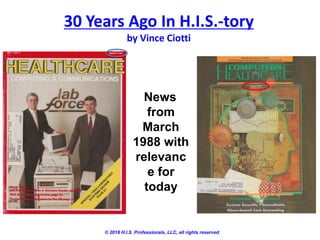
News
from
March
1988 with
relevanc
e for
today
Swinging the
Pendulum…
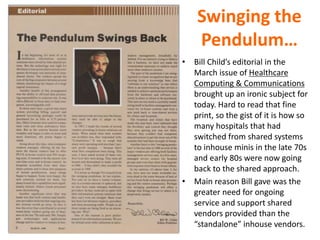
• Bill Child’s editorial in the
March issue of Healthcare
Computing & Communications
brought up an ironic subject for
today. Hard to read that fine
print, so the gist of it is how so
many hospitals that had
switched from shared systems
to inhouse minis in the late 70s
and early 80s were now going
back to the shared approach.
• Main reason Bill gave was the
greater need for ongoing
service and support shared
vendors provided than the
“standalone” inhouse vendors.
Today’s Pendulum Swings Again
• How ironic that today so most leading vendors of what were
originally inhouse systems are now offering remote hosting (aka
SaaS, ASP, etc. ), the modern equivalent of shared systems:
– Cerner – PathNet was mainly run inhouse in the 1980s, but
Millennium ran almost entirely from KC starting in the 1990s.
– Epic – announced in 2016 the option of clients hosting their
system remotely from an underground data center in Verona.
– Meditech – many 3rd party hosters today: Cloudwave,
Comport, ePlus, NTT, ICE, Teknicor, CareTech, Parallon, & Sisu.
– Allscripts – remote hosts through several large data centers.
• Today’s “Cloud” approach through the web makes key systems
like EMRs far more accessible to users with mobile devices.
• However the main attraction to vendors’ is their bottom line: a
10-12 year ongoing revenue stream (maintenance, ho$ting &
sub$cription fee$) is far greater than a one-time license fee.
1988 Seminars
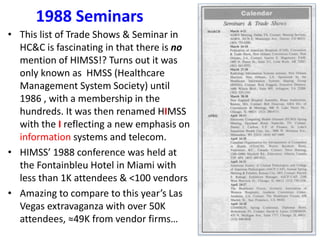
• This list of Trade Shows & Seminar in
HC&C is fascinating in that there is no
mention of HIMSS!? Turns out it was
only known as HMSS (Healthcare
Management System Society) until
1986 , with a membership in the
hundreds. It was then renamed HIMSS
with the I reflecting a new emphasis on
information systems and telecom.
• HIMSS’ 1988 conference was held at
the Fontainbleu Hotel in Miami with
less than 1K attendees & <100 vendors
• Amazing to compare to this year’s Las
Vegas extravaganza with over 50K
attendees, ≈49K from vendor firms…
Color Ad
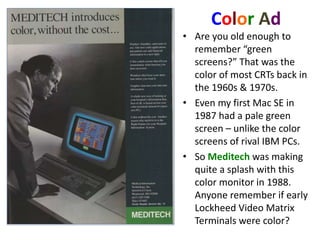
• Are you old enough to
remember “green
screens?” That was the
color of most CRTs back in
the 1960s & 1970s.
• Even my first Mac SE in
1987 had a pale green
screen – unlike the color
screens of rival IBM PCs.
• So Meditech was making
quite a splash with this
color monitor in 1988.
Anyone remember if early
Lockheed Video Matrix
Terminals were color?
LIS Systems
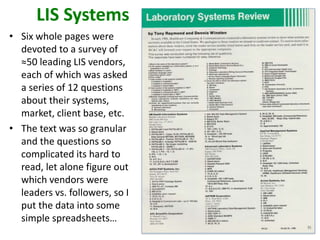
• Six whole pages were
devoted to a survey of
≈50 leading LIS vendors,
each of which was asked
a series of 12 questions
about their systems,
market, client base, etc.
• The text was so granular
and the questions so
complicated its hard to
read, let alone figure out
which vendors were
leaders vs. followers, so I
put the data into some
simple spreadsheets…
Hospital LIS Leaders
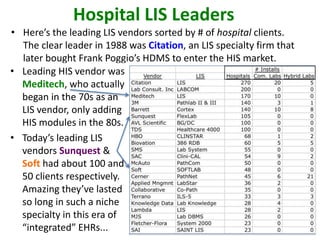
• Here’s the leading LIS vendors sorted by # of hospital clients.
The clear leader in 1988 was Citation, an LIS specialty firm that
later bought Frank Poggio’s HDMS to enter the HIS market.
• Leading HIS vendor was
Meditech, who actually
began in the 70s as an
LIS vendor, only adding
HIS modules in the 80s.
• Today’s leading LIS
vendors Sunquest &
Soft had about 100 and
50 clients respectively.
Amazing they’ve lasted
so long in such a niche
specialty in this era of
“integrated” EHRs...
Commercial LIS Leaders
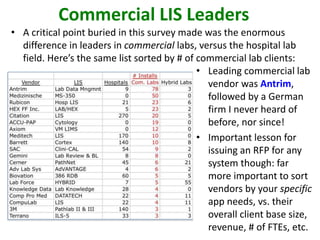
• A critical point buried in this survey made was the enormous
difference in leaders in commercial labs, versus the hospital lab
field. Here’s the same list sorted by # of commercial lab clients:
• Leading commercial lab
vendor was Antrim,
followed by a German
firm I never heard of
before, nor since!
• Important lesson for
issuing an RFP for any
system though: far
more important to sort
vendors by your specific
app needs, vs. their
overall client base size,
revenue, # of FTEs, etc.
Consulting On
Consultants
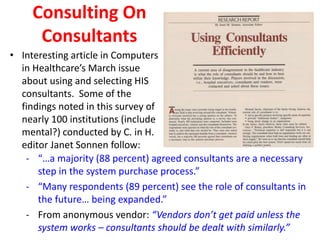
• Interesting article in Computers
in Healthcare’s March issue
about using and selecting HIS
consultants. Some of the
findings noted in this survey of
nearly 100 institutions (include
mental?) conducted by C. in H.
editor Janet Sonnen follow:
- “…a majority (88 percent) agreed consultants are a necessary
step in the system purchase process.”
- “Many respondents (89 percent) see the role of consultants in
the future… being expanded.”
- From anonymous vendor: “Vendors don’t get paid unless the
system works – consultants should be dealt with similarly.”
Selecting A Consultant
• When asked how respondents selected a consultant:
– “…the number one reply (79%) was by talking to other hospitals.”
– “The second most frequent (32%) was by the location of the consultant.”
– “One in six executives…rely on an RFP process…or chose by committee.”
– “Many (85%) would simply retain a consultant they had used in the past.”
• Interesting observations from vendors & consultants:
– “Both vendors and consultants agree that contacting similar institutions is
an effective method (61 and 72 percent respectively).”
– Rich Tarrant of IDX offered this sage advice: “…interview and check the
credentials of the consultant just like anyone else you would hire.”
– Ed Zak at Arthur Young advises “choose a consultant the way a vendor is
chosen. RFPs or RFIs should be let, references required, the firm and
individual skills determined.”
– Zak also cautioned: “Consultant/vendor alliances have made it difficult for
hospitals to obtain true independent advice and consultation.”
“Consulting” Evolution:
Consulting consuling - staffing Staffing
• Things have changed quite a bit in consulting since we
established our firm 30 years ago. Back then, consultants were
veterans with extensive experience working for vendors and/or
hospitals, who came into a client to give their expert advice, and
then left.
• That made for many brief engagements, with no little or no
ongoing revenue. The giant “Big Eight” firms soon learned that a
lot more revenue could be earned by doing installations than
selections (million$ instead of thousand$). Indeed, one of them
offered selections for free if they could “help” with the install…
• Today’s mega-consulting firms have revenue in the billions of
dollars, rivaling even the largest HIS vendors in $s & # of FTEs.
• So what advice would we give for selecting a consultant today?
Selecting A Consultant Today
• Some of the same advice from 1988 applies very well today:
– “…the number one reply (79%) was by talking to other hospitals.”
– Couldn’t agree more! Only additional advice: call references of your:
• Size – big difference among multi vs. a community vs. CAH hospitals!
• Needs – why call an outsourced client if you’re looking for a selection?
• Users – Not just the CIO calling the CIO, who may be happy with the
result, but end users (RNs, MDs, finance, etc.) who may not be…
• Separate firms for selection vs. implementation!
– Many vendors today (eg: Epic, Meditech…) “certify” consulting firms in
their system implementations; indeed, Meditech even requires new clients
to spend a million or more for a “Ready-certified” consulting firm…
– So how can you trust a “certified” firm to run an objective selection if they
stand to gain millions when a “partner” vendor wins the selection?
– Best to hire two distinct firms: one for the selection/negotiation only, and
a different one for the implementation based on which vendor wins.
Last Month Correction
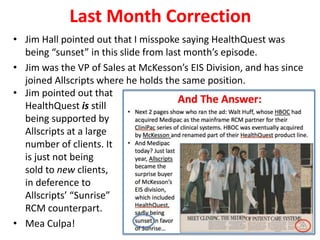
• Jim Hall pointed out that I misspoke saying HealthQuest was
being “sunset” in this slide from last month’s episode.
• Jim was the VP of Sales at McKesson’s EIS Division, and has since
joined Allscripts where he holds the same position.
• Jim pointed out that
HealthQuest is still
being supported by
Allscripts at a large
number of clients. It
is just not being
sold to new clients,
in deference to
Allscripts’ “Sunrise”
RCM counterpart.
• Mea Culpa!
Ad Index
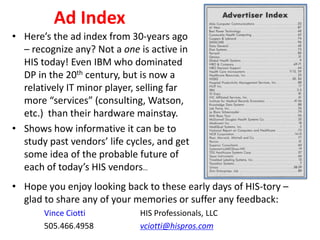
• Here’s the ad index from 30-years ago
– recognize any? Not a one is active in
HIS today! Even IBM who dominated
DP in the 20th century, but is now a
relatively IT minor player, selling far
more “services” (consulting, Watson,
etc.) than their hardware mainstay.
• Shows how informative it can be to
study past vendors’ life cycles, and get
some idea of the probable future of
each of today’s HIS vendors…
• Hope you enjoy looking back to these early days of HIS-tory –
glad to share any of your memories or suffer any feedback:
Vince Ciotti HIS Professionals, LLC
505.466.4958 vciotti@hispros.com

3. march 1988

  • 1.
    30 Years AgoIn H.I.S.-tory by Vince Ciotti © 2018 H.I.S. Professionals, LLC, all rights reserved News from March 1988 with relevanc e for today
  • 2.
    Swinging the Pendulum… • BillChild’s editorial in the March issue of Healthcare Computing & Communications brought up an ironic subject for today. Hard to read that fine print, so the gist of it is how so many hospitals that had switched from shared systems to inhouse minis in the late 70s and early 80s were now going back to the shared approach. • Main reason Bill gave was the greater need for ongoing service and support shared vendors provided than the “standalone” inhouse vendors.
  • 3.
    Today’s Pendulum SwingsAgain • How ironic that today so most leading vendors of what were originally inhouse systems are now offering remote hosting (aka SaaS, ASP, etc. ), the modern equivalent of shared systems: – Cerner – PathNet was mainly run inhouse in the 1980s, but Millennium ran almost entirely from KC starting in the 1990s. – Epic – announced in 2016 the option of clients hosting their system remotely from an underground data center in Verona. – Meditech – many 3rd party hosters today: Cloudwave, Comport, ePlus, NTT, ICE, Teknicor, CareTech, Parallon, & Sisu. – Allscripts – remote hosts through several large data centers. • Today’s “Cloud” approach through the web makes key systems like EMRs far more accessible to users with mobile devices. • However the main attraction to vendors’ is their bottom line: a 10-12 year ongoing revenue stream (maintenance, ho$ting & sub$cription fee$) is far greater than a one-time license fee.
  • 4.
    1988 Seminars • Thislist of Trade Shows & Seminar in HC&C is fascinating in that there is no mention of HIMSS!? Turns out it was only known as HMSS (Healthcare Management System Society) until 1986 , with a membership in the hundreds. It was then renamed HIMSS with the I reflecting a new emphasis on information systems and telecom. • HIMSS’ 1988 conference was held at the Fontainbleu Hotel in Miami with less than 1K attendees & <100 vendors • Amazing to compare to this year’s Las Vegas extravaganza with over 50K attendees, ≈49K from vendor firms…
  • 5.
    Color Ad • Areyou old enough to remember “green screens?” That was the color of most CRTs back in the 1960s & 1970s. • Even my first Mac SE in 1987 had a pale green screen – unlike the color screens of rival IBM PCs. • So Meditech was making quite a splash with this color monitor in 1988. Anyone remember if early Lockheed Video Matrix Terminals were color?
  • 6.
    LIS Systems • Sixwhole pages were devoted to a survey of ≈50 leading LIS vendors, each of which was asked a series of 12 questions about their systems, market, client base, etc. • The text was so granular and the questions so complicated its hard to read, let alone figure out which vendors were leaders vs. followers, so I put the data into some simple spreadsheets…
  • 7.
    Hospital LIS Leaders •Here’s the leading LIS vendors sorted by # of hospital clients. The clear leader in 1988 was Citation, an LIS specialty firm that later bought Frank Poggio’s HDMS to enter the HIS market. • Leading HIS vendor was Meditech, who actually began in the 70s as an LIS vendor, only adding HIS modules in the 80s. • Today’s leading LIS vendors Sunquest & Soft had about 100 and 50 clients respectively. Amazing they’ve lasted so long in such a niche specialty in this era of “integrated” EHRs...
  • 8.
    Commercial LIS Leaders •A critical point buried in this survey made was the enormous difference in leaders in commercial labs, versus the hospital lab field. Here’s the same list sorted by # of commercial lab clients: • Leading commercial lab vendor was Antrim, followed by a German firm I never heard of before, nor since! • Important lesson for issuing an RFP for any system though: far more important to sort vendors by your specific app needs, vs. their overall client base size, revenue, # of FTEs, etc.
  • 9.
    Consulting On Consultants • Interestingarticle in Computers in Healthcare’s March issue about using and selecting HIS consultants. Some of the findings noted in this survey of nearly 100 institutions (include mental?) conducted by C. in H. editor Janet Sonnen follow: - “…a majority (88 percent) agreed consultants are a necessary step in the system purchase process.” - “Many respondents (89 percent) see the role of consultants in the future… being expanded.” - From anonymous vendor: “Vendors don’t get paid unless the system works – consultants should be dealt with similarly.”
  • 10.
    Selecting A Consultant •When asked how respondents selected a consultant: – “…the number one reply (79%) was by talking to other hospitals.” – “The second most frequent (32%) was by the location of the consultant.” – “One in six executives…rely on an RFP process…or chose by committee.” – “Many (85%) would simply retain a consultant they had used in the past.” • Interesting observations from vendors & consultants: – “Both vendors and consultants agree that contacting similar institutions is an effective method (61 and 72 percent respectively).” – Rich Tarrant of IDX offered this sage advice: “…interview and check the credentials of the consultant just like anyone else you would hire.” – Ed Zak at Arthur Young advises “choose a consultant the way a vendor is chosen. RFPs or RFIs should be let, references required, the firm and individual skills determined.” – Zak also cautioned: “Consultant/vendor alliances have made it difficult for hospitals to obtain true independent advice and consultation.”
  • 11.
    “Consulting” Evolution: Consulting consuling- staffing Staffing • Things have changed quite a bit in consulting since we established our firm 30 years ago. Back then, consultants were veterans with extensive experience working for vendors and/or hospitals, who came into a client to give their expert advice, and then left. • That made for many brief engagements, with no little or no ongoing revenue. The giant “Big Eight” firms soon learned that a lot more revenue could be earned by doing installations than selections (million$ instead of thousand$). Indeed, one of them offered selections for free if they could “help” with the install… • Today’s mega-consulting firms have revenue in the billions of dollars, rivaling even the largest HIS vendors in $s & # of FTEs. • So what advice would we give for selecting a consultant today?
  • 12.
    Selecting A ConsultantToday • Some of the same advice from 1988 applies very well today: – “…the number one reply (79%) was by talking to other hospitals.” – Couldn’t agree more! Only additional advice: call references of your: • Size – big difference among multi vs. a community vs. CAH hospitals! • Needs – why call an outsourced client if you’re looking for a selection? • Users – Not just the CIO calling the CIO, who may be happy with the result, but end users (RNs, MDs, finance, etc.) who may not be… • Separate firms for selection vs. implementation! – Many vendors today (eg: Epic, Meditech…) “certify” consulting firms in their system implementations; indeed, Meditech even requires new clients to spend a million or more for a “Ready-certified” consulting firm… – So how can you trust a “certified” firm to run an objective selection if they stand to gain millions when a “partner” vendor wins the selection? – Best to hire two distinct firms: one for the selection/negotiation only, and a different one for the implementation based on which vendor wins.
  • 13.
    Last Month Correction •Jim Hall pointed out that I misspoke saying HealthQuest was being “sunset” in this slide from last month’s episode. • Jim was the VP of Sales at McKesson’s EIS Division, and has since joined Allscripts where he holds the same position. • Jim pointed out that HealthQuest is still being supported by Allscripts at a large number of clients. It is just not being sold to new clients, in deference to Allscripts’ “Sunrise” RCM counterpart. • Mea Culpa!
  • 14.
    Ad Index • Here’sthe ad index from 30-years ago – recognize any? Not a one is active in HIS today! Even IBM who dominated DP in the 20th century, but is now a relatively IT minor player, selling far more “services” (consulting, Watson, etc.) than their hardware mainstay. • Shows how informative it can be to study past vendors’ life cycles, and get some idea of the probable future of each of today’s HIS vendors… • Hope you enjoy looking back to these early days of HIS-tory – glad to share any of your memories or suffer any feedback: Vince Ciotti HIS Professionals, LLC 505.466.4958 vciotti@hispros.com