RATE OF REACTION
Prepared by:
Cik Nur Harlyana Binti Harun
SMK Abdul Rahman Talib,
Kuantan.
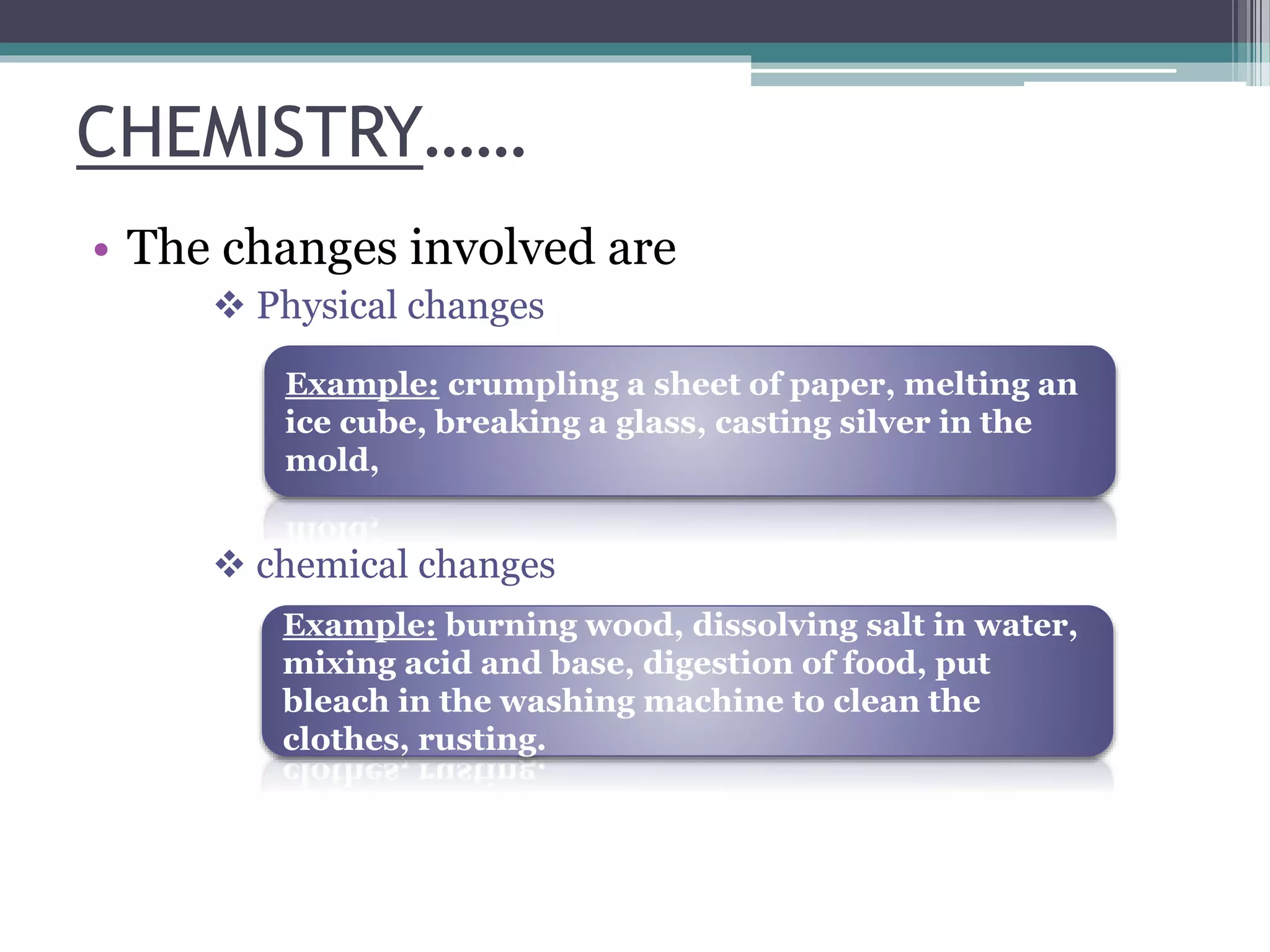
CHEMISTRY……
• The changes involved are
 Physical changes
 chemical changes
Example: crumpling a sheet of paper, melting an
ice cube, breaking a glass, casting silver in the
mold,
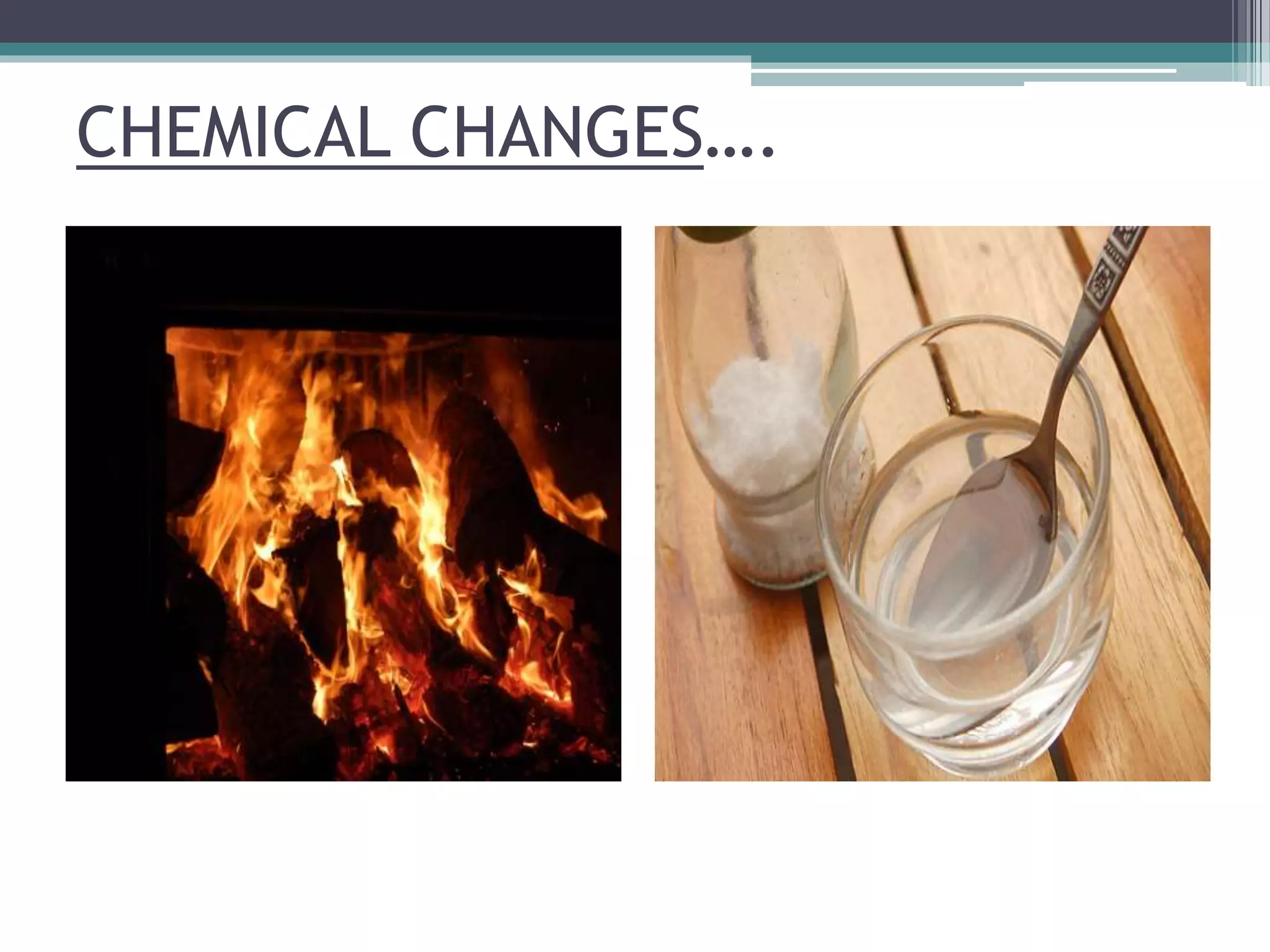
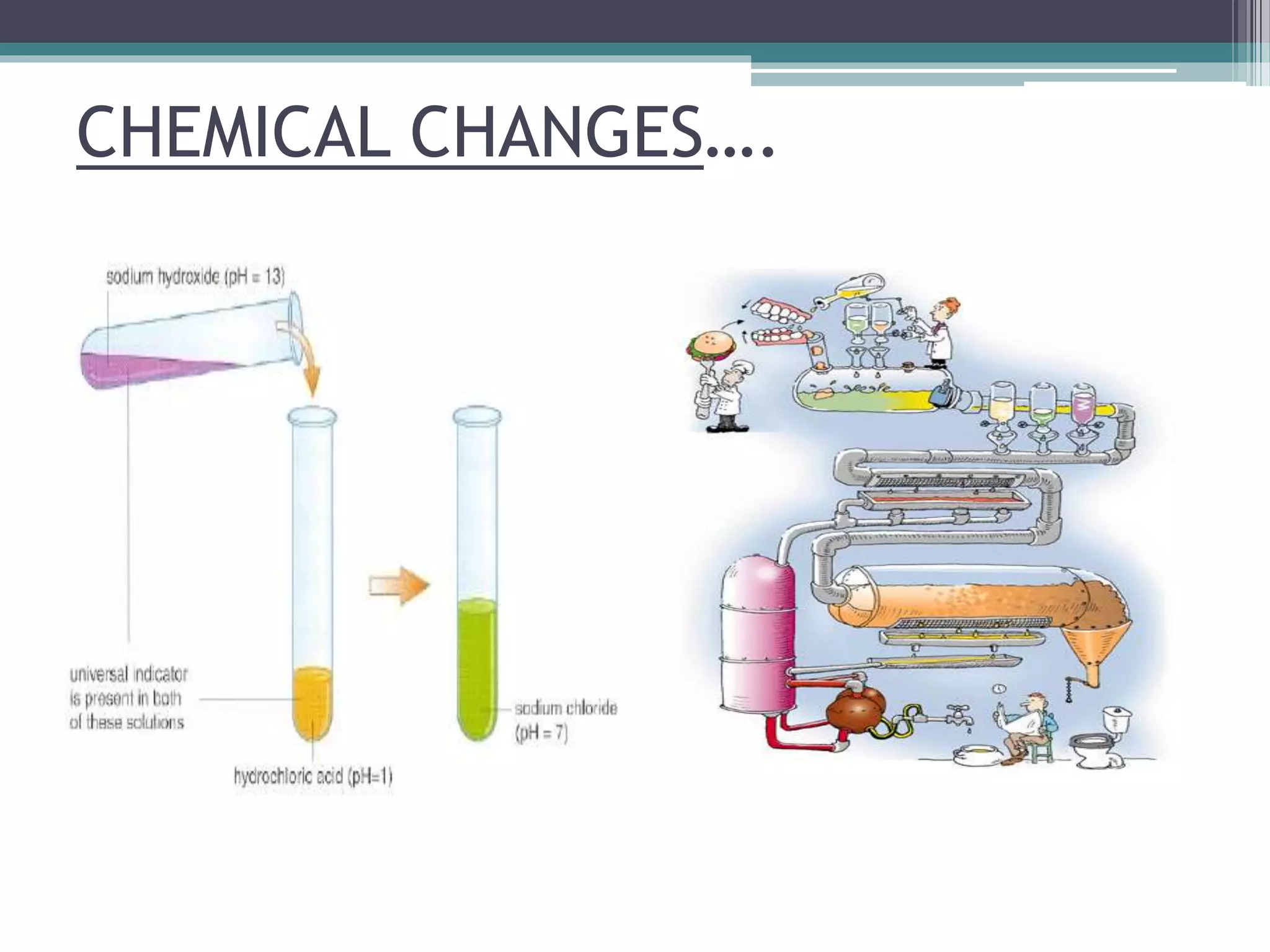
Example: burning wood, dissolving salt in water,
mixing acid and base, digestion of food, put
bleach in the washing machine to clean the
clothes, rusting.
PHYSICAL CHANGES….
PHYSICAL CHANGES….
CHEMICAL CHANGES….
CHEMICAL CHANGES….
CHEMICAL CHANGES….
CHEMISTRY……
• Physical change
 no chemical reaction occur
 no new compounds are produce BUT…
 may change in shape/form during the physical
changes.
• Chemical change
 chemical reaction occur
 the reaction produce new substances
CHEMICAL CHANGES….
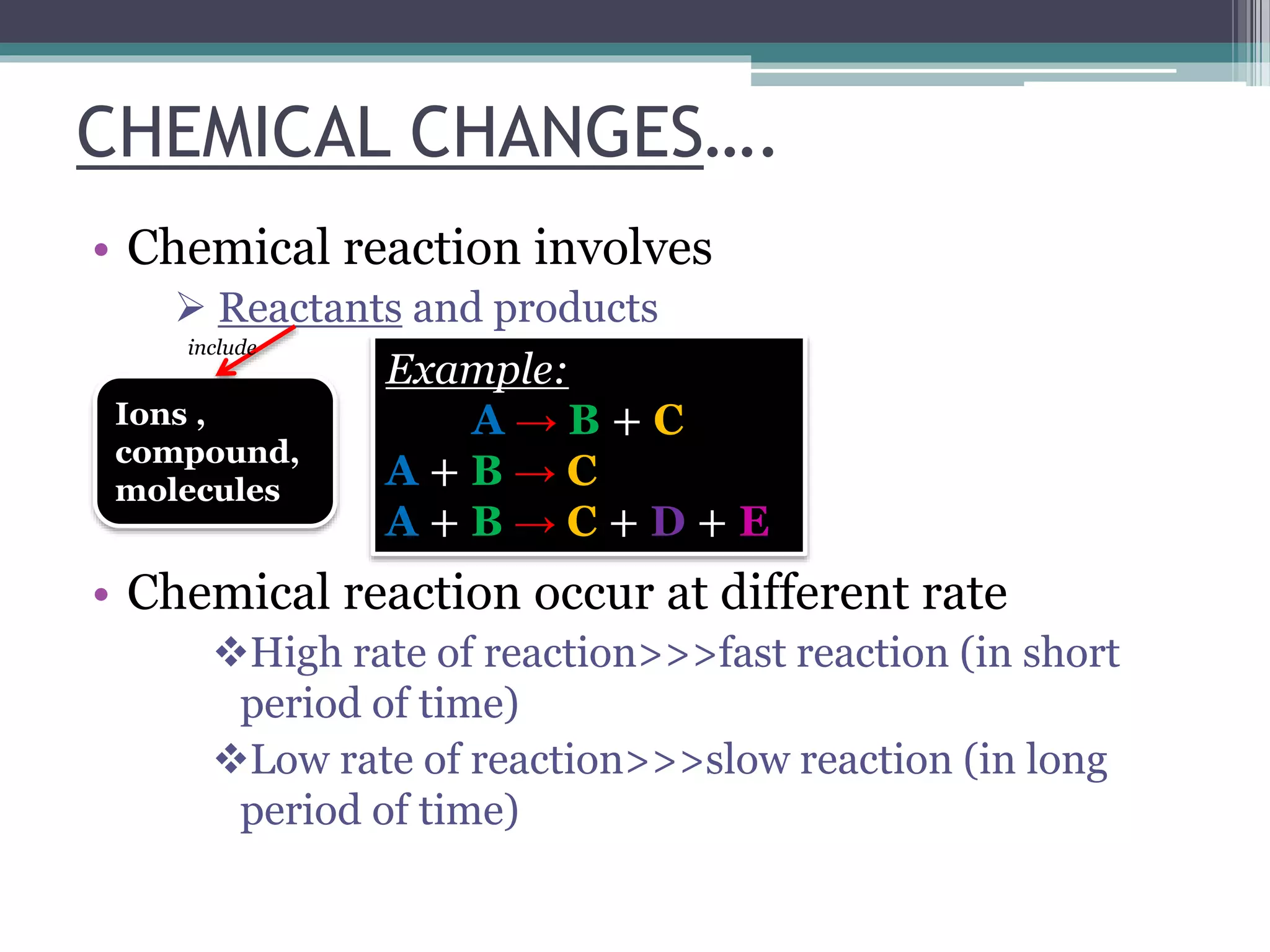
• Chemical reaction involves
 Reactants and products
• Chemical reaction occur at different rate
High rate of reaction>>>fast reaction (in short
period of time)
Low rate of reaction>>>slow reaction (in long
period of time)
Ions ,
compound,
molecules
include
Example:
A → B + C
A + B → C
A + B → C + D + E
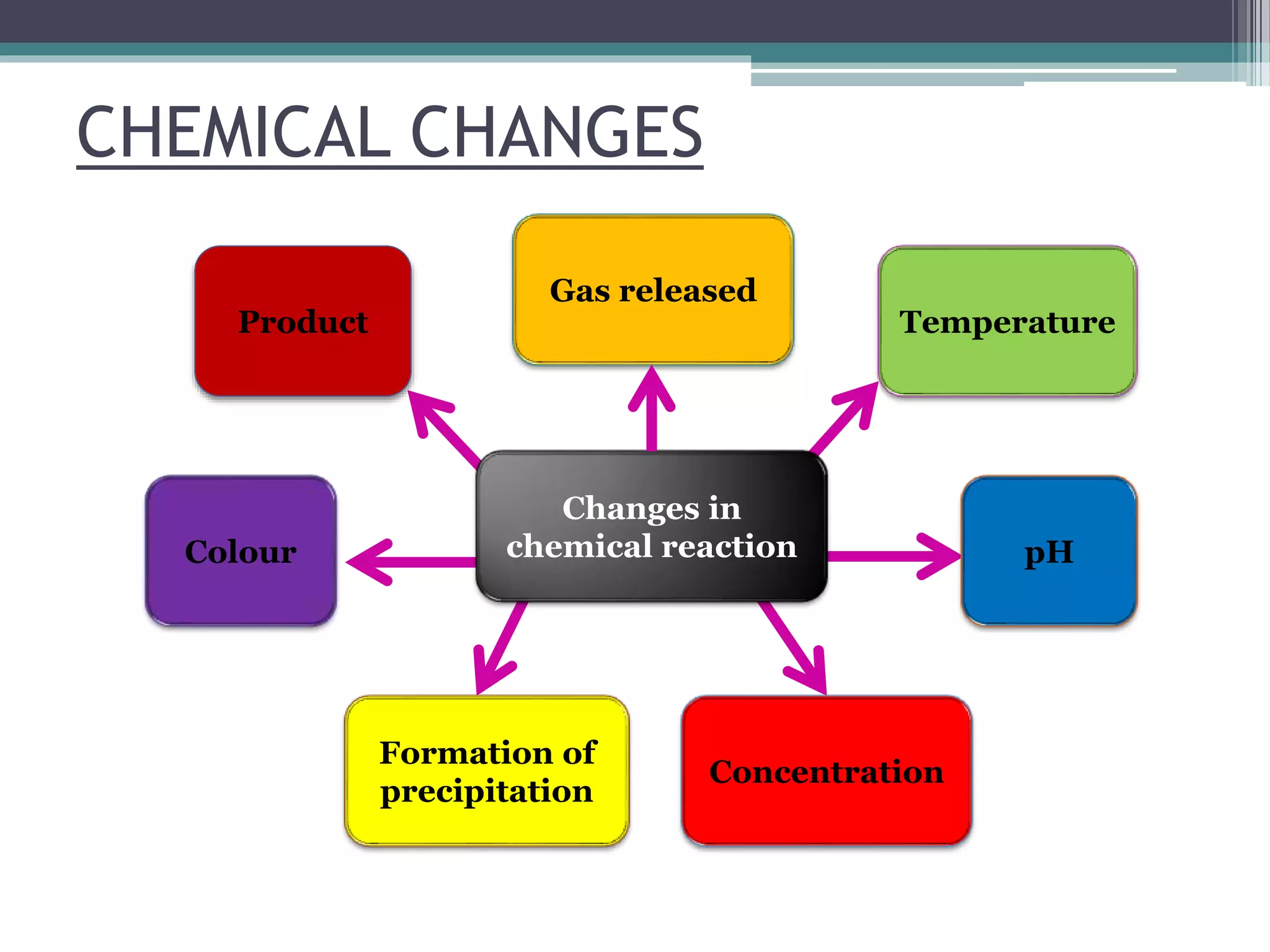
CHEMICAL CHANGES
Changes in
chemical reaction
Product Temperature
Gas released
Formation of
precipitation
Colour pH
Concentration
RATE OF REACTION….
• Generally,
Rate of reaction is the speed at which reaction occur
(reactants react to form products)
• Definition
Rate of reaction is the change of amount of
reactant/product per unit time
Rate of reaction =
𝑐ℎ𝑎𝑛𝑔𝑒 𝑜𝑓 𝑎𝑚𝑜𝑢𝑛𝑡 𝑜𝑓 𝑟𝑒𝑎𝑐𝑡𝑎𝑛𝑡/𝑝𝑟𝑜𝑑𝑢𝑐𝑡
𝑡𝑖𝑚𝑒 𝑡𝑎𝑘𝑒𝑛
• Rate of reaction is inversely proportional to time
taken.
Rate of reaction ∝
1
𝑡𝑖𝑚𝑒 𝑡𝑎𝑘𝑒𝑛
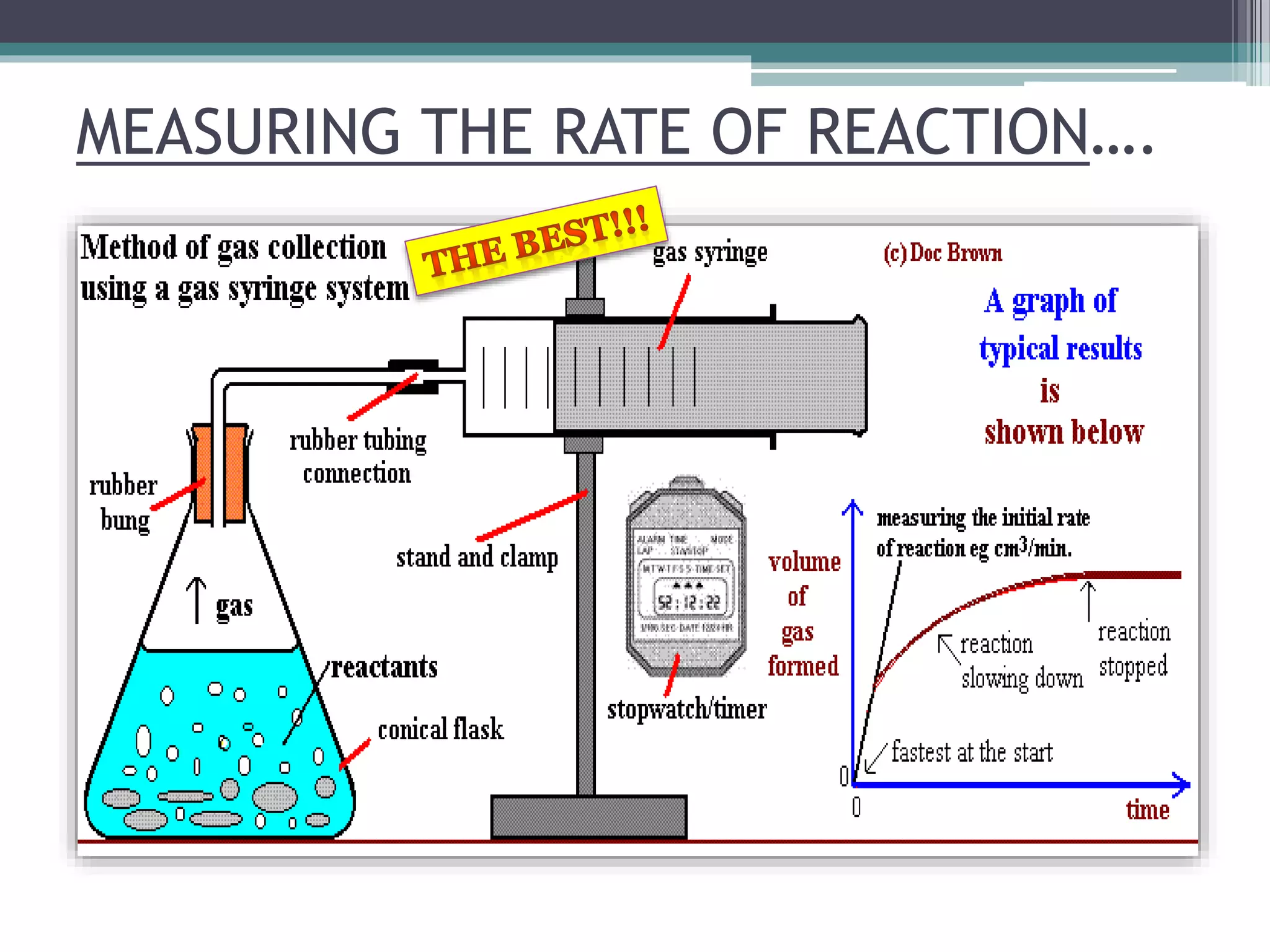
MEASURING THE RATE OF REACTION….
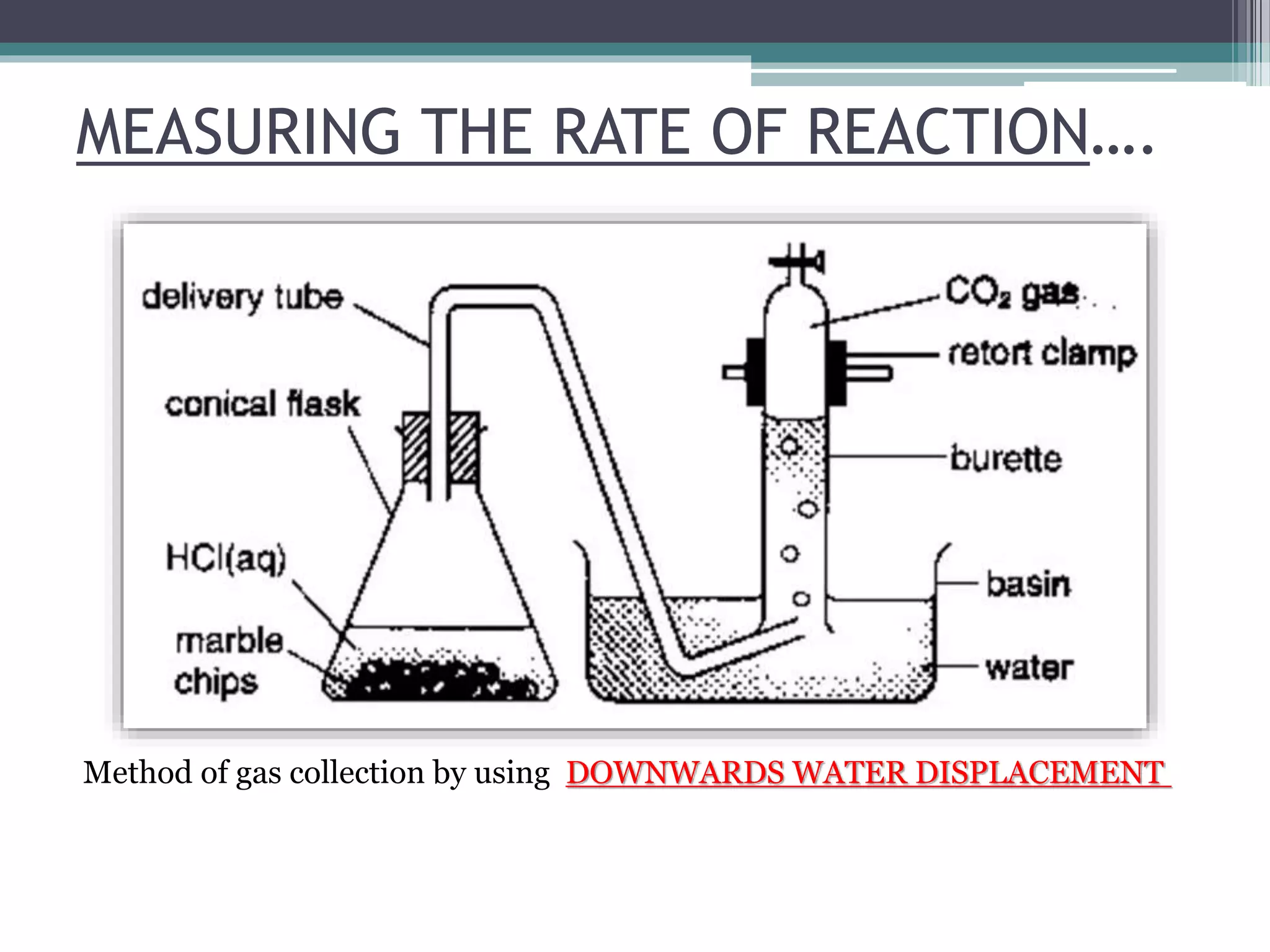
Method of gas collection by using DOWNWARDS WATER DISPLACEMENT
MEASURING THE RATE OF REACTION….
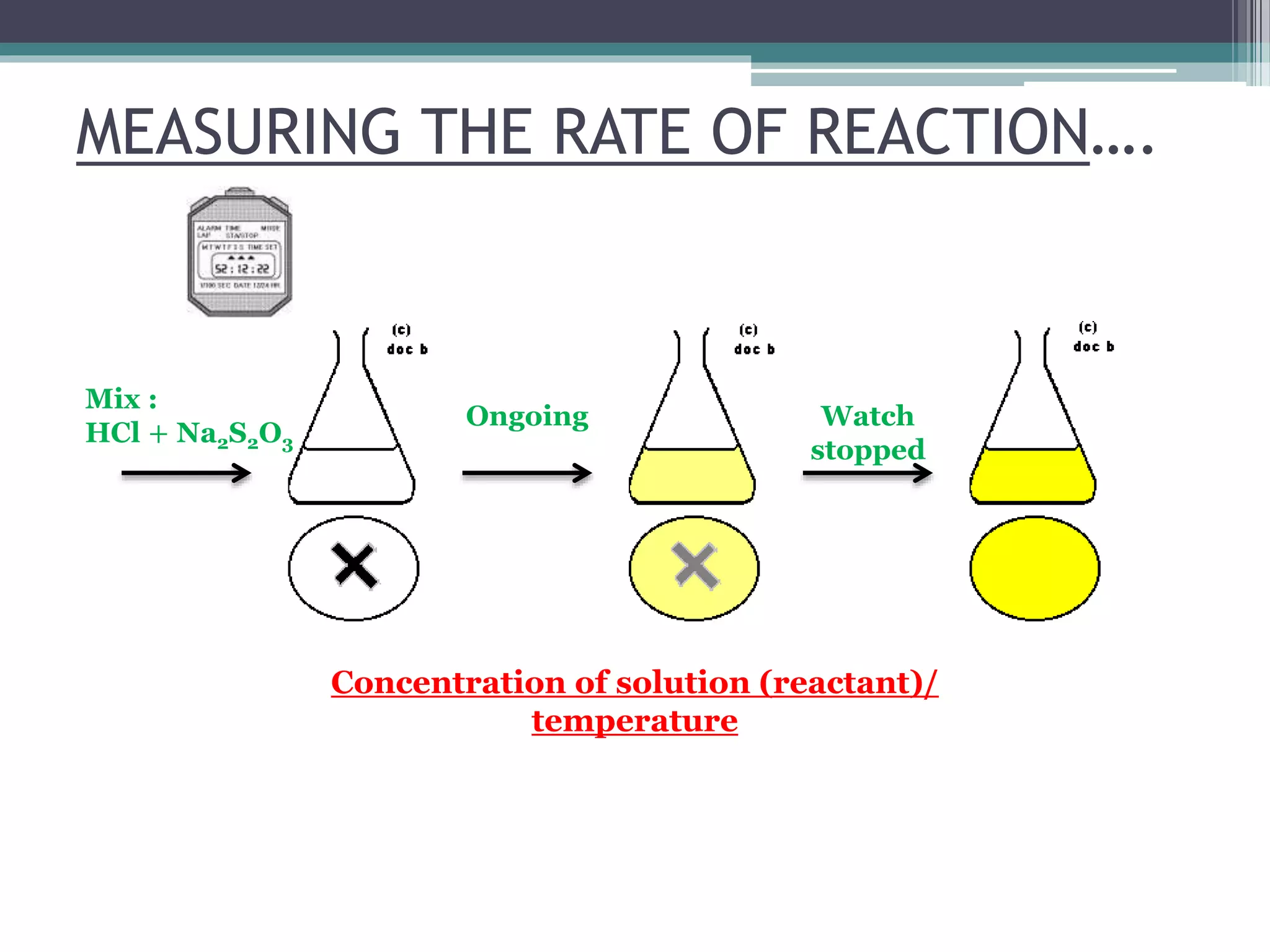
Mix :
HCl + Na2S2O3
Ongoing Watch
stopped
Concentration of solution (reactant)/
temperature
MEASURING THE RATE OF REACTION….
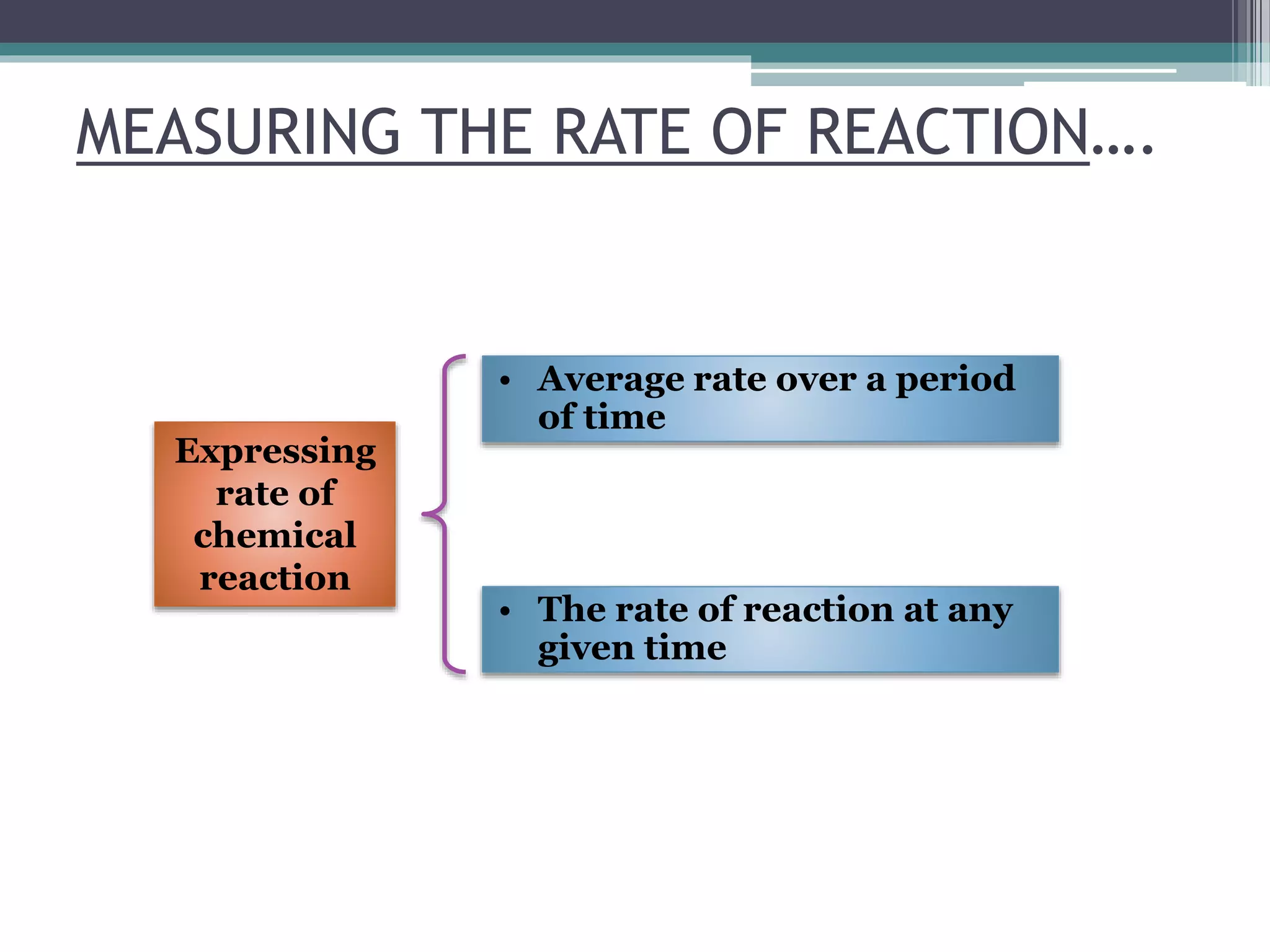
• Average rate over a period
of time
• The rate of reaction at any
given time
Expressing
rate of
chemical
reaction
RATE OF REACTION….
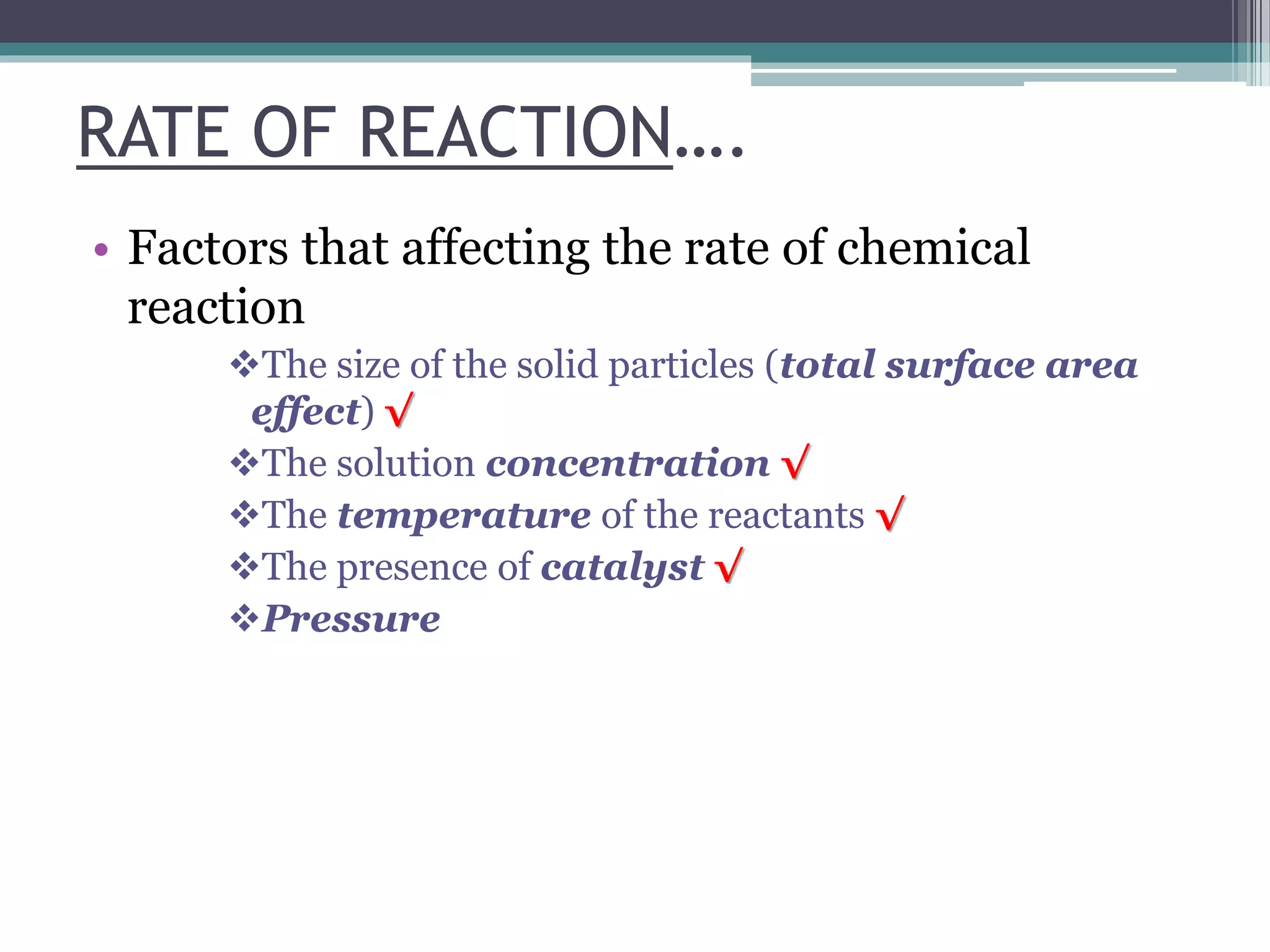
• Factors that affecting the rate of chemical
reaction
The size of the solid particles (total surface area
effect) √
The solution concentration √
The temperature of the reactants √
The presence of catalyst √
Pressure
APPLICATION OF THE FACTORS AFFECTING
THE RATE OF REACTION IN DAILY LIFE….
• Burning of charcoal
When smaller pieces of charcoal are used, food can be
cooked faster.
Smaller pieces of charcoal have bigger total
surface area which will burn faster to produce more
heat.
APPLICATION OF THE FACTORS AFFECTING
THE RATE OF REACTION IN DAILY LIFE….
• Storing food in a
refrigerator
The low temperature in
the refrigerator will slow
down the rate of decay of
food by microorganism
Hence, the food last
longer.
APPLICATION OF THE FACTORS AFFECTING
THE RATE OF REACTION IN DAILY LIFE….
• Cooking solid food in different sizes
Small pieces of food have a larger total surface area
expose to heat.
Thus, they can cooked faster.
APPLICATION OF THE FACTORS AFFECTING
THE RATE OF REACTION IN DAILY LIFE….
• Cooking of food in
a pressure cooker
High pressure in a
pressure cooker will
raise the boiling point
of water.
Thus, cooking is
done at a much
higher temperature
than 100 °C and the
food can be cooked
faster.
APPLICATION OF THE FACTORS AFFECTING
THE RATE OF REACTION IN DAILY LIFE….
• Industrial process
Catalyst are usually used to increase the rate of
industrial processes.
These enable the processes to be completed in a
shorter time at low temperature and pressure.
Hence, the cost of production will be reduced.
Industry Catalyst
Haber process – manufacture
ammoni, NH3
Iron powder (Fe)
Contact process - manufacture
sulphuric acid, H2SO4
Vanadium(v) oxide, V2O5
Ostwald process - manufacture nitric
acid, HNO3
Platinum (Pt)
COLLISION THEORY….
• The collision theory states that for a reaction to
occur between two particles
The reacting particles must collide with each other
The reacting particles must collide with a certain
minimum energy known as the activation energy,
Ea.
The reacting particles collide in the correct
orientation.
• A collision that results in a reaction is called
effective collision.
• If the frequency of effective collision is high, the
rate of reaction is also high.
COLLISION THEORY….
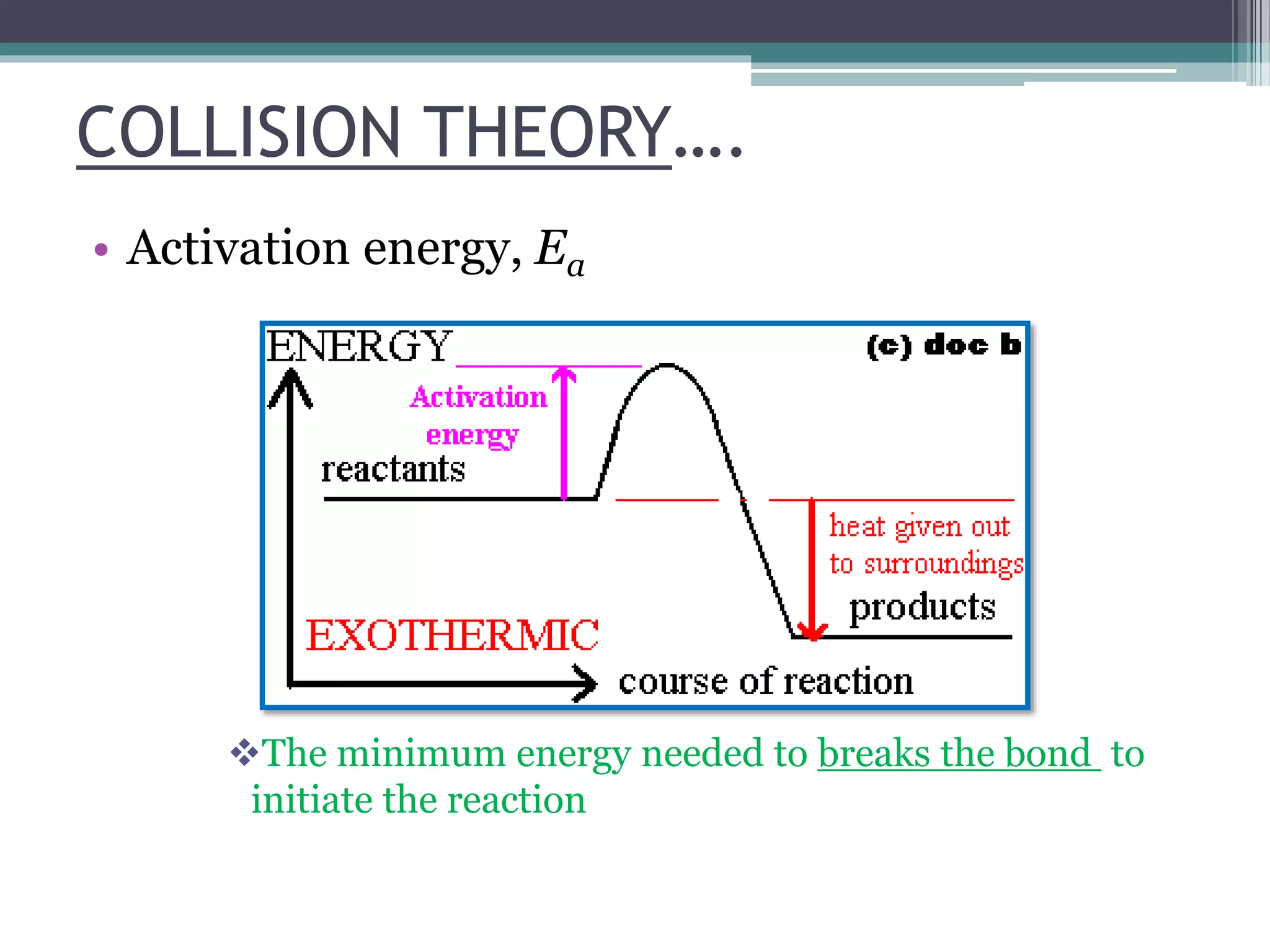
• Activation energy, Ea
The minimum energy needed to breaks the bond to
initiate the reaction
COLLISION THEORY….
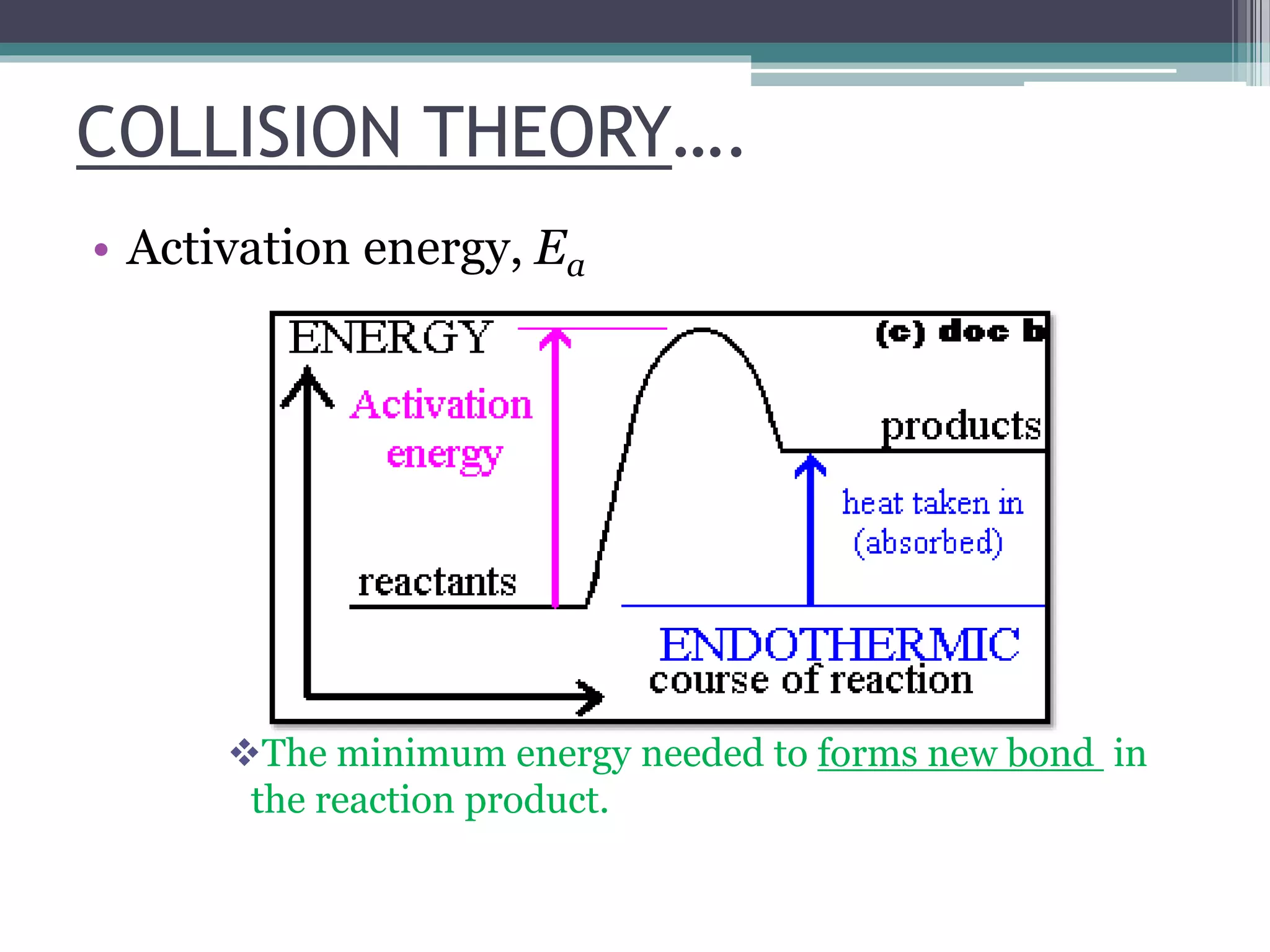
• Activation energy, Ea
The minimum energy needed to forms new bond in
the reaction product.
COLLISION THEORY….
• The concentration of reactant
When the concentration of the solution of a reactant
increases, the number of particles per unit
volume of the solution of the reactant also increases.
REACTION: SLOWER
ROR : LOW
REACTION: FASTER
ROR: HIGH
COLLISION THEORY….
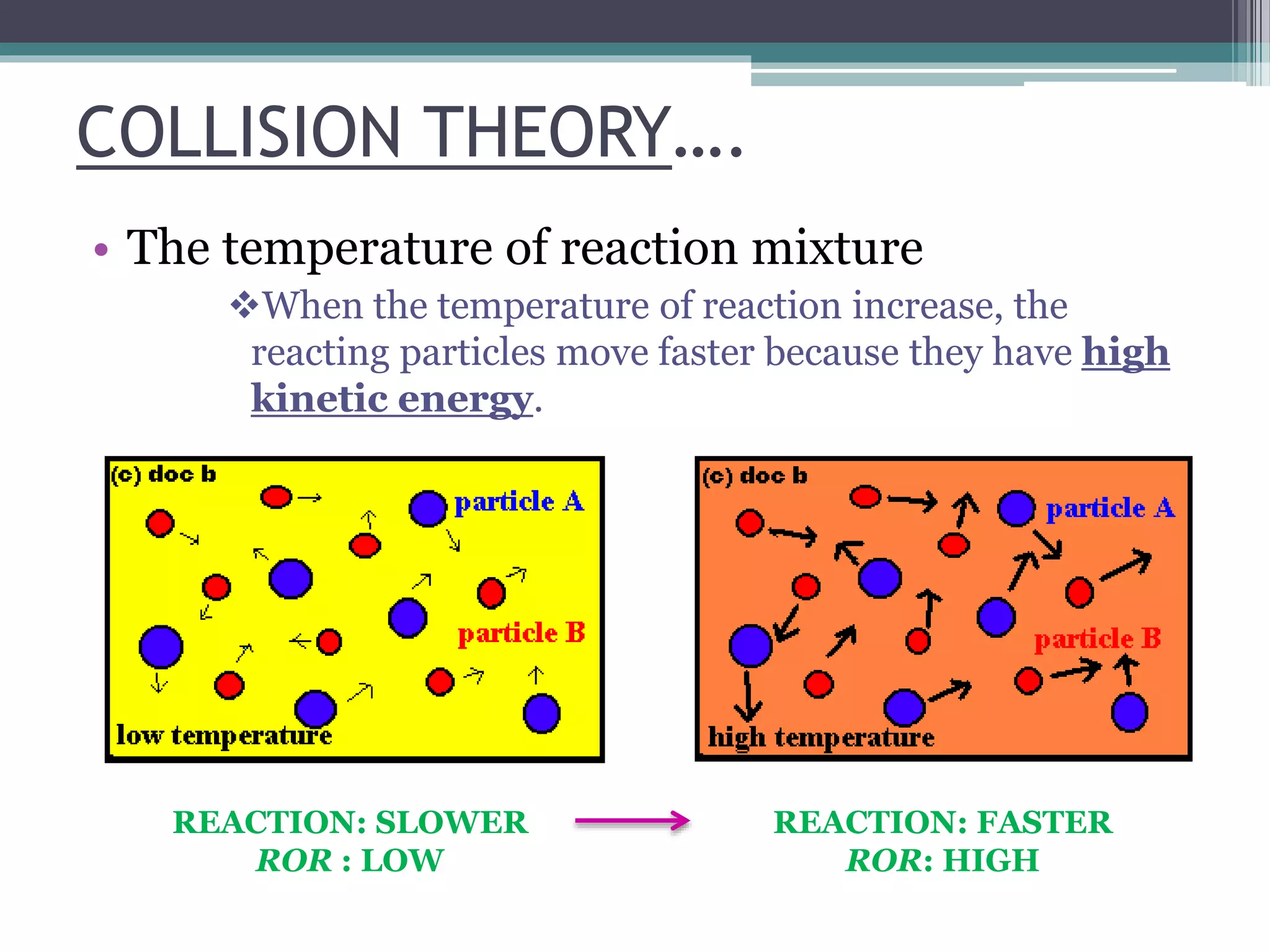
• The temperature of reaction mixture
When the temperature of reaction increase, the
reacting particles move faster because they have high
kinetic energy.
REACTION: SLOWER
ROR : LOW
REACTION: FASTER
ROR: HIGH
COLLISION THEORY….
• The size of reactant
When the size of reactants (with the fixed mass)
becomes smaller, the total surface area exposed to
collision with other particles increases.
REACTION: SLOWER
ROR : LOW
REACTION: FASTER
ROR: HIGH
COLLISION THEORY….
• Use of catalyst
When a catalyst is used in a chemical reaction, it
enables the reaction to occur through an
alternative path which requires a lower
activation energy.
REACTION: SLOWER
ROR : LOW
REACTION: FASTER
ROR: HIGH

Rate of reaction

  • 1.
    RATE OF REACTION Preparedby: Cik Nur Harlyana Binti Harun SMK Abdul Rahman Talib, Kuantan.
  • 2.
    CHEMISTRY…… • The changesinvolved are  Physical changes  chemical changes Example: crumpling a sheet of paper, melting an ice cube, breaking a glass, casting silver in the mold, Example: burning wood, dissolving salt in water, mixing acid and base, digestion of food, put bleach in the washing machine to clean the clothes, rusting.
  • 3.
  • 4.
  • 5.
  • 6.
  • 7.
  • 8.
    CHEMISTRY…… • Physical change no chemical reaction occur  no new compounds are produce BUT…  may change in shape/form during the physical changes. • Chemical change  chemical reaction occur  the reaction produce new substances
  • 9.
    CHEMICAL CHANGES…. • Chemicalreaction involves  Reactants and products • Chemical reaction occur at different rate High rate of reaction>>>fast reaction (in short period of time) Low rate of reaction>>>slow reaction (in long period of time) Ions , compound, molecules include Example: A → B + C A + B → C A + B → C + D + E
  • 10.
    CHEMICAL CHANGES Changes in chemicalreaction Product Temperature Gas released Formation of precipitation Colour pH Concentration
  • 11.
    RATE OF REACTION…. •Generally, Rate of reaction is the speed at which reaction occur (reactants react to form products) • Definition Rate of reaction is the change of amount of reactant/product per unit time Rate of reaction = 𝑐ℎ𝑎𝑛𝑔𝑒 𝑜𝑓 𝑎𝑚𝑜𝑢𝑛𝑡 𝑜𝑓 𝑟𝑒𝑎𝑐𝑡𝑎𝑛𝑡/𝑝𝑟𝑜𝑑𝑢𝑐𝑡 𝑡𝑖𝑚𝑒 𝑡𝑎𝑘𝑒𝑛 • Rate of reaction is inversely proportional to time taken. Rate of reaction ∝ 1 𝑡𝑖𝑚𝑒 𝑡𝑎𝑘𝑒𝑛
  • 12.
    MEASURING THE RATEOF REACTION….
  • 13.
    MEASURING THE RATEOF REACTION…. Method of gas collection by using DOWNWARDS WATER DISPLACEMENT
  • 14.
    MEASURING THE RATEOF REACTION….
  • 15.
    MEASURING THE RATEOF REACTION…. Mix : HCl + Na2S2O3 Ongoing Watch stopped Concentration of solution (reactant)/ temperature
  • 16.
    MEASURING THE RATEOF REACTION…. • Average rate over a period of time • The rate of reaction at any given time Expressing rate of chemical reaction
  • 17.
    RATE OF REACTION…. •Factors that affecting the rate of chemical reaction The size of the solid particles (total surface area effect) √ The solution concentration √ The temperature of the reactants √ The presence of catalyst √ Pressure
  • 18.
    APPLICATION OF THEFACTORS AFFECTING THE RATE OF REACTION IN DAILY LIFE…. • Burning of charcoal When smaller pieces of charcoal are used, food can be cooked faster. Smaller pieces of charcoal have bigger total surface area which will burn faster to produce more heat.
  • 19.
    APPLICATION OF THEFACTORS AFFECTING THE RATE OF REACTION IN DAILY LIFE…. • Storing food in a refrigerator The low temperature in the refrigerator will slow down the rate of decay of food by microorganism Hence, the food last longer.
  • 20.
    APPLICATION OF THEFACTORS AFFECTING THE RATE OF REACTION IN DAILY LIFE…. • Cooking solid food in different sizes Small pieces of food have a larger total surface area expose to heat. Thus, they can cooked faster.
  • 21.
    APPLICATION OF THEFACTORS AFFECTING THE RATE OF REACTION IN DAILY LIFE…. • Cooking of food in a pressure cooker High pressure in a pressure cooker will raise the boiling point of water. Thus, cooking is done at a much higher temperature than 100 °C and the food can be cooked faster.
  • 22.
    APPLICATION OF THEFACTORS AFFECTING THE RATE OF REACTION IN DAILY LIFE…. • Industrial process Catalyst are usually used to increase the rate of industrial processes. These enable the processes to be completed in a shorter time at low temperature and pressure. Hence, the cost of production will be reduced. Industry Catalyst Haber process – manufacture ammoni, NH3 Iron powder (Fe) Contact process - manufacture sulphuric acid, H2SO4 Vanadium(v) oxide, V2O5 Ostwald process - manufacture nitric acid, HNO3 Platinum (Pt)
  • 23.
    COLLISION THEORY…. • Thecollision theory states that for a reaction to occur between two particles The reacting particles must collide with each other The reacting particles must collide with a certain minimum energy known as the activation energy, Ea. The reacting particles collide in the correct orientation. • A collision that results in a reaction is called effective collision. • If the frequency of effective collision is high, the rate of reaction is also high.
  • 24.
    COLLISION THEORY…. • Activationenergy, Ea The minimum energy needed to breaks the bond to initiate the reaction
  • 25.
    COLLISION THEORY…. • Activationenergy, Ea The minimum energy needed to forms new bond in the reaction product.
  • 26.
    COLLISION THEORY…. • Theconcentration of reactant When the concentration of the solution of a reactant increases, the number of particles per unit volume of the solution of the reactant also increases. REACTION: SLOWER ROR : LOW REACTION: FASTER ROR: HIGH
  • 27.
    COLLISION THEORY…. • Thetemperature of reaction mixture When the temperature of reaction increase, the reacting particles move faster because they have high kinetic energy. REACTION: SLOWER ROR : LOW REACTION: FASTER ROR: HIGH
  • 28.
    COLLISION THEORY…. • Thesize of reactant When the size of reactants (with the fixed mass) becomes smaller, the total surface area exposed to collision with other particles increases. REACTION: SLOWER ROR : LOW REACTION: FASTER ROR: HIGH
  • 29.
    COLLISION THEORY…. • Useof catalyst When a catalyst is used in a chemical reaction, it enables the reaction to occur through an alternative path which requires a lower activation energy. REACTION: SLOWER ROR : LOW REACTION: FASTER ROR: HIGH