




Dr. Hazem Sharaf
Anesthesia Consultant
KFH Al-Baha
hazemsharaf@yahoo.com
10-May-14 1
Conscious sedation course
10-May-14 2
Today’s course is Mandatory for the C.S.
privilege & delivers basic knowledge about:
1- Conscious sedation terminology & basics
2- Pharmacology of Sedative Drugs
3- Patient Management under C.S.
4- Hospital sedation policy.
10-May-14 3
Egypt B4 Revolution
10-May-14 4
 Conscious sedation is administering drugs
for specific goals:
 Provision of safe analgesia, anxiolysis,
sedation, and amnesia during stressful
procedures.
 Safely decreasing adverse psychological
responses associated with stressful
procedures.
 Return of patients to their pre-procedural
level of functioning.
10-May-14 5
Procedural Sedation Continuum
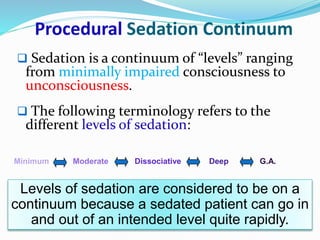
 Sedation is a continuum of “levels” ranging
from minimally impaired consciousness to
unconsciousness.
 The following terminology refers to the
different levels of sedation:
Minimum Moderate Dissociative Deep G.A.
Levels of sedation are considered to be on a
continuum because a sedated patient can go in
and out of an intended level quite rapidly.
Minimal Sedation (anxiolysis)
Drug induced state during
which; patients can respond
normally to verbal commands.
We almost never do this
10-May-14 7
ASA Continuum of Depth of Sedation. Approved 1999;last amended 2004.
10-May-14 8
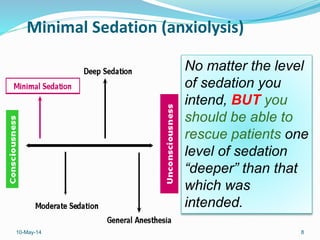
No matter the level
of sedation you
intend, BUT you
should be able to
rescue patients one
level of sedation
“deeper” than that
which was
intended.
Minimal Sedation (anxiolysis)
Moderate Sedation
(Conscious Sedation)10-May-14 9
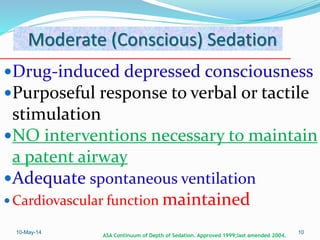
Moderate (Conscious) Sedation
Drug-induced depressed consciousness
Purposeful response to verbal or tactile
stimulation
NO interventions necessary to maintain
a patent airway
Adequate spontaneous ventilation
 Cardiovascular function maintained
10-May-14 10
ASA Continuum of Depth of Sedation. Approved 1999;last amended 2004.
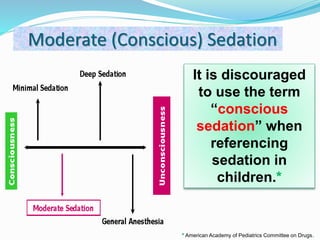
It is discouraged
to use the term
“conscious
sedation” when
referencing
sedation in
children.*
* American Academy of Pediatrics Committee on Drugs.
Moderate (Conscious) Sedation
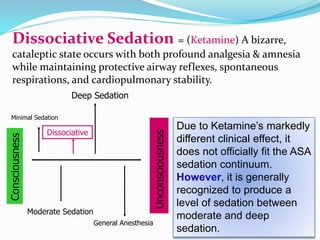
Dissociative Sedation = (Ketamine) A bizarre,
cataleptic state occurs with both profound analgesia & amnesia
while maintaining protective airway reflexes, spontaneous
respirations, and cardiopulmonary stability.
Due to Ketamine’s markedly
different clinical effect, it
does not officially fit the ASA
sedation continuum.
However, it is generally
recognized to produce a
level of sedation between
moderate and deep
sedation.
Consciousness
Unconsciousness
Moderate Sedation
Deep Sedation
General Anesthesia
Minimal Sedation
Dissociative
A patient who is appropriately
consciously (moderately) sedated:
A. Must be able to open his eyes
B. Must be able to protect his airway
C. Responds to painful stimuli only
D. Is comatosed
10-May-14 13
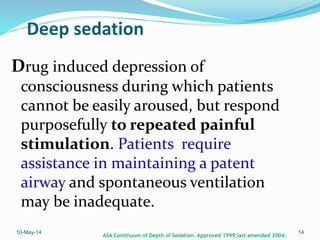
Deep sedation
Drug induced depression of
consciousness during which patients
cannot be easily aroused, but respond
purposefully to repeated painful
stimulation. Patients require
assistance in maintaining a patent
airway and spontaneous ventilation
may be inadequate.
10-May-14 14
ASA Continuum of Depth of Sedation. Approved 1999;last amended 2004.
10-May-14 15
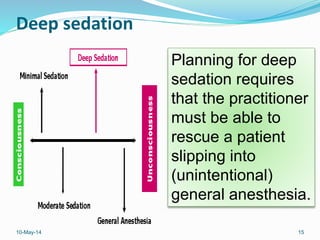
Planning for deep
sedation requires
that the practitioner
must be able to
rescue a patient
slipping into
(unintentional)
general anesthesia.
Deep sedation
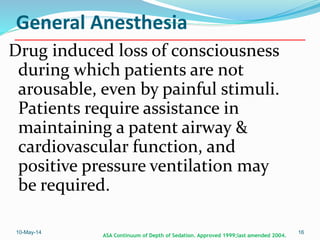
General Anesthesia
Drug induced loss of consciousness
during which patients are not
arousable, even by painful stimuli.
Patients require assistance in
maintaining a patent airway &
cardiovascular function, and
positive pressure ventilation may
be required.
10-May-14 16
ASA Continuum of Depth of Sedation. Approved 1999;last amended 2004.
10-May-14 17
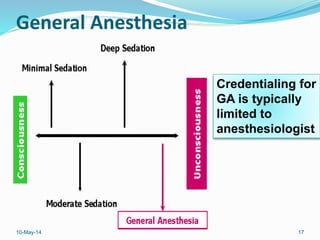
Credentialing for
GA is typically
limited to
anesthesiologist
General Anesthesia
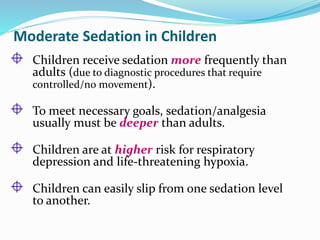
Moderate Sedation in Children
Children receive sedation more frequently than
adults (due to diagnostic procedures that require
controlled/no movement).
To meet necessary goals, sedation/analgesia
usually must be deeper than adults.
Children are at higher risk for respiratory
depression and life-threatening hypoxia.
Children can easily slip from one sedation level
to another.
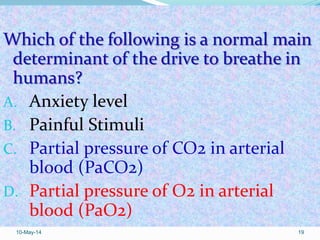
Which of the following is a normal main
determinant of the drive to breathe in
humans?
A. Anxiety level
B. Painful Stimuli
C. Partial pressure of CO2 in arterial
blood (PaCO2)
D. Partial pressure of O2 in arterial
blood (PaO2)
10-May-14 19
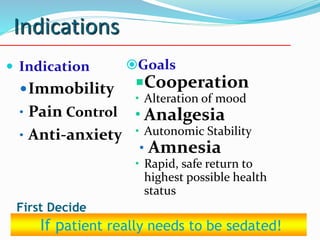
Indications
 Indication
Immobility
• Pain Control
• Anti-anxiety
Goals
Cooperation
• Alteration of mood
• Analgesia
• Autonomic Stability
• Amnesia
• Rapid, safe return to
highest possible health
status
10-May-14 20
If patient really needs to be sedated!
First Decide:
Goals of conscious sedation
include:
A. Anxiolysis
B. Analgesia
C. Amnesia
D. All of the
above10-May-14 21
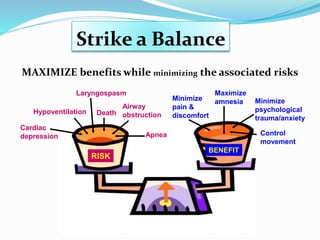
Strike a Balance
MAXIMIZE benefits while minimizing the associated risks
RISK
BENEFIT
Hypoventilation
Apnea
Airway
obstruction
Laryngospasm
Cardiac
depression
Death
Minimize
pain &
discomfort
Control
movement
Minimize
psychological
trauma/anxiety
Maximize
amnesia
10-May-14 23
10-May-14 24
Any Sedation Protocol MUST Involve:
 Appropriate number of qualified staff
 Appropriate equipment & monitoring
 Appropriate documentation
 Appropriate reporting of outcomes &
adverse effects
10-May-14 25
10-May-14 26
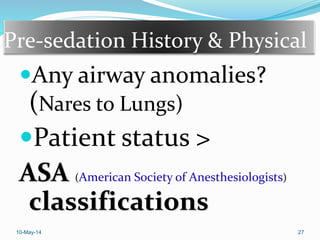
Pre-sedation History & Physical
Any airway anomalies?
(Nares to Lungs)
Patient status >
ASA (American Society of Anesthesiologists)
classifications
10-May-14 27
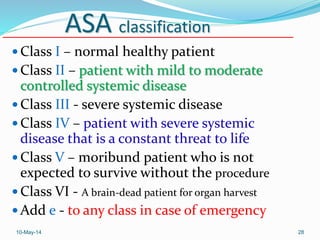
ASA classification
 Class I – normal healthy patient
 Class II – patient with mild to moderate
controlled systemic disease
 Class III - severe systemic disease
 Class IV – patient with severe systemic
disease that is a constant threat to life
 Class V – moribund patient who is not
expected to survive without the procedure
 Class VI - A brain-dead patient for organ harvest
 Add e - to any class in case of emergency
10-May-14 28
10-May-14 29
NPO guidelines‘
NPO guidelines'
NPO guidelines'
NPO guidelines'Nil Per Os
10-May-14 30
Starved for how long…?
Controversial.
Probably not as
rigid as anesthetic
guidelines for GA...
It depends on
degree and
duration of sedation
10-May-14 31
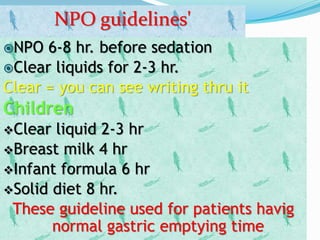
NPO guidelines'
NPO 6-8 hr. before sedation
Clear liquids for 2-3 hr.
Clear = you can see writing thru it
Children
Clear liquid 2-3 hr
Breast milk 4 hr
Infant formula 6 hr
Solid diet 8 hr.
These guideline used for patients havig
normal gastric emptying time
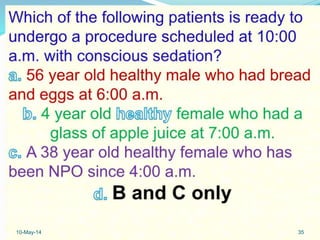
10-May-14 32
10-May-14 33
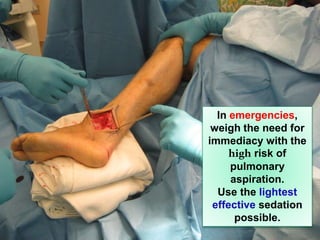
In emergencies,
weigh the need for
immediacy with the
high risk of
pulmonary
aspiration.
Use the lightest
effective sedation
possible.
10-May-14 34
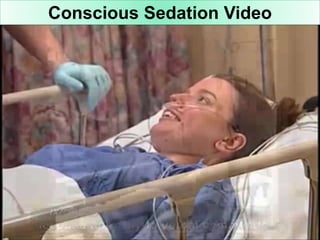
Conscious Sedation Video
10-May-14 35
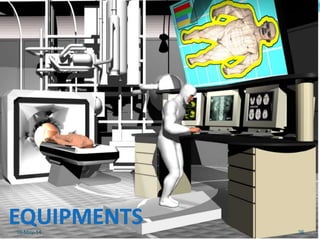
10-May-14 36
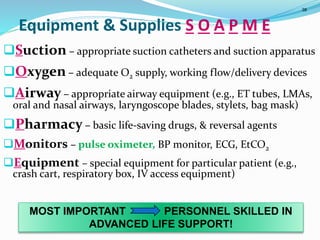
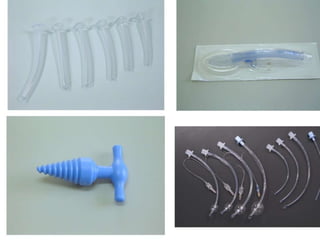
Equipment & Supplies S O A P M E
Suction – appropriate suction catheters and suction apparatus
Oxygen – adequate O2 supply, working flow/delivery devices
Airway – appropriate airway equipment (e.g., ET tubes, LMAs,
oral and nasal airways, laryngoscope blades, stylets, bag mask)
Pharmacy – basic life-saving drugs, & reversal agents
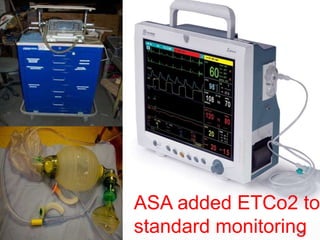
Monitors – pulse oximeter, BP monitor, ECG, EtCO2
Equipment – special equipment for particular patient (e.g.,
crash cart, respiratory box, IV access equipment)
MOST IMPORTANT PERSONNEL SKILLED IN
ADVANCED LIFE SUPPORT!
38
10-May-14 38
ASA added ETCo2 to
standard monitoring
10-May-14 39
Appropriate methods for treating
hypotension associated with the
administration of conscious sedation
include all the following except:
A. IV fluid bolus
B. Placing the patient in
Trendelenburg’s position
C. Administration of fentanyl 50 ug IV
D. Administration of a mild vasopressor
such as ephedrine 10 mg. IV
10-May-14 40
10-May-14 41
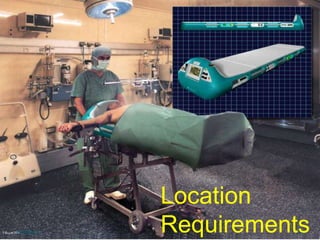
Location
Requirements
10-May-14 42
10-May-14 43
Secure I.v. access
10-May-14 44
10-May-14 45
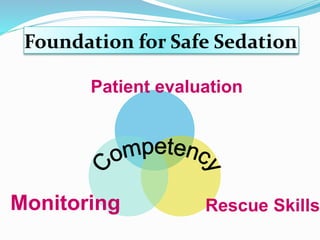
Foundation for Safe Sedation
Patient evaluation
Rescue SkillsMonitoring
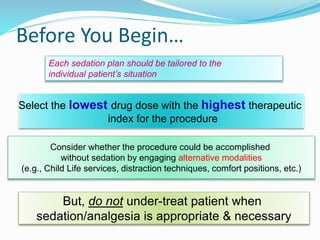
Before You Begin…
Consider whether the procedure could be accomplished
without sedation by engaging alternative modalities
(e.g., Child Life services, distraction techniques, comfort positions, etc.)
Select the lowest drug dose with the highest therapeutic
index for the procedure
Each sedation plan should be tailored to the
individual patient’s situation
But, do not under-treat patient when
sedation/analgesia is appropriate & necessary
10-May-14 48
10-May-14 49
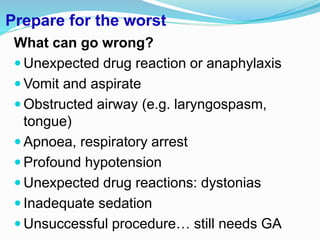
Prepare for the worst
What can go wrong?
 Unexpected drug reaction or anaphylaxis
 Vomit and aspirate
 Obstructed airway (e.g. laryngospasm,
tongue)
 Apnoea, respiratory arrest
 Profound hypotension
 Unexpected drug reactions: dystonias
 Inadequate sedation
 Unsuccessful procedure… still needs GA
10-May-14 51
10-May-14 52
*Keep watching the patient … during
*Keep watching the patient … after
*Discharge with a well-advised capable
observer
Recovery & Discharge
The recovery period lasts from the
conclusion of the procedure until the
patient has returned to baseline.
Saturation should be monitored
continuously.
Vital signs & level of consciousness
recorded at regular intervals.
Discharge instructions should be
clearly written and reviewed with
patient/responsible adult.
Patient Discharge Criteria
Return to baseline verbal skills.
 Understand and follow directions.
 Appropriately verbalize.
Return to baseline muscle control
function.
 If infant can sit up unattended.
 Children can walk unattended.
Return to baseline mental status.
Patient or responsible person with
patient can understand discharge
instructions.
10-May-14 54
10-May-14 55
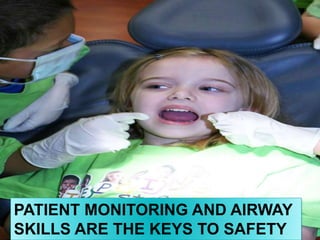
PATIENT MONITORING AND AIRWAY
SKILLS ARE THE KEYS TO SAFETY
13
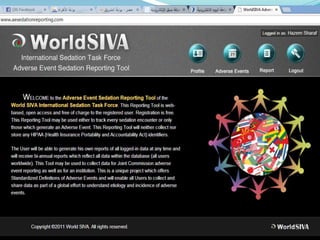
Reporting the adverse effects
 http://www.aesedationreporting.com/login.aspx
10-May-14 57
10-May-14 58
10-May-14 59
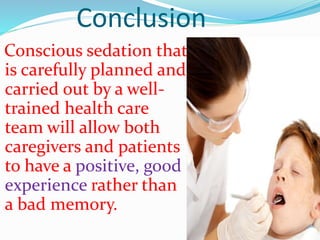
Conclusion
Conscious sedation that
is carefully planned and
carried out by a well-
trained health care
team will allow both
caregivers and patients
to have a positive, good
experience rather than
a bad memory.
10-May-14 61
THANK YOU & Have A Nice Day

Conscious Sedation Basics and Introduction

  • 1.
    Dr. Hazem Sharaf AnesthesiaConsultant KFH Al-Baha hazemsharaf@yahoo.com 10-May-14 1
  • 2.
    Conscious sedation course 10-May-142 Today’s course is Mandatory for the C.S. privilege & delivers basic knowledge about: 1- Conscious sedation terminology & basics 2- Pharmacology of Sedative Drugs 3- Patient Management under C.S. 4- Hospital sedation policy.
  • 3.
  • 4.
  • 5.
     Conscious sedationis administering drugs for specific goals:  Provision of safe analgesia, anxiolysis, sedation, and amnesia during stressful procedures.  Safely decreasing adverse psychological responses associated with stressful procedures.  Return of patients to their pre-procedural level of functioning. 10-May-14 5
  • 6.
    Procedural Sedation Continuum Sedation is a continuum of “levels” ranging from minimally impaired consciousness to unconsciousness.  The following terminology refers to the different levels of sedation: Minimum Moderate Dissociative Deep G.A. Levels of sedation are considered to be on a continuum because a sedated patient can go in and out of an intended level quite rapidly.
  • 7.
    Minimal Sedation (anxiolysis) Druginduced state during which; patients can respond normally to verbal commands. We almost never do this 10-May-14 7 ASA Continuum of Depth of Sedation. Approved 1999;last amended 2004.
  • 8.
    10-May-14 8 No matterthe level of sedation you intend, BUT you should be able to rescue patients one level of sedation “deeper” than that which was intended. Minimal Sedation (anxiolysis)
  • 9.
  • 10.
    Moderate (Conscious) Sedation Drug-induceddepressed consciousness Purposeful response to verbal or tactile stimulation NO interventions necessary to maintain a patent airway Adequate spontaneous ventilation  Cardiovascular function maintained 10-May-14 10 ASA Continuum of Depth of Sedation. Approved 1999;last amended 2004.
  • 11.
    It is discouraged touse the term “conscious sedation” when referencing sedation in children.* * American Academy of Pediatrics Committee on Drugs. Moderate (Conscious) Sedation
  • 12.
    Dissociative Sedation =(Ketamine) A bizarre, cataleptic state occurs with both profound analgesia & amnesia while maintaining protective airway reflexes, spontaneous respirations, and cardiopulmonary stability. Due to Ketamine’s markedly different clinical effect, it does not officially fit the ASA sedation continuum. However, it is generally recognized to produce a level of sedation between moderate and deep sedation. Consciousness Unconsciousness Moderate Sedation Deep Sedation General Anesthesia Minimal Sedation Dissociative
  • 13.
    A patient whois appropriately consciously (moderately) sedated: A. Must be able to open his eyes B. Must be able to protect his airway C. Responds to painful stimuli only D. Is comatosed 10-May-14 13
  • 14.
    Deep sedation Drug induceddepression of consciousness during which patients cannot be easily aroused, but respond purposefully to repeated painful stimulation. Patients require assistance in maintaining a patent airway and spontaneous ventilation may be inadequate. 10-May-14 14 ASA Continuum of Depth of Sedation. Approved 1999;last amended 2004.
  • 15.
    10-May-14 15 Planning fordeep sedation requires that the practitioner must be able to rescue a patient slipping into (unintentional) general anesthesia. Deep sedation
  • 16.
    General Anesthesia Drug inducedloss of consciousness during which patients are not arousable, even by painful stimuli. Patients require assistance in maintaining a patent airway & cardiovascular function, and positive pressure ventilation may be required. 10-May-14 16 ASA Continuum of Depth of Sedation. Approved 1999;last amended 2004.
  • 17.
    10-May-14 17 Credentialing for GAis typically limited to anesthesiologist General Anesthesia
  • 18.
    Moderate Sedation inChildren Children receive sedation more frequently than adults (due to diagnostic procedures that require controlled/no movement). To meet necessary goals, sedation/analgesia usually must be deeper than adults. Children are at higher risk for respiratory depression and life-threatening hypoxia. Children can easily slip from one sedation level to another.
  • 19.
    Which of thefollowing is a normal main determinant of the drive to breathe in humans? A. Anxiety level B. Painful Stimuli C. Partial pressure of CO2 in arterial blood (PaCO2) D. Partial pressure of O2 in arterial blood (PaO2) 10-May-14 19
  • 20.
    Indications  Indication Immobility • PainControl • Anti-anxiety Goals Cooperation • Alteration of mood • Analgesia • Autonomic Stability • Amnesia • Rapid, safe return to highest possible health status 10-May-14 20 If patient really needs to be sedated! First Decide:
  • 21.
    Goals of conscioussedation include: A. Anxiolysis B. Analgesia C. Amnesia D. All of the above10-May-14 21
  • 22.
    Strike a Balance MAXIMIZEbenefits while minimizing the associated risks RISK BENEFIT Hypoventilation Apnea Airway obstruction Laryngospasm Cardiac depression Death Minimize pain & discomfort Control movement Minimize psychological trauma/anxiety Maximize amnesia
  • 23.
  • 24.
  • 25.
    Any Sedation ProtocolMUST Involve:  Appropriate number of qualified staff  Appropriate equipment & monitoring  Appropriate documentation  Appropriate reporting of outcomes & adverse effects 10-May-14 25
  • 26.
  • 27.
    Pre-sedation History &Physical Any airway anomalies? (Nares to Lungs) Patient status > ASA (American Society of Anesthesiologists) classifications 10-May-14 27
  • 28.
    ASA classification  ClassI – normal healthy patient  Class II – patient with mild to moderate controlled systemic disease  Class III - severe systemic disease  Class IV – patient with severe systemic disease that is a constant threat to life  Class V – moribund patient who is not expected to survive without the procedure  Class VI - A brain-dead patient for organ harvest  Add e - to any class in case of emergency 10-May-14 28
  • 29.
    10-May-14 29 NPO guidelines‘ NPOguidelines' NPO guidelines' NPO guidelines'Nil Per Os
  • 30.
    10-May-14 30 Starved forhow long…? Controversial. Probably not as rigid as anesthetic guidelines for GA... It depends on degree and duration of sedation
  • 31.
    10-May-14 31 NPO guidelines' NPO6-8 hr. before sedation Clear liquids for 2-3 hr. Clear = you can see writing thru it Children Clear liquid 2-3 hr Breast milk 4 hr Infant formula 6 hr Solid diet 8 hr. These guideline used for patients havig normal gastric emptying time
  • 32.
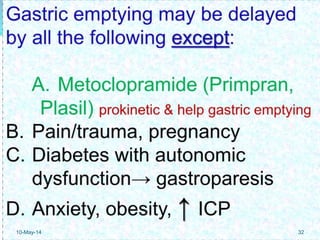
  • 33.
    10-May-14 33 In emergencies, weighthe need for immediacy with the high risk of pulmonary aspiration. Use the lightest effective sedation possible.
  • 34.
  • 35.
  • 36.
  • 37.
    Equipment & SuppliesS O A P M E Suction – appropriate suction catheters and suction apparatus Oxygen – adequate O2 supply, working flow/delivery devices Airway – appropriate airway equipment (e.g., ET tubes, LMAs, oral and nasal airways, laryngoscope blades, stylets, bag mask) Pharmacy – basic life-saving drugs, & reversal agents Monitors – pulse oximeter, BP monitor, ECG, EtCO2 Equipment – special equipment for particular patient (e.g., crash cart, respiratory box, IV access equipment) MOST IMPORTANT PERSONNEL SKILLED IN ADVANCED LIFE SUPPORT! 38
  • 38.
    10-May-14 38 ASA addedETCo2 to standard monitoring
  • 39.
  • 40.
    Appropriate methods fortreating hypotension associated with the administration of conscious sedation include all the following except: A. IV fluid bolus B. Placing the patient in Trendelenburg’s position C. Administration of fentanyl 50 ug IV D. Administration of a mild vasopressor such as ephedrine 10 mg. IV 10-May-14 40
  • 41.
  • 42.
  • 43.
  • 44.
  • 45.
  • 46.
    Foundation for SafeSedation Patient evaluation Rescue SkillsMonitoring
  • 47.
    Before You Begin… Considerwhether the procedure could be accomplished without sedation by engaging alternative modalities (e.g., Child Life services, distraction techniques, comfort positions, etc.) Select the lowest drug dose with the highest therapeutic index for the procedure Each sedation plan should be tailored to the individual patient’s situation But, do not under-treat patient when sedation/analgesia is appropriate & necessary
  • 48.
  • 49.
  • 50.
    Prepare for theworst What can go wrong?  Unexpected drug reaction or anaphylaxis  Vomit and aspirate  Obstructed airway (e.g. laryngospasm, tongue)  Apnoea, respiratory arrest  Profound hypotension  Unexpected drug reactions: dystonias  Inadequate sedation  Unsuccessful procedure… still needs GA
  • 51.
  • 52.
    10-May-14 52 *Keep watchingthe patient … during *Keep watching the patient … after *Discharge with a well-advised capable observer
  • 53.
    Recovery & Discharge Therecovery period lasts from the conclusion of the procedure until the patient has returned to baseline. Saturation should be monitored continuously. Vital signs & level of consciousness recorded at regular intervals. Discharge instructions should be clearly written and reviewed with patient/responsible adult.
  • 54.
    Patient Discharge Criteria Returnto baseline verbal skills.  Understand and follow directions.  Appropriately verbalize. Return to baseline muscle control function.  If infant can sit up unattended.  Children can walk unattended. Return to baseline mental status. Patient or responsible person with patient can understand discharge instructions. 10-May-14 54
  • 55.
  • 56.
    PATIENT MONITORING ANDAIRWAY SKILLS ARE THE KEYS TO SAFETY 13
  • 57.
    Reporting the adverseeffects  http://www.aesedationreporting.com/login.aspx 10-May-14 57
  • 58.
  • 59.
  • 60.
    Conclusion Conscious sedation that iscarefully planned and carried out by a well- trained health care team will allow both caregivers and patients to have a positive, good experience rather than a bad memory.
  • 61.
    10-May-14 61 THANK YOU& Have A Nice Day