High Performance Liquid
Chromatography HPLC
DONE BY : HADEIA MASHAQBEH
H
P
igh
erformance
Liquid
C hromatograph
y
A technique by which a mixture sample is separated
into components. Although originally intended to
separate and recover (isolate and purify) the
components of a sample.
Today, complete chromatography systems are often
used to both qualitify and quantify sample
components.
CHROMATOGRAPHY :
3
Chromato-graphy / -graph / -gram / -
grapher
4
 Chromatography: Analytical technique
 Chromatograph: Instrument
 Chromatogram: Obtained “picture”
 Chromatographer: Person
( mobile phase)
5
Mobile Phase / Stationary Phase
 A site in which a moving
phase (mobile phase) and
a non-moving phase
(stationary phase) make
contact via an interface that
is set up.
 The affinity with the mobile
phase and stationary phase
varies with the solute. 
Separation occurs due to
differences in the speed of
motion.
6
Strong Weak
Mobile
phase
Stationary
phase
Chromatography is based on the
principal that :
Under the same conditions, the time between
the injection of a component into the column
and the elution of that component (Retention
time) is constant.
This characteristic is used to perform
qualitative analysis.
7
Liquid Chromatography
8
 Chromatography in which the mobile phase is
a liquid.
 The liquid used as the mobile phase is called the “eluent”.
 The stationary phase is usually a solid or a
liquid.
 In general, it is possible to analyze any
substance that can be stably dissolved in the
mobile phase.
Advantages of High Performance Liquid
Chromatography
9
 High separation capacity, enabling the batch
analysis of multiple components
 Superior quantitative capability and reproducibility
 Moderate analytical conditions
 Unlike GC, the sample does not need to be vaporized.
 Generally high sensitivity
 Low sample consumption
 Easy preparative separation and purification of
samples
Three States of Matter and
Chromatography Types
Mobile phase
Gas Liquid Solid
Stationary
phase
Gas
Liquid
Solid
10
Gas
chromatography
Liquid
chromatography
Separation Techniques
11
I have two separation techniques in my lab,
High Performance Liquid Chromatography
and Gas Chromatography. Which should I use?
Comparison of HPLC and GC
12
Sample Volatility Sample Polarity
HPLC
• No volatility requirement
• Sample must be soluble
in mobile phase
GC
•Sample must be volatile
HPLC
GC
•Separates both polar and
non polar compounds
•PAH - inorganic ions
•Samples are nonpolar
and polar
Comparison of HPLC and GC
13
Sample Thermal Lability Sample Molecular Weight
HPLC
•Analysis can take place
at or below room
temperature
GC
•Sample must be able
to survive high
temperature injection
port and column
HPLC
GC
•No theoretical upper limit
•In practicality, solubility is
limit.
•Typically < 500 amu
Comparison of HPLC and GC
14
Sample Preparation Sample Size
HPLC
•Sample must be filtered
•Sample should be in
same solvent as mobile
phase
GC
•Solvent must be volatile
and generally lower
boiling than analytes
HPLC
GC
•Sample size based upon
column i.d.
•Typically 1 - 5 L
Comparison of HPLC and GC
15
Separation Mechanism
HPLC
•Both stationary phase
and mobile phase take
part
GC
•Mobile phase is a
sample carrier only
Principle of HPLC :
16
Chromatogram
The Chromatogram
18
Injection
to
tR
mAU
time
tR
to - elution time of unretained peak
tR- retention time - determines sample identity
Area or height is proportiona
to the quantity of analyte.
 HPLC is used for:
1) Qualitative Analysis
The identification of individual compounds in the
sample by the standard sample is measured, yielding a
peak at specific minutes.
This peak should be correspond to the sample itself
under the same conditions (the type of column, column
sizes, column temperature, composition of the mobile
phase, and flow rate)
 the most common parameter for compound identification
is its Retention time
Retention time: The time at which a specific
analyte elutes (emerges from the column) after
injection
2) Quantitative analysis
 The measurement of the amount of a compound in a
sample (concentration)
 Two main ways
a) determination of the peak height of a chromatographic
peak as measured from the baseline
b) determination of the peak area in order to make a
quantitative assessment of the compound
 Peak Area or Peak Height
For most HPLC analyses, peak areas are used for
quantitative calculations, although, in most cases,
equivalent results may be achieved with peak height.
Peak area is especially useful because HPLC peaks
may be tailed. In this case, because peak heights may
vary (although area will remain constant).
Quantitative Analysis
24
 Calibration curve created using a standard.
 Absolute calibration curve method
 Internal standard method
 Standard addition method
Calibration Curve for Absolute Calibration
Curve Method
25
C1
C4
C3
C2
Concentration
Area
A1
A2
A3
A4
C1 C2 C3 C4
A1
A2
A3
A4
Concentration
Peakarea
Calibration curve
Calibration Curve for Internal Standard
Method
26
C1
C4
C3
C2
Concentration Area
A1
A2
A3
A4
C1/CIS C2 /CIS C3 /CIS C4 /CIS
A1/AIS
A2 /AIS
A3 /AIS
A4 /AIS
Concentration of target substance /
Concentration of internal standard
Areafortargetsubstance/Areaforinternalstandard
Calibration curve
Target
substance
Internal
standard
CIS
CIS
CIS
CIS
AIS
AIS
AIS
AIS
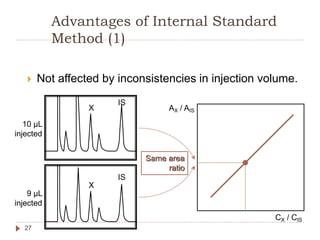
Advantages of Internal Standard
Method (1)
 Not affected by inconsistencies in injection volume.
27
10 µL
injected
9 µL
injected
CX / CIS
AX / AIS
X
IS
X
IS
Same area
ratio
Advantages of Internal Standard
Method (2)
 Not affected by the pretreatment recovery rate.
28
100%
recovery
rate
90%
recovery
rate
CX / CIS
AX/AIS
X
IS
X
IS
Same area
ratio
Selection Criteria for Internal Standard
29
 It must have similar chemical properties to the
target substance.
 Its peak must appear relatively near that of the
target substance.
 It must not already be contained in the actual
samples.
 Its peak must be completely separated from those
of other sample components.
 It must be chemically stable.
3) Separation of mixtures for later analysis –preparative
HPLC
In chromatography a small volume of a mixture of
chemicals is passed through a column using a solvent
and different molecules exit the column at different
times – this is called a separation.
 The separation of a compound involves its physical
interaction with a stationary phase and a mobile
phase.
 A small, high-surface-area stationary phase
maximizes the interaction between the substance
to be separated and the stationary phase, which
results in better separation.
Chromatogram Parameters
Methods for Expressing Separation and Column
Performance
32
Retention Factor, k
33
tR
t0
Strengthofdetectorsignal
Time
tR: Retention time
t0: Non-retention time
0
0R
t
tt
k


Theoretical Plate Number, N
34
W
W1/2
H1/2
H
2
.
21
R
R
/
R
W
t
W
2
2
2

545
16




Area
Ht
t
N
H
L
N 
Evaluation of Column Efficiency Based on
Theoretical Plate Number
35
 If the retention times are
the same, the peak width is
smaller for the one with the
larger theoretical plate
number.
 If the peak width is the
same, the retention time is
longer for the one with the
larger theoretical plate
number.
N: Large
N: Small
N: Small
N: Large
36
Peak asymmetry ( A ) :
s
Separation Factor, a
37
Separation factor: Ratio of k’s of two peaks
)( 12
1
2
kk
k
k


k1 k2
1. When calculating the selectivity factor, species 1 elutes faster than species 2. The
selectivity factor is always greater than or equal to one ( 1).
2. In general, if the selectivity of two components is equal to 1, then there is no way
to separate them by improving the column efficiency
Resolution, RS
38
2,2/11,2/1
RR
21
RR
S
12
12
18.1
)(
2
1
hh WW
tt
WW
tt
R






tR1 tR2
W1 W2
W1/2h,1 W1/2h,2 h1/2
Resolution Required for Complete
Separation
39
If the peaks are isosceles triangles,
they are completely separated.
tR2 - tR1 = W1 = W2
RS = 1
(tR2 - tR1)
W1 W2 W1 W2
If the peaks are Gaussian distributions,
RS > 1.5 is necessary for complete separation.
tR2 - tR1 = W1 = W2
RS = 1
(tR2 - tR1)
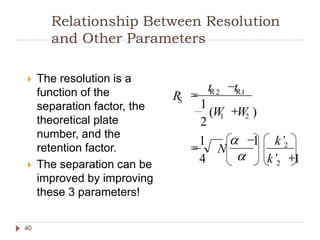
Relationship Between Resolution
and Other Parameters
 The resolution is a
function of the
separation factor, the
theoretical plate
number, and the
retention factor.
 The separation can be
improved by improving
these 3 parameters!
40






1
1
4
1
)(
2
1
2
2
21
1R2R
S
k’
k’
N
WW
tt
R


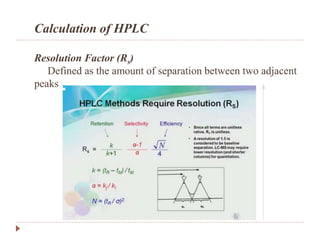
Calculation of HPLC
Resolution Factor (Rs)
Defined as the amount of separation between two adjacent
peaks
Contribution of Capacity Factor to
Resolution
 Increasing the capacity
factor improves
resolution
 A capacity factor of
around 3 to 10 is
appropriate. Exceeding
this just increases the
analysis time.
42
0.0
0.2
0.4
0.6
0.8
1.0
0 5 10 15 20
Capacity factor
Contributionratioforresolution
Contribution of Theoretical Plate
Number to Resolution
 The resolution
increases in
proportion to the
square root of the
theoretical plate
number.
0.0
1.0
2.0
0 10000 20000 30000
Theoretical plate number
Contributionfactorforresolution
43
To Improve Separation...
44
k’ increased
N increased
 increased
Before
adjustment
Eluent replaced with one
of lower elution strength.
Column replaced with one of
superior performance.
Column lengthened.
Column (packing material) replaced.
Eluent composition changed.
Column temperature changed.
Instrumentation of HPLC
Mobile
phase
reservoir
Solvent
mixing
valve
Pump
HPLC
Chart
Sample
injection
valve
Recorder
Waste
Detector
HPLC Analysis Parameters
46
Mobile Phases
Flow Rate
Composition
Injection Volume
Column
Oven Temperature
Wavelength
Time Constant
-Often the reservoirs contain a filtration system for filtering dust
and particulate matters from the solvent to prevent these particles
from damaging the pumps or injection valves or blocking the
column.
-The reservoirs are equipped with a degasser for removing
dissolved gases- usually oxygen and nitrogen-that interfere by
forming bubbles in the column and the detector.
Mobile-Phase Reservoir
Mobile phase
reservoir
Solvent
mixing
valve Pump
Chart
injection
valve
Recorder
Waste
Detector
The Function:
The pump provide a flow of the mobile-phase
through the HPLC injector, column, and detector.
HPLC Pump
Types of HPLC Pumps:
 Constant-Pressure Pump.
 Constant-Flow Pump.
The requirements of standard HPLC pump include:
 Generation of pressures up to 6000 Ibs/in2.
 Pulse-free output.
 Flow rate ranging from 0.1 to 10 ml/min.
 Made of corrosion-resistant materials (stainless steel).
Mobile phase
reservoir
Solvent
mixing
valve Pump
Chart
injection
valve
Recorder
Waste
Detector
Two types of pump operation
1) Isocratic Elution
In which the composition of the mobile phase solvent remains
constant with time
 Best for simple preparation
2) Gradient Elution
the composition changes during the separation process
(mobile phase solvent composition increase with timed)
 Best for Complex preparation
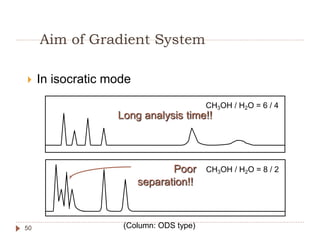
Aim of Gradient System
 In isocratic mode
50
Long analysis time!!
Poor
separation!!
CH3OH / H2O = 6 / 4
CH3OH / H2O = 8 / 2
(Column: ODS type)
Aim of Gradient System
If the eluent composition is changed gradually during
analysis...
51
95%
30%
Concentrationofmethanolineluent
Four types of columns used in HPLC
1) High performance analytical columns
The internal diameter 1.0 - 4.6 mm; lengths 15 –250 mm] - used
mainly for qualitative and quantitative analysis
2) Preparative columns
The Internal Diameter > 4.6 mm; lengths 50 –250 mm) – used
mainly for preparative work
3) Capillary columns
The internal Diameter 0.1 -1.0 mm; various lengths)
4) Nano columns
the Internal diameter (< 0.1 mm)
HPLC Column
PARAMETERS:
1- Internal diameter:
A critical aspect that determines quantity of
analyte that can be loaded onto the column
and also influences sensitivity.
2- Particle size:
Smaller particles generally provide more
surface area and better separations.
54
3- Pore size:
Many stationary phases are porous to
provide greater surface area.
Small pores provide arger pore size has
better kinetics.
55
The outer particle surface to its inner one is
about 1:1000.
4-Pump pressure:
The pump performance is measured on their
ability to yield a consistent and reproducible
pressure and flow rate.
56
Temperature Control in HPLC:
To achieve
1-Reproducibility
2-Solubility
3-Stability
57
Temperature is controlled by:
1.Oven
2.Heater Block
3.Water bath
HPLC Detector
The ideal characteristics:
1. Adequate sensitivity for the particular task.
2. Good stability and reproducibility.
3. Insensitive to changes in solvent, flow rate, and temperature.
4. High reliability and ease of use.
5. Non-destructive for the sample.
Mobile phase
reservoir
Solvent
mixing
valve Pump
Chart
injection
valve
Recorder
Waste
Detector
Representative HPLC Detectors
59
 UV-VIS absorbance detector
 Photodiode array-type UV-VIS absorbance
detector
 Fluorescence detector
 Refractive index detector
 Evaporative light scattering detector
 Electrical conductivity detector
 Electrochemical detector
 Mass spectrometer
Comparison of Detectors
Selectivity
Possibility of
Gradient System
Absorbance
Light-absorbing
substances
Possible
Fluorescence Fluorescent substances Possible
Differential
refractive index
None Impossible
Evaporative light
scattering
Nonvolatile substances Possible
Electrical
conductivity
Ionic substances Partially possible
Electrochemical
Oxidizing / reducing
substances
Partially possible
60 Note: The above table indicates general characteristics. There are exceptions.
HPLC separation modes
1) Normal Phase Liquid Chromatography
 Is a technique that uses columns packed with polar
stationary phases ( e.g Silica gel) combined with nonpolar
or moderately-polar mobile phases (e.g hexane) to separate
the components of mixtures.
 The rate at which individual solutes migrate through HPLC
columns is primarily a function of their polarity.
 Less polar solutes move the fastest and therefore exit the
column and are detected first, followed by solutes of
increasing polarity which move more slowly
Stationary Phase and Mobile Phase Used in
Normal Phase Mode
62
 Stationary Phase
 Silica gel: -Si-OH
 Cyano type: -Si-CH2CH2CH2CN
 Amino type: -Si-CH2CH2CH2NH2
 Diol type: -Si-CH2CH2CH2OCH(OH)-CH2OH
 Mobile Phase
 Basic solvents: Aliphatic hydrocarbons,
aromatic hydrocarbons, etc.
 Additional solvents: Alcohols, ethers, etc.
Relationship between Hydrogen Bonding and
Retention Time in Normal Phase Mode
63
OH
HO
SiOH
SiOH
Strong
Weak
Steric hindrance
Very weak
Relationship Between Eluent Polarity and
Retention Time in Normal Phase Mode
64
100/0
Eluent: Hexane/methanol
95/5
98/2
Nonpolar (Hydrophobic) Functional Groups and
Polar (Hydrophilic) Functional Groups
65
 Nonpolar Functional
Groups
 -(CH2)nCH3
 Alkyl groups
 -C6H5
 Phenyl groups
 Polar Functional Groups
 -COOH
 Carboxyl groups
 -NH2
 Amino groups
 -OH
 Hydroxyl groups
2) Reverse Phase Liquid Chromatography
The mobile phase is polar and the stationary pahse is non
polar
The silica in the column is modified to make it non-polar
(Silica C18 molecule), typically 8 or 18 carbons are
added to the silica (C8 – C18) then the silica C18 is non
polar.
The non polar molecules binds/adsorbs to it and the polar
molecules will pass more quickly through the stationary
phase.
Relationship Between Retention Time and
Polarity
67
C18 (ODS)
CH3
Strong
Weak
OH
Basic Settings for Eluent Used in Reversed
Phase Mode
68
 Water (buffer solution) + water-soluble organic
solvent
 Water-soluble organic solvent: Methanol
Acetonitrile
Tetrahydrofuran etc.
 The mixing ratio of the water (buffer solution) and
organic solvent has the greatest influence on
separation.
 If a buffer solution is used, its pH value is an important
separation parameter.
Relationship between Polarity of Eluent and
Retention Time in Reversed Phase Mode
69
60/40
Eluent: Methanol / Water
80/20
70/30
Normal Phase / Reversed Phase
Stationary
phase
Mobile phase
Normal
phase
High polarity
(hydrophilic)
Low polarity
(hydrophobic)
Reversed
phase
Low polarity
(hydrophobic)
High polarity
(hydrophilic)
70
Why the Reverse phase HPLC is more commonly used than
Normal phase HPLC
1) Reverse phase is easier to use than normal phase
2) Reverse phase has hydrophobic stationary which can be
applied to a wide range of molecules, it works well in
retention time for most of the organic analytes. (70 – 80
% of common analytes can be measured by RP – HPLC)
3) Reverse phase has more options for chromatographer
It also allows precise control of variables such as organic
solvent type, concentration and pH
Comparison of Normal Phase and Reversed
Phase
72
 Normal Phase
 Effective for separation of
structural isomers
 Offers separation
selectivity not available
with reversed phase
 Stabilizes slowly and is
prone to fluctuations in
retention time
 Eluents are expensive
 Reversed Phase
 Wide range of applications
 Effective for separation of
homologs
 Stationary phase has long
service life
 Stabilizes quickly
 Eluents are inexpensive and
easy to use
(3)Ion Exchange Chromatography
73
N+
R
R
R
SO3
-
+
+
+
++
++
+
+
+
Electrostatic interaction
(Coulomb force)
Anion exchange
Cation exchange
Molecules with the higher charge density bind
more strongly to the resin. The bound
sample may be selectively removed from
the stationary phase by changing the pH
or salt concentration of the mobile phase
(4)Size Exclusion Chromatography
74
 Separation is based on the size (bulkiness) of
molecules.
 The name varies with the application field!
 Size Exclusion Chromatography (SEC)
 Gel Permeation Chromatography (GPC)
 Chemical industry fields, synthetic polymers, nonaqueous
systems
 Gel Filtration Chromatography (GFC)
 Biochemical fields, biological macromolecules, aqueous
systems
Principle of Size Exclusion Mode
75
Packing
material
The size of the solute molecules
determines whether or not they can
enter the pores.
Modes of High Performance Liquid
Chromatography
76
Types of Compounds Mode Stationary
Phase
Mobile Phase
Neutrals
Weak Acids
Weak Bases
Reversed
Phase
C18, C8, C4
cyano, amino
Water/Organic
Modifiers
Ionics, Bases, Acids Ion
Pair
C-18, C-8 Water/Organic
Ion-Pair Reagent
Compounds not
soluble in water
Normal
Phase
Silica, Amino,
Cyano, Diol
Organics
Ionics Inorganic Ions Ion
Exchange
Anion or Cation
Exchange
Resin
Aqueous/Buffer
Counter Ion
High Molecular Weight
Compounds
Polymers
Size
Exclusion
Polystyrene
Silica
Gel Filtration-
Aqueous
Gel Permeation-
Organic
Guidelines for Selecting Separation Mode
Required Information
77
 Soluble solvent
 Molecular weight
 Structural formula and chemical properties
 Do the substances ionize?
 Is there UV absorption or fluorescence?
Guidelines for Selecting Separation Mode
78
 Reversed phase mode using an ODS column is
the first choice!
 Exceptions
 Large molecular weight (> 2,000)  Size exclusion
 Optical isomers  Chiral column
 Stereoisomers, positional isomers  Normal phase /
adsorption
 Inorganic ions  Ion chromatography
 Sugars, amino acids, short-chain fatty acids
•  Special column: Amino acids: Cation exchange.
• Short-chain fatty acids: Ion exclusion
Sample Pretreatment
Tasks Performed Before Injection
79
Objectives of Pretreatment
80
 To improve the accuracy of quantitative
values
 To improve sensitivity and selectivity
 To protect and prevent the deterioration of
columns and analytical instruments
 To simplify measurement operations and
procedures
 To stabilize target substances
Substances That Must Not Be Injected into
the Column
81
 Insoluble substances (e.g., microscopic
particles and precipitation)
 Substances that are precipitated in the eluent
 Substances that irreversibly adsorb to the
packing material
 Substances that dissolve, or chemically react,
with the packing material
Filtration and Centrifugal
Separation
 In general, filter every
sample before injection!
 It is convenient to use a
disposable filter with a
pore diameter of approx.
0.45 µm.
 Centrifugal separation is
applicable for samples
that are difficult to filter.
82
Filter Syringe
Solid Phase Extraction
83
(1)
Conditioning
(2)
Sample addition
(3)
Rinsing
(4)
Elution
Solvent with
low elution
strength
Solvent with
high elution
strength
Target
component
Unwanted
components
HPLC Applications
84
Chemical
Environmental
Pharmaceuticals
Consumer Products
Clinical
polystyrenes
dyes
phthalates
tetracyclines
corticosteroids
antidepressants
barbiturates
amino acids
vitamins
homocysteine
Bioscience
proteins
peptides
nucleotides
lipids
antioxidants
sugars
polyaromatic hydrocarbons
Inorganic ions
herbicides
 Pharmaceutical Application
 Assay
 Analytical Method Validation
 Stability Studies
 Compound Identification
Tablet dissolution study of pharamceutical dosages form
Identification of active ingredients of dosage form
Quality Control
High-performance liquid chromatography
(HPLC) is a chromatographic technique used to
split a mixture of compounds in the fields of
analytical chemistry, biochemistry and
industrial. The main purposes for using HPLC
are for identifying, quantifying and purifying the
individual components of the mixture.
CONCLUSION
REFRENCES
 V.R. Meyer, “Practical High – Performance Liquid
Chromatography”, Wiley, 2010
 Analysis of peak asymmetry in chromatography, Pápai
Z1, Pap TL
 Glajch J.L., Quarry M.A., Vasta J.F., and Snyder L.R. 1986.
Separation of peptide mixtures by reversed-phase gradient
elution. Use of flow rate changes for controlling band spacing
and improving resolution. Anal. Chem. 58: 280–285.
 Hancock W.S. and Sparrow J.T. 1983. The separation of
proteins by reversed-phase high-performance liquid
chromatography. In High-performance liquid chromatography.
Advances and perspectives (ed. C. Horváth), vol. 3, pp. 50–
87. Academic Press, New York.
 Liquid-solid sample preparation in drug analysis R. D.
MCDOWALL*, J. C. PEARCE and G. S. MURKITT
 www.google.com

hplc

  • 1.
    High Performance Liquid ChromatographyHPLC DONE BY : HADEIA MASHAQBEH
  • 2.
  • 3.
    A technique bywhich a mixture sample is separated into components. Although originally intended to separate and recover (isolate and purify) the components of a sample. Today, complete chromatography systems are often used to both qualitify and quantify sample components. CHROMATOGRAPHY : 3
  • 4.
    Chromato-graphy / -graph/ -gram / - grapher 4  Chromatography: Analytical technique  Chromatograph: Instrument  Chromatogram: Obtained “picture”  Chromatographer: Person
  • 5.
  • 6.
    Mobile Phase /Stationary Phase  A site in which a moving phase (mobile phase) and a non-moving phase (stationary phase) make contact via an interface that is set up.  The affinity with the mobile phase and stationary phase varies with the solute.  Separation occurs due to differences in the speed of motion. 6 Strong Weak Mobile phase Stationary phase
  • 7.
    Chromatography is basedon the principal that : Under the same conditions, the time between the injection of a component into the column and the elution of that component (Retention time) is constant. This characteristic is used to perform qualitative analysis. 7
  • 8.
    Liquid Chromatography 8  Chromatographyin which the mobile phase is a liquid.  The liquid used as the mobile phase is called the “eluent”.  The stationary phase is usually a solid or a liquid.  In general, it is possible to analyze any substance that can be stably dissolved in the mobile phase.
  • 9.
    Advantages of HighPerformance Liquid Chromatography 9  High separation capacity, enabling the batch analysis of multiple components  Superior quantitative capability and reproducibility  Moderate analytical conditions  Unlike GC, the sample does not need to be vaporized.  Generally high sensitivity  Low sample consumption  Easy preparative separation and purification of samples
  • 10.
    Three States ofMatter and Chromatography Types Mobile phase Gas Liquid Solid Stationary phase Gas Liquid Solid 10 Gas chromatography Liquid chromatography
  • 11.
    Separation Techniques 11 I havetwo separation techniques in my lab, High Performance Liquid Chromatography and Gas Chromatography. Which should I use?
  • 12.
    Comparison of HPLCand GC 12 Sample Volatility Sample Polarity HPLC • No volatility requirement • Sample must be soluble in mobile phase GC •Sample must be volatile HPLC GC •Separates both polar and non polar compounds •PAH - inorganic ions •Samples are nonpolar and polar
  • 13.
    Comparison of HPLCand GC 13 Sample Thermal Lability Sample Molecular Weight HPLC •Analysis can take place at or below room temperature GC •Sample must be able to survive high temperature injection port and column HPLC GC •No theoretical upper limit •In practicality, solubility is limit. •Typically < 500 amu
  • 14.
    Comparison of HPLCand GC 14 Sample Preparation Sample Size HPLC •Sample must be filtered •Sample should be in same solvent as mobile phase GC •Solvent must be volatile and generally lower boiling than analytes HPLC GC •Sample size based upon column i.d. •Typically 1 - 5 L
  • 15.
    Comparison of HPLCand GC 15 Separation Mechanism HPLC •Both stationary phase and mobile phase take part GC •Mobile phase is a sample carrier only
  • 16.
  • 17.
  • 18.
    The Chromatogram 18 Injection to tR mAU time tR to -elution time of unretained peak tR- retention time - determines sample identity Area or height is proportiona to the quantity of analyte.
  • 19.
     HPLC isused for: 1) Qualitative Analysis The identification of individual compounds in the sample by the standard sample is measured, yielding a peak at specific minutes. This peak should be correspond to the sample itself under the same conditions (the type of column, column sizes, column temperature, composition of the mobile phase, and flow rate)  the most common parameter for compound identification is its Retention time
  • 20.
    Retention time: Thetime at which a specific analyte elutes (emerges from the column) after injection
  • 21.
    2) Quantitative analysis The measurement of the amount of a compound in a sample (concentration)  Two main ways a) determination of the peak height of a chromatographic peak as measured from the baseline
  • 22.
    b) determination ofthe peak area in order to make a quantitative assessment of the compound
  • 23.
     Peak Areaor Peak Height For most HPLC analyses, peak areas are used for quantitative calculations, although, in most cases, equivalent results may be achieved with peak height. Peak area is especially useful because HPLC peaks may be tailed. In this case, because peak heights may vary (although area will remain constant).
  • 24.
    Quantitative Analysis 24  Calibrationcurve created using a standard.  Absolute calibration curve method  Internal standard method  Standard addition method
  • 25.
    Calibration Curve forAbsolute Calibration Curve Method 25 C1 C4 C3 C2 Concentration Area A1 A2 A3 A4 C1 C2 C3 C4 A1 A2 A3 A4 Concentration Peakarea Calibration curve
  • 26.
    Calibration Curve forInternal Standard Method 26 C1 C4 C3 C2 Concentration Area A1 A2 A3 A4 C1/CIS C2 /CIS C3 /CIS C4 /CIS A1/AIS A2 /AIS A3 /AIS A4 /AIS Concentration of target substance / Concentration of internal standard Areafortargetsubstance/Areaforinternalstandard Calibration curve Target substance Internal standard CIS CIS CIS CIS AIS AIS AIS AIS
  • 27.
    Advantages of InternalStandard Method (1)  Not affected by inconsistencies in injection volume. 27 10 µL injected 9 µL injected CX / CIS AX / AIS X IS X IS Same area ratio
  • 28.
    Advantages of InternalStandard Method (2)  Not affected by the pretreatment recovery rate. 28 100% recovery rate 90% recovery rate CX / CIS AX/AIS X IS X IS Same area ratio
  • 29.
    Selection Criteria forInternal Standard 29  It must have similar chemical properties to the target substance.  Its peak must appear relatively near that of the target substance.  It must not already be contained in the actual samples.  Its peak must be completely separated from those of other sample components.  It must be chemically stable.
  • 30.
    3) Separation ofmixtures for later analysis –preparative HPLC In chromatography a small volume of a mixture of chemicals is passed through a column using a solvent and different molecules exit the column at different times – this is called a separation.  The separation of a compound involves its physical interaction with a stationary phase and a mobile phase.
  • 31.
     A small,high-surface-area stationary phase maximizes the interaction between the substance to be separated and the stationary phase, which results in better separation.
  • 32.
    Chromatogram Parameters Methods forExpressing Separation and Column Performance 32
  • 33.
    Retention Factor, k 33 tR t0 Strengthofdetectorsignal Time tR:Retention time t0: Non-retention time 0 0R t tt k  
  • 34.
    Theoretical Plate Number,N 34 W W1/2 H1/2 H 2 . 21 R R / R W t W 2 2 2  545 16     Area Ht t N H L N 
  • 35.
    Evaluation of ColumnEfficiency Based on Theoretical Plate Number 35  If the retention times are the same, the peak width is smaller for the one with the larger theoretical plate number.  If the peak width is the same, the retention time is longer for the one with the larger theoretical plate number. N: Large N: Small N: Small N: Large
  • 36.
  • 37.
    Separation Factor, a 37 Separationfactor: Ratio of k’s of two peaks )( 12 1 2 kk k k   k1 k2 1. When calculating the selectivity factor, species 1 elutes faster than species 2. The selectivity factor is always greater than or equal to one ( 1). 2. In general, if the selectivity of two components is equal to 1, then there is no way to separate them by improving the column efficiency
  • 38.
  • 39.
    Resolution Required forComplete Separation 39 If the peaks are isosceles triangles, they are completely separated. tR2 - tR1 = W1 = W2 RS = 1 (tR2 - tR1) W1 W2 W1 W2 If the peaks are Gaussian distributions, RS > 1.5 is necessary for complete separation. tR2 - tR1 = W1 = W2 RS = 1 (tR2 - tR1)
  • 40.
    Relationship Between Resolution andOther Parameters  The resolution is a function of the separation factor, the theoretical plate number, and the retention factor.  The separation can be improved by improving these 3 parameters! 40       1 1 4 1 )( 2 1 2 2 21 1R2R S k’ k’ N WW tt R  
  • 41.
    Calculation of HPLC ResolutionFactor (Rs) Defined as the amount of separation between two adjacent peaks
  • 42.
    Contribution of CapacityFactor to Resolution  Increasing the capacity factor improves resolution  A capacity factor of around 3 to 10 is appropriate. Exceeding this just increases the analysis time. 42 0.0 0.2 0.4 0.6 0.8 1.0 0 5 10 15 20 Capacity factor Contributionratioforresolution
  • 43.
    Contribution of TheoreticalPlate Number to Resolution  The resolution increases in proportion to the square root of the theoretical plate number. 0.0 1.0 2.0 0 10000 20000 30000 Theoretical plate number Contributionfactorforresolution 43
  • 44.
    To Improve Separation... 44 k’increased N increased  increased Before adjustment Eluent replaced with one of lower elution strength. Column replaced with one of superior performance. Column lengthened. Column (packing material) replaced. Eluent composition changed. Column temperature changed.
  • 45.
  • 46.
    HPLC Analysis Parameters 46 MobilePhases Flow Rate Composition Injection Volume Column Oven Temperature Wavelength Time Constant
  • 47.
    -Often the reservoirscontain a filtration system for filtering dust and particulate matters from the solvent to prevent these particles from damaging the pumps or injection valves or blocking the column. -The reservoirs are equipped with a degasser for removing dissolved gases- usually oxygen and nitrogen-that interfere by forming bubbles in the column and the detector. Mobile-Phase Reservoir Mobile phase reservoir Solvent mixing valve Pump Chart injection valve Recorder Waste Detector
  • 48.
    The Function: The pumpprovide a flow of the mobile-phase through the HPLC injector, column, and detector. HPLC Pump Types of HPLC Pumps:  Constant-Pressure Pump.  Constant-Flow Pump. The requirements of standard HPLC pump include:  Generation of pressures up to 6000 Ibs/in2.  Pulse-free output.  Flow rate ranging from 0.1 to 10 ml/min.  Made of corrosion-resistant materials (stainless steel). Mobile phase reservoir Solvent mixing valve Pump Chart injection valve Recorder Waste Detector
  • 49.
    Two types ofpump operation 1) Isocratic Elution In which the composition of the mobile phase solvent remains constant with time  Best for simple preparation 2) Gradient Elution the composition changes during the separation process (mobile phase solvent composition increase with timed)  Best for Complex preparation
  • 50.
    Aim of GradientSystem  In isocratic mode 50 Long analysis time!! Poor separation!! CH3OH / H2O = 6 / 4 CH3OH / H2O = 8 / 2 (Column: ODS type)
  • 51.
    Aim of GradientSystem If the eluent composition is changed gradually during analysis... 51 95% 30% Concentrationofmethanolineluent
  • 53.
    Four types ofcolumns used in HPLC 1) High performance analytical columns The internal diameter 1.0 - 4.6 mm; lengths 15 –250 mm] - used mainly for qualitative and quantitative analysis 2) Preparative columns The Internal Diameter > 4.6 mm; lengths 50 –250 mm) – used mainly for preparative work 3) Capillary columns The internal Diameter 0.1 -1.0 mm; various lengths) 4) Nano columns the Internal diameter (< 0.1 mm) HPLC Column
  • 54.
    PARAMETERS: 1- Internal diameter: Acritical aspect that determines quantity of analyte that can be loaded onto the column and also influences sensitivity. 2- Particle size: Smaller particles generally provide more surface area and better separations. 54
  • 55.
    3- Pore size: Manystationary phases are porous to provide greater surface area. Small pores provide arger pore size has better kinetics. 55
  • 56.
    The outer particlesurface to its inner one is about 1:1000. 4-Pump pressure: The pump performance is measured on their ability to yield a consistent and reproducible pressure and flow rate. 56
  • 57.
    Temperature Control inHPLC: To achieve 1-Reproducibility 2-Solubility 3-Stability 57 Temperature is controlled by: 1.Oven 2.Heater Block 3.Water bath
  • 58.
    HPLC Detector The idealcharacteristics: 1. Adequate sensitivity for the particular task. 2. Good stability and reproducibility. 3. Insensitive to changes in solvent, flow rate, and temperature. 4. High reliability and ease of use. 5. Non-destructive for the sample. Mobile phase reservoir Solvent mixing valve Pump Chart injection valve Recorder Waste Detector
  • 59.
    Representative HPLC Detectors 59 UV-VIS absorbance detector  Photodiode array-type UV-VIS absorbance detector  Fluorescence detector  Refractive index detector  Evaporative light scattering detector  Electrical conductivity detector  Electrochemical detector  Mass spectrometer
  • 60.
    Comparison of Detectors Selectivity Possibilityof Gradient System Absorbance Light-absorbing substances Possible Fluorescence Fluorescent substances Possible Differential refractive index None Impossible Evaporative light scattering Nonvolatile substances Possible Electrical conductivity Ionic substances Partially possible Electrochemical Oxidizing / reducing substances Partially possible 60 Note: The above table indicates general characteristics. There are exceptions.
  • 61.
    HPLC separation modes 1)Normal Phase Liquid Chromatography  Is a technique that uses columns packed with polar stationary phases ( e.g Silica gel) combined with nonpolar or moderately-polar mobile phases (e.g hexane) to separate the components of mixtures.  The rate at which individual solutes migrate through HPLC columns is primarily a function of their polarity.  Less polar solutes move the fastest and therefore exit the column and are detected first, followed by solutes of increasing polarity which move more slowly
  • 62.
    Stationary Phase andMobile Phase Used in Normal Phase Mode 62  Stationary Phase  Silica gel: -Si-OH  Cyano type: -Si-CH2CH2CH2CN  Amino type: -Si-CH2CH2CH2NH2  Diol type: -Si-CH2CH2CH2OCH(OH)-CH2OH  Mobile Phase  Basic solvents: Aliphatic hydrocarbons, aromatic hydrocarbons, etc.  Additional solvents: Alcohols, ethers, etc.
  • 63.
    Relationship between HydrogenBonding and Retention Time in Normal Phase Mode 63 OH HO SiOH SiOH Strong Weak Steric hindrance Very weak
  • 64.
    Relationship Between EluentPolarity and Retention Time in Normal Phase Mode 64 100/0 Eluent: Hexane/methanol 95/5 98/2
  • 65.
    Nonpolar (Hydrophobic) FunctionalGroups and Polar (Hydrophilic) Functional Groups 65  Nonpolar Functional Groups  -(CH2)nCH3  Alkyl groups  -C6H5  Phenyl groups  Polar Functional Groups  -COOH  Carboxyl groups  -NH2  Amino groups  -OH  Hydroxyl groups
  • 66.
    2) Reverse PhaseLiquid Chromatography The mobile phase is polar and the stationary pahse is non polar The silica in the column is modified to make it non-polar (Silica C18 molecule), typically 8 or 18 carbons are added to the silica (C8 – C18) then the silica C18 is non polar. The non polar molecules binds/adsorbs to it and the polar molecules will pass more quickly through the stationary phase.
  • 67.
    Relationship Between RetentionTime and Polarity 67 C18 (ODS) CH3 Strong Weak OH
  • 68.
    Basic Settings forEluent Used in Reversed Phase Mode 68  Water (buffer solution) + water-soluble organic solvent  Water-soluble organic solvent: Methanol Acetonitrile Tetrahydrofuran etc.  The mixing ratio of the water (buffer solution) and organic solvent has the greatest influence on separation.  If a buffer solution is used, its pH value is an important separation parameter.
  • 69.
    Relationship between Polarityof Eluent and Retention Time in Reversed Phase Mode 69 60/40 Eluent: Methanol / Water 80/20 70/30
  • 70.
    Normal Phase /Reversed Phase Stationary phase Mobile phase Normal phase High polarity (hydrophilic) Low polarity (hydrophobic) Reversed phase Low polarity (hydrophobic) High polarity (hydrophilic) 70
  • 71.
    Why the Reversephase HPLC is more commonly used than Normal phase HPLC 1) Reverse phase is easier to use than normal phase 2) Reverse phase has hydrophobic stationary which can be applied to a wide range of molecules, it works well in retention time for most of the organic analytes. (70 – 80 % of common analytes can be measured by RP – HPLC) 3) Reverse phase has more options for chromatographer It also allows precise control of variables such as organic solvent type, concentration and pH
  • 72.
    Comparison of NormalPhase and Reversed Phase 72  Normal Phase  Effective for separation of structural isomers  Offers separation selectivity not available with reversed phase  Stabilizes slowly and is prone to fluctuations in retention time  Eluents are expensive  Reversed Phase  Wide range of applications  Effective for separation of homologs  Stationary phase has long service life  Stabilizes quickly  Eluents are inexpensive and easy to use
  • 73.
    (3)Ion Exchange Chromatography 73 N+ R R R SO3 - + + + ++ ++ + + + Electrostaticinteraction (Coulomb force) Anion exchange Cation exchange Molecules with the higher charge density bind more strongly to the resin. The bound sample may be selectively removed from the stationary phase by changing the pH or salt concentration of the mobile phase
  • 74.
    (4)Size Exclusion Chromatography 74 Separation is based on the size (bulkiness) of molecules.  The name varies with the application field!  Size Exclusion Chromatography (SEC)  Gel Permeation Chromatography (GPC)  Chemical industry fields, synthetic polymers, nonaqueous systems  Gel Filtration Chromatography (GFC)  Biochemical fields, biological macromolecules, aqueous systems
  • 75.
    Principle of SizeExclusion Mode 75 Packing material The size of the solute molecules determines whether or not they can enter the pores.
  • 76.
    Modes of HighPerformance Liquid Chromatography 76 Types of Compounds Mode Stationary Phase Mobile Phase Neutrals Weak Acids Weak Bases Reversed Phase C18, C8, C4 cyano, amino Water/Organic Modifiers Ionics, Bases, Acids Ion Pair C-18, C-8 Water/Organic Ion-Pair Reagent Compounds not soluble in water Normal Phase Silica, Amino, Cyano, Diol Organics Ionics Inorganic Ions Ion Exchange Anion or Cation Exchange Resin Aqueous/Buffer Counter Ion High Molecular Weight Compounds Polymers Size Exclusion Polystyrene Silica Gel Filtration- Aqueous Gel Permeation- Organic
  • 77.
    Guidelines for SelectingSeparation Mode Required Information 77  Soluble solvent  Molecular weight  Structural formula and chemical properties  Do the substances ionize?  Is there UV absorption or fluorescence?
  • 78.
    Guidelines for SelectingSeparation Mode 78  Reversed phase mode using an ODS column is the first choice!  Exceptions  Large molecular weight (> 2,000)  Size exclusion  Optical isomers  Chiral column  Stereoisomers, positional isomers  Normal phase / adsorption  Inorganic ions  Ion chromatography  Sugars, amino acids, short-chain fatty acids •  Special column: Amino acids: Cation exchange. • Short-chain fatty acids: Ion exclusion
  • 79.
  • 80.
    Objectives of Pretreatment 80 To improve the accuracy of quantitative values  To improve sensitivity and selectivity  To protect and prevent the deterioration of columns and analytical instruments  To simplify measurement operations and procedures  To stabilize target substances
  • 81.
    Substances That MustNot Be Injected into the Column 81  Insoluble substances (e.g., microscopic particles and precipitation)  Substances that are precipitated in the eluent  Substances that irreversibly adsorb to the packing material  Substances that dissolve, or chemically react, with the packing material
  • 82.
    Filtration and Centrifugal Separation In general, filter every sample before injection!  It is convenient to use a disposable filter with a pore diameter of approx. 0.45 µm.  Centrifugal separation is applicable for samples that are difficult to filter. 82 Filter Syringe
  • 83.
    Solid Phase Extraction 83 (1) Conditioning (2) Sampleaddition (3) Rinsing (4) Elution Solvent with low elution strength Solvent with high elution strength Target component Unwanted components
  • 84.
    HPLC Applications 84 Chemical Environmental Pharmaceuticals Consumer Products Clinical polystyrenes dyes phthalates tetracyclines corticosteroids antidepressants barbiturates aminoacids vitamins homocysteine Bioscience proteins peptides nucleotides lipids antioxidants sugars polyaromatic hydrocarbons Inorganic ions herbicides
  • 85.
     Pharmaceutical Application Assay  Analytical Method Validation  Stability Studies  Compound Identification Tablet dissolution study of pharamceutical dosages form Identification of active ingredients of dosage form Quality Control
  • 86.
    High-performance liquid chromatography (HPLC)is a chromatographic technique used to split a mixture of compounds in the fields of analytical chemistry, biochemistry and industrial. The main purposes for using HPLC are for identifying, quantifying and purifying the individual components of the mixture. CONCLUSION
  • 87.
    REFRENCES  V.R. Meyer,“Practical High – Performance Liquid Chromatography”, Wiley, 2010  Analysis of peak asymmetry in chromatography, Pápai Z1, Pap TL  Glajch J.L., Quarry M.A., Vasta J.F., and Snyder L.R. 1986. Separation of peptide mixtures by reversed-phase gradient elution. Use of flow rate changes for controlling band spacing and improving resolution. Anal. Chem. 58: 280–285.  Hancock W.S. and Sparrow J.T. 1983. The separation of proteins by reversed-phase high-performance liquid chromatography. In High-performance liquid chromatography. Advances and perspectives (ed. C. Horváth), vol. 3, pp. 50– 87. Academic Press, New York.  Liquid-solid sample preparation in drug analysis R. D. MCDOWALL*, J. C. PEARCE and G. S. MURKITT  www.google.com