2016 International Conference on Natural Hazards and Infrastructure
Understanding Resilience
through a Musical Analogy
Ramon Gilsanz, PE, SE, FSEI
2016 International Conference on Natural Hazards and Infrastructure
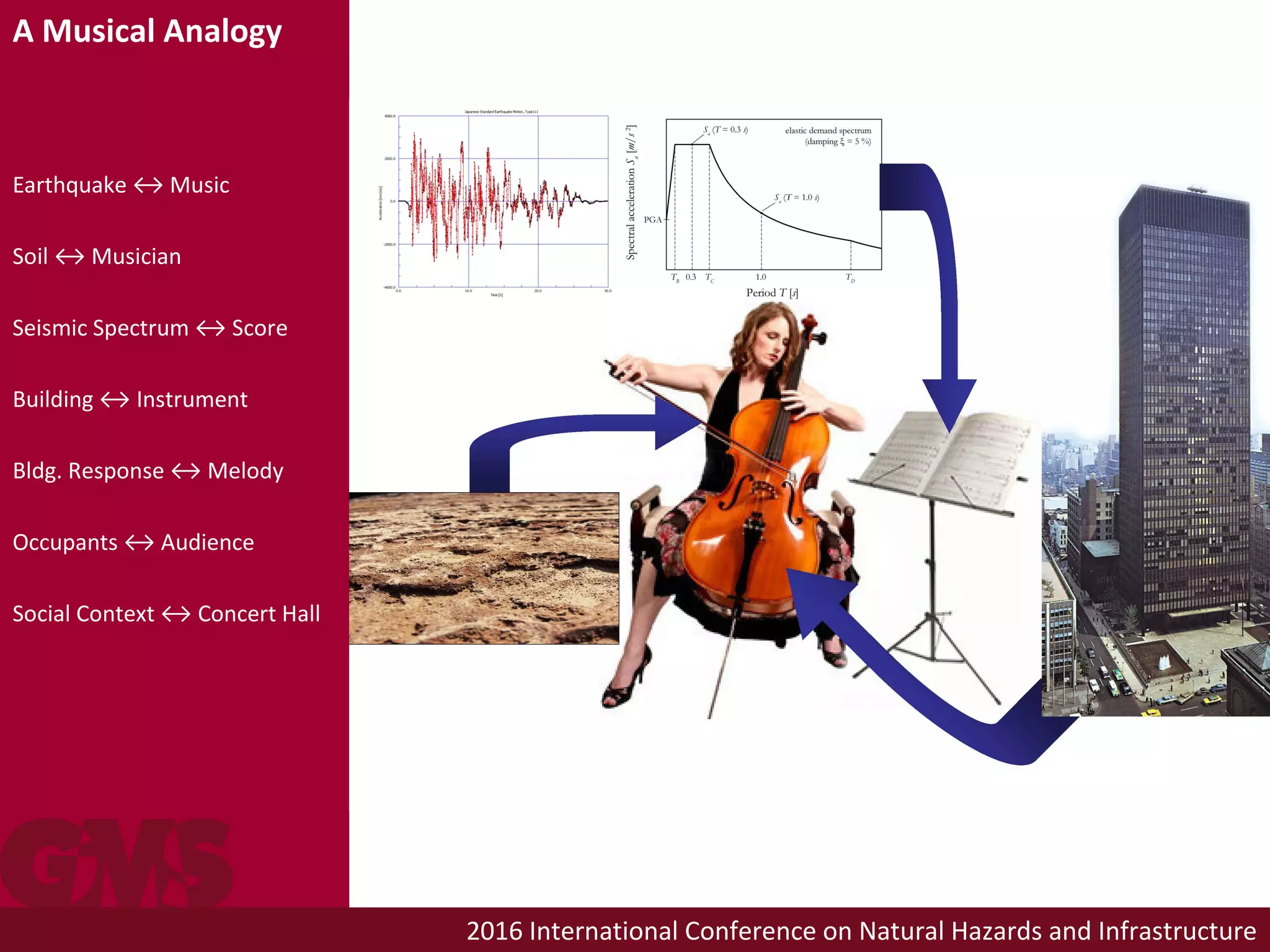
A Musical Analogy
Earthquake ↔ Music
Soil ↔ Musician
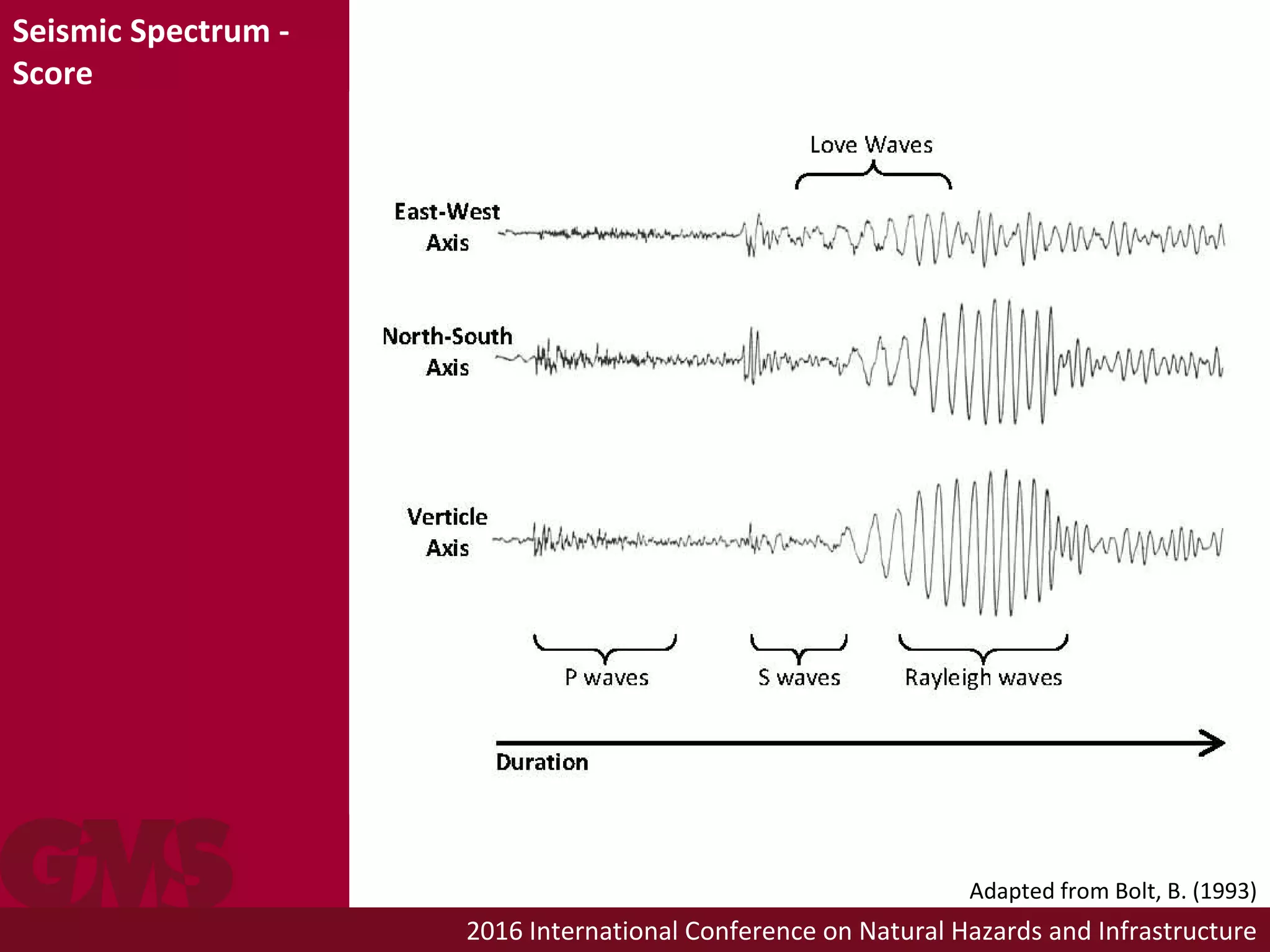
Seismic Spectrum ↔ Score
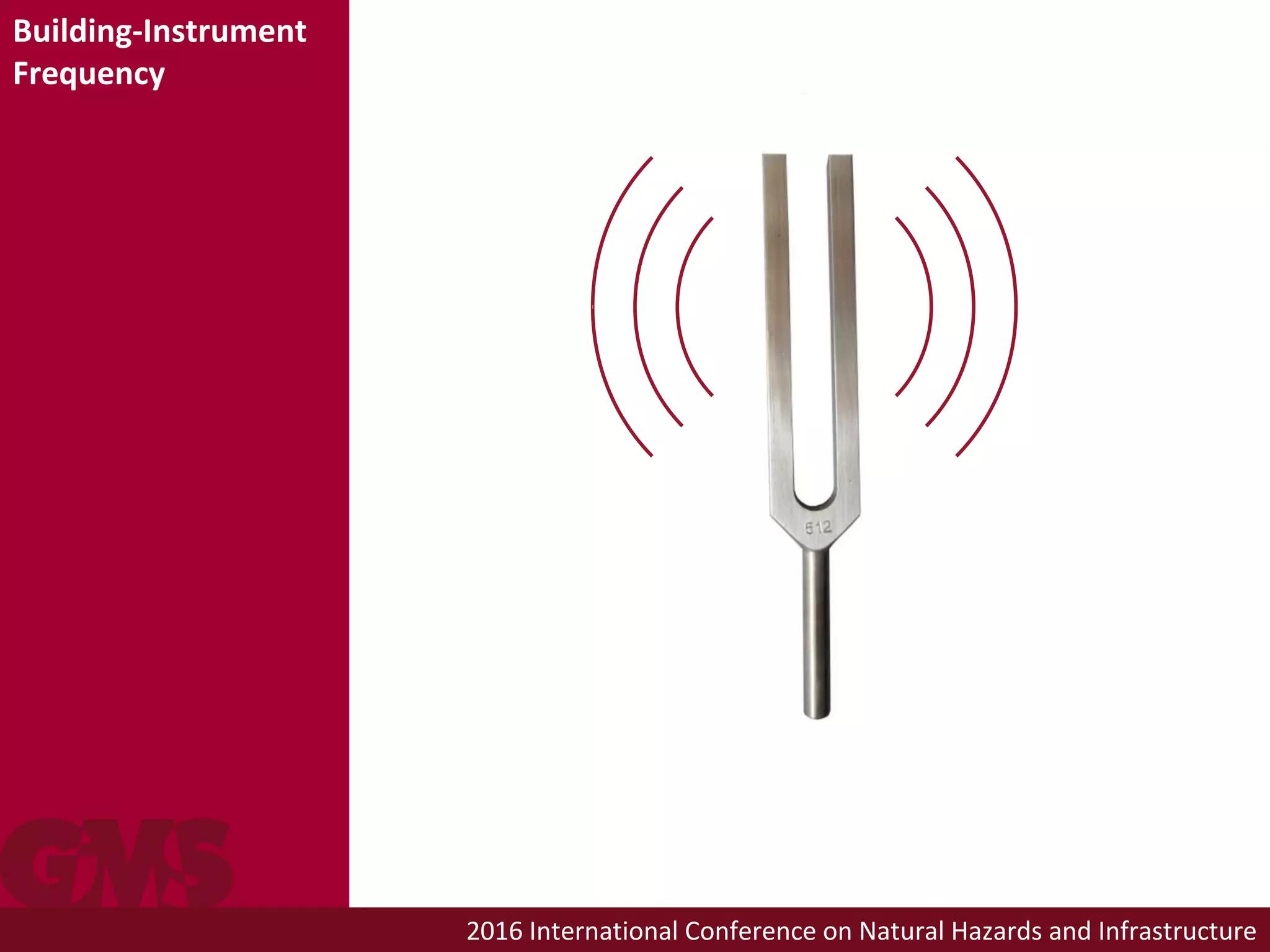
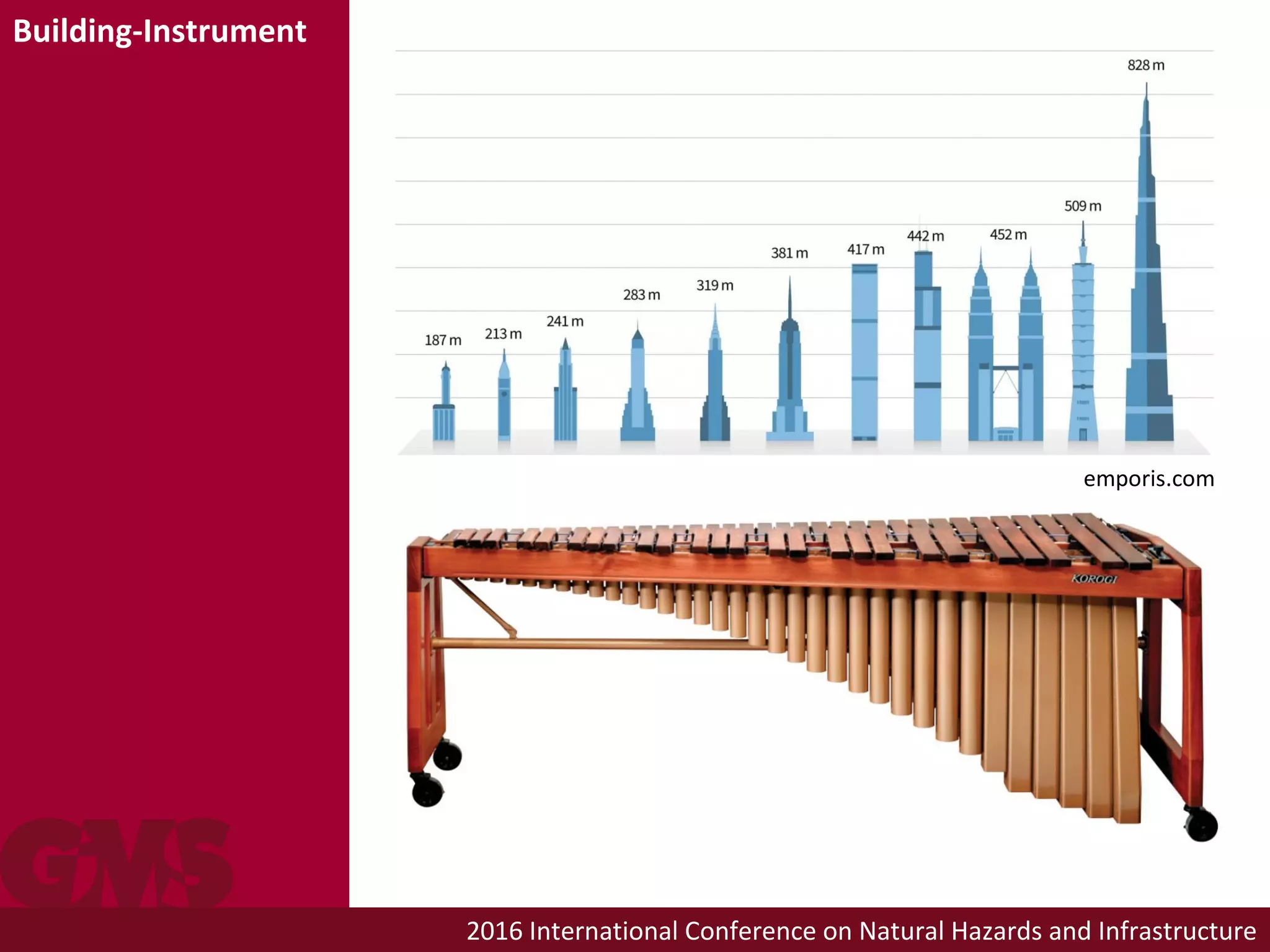
Building ↔ Instrument
Bldg. Response ↔ Melody
Occupants ↔ Audience
Social Context ↔ Concert Hall
2016 International Conference on Natural Hazards and Infrastructure
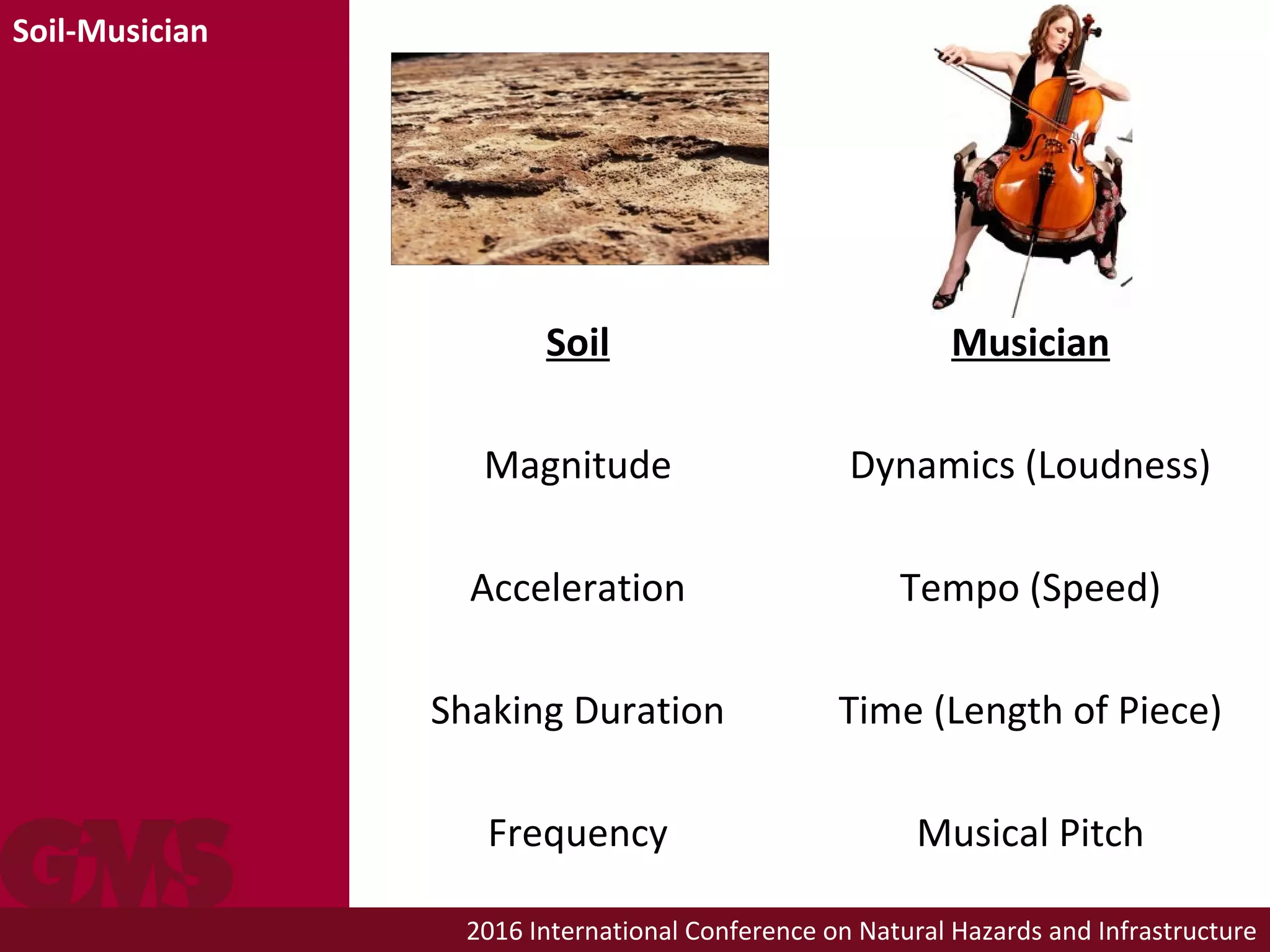
Soil
Magnitude
Acceleration
Shaking Duration
Frequency
Musician
Dynamics (Loudness)
Tempo (Speed)
Time (Length of Piece)
Musical Pitch
Soil-Musician
2016 International Conference on Natural Hazards and Infrastructure
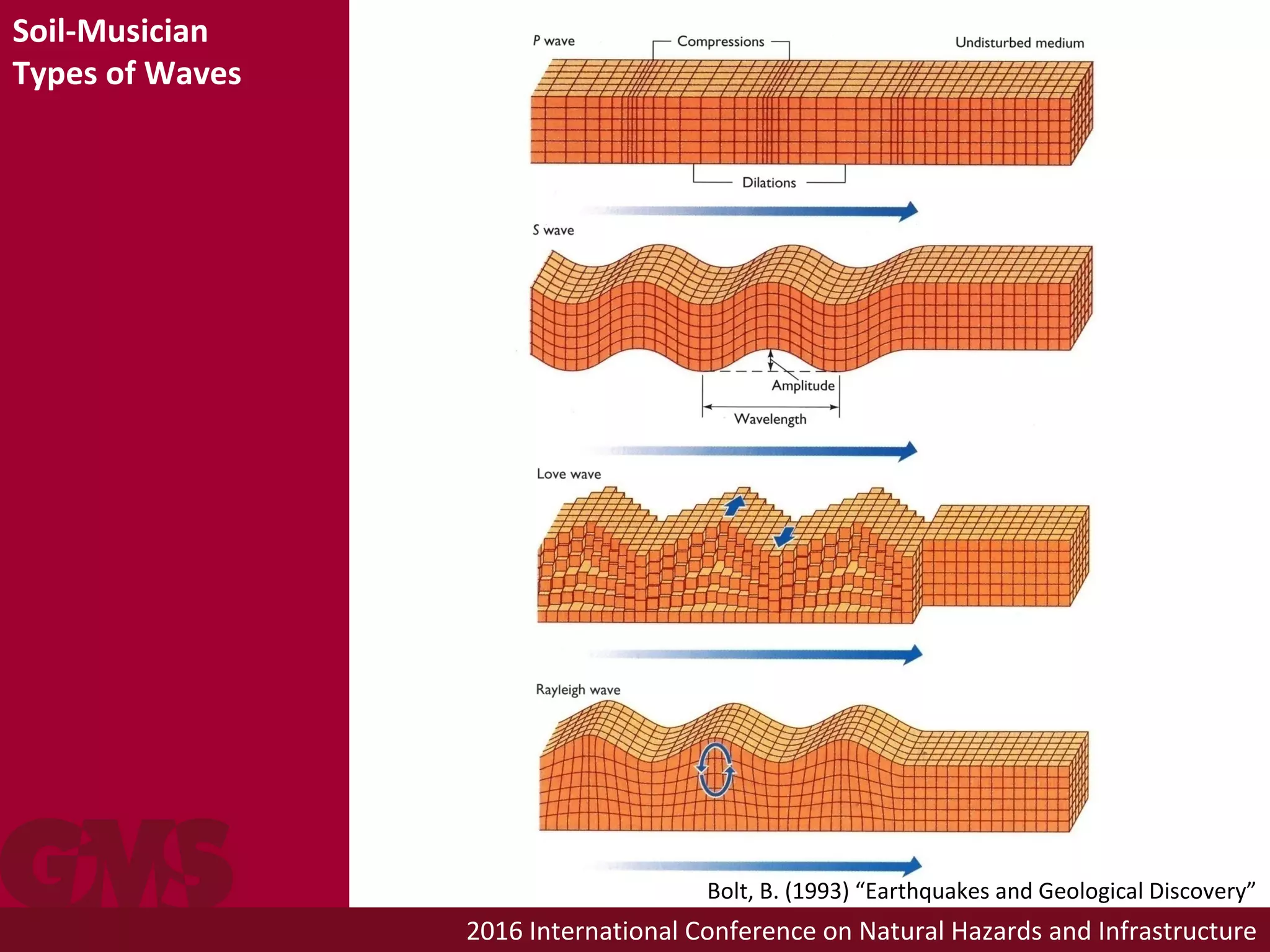
Soil-Musician
Types of Waves
Bolt, B. (1993) “Earthquakes and Geological Discovery”
2016 International Conference on Natural Hazards and Infrastructure
Soil-Musician
Types of Waves
Atkinson Physics (YouTube)
2016 International Conference on Natural Hazards and Infrastructure
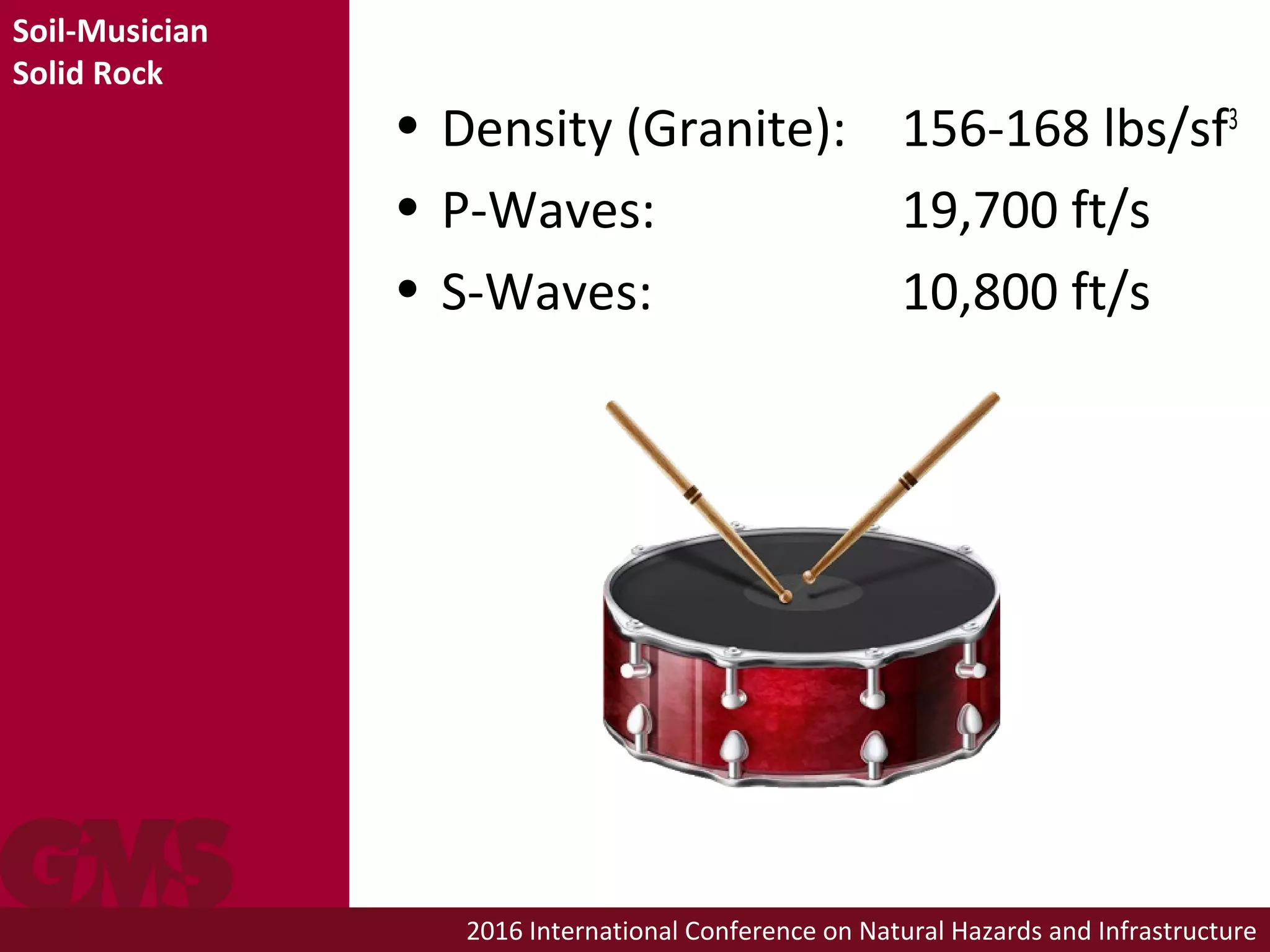
• Density (Granite): 156-168 lbs/sf3
• P-Waves: 19,700 ft/s
• S-Waves: 10,800 ft/s
Soil-Musician
Solid Rock
2016 International Conference on Natural Hazards and Infrastructure
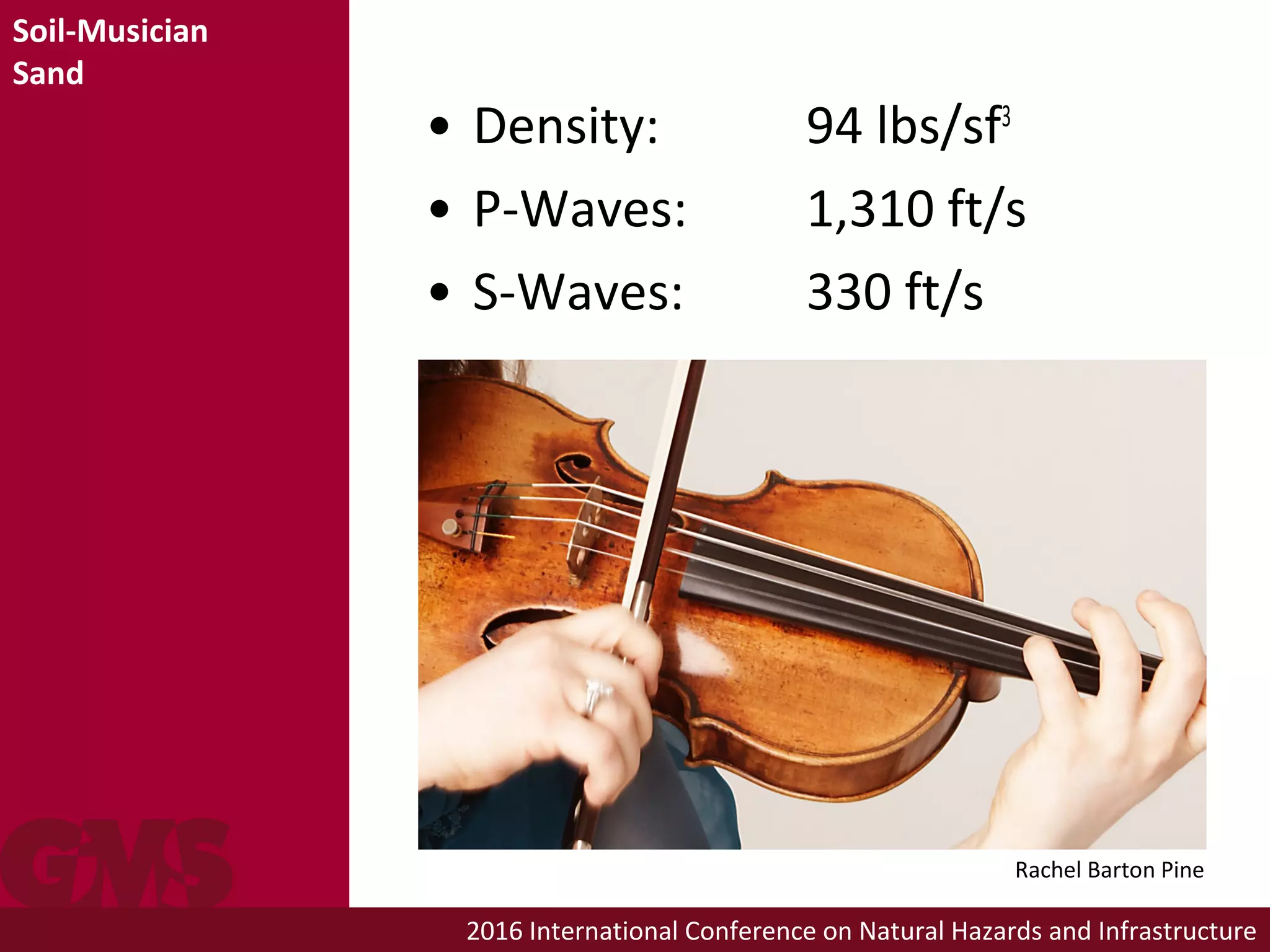
• Density: 94 lbs/sf3
• P-Waves: 1,310 ft/s
• S-Waves: 330 ft/s
Soil-Musician
Sand
Rachel Barton Pine
2016 International Conference on Natural Hazards and Infrastructure
Soil-Musician
esmes.com
2016 International Conference on Natural Hazards and Infrastructure
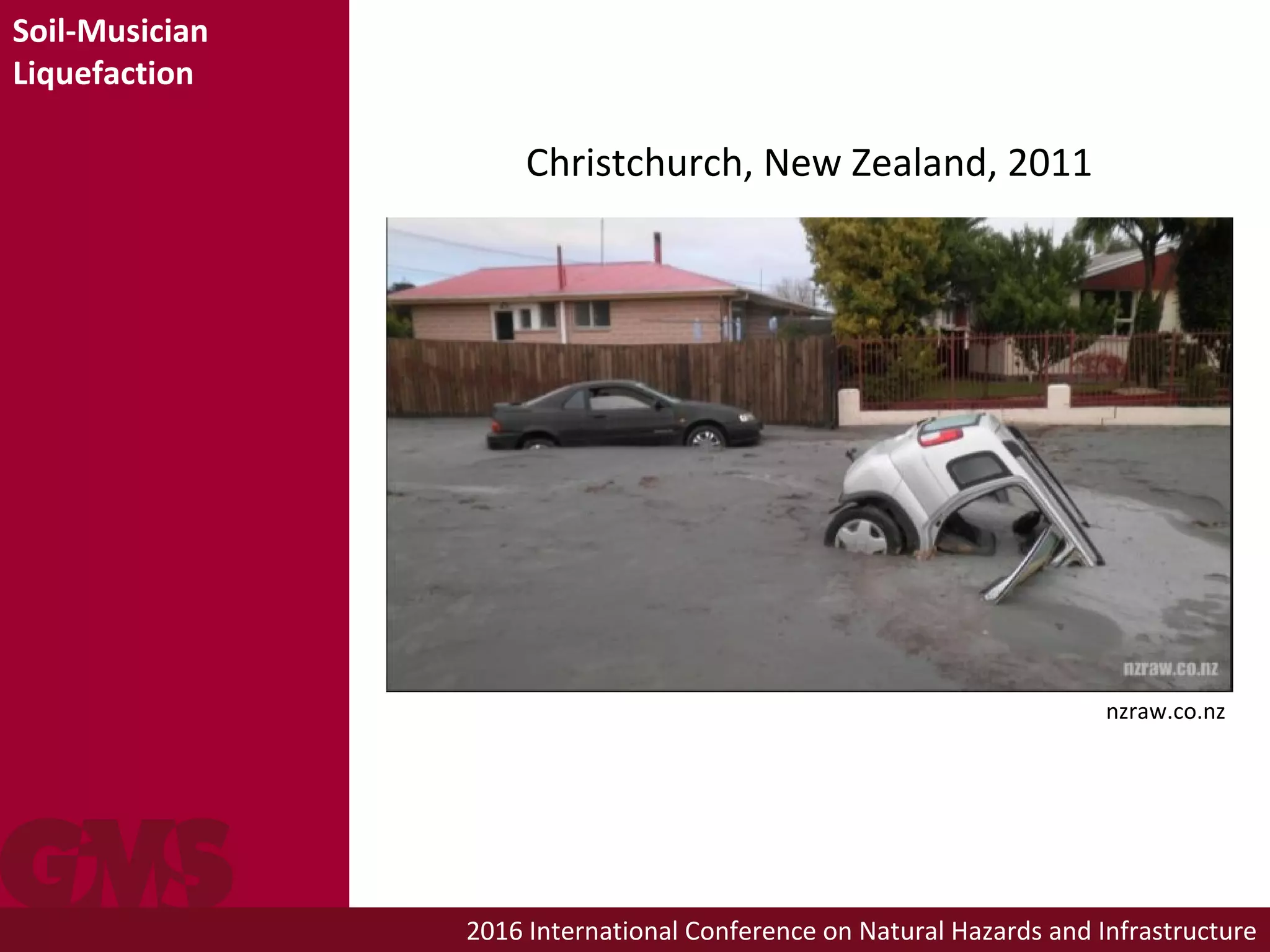
Soil-Musician
Liquefaction
Christchurch, New Zealand, 2011
nzraw.co.nz
2016 International Conference on Natural Hazards and Infrastructure
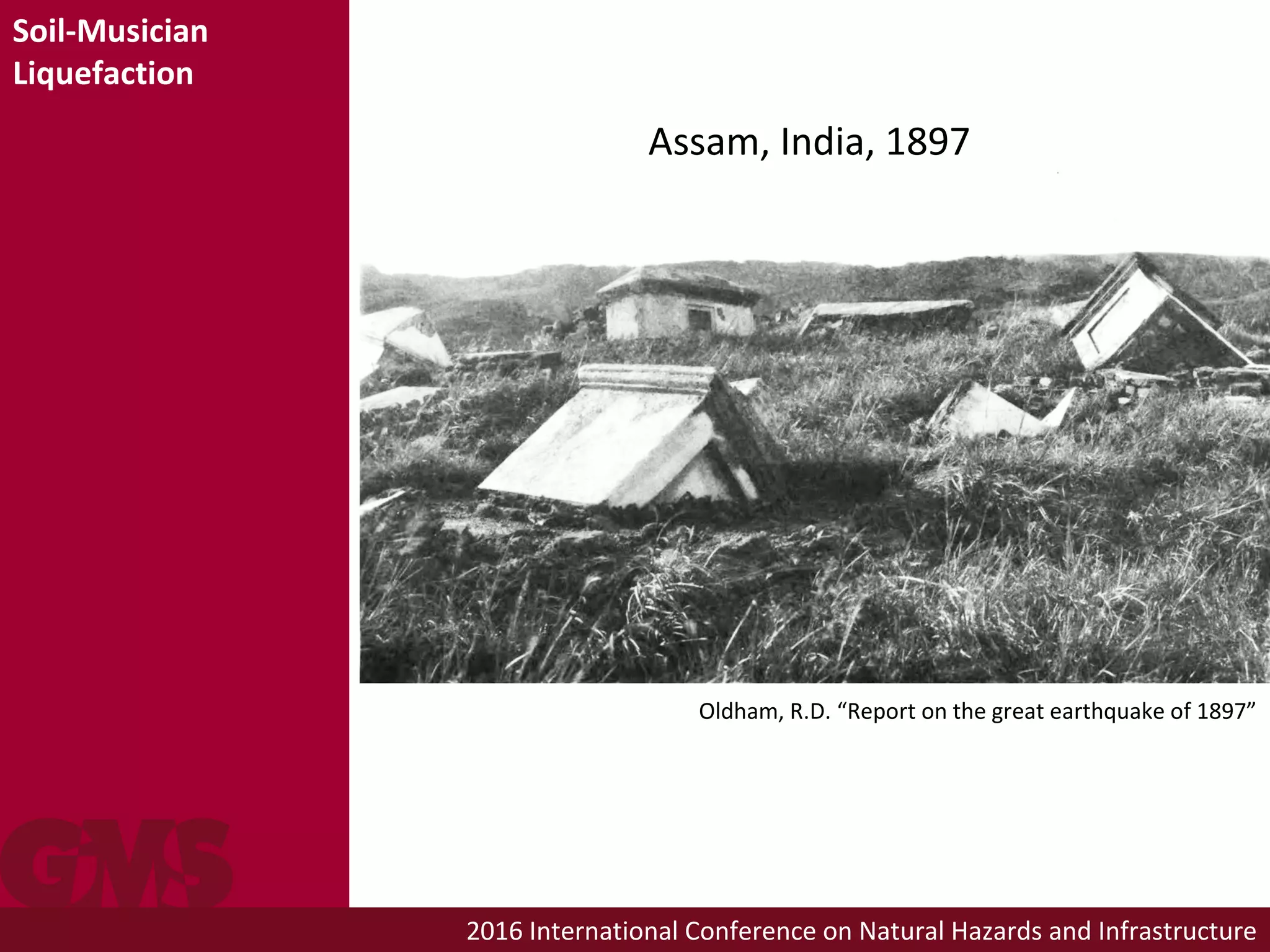
Soil-Musician
Liquefaction
Assam, India, 1897
Oldham, R.D. “Report on the great earthquake of 1897”
2016 International Conference on Natural Hazards and Infrastructure
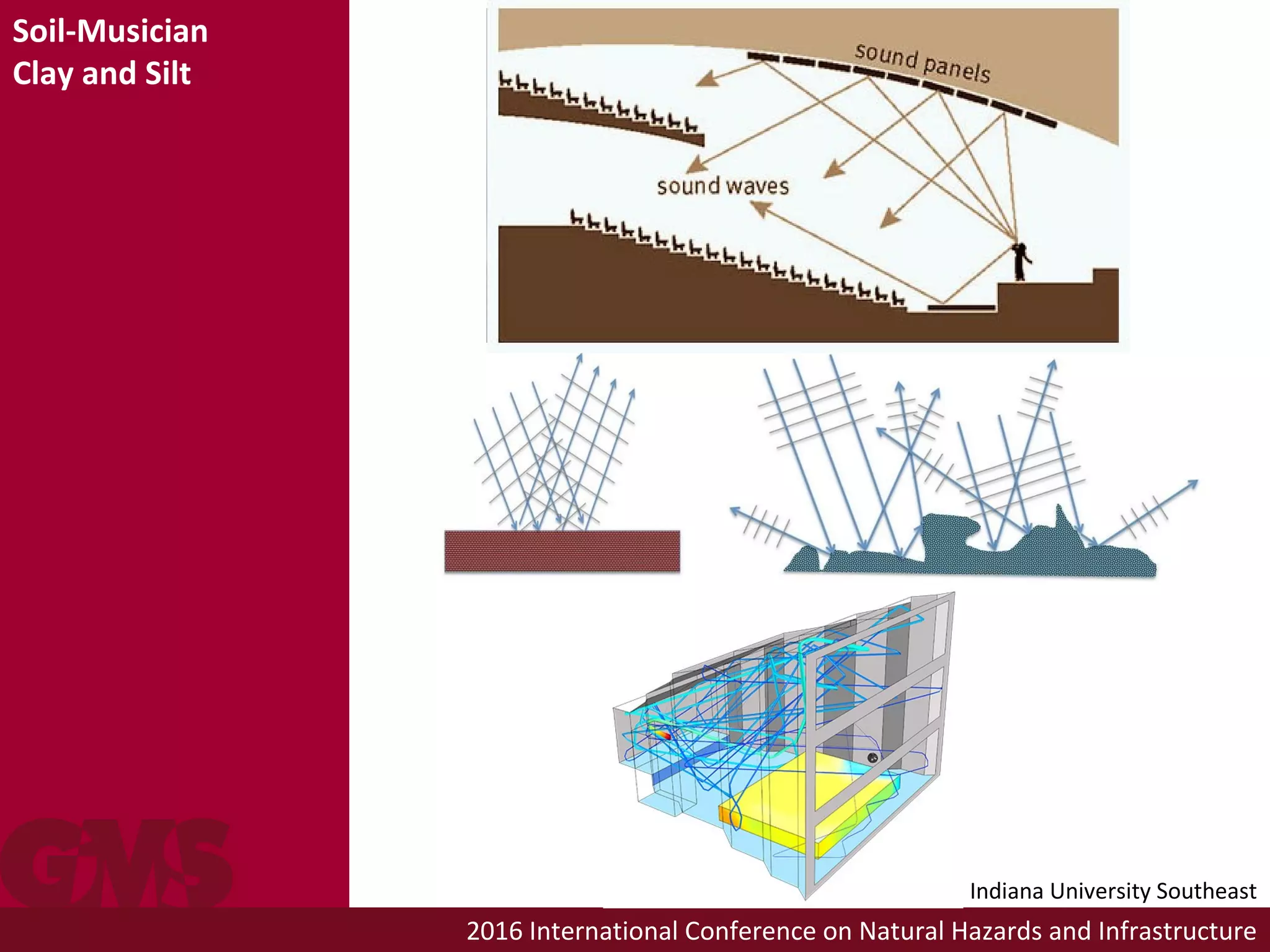
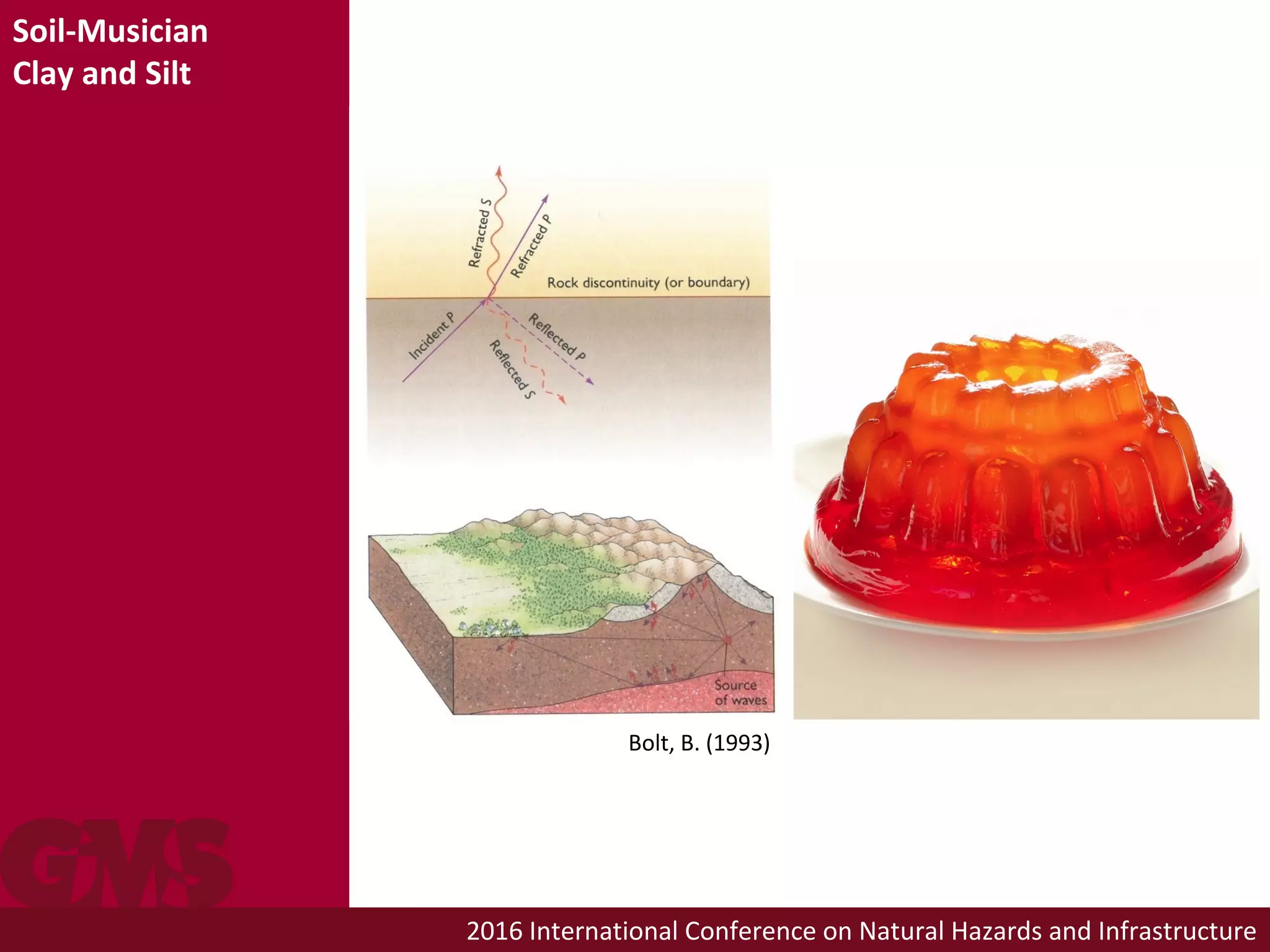
Soil-Musician
Clay and Silt
Indiana University Southeast
2016 International Conference on Natural Hazards and Infrastructure
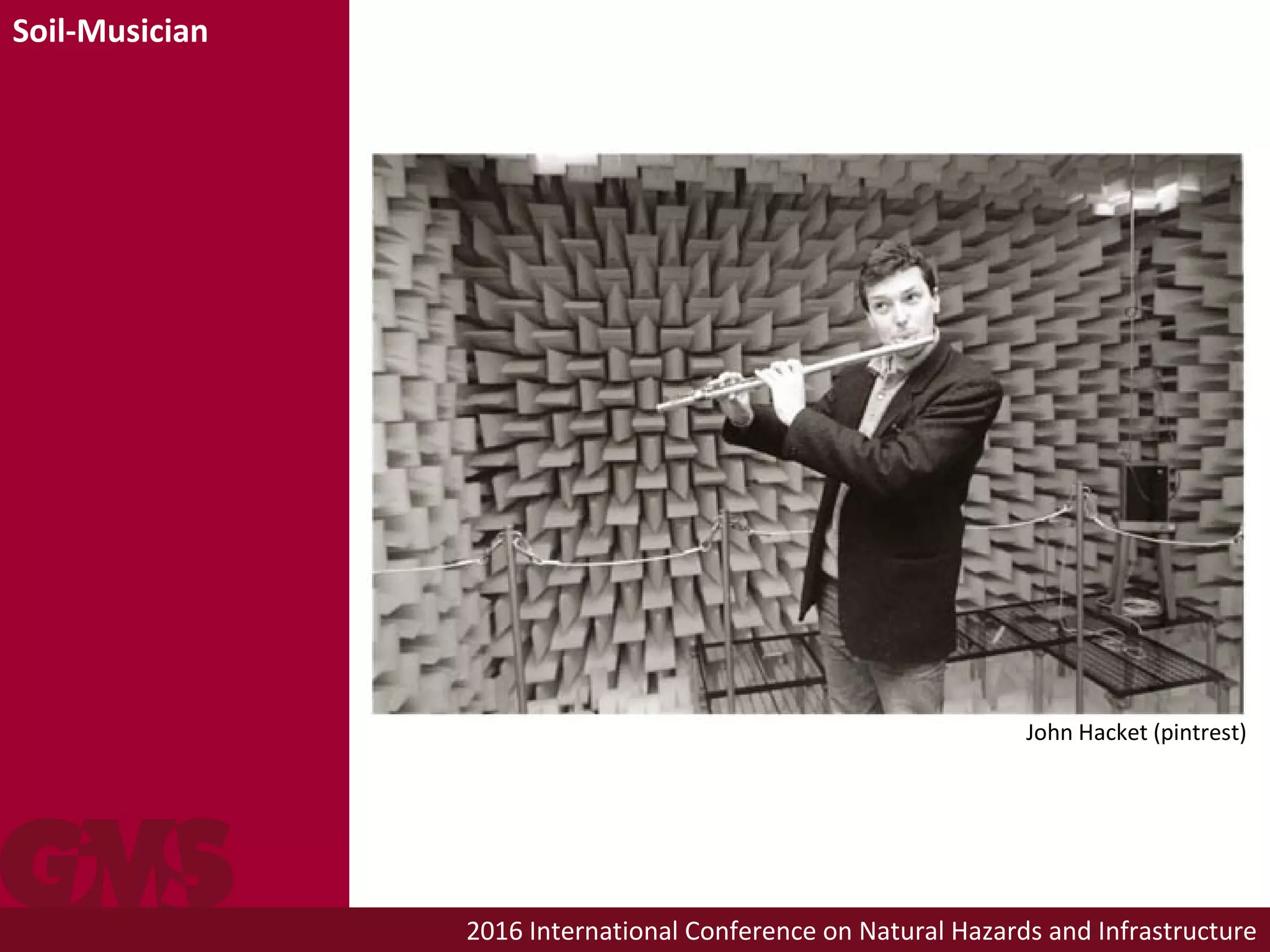
Soil-Musician
John Hacket (pintrest)
2016 International Conference on Natural Hazards and Infrastructure
Soil-Musician
Clay and Silt
Bolt, B. (1993)
2016 International Conference on Natural Hazards and Infrastructure
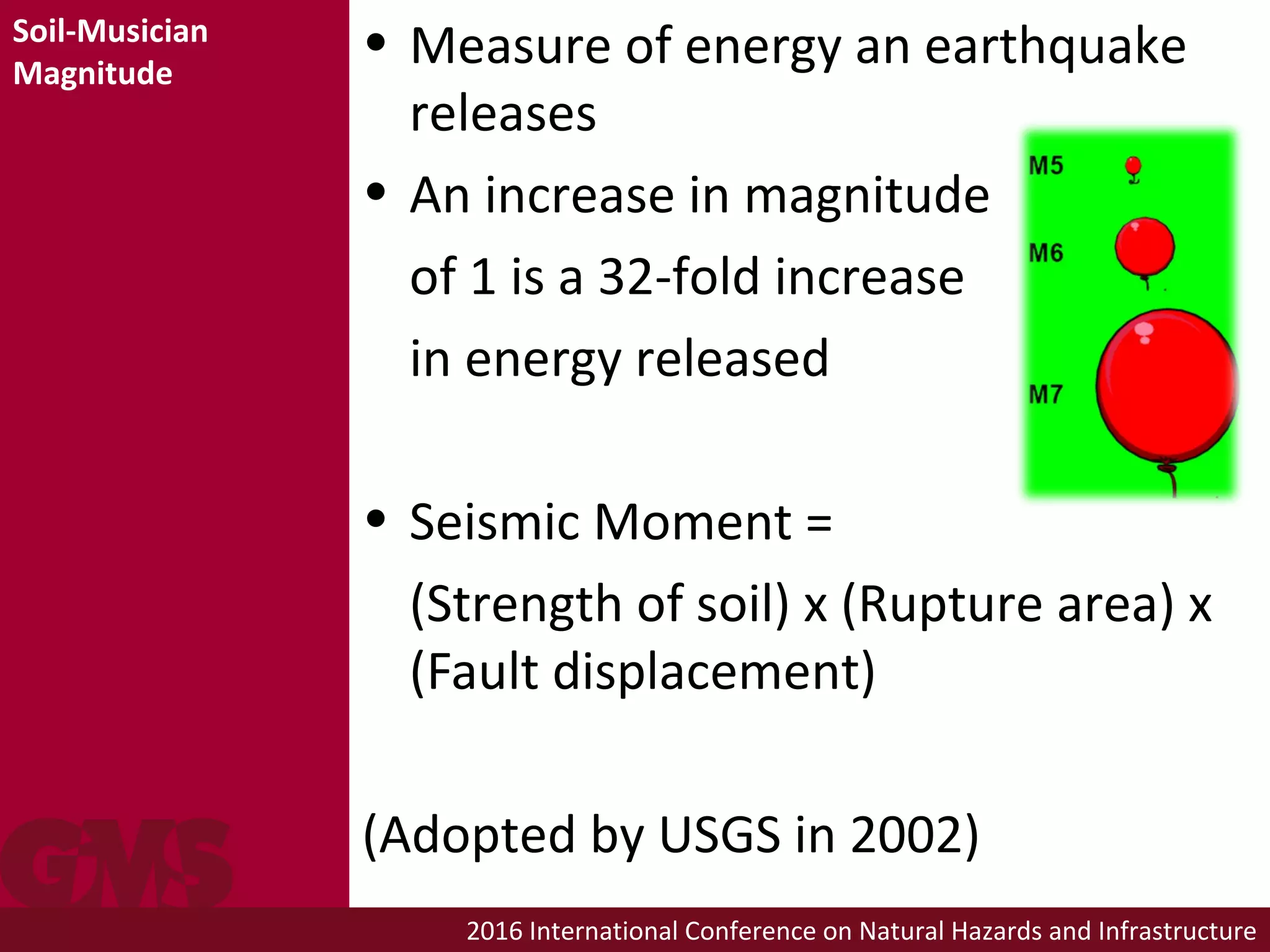
• Measure of energy an earthquake
releases
• An increase in magnitude
of 1 is a 32-fold increase
in energy released
• Seismic Moment =
(Strength of soil) x (Rupture area) x
(Fault displacement)
(Adopted by USGS in 2002)
Soil-Musician
Magnitude
2016 International Conference on Natural Hazards and Infrastructure
• Peak Ground Acceleration (PGA)
– Maximum acceleration experienced by
a particle at ground level
• Peak Floor Acceleration (PFA)
– Maximum acceleration experienced at
a floor level
Soil-Musician
Accelerations
2016 International Conference on Natural Hazards and Infrastructure
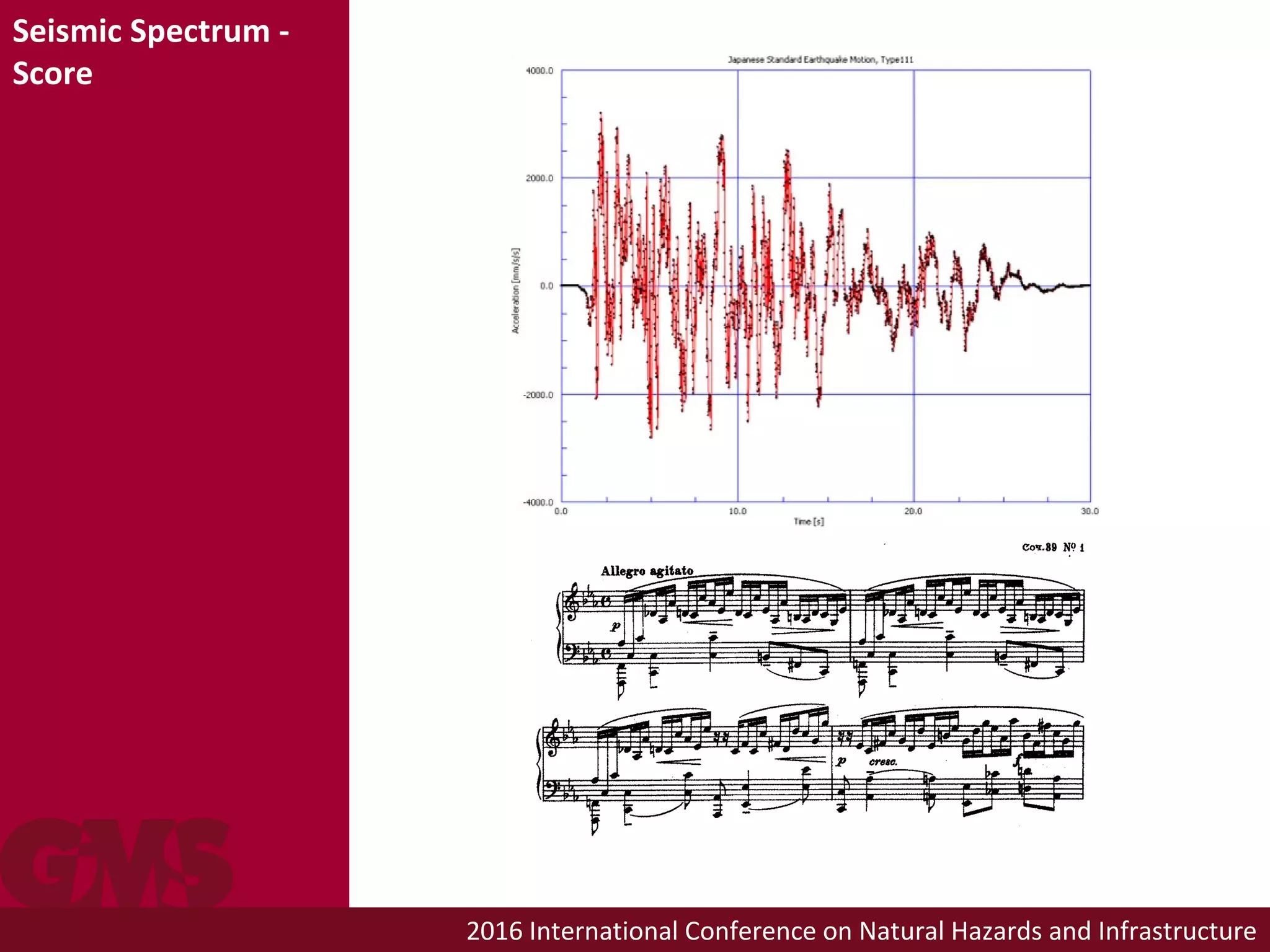
Seismic Spectrum -
Score
2016 International Conference on Natural Hazards and Infrastructure
Seismic Spectrum -
Score
Adapted from Bolt, B. (1993)
2016 International Conference on Natural Hazards and Infrastructure
Building-Instrument
Frequency
2016 International Conference on Natural Hazards and Infrastructure
Building-Instrument
emporis.com
2016 International Conference on Natural Hazards and Infrastructure
Building-Instrument
Resonance
Missouri S&T, Prof. O. Kwon (YouTube)
2016 International Conference on Natural Hazards and Infrastructure
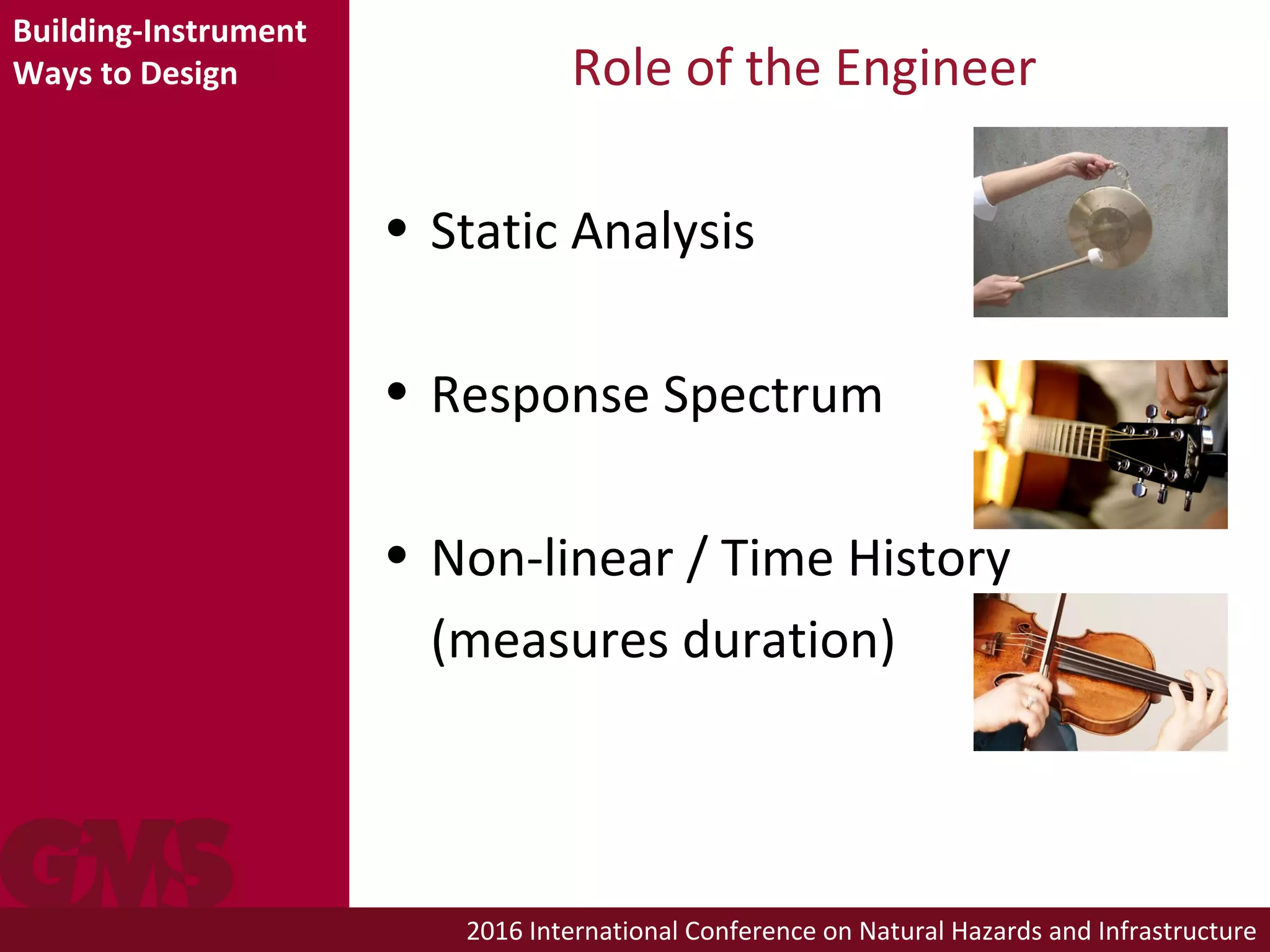
Role of the Engineer
• Static Analysis
• Response Spectrum
• Non-linear / Time History
(measures duration)
Building-Instrument
Ways to Design
2016 International Conference on Natural Hazards and Infrastructure
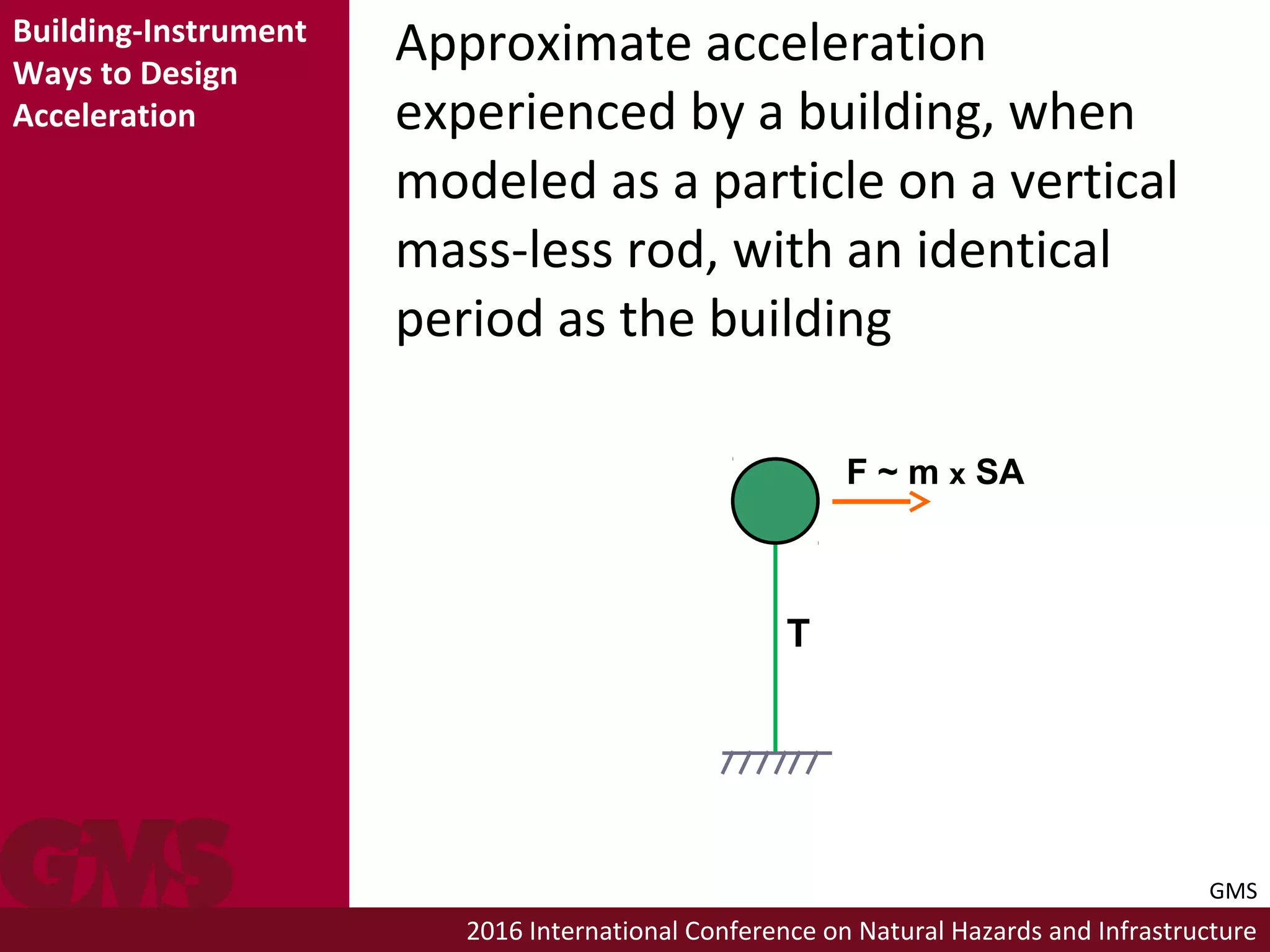
Approximate acceleration
experienced by a building, when
modeled as a particle on a vertical
mass-less rod, with an identical
period as the building
Building-Instrument
Ways to Design
Acceleration
T
F ~ m x SA
GMS
2016 International Conference on Natural Hazards and Infrastructure
Building-Instrument
Ways to Design
Acceleration
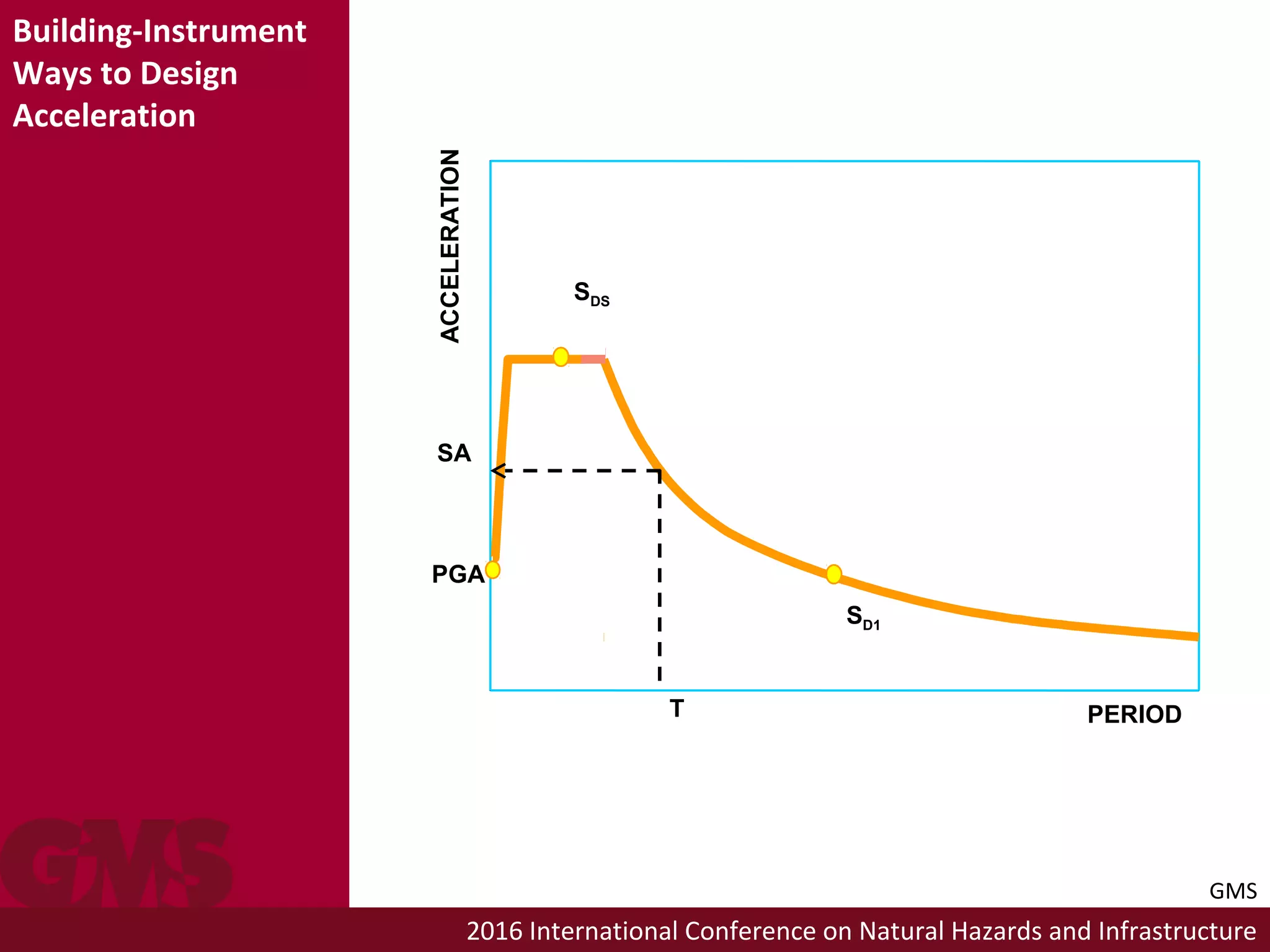
PERIOD
SA
T
ACCELERATION
SDS
SD1
PGA
GMS
2016 International Conference on Natural Hazards and Infrastructure
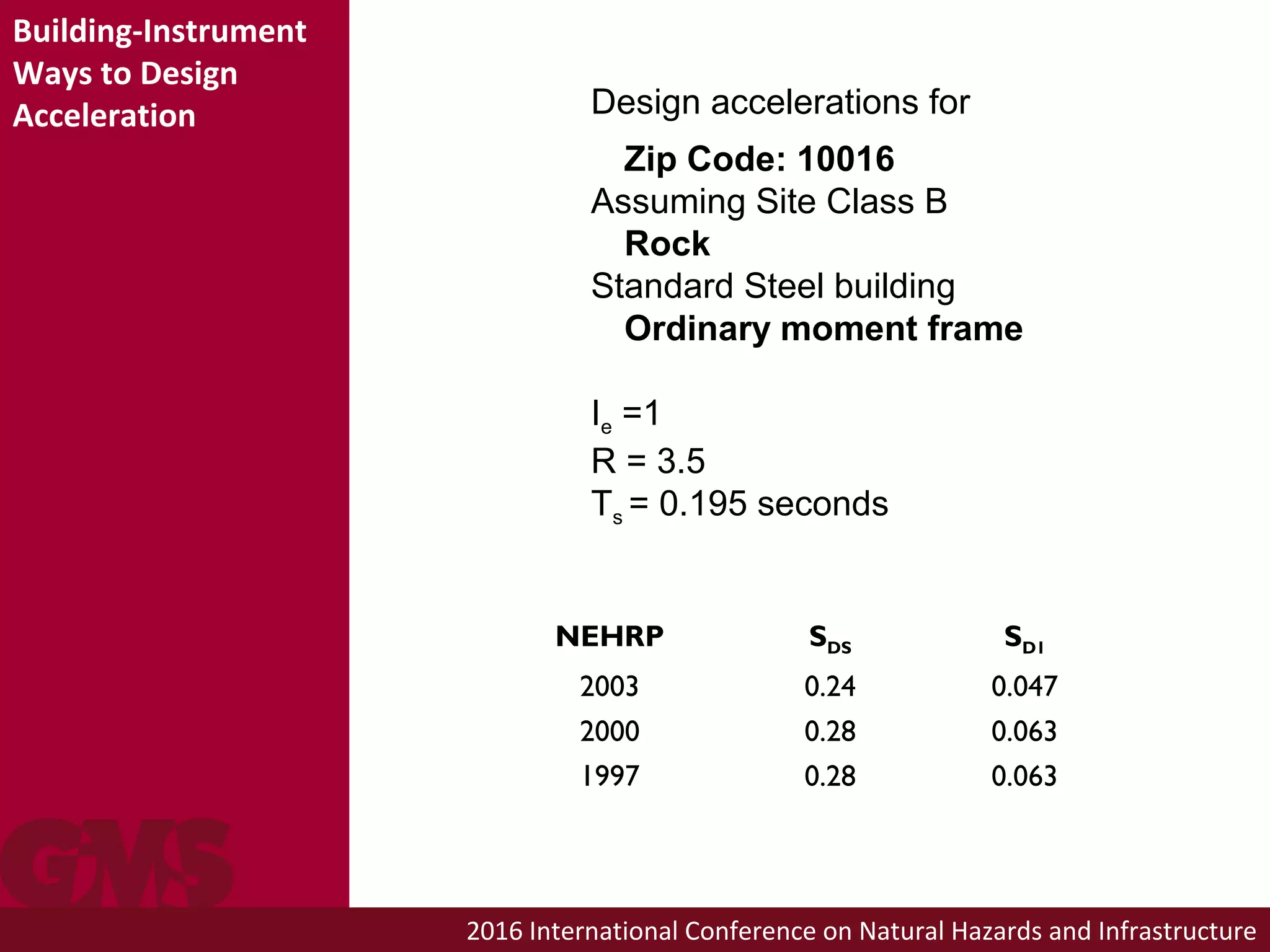
NEHRP SDS SD1
2003 0.24 0.047
2000 0.28 0.063
1997 0.28 0.063
Design accelerations for
Zip Code: 10016
Assuming Site Class B
Rock
Standard Steel building
Ordinary moment frame
Ie =1
R = 3.5
Ts = 0.195 seconds
Building-Instrument
Ways to Design
Acceleration
2016 International Conference on Natural Hazards and Infrastructure
• Approach: Redundant shear wall
construction
• Goal: Immediate occupancy
• Downside: High non-structural
damage, architectural constraints
Building-Instrument
Design Approach:
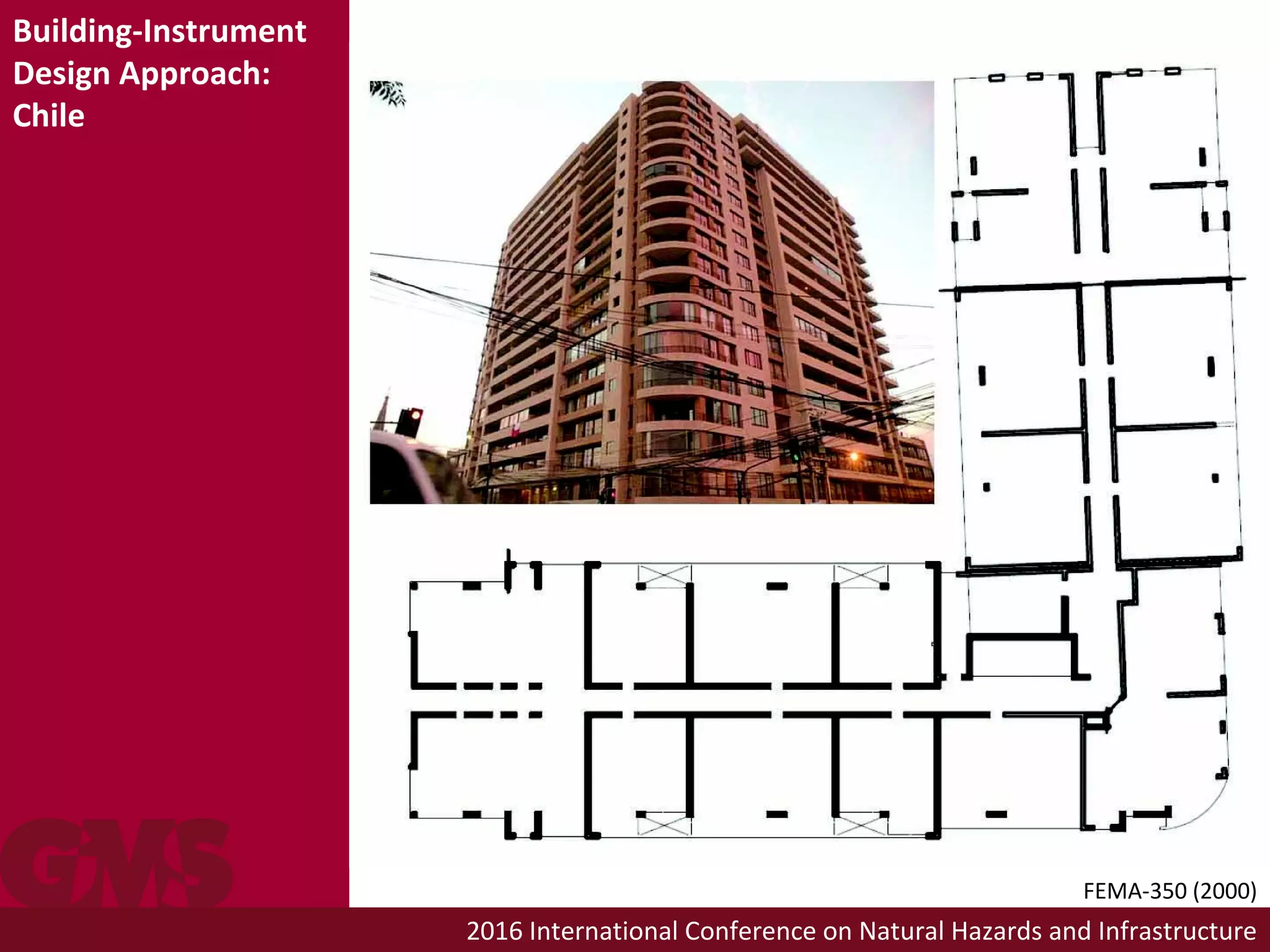
Chile
2016 International Conference on Natural Hazards and Infrastructure
Building-Instrument
Design Approach:
Chile
FEMA-350 (2000)
2016 International Conference on Natural Hazards and Infrastructure
Building-Instrument
Design Approach:
Japan
• Approach: Base isolation
• Goal: Immediate occupancy
& minimal damage
• Downside: High cost
2016 International Conference on Natural Hazards and Infrastructure
Building-Instrument
Design Approach:
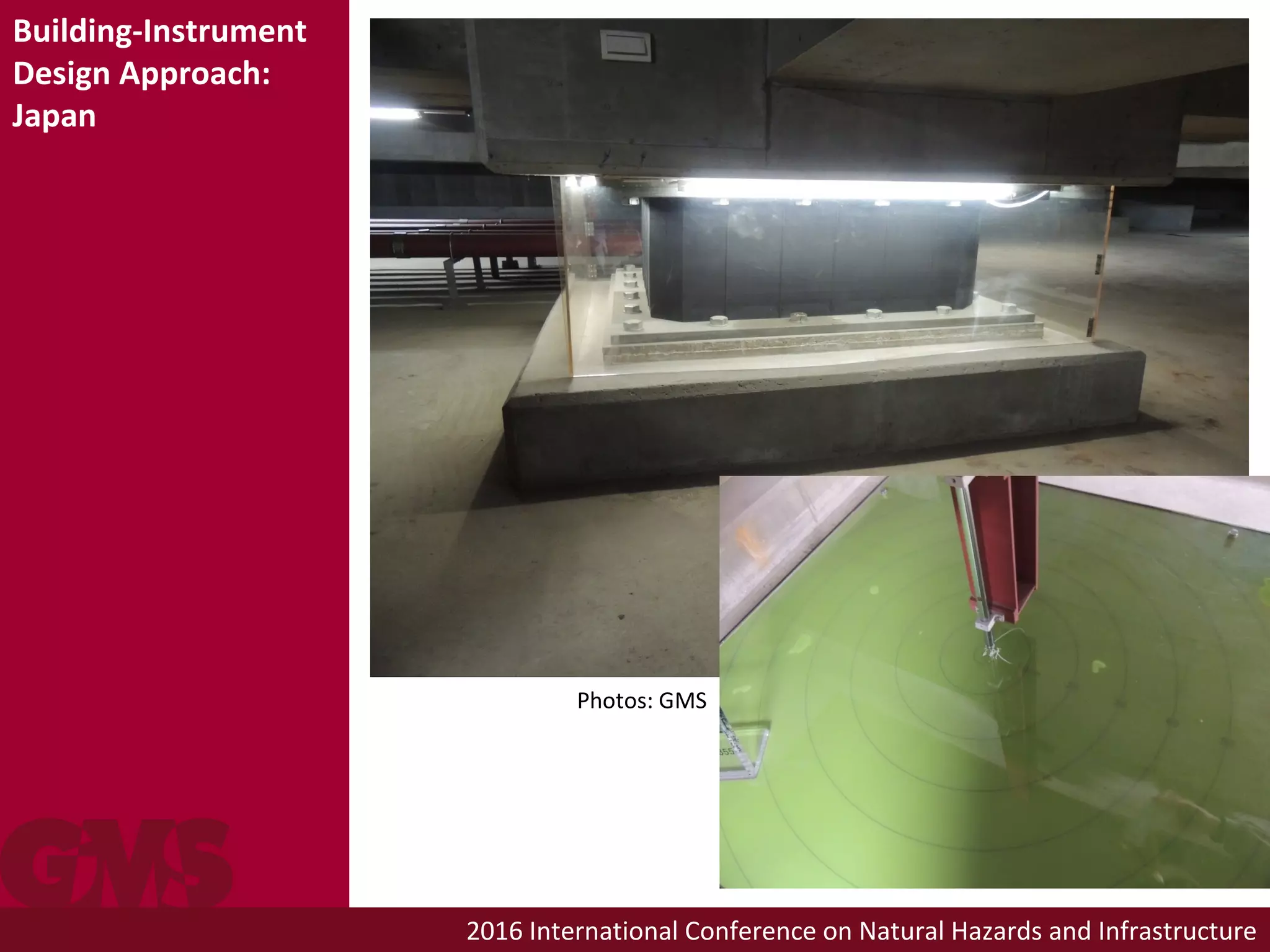
Japan
Photos: GMS
2016 International Conference on Natural Hazards and Infrastructure
Building-Instrument
Design Approach:
Japan
Shimizu Corporation
2016 International Conference on Natural Hazards and Infrastructure
Building-Instrument
Design Approach:
United States
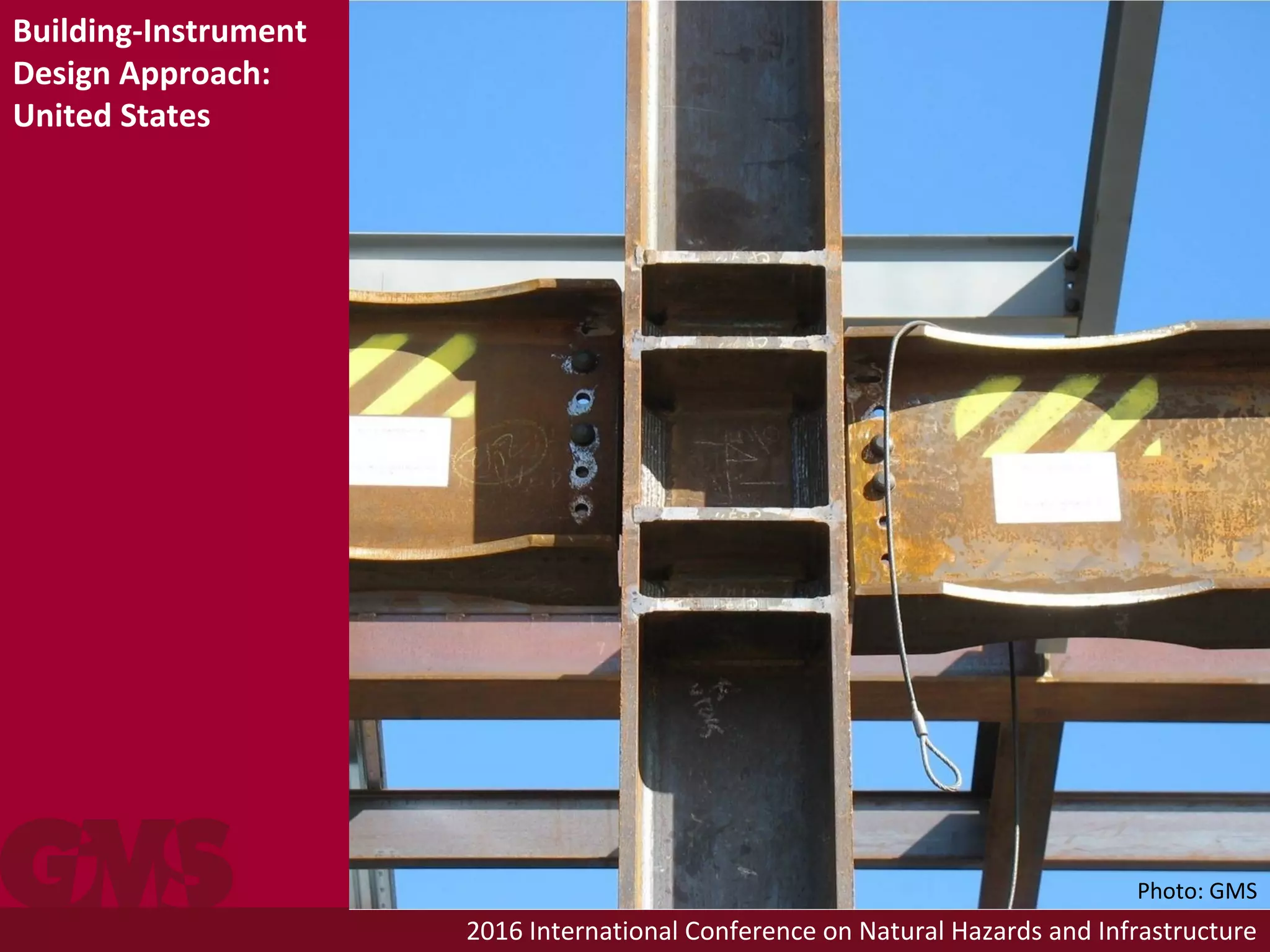
• Approach: Energy dissipation
through plastic deformations
of the structure
• Goal: Cost effective life safety
• Downside: Significant damage
to building
2016 International Conference on Natural Hazards and Infrastructure
Building-Instrument
Design Approach:
United States
Photo: GMS
2016 International Conference on Natural Hazards and Infrastructure
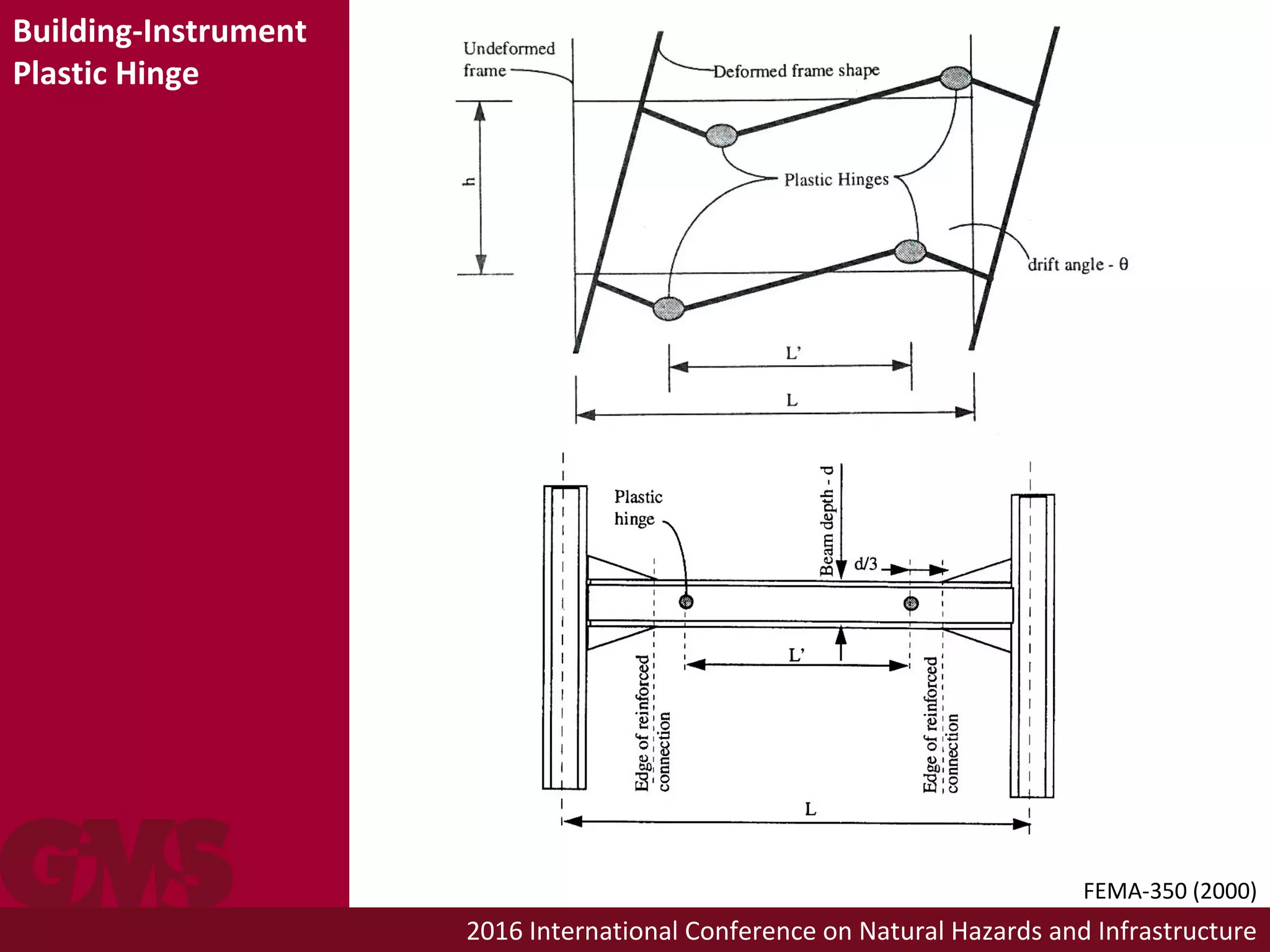
Building-Instrument
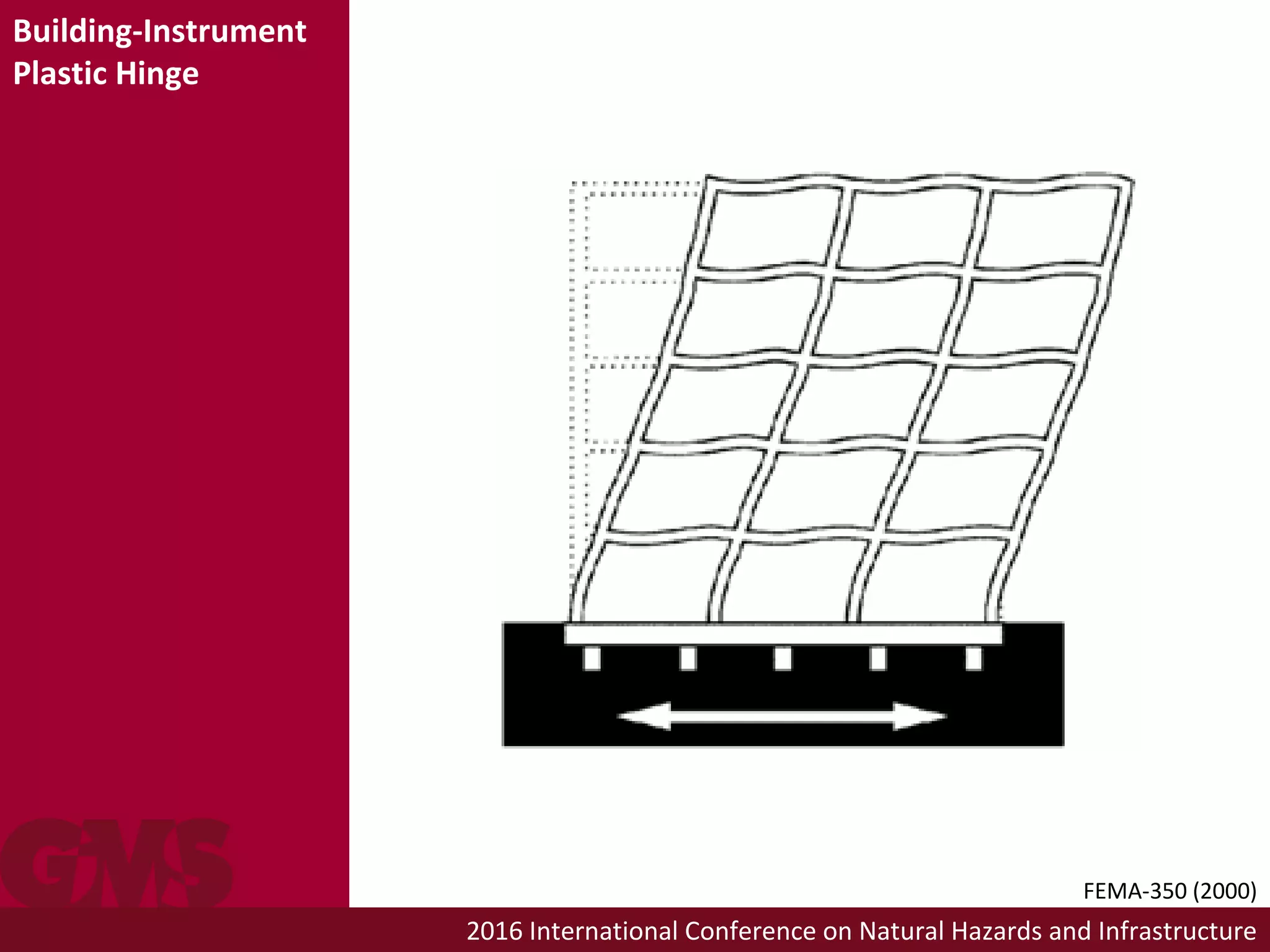
Plastic Hinge
FEMA-350 (2000)
2016 International Conference on Natural Hazards and Infrastructure
Building-Instrument
Plastic Hinge
FEMA-350 (2000)
2016 International Conference on Natural Hazards and Infrastructure
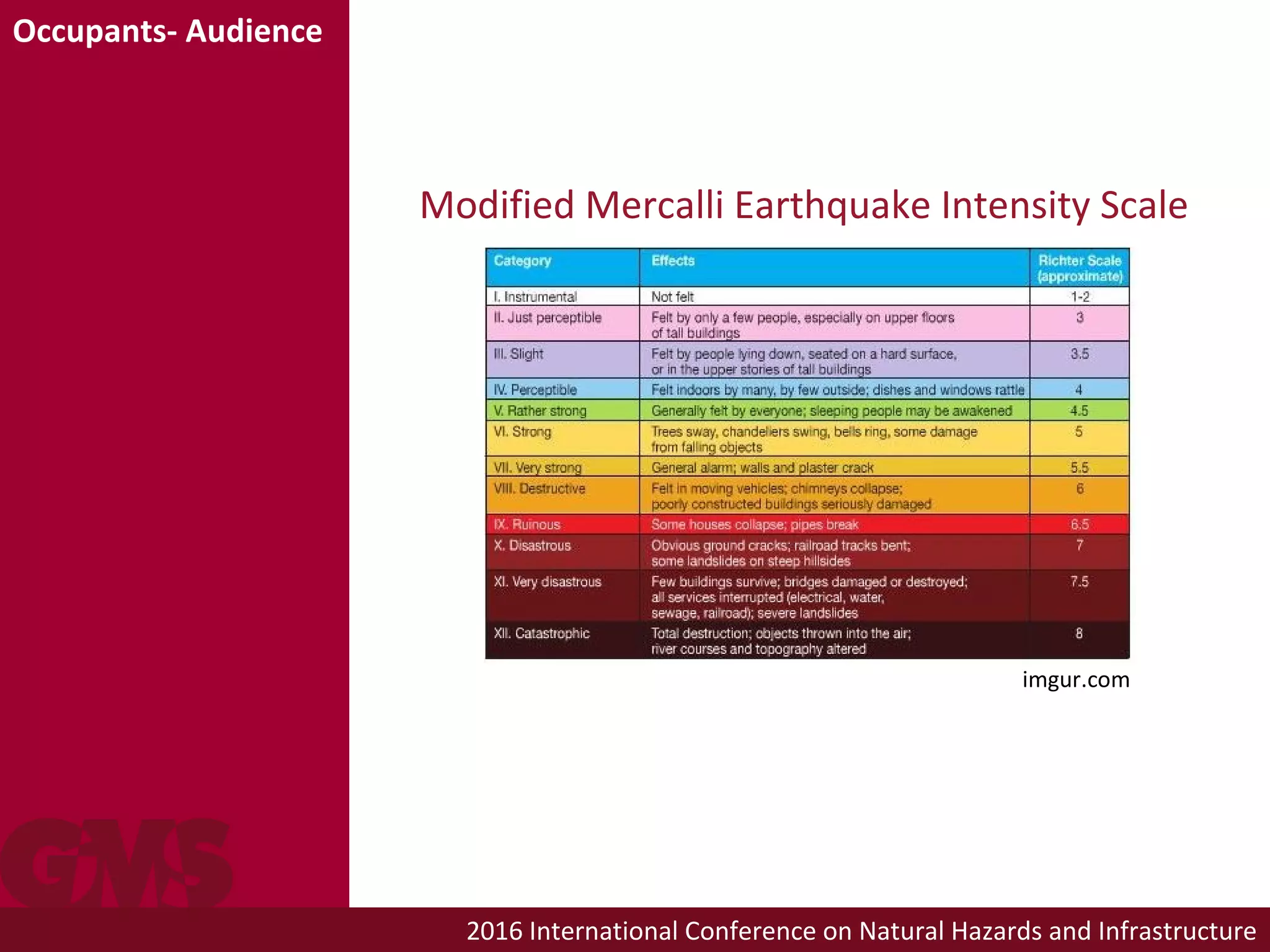
Occupants- Audience
Modified Mercalli Earthquake Intensity Scale
imgur.com
2016 International Conference on Natural Hazards and Infrastructure
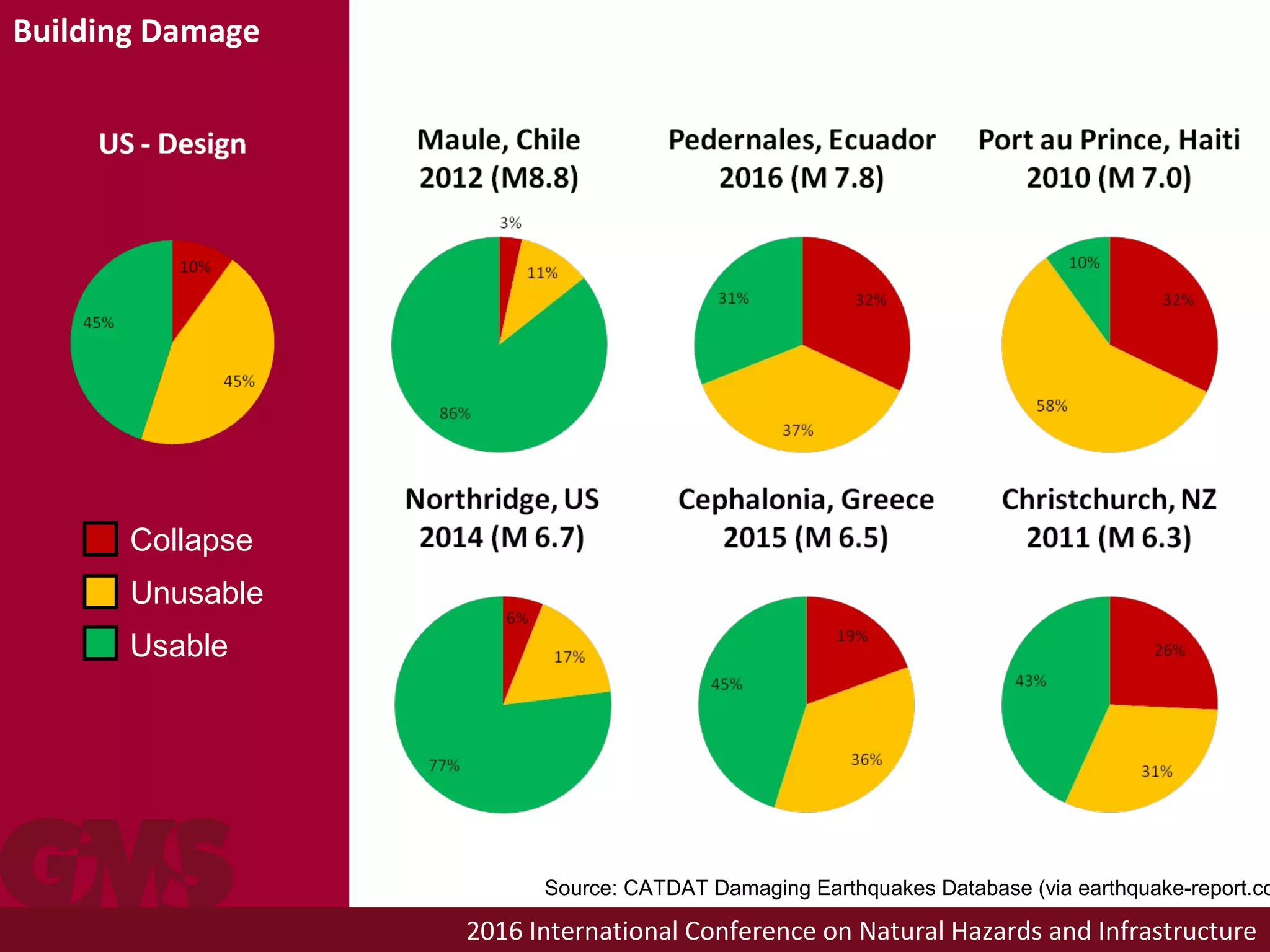
Collapse
Unusable
Usable
Source: CATDAT Damaging Earthquakes Database (via earthquake-report.co
Building Damage
2016 International Conference on Natural Hazards and Infrastructure
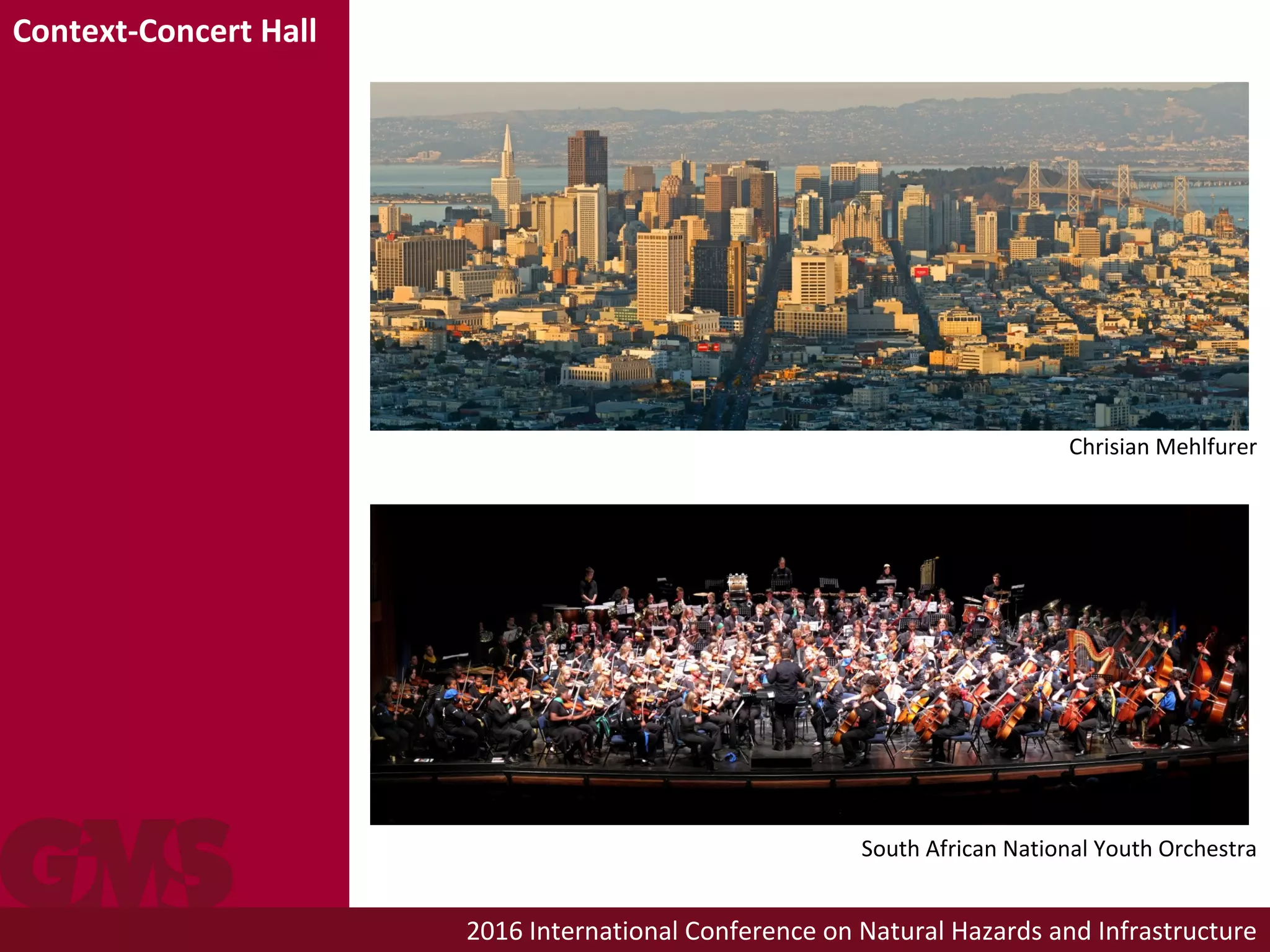
Context-Concert Hall
South African National Youth Orchestra
Chrisian Mehlfurer
2016 International Conference on Natural Hazards and Infrastructure
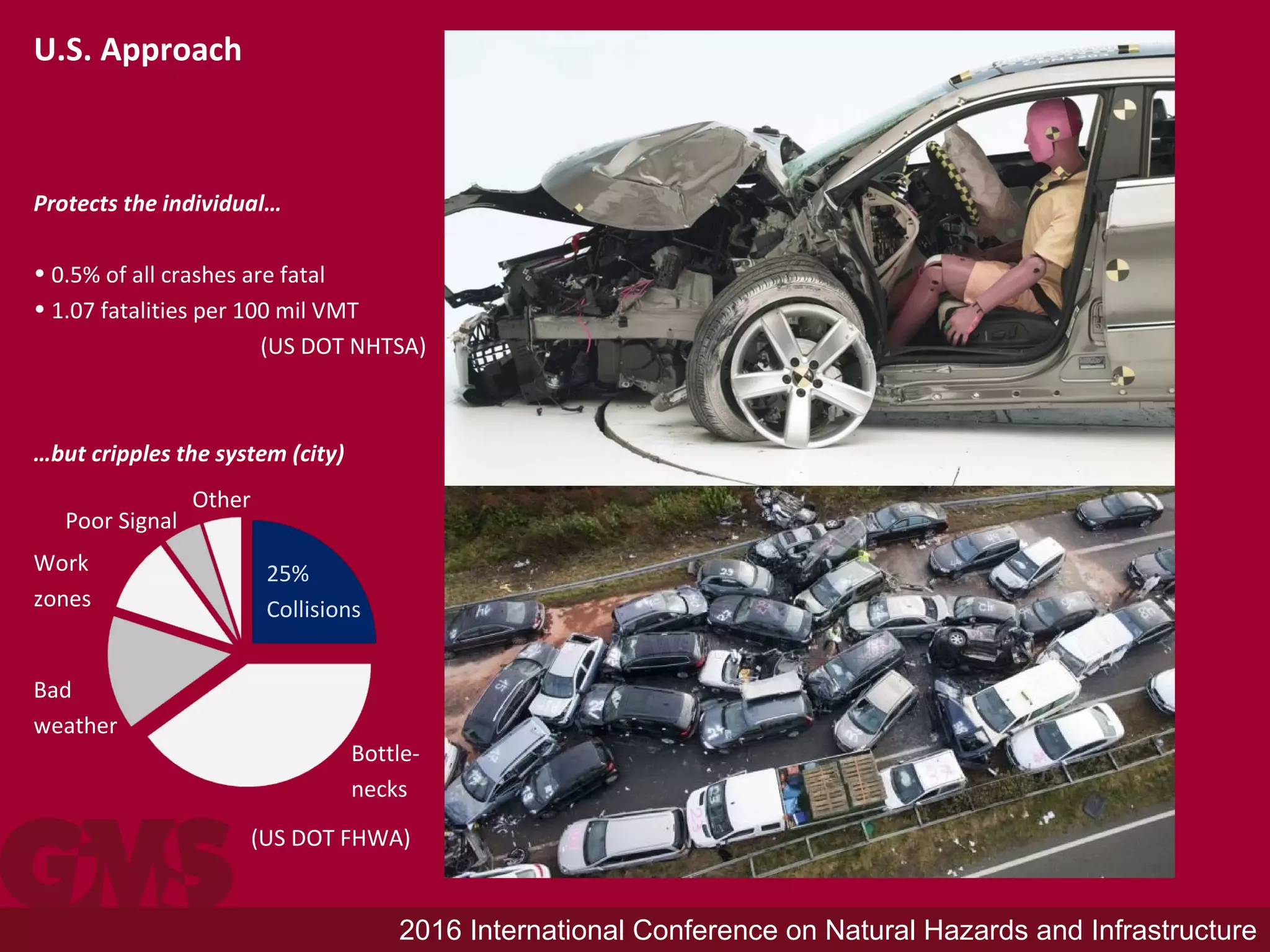
U.S. Approach
Protects the individual…
• 0.5% of all crashes are fatal
• 1.07 fatalities per 100 mil VMT
(US DOT NHTSA)
…but cripples the system (city)
(US DOT FHWA)
Bottle-
necks
25%
Collisions
Bad
weather
Work
zones
Poor Signal
Other
2016 International Conference on Natural Hazards and Infrastructure
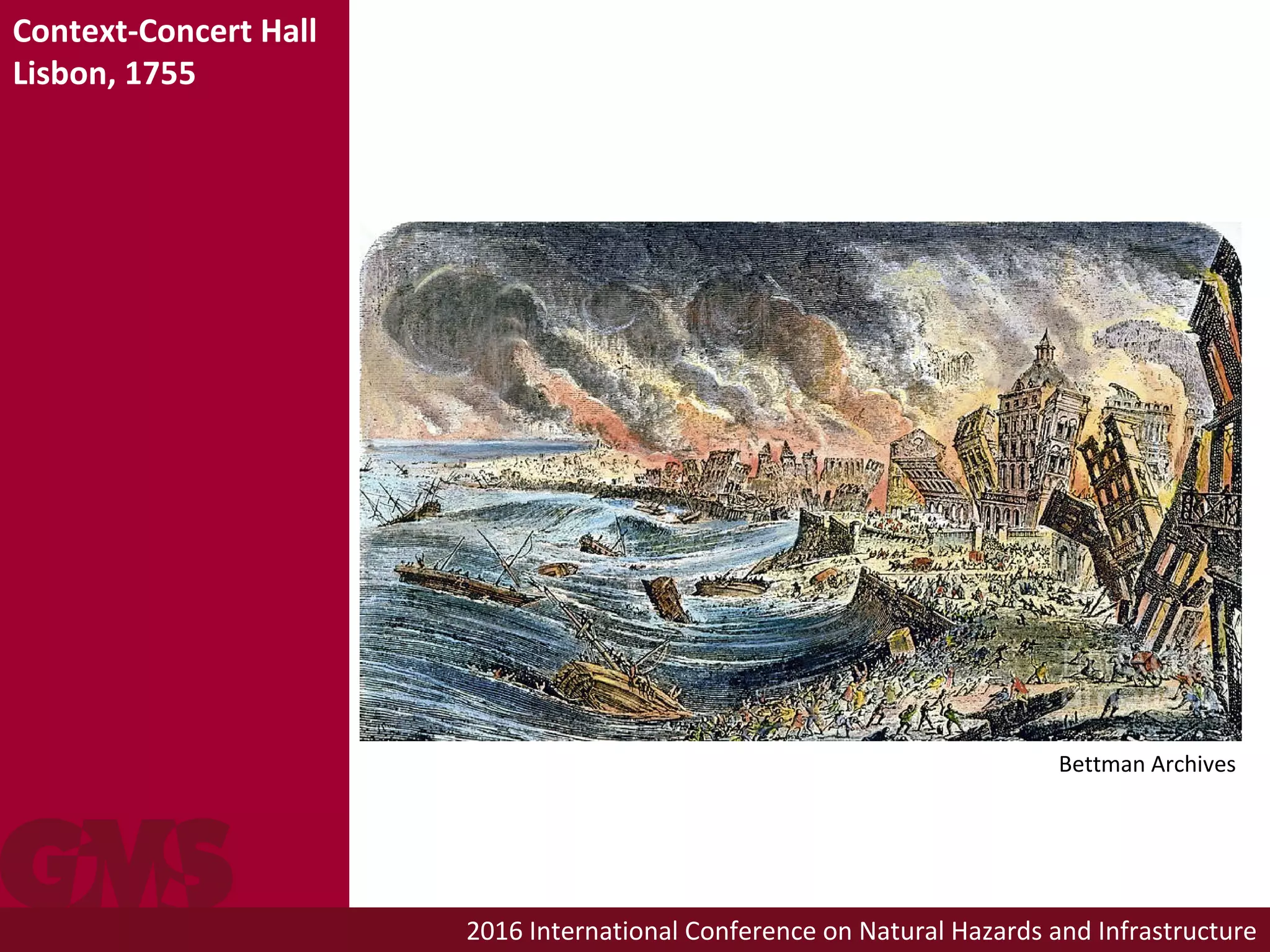
Context-Concert Hall
Lisbon, 1755
Bettman Archives
2016 International Conference on Natural Hazards and Infrastructure
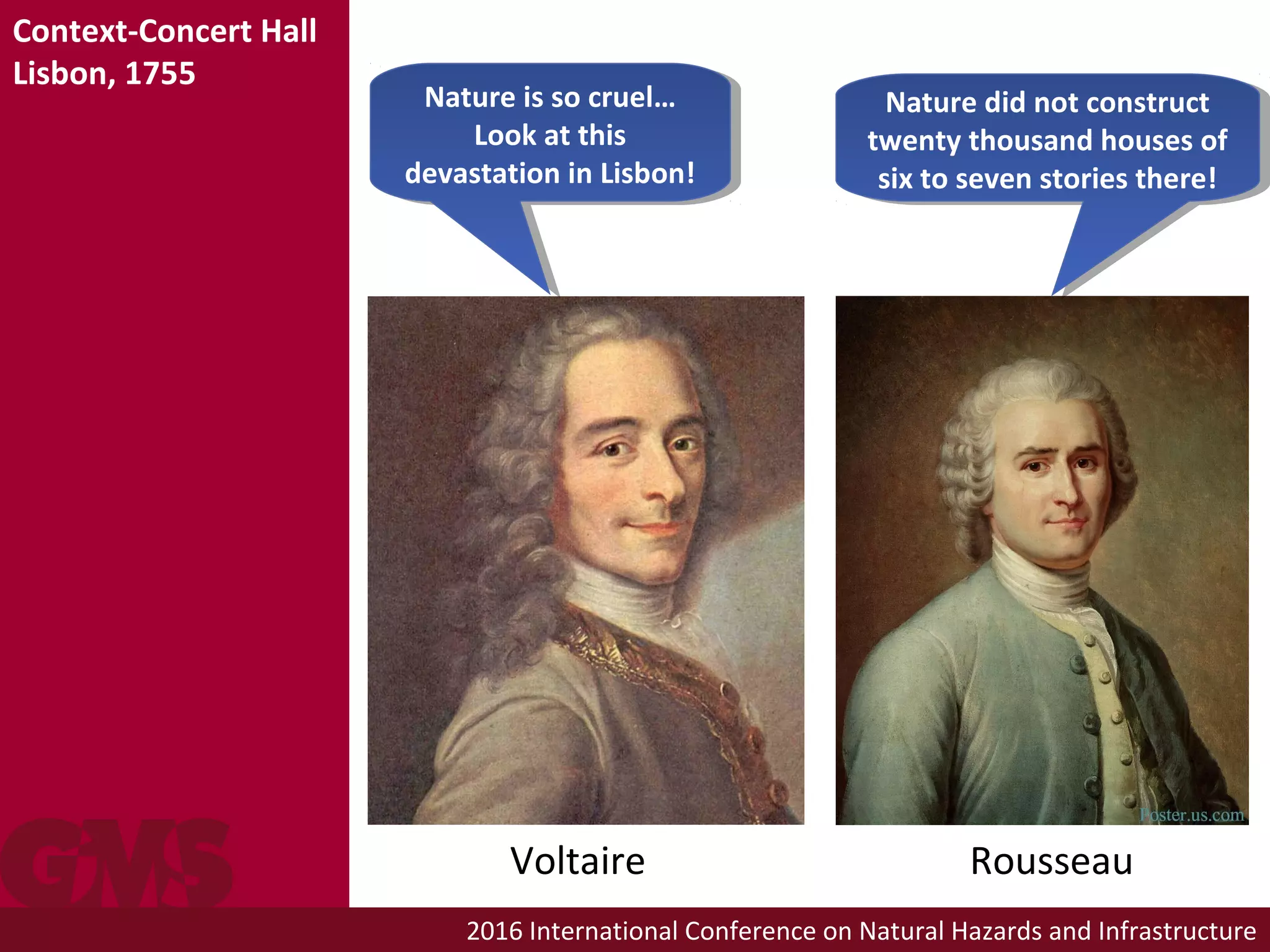
Context-Concert Hall
Lisbon, 1755
Voltaire Rousseau
Nature is so cruel…
Look at this
devastation in Lisbon!
Nature is so cruel…
Look at this
devastation in Lisbon!
Nature did not construct
twenty thousand houses of
six to seven stories there!
Nature did not construct
twenty thousand houses of
six to seven stories there!
2016 International Conference on Natural Hazards and Infrastructure
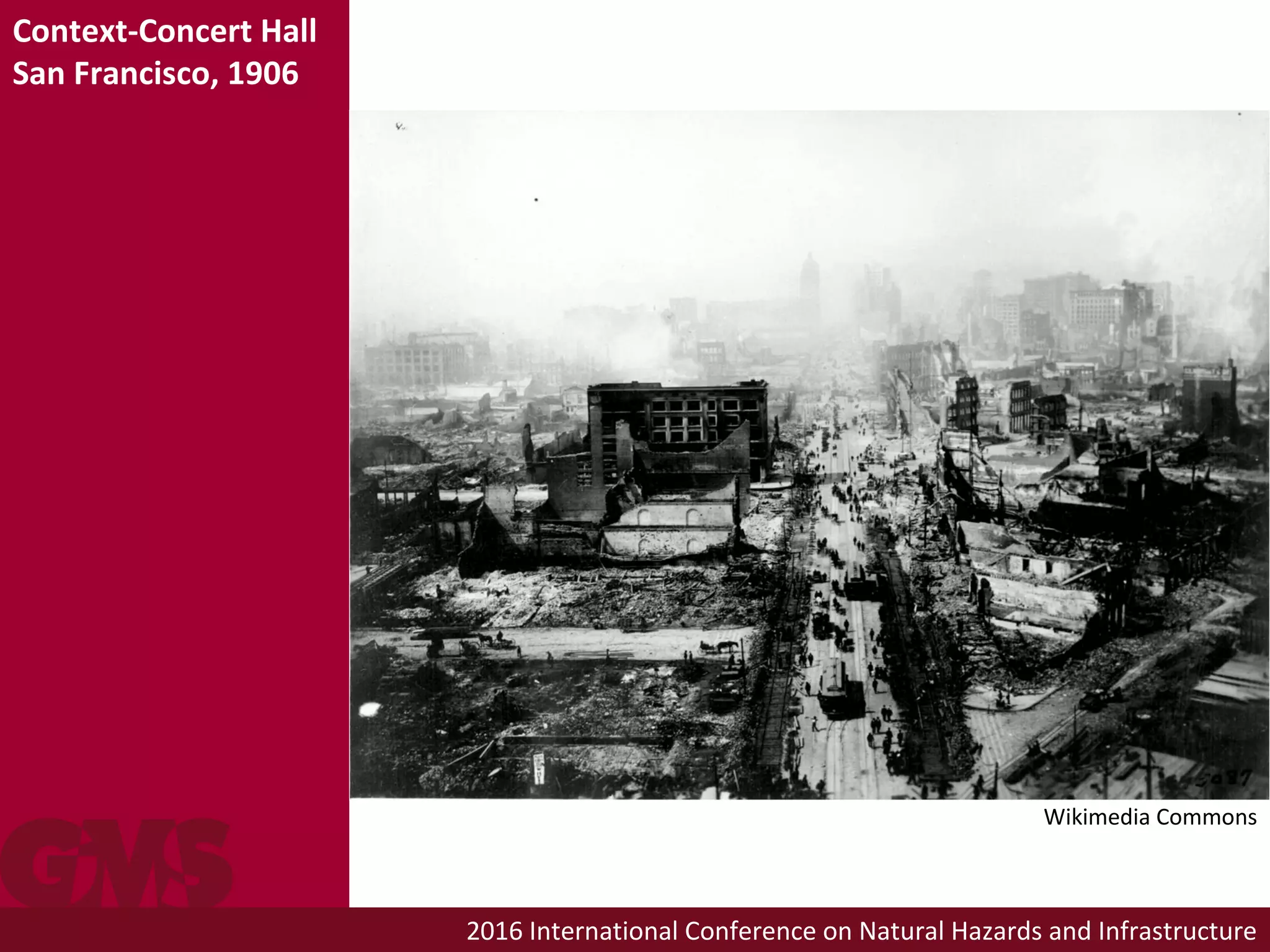
Context-Concert Hall
San Francisco, 1906
Wikimedia Commons
2016 International Conference on Natural Hazards and Infrastructure
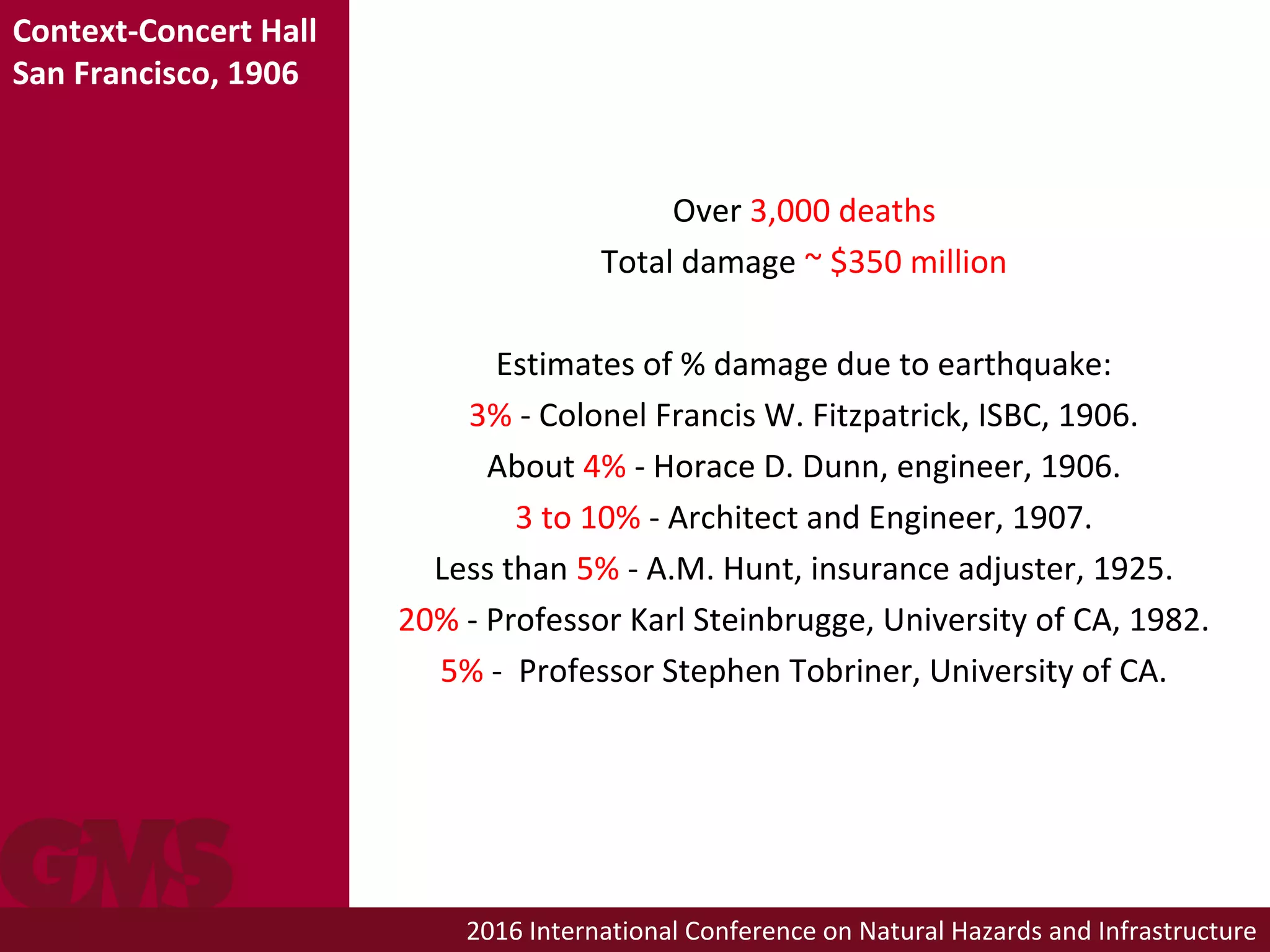
Context-Concert Hall
San Francisco, 1906
Over 3,000 deaths
Total damage ~ $350 million
Estimates of % damage due to earthquake:
3% - Colonel Francis W. Fitzpatrick, ISBC, 1906.
About 4% - Horace D. Dunn, engineer, 1906.
3 to 10% - Architect and Engineer, 1907.
Less than 5% - A.M. Hunt, insurance adjuster, 1925.
20% - Professor Karl Steinbrugge, University of CA, 1982.
5% - Professor Stephen Tobriner, University of CA.
2016 International Conference on Natural Hazards and Infrastructure
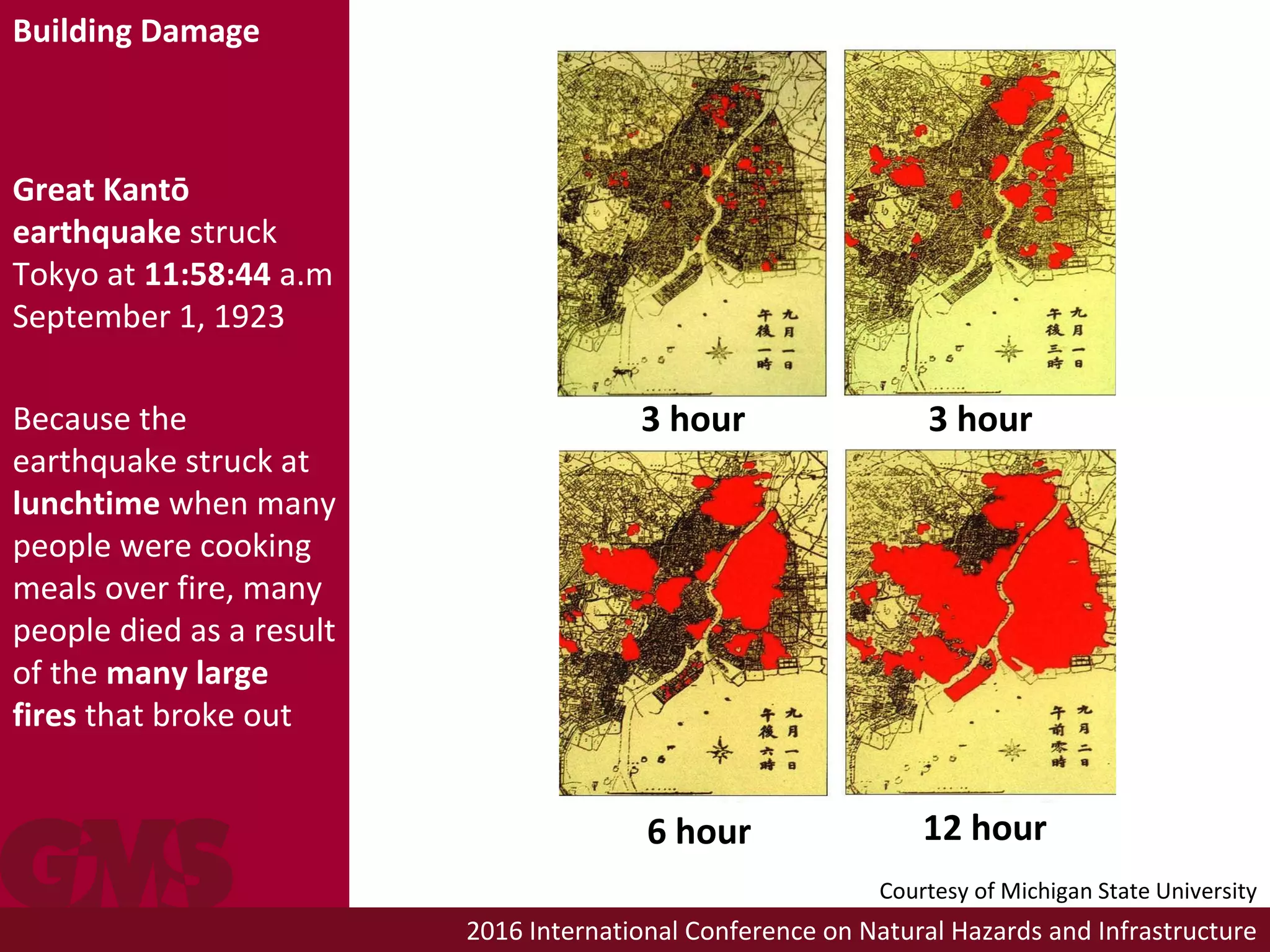
Great Kantō
earthquake struck
Tokyo at 11:58:44 a.m
September 1, 1923
Because the
earthquake struck at
lunchtime when many
people were cooking
meals over fire, many
people died as a result
of the many large
fires that broke out
3 hour
6 hour 12 hour
Building Damage
3 hour
Courtesy of Michigan State University
2016 International Conference on Natural Hazards and Infrastructure
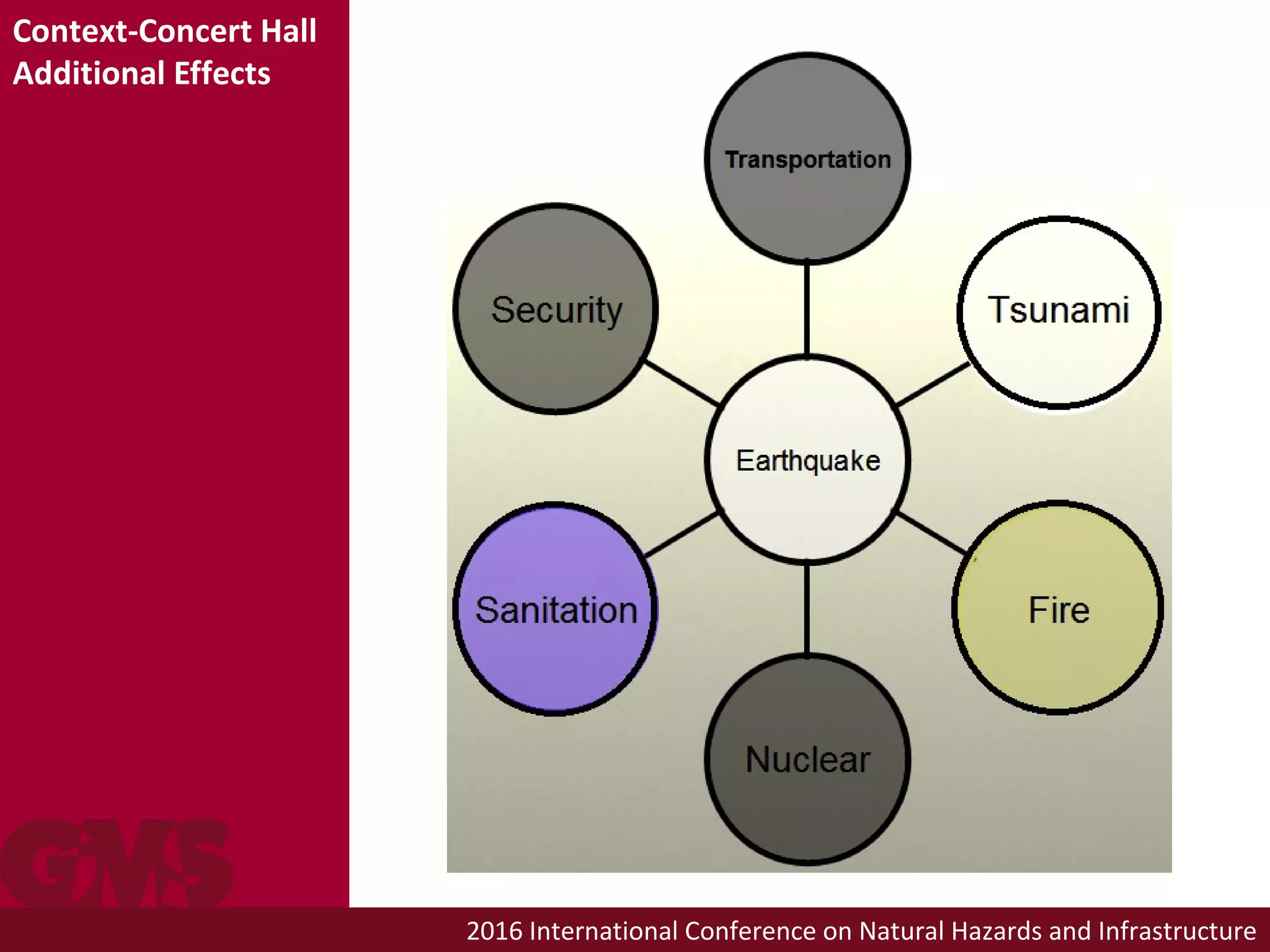
Context-Concert Hall
Additional Effects
2016 International Conference on Natural Hazards and Infrastructure
• How many instruments must break
before a performance gets canceled?
• How important are those instruments?
• Not only individual buildings, but the
entire neighborhood must be resilient.
• It is important that the neighbor remains
standing
Context-Concert Hall
2016 International Conference on Natural Hazards and Infrastructure
• The most vulnerable elements of the city
are most in need of protection.
• 9/11 attack
– Economically strong neighborhood
– Newer construction
– Localized damage
– City is not paralyzed
• Hurricane Sandy
– Economically weak neighborhoods
– Older construction
– Widespread damage
– More difficult to respond
Context-Concert Hall
2016 International Conference on Natural Hazards and Infrastructure
Credits
Staring
Ramon Gilsanz
Supporting Roles
Verónica Cedillos
Dan Eschanasy
Ayse Hortacsu
Sissy Nikolaou
Len Joseph
Produced by
Petr Vancura
2016 International Conference on Natural Hazards and Infrastructure
Thank you
Gilsanz Murray Steficek
Engineers and Architects

Understanding Resilience through a Musical Analogy

  • 1.
    2016 International Conferenceon Natural Hazards and Infrastructure Understanding Resilience through a Musical Analogy Ramon Gilsanz, PE, SE, FSEI
  • 2.
    2016 International Conferenceon Natural Hazards and Infrastructure A Musical Analogy Earthquake ↔ Music Soil ↔ Musician Seismic Spectrum ↔ Score Building ↔ Instrument Bldg. Response ↔ Melody Occupants ↔ Audience Social Context ↔ Concert Hall
  • 3.
    2016 International Conferenceon Natural Hazards and Infrastructure Soil Magnitude Acceleration Shaking Duration Frequency Musician Dynamics (Loudness) Tempo (Speed) Time (Length of Piece) Musical Pitch Soil-Musician
  • 4.
    2016 International Conferenceon Natural Hazards and Infrastructure Soil-Musician Types of Waves Bolt, B. (1993) “Earthquakes and Geological Discovery”
  • 5.
    2016 International Conferenceon Natural Hazards and Infrastructure Soil-Musician Types of Waves Atkinson Physics (YouTube)
  • 6.
    2016 International Conferenceon Natural Hazards and Infrastructure • Density (Granite): 156-168 lbs/sf3 • P-Waves: 19,700 ft/s • S-Waves: 10,800 ft/s Soil-Musician Solid Rock
  • 7.
    2016 International Conferenceon Natural Hazards and Infrastructure • Density: 94 lbs/sf3 • P-Waves: 1,310 ft/s • S-Waves: 330 ft/s Soil-Musician Sand Rachel Barton Pine
  • 8.
    2016 International Conferenceon Natural Hazards and Infrastructure Soil-Musician esmes.com
  • 9.
    2016 International Conferenceon Natural Hazards and Infrastructure Soil-Musician Liquefaction Christchurch, New Zealand, 2011 nzraw.co.nz
  • 10.
    2016 International Conferenceon Natural Hazards and Infrastructure Soil-Musician Liquefaction Assam, India, 1897 Oldham, R.D. “Report on the great earthquake of 1897”
  • 11.
    2016 International Conferenceon Natural Hazards and Infrastructure Soil-Musician Clay and Silt Indiana University Southeast
  • 12.
    2016 International Conferenceon Natural Hazards and Infrastructure Soil-Musician John Hacket (pintrest)
  • 13.
    2016 International Conferenceon Natural Hazards and Infrastructure Soil-Musician Clay and Silt Bolt, B. (1993)
  • 14.
    2016 International Conferenceon Natural Hazards and Infrastructure • Measure of energy an earthquake releases • An increase in magnitude of 1 is a 32-fold increase in energy released • Seismic Moment = (Strength of soil) x (Rupture area) x (Fault displacement) (Adopted by USGS in 2002) Soil-Musician Magnitude
  • 15.
    2016 International Conferenceon Natural Hazards and Infrastructure • Peak Ground Acceleration (PGA) – Maximum acceleration experienced by a particle at ground level • Peak Floor Acceleration (PFA) – Maximum acceleration experienced at a floor level Soil-Musician Accelerations
  • 16.
    2016 International Conferenceon Natural Hazards and Infrastructure Seismic Spectrum - Score
  • 17.
    2016 International Conferenceon Natural Hazards and Infrastructure Seismic Spectrum - Score Adapted from Bolt, B. (1993)
  • 18.
    2016 International Conferenceon Natural Hazards and Infrastructure Building-Instrument Frequency
  • 19.
    2016 International Conferenceon Natural Hazards and Infrastructure Building-Instrument emporis.com
  • 20.
    2016 International Conferenceon Natural Hazards and Infrastructure Building-Instrument Resonance Missouri S&T, Prof. O. Kwon (YouTube)
  • 21.
    2016 International Conferenceon Natural Hazards and Infrastructure Role of the Engineer • Static Analysis • Response Spectrum • Non-linear / Time History (measures duration) Building-Instrument Ways to Design
  • 22.
    2016 International Conferenceon Natural Hazards and Infrastructure Approximate acceleration experienced by a building, when modeled as a particle on a vertical mass-less rod, with an identical period as the building Building-Instrument Ways to Design Acceleration T F ~ m x SA GMS
  • 23.
    2016 International Conferenceon Natural Hazards and Infrastructure Building-Instrument Ways to Design Acceleration PERIOD SA T ACCELERATION SDS SD1 PGA GMS
  • 24.
    2016 International Conferenceon Natural Hazards and Infrastructure NEHRP SDS SD1 2003 0.24 0.047 2000 0.28 0.063 1997 0.28 0.063 Design accelerations for Zip Code: 10016 Assuming Site Class B Rock Standard Steel building Ordinary moment frame Ie =1 R = 3.5 Ts = 0.195 seconds Building-Instrument Ways to Design Acceleration
  • 25.
    2016 International Conferenceon Natural Hazards and Infrastructure • Approach: Redundant shear wall construction • Goal: Immediate occupancy • Downside: High non-structural damage, architectural constraints Building-Instrument Design Approach: Chile
  • 26.
    2016 International Conferenceon Natural Hazards and Infrastructure Building-Instrument Design Approach: Chile FEMA-350 (2000)
  • 27.
    2016 International Conferenceon Natural Hazards and Infrastructure Building-Instrument Design Approach: Japan • Approach: Base isolation • Goal: Immediate occupancy & minimal damage • Downside: High cost
  • 28.
    2016 International Conferenceon Natural Hazards and Infrastructure Building-Instrument Design Approach: Japan Photos: GMS
  • 29.
    2016 International Conferenceon Natural Hazards and Infrastructure Building-Instrument Design Approach: Japan Shimizu Corporation
  • 30.
    2016 International Conferenceon Natural Hazards and Infrastructure Building-Instrument Design Approach: United States • Approach: Energy dissipation through plastic deformations of the structure • Goal: Cost effective life safety • Downside: Significant damage to building
  • 31.
    2016 International Conferenceon Natural Hazards and Infrastructure Building-Instrument Design Approach: United States Photo: GMS
  • 32.
    2016 International Conferenceon Natural Hazards and Infrastructure Building-Instrument Plastic Hinge FEMA-350 (2000)
  • 33.
    2016 International Conferenceon Natural Hazards and Infrastructure Building-Instrument Plastic Hinge FEMA-350 (2000)
  • 34.
    2016 International Conferenceon Natural Hazards and Infrastructure Occupants- Audience Modified Mercalli Earthquake Intensity Scale imgur.com
  • 35.
    2016 International Conferenceon Natural Hazards and Infrastructure Collapse Unusable Usable Source: CATDAT Damaging Earthquakes Database (via earthquake-report.co Building Damage
  • 36.
    2016 International Conferenceon Natural Hazards and Infrastructure Context-Concert Hall South African National Youth Orchestra Chrisian Mehlfurer
  • 37.
    2016 International Conferenceon Natural Hazards and Infrastructure U.S. Approach Protects the individual… • 0.5% of all crashes are fatal • 1.07 fatalities per 100 mil VMT (US DOT NHTSA) …but cripples the system (city) (US DOT FHWA) Bottle- necks 25% Collisions Bad weather Work zones Poor Signal Other
  • 38.
    2016 International Conferenceon Natural Hazards and Infrastructure Context-Concert Hall Lisbon, 1755 Bettman Archives
  • 39.
    2016 International Conferenceon Natural Hazards and Infrastructure Context-Concert Hall Lisbon, 1755 Voltaire Rousseau Nature is so cruel… Look at this devastation in Lisbon! Nature is so cruel… Look at this devastation in Lisbon! Nature did not construct twenty thousand houses of six to seven stories there! Nature did not construct twenty thousand houses of six to seven stories there!
  • 40.
    2016 International Conferenceon Natural Hazards and Infrastructure Context-Concert Hall San Francisco, 1906 Wikimedia Commons
  • 41.
    2016 International Conferenceon Natural Hazards and Infrastructure Context-Concert Hall San Francisco, 1906 Over 3,000 deaths Total damage ~ $350 million Estimates of % damage due to earthquake: 3% - Colonel Francis W. Fitzpatrick, ISBC, 1906. About 4% - Horace D. Dunn, engineer, 1906. 3 to 10% - Architect and Engineer, 1907. Less than 5% - A.M. Hunt, insurance adjuster, 1925. 20% - Professor Karl Steinbrugge, University of CA, 1982. 5% - Professor Stephen Tobriner, University of CA.
  • 42.
    2016 International Conferenceon Natural Hazards and Infrastructure Great Kantō earthquake struck Tokyo at 11:58:44 a.m September 1, 1923 Because the earthquake struck at lunchtime when many people were cooking meals over fire, many people died as a result of the many large fires that broke out 3 hour 6 hour 12 hour Building Damage 3 hour Courtesy of Michigan State University
  • 43.
    2016 International Conferenceon Natural Hazards and Infrastructure Context-Concert Hall Additional Effects
  • 44.
    2016 International Conferenceon Natural Hazards and Infrastructure • How many instruments must break before a performance gets canceled? • How important are those instruments? • Not only individual buildings, but the entire neighborhood must be resilient. • It is important that the neighbor remains standing Context-Concert Hall
  • 45.
    2016 International Conferenceon Natural Hazards and Infrastructure • The most vulnerable elements of the city are most in need of protection. • 9/11 attack – Economically strong neighborhood – Newer construction – Localized damage – City is not paralyzed • Hurricane Sandy – Economically weak neighborhoods – Older construction – Widespread damage – More difficult to respond Context-Concert Hall
  • 46.
    2016 International Conferenceon Natural Hazards and Infrastructure Credits Staring Ramon Gilsanz Supporting Roles Verónica Cedillos Dan Eschanasy Ayse Hortacsu Sissy Nikolaou Len Joseph Produced by Petr Vancura
  • 47.
    2016 International Conferenceon Natural Hazards and Infrastructure Thank you Gilsanz Murray Steficek Engineers and Architects

Editor's Notes