CASE REPORT
A 79 - year - old woman with altered
bowel habit and weight loss
Main complains
Mrs MS is a 79 - year - old woman who attends
your outpatient clinic with her daughter.
-constipation
- vague abdominal discomfort.
-lost her appetite
-her clothes have become looser over the last
few months.
• What are your main concerns?
• What other information do you need to
know?
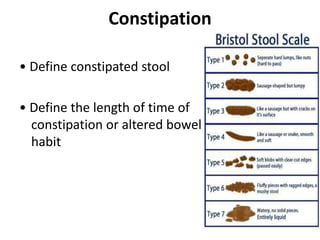
Constipation
• Define constipated stool
• Define the length of time of
constipation or altered bowel
habit
Weight loss
• Establish the amount of weight lost over what
time period. Has it been purposeful or non -
intentional?
– Malignancy ?
– Malabsorptive?
– Inflammatory processes?
Abdominal discomfort
Describe the abdominal discomfort
Other symptoms
• Rectal bleeding
• Nausea or vomiting
• Anaemia
History of the disease
She explains that she has felt constipated for the
last year. Her bowel habit is regular, once per
day, with hard, pellet - like stool. There is no
excessive straining at stool and no rectal
bleeding.
Her abdominal discomfort is deep and constant.
It is located around the epigastrum and does
not radiate elsewhere.
It has no relieving or aggravating factors
History of the disease
• She feels bloated most of the day. She does
not have any nausea and never vomits. Her
appetite has declined and she has probably
lost about 6 kg in weight over the last 2
months (almost two dress sizes for her). She is
happy with this.
• She feels tired and lethargic but puts this
down to her age.
What other information do you need
before planning investigations?
Family history
• There is a family history of diabetes and
ischaemic heart disease but no colorectal
cancer.
Past medical history
2016-non - insulin dependent type 2 diabetes mellitus.
2020-ischaemic heart disease (recently diagnosed 6 months ago by her
general practitioner),
- 2020- claudication on walking 200 m and She considers herself to be
well.
Her medications include aspirin, lisinopril, atorvastatin and metformin.
She was recently started on iron supplements for anaemia. She has
used lactulose as needed for constipated stool, usually once a month
at most.
She is an ex - smoker of 20 years with a 30 pack – year history.
What is your differential diagnosis?
What findings on the examination will
confirm your suspicions?
On examination she has conjunctival pallor.
There is no lymphadenopathy.
Her abdomen is soft and tender in the
epigastrium with no obvious masses or
organomegaly.
There is nothing to find on rectal exam.
RED FLAG
Change of bowel habit, abdominal pain, rectal
bleeding or iron deficiency in older patients
are alarm features to suggest malignancy.
What investigations do you choose?
Blood tests
-Full blood count
-Iron, feritine
-urea, creatinine, electrolytes
-liver function
-calcium
-thyroid function
Colonoscopy
What are the other options instead
of colonoscopy?
• CT colonography with oral gastrografin to
opacify the stool.
When do you choose
radiological investigation?
If the patient was not fit for sedation or bowel
preparation for colonoscopy
If the patient refused an invasive procedure
What if a lesion is found?
• If a mass lesion is detected on imaging, an
endoscopic examination would be needed to
confirm radiological findings and obtain
histology.
• A staging CT scan is also appropriate to look
for the extent of disease and guide
management.
Blood tests confirmed a
microcytic anaemia with
iron - deficiency pattern.
-normal thyroid function
-normal calcium level
Hb 11,4 g/dl
Ht 29.4 %
Trombocite 495.000/mmc
Leucocite 7540/mmc
TGP 12 U/L
TGO 16 U/L
BT 0.34 mg/dl
BD 0.06 mg/dl
GGT 34.5 U/l
Uree 34 mg/dl
creatinina 0.67 mg/dl
Feritine 18 ng/dl
Iron 7γ%
She proceeded to CT colonography given her age
and co - morbidities.
This demonstrated thickening of a region in the
ascending colon and scattered diverticula to
the splenic flexure
• She proceeded to have a colonoscopy, aware
of the findings on the CT scan.
• She was admitted as an inpatient and given
intravenous rehydration pre – and
postoperatively.
• The colonoscopy revealed a polypoid mass
lesion causing partial obstruction in the
ascending colon
What are the management options?
• Surgery
• Chemotherapy
• Palliation of symptoms
The case was re - discussed at the MDT meeting and
surgical resection was deemed appropriate .
She underwent an exercise tolerance test and managed 3
min 25 s of the Bruce protocol, limited by dyspnoea.
There was evidence of ST depression consistent with
coronary artery disease. She was reviewed by the
cardiologists and commenced on anti - anginal
medication.
• This improved her symptoms. Echocardiogram
confirmed good left ventricular function and no
valvular disease.
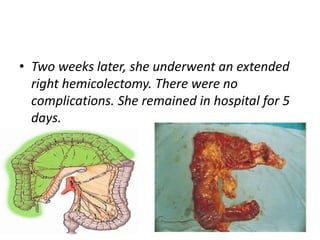
• Two weeks later, she underwent an extended
right hemicolectomy. There were no
complications. She remained in hospital for 5
days.
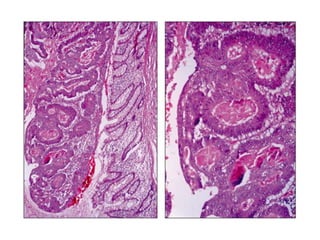
• Histology revealed a T3,N0,M0 moderately
differentiated mucinous adenocarcinoma of
the ascending colon
• She was offered, but declined, adjuvant
chemotherapy due to the potential risks and
complications. She remains well 1 year later.
What about follow - up?
• She requires a surveillance colonoscopy 1 year
postoperatively.
CASE REVIEW
• A change of bowel habit, abdominal pain, rectal bleeding or iron
deficiency in older patients should alert the clinician to consider a
colorectal malignancy.
• Colonoscopy is the ideal investigation of choice. Radiological
investigation of the bowel should be considered depending on age,
frailty, co - morbidities and patient preference.
• Management of colorectal cancer should be decided in a
multidisciplinary team setting. This may include surgery,
chemotherapy and palliative stenting of the colon for obstructive
symptoms and/or medical management.
• Surveillance after initial management is in accordance with
determined guidelines.

Case report

  • 1.
  • 2.
    A 79 -year - old woman with altered bowel habit and weight loss
  • 3.
    Main complains Mrs MSis a 79 - year - old woman who attends your outpatient clinic with her daughter. -constipation - vague abdominal discomfort. -lost her appetite -her clothes have become looser over the last few months.
  • 4.
    • What areyour main concerns? • What other information do you need to know?
  • 5.
    Constipation • Define constipatedstool • Define the length of time of constipation or altered bowel habit
  • 6.
    Weight loss • Establishthe amount of weight lost over what time period. Has it been purposeful or non - intentional? – Malignancy ? – Malabsorptive? – Inflammatory processes?
  • 7.
  • 8.
    Other symptoms • Rectalbleeding • Nausea or vomiting • Anaemia
  • 9.
    History of thedisease She explains that she has felt constipated for the last year. Her bowel habit is regular, once per day, with hard, pellet - like stool. There is no excessive straining at stool and no rectal bleeding. Her abdominal discomfort is deep and constant. It is located around the epigastrum and does not radiate elsewhere. It has no relieving or aggravating factors
  • 10.
    History of thedisease • She feels bloated most of the day. She does not have any nausea and never vomits. Her appetite has declined and she has probably lost about 6 kg in weight over the last 2 months (almost two dress sizes for her). She is happy with this. • She feels tired and lethargic but puts this down to her age.
  • 11.
    What other informationdo you need before planning investigations?
  • 12.
    Family history • Thereis a family history of diabetes and ischaemic heart disease but no colorectal cancer.
  • 13.
    Past medical history 2016-non- insulin dependent type 2 diabetes mellitus. 2020-ischaemic heart disease (recently diagnosed 6 months ago by her general practitioner), - 2020- claudication on walking 200 m and She considers herself to be well. Her medications include aspirin, lisinopril, atorvastatin and metformin. She was recently started on iron supplements for anaemia. She has used lactulose as needed for constipated stool, usually once a month at most. She is an ex - smoker of 20 years with a 30 pack – year history.
  • 14.
    What is yourdifferential diagnosis?
  • 15.
    What findings onthe examination will confirm your suspicions?
  • 16.
    On examination shehas conjunctival pallor. There is no lymphadenopathy. Her abdomen is soft and tender in the epigastrium with no obvious masses or organomegaly. There is nothing to find on rectal exam.
  • 17.
    RED FLAG Change ofbowel habit, abdominal pain, rectal bleeding or iron deficiency in older patients are alarm features to suggest malignancy.
  • 18.
    What investigations doyou choose? Blood tests -Full blood count -Iron, feritine -urea, creatinine, electrolytes -liver function -calcium -thyroid function
  • 19.
  • 20.
    What are theother options instead of colonoscopy? • CT colonography with oral gastrografin to opacify the stool.
  • 21.
    When do youchoose radiological investigation? If the patient was not fit for sedation or bowel preparation for colonoscopy If the patient refused an invasive procedure
  • 22.
    What if alesion is found? • If a mass lesion is detected on imaging, an endoscopic examination would be needed to confirm radiological findings and obtain histology. • A staging CT scan is also appropriate to look for the extent of disease and guide management.
  • 23.
    Blood tests confirmeda microcytic anaemia with iron - deficiency pattern. -normal thyroid function -normal calcium level Hb 11,4 g/dl Ht 29.4 % Trombocite 495.000/mmc Leucocite 7540/mmc TGP 12 U/L TGO 16 U/L BT 0.34 mg/dl BD 0.06 mg/dl GGT 34.5 U/l Uree 34 mg/dl creatinina 0.67 mg/dl Feritine 18 ng/dl Iron 7γ%
  • 24.
    She proceeded toCT colonography given her age and co - morbidities. This demonstrated thickening of a region in the ascending colon and scattered diverticula to the splenic flexure
  • 26.
    • She proceededto have a colonoscopy, aware of the findings on the CT scan. • She was admitted as an inpatient and given intravenous rehydration pre – and postoperatively. • The colonoscopy revealed a polypoid mass lesion causing partial obstruction in the ascending colon
  • 29.
    What are themanagement options? • Surgery • Chemotherapy • Palliation of symptoms
  • 30.
    The case wasre - discussed at the MDT meeting and surgical resection was deemed appropriate . She underwent an exercise tolerance test and managed 3 min 25 s of the Bruce protocol, limited by dyspnoea. There was evidence of ST depression consistent with coronary artery disease. She was reviewed by the cardiologists and commenced on anti - anginal medication. • This improved her symptoms. Echocardiogram confirmed good left ventricular function and no valvular disease.
  • 31.
    • Two weekslater, she underwent an extended right hemicolectomy. There were no complications. She remained in hospital for 5 days.
  • 32.
    • Histology revealeda T3,N0,M0 moderately differentiated mucinous adenocarcinoma of the ascending colon
  • 33.
    • She wasoffered, but declined, adjuvant chemotherapy due to the potential risks and complications. She remains well 1 year later.
  • 34.
    What about follow- up? • She requires a surveillance colonoscopy 1 year postoperatively.
  • 35.
    CASE REVIEW • Achange of bowel habit, abdominal pain, rectal bleeding or iron deficiency in older patients should alert the clinician to consider a colorectal malignancy. • Colonoscopy is the ideal investigation of choice. Radiological investigation of the bowel should be considered depending on age, frailty, co - morbidities and patient preference. • Management of colorectal cancer should be decided in a multidisciplinary team setting. This may include surgery, chemotherapy and palliative stenting of the colon for obstructive symptoms and/or medical management. • Surveillance after initial management is in accordance with determined guidelines.