Visuel à insérer ici
EZ CONFERENCE 2016
PARIS
Managing Changes to the Database Across the
Project Life Cycle
WHO AM I
The short version
• « the guy who has written a lot of answers
on the eZPublish forums »
• Working at Kaliop in London since 2014
• Principal consultant at eZ Systems for 7 years
• Love coffee and bicycles ?
• @gggeek
VOTRE SCHEMA
WHAT THIS TALK IS ABOUT
The short version, too
Database vs. cms vs. the project
lifecycle
01
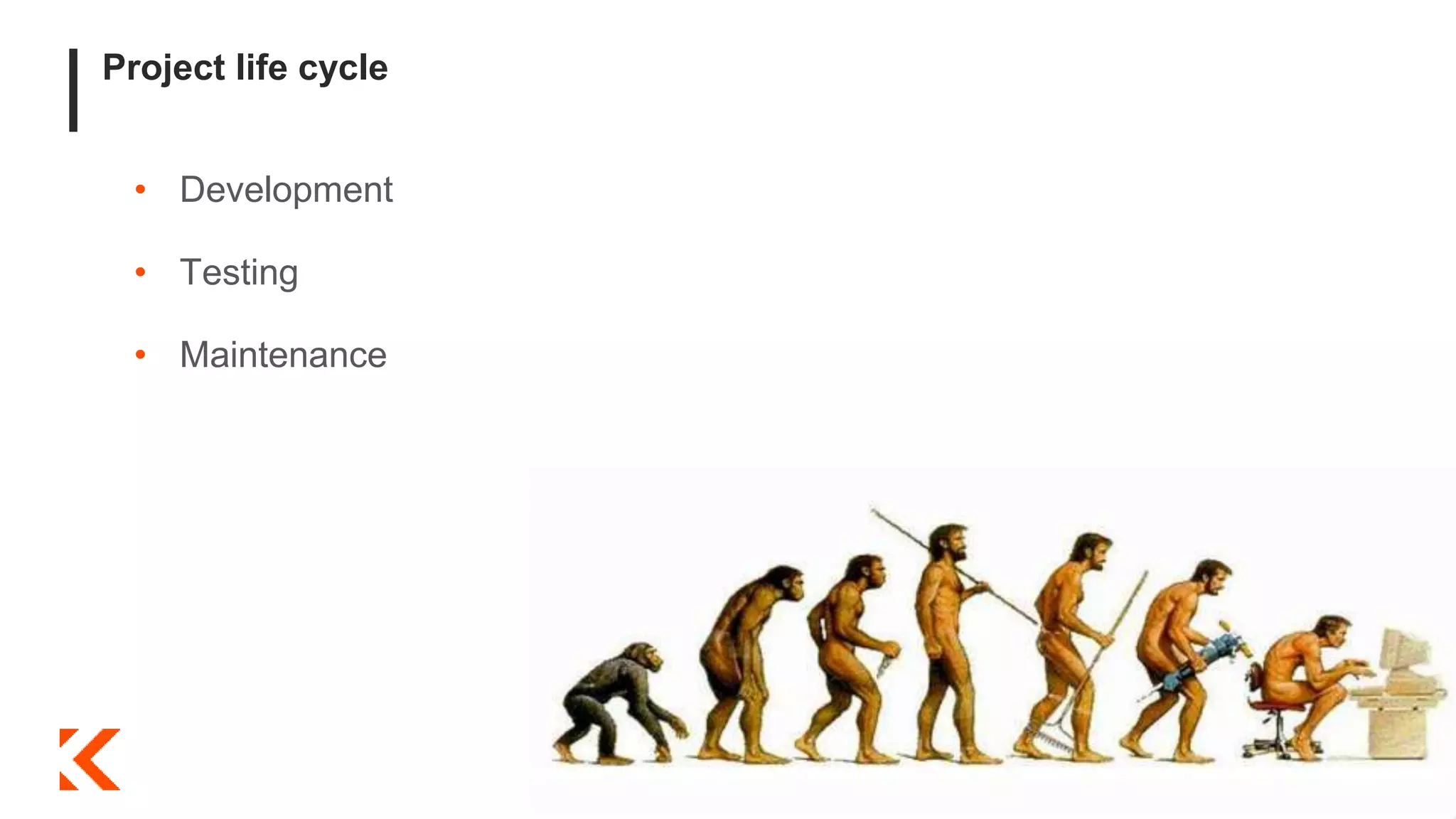
Project life cycle
• Development
• Testing
• Maintenance
Development phase
• Only one source of data: the “dev” db
• Size of data set is generally small
• Changes to content structure are frequent
• Developers need to share the database (mostly the structure)
Testing phase
• Two sources of data: the “dev” and “test” db
• Size of data set can be small or not
• Changes to content structure are less frequent
• Developers need to share the dev database
• Controlled releases of changes from dev to test
• The bulk of test “content” is not overwritten
Maintenance phase
• 3 (or more) sources of data: the “dev”, “test” and “prod” db
• Size of data set can be large
• Changes to content structure are infrequent
• Few developers need to share the dev database
• Controlled releases of changes
• Content might flow the opposite way than
changes to structure: “copy prod to test”
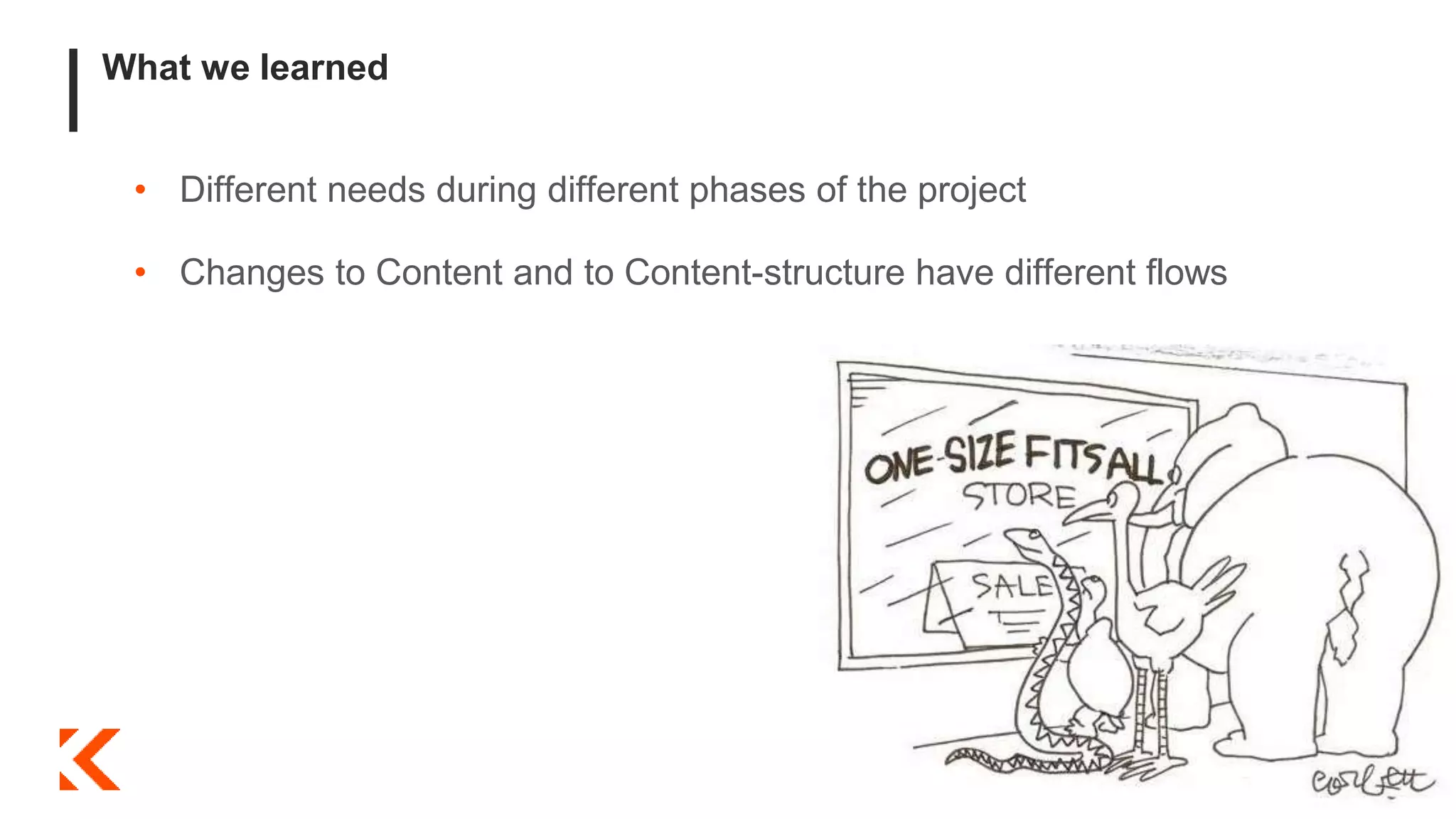
What we learned
• Different needs during different phases of the project
• Changes to Content and to Content-structure have different flows
What the CMS brings in
• Content structure can be modified via the GUI! 
• Many tables, with many relations
• No foreign keys 
(import scripts can break referential integrity)
• Some data is tied to files stored on disk 
(take care when doing backups!)
• Impossible to replicate / sync single tables 
Is it all for the better?
• Easy to deploy changes to Content Structure after go live
Unless the changes takes hours to apply
Will never cover 100% of the cases
• Hard to automate
• Hard to verify
Managing database changes
A. I connect to the Admin Interface
B. A solved problem
02
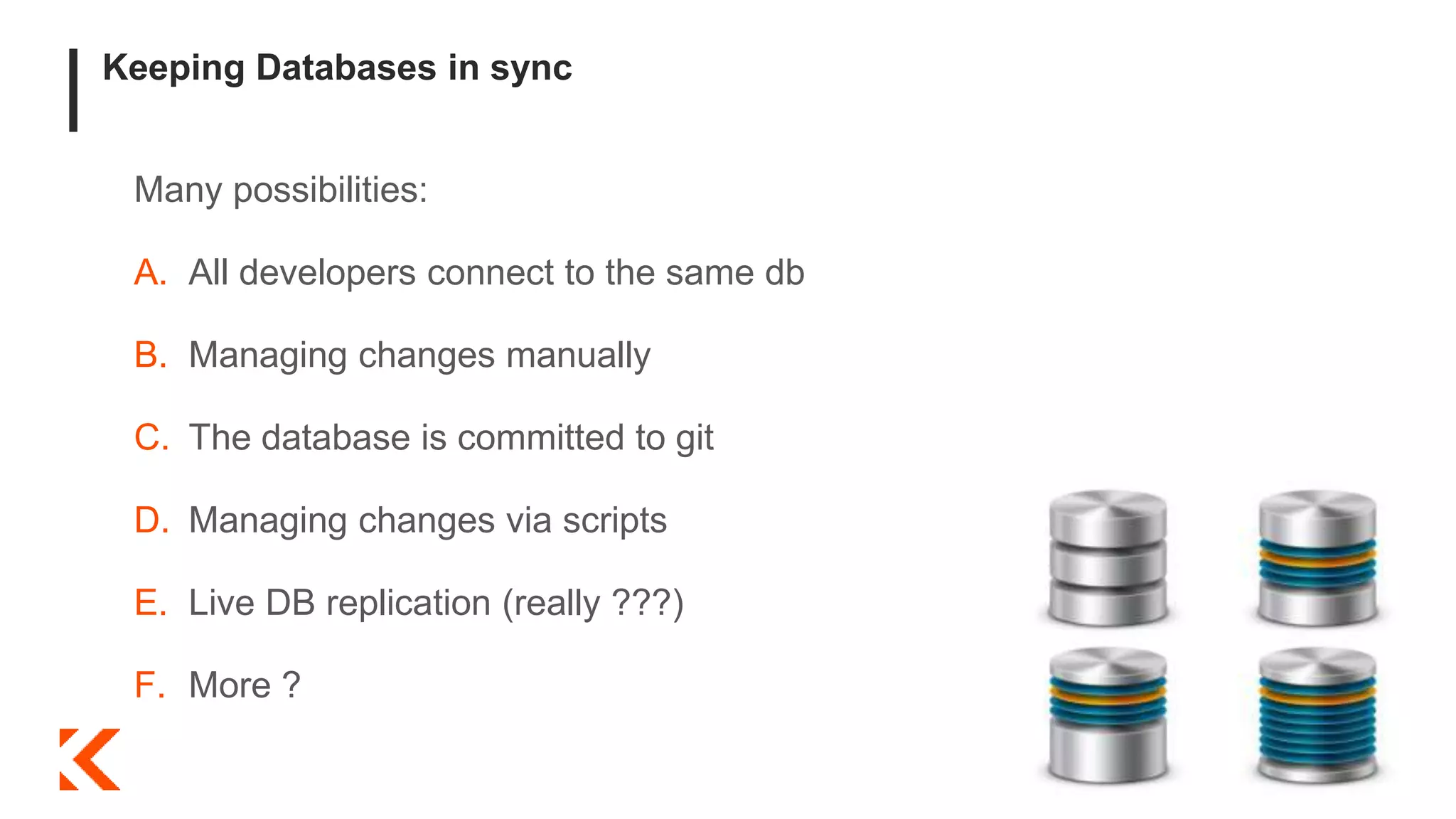
Keeping Databases in sync
Many possibilities:
A. All developers connect to the same db
B. Managing changes manually
C. The database is committed to git
D. Managing changes via scripts
E. Live DB replication (really ???)
F. More ?
A single, shared database
A
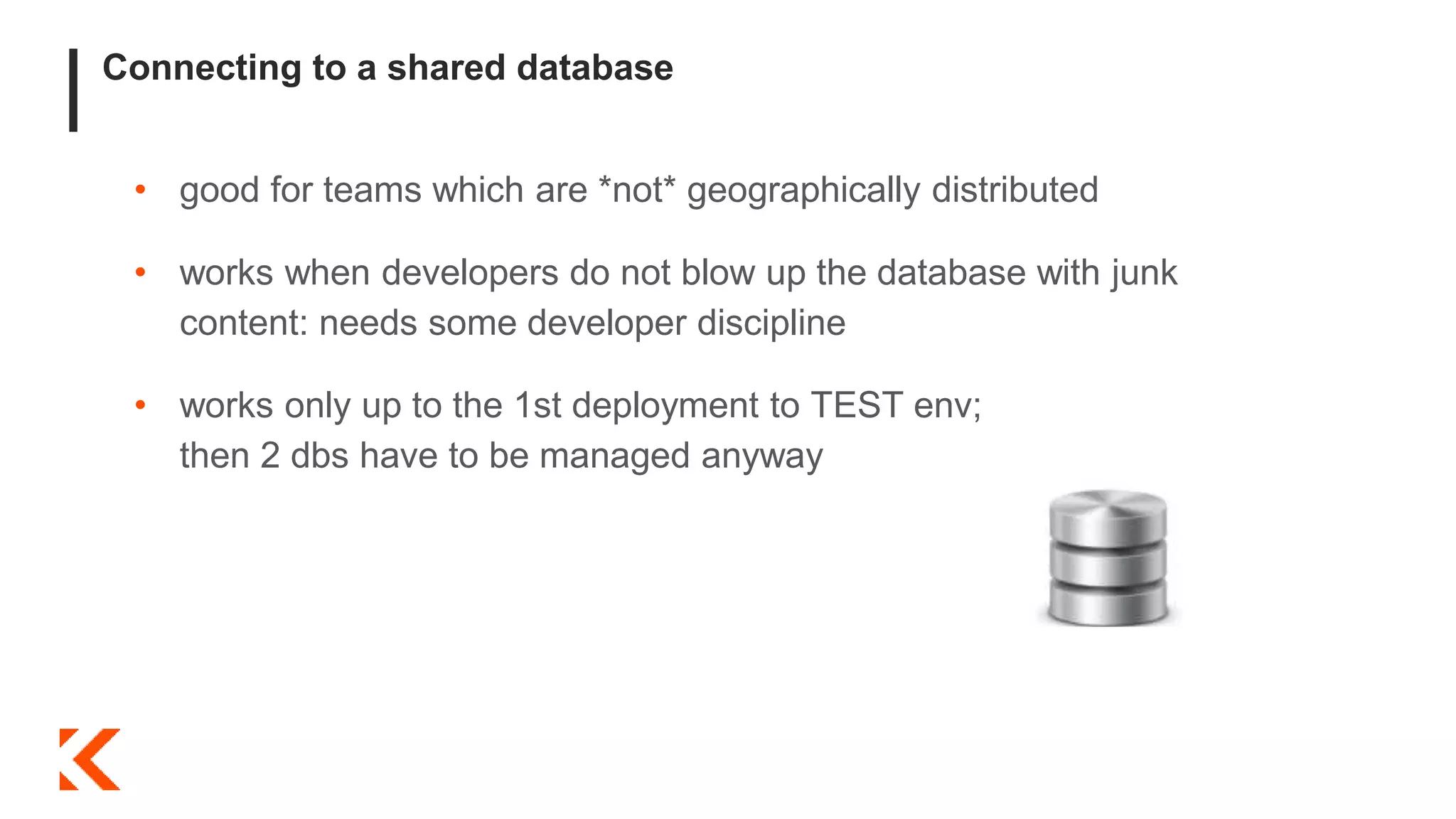
Connecting to a shared database
• good for teams which are *not* geographically distributed
• works when developers do not blow up the database with junk
content: needs some developer discipline
• works only up to the 1st deployment to TEST env;
then 2 dbs have to be managed anyway
Manual change control
B
Managing database changes manually
• Changes to be applied are documented and applied via GUI
• Most Unsafe Option (TM)
• Some tools to help you to keep mental sanity:
ggsysinfo
ezdbintegrity
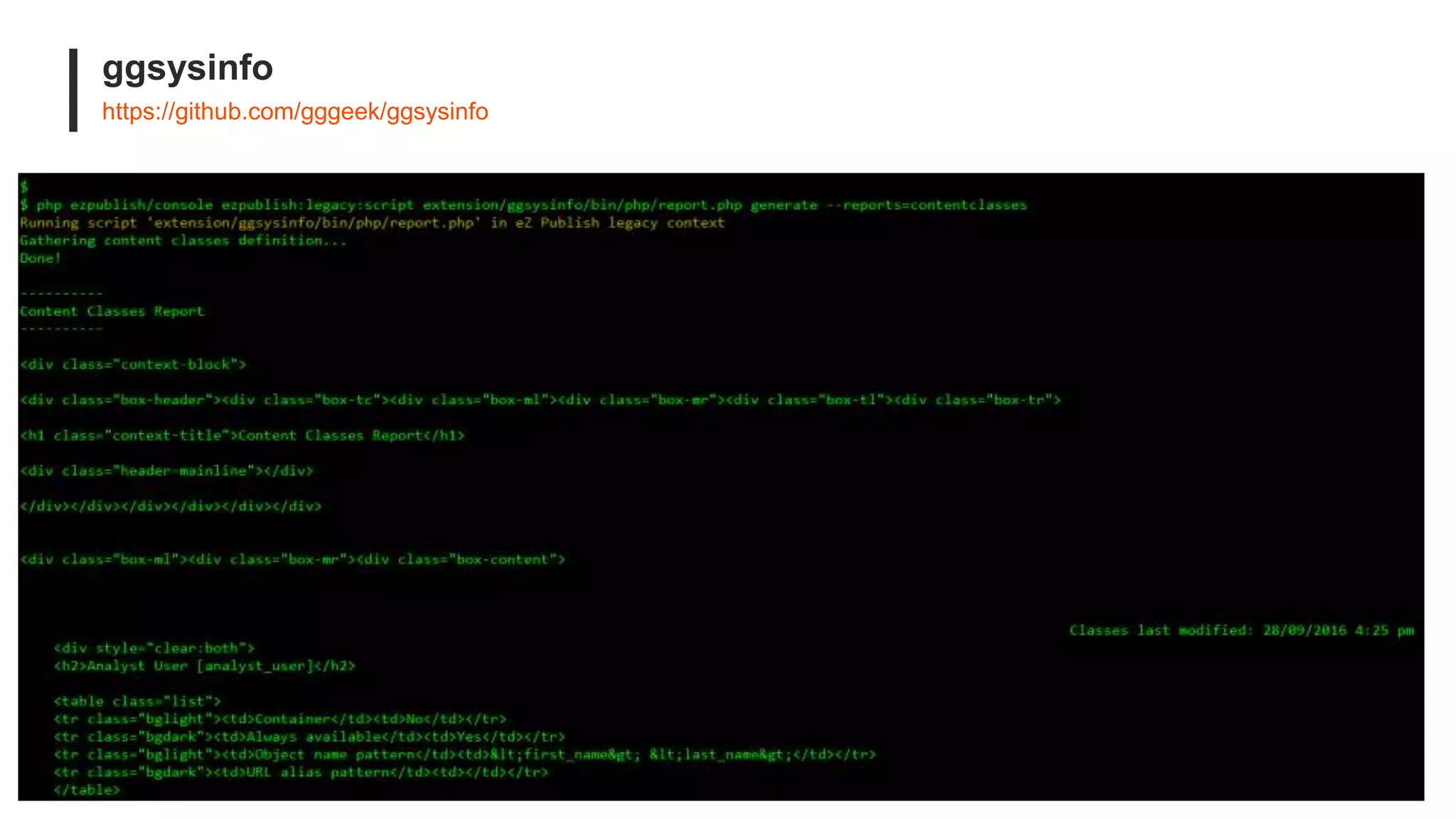
ggsysinfo
https://github.com/gggeek/ggsysinfo
• Legacy Extension (no eZPlatform version yet)
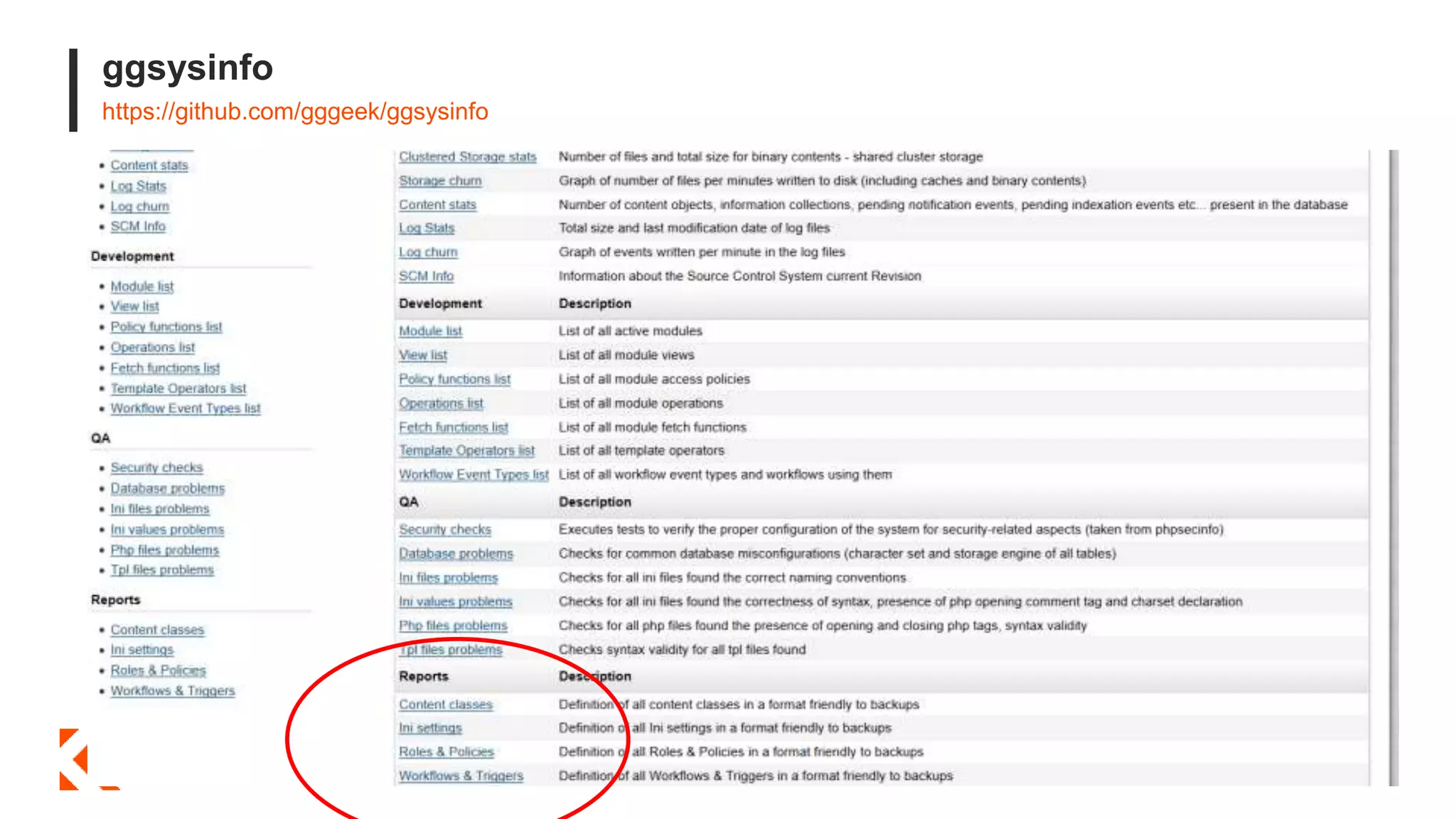
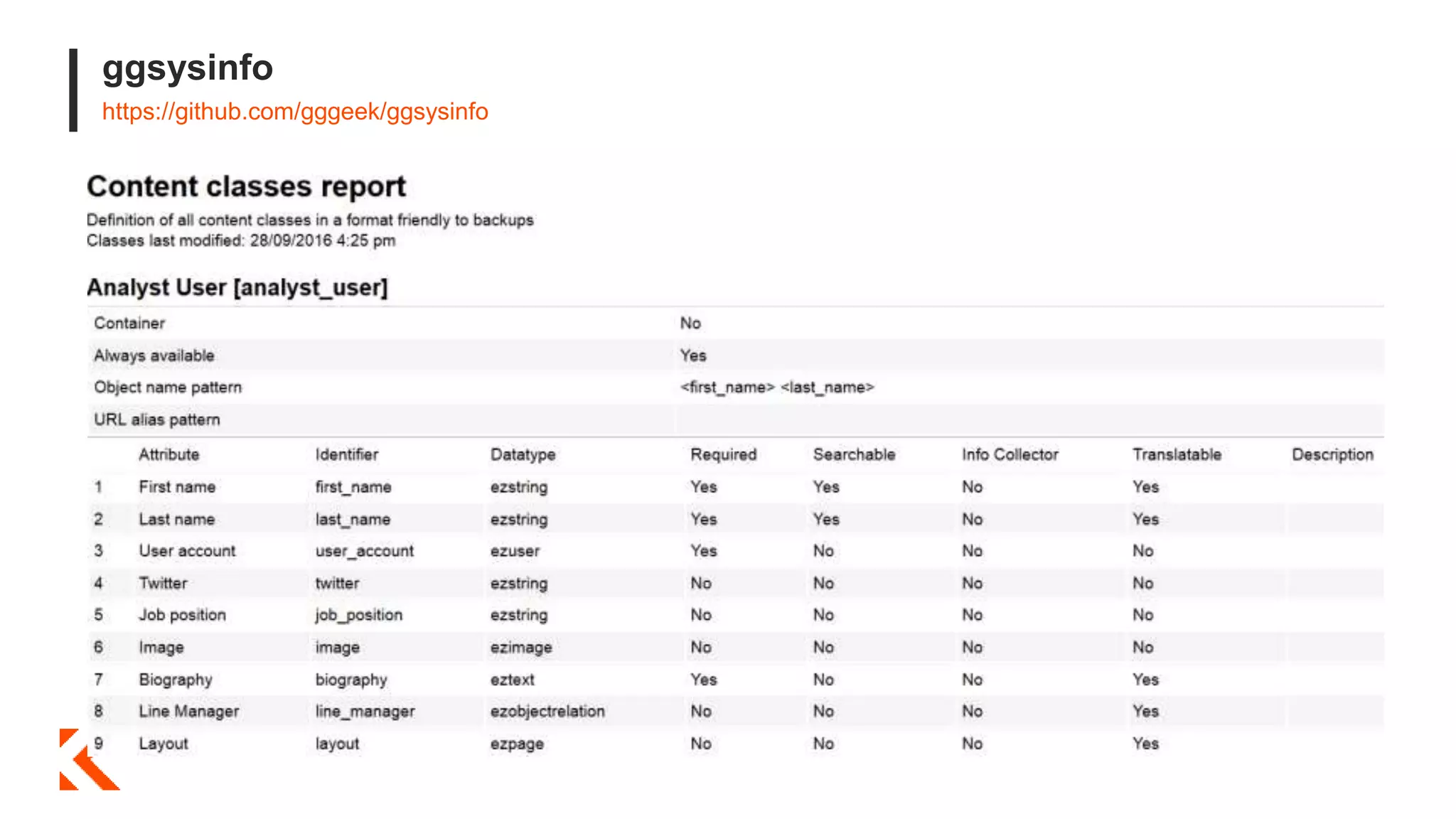
• Allows to export in a format easy to diff:
Content Types definitions
Roles and Policies definitions
Workflows and Triggers
ggsysinfo
https://github.com/gggeek/ggsysinfo
ggsysinfo
https://github.com/gggeek/ggsysinfo
ggsysinfo
https://github.com/gggeek/ggsysinfo
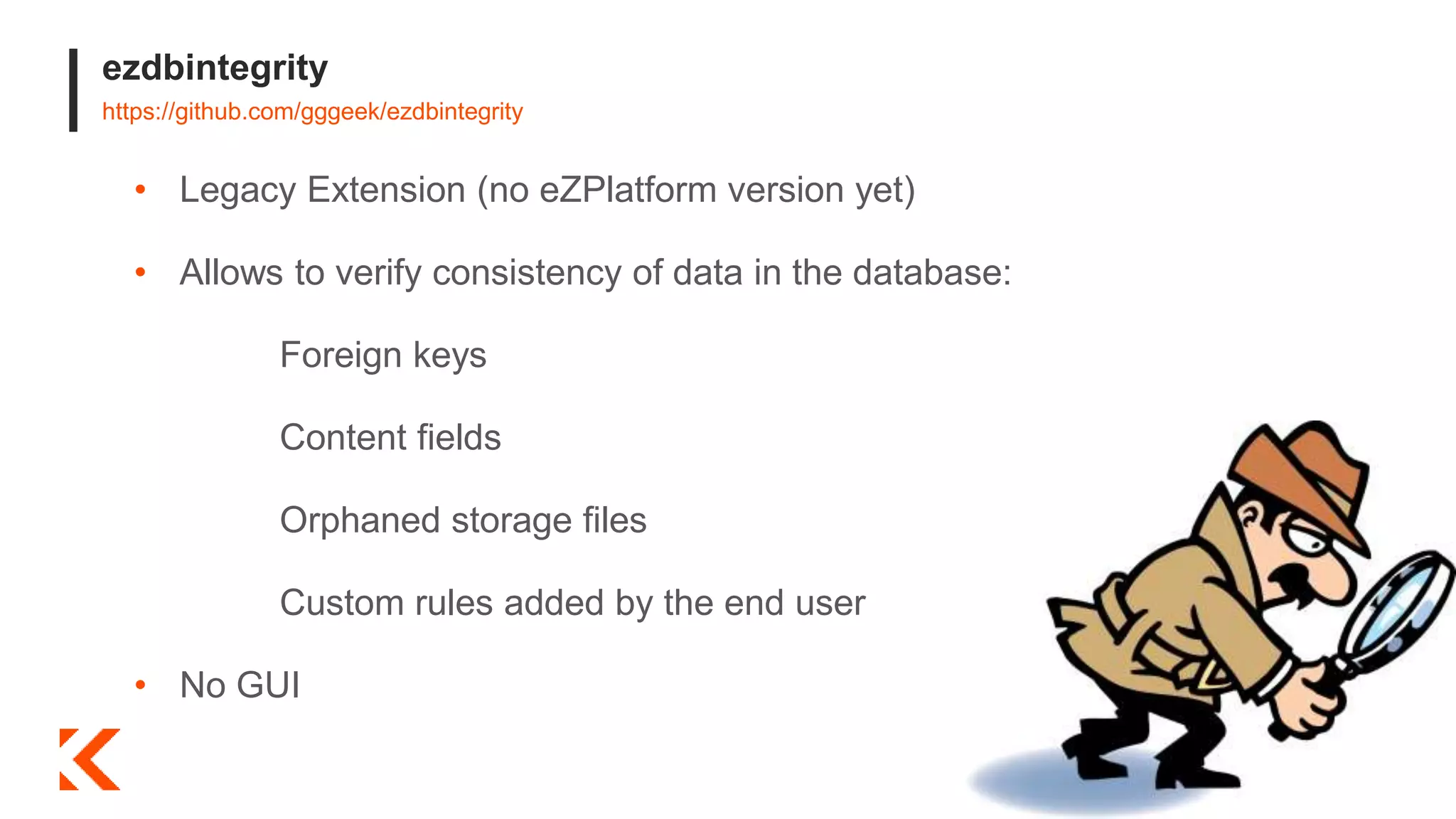
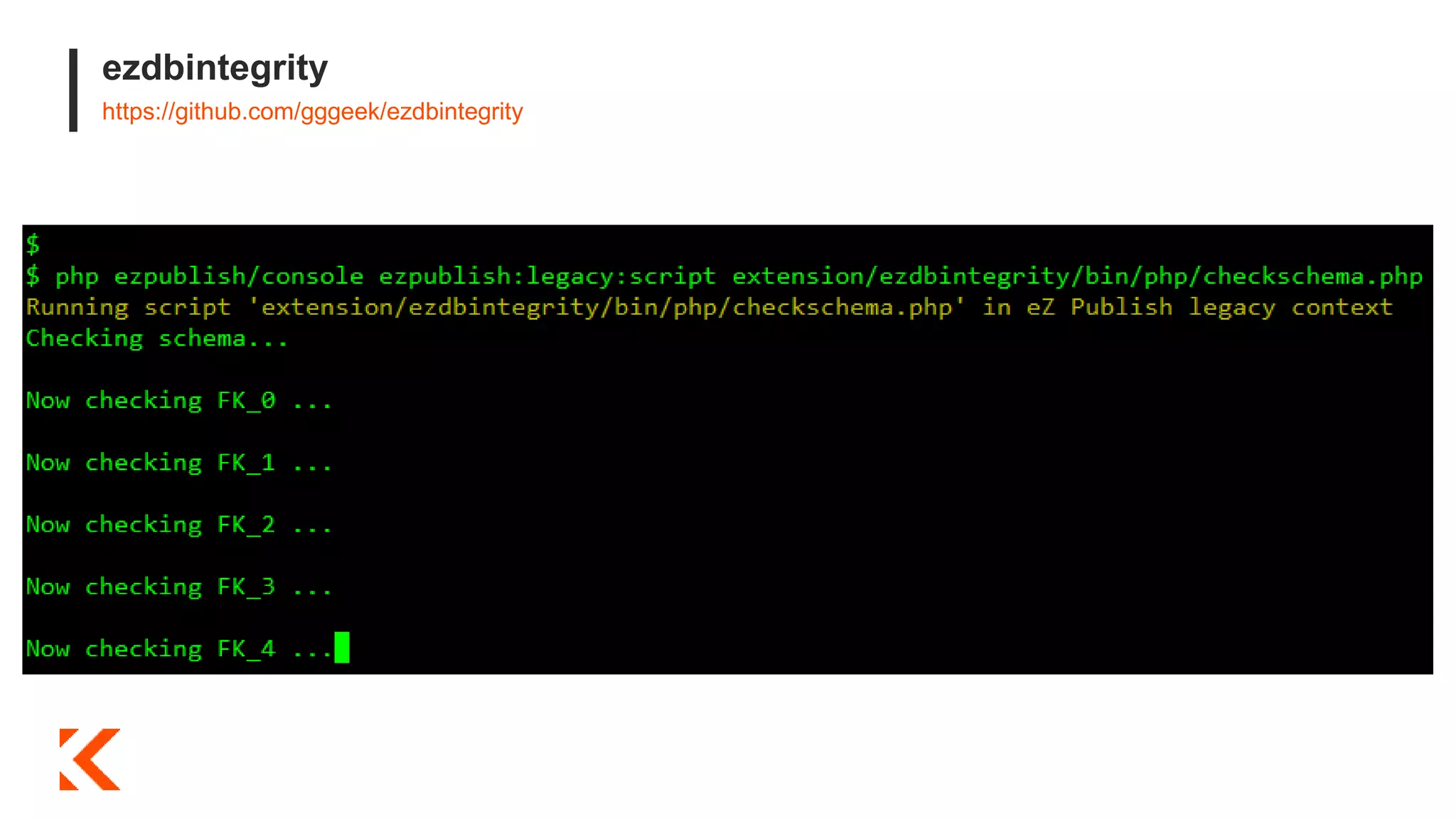
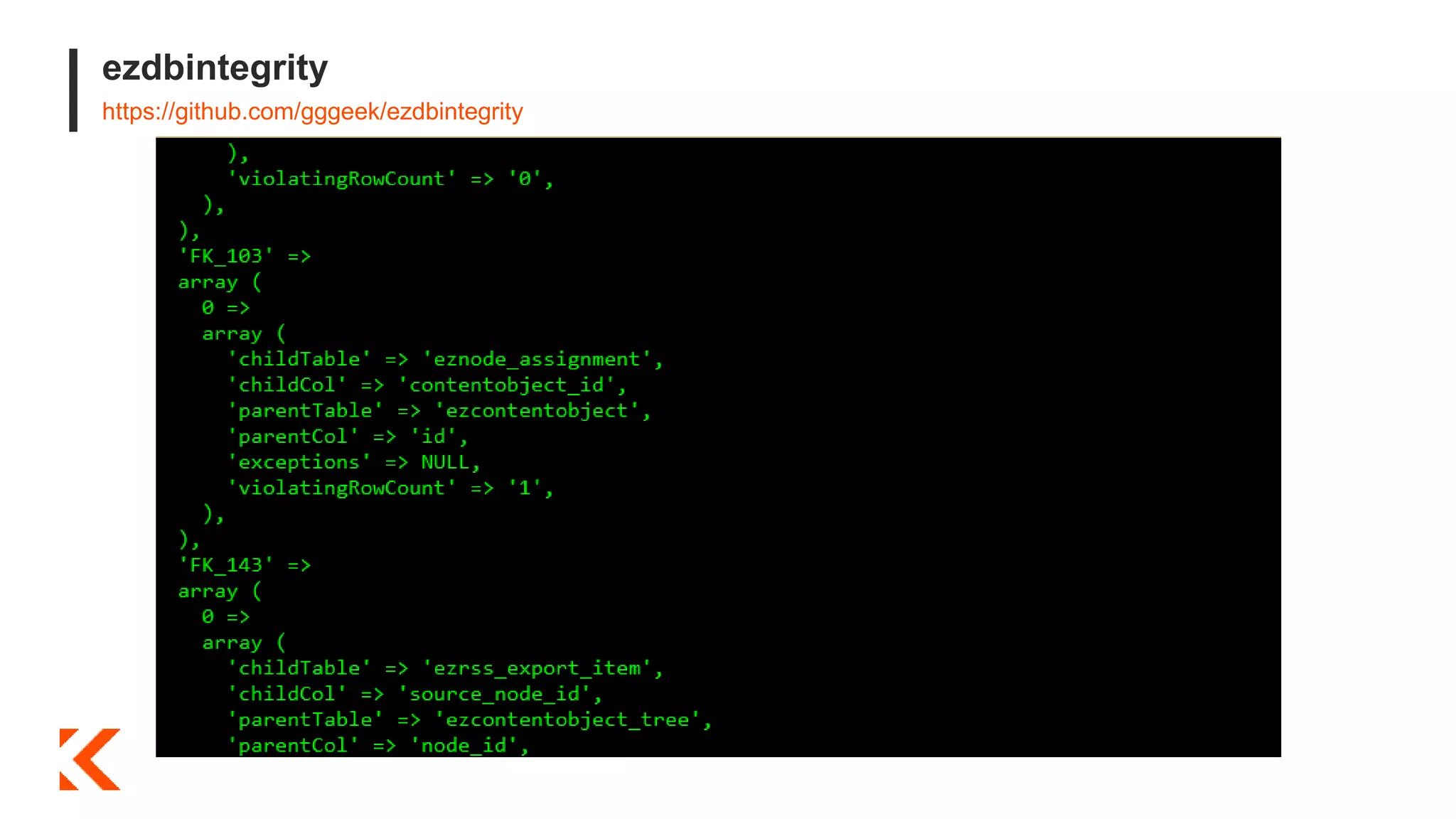
ezdbintegrity
https://github.com/gggeek/ezdbintegrity
• Legacy Extension (no eZPlatform version yet)
• Allows to verify consistency of data in the database:
Foreign keys
Content fields
Orphaned storage files
Custom rules added by the end user
• No GUI
ezdbintegrity
https://github.com/gggeek/ezdbintegrity
ezdbintegrity
https://github.com/gggeek/ezdbintegrity
Database as source code
C
Committing the database to git
• good for when the development database does not contain a
huge number of contents and assets
• good for when the development database does not change too
frequently
• developers might be working on different versions
of the db: needs some developer discipline
• works only up to the 1st deployment to UAT env;
then 2 dbs have to be managed anyway
Committing the database to git
TIPS
• Database export/import scripts have to developed
• Good idea: remove temporary data before export
• Bad idea: hardcode database passwords in the scripts
• Good idea: read the db passwords from the ezpublish configuration
“Kaliop eZPublish 5 installer”
• Good idea: have the script manage binary contents & clear caches
ex: github.com/kaliop-uk/websummercamp2016/tree/master/site/bin
Automated change control
D
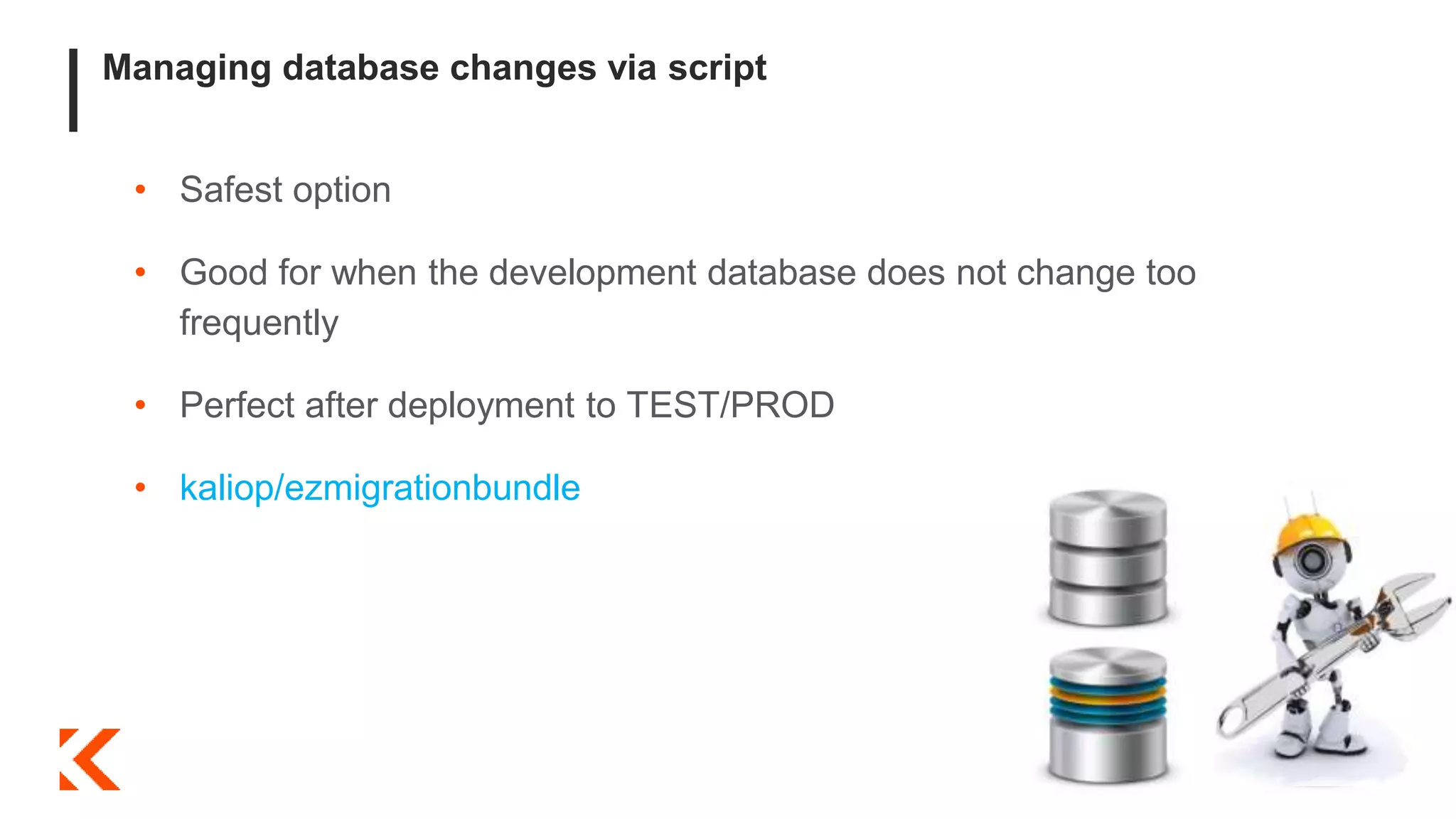
Managing database changes via script
• Safest option
• Good for when the development database does not change too
frequently
• Perfect after deployment to TEST/PROD
• kaliop/ezmigrationbundle
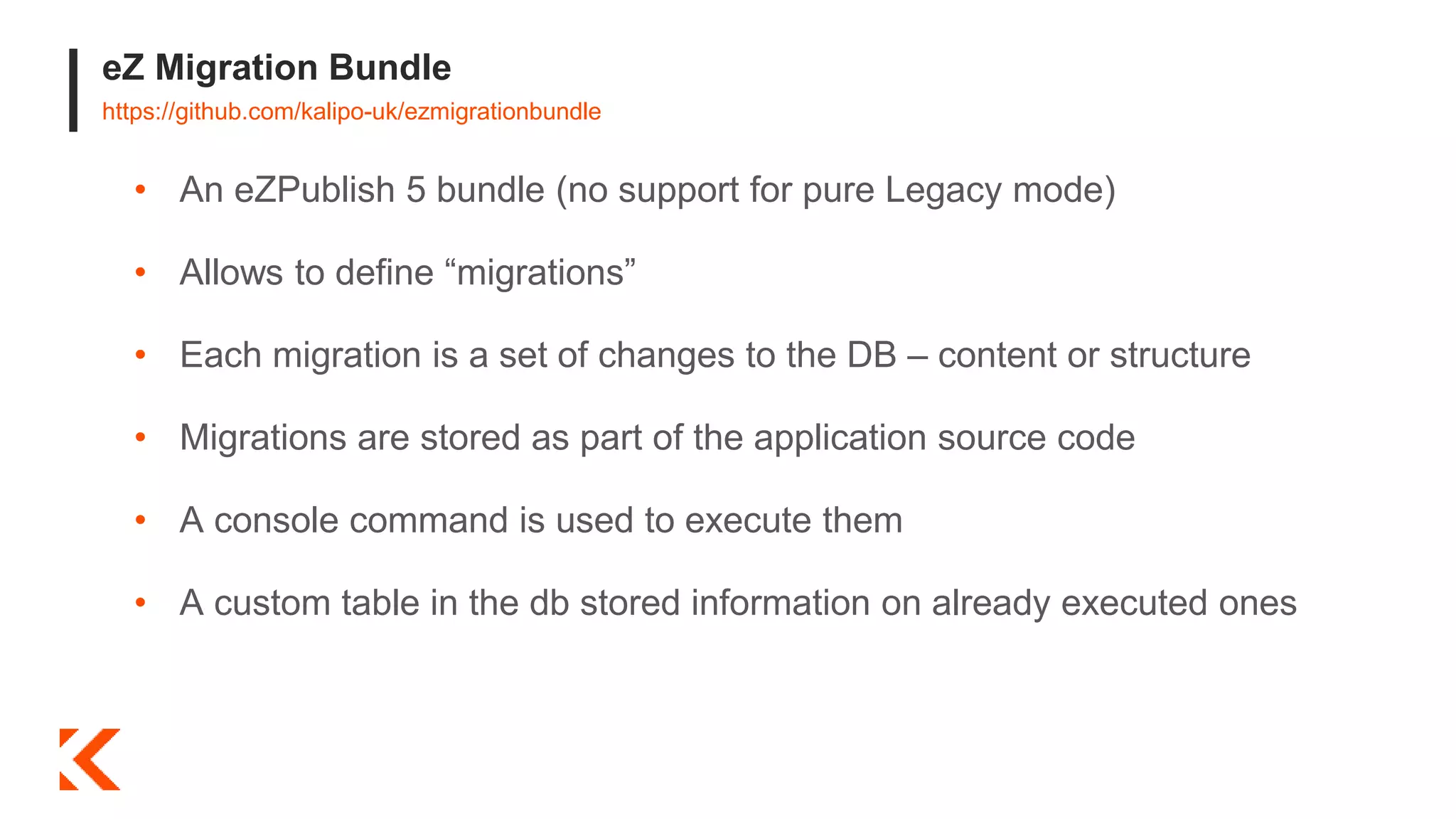
eZ Migration Bundle
https://github.com/kalipo-uk/ezmigrationbundle
• An eZPublish 5 bundle (no support for pure Legacy mode)
• Allows to define “migrations”
• Each migration is a set of changes to the DB – content or structure
• Migrations are stored as part of the application source code
• A console command is used to execute them
• A custom table in the db stored information on already executed ones
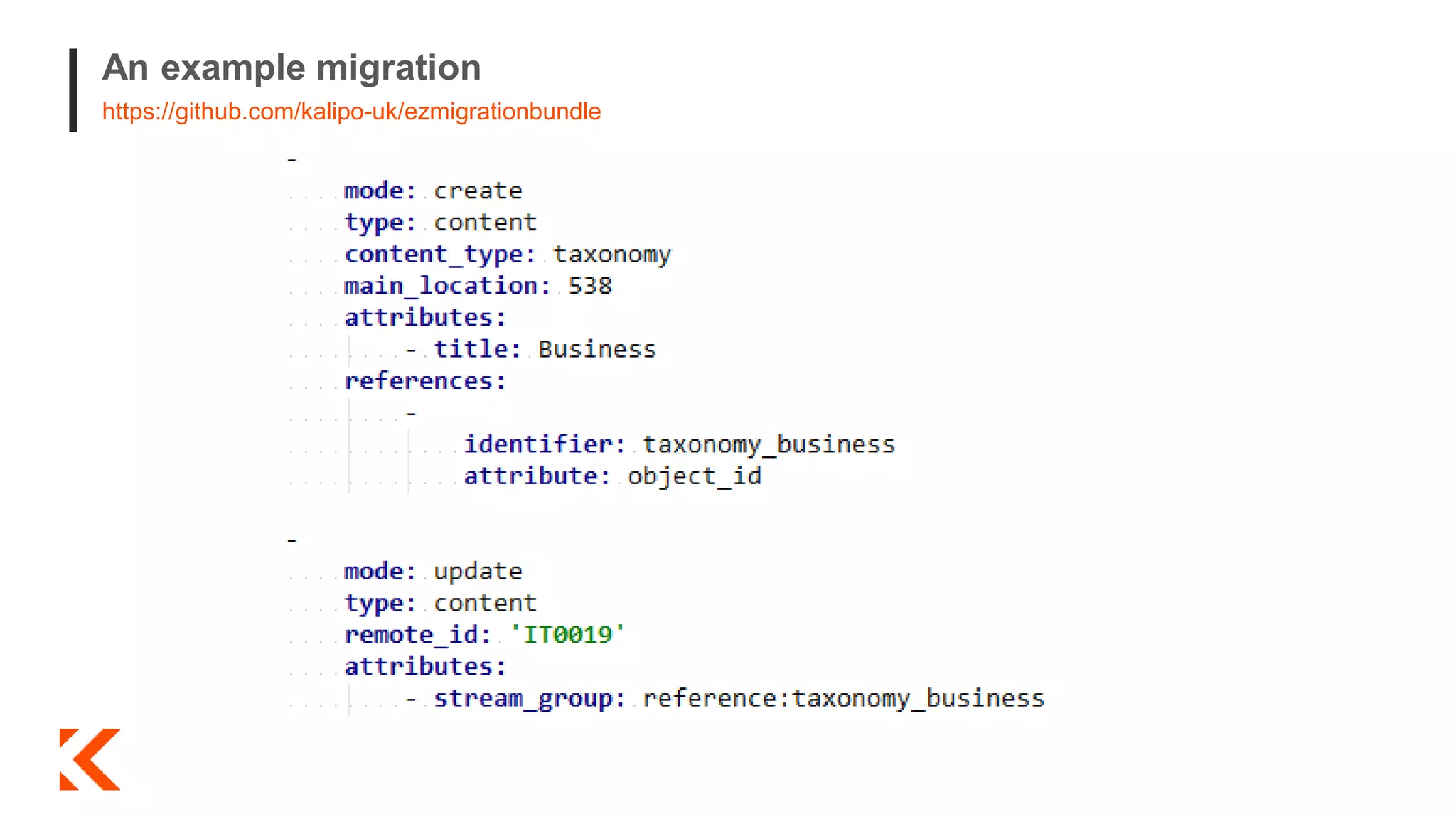
An example migration
https://github.com/kalipo-uk/ezmigrationbundle
What types of migrations are supported
https://github.com/kalipo-uk/ezmigrationbundle
• creation, update and deletion of Contents
• creation, update and deletion of Locations
• creation, update and deletion of Users
• creation, update and deletion of UserGroups
• creation, update and deletion of Roles
• creation, update and deletion of ContentTypes
• creation and deletion of Languages
• creation of Tags (from the Netgen Tags Bundle)
Cool features I
https://github.com/kalipo-uk/ezmigrationbundle
• Well documented (*)
• Stable: functional tests are run on Travis
• Future proof: based on the eZPublish Public API
* = opinions may vary
Cool features II
https://github.com/kalipo-uk/ezmigrationbundle
• Supports ids, identifiers and remote-ids to match elements
• Supports the concept of ‘references’ to anything which has just been
created/updated
• Update and delete operations can affect a whole set of
elements in a single pass
Cool features III
https://github.com/kalipo-uk/ezmigrationbundle
For more complex needs, two types of custom migrations:
• SQL files
• PHP classes with a simple Interface
Fully extensible using standard Symfony mechanisms
• Event listeners
• Tagged services
• Service definition takeover
Demo time
03
Going forward
04
Version 3 released today!
https://github.com/kalipo-uk/ezmigrationbundle
If the demo effect does not strike now…
Is your favourite feature missing?
https://github.com/kalipo-uk/ezmigrationbundle
The first brick is laid, many scenarios are possible
ex: allow a full ETL process / migrate across eZ installations
Feature requests and Bugs are managed on Github
Pull Requests are welcome
(thanks Lolautruche!)
THANK YOU
@gggeek
https://github.com/kaliop-uk
https://github.com/kaliop
http://www.kaliop.co.uk/info/ez.html

Managing changes to eZPublish Database

  • 1.
    Visuel à insérerici EZ CONFERENCE 2016 PARIS Managing Changes to the Database Across the Project Life Cycle
  • 2.
    WHO AM I Theshort version • « the guy who has written a lot of answers on the eZPublish forums » • Working at Kaliop in London since 2014 • Principal consultant at eZ Systems for 7 years • Love coffee and bicycles ? • @gggeek VOTRE SCHEMA
  • 3.
    WHAT THIS TALKIS ABOUT The short version, too
  • 4.
    Database vs. cmsvs. the project lifecycle 01
  • 5.
    Project life cycle •Development • Testing • Maintenance
  • 6.
    Development phase • Onlyone source of data: the “dev” db • Size of data set is generally small • Changes to content structure are frequent • Developers need to share the database (mostly the structure)
  • 7.
    Testing phase • Twosources of data: the “dev” and “test” db • Size of data set can be small or not • Changes to content structure are less frequent • Developers need to share the dev database • Controlled releases of changes from dev to test • The bulk of test “content” is not overwritten
  • 8.
    Maintenance phase • 3(or more) sources of data: the “dev”, “test” and “prod” db • Size of data set can be large • Changes to content structure are infrequent • Few developers need to share the dev database • Controlled releases of changes • Content might flow the opposite way than changes to structure: “copy prod to test”
  • 9.
    What we learned •Different needs during different phases of the project • Changes to Content and to Content-structure have different flows
  • 10.
    What the CMSbrings in • Content structure can be modified via the GUI!  • Many tables, with many relations • No foreign keys  (import scripts can break referential integrity) • Some data is tied to files stored on disk  (take care when doing backups!) • Impossible to replicate / sync single tables 
  • 11.
    Is it allfor the better? • Easy to deploy changes to Content Structure after go live Unless the changes takes hours to apply Will never cover 100% of the cases • Hard to automate • Hard to verify
  • 12.
    Managing database changes A.I connect to the Admin Interface B. A solved problem 02
  • 13.
    Keeping Databases insync Many possibilities: A. All developers connect to the same db B. Managing changes manually C. The database is committed to git D. Managing changes via scripts E. Live DB replication (really ???) F. More ?
  • 14.
    A single, shareddatabase A
  • 15.
    Connecting to ashared database • good for teams which are *not* geographically distributed • works when developers do not blow up the database with junk content: needs some developer discipline • works only up to the 1st deployment to TEST env; then 2 dbs have to be managed anyway
  • 16.
  • 17.
    Managing database changesmanually • Changes to be applied are documented and applied via GUI • Most Unsafe Option (TM) • Some tools to help you to keep mental sanity: ggsysinfo ezdbintegrity
  • 18.
    ggsysinfo https://github.com/gggeek/ggsysinfo • Legacy Extension(no eZPlatform version yet) • Allows to export in a format easy to diff: Content Types definitions Roles and Policies definitions Workflows and Triggers
  • 19.
  • 20.
  • 21.
  • 22.
    ezdbintegrity https://github.com/gggeek/ezdbintegrity • Legacy Extension(no eZPlatform version yet) • Allows to verify consistency of data in the database: Foreign keys Content fields Orphaned storage files Custom rules added by the end user • No GUI
  • 23.
  • 24.
  • 25.
  • 26.
    Committing the databaseto git • good for when the development database does not contain a huge number of contents and assets • good for when the development database does not change too frequently • developers might be working on different versions of the db: needs some developer discipline • works only up to the 1st deployment to UAT env; then 2 dbs have to be managed anyway
  • 27.
    Committing the databaseto git TIPS • Database export/import scripts have to developed • Good idea: remove temporary data before export • Bad idea: hardcode database passwords in the scripts • Good idea: read the db passwords from the ezpublish configuration “Kaliop eZPublish 5 installer” • Good idea: have the script manage binary contents & clear caches ex: github.com/kaliop-uk/websummercamp2016/tree/master/site/bin
  • 28.
  • 29.
    Managing database changesvia script • Safest option • Good for when the development database does not change too frequently • Perfect after deployment to TEST/PROD • kaliop/ezmigrationbundle
  • 30.
    eZ Migration Bundle https://github.com/kalipo-uk/ezmigrationbundle •An eZPublish 5 bundle (no support for pure Legacy mode) • Allows to define “migrations” • Each migration is a set of changes to the DB – content or structure • Migrations are stored as part of the application source code • A console command is used to execute them • A custom table in the db stored information on already executed ones
  • 31.
  • 32.
    What types ofmigrations are supported https://github.com/kalipo-uk/ezmigrationbundle • creation, update and deletion of Contents • creation, update and deletion of Locations • creation, update and deletion of Users • creation, update and deletion of UserGroups • creation, update and deletion of Roles • creation, update and deletion of ContentTypes • creation and deletion of Languages • creation of Tags (from the Netgen Tags Bundle)
  • 33.
    Cool features I https://github.com/kalipo-uk/ezmigrationbundle •Well documented (*) • Stable: functional tests are run on Travis • Future proof: based on the eZPublish Public API * = opinions may vary
  • 34.
    Cool features II https://github.com/kalipo-uk/ezmigrationbundle •Supports ids, identifiers and remote-ids to match elements • Supports the concept of ‘references’ to anything which has just been created/updated • Update and delete operations can affect a whole set of elements in a single pass
  • 35.
    Cool features III https://github.com/kalipo-uk/ezmigrationbundle Formore complex needs, two types of custom migrations: • SQL files • PHP classes with a simple Interface Fully extensible using standard Symfony mechanisms • Event listeners • Tagged services • Service definition takeover
  • 36.
  • 37.
  • 38.
    Version 3 releasedtoday! https://github.com/kalipo-uk/ezmigrationbundle If the demo effect does not strike now…
  • 39.
    Is your favouritefeature missing? https://github.com/kalipo-uk/ezmigrationbundle The first brick is laid, many scenarios are possible ex: allow a full ETL process / migrate across eZ installations Feature requests and Bugs are managed on Github Pull Requests are welcome (thanks Lolautruche!)
  • 40.

Editor's Notes

  • #4 do I even have to explain why ?
  • #22 Easy to automate