GABRIELLE CLARK
November 28,
2017
Viral Genotyping of Hepatit
INTRO TO HEPATITIS C
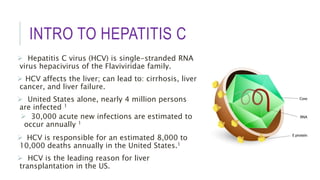
 Hepatitis C virus (HCV) is single-stranded RNA
virus hepacivirus of the Flaviviridae family.
 HCV affects the liver; can lead to: cirrhosis, liver
cancer, and liver failure.
 United States alone, nearly 4 million persons
are infected 1
 30,000 acute new infections are estimated to
occur annually 1
 HCV is responsible for an estimated 8,000 to
10,000 deaths annually in the United States.1
 HCV is the leading reason for liver
transplantation in the US.
INTRO TO HEPATITIS C
There are two main types of
hepatitis C:
Acute hepatitis C
Short-term- lasting only six
months or less
Chronic hepatitis C
Can last for one's entire life

HCV GENOTYPES
 The ability of the virus to mutate has resulted in the existence of
different genetic variations of HCV
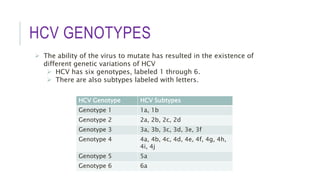
 HCV has six genotypes, labeled 1 through 6.
 There are also subtypes labeled with letters.
HCV Genotype HCV Subtypes
Genotype 1 1a, 1b
Genotype 2 2a, 2b, 2c, 2d
Genotype 3 3a, 3b, 3c, 3d, 3e, 3f
Genotype 4 4a, 4b, 4c, 4d, 4e, 4f, 4g, 4h,
4i, 4j
Genotype 5 5a
Genotype 6 6a
HCV GENOTYPES
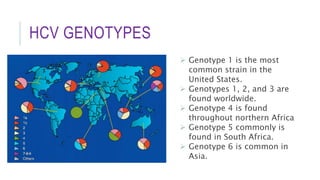
 Genotype 1 is the most
common strain in the
United States.
 Genotypes 1, 2, and 3 are
found worldwide.
 Genotype 4 is found
throughout northern Africa
 Genotype 5 commonly is
found in South Africa.
 Genotype 6 is common in
Asia.
HCV GENOTYPES
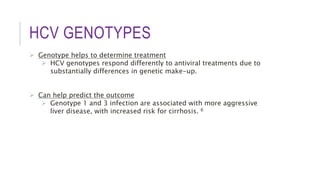
 Genotype helps to determine treatment
 HCV genotypes respond differently to antiviral treatments due to
substantially differences in genetic make-up.
 Can help predict the outcome
 Genotype 1 and 3 infection are associated with more aggressive
liver disease, with increased risk for cirrhosis. 6
“GOLDEN STANDARD”
Molecular Genotyping
1) Genomic amplification
through polymerase chain
reaction
2) Sequencing of a specific
amplified portion of the HCV
genome obtained from the
patient
(NS5, core, E1, and 5’ UTRs
region)
3) Phylogenetic tree analysis
confirmation
“GOLDEN STANDARD "LIMITATIONS
1) The amplification of some genomic regions may not be efficient. 2
2) If population template sequencing is employed, the predominant HCV
genotype will be revealed in patients with mixed infection. 2
3) When a large number of isolates are studied, the assignment of some
isolates may not be clear cut. 2
4) Expensive and labor intensive, making it difficult to study HCV
genotypes in a large number of patients.
ALTERNATIVE METHODS
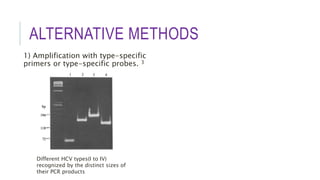
1) Amplification with type-specific
primers or type-specific probes. 3
Different HCV types(I to IV)
recognized by the distinct sizes of
their PCR products
ALTERNATIVE METHODS
1) Amplification with type-specific
primers or type-specific probes. 3
2) Line probe assay (LiPA)- allows
discrimination of HCV types and
subtypes  capable of detecting
single nucleotide differences in 5’
UTR. 4
Different HCV types(I to IV)
recognized by the distinct sizes of
their PCR products
ALTERNATIVE METHODS
2) Line probe assay (LiPA)- allows
discrimination of HCV types and
subtypes  capable of detecting
single nucleotide differences in 5’
UTR. 4
HCV GENOTYPE AND RESPONSE
TO THERAPY
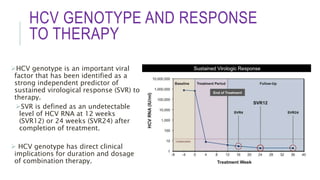
HCV genotype is an important viral
factor that has been identified as a
strong independent predictor of
sustained virological response (SVR) to
therapy.
SVR is defined as an undetectable
level of HCV RNA at 12 weeks
(SVR12) or 24 weeks (SVR24) after
completion of treatment.
 HCV genotype has direct clinical
implications for duration and dosage
of combination therapy.
HCV GENOTYPE AND RESPONSE
TO THERAPY
An important breakthrough in the treatment of chronic HCV
infection includes standard or pegylated interferon-α (IFN-α)
administered as a monotherapy or in combination with ribavirin.7
Response to IFN-α therapy differs among HCV genotypes
Response rates among patients with genotypes 2 and 3 observed
to be two- to threefold higher than in individuals infected with
genotype 1. 8
The limited efficacy of IFN-α to block viral replication and the
reduced rate of sustained HCV clearance observed in patients
infected with HCV genotype 1. 9
Therapy for patients with infected with genotypes 2 or 3 has been
optimized for a duration of 24 weeks rather than the 48 weeks
10
HCV GENOTYPE AND RESPONSE
TO THERAPY
New treatment option - Direct acting antivirals (DAA)- high efficacy
and well-tolerated medications with high cure rates
DAAs are molecules that target specific nonstructural proteins of the virus and
results in disruption of viral replication and infection.
The first approved DAAs, telaprevir and boceprevir, were
introduced in 2011 for the treatment of HCV genotype 1 infection.
Use of telaprevir and boceprevir in combination with pegylated
IFN-α and ribavirin  led to achievement of SVR rates in 65%–75%
of patients with HCV genotype 1. 11
Treatment durations are adapted from the 2015 guidelines of the American Association for the
Study of Liver Diseases (AASLD) (50) and European Association for the Study of the Liver (EASL)
(51).
Thank
You
REFERENCES
1. National Institutes of Health Consensus Development Conference Panel. 1997. National Institutes of Health Consensus Development
Conference Panel statement: management of hepatitis C. Hepatology 26(Suppl. 1):2S–10S.
2. Zeuzem S, Franke A, Lee JH, Herrmann G, Ruster B, Roth WK. Phylogenetic analysis of hepatitis C virus isolates and their correlation to
viremia, liver function tests and histology. Hepatology 1996.
3. H. Okamoto, Y. Sugiyama, S. Okada, K.Kurai, Y. Akahane, Y. Sugai, T. Tanaka, K.Sato, F. Tsuda, Y. Miyakawa, et al.Typing hepatitis C
virus by polymerase chain reaction with type-specific primers: application to clinical surveys and tracing infectious sources. J. Gen.
Virol., 73 (Pt 3) (1992), pp. 673-679
4. L. Stuyver, A. Wyseur, W. van Arnhem, F.Hernandez, G. MaertensSecond-generation line probe assay for hepatitis C virus genotyping.
J. Clin. Microbiol., 34 (1996), pp. 2259-2266
5. E.N. Ilina, M.V. Malakhova, E.V.Generozov, E.N. Nikolaev, V.M. GovorunMatrix-assisted laser desorption ionization-time of flight
(mass spectrometry) for hepatitis C virus genotyping. J. Clin. Microbiol., 43 (2005), pp. 2810-2815
6. Chopra S. Characteristics of the hepatitis C virus. Uptodate. Edwards MS, Di Bisceglie AM, Bloom A, eds. Accessed at:
www.uptodate.com. 2014.
7. McHutchison JG & Fried MW. Current therapy for hepatitis C: pegylated interferon and ribavirin. Clinical Liver Disease 2003; 7:149–
161.
8. Poynard T, Marcellin P, Lee SS, Niederau C, Minuk GS, Ideo G, Bain V, Heathcote J, Zeuzem S, Trepo C & Albrecht J. Randomised trial of
interferon alpha2b plus ribavirin for 48 weeks or for 24 weeks versus interferon alpha2b plus placebo for 48 weeks for treatment of
chronic infection with hepatitis C virus. International Hepatitis Interventional Therapy Group (IHIT). Lancet 1998; 352:1426–1432.
9. Hadziyannis SJ, Sette H Jr, Morgan TR, Balan V, Diago M, Marcellin P, Ramadori G, Bodenheimer H Jr, Bernstein D, Rizzetto M, Zeuzem
S, Pockros PJ, Lin A & Ackrill AM. Peginterferon-alpha2a and ribavirin combination therapy in chronic hepatitis C: a randomized study
of treatment duration and ribavirin dose. Annals of Internal Medicine 2004; 140:346–355.
10. Seeff LB & Hoofnagle JH. Appendix: The National Institutes of Health Consensus Development Conference Management of Hepatitis C
2002. Clinical Liver Disease 2003; 7:261–287.
11. European Association for Study of Liver. EASL recommendations on treat- ment of hepatitis C 2015. J Hepatol 2015;63:199–236.

Hcv genotyping

  • 1.
  • 2.
    INTRO TO HEPATITISC  Hepatitis C virus (HCV) is single-stranded RNA virus hepacivirus of the Flaviviridae family.  HCV affects the liver; can lead to: cirrhosis, liver cancer, and liver failure.  United States alone, nearly 4 million persons are infected 1  30,000 acute new infections are estimated to occur annually 1  HCV is responsible for an estimated 8,000 to 10,000 deaths annually in the United States.1  HCV is the leading reason for liver transplantation in the US.
  • 3.
    INTRO TO HEPATITISC There are two main types of hepatitis C: Acute hepatitis C Short-term- lasting only six months or less Chronic hepatitis C Can last for one's entire life 
  • 4.
    HCV GENOTYPES  Theability of the virus to mutate has resulted in the existence of different genetic variations of HCV  HCV has six genotypes, labeled 1 through 6.  There are also subtypes labeled with letters. HCV Genotype HCV Subtypes Genotype 1 1a, 1b Genotype 2 2a, 2b, 2c, 2d Genotype 3 3a, 3b, 3c, 3d, 3e, 3f Genotype 4 4a, 4b, 4c, 4d, 4e, 4f, 4g, 4h, 4i, 4j Genotype 5 5a Genotype 6 6a
  • 5.
    HCV GENOTYPES  Genotype1 is the most common strain in the United States.  Genotypes 1, 2, and 3 are found worldwide.  Genotype 4 is found throughout northern Africa  Genotype 5 commonly is found in South Africa.  Genotype 6 is common in Asia.
  • 6.
    HCV GENOTYPES  Genotypehelps to determine treatment  HCV genotypes respond differently to antiviral treatments due to substantially differences in genetic make-up.  Can help predict the outcome  Genotype 1 and 3 infection are associated with more aggressive liver disease, with increased risk for cirrhosis. 6
  • 8.
    “GOLDEN STANDARD” Molecular Genotyping 1)Genomic amplification through polymerase chain reaction 2) Sequencing of a specific amplified portion of the HCV genome obtained from the patient (NS5, core, E1, and 5’ UTRs region) 3) Phylogenetic tree analysis confirmation
  • 9.
    “GOLDEN STANDARD "LIMITATIONS 1)The amplification of some genomic regions may not be efficient. 2 2) If population template sequencing is employed, the predominant HCV genotype will be revealed in patients with mixed infection. 2 3) When a large number of isolates are studied, the assignment of some isolates may not be clear cut. 2 4) Expensive and labor intensive, making it difficult to study HCV genotypes in a large number of patients.
  • 10.
    ALTERNATIVE METHODS 1) Amplificationwith type-specific primers or type-specific probes. 3 Different HCV types(I to IV) recognized by the distinct sizes of their PCR products
  • 11.
    ALTERNATIVE METHODS 1) Amplificationwith type-specific primers or type-specific probes. 3 2) Line probe assay (LiPA)- allows discrimination of HCV types and subtypes  capable of detecting single nucleotide differences in 5’ UTR. 4 Different HCV types(I to IV) recognized by the distinct sizes of their PCR products
  • 12.
    ALTERNATIVE METHODS 2) Lineprobe assay (LiPA)- allows discrimination of HCV types and subtypes  capable of detecting single nucleotide differences in 5’ UTR. 4
  • 13.
    HCV GENOTYPE ANDRESPONSE TO THERAPY HCV genotype is an important viral factor that has been identified as a strong independent predictor of sustained virological response (SVR) to therapy. SVR is defined as an undetectable level of HCV RNA at 12 weeks (SVR12) or 24 weeks (SVR24) after completion of treatment.  HCV genotype has direct clinical implications for duration and dosage of combination therapy.
  • 14.
    HCV GENOTYPE ANDRESPONSE TO THERAPY An important breakthrough in the treatment of chronic HCV infection includes standard or pegylated interferon-α (IFN-α) administered as a monotherapy or in combination with ribavirin.7 Response to IFN-α therapy differs among HCV genotypes Response rates among patients with genotypes 2 and 3 observed to be two- to threefold higher than in individuals infected with genotype 1. 8 The limited efficacy of IFN-α to block viral replication and the reduced rate of sustained HCV clearance observed in patients infected with HCV genotype 1. 9 Therapy for patients with infected with genotypes 2 or 3 has been optimized for a duration of 24 weeks rather than the 48 weeks 10
  • 15.
    HCV GENOTYPE ANDRESPONSE TO THERAPY New treatment option - Direct acting antivirals (DAA)- high efficacy and well-tolerated medications with high cure rates DAAs are molecules that target specific nonstructural proteins of the virus and results in disruption of viral replication and infection. The first approved DAAs, telaprevir and boceprevir, were introduced in 2011 for the treatment of HCV genotype 1 infection. Use of telaprevir and boceprevir in combination with pegylated IFN-α and ribavirin  led to achievement of SVR rates in 65%–75% of patients with HCV genotype 1. 11
  • 16.
    Treatment durations areadapted from the 2015 guidelines of the American Association for the Study of Liver Diseases (AASLD) (50) and European Association for the Study of the Liver (EASL) (51).
  • 17.
  • 18.
    REFERENCES 1. National Institutesof Health Consensus Development Conference Panel. 1997. National Institutes of Health Consensus Development Conference Panel statement: management of hepatitis C. Hepatology 26(Suppl. 1):2S–10S. 2. Zeuzem S, Franke A, Lee JH, Herrmann G, Ruster B, Roth WK. Phylogenetic analysis of hepatitis C virus isolates and their correlation to viremia, liver function tests and histology. Hepatology 1996. 3. H. Okamoto, Y. Sugiyama, S. Okada, K.Kurai, Y. Akahane, Y. Sugai, T. Tanaka, K.Sato, F. Tsuda, Y. Miyakawa, et al.Typing hepatitis C virus by polymerase chain reaction with type-specific primers: application to clinical surveys and tracing infectious sources. J. Gen. Virol., 73 (Pt 3) (1992), pp. 673-679 4. L. Stuyver, A. Wyseur, W. van Arnhem, F.Hernandez, G. MaertensSecond-generation line probe assay for hepatitis C virus genotyping. J. Clin. Microbiol., 34 (1996), pp. 2259-2266 5. E.N. Ilina, M.V. Malakhova, E.V.Generozov, E.N. Nikolaev, V.M. GovorunMatrix-assisted laser desorption ionization-time of flight (mass spectrometry) for hepatitis C virus genotyping. J. Clin. Microbiol., 43 (2005), pp. 2810-2815 6. Chopra S. Characteristics of the hepatitis C virus. Uptodate. Edwards MS, Di Bisceglie AM, Bloom A, eds. Accessed at: www.uptodate.com. 2014. 7. McHutchison JG & Fried MW. Current therapy for hepatitis C: pegylated interferon and ribavirin. Clinical Liver Disease 2003; 7:149– 161. 8. Poynard T, Marcellin P, Lee SS, Niederau C, Minuk GS, Ideo G, Bain V, Heathcote J, Zeuzem S, Trepo C & Albrecht J. Randomised trial of interferon alpha2b plus ribavirin for 48 weeks or for 24 weeks versus interferon alpha2b plus placebo for 48 weeks for treatment of chronic infection with hepatitis C virus. International Hepatitis Interventional Therapy Group (IHIT). Lancet 1998; 352:1426–1432. 9. Hadziyannis SJ, Sette H Jr, Morgan TR, Balan V, Diago M, Marcellin P, Ramadori G, Bodenheimer H Jr, Bernstein D, Rizzetto M, Zeuzem S, Pockros PJ, Lin A & Ackrill AM. Peginterferon-alpha2a and ribavirin combination therapy in chronic hepatitis C: a randomized study of treatment duration and ribavirin dose. Annals of Internal Medicine 2004; 140:346–355. 10. Seeff LB & Hoofnagle JH. Appendix: The National Institutes of Health Consensus Development Conference Management of Hepatitis C 2002. Clinical Liver Disease 2003; 7:261–287. 11. European Association for Study of Liver. EASL recommendations on treat- ment of hepatitis C 2015. J Hepatol 2015;63:199–236.

Editor's Notes

  • #4 There are two main types of hepatitis C • Acute hepatitis C and • Chronic hepatitis C The length of time you may experience symptoms will depend on the type of infection you have. With acute hepatitis C, the symptoms are more short-term, lasting only six months or less. Acute hepatitis, however, can lead to another type of hepatitis, chronic hepatitis. Chronic hepatitis can last for one's entire life because it's very difficult for the body to get rid of the virus.
  • #5 The HCV genotype isn’t absolutely related to the rate of liver damage, or the likelihood of eventually developing cirrhosis. However, it can help predict the outcome of treatment. The genotype can help predict the outcome of anti-HCV therapy with interferon-based treatment regimens. Genotype has also helped to determine treatment. In some formulations, the recommended doses of ribavirin and pegylated interferon (PEG) are for people with specific HCV genotypes. different genotypes respond differently to medicines that treat and cure HCV. Genotype assignment helps in disease prognosis and assists in establishing the appropriate duration of treatment. More than 10 types and 70 subtypes of HCV have been described.
  • #6 The HCV genotype isn’t absolutely related to the rate of liver damage, or the likelihood of eventually developing cirrhosis. However, it can help predict the outcome of treatment. The genotype can help predict the outcome of anti-HCV therapy with interferon-based treatment regimens. Genotype has also helped to determine treatment. In some formulations, the recommended doses of ribavirin and pegylated interferon (PEG) are for people with specific HCV genotypes. different genotypes respond differently to medicines that treat and cure HCV. Genotype assignment helps in disease prognosis and assists in establishing the appropriate duration of treatment. More than 10 types and 70 subtypes of HCV have been described.
  • #7 Treatment durations are adapted from the 2015 guidelines of the American Association for the Study of Liver Diseases (AASLD) (50) and European Association for the Study of the Liver (EASL) (51). səˈrōsəs/
  • #8 https://www.youtube.com/watch?v=DLYaRBzuLpk NS5 – regulator protien
  • #9 The reference standard and most definitive method for determining genotype involves the direct sequencing of a specific polymerase chain reaction (PCR)-amplified portion of the viral genome obtained from a patient sample, followed by phyloge- netic analysis. The NS5, core, E1 and 5′ UTR regions of the HCV genome have been used to determine viral genotype using this method
  • #10  However, alternative methods that offer rapid and cost-effective genotyping are more suitable for clinical use.
  • #15 Ryebavirin
  • #16 Tell-ay-previr Bose-previr
  • #17 Hepatitis C Virus: A Review of Treatment Guidelines, Cost-effectiveness, and Access to Therapy here are four classes of DAAs, which are defined by their mechanism of action and therapeutic target. The four classes are nonstructural proteins 3/4A (NS3/4A) protease inhibitors (PIs), NS5B nucleoside polymerase inhibitors (NPIs), NS5B non-nucleoside polymerase inhibitors (NNPIs), and NS5A inhibitors 
  • #18 Hepatitis C Virus: A Review of Treatment Guidelines, Cost-effectiveness, and Access to Therapy here are four classes of DAAs, which are defined by their mechanism of action and therapeutic target. The four classes are nonstructural proteins 3/4A (NS3/4A) protease inhibitors (PIs), NS5B nucleoside polymerase inhibitors (NPIs), NS5B non-nucleoside polymerase inhibitors (NNPIs), and NS5A inhibitors