SEDATIVE-HYPNOTIC
DRUGS
Anita Q. Sangalang, MD, FPOGS
FACULTY OF PHARMACY
UNIVERSITY OF SANTO TOMAS
SEDATIVE-HYPNOTIC DRUGS
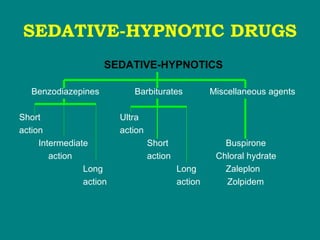
SEDATIVE-HYPNOTICS
Benzodiazepines Barbiturates Miscellaneous agents
Short Ultra
action action
Intermediate Short Buspirone
action action Chloral hydrate
Long Long Zaleplon
action action Zolpidem
SEDATIVE-HYPNOTIC DRUGS
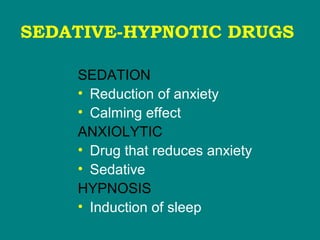
SEDATION
• Reduction of anxiety
• Calming effect
ANXIOLYTIC
• Drug that reduces anxiety
• Sedative
HYPNOSIS
• Induction of sleep
SEDATIVE-HYPNOTIC DRUGS
• Lipid soluble
• Absorbed well from the GIT
• Good distribution to the brain
• Metabolized before elimination from
the body by hepatic enzymes
SEDATIVE-HYPNOTIC DRUGS
BENZODIAZEPINES
• Converted initially to active metabolites
with long half-lives
• Diazepam and flurazepam
 After several days of therapy
accumulation of active metabolites
can lead to excessive sedation
SEDATIVE-HYPNOTIC DRUGS
BENZODIAZEPINES
• Lorazepam and oxazepam
 Undergo extrahepatic conjugation
and do not form active metabolites
SEDATIVE-HYPNOTIC DRUGS
BENZODIAZEPINES
• Bz receptors
 Form part of GABAA receptor-chloride
ion channel macromolecular structure
 Binding facilitates the inhibitory actions
of GABA
 Increased GABA mediated chloride ion
conductance
SEDATIVE-HYPNOTIC DRUGS
BENZODIAZEPINES
• Flumazenil
 Reverses the CNS effects of
benzodiazepines
 Antagonist at the Bz receptor
SEDATIVE-HYPNOTIC DRUGS
BENZODIAZEPINES
• Beta-carbolines
 High affinity for Bz receptors
 Can elicit anxiogenic and convulsant
effects
 Inverse agonists
SEDATIVE-HYPNOTIC DRUGS
BENZODIAZEPINES
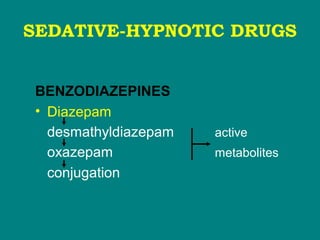
• Diazepam
desmathyldiazepam active
oxazepam metabolites
conjugation
SEDATIVE-HYPNOTIC DRUGS
BENZODIAZEPINES
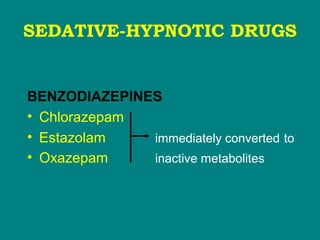
• Chlorazepam
• Estazolam immediately converted to
• Oxazepam inactive metabolites
SEDATIVE-HYPNOTIC DRUGS
BARBITURATES
• Extensively metabolized
• Depress the neuronal activity
• Facilitates and prolongs the inhibitory
effects of GABA and glycine
SEDATIVE-HYPNOTIC DRUGS
BARBITURATES
• Bind to multiple isoforms of GABAA
receptor but at different sites from
those with which benzodiazepines
interact
SEDATIVE-HYPNOTIC DRUGS
BARBITURATES
• Not antagonize by flumazenil
• Increase the duration of GABA-
mediated chloride ion channel
opening
SEDATIVE-HYPNOTIC DRUGS
BARBITURATES
• Block the excitatory transmitter glutamic
acid and at high concentration, sodium
channels
SEDATIVE-HYPNOTIC DRUGS
BARBITURATES
• Thiopental
 Drug with highest lipid solubility enter
the CNS rapidly
 Used as induction agents in anesthesia
SEDATIVE-HYPNOTIC DRUGS
BARBITURATES
• Thiopental
 CNS effects are terminated by rapid
redistribution of the drug from the
brain to other highly perfused tissues
(skeletal muscles)
SEDATIVE-HYPNOTIC DRUGS
BARBITURATES
• Thiopental
 Metabolism occur via oxidation
and glucoronidation
 Converted to active metabolite
SEDATIVE-HYPNOTIC DRUGS
BARBITURATES
• Phenobarbital
 Goes to the liver to be oxidized
 Excreted partly unchanged in the urine
 Alkalinizes the urine
 Half-life of 4-5 days
 Requires loading dose
SEDATIVE-HYPNOTIC DRUGS
OTHER DRUGS
• Buspirone
 Partial agonist at serotonin receptor
(5-HT receptor)
 Impairment of mental activity
 Psychomotor impairment
 Selective with minimal depressant
effects on the CNS
SEDATIVE-HYPNOTIC DRUGS
OTHER DRUGS
• Zolpidem and zaleplon
 Exert their CNS effects via interaction
with benzodiazepine receptors
 Bind more selectively
 Antagonize by flumazenil
SEDATIVE-HYPNOTIC DRUGS
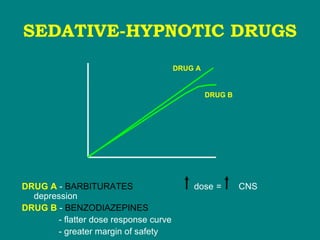
DRUG A - BARBITURATES dose = CNS
depression
DRUG B - BENZODIAZEPINES
- flatter dose response curve
- greater margin of safety
DRUG A
DRUG B
SEDATIVE-HYPNOTIC DRUGS
ORGAN SYSTEM EFFECTS
1. Sedation
2. Hypnosis
• Promote sleep onset
• Increase the duration of the sleep state
STAGES OF SLEEP
a. REM (Rapid eye movement)
• Dream
• Decreases at high doses
b. Non-REM
• 70-75%
SEDATIVE-HYPNOTIC DRUGS
ORGAN SYSTEM EFFECTS
3. Anesthesia
• Thiopental (barbiturate)
• Midazolam (benzodiazepine)
• Loss of consciousness, amnesia
and suppression of reflexes
SEDATIVE-HYPNOTIC DRUGS
ORGAN SYSTEM EFFECTS
4. Anticonvulsant actions
• Phenobarbital, clonazepam
 Suppression of seizure activity
 Selective because they do not
cause severe sedation
SEDATIVE-HYPNOTIC DRUGS
ORGAN SYSTEM EFFECTS
4. Anticonvulsant actions
• Diazepam, lorazepam and phenobarbital
 Given IV
 Used in status epilepticus
 Heavy sedation is needed
SEDATIVE-HYPNOTIC DRUGS
ORGAN SYSTEM EFFECTS
5. Muscle relaxation
• Diazepam
 Spasticity states
 Cerebral palsy
SEDATIVE-HYPNOTIC DRUGS
ORGAN SYSTEM EFFECTS
6. Medullary depression
• High doses can lead to
 Respiratory arrest
 Hypotension
 CVS collapse
 Death in suicidal overdose
SEDATIVE-HYPNOTIC DRUGS
ORGAN SYSTEM EFFECTS
7. Tolerance and dependence
• Tolerance
 Decrease in responsiveness
 Used chronically or in high dosage
SEDATIVE-HYPNOTIC DRUGS
ORGAN SYSTEM EFFECTS
7. Tolerance and dependence
• Tolerance
 Metabolic tolerance
 Occurs with phenobarbital
 Induces its own metabolism
 Decreases CNS response to the
drug itself
SEDATIVE-HYPNOTIC DRUGS
ORGAN SYSTEM EFFECTS
7. Tolerance and dependence
• Dependence
Physiologic
 State of response to a drug
 Removal of the drug evokes
unpleasant symptoms
 Opposite of the drug’s effects
SEDATIVE-HYPNOTIC DRUGS
ORGAN SYSTEM EFFECTS
7. Tolerance and dependence
• Dependence
Physiologic
 Leads to abstinence syndrome
(withdrawal state) when the drug
is discontinued
SEDATIVE-HYPNOTIC DRUGS
ORGAN –SYSTEM EFFECTS
7. Tolerance and dependence
• Dependence
Physiologic
 Withdrawal signs
 Anxiety
 Tremors
 Hyperreflexia
 Seizures
SEDATIVE-HYPNOTIC DRUGS
ORGAN SYSTEM EFFECTS
7. Tolerance and dependence
• Dependence
Physiologic
 Occur more commonly with short-
acting drugs
 Pentobarbital and secobarbital
 Dependence is unlikely to occur
with buspirone
SEDATIVE-HYPNOTIC DRUGS
ORGAN SYSTEM EFFECTS
7. Tolerance and dependence
• Dependence
Psychological
 State of response to a drug
 Drug taker feels compelled to use
the drug
 Suffers anxiety when separated
from the drug
SEDATIVE-HYPNOTIC DRUGS
CLINICAL USES
1. Anxiety states
• Benzodiazepines with intermediate or
long durations of action are favored
• Buspirone
 Used for generalized anxiety disorders
• Alprazolam
 Phobic and panic attacks
SEDATIVE-HYPNOTIC DRUGS
CLINICAL USES
2. Sleep disorders
• Used to treat primary insomnia and
other sleep disorders
SEDATIVE-HYPNOTIC DRUGS
CLINICAL USES
3. Sedation
• Prior to medical/surgical procedures
• Conscious sedation-anterograde
amnesia
4. Treatment of seizures and convulsions
SEDATIVE-HYPNOTIC DRUGS
CLINICAL USES
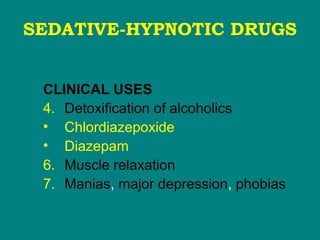
4. Detoxification of alcoholics
• Chlordiazepoxide
• Diazepam
6. Muscle relaxation
7. Manias, major depression, phobias
SEDATIVE-HYPNOTIC DRUGS
TOXICITY
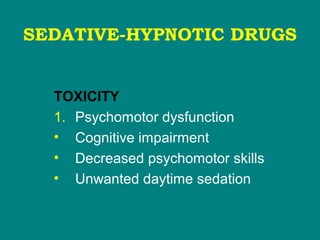
1. Psychomotor dysfunction
• Cognitive impairment
• Decreased psychomotor skills
• Unwanted daytime sedation
SEDATIVE-HYPNOTIC DRUGS
TOXICITY
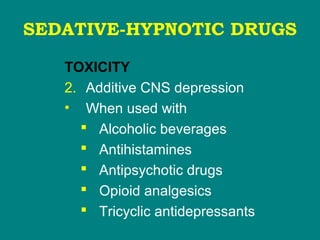
2. Additive CNS depression
• When used with
 Alcoholic beverages
 Antihistamines
 Antipsychotic drugs
 Opioid analgesics
 Tricyclic antidepressants
SEDATIVE-HYPNOTIC DRUGS
TOXICITY
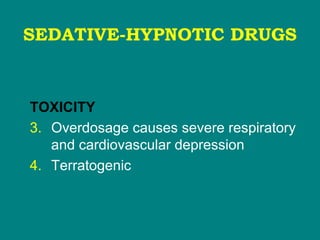
3. Overdosage causes severe respiratory
and cardiovascular depression
4. Terratogenic
SEDATIVE-HYPNOTIC DRUGS
TOXICITY
3. Induce formation of liver microsomal
enzymes
• Metabolize drugs multiple drug
interactions
• Chloral hydrate displaces coumarin
from protein binding sites and increases
anticoagulant effects

22 sedative hypnotic drugs