Storytelling
Question # 1
Why do you want to
tell the story?
http://karrierebibel.de/storytelling/
Why do you want to tell people the story,
you want to tell? What is the purpose?
Question # 2
What will you include
in your story?
Make the story about 1 person. A story of 1 person
talks to our hearts, touches us, reaches inside us,
connects with us.
https://www.goodreads.com/review/show/1769313051 p. 40.
"In September 2009, a software developer in Denmark..."
https://www.goodreads.com/review/show/1659517996 page 67.
Communicate time and place of the story. That
signals to listeners / readers that it is a true story.
https://www.goodreads.com/review/show/1659517996 page 67.
A story is a journey. It begins at a point in time from
which a person heads out, does something and then
finds his / her way back.
Example
Donald starts his day at home. He goes to a makerspace
to work on his newest product. During the day he works
on tasks X, Y, and Z. At 6 PM, he goes back home.
https://www.goodreads.com/review/show/1769313051 p. 54.
A story is a series of events that happen along the
way in the search for a solution to a problem.
In other words, a clear problem is presented, and things /
events happen with the goal of solving the problem.
https://www.goodreads.com/review/show/1769313051 p. 182.
Use examples when telling your story.
Thereby, you can explain where the change
idea has already happened. That is powerful.
https://www.goodreads.com/review/show/1659517996 page 64-65.
When telling a story, explain how that, which
happened there and then, made you feel?
What emotions did the story release in you?
https://www.goodreads.com/review/show/1769313051 p. 163.
Question # 3
How do you
structure your story?
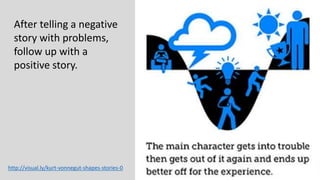
After telling a negative
story with problems,
follow up with a
positive story.
http://visual.ly/kurt-vonnegut-shapes-stories-0
Another example of a story structure:
1. A negative story.
2. A positive story.
3. A neutral story.
https://www.goodreads.com/review/show/1659517996 pages 81 and 241.
7 basic stories.
 Story # 1: Conquer the monster.
 Story # 2a: From dish washer to millionaire.
 Story # 2b: From victim to hero.
 Story # 3: The big task.
 Story # 4: Going on a trip and coming home.
 Story # 5: Rebirth.
 Story # 6: Tragedy.
 Story # 7: Comedy.
http://www.vomschreibenleben.de/es-gibt-nur-7-geschichten-auf-der-ganzen-welt/
Further inspiration
https://youtu.be/RbA2eHO_YdY minute 23.
Question # 4
What do positive and negative
stories do to us?
2 stories that can be used to tell a story about values:
 Your worst day at work = the negative story.
 Your best day at work = the positive story.
https://www.ffhs.ch/home/news-events/cloud--das-magazin/aktuelle-ausgabe/sind-geschichten-die-besseren-lehrer
https://www.goodreads.com/review/show/1659517996 page 146.
Negative stories get people's attention.
Tell a negative story to explain to people that the
situation is bad, to shake people out of their
complacency and force them to think of alternatives.
https://www.goodreads.com/review/show/1659517996 pages 81 and 241.
Tell a painful event in a humorous way.
Then you demonstrate that you have mastered
the experience and taken control of it.
https://www.goodreads.com/review/show/1659517996 page 103.
After you have told a negative story, follow up
with a positive story that shows how
to solve the problem.
https://www.goodreads.com/review/show/1659517996 pages 81 and 241.
In modern management, we have found out how to get
order, but in establishing order, we have lost music and
beauty.
An elegant, positive story can show how to bring back
beauty in our work lives.
Adapted from
https://www.goodreads.com/review/show/1659517996 page 287.
After you have told a negative story and a positive story,
use a neutral story to explain what, when, why,
and how.
https://www.goodreads.com/review/show/1659517996 pages 81 and 241.
Question # 5
How can we use the words
”and” and ”but”?
The word “and” expresses agreement and positivity.
Synonyms are “also”, “likewise”, “similarly”, “as well as”,
“in addition”.
https://www.goodreads.com/review/show/1769313051 p. 111
The word “but” expresses contradiction and denial. It creates tension
and conflict. It changes the direction of the story. Synonyms are
“despite”, “yet”, “however”, “instead”, “rather”, “otherwise”.
Be aware that using too many contradiction words can make the story
confusing to follow. Example: “But” sends the reader in one direction.
“However” sends the reader in another direction.
https://www.goodreads.com/review/show/1769313051 p. 112-114.
Question # 6
Why do we like stories?
Storytelling is the instrument
of continuing creativity, a
power that inexorably
propels us forward into the
future, building new worlds
and new selves.
http://www.forbes.com/sites/stevedenning/2015/07/22/how-to-make-the-whole-organization-agile/#dcfa6bd135ba
Good stories are simple to understand.
Simplicity is the essence of communication, and
simplicity is at the core of art.
https://www.goodreads.com/review/show/1769313051 p. 27-30 and p. 76.
https://youtu.be/wexb8tglj1o
A good story is a short story.
When a story reaches our hearts with
deep meaning, it takes hold of us.
http://www.forbes.com/sites/stevedenning/2015/07/22/how-to-make-the-whole-organization-agile/#dcfa6bd135ba
Since the dawn of language, people have shared
stories with others to
 entertain and persuade,
 connect, and
 make sense of changes in their lives.
http://info.arielgroup.com/blog/storytelling-works-science/
http://www.forbes.com/sites/stevedenning/2015/07/22/how-to-make-the-whole-organization-agile/#dcfa6bd135ba
http://www.wsj.com/articles/why-good-storytellers-are-happier-in-life-and-in-love-1467652052
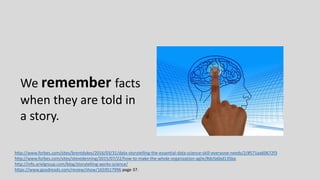
We remember facts
when they are told in
a story.
http://www.forbes.com/sites/brentdykes/2016/03/31/data-storytelling-the-essential-data-science-skill-everyone-needs/2/#571aa60672f3
http://www.forbes.com/sites/stevedenning/2015/07/22/how-to-make-the-whole-organization-agile/#dcfa6bd135ba
http://info.arielgroup.com/blog/storytelling-works-science/
https://www.goodreads.com/review/show/1659517996 page 37.
Further inspiration
https://www.teacherspayteachers.com/Product/Questions-to-discover-your-values-1329394
Question # 7
How can you
practice storytelling?
To practice storytelling, a possibility is to create a story
circle with a couple of people.
While one person shares a story he or she is working on,
the others listen and ask questions.
https://www.goodreads.com/review/show/1769313051 p. 222.
Thank you for inspiration
 Hans Christian Andersen.
 Nicole Bittel.
 Luca Botturi.
 Hanne Calberg.
 David Gurteen.
 Paola Rattu.
 Paul Sloane.

Storytelling

  • 1.
  • 2.
    Question # 1 Whydo you want to tell the story?
  • 3.
    http://karrierebibel.de/storytelling/ Why do youwant to tell people the story, you want to tell? What is the purpose?
  • 4.
    Question # 2 Whatwill you include in your story?
  • 5.
    Make the storyabout 1 person. A story of 1 person talks to our hearts, touches us, reaches inside us, connects with us. https://www.goodreads.com/review/show/1769313051 p. 40.
  • 6.
    "In September 2009,a software developer in Denmark..." https://www.goodreads.com/review/show/1659517996 page 67.
  • 8.
    Communicate time andplace of the story. That signals to listeners / readers that it is a true story. https://www.goodreads.com/review/show/1659517996 page 67.
  • 9.
    A story isa journey. It begins at a point in time from which a person heads out, does something and then finds his / her way back. Example Donald starts his day at home. He goes to a makerspace to work on his newest product. During the day he works on tasks X, Y, and Z. At 6 PM, he goes back home. https://www.goodreads.com/review/show/1769313051 p. 54.
  • 10.
    A story isa series of events that happen along the way in the search for a solution to a problem. In other words, a clear problem is presented, and things / events happen with the goal of solving the problem. https://www.goodreads.com/review/show/1769313051 p. 182.
  • 11.
    Use examples whentelling your story. Thereby, you can explain where the change idea has already happened. That is powerful. https://www.goodreads.com/review/show/1659517996 page 64-65.
  • 12.
    When telling astory, explain how that, which happened there and then, made you feel? What emotions did the story release in you? https://www.goodreads.com/review/show/1769313051 p. 163.
  • 13.
    Question # 3 Howdo you structure your story?
  • 14.
    After telling anegative story with problems, follow up with a positive story. http://visual.ly/kurt-vonnegut-shapes-stories-0
  • 15.
    Another example ofa story structure: 1. A negative story. 2. A positive story. 3. A neutral story. https://www.goodreads.com/review/show/1659517996 pages 81 and 241.
  • 16.
    7 basic stories. Story # 1: Conquer the monster.  Story # 2a: From dish washer to millionaire.  Story # 2b: From victim to hero.  Story # 3: The big task.  Story # 4: Going on a trip and coming home.  Story # 5: Rebirth.  Story # 6: Tragedy.  Story # 7: Comedy. http://www.vomschreibenleben.de/es-gibt-nur-7-geschichten-auf-der-ganzen-welt/
  • 17.
  • 18.
    Question # 4 Whatdo positive and negative stories do to us?
  • 19.
    2 stories thatcan be used to tell a story about values:  Your worst day at work = the negative story.  Your best day at work = the positive story. https://www.ffhs.ch/home/news-events/cloud--das-magazin/aktuelle-ausgabe/sind-geschichten-die-besseren-lehrer https://www.goodreads.com/review/show/1659517996 page 146.
  • 20.
    Negative stories getpeople's attention. Tell a negative story to explain to people that the situation is bad, to shake people out of their complacency and force them to think of alternatives. https://www.goodreads.com/review/show/1659517996 pages 81 and 241.
  • 22.
    Tell a painfulevent in a humorous way. Then you demonstrate that you have mastered the experience and taken control of it. https://www.goodreads.com/review/show/1659517996 page 103.
  • 23.
    After you havetold a negative story, follow up with a positive story that shows how to solve the problem. https://www.goodreads.com/review/show/1659517996 pages 81 and 241.
  • 24.
    In modern management,we have found out how to get order, but in establishing order, we have lost music and beauty. An elegant, positive story can show how to bring back beauty in our work lives. Adapted from https://www.goodreads.com/review/show/1659517996 page 287.
  • 26.
    After you havetold a negative story and a positive story, use a neutral story to explain what, when, why, and how. https://www.goodreads.com/review/show/1659517996 pages 81 and 241.
  • 27.
    Question # 5 Howcan we use the words ”and” and ”but”?
  • 28.
    The word “and”expresses agreement and positivity. Synonyms are “also”, “likewise”, “similarly”, “as well as”, “in addition”. https://www.goodreads.com/review/show/1769313051 p. 111
  • 29.
    The word “but”expresses contradiction and denial. It creates tension and conflict. It changes the direction of the story. Synonyms are “despite”, “yet”, “however”, “instead”, “rather”, “otherwise”. Be aware that using too many contradiction words can make the story confusing to follow. Example: “But” sends the reader in one direction. “However” sends the reader in another direction. https://www.goodreads.com/review/show/1769313051 p. 112-114.
  • 30.
    Question # 6 Whydo we like stories?
  • 31.
    Storytelling is theinstrument of continuing creativity, a power that inexorably propels us forward into the future, building new worlds and new selves. http://www.forbes.com/sites/stevedenning/2015/07/22/how-to-make-the-whole-organization-agile/#dcfa6bd135ba
  • 32.
    Good stories aresimple to understand. Simplicity is the essence of communication, and simplicity is at the core of art. https://www.goodreads.com/review/show/1769313051 p. 27-30 and p. 76.
  • 33.
  • 34.
    When a storyreaches our hearts with deep meaning, it takes hold of us. http://www.forbes.com/sites/stevedenning/2015/07/22/how-to-make-the-whole-organization-agile/#dcfa6bd135ba
  • 35.
    Since the dawnof language, people have shared stories with others to  entertain and persuade,  connect, and  make sense of changes in their lives. http://info.arielgroup.com/blog/storytelling-works-science/ http://www.forbes.com/sites/stevedenning/2015/07/22/how-to-make-the-whole-organization-agile/#dcfa6bd135ba http://www.wsj.com/articles/why-good-storytellers-are-happier-in-life-and-in-love-1467652052
  • 36.
    We remember facts whenthey are told in a story. http://www.forbes.com/sites/brentdykes/2016/03/31/data-storytelling-the-essential-data-science-skill-everyone-needs/2/#571aa60672f3 http://www.forbes.com/sites/stevedenning/2015/07/22/how-to-make-the-whole-organization-agile/#dcfa6bd135ba http://info.arielgroup.com/blog/storytelling-works-science/ https://www.goodreads.com/review/show/1659517996 page 37.
  • 37.
  • 38.
    Question # 7 Howcan you practice storytelling?
  • 39.
    To practice storytelling,a possibility is to create a story circle with a couple of people. While one person shares a story he or she is working on, the others listen and ask questions. https://www.goodreads.com/review/show/1769313051 p. 222.
  • 40.
    Thank you forinspiration  Hans Christian Andersen.  Nicole Bittel.  Luca Botturi.  Hanne Calberg.  David Gurteen.  Paola Rattu.  Paul Sloane.