COMMUNITY ENGAGEMENT &
COALITIONS
COMMUNITY ENGAGEMENT
Working collaboratively with & through groups of
people affiliated by geographic proximity, special
interest, or similar situations to address issues
affecting their well-being
Centers for Disease Control and Prevention (CDC). (1997), Principles of
Community Engagement. Atlanta: Author.
WHAT DOES THAT MEAN?
• Focus on community’s expectations, assets &
needs when designing, implementing &
evaluating solutions to issues
• Value community members as equal partners
• Meld community “wisdom” with institutional &
scientific expertise
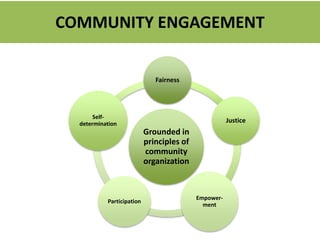
Grounded in
principles of
community
organization
Fairness
Justice
Empower-
ment
Participation
Self-
determination
COMMUNITY ENGAGEMENT
GOALS OF COMMUNITY ENGAGEMENT
CDC. (2011) Principles of Community Engagement, 2nd Ed.
Atlanta: Author.
Build trust
Enlist new resources & allies
Create better communication
BENEFITS OF COMMUNITY ENGAGEMENT
Strengthened communities & cohesion
Strengthened accountability of partners & coalitions
Improved service delivery, efficiency & effectiveness
Improved health & social outcomes
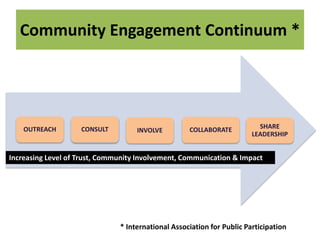
Community Engagement Continuum *
OUTREACH CONSULT INVOLVE COLLABORATE SHARE
LEADERSHIP
* International Association for Public Participation
Increasing Level of Trust, Community Involvement, Communication & Impact
COALITIONS & COMMUNITY
ENGAGEMENT REALITIES
• Each coalition member must believe it needs
help to reach goals
• Common ground must exist so members will
eventually agree on purpose, policies &
strategies
• Continuous negotiation is required
• Each member must believe that it will receive
benefits that match/exceed their contributions
ENGAGING
THE
COMMUNITY
IN
COALITIONS
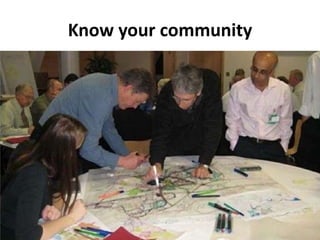
Know your community
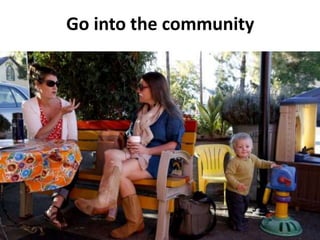
Go into the community
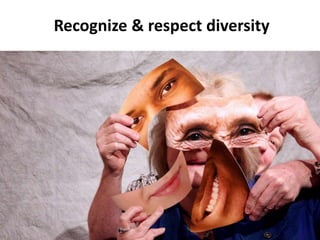
Recognize & respect diversity
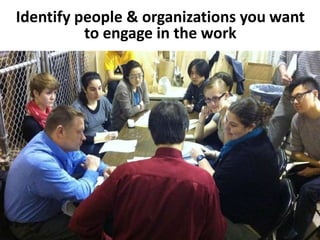
Identify people & organizations you want
to engage in the work
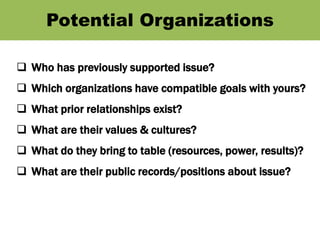
Potential Organizations
 Who has previously supported issue?
 Which organizations have compatible goals with yours?
 What prior relationships exist?
 What are their values & cultures?
 What do they bring to table (resources, power, results)?
 What are their public records/positions about issue?
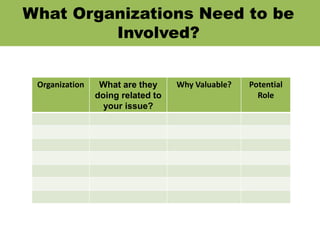
What Organizations Need to be
Involved?
Organization What are they
doing related to
your issue?
Why Valuable? Potential
Role
Identify & overcome any barriers to involvement
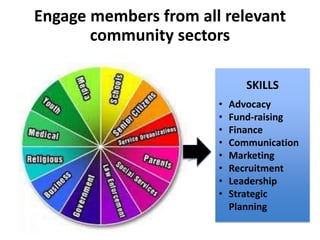
Engage members from all relevant
community sectors
.
Advocacy
SKILLS
• Advocacy
• Fund-raising
• Finance
• Communication
• Marketing
• Recruitment
• Leadership
• Strategic
Planning
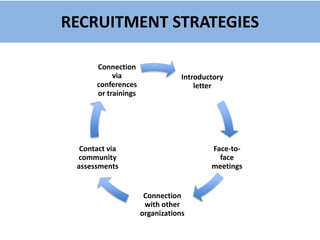
Introductory
letter
Face-to-
face
meetings
Connection
with other
organizations
Contact via
community
assessments
Connection
via
conferences
or trainings
RECRUITMENT STRATEGIES
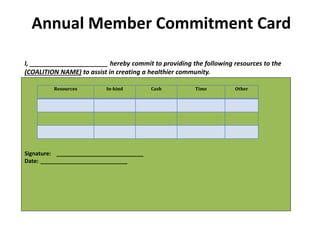
Annual Member Commitment Card
Resources In-kind Cash Time Other
I, ______________________ hereby commit to providing the following resources to the
(COALITION NAME) to assist in creating a healthier community.
Signature: ____________________________
Date: ____________________________
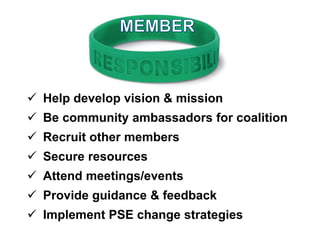
 Help develop vision & mission
 Be community ambassadors for coalition
 Recruit other members
 Secure resources
 Attend meetings/events
 Provide guidance & feedback
 Implement PSE change strategies
Every single person has capabilities, abilities, and gifts. Living a good life
depends on whether those capabilities can be used, abilities expressed,
and gifts given. If they are, the person will be valued, feel powerful and
be well connected to people … and the community around the person
will be more powerful because of the contribution that person is making.
Kretzmann & McKnight, 1993
Why Members Join & Stay
• Believe in issue & mission
• Build relationships
• Accomplish goals
• Have influence & impact
• Like being informed & up-to-date
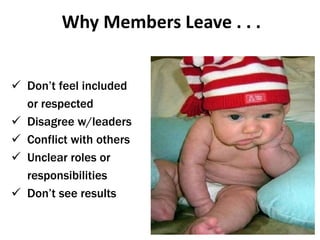
Why Members Leave . . .
 Don’t feel included
or respected
 Disagree w/leaders
 Conflict with others
 Unclear roles or
responsibilities
 Don’t see results
Motivate Members
• Provide training - leadership, meeting
facilitation & other skills
• Offer annual retreats to build skills & interest
in coalition
• Offer transportation to state partnership
meetings & legislative forums
• Invite leaders to represent coalition at
grantee meetings
• Write letters of appreciation to bosses &
recommendations for colleges/jobs
Retention Tips
• Use Buddy System – link experienced &
new members
• Provide small stipends to members
• Make attendance easy: Parking, meals,
childcare & convenient times/places
• Promote sense of team spirit & fun
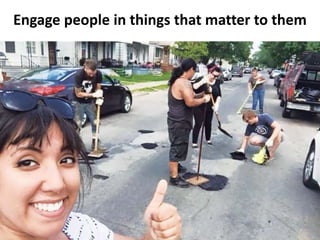
Engage people in things that matter to them
Provide opportunities to share knowledge,
experience, goals & energy
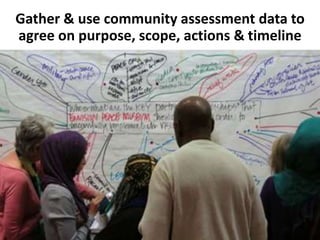
Gather & use community assessment data to
agree on purpose, scope, actions & timeline
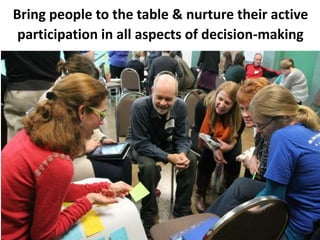
Bring people to the table & nurture their active
participation in all aspects of decision-making
Develop members’ commitment & capacity to
plan & take action
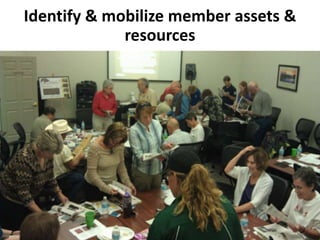
Identify & mobilize member assets &
resources
.
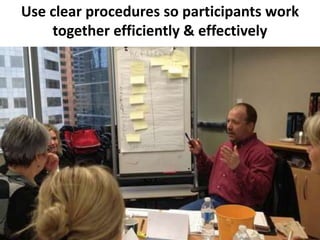
Use clear procedures so participants work
together efficiently & effectively
Create plans that are politically viable,
economical, understandable & accepted by most
Foster & implement strategies that change
policies, systems & environments
Monitor, evaluate & communicate
outcomes
Prepare to release control of coalition &
strategies
Remember: Community collaboration
requires long-term commitment

Community Engagement

Editor's Notes

  • #14 Build trust Establish relationships with formal & informal leaders Seek commitment from organizations to help mobilize community members