ExxonMobil
Presented by:
Ferdinand C. Importado
Dr. Cecile Santiago-Garcia
Seminar on Special Cases in Management
Report outline
• History of Exxon and Mobil
• Mission, vision, principles and corporate
culture
• Competitors
• ExxonMobil’s controversies
• S-W-O-T ExxonMobil merger
• ExxonMobil’s merger facts
• ExxonMobil’s post-merger facts
• Reasons, risks and criticisms
• ExxonMobil’s competitive advantages
Exxon Mobil History
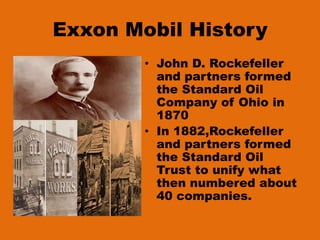
• John D. Rockefeller
and partners formed
the Standard Oil
Company of Ohio in
1870
• In 1882,Rockefeller
and partners formed
the Standard Oil
Trust to unify what
then numbered about
40 companies.
Exxon Mobil History
• The Trust formed Standard
Oil Company of New Jersey
New York.
• By 1889, the Trust
established itself as a
vertically integrated
organization.
• Congress's passage of the
Sherman Anti-Trust Act of
1890, eventually led to the
dissolution of the Trust in
1892.
Exxon Mobil History
The Standard Oil Interest was
formed and in 1899 the Standard
Oil of New Jersey became its
holding company.
In May 1911, the United States
Supreme Court declared
Standard Oil Company of New
Jersey an "unreasonable"
monopoly and ordered it to
dissolve, resulting in 34
distinct and separate
companies.
Exxon Mobil History
• The Standard Oil
Company of New Jersey
would become Exxon
• The Standard Oil
Company of New York
would become Mobil
• 1999 Exxon and Mobil
merged and become the
world's largest energy
corporation
Mission
―Exxon Mobil Corporation is
committed to being the world's
premier petroleum and
petrochemical company. To that
end, we must continuously
achieve superior financial and
operating results while
simultaneously adhering to high
ethical standards.‖
Exxon Mobil Corporation aspires to
be at the leading edge of
competition in every aspect of
business. That requires the
Corporation's resources —
financial, operational,
technological, and human to be
employed wisely and evaluated
regularly
Vision
Shareholders
Committed to enhancing the long-term value of the
investment dollars entrusted by shareholders. By
running the business profitably and responsibly,
shareholders are expected to be rewarded with
superior returns. This commitment drives the
management of the Corporation
Customers
Success depends on ability to consistently satisfy ever
changing customer preferences. By committing to be
innovative and responsive, while offering high quality
products and services at competitive prices
ExxonMobil Brands
Customers in the United States have come to
respect and rely on Exxon-branded fuels,
services and lubricants for their personal
and business needs.
Customers around the world have come to
respect and rely on Esso-branded fuels,
services and lubricants for their personal
and business needs.
Marketed around the world, Mobil is
known for performance and
innovation. Mobil is recognized for its
advanced technology in fuels, lubricants
and services.
Employees
Exxon strive to hire and retain the most
qualified people available and to maximize their
opportunities for success through training and
development. They are also committed to
maintaining a safe work environment enriched
by diversity and characterized by open
communication, trust, and fair treatment
Leadership in process safety
ExxonMobil is committed to providing a safe
work environment for employees,
contractors, and the communities they
operate. The process safety approach focuses
on reducing risk through the flawless
execution of Operations Integrity
Management System (OIMS). Rigorously
deployed throughout global operations, OIMS
establishes expectations by which facilities
are designed, operated, and maintained in
order to continuously improve safety and
environmental performance.
Community
The firm commit to be a good corporate citizen
in all the places they operate worldwide. They
maintain high ethical standards, obey all
applicable laws, rules, and regulations, and
respect local and national cultures. Above all
other objectives, they are dedicated to running
safe and environmentally responsible operations
Corporate citizenship
7,500 acres
of protected wildlife
habitat actively
managed in 2012
$330 million
invested to improve
energy efficiency,
reduce flaring, and
reduce GHG emissions
in 2012
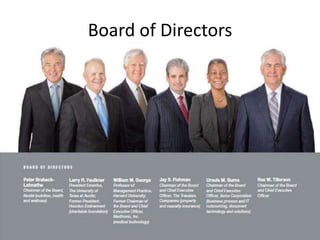
Board of Directors
Board of Directors
Corporate Culture
• Consistently strive to improve efficiency and
productivity through learning, sharing, and
implementing best practices
• Seek to develop proprietary technologies that
provide a competitive edge
• Maintain public trust is a key to success
• Strive to be a leader in corporate citizenship by
operating with the highest integrity,
maintaining a steadfast commitment to safety,
health and environmental protection, and
playing a positive role in the global community
Corporate culture
• A technology company,
applying science and
innovation to find better,
safer and cleaner ways to
deliver the energy the world
needs
• New and ongoing measures
are taken to prevent and
minimize the impact of
operations on air, water and
ground
Upstream Operations
Upstream business encompasses high-
quality exploration opportunities across all
resource types and geographies, an
industry-leading resource base, a portfolio
of world-class projects, and a diverse set
of producing assets. Exxon have an active
exploration or production presence in 40
countries.
S T R AT E G I E S
• Apply effective risk
management, safety, and
operational excellence
• Identify and selectively capture
the highest-quality resources
• Exercise a disciplined approach
to investing and cost management
• Develop and apply high-impact
technologies
• Maximize profitability of existing
oil and gas production
• Capitalize on growing natural gas
and power markets
Downstream Operations
Downstream portfolio includes refining
facilities in 17 countries. Exxon is the
world’s largest integrated refiner and
manufacturer of lube base stocks and a
leading marketer of petroleum products
and finished lubricants. The high-quality
products, combined with a strong global
refining and distribution network, position
Exxon as premier supplier around the
world.S T R AT E G I E S
• Maintain best-in-class operations
• Provide quality, valued products and services
to our customers
• Lead industry in efficiency and effectiveness
• Capitalize on integration across ExxonMobil
businesses
• Maintain capital discipline
• Maximize value from leading-edge
technologies
Chemical Operations
ExxonMobil Chemical is one of the largest chemical companies in
the world. The unique portfolio of specialty and commodity
businesses delivers superior returns across the business cycle. They
manufacture high-quality chemical products in 15 countries. With a
major presence in Asia Pacific, we are well positioned to
competitively supply the rapid chemical demand growth in this
region.
S T R AT E G I E S
• Consistently deliver best-in-class operational performance
• Focus on businesses that capitalize on core competencies
• Build proprietary technology positions
• Capture full benefits of integration across ExxonMobil operations
• Selectively invest in advantaged projects
Royal Dutch Shell
• Headquarters at The Hague, the Netherlands
• Operates in more than 70 countries with an
average of 87,00 employees and 44,000 Shell
service stations worldwide
• 50% production is natural gas where 20.2 million
ton of equity LNG are sold during the year
• 3.3 million barrels of oil equivalent are produced
every day.
• Revenue for 2012 amounted to $467.2 billion
with net Income equivalent to $26.8 billion.
• Shell also spent $2.2 billion on developing
alternative energies, carbon capture and storage,
and CO2-related R&D over the past five years
British Petroleum PLC
• International headquarters is located at London,
England
• Operates in over 80 countries with 20,700 sites
and 85,900 employees
• The firm produces at least 2,354 thousand barrels
per day
• Total sales and other operating revenues as of
2012 amounted to $376B with $12B in net
income
• Refining availability remained at a high level of
94.8%, reflecting strong operations around global
refining portfolio
Chevron
• Chevron is the second-largest integrated energy
company headquartered in the United States and
among the largest corporations in the world
• In 2012, average net production was 2.61 million
barrels of oil-equivalent per day.
• Chevron had a global refining capacity of 1.95
million barrels of oil per day at the end of 2012.
• It boasts global workforce consists of
approximately 61,900 employees, including more
than 3,600 service station employees.
• Sales and other operating revenues amounted to
$231 billion with net income of $26 billion, or
$13.32 per share, diluted.
Conoco Phillips
• Operations in 30 countries with over 17,000
men and women work in a truly integrated way
to find and produce oil and natural gas
• Operates on segments which are defined by
geographic region: Alaska, Lower 48 and Latin
America, Canada, Europe, Asia Pacific and
Middle East, and Other International.
• In 2012, Conoco Phillips reported total
revenues and other income of $63B with Net
income attributable to ConocoPhillips at $8.4B.
• Dividend per share is estimated at $2.64.
Capital program investments totaled $15.7.
• Crude oil production in 2012 totaled 618B tons,
natural gas liquids at 160B tons, bitumen at 93B
tons and natural gas at 4,245B tons.
Brief comparison
Exxon Shell British Chevron Conoco
Assets 333,795 360,325 300,193 232,982 117,144
Revenue 482,295 481,700 388,285 241,901 62,004
Net income 44,880 26,592 11,816 26,179 8,428
Profit margin 9.31% 5.52% 3.04% 10.82% 13.59%
R&D costs 1,042 1,314 674 648 221
R&D margin 0.22% 0.27% 0.17% 0.27% 0.36%
Employees 76,900 87,000 86,000 62,000 16,900
Retail shops 19,382 44,000 20,700 8,700 -
ExxonMobil Controversies
Various leaks in its
facilities, the most notable
of which is the Exxon
Valdez oil spill
The use of hydraulic
fracturing procedures in its
upstream operations
Questionable foreign
practices and dealings
Human rights violations
Issues on LGBT rights
Exxon Valdez Oil Spill
In March 24, 1989, the Exxon Valdez
supertanker ran aground in Alaska’s
Prince William Sound
More than 250,000 barrels were
spilled
Exxon and the U.S. Coast Guard
began a massive cleanup effort that
eventually involved more than 11,000
Alaskan residents and thousands of
Exxon and contractor personnel.
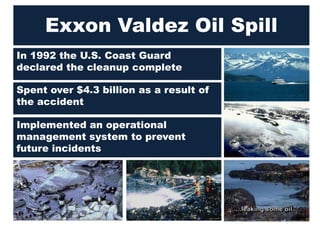
Exxon Valdez Oil Spill
In 1992 the U.S. Coast Guard
declared the cleanup complete
Spent over $4.3 billion as a result of
the accident
Implemented an operational
management system to prevent
future incidents
Hydraulic Fracturing
Hydraulic fracturing is describes as
involving the injection of a solution that
is primarily water and sand, mixed with a
small amount of chemicals often found in
swimming pools, dish detergents and
other common uses to open up cracks in
water formations that allows natural gas
to migrate to the well
Effects of hydraulic
fracturing
May contaminate water supplies
Associated with an increased seismic activity
Negative impact on the quality of life of the area
and nearby areas
May cause serious health hazzard
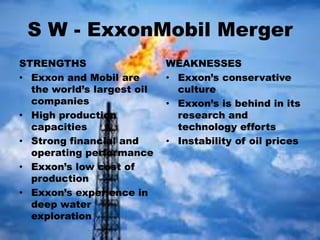
S W - ExxonMobil Merger
STRENGTHS
• Exxon and Mobil are
the world’s largest oil
companies
• High production
capacities
• Strong financial and
operating performance
• Exxon’s low cost of
production
• Exxon’s experience in
deep water
exploration
WEAKNESSES
• Exxon’s conservative
culture
• Exxon’s is behind in its
research and
technology efforts
• Instability of oil prices
O T - ExxonMobil Merger
OPPORTUNITIES
• Growing market for
chemical synthesis
of plastic
• Saudi Arabia opens
its oil fields to
foreign companies
• Alternative
sources of fuel and
energy
THREATS
• High cost of
replacing assets
• Major influence of
OPEC on oil prices
• Restructuring of
other oil
companies
• The U.S. Anti-trust
laws and similar
regulations
ExxonMobil Merger facts
Third largest merger in
the U.S. after America
Online – Time Warner
($162B in 2001) and
Pfizer’s – Warner-Lambert
($90B in 1999) at $82B
(1999)
Combined 1997 profit of
$11.8 billion on $203.1
billion in revenue
Exxon and Mobil employed
about 122,700 people,
branding more than
48,000 service stations
and possessing energy
reserves larger than
Canada’s
ExxonMobil Merger facts
Largest divestiture that
requires that sale of 2,431
gas stations in the
northeast
Total savings were estimated at $2.8
billion
• $730 million from cutting 9,000 jobs
and closing offices
• $1.15 billion from trimming business
overlap
Grand total of 14,000 jobs
cut and $3.8 billion of
annual pretax savings
ExxonMobil Merger Facts
The Federal Trade
Commission has allowed
Exxon to nine months to
complete most of its
sales otherwise a
trustee can be assigned
to complete the sale
Owners and operators
may use the names
"Exxon" and "Mobil," and
accept their credit
cards, for up to 10 years
Reasons for merger
• Technical capabilities will
complement each other’s
operations
• Operating synergies
• Increased scale of economies
Risks and criticisms
Creation of a
new or common
corporate
culture between
Exxon and Mobil
Meeting regulatory and Anti-trust
requirements to prevent
dissolution and maintain
competitiveness
Retention of key
employees with
the right
knowledge and
expertise
ExxonMobil today
World largest publicly traded
international oil and gas company
with total assets of $334B.
One of the top chemical companies
in 2012 based on chemical sales with
total revenues of $482B.
Tops the list as the world’s largest
refiner with 1,655,500 barrels of
crude per calendar day
ExxonMobil today
Exploration and production
acreages in
36 countries
Production operations are
spread in
23 countries
worldwide
Interests in 32 refineries in
17 countries
worldwide
Over 120
major development projects
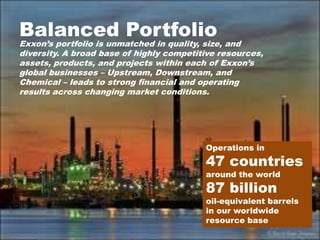
Balanced Portfolio
Exxon’s portfolio is unmatched in quality, size, and
diversity. A broad base of highly competitive resources,
assets, products, and projects within each of Exxon’s
global businesses – Upstream, Downstream, and
Chemical – leads to strong financial and operating
results across changing market conditions.
Operations in
47 countries
around the world
87 billion
oil-equivalent barrels
in our worldwide
resource base
Disciplined Investing
Exxon’s diverse resource and asset base offers a
large inventory of high-quality investment options.
The company carefully evaluates these opportunities
across a range of market conditions and time
horizons that often span decades. They advance only
those projects likely to provide long-term
shareholder value, and focus on the efficient use of
capital to achieve superior investment returns.
28 major
Upstream project
start-ups between 2013
and 2017
25 percent
return on capital
employed across our
worldwide operations,
leading the industry
High-impact technologies
ExxonMobil is an industry leader in the
development and application of
new technologies that create advantage across
our global businesses. Exxon pursue high-impact
technologies that unlock new energy sources,
reduce the cost of projects, improve the
efficiency of operations, and increase the value
of products.
$5 billion
invested in research
and development
since 2008
World-record
7.7-mile-long horizontal
well drilled in 2012
Operational Excellence
Maximizing shareholder value requires
a relentless focus on operational
excellence and effective risk
management. The management
systems enable them to maintain high
operational standards by providing a
framework of proven processes and
best practices that are applied
consistently and rigorously across
worldwide operations.
10 percent
improvement in
refinery energy
efficiency since 2002
45 thousand
net oil-equivalent
barrels
per day of additional
production from higher
operated reliability
Global integration
The global integration of business lines and functional
organizations creates significant advantage by enabling them
to maximize the value of every molecule that they produce
and rapidly deploy best practices around the globe.
The level of integration results in structural and market
advantages that are difficult for competitors to replicate.
More than
90 percent
of Chemical operations
integrated with
Downstream or
Upstream
More than
75 percent
of refining capacity
integrated with
Chemical or Lubes
operations
Conclusion
The ExxonMobil combination is an
archetype of a successful merger. The
industry is increasingly utilizing
advanced technology in exploration,
production, refining, and in the
logistics of its operations. It is
international in scope. But more
importantly, the benefits of synergies
that include improvements in the
performance of all the parties in the
transaction are well pronounced.

ExxonMobil

  • 1.
    ExxonMobil Presented by: Ferdinand C.Importado Dr. Cecile Santiago-Garcia Seminar on Special Cases in Management
  • 2.
    Report outline • Historyof Exxon and Mobil • Mission, vision, principles and corporate culture • Competitors • ExxonMobil’s controversies • S-W-O-T ExxonMobil merger • ExxonMobil’s merger facts • ExxonMobil’s post-merger facts • Reasons, risks and criticisms • ExxonMobil’s competitive advantages
  • 3.
    Exxon Mobil History •John D. Rockefeller and partners formed the Standard Oil Company of Ohio in 1870 • In 1882,Rockefeller and partners formed the Standard Oil Trust to unify what then numbered about 40 companies.
  • 4.
    Exxon Mobil History •The Trust formed Standard Oil Company of New Jersey New York. • By 1889, the Trust established itself as a vertically integrated organization. • Congress's passage of the Sherman Anti-Trust Act of 1890, eventually led to the dissolution of the Trust in 1892.
  • 5.
    Exxon Mobil History TheStandard Oil Interest was formed and in 1899 the Standard Oil of New Jersey became its holding company. In May 1911, the United States Supreme Court declared Standard Oil Company of New Jersey an "unreasonable" monopoly and ordered it to dissolve, resulting in 34 distinct and separate companies.
  • 6.
    Exxon Mobil History •The Standard Oil Company of New Jersey would become Exxon • The Standard Oil Company of New York would become Mobil • 1999 Exxon and Mobil merged and become the world's largest energy corporation
  • 7.
    Mission ―Exxon Mobil Corporationis committed to being the world's premier petroleum and petrochemical company. To that end, we must continuously achieve superior financial and operating results while simultaneously adhering to high ethical standards.‖
  • 8.
    Exxon Mobil Corporationaspires to be at the leading edge of competition in every aspect of business. That requires the Corporation's resources — financial, operational, technological, and human to be employed wisely and evaluated regularly Vision
  • 9.
    Shareholders Committed to enhancingthe long-term value of the investment dollars entrusted by shareholders. By running the business profitably and responsibly, shareholders are expected to be rewarded with superior returns. This commitment drives the management of the Corporation
  • 10.
    Customers Success depends onability to consistently satisfy ever changing customer preferences. By committing to be innovative and responsive, while offering high quality products and services at competitive prices
  • 11.
    ExxonMobil Brands Customers inthe United States have come to respect and rely on Exxon-branded fuels, services and lubricants for their personal and business needs. Customers around the world have come to respect and rely on Esso-branded fuels, services and lubricants for their personal and business needs. Marketed around the world, Mobil is known for performance and innovation. Mobil is recognized for its advanced technology in fuels, lubricants and services.
  • 12.
    Employees Exxon strive tohire and retain the most qualified people available and to maximize their opportunities for success through training and development. They are also committed to maintaining a safe work environment enriched by diversity and characterized by open communication, trust, and fair treatment
  • 13.
    Leadership in processsafety ExxonMobil is committed to providing a safe work environment for employees, contractors, and the communities they operate. The process safety approach focuses on reducing risk through the flawless execution of Operations Integrity Management System (OIMS). Rigorously deployed throughout global operations, OIMS establishes expectations by which facilities are designed, operated, and maintained in order to continuously improve safety and environmental performance.
  • 14.
    Community The firm committo be a good corporate citizen in all the places they operate worldwide. They maintain high ethical standards, obey all applicable laws, rules, and regulations, and respect local and national cultures. Above all other objectives, they are dedicated to running safe and environmentally responsible operations
  • 15.
    Corporate citizenship 7,500 acres ofprotected wildlife habitat actively managed in 2012 $330 million invested to improve energy efficiency, reduce flaring, and reduce GHG emissions in 2012
  • 16.
  • 17.
  • 18.
    Corporate Culture • Consistentlystrive to improve efficiency and productivity through learning, sharing, and implementing best practices • Seek to develop proprietary technologies that provide a competitive edge • Maintain public trust is a key to success • Strive to be a leader in corporate citizenship by operating with the highest integrity, maintaining a steadfast commitment to safety, health and environmental protection, and playing a positive role in the global community
  • 19.
    Corporate culture • Atechnology company, applying science and innovation to find better, safer and cleaner ways to deliver the energy the world needs • New and ongoing measures are taken to prevent and minimize the impact of operations on air, water and ground
  • 20.
    Upstream Operations Upstream businessencompasses high- quality exploration opportunities across all resource types and geographies, an industry-leading resource base, a portfolio of world-class projects, and a diverse set of producing assets. Exxon have an active exploration or production presence in 40 countries. S T R AT E G I E S • Apply effective risk management, safety, and operational excellence • Identify and selectively capture the highest-quality resources • Exercise a disciplined approach to investing and cost management • Develop and apply high-impact technologies • Maximize profitability of existing oil and gas production • Capitalize on growing natural gas and power markets
  • 21.
    Downstream Operations Downstream portfolioincludes refining facilities in 17 countries. Exxon is the world’s largest integrated refiner and manufacturer of lube base stocks and a leading marketer of petroleum products and finished lubricants. The high-quality products, combined with a strong global refining and distribution network, position Exxon as premier supplier around the world.S T R AT E G I E S • Maintain best-in-class operations • Provide quality, valued products and services to our customers • Lead industry in efficiency and effectiveness • Capitalize on integration across ExxonMobil businesses • Maintain capital discipline • Maximize value from leading-edge technologies
  • 22.
    Chemical Operations ExxonMobil Chemicalis one of the largest chemical companies in the world. The unique portfolio of specialty and commodity businesses delivers superior returns across the business cycle. They manufacture high-quality chemical products in 15 countries. With a major presence in Asia Pacific, we are well positioned to competitively supply the rapid chemical demand growth in this region. S T R AT E G I E S • Consistently deliver best-in-class operational performance • Focus on businesses that capitalize on core competencies • Build proprietary technology positions • Capture full benefits of integration across ExxonMobil operations • Selectively invest in advantaged projects
  • 23.
    Royal Dutch Shell •Headquarters at The Hague, the Netherlands • Operates in more than 70 countries with an average of 87,00 employees and 44,000 Shell service stations worldwide • 50% production is natural gas where 20.2 million ton of equity LNG are sold during the year • 3.3 million barrels of oil equivalent are produced every day. • Revenue for 2012 amounted to $467.2 billion with net Income equivalent to $26.8 billion. • Shell also spent $2.2 billion on developing alternative energies, carbon capture and storage, and CO2-related R&D over the past five years
  • 24.
    British Petroleum PLC •International headquarters is located at London, England • Operates in over 80 countries with 20,700 sites and 85,900 employees • The firm produces at least 2,354 thousand barrels per day • Total sales and other operating revenues as of 2012 amounted to $376B with $12B in net income • Refining availability remained at a high level of 94.8%, reflecting strong operations around global refining portfolio
  • 25.
    Chevron • Chevron isthe second-largest integrated energy company headquartered in the United States and among the largest corporations in the world • In 2012, average net production was 2.61 million barrels of oil-equivalent per day. • Chevron had a global refining capacity of 1.95 million barrels of oil per day at the end of 2012. • It boasts global workforce consists of approximately 61,900 employees, including more than 3,600 service station employees. • Sales and other operating revenues amounted to $231 billion with net income of $26 billion, or $13.32 per share, diluted.
  • 26.
    Conoco Phillips • Operationsin 30 countries with over 17,000 men and women work in a truly integrated way to find and produce oil and natural gas • Operates on segments which are defined by geographic region: Alaska, Lower 48 and Latin America, Canada, Europe, Asia Pacific and Middle East, and Other International. • In 2012, Conoco Phillips reported total revenues and other income of $63B with Net income attributable to ConocoPhillips at $8.4B. • Dividend per share is estimated at $2.64. Capital program investments totaled $15.7. • Crude oil production in 2012 totaled 618B tons, natural gas liquids at 160B tons, bitumen at 93B tons and natural gas at 4,245B tons.
  • 27.
    Brief comparison Exxon ShellBritish Chevron Conoco Assets 333,795 360,325 300,193 232,982 117,144 Revenue 482,295 481,700 388,285 241,901 62,004 Net income 44,880 26,592 11,816 26,179 8,428 Profit margin 9.31% 5.52% 3.04% 10.82% 13.59% R&D costs 1,042 1,314 674 648 221 R&D margin 0.22% 0.27% 0.17% 0.27% 0.36% Employees 76,900 87,000 86,000 62,000 16,900 Retail shops 19,382 44,000 20,700 8,700 -
  • 28.
    ExxonMobil Controversies Various leaksin its facilities, the most notable of which is the Exxon Valdez oil spill The use of hydraulic fracturing procedures in its upstream operations Questionable foreign practices and dealings Human rights violations Issues on LGBT rights
  • 29.
    Exxon Valdez OilSpill In March 24, 1989, the Exxon Valdez supertanker ran aground in Alaska’s Prince William Sound More than 250,000 barrels were spilled Exxon and the U.S. Coast Guard began a massive cleanup effort that eventually involved more than 11,000 Alaskan residents and thousands of Exxon and contractor personnel.
  • 30.
    Exxon Valdez OilSpill In 1992 the U.S. Coast Guard declared the cleanup complete Spent over $4.3 billion as a result of the accident Implemented an operational management system to prevent future incidents
  • 31.
    Hydraulic Fracturing Hydraulic fracturingis describes as involving the injection of a solution that is primarily water and sand, mixed with a small amount of chemicals often found in swimming pools, dish detergents and other common uses to open up cracks in water formations that allows natural gas to migrate to the well
  • 32.
    Effects of hydraulic fracturing Maycontaminate water supplies Associated with an increased seismic activity Negative impact on the quality of life of the area and nearby areas May cause serious health hazzard
  • 33.
    S W -ExxonMobil Merger STRENGTHS • Exxon and Mobil are the world’s largest oil companies • High production capacities • Strong financial and operating performance • Exxon’s low cost of production • Exxon’s experience in deep water exploration WEAKNESSES • Exxon’s conservative culture • Exxon’s is behind in its research and technology efforts • Instability of oil prices
  • 34.
    O T -ExxonMobil Merger OPPORTUNITIES • Growing market for chemical synthesis of plastic • Saudi Arabia opens its oil fields to foreign companies • Alternative sources of fuel and energy THREATS • High cost of replacing assets • Major influence of OPEC on oil prices • Restructuring of other oil companies • The U.S. Anti-trust laws and similar regulations
  • 35.
    ExxonMobil Merger facts Thirdlargest merger in the U.S. after America Online – Time Warner ($162B in 2001) and Pfizer’s – Warner-Lambert ($90B in 1999) at $82B (1999) Combined 1997 profit of $11.8 billion on $203.1 billion in revenue Exxon and Mobil employed about 122,700 people, branding more than 48,000 service stations and possessing energy reserves larger than Canada’s
  • 36.
    ExxonMobil Merger facts Largestdivestiture that requires that sale of 2,431 gas stations in the northeast Total savings were estimated at $2.8 billion • $730 million from cutting 9,000 jobs and closing offices • $1.15 billion from trimming business overlap Grand total of 14,000 jobs cut and $3.8 billion of annual pretax savings
  • 37.
    ExxonMobil Merger Facts TheFederal Trade Commission has allowed Exxon to nine months to complete most of its sales otherwise a trustee can be assigned to complete the sale Owners and operators may use the names "Exxon" and "Mobil," and accept their credit cards, for up to 10 years
  • 38.
    Reasons for merger •Technical capabilities will complement each other’s operations • Operating synergies • Increased scale of economies
  • 39.
    Risks and criticisms Creationof a new or common corporate culture between Exxon and Mobil Meeting regulatory and Anti-trust requirements to prevent dissolution and maintain competitiveness Retention of key employees with the right knowledge and expertise
  • 40.
    ExxonMobil today World largestpublicly traded international oil and gas company with total assets of $334B. One of the top chemical companies in 2012 based on chemical sales with total revenues of $482B. Tops the list as the world’s largest refiner with 1,655,500 barrels of crude per calendar day
  • 41.
    ExxonMobil today Exploration andproduction acreages in 36 countries Production operations are spread in 23 countries worldwide Interests in 32 refineries in 17 countries worldwide Over 120 major development projects
  • 42.
    Balanced Portfolio Exxon’s portfoliois unmatched in quality, size, and diversity. A broad base of highly competitive resources, assets, products, and projects within each of Exxon’s global businesses – Upstream, Downstream, and Chemical – leads to strong financial and operating results across changing market conditions. Operations in 47 countries around the world 87 billion oil-equivalent barrels in our worldwide resource base
  • 43.
    Disciplined Investing Exxon’s diverseresource and asset base offers a large inventory of high-quality investment options. The company carefully evaluates these opportunities across a range of market conditions and time horizons that often span decades. They advance only those projects likely to provide long-term shareholder value, and focus on the efficient use of capital to achieve superior investment returns. 28 major Upstream project start-ups between 2013 and 2017 25 percent return on capital employed across our worldwide operations, leading the industry
  • 44.
    High-impact technologies ExxonMobil isan industry leader in the development and application of new technologies that create advantage across our global businesses. Exxon pursue high-impact technologies that unlock new energy sources, reduce the cost of projects, improve the efficiency of operations, and increase the value of products. $5 billion invested in research and development since 2008 World-record 7.7-mile-long horizontal well drilled in 2012
  • 45.
    Operational Excellence Maximizing shareholdervalue requires a relentless focus on operational excellence and effective risk management. The management systems enable them to maintain high operational standards by providing a framework of proven processes and best practices that are applied consistently and rigorously across worldwide operations. 10 percent improvement in refinery energy efficiency since 2002 45 thousand net oil-equivalent barrels per day of additional production from higher operated reliability
  • 46.
    Global integration The globalintegration of business lines and functional organizations creates significant advantage by enabling them to maximize the value of every molecule that they produce and rapidly deploy best practices around the globe. The level of integration results in structural and market advantages that are difficult for competitors to replicate. More than 90 percent of Chemical operations integrated with Downstream or Upstream More than 75 percent of refining capacity integrated with Chemical or Lubes operations
  • 47.
    Conclusion The ExxonMobil combinationis an archetype of a successful merger. The industry is increasingly utilizing advanced technology in exploration, production, refining, and in the logistics of its operations. It is international in scope. But more importantly, the benefits of synergies that include improvements in the performance of all the parties in the transaction are well pronounced.