Itโ€™s All About Risk!The key to project financing is the reallocation of any risk away from the lenders to the project.
Definition of Project CompletionPrinciple Categories of Risk: Pre-Completionand Post-CompletionPhysical CompletionProject is physically complete according to technical design criteria.Mechanical CompletionProject can sustain production at a specified capacity for a certain period of time.Financial Completion (financial sustainability)Project can produce under a certain unit cost for a certain period of time & meets certain financial ratios (current ratio, Debt/Equity, Debt Service Capacity ratios)
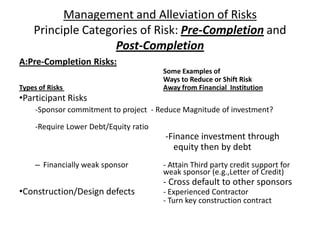
Management and Alleviation of RisksPrinciple Categories of Risk: Pre-Completionand Post-CompletionA:Pre-Completion Risks:	Some Examples ofWays to Reduce or Shift RiskTypes of Risks Away from Financial  InstitutionParticipant Risks-Sponsor commitment to project- Reduce Magnitude of investment?-Require Lower Debt/Equity ratio-Finance investment through                                                               equity thenby debtFinancially weak sponsor	- Attain Third party credit support for 	weak sponsor (e.g.,Letter of Credit)		- Cross default to other sponsorsConstruction/Design defects	- Experienced Contractor- Turn key construction contract
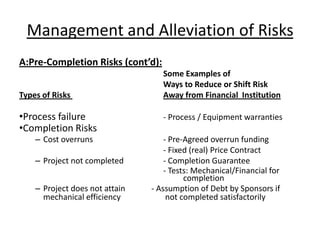
Management and Alleviation of RisksA:Pre-Completion Risks (contโ€™d):	Some Examples ofWays to Reduce or Shift RiskTypes of Risks Away from Financial  InstitutionProcess failure	- Process / Equipment warrantiesCompletion RisksCost overruns 	- Pre-Agreed overrun funding		- Fixed (real) Price ContractProject not completed	- Completion Guarantee			- Tests: Mechanical/Financial for 		  completion	Project does not attain             - Assumption of Debt by Sponsors if mechanical efficiency	 not completed satisfactorily
Regulatory RisksRegulatory is the risk of not obtaining all approvals required to build (e.g. export licences)and operate (e.g. orbital slots assignment and frequency coordination, landing rights) thesystem.
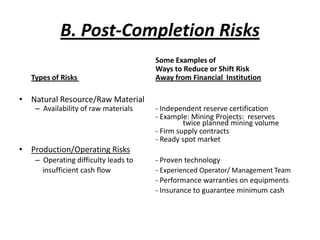
B. Post-Completion Risks		Some Examples ofWays to Reduce or Shift RiskTypes of Risks Away from Financial  InstitutionNatural Resource/Raw MaterialAvailability of raw materials	- Independent reserve certification		- Example: Mining Projects:  reserves 		  twice planned mining volume		- Firm supply contracts		- Ready spot marketProduction/Operating RisksOperating difficulty leads to 	- Proven technology    insufficient cash flow 	- Experienced Operator/ Management Team	- Performance warranties on equipments		- Insurance to guarantee minimum cash
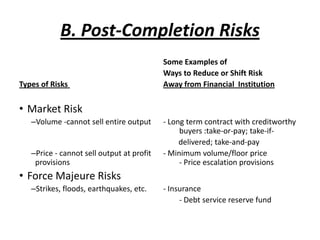
B. Post-Completion Risks		Some Examples ofWays to Reduce or Shift RiskTypes of Risks Away from Financial  InstitutionMarket RiskVolume -cannot sell entire output- Long term contract with creditworthy 		buyers :take-or-pay; take-if-  delivered; take-and-payPrice - cannot sell output at profit- Minimum volume/floor price provisions	- Price escalation provisionsForce Majeure RisksStrikes, floods, earthquakes, etc.- Insurance- Debt service reserve fund
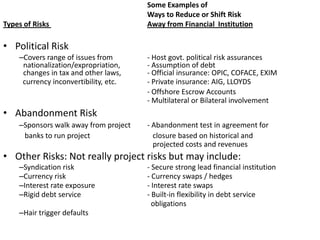
		Some Examples ofWays to Reduce or Shift RiskTypes of Risks Away from Financial  InstitutionPolitical RiskCovers range of issues from	- Host govt. political risk assurances nationalization/expropriation, 	- Assumption of debtchanges in tax and other laws,	- Official insurance: OPIC, COFACE, EXIM  currency inconvertibility, etc. 	- Private insurance: AIG, LLOYDS		- Offshore Escrow Accounts 			- Multilateral or Bilateral involvement Abandonment RiskSponsors walk away from project   	- Abandonment test in agreement for   banks to run project	   closure based on historical and 		      	   projected costs and revenues	Other Risks: Not really project risks but may include:Syndication risk	- Secure strong lead financial institution	Currency risk 	- Currency swaps / hedges 	Interest rate exposure 	- Interest rate swaps 	Rigid debt service	- Built-in flexibility in debt service		  obligationsHair trigger defaults
Currency riskย Currency risks include the risks that: (a) a depreciation in loan currencies may increase the costs of construction where significant construction items are sourced offshore; or (b) a depreciation in the revenue currencies may cause a cash-flow problem in the operating phase.
Project Financing and Political Risk MitigationThe Singular Case of the Chad-Cameroon Pipeline
Chad-Cameroon Pipelines: Project BackgroundOil first discovered in southern Chad by Conoco early in 1970โ€™sInitial consortium: Conoco, Exxon, Shell, ChevronAdditional discoveries brought reserves to ~1 billion barrelsChadโ€™s unique risk profileLandlocked country: oil must be pipelined to Atlantic coast for exportBest route: through Cameroon โ€“ ranked 148/177 on poverty, 99/99 on corruption โ€“ potential for pipeline to be held โ€œhostageโ€Chad: 30 year civil war after independence; ruled by Gen. Indris Deby since 1990; unstable borders; $300 per capita income; 173/177 povertyOil companies declined to develop Chadโ€™s reservesConoco withdrew in favor of Exxon; Chevron sold to Elf-Acquitaine
Key to Unlocking Chadโ€™s Reserves โ€“ Risk MitigationProject Finance one of few Available ToolsProject Finance can mitigate location/political risk in 3 ways:Stake Reduction: limiting project sponsorโ€™s capital at riskRequires financing to be โ€œnon-recourseโ€ to sponsorAlso strengthens sponsorโ€™s ability to resist host government pressureDeterrence: disrupting financing involves consequences that deter 		       host government disruptive actionsFinancing to include lenders which host governments donโ€™t want to offend3.	Terms Clarification: project finance process forces host government                                         to clarify/document commitmentsTies commitments to NY/UK law and/or offshore arbitrationPrivate firms want deterrence to avoid unilateral contract revision
First Test:  Esso Production Malaysia(EPMI)1978Concept:  Cash flow allocated for debt service could be impacted by government changes in tax ratesBank loan repayment at risk if government raises ratesConsortium: Top three international PF banks in leadCitibank, JP Morgan, ChaseFollowed by top 3 Malaysian commercial banksResult: InconclusiveMalaysia raised rates, banks responded with mild protestsExxon repaid loans; Malaysia did not raise rates againResult left Exxon disinclined to use PF for upstream risk mitigation
Special Risks in Chad-Cameroon led Oil Company Consortium to reconsider using PFChadโ€™s acute revenue needs for poverty/security; lack of rule of lawCameroonโ€™s potential to hold pipeline hostage once built, demanding higher transit fees, equity participationsNothing about EPMI suggested PF by itself would deter such eventsConsortiumโ€™s new concept: combine PF & World Bank deterrenceWBโ€™s status: โ€œconcessionaryโ€ lender, ties to IMF as โ€˜lender of last resortโ€™Track record where few if any countries failed to repay WB loansPlan to combine WB participation with strategic ECA/MLA lendersUS Ex-Im, CoFACE, European Investment Bank (EIB)
risk management

risk management

  • 2.
    Itโ€™s All AboutRisk!The key to project financing is the reallocation of any risk away from the lenders to the project.
  • 3.
    Definition of ProjectCompletionPrinciple Categories of Risk: Pre-Completionand Post-CompletionPhysical CompletionProject is physically complete according to technical design criteria.Mechanical CompletionProject can sustain production at a specified capacity for a certain period of time.Financial Completion (financial sustainability)Project can produce under a certain unit cost for a certain period of time & meets certain financial ratios (current ratio, Debt/Equity, Debt Service Capacity ratios)
  • 4.
    Management and Alleviationof RisksPrinciple Categories of Risk: Pre-Completionand Post-CompletionA:Pre-Completion Risks: Some Examples ofWays to Reduce or Shift RiskTypes of Risks Away from Financial InstitutionParticipant Risks-Sponsor commitment to project- Reduce Magnitude of investment?-Require Lower Debt/Equity ratio-Finance investment through equity thenby debtFinancially weak sponsor - Attain Third party credit support for weak sponsor (e.g.,Letter of Credit) - Cross default to other sponsorsConstruction/Design defects - Experienced Contractor- Turn key construction contract
  • 5.
    Management and Alleviationof RisksA:Pre-Completion Risks (contโ€™d): Some Examples ofWays to Reduce or Shift RiskTypes of Risks Away from Financial InstitutionProcess failure - Process / Equipment warrantiesCompletion RisksCost overruns - Pre-Agreed overrun funding - Fixed (real) Price ContractProject not completed - Completion Guarantee - Tests: Mechanical/Financial for completion Project does not attain - Assumption of Debt by Sponsors if mechanical efficiency not completed satisfactorily
  • 6.
    Regulatory RisksRegulatory isthe risk of not obtaining all approvals required to build (e.g. export licences)and operate (e.g. orbital slots assignment and frequency coordination, landing rights) thesystem.
  • 7.
    B. Post-Completion Risks SomeExamples ofWays to Reduce or Shift RiskTypes of Risks Away from Financial InstitutionNatural Resource/Raw MaterialAvailability of raw materials - Independent reserve certification - Example: Mining Projects: reserves twice planned mining volume - Firm supply contracts - Ready spot marketProduction/Operating RisksOperating difficulty leads to - Proven technology insufficient cash flow - Experienced Operator/ Management Team - Performance warranties on equipments - Insurance to guarantee minimum cash
  • 8.
    B. Post-Completion Risks SomeExamples ofWays to Reduce or Shift RiskTypes of Risks Away from Financial InstitutionMarket RiskVolume -cannot sell entire output- Long term contract with creditworthy buyers :take-or-pay; take-if- delivered; take-and-payPrice - cannot sell output at profit- Minimum volume/floor price provisions - Price escalation provisionsForce Majeure RisksStrikes, floods, earthquakes, etc.- Insurance- Debt service reserve fund
  • 9.
    Some Examples ofWaysto Reduce or Shift RiskTypes of Risks Away from Financial InstitutionPolitical RiskCovers range of issues from - Host govt. political risk assurances nationalization/expropriation, - Assumption of debtchanges in tax and other laws, - Official insurance: OPIC, COFACE, EXIM currency inconvertibility, etc. - Private insurance: AIG, LLOYDS - Offshore Escrow Accounts - Multilateral or Bilateral involvement Abandonment RiskSponsors walk away from project - Abandonment test in agreement for banks to run project closure based on historical and projected costs and revenues Other Risks: Not really project risks but may include:Syndication risk - Secure strong lead financial institution Currency risk - Currency swaps / hedges Interest rate exposure - Interest rate swaps Rigid debt service - Built-in flexibility in debt service obligationsHair trigger defaults
  • 10.
    Currency riskย Currency risksinclude the risks that: (a) a depreciation in loan currencies may increase the costs of construction where significant construction items are sourced offshore; or (b) a depreciation in the revenue currencies may cause a cash-flow problem in the operating phase.
  • 11.
    Project Financing andPolitical Risk MitigationThe Singular Case of the Chad-Cameroon Pipeline
  • 12.
    Chad-Cameroon Pipelines: ProjectBackgroundOil first discovered in southern Chad by Conoco early in 1970โ€™sInitial consortium: Conoco, Exxon, Shell, ChevronAdditional discoveries brought reserves to ~1 billion barrelsChadโ€™s unique risk profileLandlocked country: oil must be pipelined to Atlantic coast for exportBest route: through Cameroon โ€“ ranked 148/177 on poverty, 99/99 on corruption โ€“ potential for pipeline to be held โ€œhostageโ€Chad: 30 year civil war after independence; ruled by Gen. Indris Deby since 1990; unstable borders; $300 per capita income; 173/177 povertyOil companies declined to develop Chadโ€™s reservesConoco withdrew in favor of Exxon; Chevron sold to Elf-Acquitaine
  • 13.
    Key to UnlockingChadโ€™s Reserves โ€“ Risk MitigationProject Finance one of few Available ToolsProject Finance can mitigate location/political risk in 3 ways:Stake Reduction: limiting project sponsorโ€™s capital at riskRequires financing to be โ€œnon-recourseโ€ to sponsorAlso strengthens sponsorโ€™s ability to resist host government pressureDeterrence: disrupting financing involves consequences that deter host government disruptive actionsFinancing to include lenders which host governments donโ€™t want to offend3. Terms Clarification: project finance process forces host government to clarify/document commitmentsTies commitments to NY/UK law and/or offshore arbitrationPrivate firms want deterrence to avoid unilateral contract revision
  • 14.
    First Test: Esso Production Malaysia(EPMI)1978Concept: Cash flow allocated for debt service could be impacted by government changes in tax ratesBank loan repayment at risk if government raises ratesConsortium: Top three international PF banks in leadCitibank, JP Morgan, ChaseFollowed by top 3 Malaysian commercial banksResult: InconclusiveMalaysia raised rates, banks responded with mild protestsExxon repaid loans; Malaysia did not raise rates againResult left Exxon disinclined to use PF for upstream risk mitigation
  • 15.
    Special Risks inChad-Cameroon led Oil Company Consortium to reconsider using PFChadโ€™s acute revenue needs for poverty/security; lack of rule of lawCameroonโ€™s potential to hold pipeline hostage once built, demanding higher transit fees, equity participationsNothing about EPMI suggested PF by itself would deter such eventsConsortiumโ€™s new concept: combine PF & World Bank deterrenceWBโ€™s status: โ€œconcessionaryโ€ lender, ties to IMF as โ€˜lender of last resortโ€™Track record where few if any countries failed to repay WB loansPlan to combine WB participation with strategic ECA/MLA lendersUS Ex-Im, CoFACE, European Investment Bank (EIB)