ExxonMobil vs. BP CSR 2012
by
Judith Nathanson
Natalya Prilipko
March 2014
Company vision
“ExxonMobil’s role is to create the technologies
and techniques to develop and supply energy to
growing populations and economies — in a
safe, secure and environmentally responsible
manner.”
— Rex W. Tillerson, Chairman and CEO
We aim to create value for shareholders by
helping to meet growing demand for energy in a
responsible way.
BP’s objective is to create value for
shareholders and supplies of energy for the
world in a safe and responsible way. We strive
to be a safety leader in our industry, a world-
class operator, a responsible corporate
citizen and a good employer. We are working
to enhance safety and risk management, earn
back trust and grow value.
Bob Dudley
Group Chief Executive
20 March 2013
Company intro
Questions we asked
● What is their environmental policy?
● Are reports balanced?
● Is the information clear? | Is the data accurate? | Do reports indicate the
data that has been measured?
● Is the information comparable? | The report and the information contained
within it can be compared on a year-to-year basis.
● What information is reflected on the oil spills and other disasters caused by
company activities?
● What are they benchmarking against?
● What issues they are dealing with? | What are they saying about fracking?
● Internal/external consultants?
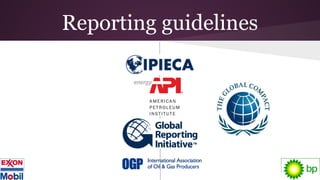
Reporting guidelines
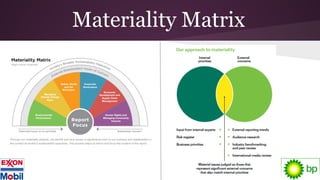
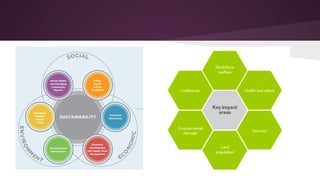
Materiality Matrix
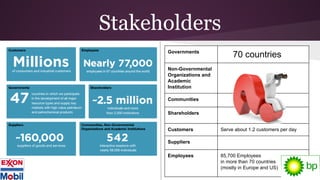
Stakeholders
Governments
70 countries
Non-Governmental
Organizations and
Academic
Institution
Communities
Shareholders
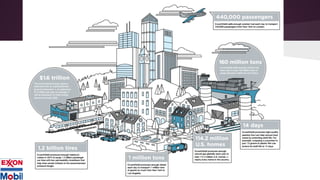
Customers Serve about 1.2 customers per day
Suppliers
Employees 85,700 Employees
in more than 70 countries
(mostly in Europe and US)
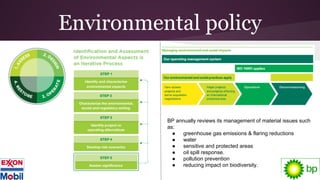
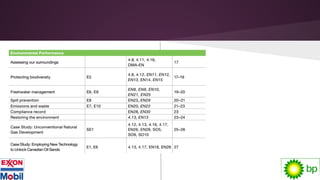
Environmental policy
BP annually reviews its management of material issues such
as:
● greenhouse gas emissions & flaring reductions
● water
● sensitive and protected areas
● oil spill response.
● pollution prevention
● reducing impact on biodiversity.
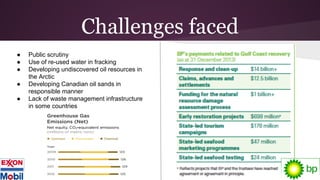
Challenges faced
● Public scrutiny
● Use of re-used water in fracking
● Developing undiscovered oil resources in
the Arctic
● Developing Canadian oil sands in
responsible manner
● Lack of waste management infrastructure
in some countries
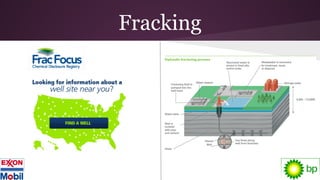
Fracking
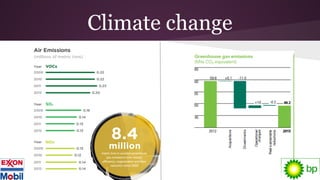
Climate change
Oil Spills
Internal/External audits
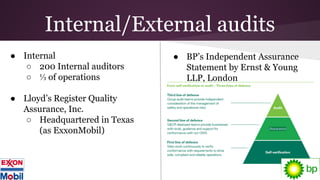
● Internal
○ 200 Internal auditors
○ ⅓ of operations
● Lloyd’s Register Quality
Assurance, Inc.
○ Headquartered in Texas
(as ExxonMobil)
● BP’s Independent Assurance
Statement by Ernst & Young
LLP, London
Conclusion
Citations
1. ExxonMobil Corporate Citizenship report 2012
2. http://www.ipieca.org/
3. http://www.bp.
com/en/global/corporate/sustainability/environment/managi
ng-our-impact-on-the-environment.html
4. Sustainability Reporting Guidelines & Oil and Gas Sector
Supplement, Version 3.1/OGSS Final version © 2000-2011
Global Reporting Initiative.
5. http://www.forbes.com/pictures/mef45glfe/6-bp-4-1-million-
barrels-per-day-3/
6. ReportAlert Announcement on ExxonMobil of 29th May,
2013 from www.reportalert.info
7. Images:
a. www.fightblindness.org
1. BP Sustainability Review 2012
2. http://www.ipieca.org/
3. http://www.bp.
com/en/global/corporate/sustainability/environment/managi
ng-our-impact-on-the-environment.html
4. Sustainability Reporting Guidelines & Oil and Gas Sector
Supplement, Version 3.1/OGSS Final version © 2000-2011
Global Reporting Initiative.
5. “Exxon CEO Profits Huge As America's Largest Natural
Gas Producer-But Frack In His Own Backyard And He
Sues! by Rick Ungar at Forbes.com
6. Images:
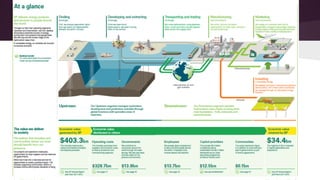
Supply chain
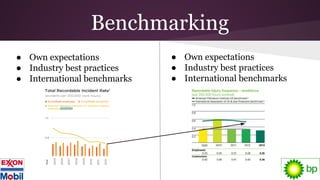
Benchmarking
● Own expectations
● Industry best practices
● International benchmarks
● Own expectations
● Industry best practices
● International benchmarks
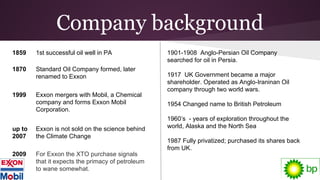
Company background
1901-1908 Anglo-Persian Oil Company
searched for oil in Persia.
1917 UK Government became a major
shareholder. Operated as Anglo-Iraninan Oil
company through two world wars.
1954 Changed name to British Petroleum
1960’s - years of exploration throughout the
world, Alaska and the North Sea
1987 Fully privatized; purchased its shares back
from UK.
1859 1st successful oil well in PA
1870 Standard Oil Company formed, later
renamed to Exxon
1999 Exxon mergers with Mobil, a Chemical
company and forms Exxon Mobil
Corporation.
up to
2007
Exxon is not sold on the science behind
the Climate Change
2009 For Exxon the XTO purchase signals
that it expects the primacy of petroleum
to wane somewhat.
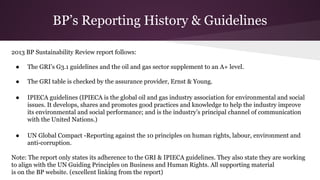
BP’s Reporting History & Guidelines
2013 BP Sustainability Review report follows:
● The GRI’s G3.1 guidelines and the oil and gas sector supplement to an A+ level.
● The GRI table is checked by the assurance provider, Ernst & Young.
● IPIECA guidelines (IPIECA is the global oil and gas industry association for environmental and social
issues. It develops, shares and promotes good practices and knowledge to help the industry improve
its environmental and social performance; and is the industry’s principal channel of communication
with the United Nations.)
● UN Global Compact -Reporting against the 10 principles on human rights, labour, environment and
anti-corruption.
Note: The report only states its adherence to the GRI & IPIECA guidelines. They also state they are working
to align with the UN Guiding Principles on Business and Human Rights. All supporting material
is on the BP website. (excellent linking from the report)
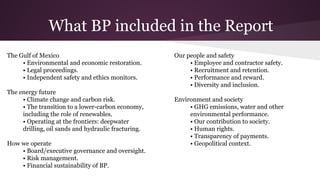
What BP included in the Report
The Gulf of Mexico
• Environmental and economic restoration.
• Legal proceedings.
• Independent safety and ethics monitors.
The energy future
• Climate change and carbon risk.
• The transition to a lower-carbon economy,
including the role of renewables.
• Operating at the frontiers: deepwater
drilling, oil sands and hydraulic fracturing.
How we operate
• Board/executive governance and oversight.
• Risk management.
• Financial sustainability of BP.
Our people and safety
• Employee and contractor safety.
• Recruitment and retention.
• Performance and reward.
• Diversity and inclusion.
Environment and society
• GHG emissions, water and other
environmental performance.
• Our contribution to society.
• Human rights.
• Transparency of payments.
• Geopolitical context.
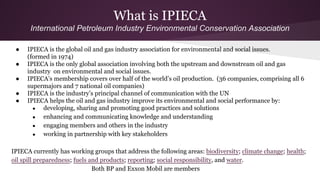
What is IPIECA
International Petroleum Industry Environmental Conservation Association
● IPIECA is the global oil and gas industry association for environmental and social issues.
(formed in 1974)
● IPIECA is the only global association involving both the upstream and downstream oil and gas
industry on environmental and social issues.
● IPIECA’s membership covers over half of the world’s oil production. (36 companies, comprising all 6
supermajors and 7 national oil companies)
● IPIECA is the industry’s principal channel of communication with the UN
● IPIECA helps the oil and gas industry improve its environmental and social performance by:
● developing, sharing and promoting good practices and solutions
● enhancing and communicating knowledge and understanding
● engaging members and others in the industry
● working in partnership with key stakeholders
IPIECA currently has working groups that address the following areas: biodiversity; climate change; health;
oil spill preparedness; fuels and products; reporting; social responsibility, and water.
Both BP and Exxon Mobil are members
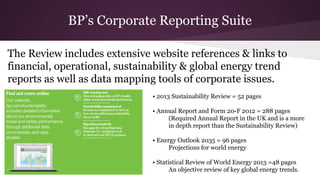
BP’s Corporate Reporting Suite
• 2013 Sustainability Review = 52 pages
• Annual Report and Form 20-F 2012 = 288 pages
(Required Annual Report in the UK and is a more
in depth report than the Sustainability Review)
• Energy Outlook 2035 = 96 pages
Projections for world energy
• Statistical Review of World Energy 2013 =48 pages
An objective review of key global energy trends.
The Review includes extensive website references & links to
financial, operational, sustainability & global energy trend
reports as well as data mapping tools of corporate issues.
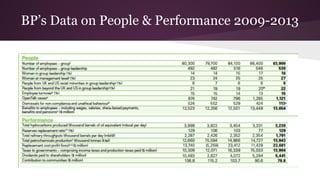
BP’s Data on People & Performance 2009-2013
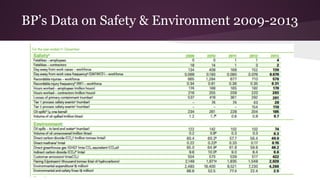
BP’s Data on Safety & Environment 2009-2013
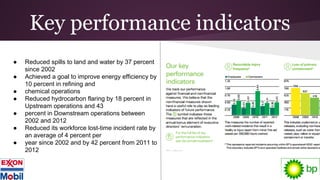
Key performance indicators
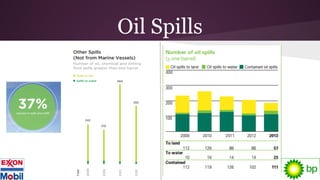
● Reduced spills to land and water by 37 percent
since 2002
● Achieved a goal to improve energy efficiency by
10 percent in refining and
● chemical operations
● Reduced hydrocarbon flaring by 18 percent in
Upstream operations and 43
● percent in Downstream operations between
2002 and 2012
● Reduced its workforce lost-time incident rate by
an average of 4 percent per
● year since 2002 and by 42 percent from 2011 to
2012
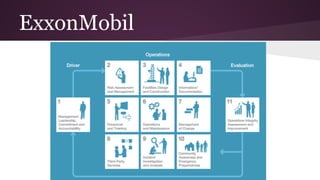
ExxonMobil
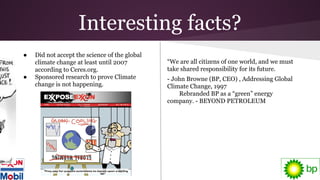
Interesting facts?
● Did not accept the science of the global
climate change at least until 2007
according to Ceres.org.
● Sponsored research to prove Climate
change is not happening.
“We are all citizens of one world, and we must
take shared responsibility for its future.
- John Browne (BP, CEO) , Addressing Global
Climate Change, 1997
Rebranded BP as a “green” energy
company. - BEYOND PETROLEUM
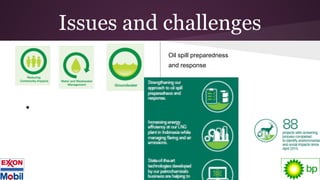
Issues and challenges
Oil spill preparedness
and response
●

Exxon bp csr 2012 analysis

  • 1.
    ExxonMobil vs. BPCSR 2012 by Judith Nathanson Natalya Prilipko March 2014
  • 2.
    Company vision “ExxonMobil’s roleis to create the technologies and techniques to develop and supply energy to growing populations and economies — in a safe, secure and environmentally responsible manner.” — Rex W. Tillerson, Chairman and CEO We aim to create value for shareholders by helping to meet growing demand for energy in a responsible way. BP’s objective is to create value for shareholders and supplies of energy for the world in a safe and responsible way. We strive to be a safety leader in our industry, a world- class operator, a responsible corporate citizen and a good employer. We are working to enhance safety and risk management, earn back trust and grow value. Bob Dudley Group Chief Executive 20 March 2013
  • 3.
  • 4.
    Questions we asked ●What is their environmental policy? ● Are reports balanced? ● Is the information clear? | Is the data accurate? | Do reports indicate the data that has been measured? ● Is the information comparable? | The report and the information contained within it can be compared on a year-to-year basis. ● What information is reflected on the oil spills and other disasters caused by company activities? ● What are they benchmarking against? ● What issues they are dealing with? | What are they saying about fracking? ● Internal/external consultants?
  • 5.
  • 6.
  • 7.
    Stakeholders Governments 70 countries Non-Governmental Organizations and Academic Institution Communities Shareholders CustomersServe about 1.2 customers per day Suppliers Employees 85,700 Employees in more than 70 countries (mostly in Europe and US)
  • 8.
    Environmental policy BP annuallyreviews its management of material issues such as: ● greenhouse gas emissions & flaring reductions ● water ● sensitive and protected areas ● oil spill response. ● pollution prevention ● reducing impact on biodiversity.
  • 9.
    Challenges faced ● Publicscrutiny ● Use of re-used water in fracking ● Developing undiscovered oil resources in the Arctic ● Developing Canadian oil sands in responsible manner ● Lack of waste management infrastructure in some countries
  • 10.
  • 11.
  • 12.
  • 13.
    Internal/External audits ● Internal ○200 Internal auditors ○ ⅓ of operations ● Lloyd’s Register Quality Assurance, Inc. ○ Headquartered in Texas (as ExxonMobil) ● BP’s Independent Assurance Statement by Ernst & Young LLP, London
  • 14.
  • 16.
    Citations 1. ExxonMobil CorporateCitizenship report 2012 2. http://www.ipieca.org/ 3. http://www.bp. com/en/global/corporate/sustainability/environment/managi ng-our-impact-on-the-environment.html 4. Sustainability Reporting Guidelines & Oil and Gas Sector Supplement, Version 3.1/OGSS Final version © 2000-2011 Global Reporting Initiative. 5. http://www.forbes.com/pictures/mef45glfe/6-bp-4-1-million- barrels-per-day-3/ 6. ReportAlert Announcement on ExxonMobil of 29th May, 2013 from www.reportalert.info 7. Images: a. www.fightblindness.org 1. BP Sustainability Review 2012 2. http://www.ipieca.org/ 3. http://www.bp. com/en/global/corporate/sustainability/environment/managi ng-our-impact-on-the-environment.html 4. Sustainability Reporting Guidelines & Oil and Gas Sector Supplement, Version 3.1/OGSS Final version © 2000-2011 Global Reporting Initiative. 5. “Exxon CEO Profits Huge As America's Largest Natural Gas Producer-But Frack In His Own Backyard And He Sues! by Rick Ungar at Forbes.com 6. Images:
  • 17.
  • 19.
    Benchmarking ● Own expectations ●Industry best practices ● International benchmarks ● Own expectations ● Industry best practices ● International benchmarks
  • 22.
    Company background 1901-1908 Anglo-PersianOil Company searched for oil in Persia. 1917 UK Government became a major shareholder. Operated as Anglo-Iraninan Oil company through two world wars. 1954 Changed name to British Petroleum 1960’s - years of exploration throughout the world, Alaska and the North Sea 1987 Fully privatized; purchased its shares back from UK. 1859 1st successful oil well in PA 1870 Standard Oil Company formed, later renamed to Exxon 1999 Exxon mergers with Mobil, a Chemical company and forms Exxon Mobil Corporation. up to 2007 Exxon is not sold on the science behind the Climate Change 2009 For Exxon the XTO purchase signals that it expects the primacy of petroleum to wane somewhat.
  • 23.
    BP’s Reporting History& Guidelines 2013 BP Sustainability Review report follows: ● The GRI’s G3.1 guidelines and the oil and gas sector supplement to an A+ level. ● The GRI table is checked by the assurance provider, Ernst & Young. ● IPIECA guidelines (IPIECA is the global oil and gas industry association for environmental and social issues. It develops, shares and promotes good practices and knowledge to help the industry improve its environmental and social performance; and is the industry’s principal channel of communication with the United Nations.) ● UN Global Compact -Reporting against the 10 principles on human rights, labour, environment and anti-corruption. Note: The report only states its adherence to the GRI & IPIECA guidelines. They also state they are working to align with the UN Guiding Principles on Business and Human Rights. All supporting material is on the BP website. (excellent linking from the report)
  • 24.
    What BP includedin the Report The Gulf of Mexico • Environmental and economic restoration. • Legal proceedings. • Independent safety and ethics monitors. The energy future • Climate change and carbon risk. • The transition to a lower-carbon economy, including the role of renewables. • Operating at the frontiers: deepwater drilling, oil sands and hydraulic fracturing. How we operate • Board/executive governance and oversight. • Risk management. • Financial sustainability of BP. Our people and safety • Employee and contractor safety. • Recruitment and retention. • Performance and reward. • Diversity and inclusion. Environment and society • GHG emissions, water and other environmental performance. • Our contribution to society. • Human rights. • Transparency of payments. • Geopolitical context.
  • 25.
    What is IPIECA InternationalPetroleum Industry Environmental Conservation Association ● IPIECA is the global oil and gas industry association for environmental and social issues. (formed in 1974) ● IPIECA is the only global association involving both the upstream and downstream oil and gas industry on environmental and social issues. ● IPIECA’s membership covers over half of the world’s oil production. (36 companies, comprising all 6 supermajors and 7 national oil companies) ● IPIECA is the industry’s principal channel of communication with the UN ● IPIECA helps the oil and gas industry improve its environmental and social performance by: ● developing, sharing and promoting good practices and solutions ● enhancing and communicating knowledge and understanding ● engaging members and others in the industry ● working in partnership with key stakeholders IPIECA currently has working groups that address the following areas: biodiversity; climate change; health; oil spill preparedness; fuels and products; reporting; social responsibility, and water. Both BP and Exxon Mobil are members
  • 26.
    BP’s Corporate ReportingSuite • 2013 Sustainability Review = 52 pages • Annual Report and Form 20-F 2012 = 288 pages (Required Annual Report in the UK and is a more in depth report than the Sustainability Review) • Energy Outlook 2035 = 96 pages Projections for world energy • Statistical Review of World Energy 2013 =48 pages An objective review of key global energy trends. The Review includes extensive website references & links to financial, operational, sustainability & global energy trend reports as well as data mapping tools of corporate issues.
  • 27.
    BP’s Data onPeople & Performance 2009-2013
  • 28.
    BP’s Data onSafety & Environment 2009-2013
  • 29.
    Key performance indicators ●Reduced spills to land and water by 37 percent since 2002 ● Achieved a goal to improve energy efficiency by 10 percent in refining and ● chemical operations ● Reduced hydrocarbon flaring by 18 percent in Upstream operations and 43 ● percent in Downstream operations between 2002 and 2012 ● Reduced its workforce lost-time incident rate by an average of 4 percent per ● year since 2002 and by 42 percent from 2011 to 2012
  • 30.
  • 31.
    Interesting facts? ● Didnot accept the science of the global climate change at least until 2007 according to Ceres.org. ● Sponsored research to prove Climate change is not happening. “We are all citizens of one world, and we must take shared responsibility for its future. - John Browne (BP, CEO) , Addressing Global Climate Change, 1997 Rebranded BP as a “green” energy company. - BEYOND PETROLEUM
  • 32.
    Issues and challenges Oilspill preparedness and response ●