Strengthening Europe through
                                                                  grassroots civil initiatives in
                                                                  education


                                                                   Mitsuo Kanemaki, verikom e.V, Hamburg, Germany |
                                                                   05. - 06. March 2012, Brussels
                                                                   mentoring@verikom.de | www.verikom.de


                                                                                                                      1


05.03.2012 |   Strengthening Europe through civil grassroots initiatives in education
Mentoring and Empowerment:
                                                                        Students-mentors as examples
                                                                        for young students- and for the
                                                                        society at large


                                                                                                      2


06.03.2012 |   Strengthening Europe through grassroots civil initiatives in education
Overview

  1       History of the project “Junge Vorbilder”
  2       What is mentoring?
  3       Background
  4       Situation of immigrant students (mentees)
  5       Focus and goals
  6       The mentors
  7       Mentoring and empowerment
  8       Project results
  9       Sources

                                                                                        3


06.03.2012 |   Strengthening Europe through grassroots civil initiatives in education
1
                                                                            History of the project
                                                                            “Junge Vorbilder”


                                                                                                     4


06.03.2012 |   Strengthening Europe through grassroots civil initiatives in education
1. Project: “Junge Vorbilder”

1

2
                                                                           Pilot project
                               Inspired by                                                                       Since 2007
3                                                                            begun in
                               Marokaane                                                                          known as
                                                                            Dec. 2004
                             Coachingproject                                                                   Junge Vorbilder
4                                                                        under the name
                            Netherland (1999)                                                                (Young Role Models)
                                                                              Kendi
5

6

7

8
                                                                                                In 2010 sub-
9                                        Since Nov. 2011                                    projects YES (young
                                                                                            mentors for equality
                                        implementation of
                                                                                            at school), MAX100
                                        group mentoring at                                    and in April 2011
                                          several schools                                     HipHop4School
                                                                                              were introduced


                                                                                                                                   5


    06.03.2012 |   Strengthening Europe through grassroots civil initiatives in education
2          What is mentoring?


                                                                                                 6


06.03.2012 |   Strengthening Europe through grassroots civil initiatives in education
2. What is Mentoring?

1

2
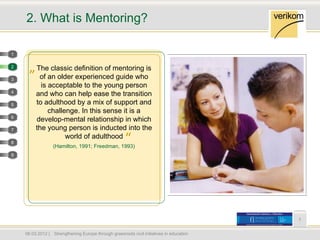
     „ The classic definition of mentoring is
3         of an older experienced guide who
           is acceptable to the young person
4
         and who can help ease the transition
5        to adulthood by a mix of support and
              challenge. In this sense it is a
6
         develop-mental relationship in which
7        the young person is inducted into the
8
                    world of adulthood
                   (Hamilton, 1991; Freedman, 1993)
                                                        “
9


                                                                                            7


    06.03.2012 |   Strengthening Europe through grassroots civil initiatives in education
3          Background


                                                                                         8


06.03.2012 |   Strengthening Europe through grassroots civil initiatives in education
3. Background

1
         Immigrant children are primarily
2
          represented at lower qualifying schools
3         (61,5%), such as secondary general
          school (Hauptschule 31,8%) and
4         intermediate school (Realschule 29,7%)
5
         A quarter (24,6%) of immigrant children
6
          go to grammar school (Gymnasium)
7

8        School drop-out rate of immigrant
          students, without any graduation
9         is twice as much as non immigration
          students


         Higher rate of “late bloomers” especially
          by immigrant children


                                                                                            9


    06.03.2012 |   Strengthening Europe through grassroots civil initiatives in education
4
                                                                            Situation of immigrant
                                                                            students (mentees)


                                                                                                     10


06.03.2012 |   Strengthening Europe through grassroots civil initiatives in education
4. Situation of immigrant students
    (mentees)
1
         Immigrant students have to accomplish
2
          higher social and
3         cultural adaptation levels

4
         Parents show less participation
5         in everyday school life
6
         Less qualitative homework support from
7
          family
8

9        Teachers give up and underestimate
          students, when weak performance at
          school is delivered


         Students are confronted with prejudices


                                                                                            11


    06.03.2012 |   Strengthening Europe through grassroots civil initiatives in education
4. Situation of immigrant students
    (mentees)
1
        According to our experiences in the
2
        project:
3        Bad grades and underachievement
          comes not only from subject related
4
          gaps, but also from less self-confidence
5         and demotivation

6

7

8       Root cause often motivational nature
9        Less self-confidence in their own
          potential
         Feeling misunderstood
         Lack of prospects
         Downwards spiral


                                                                                            12


    06.03.2012 |   Strengthening Europe through grassroots civil initiatives in education
5          Focus and goals


                                                                                              13


06.03.2012 |   Strengthening Europe through grassroots civil initiatives in education
5. Focus and goals

1
        Three Aspects of “Junge Vorbilder”
2
         Social-emotional companionship
3
         Subject-specific tutoring
4        Orientation for future prospects, career,
          study etc.
5

6

7

8       Project goals:
9        Independence of mentees
         Empowerment of mentees and mentors


                                                                                            14


    06.03.2012 |   Strengthening Europe through grassroots civil initiatives in education
6          The mentors


                                                                                          15


06.03.2012 |   Strengthening Europe through grassroots civil initiatives in education
6. The mentors

1
         Mentors have a immigration background
2

3
         Successful graduated from the German
4         higher secondary education system

5
         “Experienced experts”
6

7        Close in age to the mentees
8
         Bridge-builders between parents,
9
          teachers and mentees


                                                                                            16


    06.03.2012 |   Strengthening Europe through grassroots civil initiatives in education
7
                                                                            Mentoring and
                                                                            empowerment


                                                                                            17


06.03.2012 |   Strengthening Europe through grassroots civil initiatives in education
7. Mentoring and empowerment:
    mentors
1
         Opportunity to take over responsibility in
2
          organisations and society
3

4        Gaining abilities/qualifications through
          trainings and seminars
5

6        From mentor, to project assistant, to
          trainer, to project leader … ?
7

8
         Recognition in community
9

         Payment


                                                                                            18


    06.03.2012 |   Strengthening Europe through grassroots civil initiatives in education
7. Mentoring and empowerment:
    qualification
1
         Two-days basic-training
2

3
         Subject related advanced training
4

5        Learning methods

6
         Regular mentor meetings
7

8        Train the trainer, coaching
9
         Participating in other sub-projects (YES,
          MAX100, HH4S)


         Certificates for participants of the
          project


                                                                                            19


    06.03.2012 |   Strengthening Europe through grassroots civil initiatives in education
7. Mentoring and empowerment:
    mentors’ feedback
1
         Motivated participants
2

3
         Recommendation and
4         new potential mentors

5
         Suggestions for improvements
6

7        New input for seminars
8
         New project ideas
9


         Ambassadors of a new and self-
           confident Germany


                                                                                            20


    06.03.2012 |   Strengthening Europe through grassroots civil initiatives in education
7. Mentoring and empowerment:
    cooperation
1

2
              20 schools mostly in social
3                     hotspots
4

5

6
              Regional Teacher Training
7
                    Institute (LI)
8

9


        University: Intercultural education
                       (IKS)


                                                                                            21


    06.03.2012 |   Strengthening Europe through grassroots civil initiatives in education
8          Project results


                                                                                              22


06.03.2012 |   Strengthening Europe through grassroots civil initiatives in education
8. Project results

1

2
                     Mentees                                          Mentors                    Community
3

4

5

6             Get better grades                               Get qualified, skilled            No PR needed,
                 at school                                   and prepared for later             due to personal
7                                                                   career                     recommendation
              Positive impact on                                                                within families,
8            the learning climate                           More than 150 mentors           neighborhoods, schools
                    in class                                 with different cultural                  etc.
9
                                                             background trained
          Parents better involved                                                              Increased interest
          in every day school life                           Now around 40 active             in cooperation from
                                                              mentors including              schools, foundations,
                                                               group mentoring               administrative bodies
                                                                  at schools


                                                                                                                     23


    06.03.2012 |   Strengthening Europe through grassroots civil initiatives in education
9          Source


                                                                                        24


06.03.2012 |   Strengthening Europe through grassroots civil initiatives in education
9. Source

1
           Benholz, C. (2010). Förderunterricht für Kinder und Jugendliche ausländischer Herkunft an der Universität Duisburg-Essen. In Stiftung Mercator (Hrsg.). Der
            Mercator-Förderunterricht (S. 23-33). Münster u.a.: Waxmann.
2
           Bundesministerium für Bildung und Forschung (2006), (2008), (2010): Bildung in Deutschland. Ein indikatorengestützter Bericht mit einer Analyse zu Bildung und
            Migration.
3
           Crul, M. (2002). Success breeds success. Moroccan and Turkish student mentors in the Netherlands. International Journal for the Advancement of Counseling
            24, 275-287.
4          Die Beauftragte der Bundesregierung für Migration, Flüchtlinge und Integration (2008). Aktion Zusammenwachsen. Bildungspatenschaften stärken, Integration
            fördern. Patenatlas. Berlin.
5          DuBois, D.L., Holloway, B.E., Valentine, J.C. & Cooper, H. (2002). Effectiveness of Mentoring Programs for Youth: A Meta-Analytic Review. American Journal of
            Community Psychology, Vol. 30 (2), 157-197.

6          Ehlers, J. (2007). Mentoring im Prozess der Berufsorientierung – eine theoriegeleitete Analyse seiner Möglichkeiten. In J. Ehlers & N. Kruse (Hrsg.). Jugend-
            Mentoring in Deutschland (S. 13-142). Norderstedt.
           efms (europäisches forum für migrationsstudien) (2009). Förderunterricht für Kinder und Jugendliche mit Migrationshintergrund. Evaluation des Projekts der
7           Stiftung Mercator. Kurzbericht der Evaluation. Bamberg (unveröffentlicht).
           Keating, L.M., Tomishima, M.A., Foster, S. & Allesandri, M. (2002). The Effects of a Mentoring Program on At-Risk Youth. Adolescence Vol. 37 (148), 717-734.
8
           Klemm, K. & Klemm, A. (2010). Ausgaben für Nachhilfe – teuer und unfairer Ausgleich für fehlende individuelle Förderung. Bertelsmann-Stiftung: Bielefeld.
           Rohdes, J.E. (1994). Older and wiser: Mentoring relationships in childhood and adolescence. The Journal of Primary Prevention, Vol. 14 (3), 187-195.
9
           Stiftung Mercator (Hrsg.) (2010). Der Mercator-Förderunterricht. Sprachförderung für Schüler mit Migrationshintergrund durch Studierende. Münster u.a.
            Waxmann.
           Tierney, J.P & Grossman, J. (1995), Making a difference: An impact study. Philadelphia: Public/Private Ventures.
           Freedman, M. (1993) The Kindness of Strangers: adult mentors, urban youth and the new voluntarism, San Francisco: Jossey-Bass Publishers.
           Hamilton, S. F. (1991) Unrelated Adults in Adolescent Lives, Occasional Paper No 29, New York: Cornell University.
           Schneider, J. (2011) Vielfalt gestallten. Junge Vorbilder – Was können Studierende mit Migrationshintergrund als Vorbilder bewirken? Pädagogik (Vol.9).


                                                                                                                                                                             25


    06.03.2012 |    Strengthening Europe through grassroots civil initiatives in education
26


06.03.2012 |   Strengthening Europe through grassroots civil initiatives in education

Mitsou Kanemaki

  • 1.
    Strengthening Europe through grassroots civil initiatives in education Mitsuo Kanemaki, verikom e.V, Hamburg, Germany | 05. - 06. March 2012, Brussels mentoring@verikom.de | www.verikom.de 1 05.03.2012 | Strengthening Europe through civil grassroots initiatives in education
  • 2.
    Mentoring and Empowerment: Students-mentors as examples for young students- and for the society at large 2 06.03.2012 | Strengthening Europe through grassroots civil initiatives in education
  • 3.
    Overview 1 History of the project “Junge Vorbilder” 2 What is mentoring? 3 Background 4 Situation of immigrant students (mentees) 5 Focus and goals 6 The mentors 7 Mentoring and empowerment 8 Project results 9 Sources 3 06.03.2012 | Strengthening Europe through grassroots civil initiatives in education
  • 4.
    1 History of the project “Junge Vorbilder” 4 06.03.2012 | Strengthening Europe through grassroots civil initiatives in education
  • 5.
    1. Project: “JungeVorbilder” 1 2 Pilot project Inspired by Since 2007 3 begun in Marokaane known as Dec. 2004 Coachingproject Junge Vorbilder 4 under the name Netherland (1999) (Young Role Models) Kendi 5 6 7 8 In 2010 sub- 9 Since Nov. 2011 projects YES (young mentors for equality implementation of at school), MAX100 group mentoring at and in April 2011 several schools HipHop4School were introduced 5 06.03.2012 | Strengthening Europe through grassroots civil initiatives in education
  • 6.
    2 What is mentoring? 6 06.03.2012 | Strengthening Europe through grassroots civil initiatives in education
  • 7.
    2. What isMentoring? 1 2 „ The classic definition of mentoring is 3 of an older experienced guide who is acceptable to the young person 4 and who can help ease the transition 5 to adulthood by a mix of support and challenge. In this sense it is a 6 develop-mental relationship in which 7 the young person is inducted into the 8 world of adulthood (Hamilton, 1991; Freedman, 1993) “ 9 7 06.03.2012 | Strengthening Europe through grassroots civil initiatives in education
  • 8.
    3 Background 8 06.03.2012 | Strengthening Europe through grassroots civil initiatives in education
  • 9.
    3. Background 1  Immigrant children are primarily 2 represented at lower qualifying schools 3 (61,5%), such as secondary general school (Hauptschule 31,8%) and 4 intermediate school (Realschule 29,7%) 5  A quarter (24,6%) of immigrant children 6 go to grammar school (Gymnasium) 7 8  School drop-out rate of immigrant students, without any graduation 9 is twice as much as non immigration students  Higher rate of “late bloomers” especially by immigrant children 9 06.03.2012 | Strengthening Europe through grassroots civil initiatives in education
  • 10.
    4 Situation of immigrant students (mentees) 10 06.03.2012 | Strengthening Europe through grassroots civil initiatives in education
  • 11.
    4. Situation ofimmigrant students (mentees) 1  Immigrant students have to accomplish 2 higher social and 3 cultural adaptation levels 4  Parents show less participation 5 in everyday school life 6  Less qualitative homework support from 7 family 8 9  Teachers give up and underestimate students, when weak performance at school is delivered  Students are confronted with prejudices 11 06.03.2012 | Strengthening Europe through grassroots civil initiatives in education
  • 12.
    4. Situation ofimmigrant students (mentees) 1 According to our experiences in the 2 project: 3  Bad grades and underachievement comes not only from subject related 4 gaps, but also from less self-confidence 5 and demotivation 6 7 8 Root cause often motivational nature 9  Less self-confidence in their own potential  Feeling misunderstood  Lack of prospects  Downwards spiral 12 06.03.2012 | Strengthening Europe through grassroots civil initiatives in education
  • 13.
    5 Focus and goals 13 06.03.2012 | Strengthening Europe through grassroots civil initiatives in education
  • 14.
    5. Focus andgoals 1 Three Aspects of “Junge Vorbilder” 2  Social-emotional companionship 3  Subject-specific tutoring 4  Orientation for future prospects, career, study etc. 5 6 7 8 Project goals: 9  Independence of mentees  Empowerment of mentees and mentors 14 06.03.2012 | Strengthening Europe through grassroots civil initiatives in education
  • 15.
    6 The mentors 15 06.03.2012 | Strengthening Europe through grassroots civil initiatives in education
  • 16.
    6. The mentors 1  Mentors have a immigration background 2 3  Successful graduated from the German 4 higher secondary education system 5  “Experienced experts” 6 7  Close in age to the mentees 8  Bridge-builders between parents, 9 teachers and mentees 16 06.03.2012 | Strengthening Europe through grassroots civil initiatives in education
  • 17.
    7 Mentoring and empowerment 17 06.03.2012 | Strengthening Europe through grassroots civil initiatives in education
  • 18.
    7. Mentoring andempowerment: mentors 1  Opportunity to take over responsibility in 2 organisations and society 3 4  Gaining abilities/qualifications through trainings and seminars 5 6  From mentor, to project assistant, to trainer, to project leader … ? 7 8  Recognition in community 9  Payment 18 06.03.2012 | Strengthening Europe through grassroots civil initiatives in education
  • 19.
    7. Mentoring andempowerment: qualification 1  Two-days basic-training 2 3  Subject related advanced training 4 5  Learning methods 6  Regular mentor meetings 7 8  Train the trainer, coaching 9  Participating in other sub-projects (YES, MAX100, HH4S)  Certificates for participants of the project 19 06.03.2012 | Strengthening Europe through grassroots civil initiatives in education
  • 20.
    7. Mentoring andempowerment: mentors’ feedback 1  Motivated participants 2 3  Recommendation and 4 new potential mentors 5  Suggestions for improvements 6 7  New input for seminars 8  New project ideas 9  Ambassadors of a new and self- confident Germany 20 06.03.2012 | Strengthening Europe through grassroots civil initiatives in education
  • 21.
    7. Mentoring andempowerment: cooperation 1 2 20 schools mostly in social 3 hotspots 4 5 6 Regional Teacher Training 7 Institute (LI) 8 9 University: Intercultural education (IKS) 21 06.03.2012 | Strengthening Europe through grassroots civil initiatives in education
  • 22.
    8 Project results 22 06.03.2012 | Strengthening Europe through grassroots civil initiatives in education
  • 23.
    8. Project results 1 2 Mentees Mentors Community 3 4 5 6 Get better grades Get qualified, skilled No PR needed, at school and prepared for later due to personal 7 career recommendation Positive impact on within families, 8 the learning climate More than 150 mentors neighborhoods, schools in class with different cultural etc. 9 background trained Parents better involved Increased interest in every day school life Now around 40 active in cooperation from mentors including schools, foundations, group mentoring administrative bodies at schools 23 06.03.2012 | Strengthening Europe through grassroots civil initiatives in education
  • 24.
    9 Source 24 06.03.2012 | Strengthening Europe through grassroots civil initiatives in education
  • 25.
    9. Source 1  Benholz, C. (2010). Förderunterricht für Kinder und Jugendliche ausländischer Herkunft an der Universität Duisburg-Essen. In Stiftung Mercator (Hrsg.). Der Mercator-Förderunterricht (S. 23-33). Münster u.a.: Waxmann. 2  Bundesministerium für Bildung und Forschung (2006), (2008), (2010): Bildung in Deutschland. Ein indikatorengestützter Bericht mit einer Analyse zu Bildung und Migration. 3  Crul, M. (2002). Success breeds success. Moroccan and Turkish student mentors in the Netherlands. International Journal for the Advancement of Counseling 24, 275-287. 4  Die Beauftragte der Bundesregierung für Migration, Flüchtlinge und Integration (2008). Aktion Zusammenwachsen. Bildungspatenschaften stärken, Integration fördern. Patenatlas. Berlin. 5  DuBois, D.L., Holloway, B.E., Valentine, J.C. & Cooper, H. (2002). Effectiveness of Mentoring Programs for Youth: A Meta-Analytic Review. American Journal of Community Psychology, Vol. 30 (2), 157-197. 6  Ehlers, J. (2007). Mentoring im Prozess der Berufsorientierung – eine theoriegeleitete Analyse seiner Möglichkeiten. In J. Ehlers & N. Kruse (Hrsg.). Jugend- Mentoring in Deutschland (S. 13-142). Norderstedt.  efms (europäisches forum für migrationsstudien) (2009). Förderunterricht für Kinder und Jugendliche mit Migrationshintergrund. Evaluation des Projekts der 7 Stiftung Mercator. Kurzbericht der Evaluation. Bamberg (unveröffentlicht).  Keating, L.M., Tomishima, M.A., Foster, S. & Allesandri, M. (2002). The Effects of a Mentoring Program on At-Risk Youth. Adolescence Vol. 37 (148), 717-734. 8  Klemm, K. & Klemm, A. (2010). Ausgaben für Nachhilfe – teuer und unfairer Ausgleich für fehlende individuelle Förderung. Bertelsmann-Stiftung: Bielefeld.  Rohdes, J.E. (1994). Older and wiser: Mentoring relationships in childhood and adolescence. The Journal of Primary Prevention, Vol. 14 (3), 187-195. 9  Stiftung Mercator (Hrsg.) (2010). Der Mercator-Förderunterricht. Sprachförderung für Schüler mit Migrationshintergrund durch Studierende. Münster u.a. Waxmann.  Tierney, J.P & Grossman, J. (1995), Making a difference: An impact study. Philadelphia: Public/Private Ventures.  Freedman, M. (1993) The Kindness of Strangers: adult mentors, urban youth and the new voluntarism, San Francisco: Jossey-Bass Publishers.  Hamilton, S. F. (1991) Unrelated Adults in Adolescent Lives, Occasional Paper No 29, New York: Cornell University.  Schneider, J. (2011) Vielfalt gestallten. Junge Vorbilder – Was können Studierende mit Migrationshintergrund als Vorbilder bewirken? Pädagogik (Vol.9). 25 06.03.2012 | Strengthening Europe through grassroots civil initiatives in education
  • 26.
    26 06.03.2012 | Strengthening Europe through grassroots civil initiatives in education

Editor's Notes

  • #2 My name is Mitsuo Kanemaki from the project “Junge Vorbilder”, which means “young role models” or “young examples” As a little background information to my person; I started in this project as mentor in 2008, became later a mentor coach and now, currently work as one of the project coordinator. And I am here today as a ambassador of all our Mentors, Mentor coaches, as well as the coordination team. Thank you for giving us this possibility to speak to you. ENDE
  • #3 The theme of today’s presentation is: Mentoring and empowerment: Students-mentors as examples for young students- and for the society at large. If you have any questions during the presentation, what I suppose… Please ask….but after the presentation… because I am so nervous, that I probably forget what I want to say. Thank you for your cooperation. ENDE
  • #4 Before I begin, I would like to show you the overview of my presentation: First I ‘d like to talk shortly about the beginning of the project (1), then… for all who do not know yet, …. explain what “mentoring” means (2)… Switch to some statistical background (3) related to immigrants and education in Germany, after this Touch on the situation of our mentees (4). Later i ntroduce our goals (5), and talk about our mentors (6). Because they are different, I mean special,… in a positive way…compared to other German mentoring projects Followed by our understanding of an “mentoring & empowerment” approach (7) Last but not least; a short summary of the “Project results” (8) And the sources (9) If you would like to read something in detail. I found English literature as well. ENDE
  • #6 The project “JV” was inspired through good experiences in the Netherlands with the mentoring project “Marokaane Coachingproject”, (initialized by Prof. Maurice Crul, and Karen Kraal) In December 2004 a similar pilot project begun in Hamburg called “Kendi”. (While the “target group of “Marrokaane coachingproject” was Moroccan children, being supported by Moroccan mentors. “Kendi” started with Turkish children and Turkish mentors and it is a one to one mentoring project. Since February 2007 this project is now known as “Junge Vorbilder” (Young Role Models) and is open to all immigrant children. In 2010 sub-projects YES (young mentors for equality at school), MAX100 and in April 2011 HipHop4School were introduced, all projects were supported by our mentors. Since Nov. 2011 we implemented group mentoring (which means a groups of maximum 5 students in each class) at several schools. -> But what actually does mentoring mean? ENDE _________________________________________________________________________________________________________________________ [1] HH4S: Is a career supporting project of JV, where mainly migrant children between 14 – 18 years old, had the possibility to get free professional lessons in break-dance, graffiti, singing and making experiences in video shooting (camera). In a creative environment, the participants could naturally learn and make first experiences in media related professions as dancer, graphic designer, producer and director of photography.   [2] JV (Junge Vorbilder): Encourages and supports students with migrant backgrounds between 8th-11th grade, in graduating high school. Unlike to other mentoring projects, most participants (Mentors) of our mentoring projects are aged between 18 and 30 years and have a migrant background themselves. All Mentors have successfully gone through the German school system and have the university-entrance-diploma and are now studying at a university or college. Therefore they are not only tutors, but also "experience experts" and role models.   [3] verikom e.V. (Verbund für interkulturelle Kommunikation e.V.) is an NGO uniting different intercultural projects (especially for migrants, foreigner and refugees). And offers consulting services against domestic abuse, gives German lessons, free medical treatment for refugees etc. In this NGO the project Junge Vorbilder (JV) and he sub-projects  HipHop4School (HH4S) and Young mentors for equality at school (YES) is located.   [4] YES: It is still a taboo to talk about discrimination in schools, although it is always present on institutional and individual level. The goal of our project is to create an awareness of discrimination mechanisms to ensure a democratic and social interaction.
  • #8 We have many different Mentoring approaches,….. in as many different areas, such as in policy, economics, universities etc. but a precise definitions is elusive. (schwer fassbar) -> maybe the best fitting general definition is as follows: „ The classic definition of mentoring is of an older experienced guide who is acceptable to the young person and who can help ease the transition to adulthood by a mix of support and challenge. In this sense it is a developmental relationship in which the young person is inducted into the world of adulthood“ (Hamilton, 1991; Freedman, 1993) In our case we are aiming an educational success of immigrant teenager (mentee), who are between 14-18 years old. And the focus for this approach has many different reasons. ENDE
  • #10 The German federal ministry of education and research, revealed and evaluated that immigrant students have to master several challenges, such as that immigrant children are primary represented at lower qualifying schools (61,5% of all immigrant students), such as secondary general school (Hauptschule 31,8%) and intermediate school (Realschule 29,7%) (Compared to non immigrant children; secondary general school: HS 16,6%, intermediate school: RS 38,6%) There is a huge gap! Only a quarter (24,6%) of the immigrant children go to the grammar school (Gymnasium) (higher qualified school) (compared to non immigrant children reaching a percentage of one-third (33,2%) The school drop-out rate of immigrant students without any graduation is twice as high as those without a immigration background And there is a phenomenon of a higher “late bloomers rate” by immigrant children, (Late bloomers means students who graduate later through late school enrolment and repeating classes) What about the situation of immigrant students? ENDE
  • #12 immigrant students have to accomplish higher social and cultural adaptation efforts They switch between different cultures, languages, habits. While they have to speak German at school, they are confronted with their mother tough at home) (Schneider 2011) Parents of mentees show less participation in everyday school life. The German educational system involves parents more in school matters, but immigrant parents are not used to this and often have language barriers, so that they avoid parent-teacher-conferences etc.) Mentees get less qualitative homework support from the family. Homework is difficult to do for immigrant children; the parents often cannot help in educational matters. -> lack of sufficient knowledge of the subjects and the German educational system. In addition teachers give up on their students, when they show a weak performance at school and underestimate their potential They also have to cope with prejudices not only at school ENDE
  • #13 Anyway,…. also the experiences in our project shows, that students often have to cope with multiple problems, as described before. ->But bad marks are often only an effect of their difficult situation, than an intellectual deficit or lack. The root cause for bad marks have often motivational character, such as -> less self-confidence in their own potential, often feel stupid, -> feeling misunderstood (living in two cultures) -> have a lack of prospects and future fears -> which causes often a downwards spiral What can we do? ENDE
  • #15 Therefore our mentoring approach focuses on three important aspects social-emotional companionship Authority through patience, encouragement and inspiration, instead of pressure to perform. Self-confidence through common trust. 2. subject-specific tutoring Implies a subject related teaching and learning on how to study better (study methods and techniques) Raising self-confidence of the mentee through short term successes such as tests etc. articulating binding work agreements for both 3. orientation for future prospects, career, study etc. It is very important to support, to express realistic future aims and goals Mentee-mentor project goal Independence of mentees Empowerment of mentees and mentors ->You cannot separate both, because they are linked to each other, but besides the educational success for the mentee, it is important to work on the mentees independence. The mentor only supports, but the mentee have to take responsibility for their further success at school. The ideal end of a mentor-mentee relationship (takes about a year) is, that the mentee does not need to be helped any more and maybe even take on the Mentor Role themselves later. -> At the same time we want our mentor to take over responsibility for their mentee to strengthen in their personality and raise their potential. And to become a persons of trust at the mentee’s home, by acting like a big sister or big brother and to connect between teacher, student and parents. This is a very big responsibility for a mentor. But as the mentors support the mentees, we the project leaders try to support and encourage our mentors to become good role models, through communication and coaching. ENDE
  • #17 What are our mentors like? Unlike to other mentoring projects in Germany: our mentors themselves have a immigration background They are examples of immigrants who successful graduated from the German higher secondary education system They are “experienced experts” through the same or similar social, cultural and educational biography as their mentees. Mentor and mentee are close in age, so that there is a better identification to the mentees and the mentors; especially mentors, because they have to turn back time and put themselves in the position of a student again They are also bridge-builder between parents, teachers and students as said before ENDE
  • #19 Our aim is not only to empower our mentees, but also our Mentors. But how can we assure to make “mentoring” attractive and raise the participation? -> What incentives (Anreize) do we create for them? we support our mentors and encourage them, to take over responsibility in our organisation and society, by being a active part of it. To grow in personality. as well as giving them the possibility to gain abilities/qualifications through trainings and seminar. We give promotion prospects: (Aufstiegschancen) From a mentor, to project assistant, to trainer, to project leader? As a mentor you will win recognition in community And our mentors gets paid for their efforts -> it is not volunteer work (In fact, most mentoring projects work with much older mentors which have either the money or time, or both. (e.g. pensioners etc.) As I described before, our approach includes young mentors between the ages of 18-26, they have finished high school and have started university, or an apprentice-ship. At this age and stage in life they usually have financial problems. Therefore, being a mentor enables them to spend time helping other students without any financial barriers. This is a possibility they would otherwise not have. -> For this reason, to make it possible for them to participate in our project, we honour their contribution with a fair financial re-imbursement. ENDE
  • #20 What trainings and coaching possibilities do we have at “Junge Vorbilder” Two days basic-training to become a mentor (prepared for the work as mentor) Subject related advanced training, in Mathematics, German and English. Also information about test etc. Learn how to study, methods / techniques regular mentor meetings (to share experiences, talk about problems) Train the trainer, coaching Participation in other sub-projects (YES, HH4S, MAX100) Certificate of participation in the project This all has not only a positive effect on the dynamic of our organisation; it also raises confidence and consciousness in our mentors. Gaining soft skills through empathy and intercultural communication, and first experiences in working environment ENDE
  • #21 But it is not that we are only giving. We are also getting many benefits back from our mentors! We have motivated mentors that identify with the project and work proactively ( mitdenkend/vorausschauend ) Through recommendation to other friends, we get more and more applications from interested students to become a mentor Our mentors give feedback and suggestions for improvements (at mentor meetings etc.) Give input and decide what seminars should be given Sometimes they also come back with ideas for a new project Ambassadors, representing our project in daily life and can gradually build a new Germany ENDE
  • #22 We have also cooperation partners: e.g. We are working currently with 20 schools mostly in social hotspots We are in contact with the Regional Teacher Training Institute (LI), and from time to time we give anti-discrimination or intercultural seminars for teachers. At the University we are cooperating with the project (IKS) Intercultural education student seminar, where we can train our mentors for language skills. ENDE
  • #24 Finally: To summarize the results shortly On the Mentees side: We could mainly help to succeed in school and get better grades-> many mentees could graduate After talked to a few teachers, they could also see/recognize a positive impact on the general learning climate in class, with increased awareness of the mentees’ potential And the mentees parents became more involved in school affairs On Mentors side: Mentors get a higher qualification and preparation for their careers after university (Some could also gain firsthand experience in leadership and NGO work. And through the good contact to many schools, we could also organize internship for a few mentors) We could rise a higher awareness of the immigration issue in society, because of their strong identification to the project We have trained more than 150 mentors with different cultural background And about 40 active mentors including group mentoring at schools, are currently working in this project. In Community: No PR needed, due to personal recommendation within families, neighborhoods, schools etc.-> which means we are recognized by the society And we could increase the interest in cooperation from schools, foundations, administrative bodies. So that the were also honored by the German federal ministry of education and research, among other projects as excellent educational idea, last year. Even we could gain such results, it does not mean that everything works fine in our project, because we are still struggling with many financial problems and fluctuations of mentors and mentees. But I hope that this presentation, might make a very small contribution to this discussion particularly to one of the question for the panel; Which is: “ How can all young people, including those from an immigrant background, be given the opportunity to develop their full potential and contribute to Europe’s future?” Thank you for your kind attention! ENDE