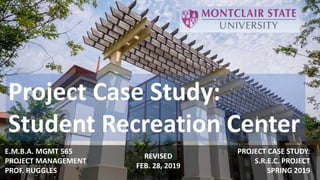



Project Case Study:
Student Recreation Center
E.M.B.A. MGMT 565
PROJECT MANAGEMENT
PROF. RUGGLES
PROJECT CASE STUDY:
S.R.E.C. PROJECT
SPRING 2019
REVISED
FEB. 28, 2019
A.C.E.R. PROJECT SPONSOR TEAM
ELISA APONTE MARIAN EKLADIOUSFRANK CUNHA WILSON ROBLES
1 of 30
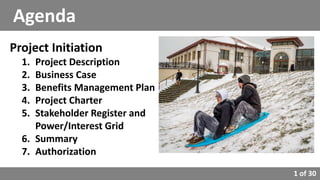
Project Initiation
1. Project Description
2. Business Case
3. Benefits Management Plan
4. Project Charter
5. Stakeholder Register and
Power/Interest Grid
6. Summary
7. Authorization
Agenda
2 of 30
A. Introduction/Background
B. Business Objectives
C. Key Deliverables
D. Proposed Approach
1 - Project Description
3 of 30
A - Introduction/Background
 Proposed by MSU’s Student Government
Association and Student Development and
Campus Life (SDCL)
 Address increasing student enrollment and
on-campus living
1 - Project Description
4 of 30
B - Business Objectives
 Design and construct a state-of-the-art recreation facility
 The expansion of our recreational programs aligns with the
strategic vision of our university and addresses the current
population and our anticipated target enrollment 10 years out.
 The facility that will house recreational programs
 Occupancy within 3-years of project initiation.
1 - Project Description
5 of 30
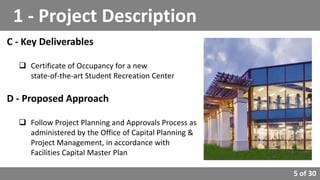
C - Key Deliverables
 Certificate of Occupancy for a new
state-of-the-art Student Recreation Center
D - Proposed Approach
 Follow Project Planning and Approvals Process as
administered by the Office of Capital Planning &
Project Management, in accordance with
Facilities Capital Master Plan
1 - Project Description
6 of 30
2 - Business Case
A. Value Proposition
B. Preliminary Project Deliverables &
Project Requirements
C. Net Present Value
D. Preliminary Budget & Schedule
(Discussed in Section 3)
E. Potential Risks
(Discussed in Section 3)
7 of 30
A - Value Proposition
 The new Recreation Center contains several features that are not part
of Panzer Gymnasium and will be three times as large.
 Anticipated construction cost is $22 Million.
 If we are able to obtain authorization for an April 1, 2019 start, the
new Student Recreation Center will be expected to be open to
students by the first day of the Fall 2022 semester.
2 - Business Case
8 of 30
B. Preliminary Project Deliverables & Project Requirements
The new Student Recreation Center will be 78,000 SF.
 First Floor: Entry lobby, offices, 6 lane pool, multi-court gymnasium,
locker rooms, café, two racquetball courts, three lounge areas and a
weight training area
 Second Floor: Balance of the weight lifting and cardio training
equipment, the running track, the two multi-purpose rooms, two
seating areas, fitness assessment offices and bathrooms.
2 - Business Case
9 of 30
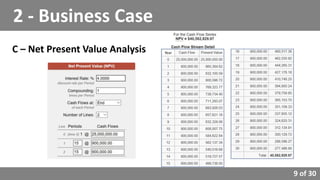
C – Net Present Value Analysis Year
2 - Business Case
10 of 30
A. Target Benefits
B. Benefits Owner
C. Strategic Alignment of the Target Benefits
D. Design & Construction Project Schedule
E. Project Cost Estimate Worksheet
F. Project Performance Metrics
G. Critical Assumptions and Constraints
H. Risk Management Analysis
3 - Benefits Management Plan
11 of 30
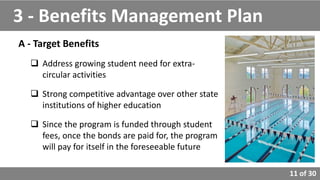
A - Target Benefits
 Address growing student need for extra-
circular activities
 Strong competitive advantage over other state
institutions of higher education
 Since the program is funded through student
fees, once the bonds are paid for, the program
will pay for itself in the foreseeable future
3 - Benefits Management Plan
12 of 30
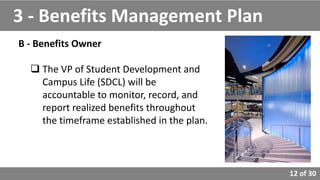
B - Benefits Owner
 The VP of Student Development and
Campus Life (SDCL) will be
accountable to monitor, record, and
report realized benefits throughout
the timeframe established in the plan.
3 - Benefits Management Plan
13 of 30
C - Strategic Alignment of the Target Benefits
The targeted benefits of this project align closely to the business strategies of
the organization, namely:
 Connecting students with a successful future
 Connecting people and ideas
 Connecting to place
 Connecting globally
3 - Benefits Management Plan
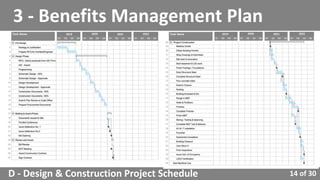
D - Design & Construction Project Schedule 14 of 30
2019 2020 2021 2022 2019 2020 2021 2022
3 - Benefits Management Plan
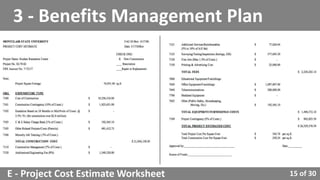
15 of 30E - Project Cost Estimate Worksheet
3 - Benefits Management Plan
16 of 30
3 - Benefits Management Plan
F - Critical Assumptions and Constraints
Project Performance Metrics
 Life Safety: Recordable Incident Rate
 Quality Control: Project Defect Rate
 Project Budget: Cost Variances (Change Orders) & Project Cash Flow
 Project Schedule: Lost Workday Incident Rate
17 of 30
3 - Benefits Management Plan
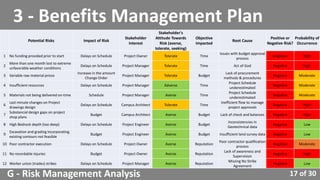
Potential Risks Impact of Risk
Stakeholder
Interest
Stakeholder's
Attitude Towards
Risk (averse,
tolerate, seeking)
Objective
Impacted
Root Cause
Positive or
Negative Risk?
Probability of
Occurrence
1 No funding provided prior to start Delays on Schedule Project Owner Tolerate Time
Issues with budget approval
process
Negative High
2
More than one month lost to extreme
unfavorable weather conditions
Delays on Schedule Project Manager Tolerate Time Act of God Negative High
3 Variable raw material prices
Increase in the amount
Change Order
Project Manager Tolerate Budget
Lack of procurement
methods & procedures
Negative Moderate
4 Insufficient resources Delays on Schedule Project Manager Adverse Time
Project Schedule
underestimated
Negative Moderate
5 Materials not being delivered on-time Schedule Project Manager Averse Time
Project Schedule
underestimated
Negative Moderate
6
Last minute changes on Project
drawings design
Delays on Schedule Campus Architect Tolerate Time
Inefficient flow to manage
project approvals
Negative High
7
Substancial design gaps on project
shop plans
Budget Campus Architect Averse Budget Lack of check and balances Negative High
8 High Bedrock depth (too deep) Delays on Schedule Project Engineer Averse Budget
Inconsistencies in
Geotechnical data
Negative Low
9
Excavation and grading incorporating
existing contours not feasible
Budget Project Engineer Averse Budget Insufficient land survey data Negative Low
10 Poor contractor execution Delays on Schedule Project Owner Averse Reputation
Poor contractor qualification
process
Negative Moderate
11 No recordable injuries Budget Project Owner Averse Reputation
Lack of awareness and
Supervision
Negative High
12 Worker union (trades) strikes Delays on Schedule Project Manager Averse Reputation
Missing No Strike
Agreement
Negative Low
G - Risk Management Analysis
18 of 30
3 - Benefits Management Plan
Project
Objective
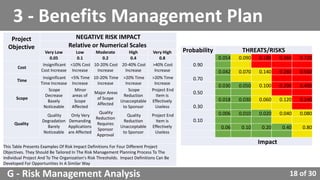
NEGATIVE RISK IMPACT
Relative or Numerical Scales
Very Low Low Moderate High Very High
0.05 0.1 0.2 0.4 0.8
Cost
Insignificant
Cost Increase
<10% Cost
Increase
10-20% Cost
Increase
20-40% Cost
Increase
>40% Cost
Increase
Time
Insignificant
Time Increase
<5% Time
Increase
10-20% Time
Increase
>20% Time
Increase
>20% Time
Increase
Scope
Scope
Decrease
Basely
Noticeable
Minor
areas of
Scope
Affected
Major Areas
of Scope
Affected
Scope
Reduction
Unacceptable
to Sponsor
Project End
Item is
Effectively
Useless
Quality
Quality
Degradation
Barely
Noticeable
Only Very
Demanding
Applications
are Affected
Quality
Reduction
Requires
Sponsor
Approval
Quality
Reduction
Unacceptable
to Sponsor
Project End
Item is
Effectively
Useless
This Table Presents Examples Of Risk Impact Definitions For Four Different Project
Objectives. They Should Be Tailored In The Risk Management Planning Process To The
Individual Project And To The Organization's Risk Thresholds. Impact Definitions Can Be
Developed For Opportunities In A Similar Way
Probability THREATS/RISKS
0.90
0.054 0.090 0.180 0.360 0.720
0.70
0.042 0.070 0.140 0.280 0.560
0.50
0.030 0.050 0.100 0.200 0.400
0.30
0.018 0.030 0.060 0.120 0.240
0.10
0.006 0.010 0.020 0.040 0.080
0.06 0.10 0.20 0.40 0.80
Impact
G - Risk Management Analysis
19 of 30
4 - Project Charter
A. Project Manager’s Authority
B. Project Manager’s Critical Constraints & Assumptions
C. Project Manager’s Work Breakdown Structure
D. Example Work Breakdown Structure
20 of 30
4 - Project Charter
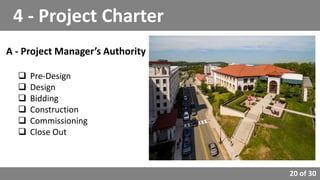
A - Project Manager’s Authority
 Pre-Design
 Design
 Bidding
 Construction
 Commissioning
 Close Out
21 of 30
4 - Project Charter
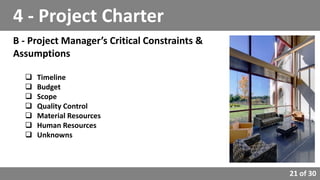
B - Project Manager’s Critical Constraints &
Assumptions
 Timeline
 Budget
 Scope
 Quality Control
 Material Resources
 Human Resources
 Unknowns
22 of 30
4 - Project Charter
C - Project Manager’s Work Breakdown Structure
 Construction Project Initiation & Budget Process
 Procurement Process for A/E Firm
 A/E Design Phases & Deliverables (Scope & Budget Control)
 Procurement Process for Construction Company
 Plan Review and Approval Process
 Construction Process
23 of 30
4 - Project Charter
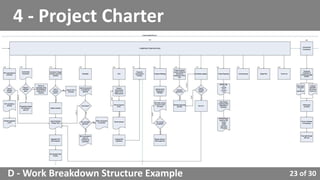
D - Work Breakdown Structure Example
24 of 30
5 - Stakeholders
A. Stakeholders – Student Development & Campus Life
B. Stakeholders – University Facilities
C. Stakeholders – Select List
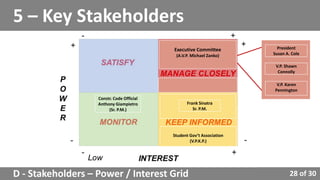
D. Stakeholders – Power / Interest Grid
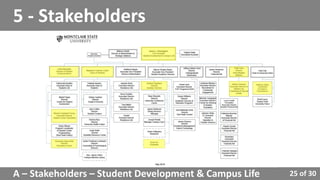
25 of 30
5 - Stakeholders
A – Stakeholders – Student Development & Campus Life
26 of 30
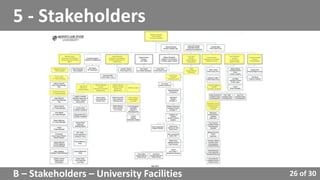
5 - Stakeholders
B – Stakeholders – University Facilities
27 of 30
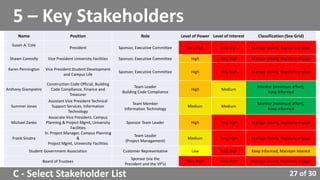
5 – Key Stakeholders
Name Position Role Level of Power Level of Interest Classification (See Grid)
Susan A. Cole
President Sponsor, Executive Committee Very High Very High Manage closely, Regularly engage
Shawn Connolly Vice President University Facilities Sponsor, Executive Committee High Very High Manage closely, Regularly engage
Karen Pennington Vice President Student Development
and Campus Life
Sponsor, Executive Committee High Very High Manage closely, Regularly engage
Anthony Giampietro
Construction Code Official, Building
Code Compliance, Finance and
Treasurer
Team Leader
Building Code Compliance
High Medium
Monitor (minimum effort),
Keep informed
Summer Jones
Assistant Vice President Technical
Support Services, Information
Technology
Team Member
Information Technology
Medium Medium
Monitor (minimum effort),
Keep informed
Michael Zanko
Associate Vice President, Campus
Planning & Project Mgmt, University
Facilities
Sponsor Team Leader High Very High Manage closely, Regularly engage
Frank Sinatra
Sr. Project Manager, Campus Planning
&
Project Mgmt, University Facilities
Team Leader
(Project Management)
Medium Very High Manage closely, Regularly engage
Student Government Association Customer Representative Low Very High Keep Informed, Maintain Interest
Board of Trustees
Sponsor (via the
President and the VP’s)
Very High Very High Manage closely, Regularly engage
C - Select Stakeholder List
28 of 30
5 – Key Stakeholders
D - Stakeholders – Power / Interest Grid
Constr. Code Official
Anthony Giampietro
(Sr. P.M.)
Student Gov’t Association
(V.P.K.P.)
Executive Committee
(A.V.P. Michael Zanko)
Frank Sinatra
Sr. P.M.
President
Susan A. Cole
V.P. Shawn
Connolly
V.P. Karen
Pennington
29 of 30
1. Project Description
2. Business Case
3. Benefits Management Plan
4. Project Charter
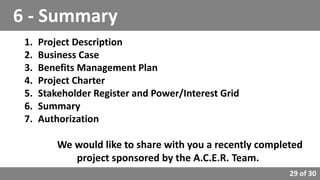
5. Stakeholder Register and Power/Interest Grid
6. Summary
7. Authorization
We would like to share with you a recently completed
project sponsored by the A.C.E.R. Team.
6 - Summary
29a of 30
6 - Summary
30 of 30
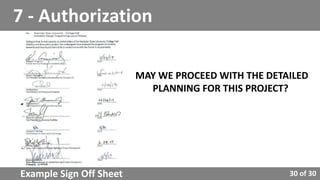
7 - Authorization
Example Sign Off Sheet
MAY WE PROCEED WITH THE DETAILED
PLANNING FOR THIS PROJECT?
FAST FORWARD….
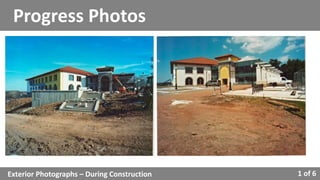
Exterior Photographs – During Construction
Progress Photos
1 of 6
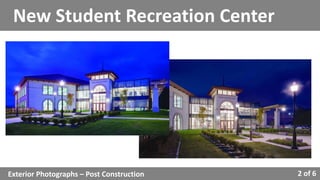
Exterior Photographs – Post Construction
New Student Recreation Center
2 of 6
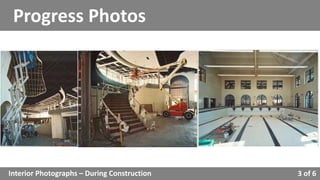
Interior Photographs – During Construction
Progress Photos
3 of 6
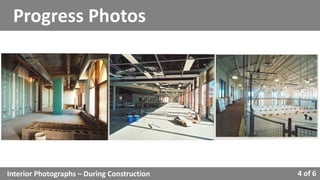
Progress Photos
Interior Photographs – During Construction 4 of 6
New Student Recreation Center
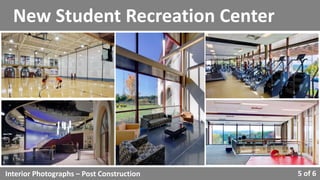
Interior Photographs – Post Construction 5 of 6
New Student Recreation Center
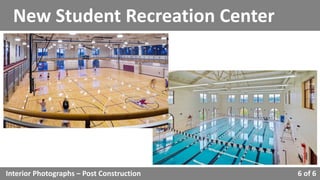
Interior Photographs – Post Construction 6 of 6

New Student Recreation Center Project Management Case Study

  • 1.
    Project Case Study: StudentRecreation Center E.M.B.A. MGMT 565 PROJECT MANAGEMENT PROF. RUGGLES PROJECT CASE STUDY: S.R.E.C. PROJECT SPRING 2019 REVISED FEB. 28, 2019
  • 2.
    A.C.E.R. PROJECT SPONSORTEAM ELISA APONTE MARIAN EKLADIOUSFRANK CUNHA WILSON ROBLES
  • 3.
    1 of 30 ProjectInitiation 1. Project Description 2. Business Case 3. Benefits Management Plan 4. Project Charter 5. Stakeholder Register and Power/Interest Grid 6. Summary 7. Authorization Agenda
  • 4.
    2 of 30 A.Introduction/Background B. Business Objectives C. Key Deliverables D. Proposed Approach 1 - Project Description
  • 5.
    3 of 30 A- Introduction/Background  Proposed by MSU’s Student Government Association and Student Development and Campus Life (SDCL)  Address increasing student enrollment and on-campus living 1 - Project Description
  • 6.
    4 of 30 B- Business Objectives  Design and construct a state-of-the-art recreation facility  The expansion of our recreational programs aligns with the strategic vision of our university and addresses the current population and our anticipated target enrollment 10 years out.  The facility that will house recreational programs  Occupancy within 3-years of project initiation. 1 - Project Description
  • 7.
    5 of 30 C- Key Deliverables  Certificate of Occupancy for a new state-of-the-art Student Recreation Center D - Proposed Approach  Follow Project Planning and Approvals Process as administered by the Office of Capital Planning & Project Management, in accordance with Facilities Capital Master Plan 1 - Project Description
  • 8.
    6 of 30 2- Business Case A. Value Proposition B. Preliminary Project Deliverables & Project Requirements C. Net Present Value D. Preliminary Budget & Schedule (Discussed in Section 3) E. Potential Risks (Discussed in Section 3)
  • 9.
    7 of 30 A- Value Proposition  The new Recreation Center contains several features that are not part of Panzer Gymnasium and will be three times as large.  Anticipated construction cost is $22 Million.  If we are able to obtain authorization for an April 1, 2019 start, the new Student Recreation Center will be expected to be open to students by the first day of the Fall 2022 semester. 2 - Business Case
  • 10.
    8 of 30 B.Preliminary Project Deliverables & Project Requirements The new Student Recreation Center will be 78,000 SF.  First Floor: Entry lobby, offices, 6 lane pool, multi-court gymnasium, locker rooms, café, two racquetball courts, three lounge areas and a weight training area  Second Floor: Balance of the weight lifting and cardio training equipment, the running track, the two multi-purpose rooms, two seating areas, fitness assessment offices and bathrooms. 2 - Business Case
  • 11.
    9 of 30 C– Net Present Value Analysis Year 2 - Business Case
  • 12.
    10 of 30 A.Target Benefits B. Benefits Owner C. Strategic Alignment of the Target Benefits D. Design & Construction Project Schedule E. Project Cost Estimate Worksheet F. Project Performance Metrics G. Critical Assumptions and Constraints H. Risk Management Analysis 3 - Benefits Management Plan
  • 13.
    11 of 30 A- Target Benefits  Address growing student need for extra- circular activities  Strong competitive advantage over other state institutions of higher education  Since the program is funded through student fees, once the bonds are paid for, the program will pay for itself in the foreseeable future 3 - Benefits Management Plan
  • 14.
    12 of 30 B- Benefits Owner  The VP of Student Development and Campus Life (SDCL) will be accountable to monitor, record, and report realized benefits throughout the timeframe established in the plan. 3 - Benefits Management Plan
  • 15.
    13 of 30 C- Strategic Alignment of the Target Benefits The targeted benefits of this project align closely to the business strategies of the organization, namely:  Connecting students with a successful future  Connecting people and ideas  Connecting to place  Connecting globally 3 - Benefits Management Plan
  • 16.
    D - Design& Construction Project Schedule 14 of 30 2019 2020 2021 2022 2019 2020 2021 2022 3 - Benefits Management Plan
  • 17.
    15 of 30E- Project Cost Estimate Worksheet 3 - Benefits Management Plan
  • 18.
    16 of 30 3- Benefits Management Plan F - Critical Assumptions and Constraints Project Performance Metrics  Life Safety: Recordable Incident Rate  Quality Control: Project Defect Rate  Project Budget: Cost Variances (Change Orders) & Project Cash Flow  Project Schedule: Lost Workday Incident Rate
  • 19.
    17 of 30 3- Benefits Management Plan Potential Risks Impact of Risk Stakeholder Interest Stakeholder's Attitude Towards Risk (averse, tolerate, seeking) Objective Impacted Root Cause Positive or Negative Risk? Probability of Occurrence 1 No funding provided prior to start Delays on Schedule Project Owner Tolerate Time Issues with budget approval process Negative High 2 More than one month lost to extreme unfavorable weather conditions Delays on Schedule Project Manager Tolerate Time Act of God Negative High 3 Variable raw material prices Increase in the amount Change Order Project Manager Tolerate Budget Lack of procurement methods & procedures Negative Moderate 4 Insufficient resources Delays on Schedule Project Manager Adverse Time Project Schedule underestimated Negative Moderate 5 Materials not being delivered on-time Schedule Project Manager Averse Time Project Schedule underestimated Negative Moderate 6 Last minute changes on Project drawings design Delays on Schedule Campus Architect Tolerate Time Inefficient flow to manage project approvals Negative High 7 Substancial design gaps on project shop plans Budget Campus Architect Averse Budget Lack of check and balances Negative High 8 High Bedrock depth (too deep) Delays on Schedule Project Engineer Averse Budget Inconsistencies in Geotechnical data Negative Low 9 Excavation and grading incorporating existing contours not feasible Budget Project Engineer Averse Budget Insufficient land survey data Negative Low 10 Poor contractor execution Delays on Schedule Project Owner Averse Reputation Poor contractor qualification process Negative Moderate 11 No recordable injuries Budget Project Owner Averse Reputation Lack of awareness and Supervision Negative High 12 Worker union (trades) strikes Delays on Schedule Project Manager Averse Reputation Missing No Strike Agreement Negative Low G - Risk Management Analysis
  • 20.
    18 of 30 3- Benefits Management Plan Project Objective NEGATIVE RISK IMPACT Relative or Numerical Scales Very Low Low Moderate High Very High 0.05 0.1 0.2 0.4 0.8 Cost Insignificant Cost Increase <10% Cost Increase 10-20% Cost Increase 20-40% Cost Increase >40% Cost Increase Time Insignificant Time Increase <5% Time Increase 10-20% Time Increase >20% Time Increase >20% Time Increase Scope Scope Decrease Basely Noticeable Minor areas of Scope Affected Major Areas of Scope Affected Scope Reduction Unacceptable to Sponsor Project End Item is Effectively Useless Quality Quality Degradation Barely Noticeable Only Very Demanding Applications are Affected Quality Reduction Requires Sponsor Approval Quality Reduction Unacceptable to Sponsor Project End Item is Effectively Useless This Table Presents Examples Of Risk Impact Definitions For Four Different Project Objectives. They Should Be Tailored In The Risk Management Planning Process To The Individual Project And To The Organization's Risk Thresholds. Impact Definitions Can Be Developed For Opportunities In A Similar Way Probability THREATS/RISKS 0.90 0.054 0.090 0.180 0.360 0.720 0.70 0.042 0.070 0.140 0.280 0.560 0.50 0.030 0.050 0.100 0.200 0.400 0.30 0.018 0.030 0.060 0.120 0.240 0.10 0.006 0.010 0.020 0.040 0.080 0.06 0.10 0.20 0.40 0.80 Impact G - Risk Management Analysis
  • 21.
    19 of 30 4- Project Charter A. Project Manager’s Authority B. Project Manager’s Critical Constraints & Assumptions C. Project Manager’s Work Breakdown Structure D. Example Work Breakdown Structure
  • 22.
    20 of 30 4- Project Charter A - Project Manager’s Authority  Pre-Design  Design  Bidding  Construction  Commissioning  Close Out
  • 23.
    21 of 30 4- Project Charter B - Project Manager’s Critical Constraints & Assumptions  Timeline  Budget  Scope  Quality Control  Material Resources  Human Resources  Unknowns
  • 24.
    22 of 30 4- Project Charter C - Project Manager’s Work Breakdown Structure  Construction Project Initiation & Budget Process  Procurement Process for A/E Firm  A/E Design Phases & Deliverables (Scope & Budget Control)  Procurement Process for Construction Company  Plan Review and Approval Process  Construction Process
  • 25.
    23 of 30 4- Project Charter D - Work Breakdown Structure Example
  • 26.
    24 of 30 5- Stakeholders A. Stakeholders – Student Development & Campus Life B. Stakeholders – University Facilities C. Stakeholders – Select List D. Stakeholders – Power / Interest Grid
  • 27.
    25 of 30 5- Stakeholders A – Stakeholders – Student Development & Campus Life
  • 28.
    26 of 30 5- Stakeholders B – Stakeholders – University Facilities
  • 29.
    27 of 30 5– Key Stakeholders Name Position Role Level of Power Level of Interest Classification (See Grid) Susan A. Cole President Sponsor, Executive Committee Very High Very High Manage closely, Regularly engage Shawn Connolly Vice President University Facilities Sponsor, Executive Committee High Very High Manage closely, Regularly engage Karen Pennington Vice President Student Development and Campus Life Sponsor, Executive Committee High Very High Manage closely, Regularly engage Anthony Giampietro Construction Code Official, Building Code Compliance, Finance and Treasurer Team Leader Building Code Compliance High Medium Monitor (minimum effort), Keep informed Summer Jones Assistant Vice President Technical Support Services, Information Technology Team Member Information Technology Medium Medium Monitor (minimum effort), Keep informed Michael Zanko Associate Vice President, Campus Planning & Project Mgmt, University Facilities Sponsor Team Leader High Very High Manage closely, Regularly engage Frank Sinatra Sr. Project Manager, Campus Planning & Project Mgmt, University Facilities Team Leader (Project Management) Medium Very High Manage closely, Regularly engage Student Government Association Customer Representative Low Very High Keep Informed, Maintain Interest Board of Trustees Sponsor (via the President and the VP’s) Very High Very High Manage closely, Regularly engage C - Select Stakeholder List
  • 30.
    28 of 30 5– Key Stakeholders D - Stakeholders – Power / Interest Grid Constr. Code Official Anthony Giampietro (Sr. P.M.) Student Gov’t Association (V.P.K.P.) Executive Committee (A.V.P. Michael Zanko) Frank Sinatra Sr. P.M. President Susan A. Cole V.P. Shawn Connolly V.P. Karen Pennington
  • 31.
    29 of 30 1.Project Description 2. Business Case 3. Benefits Management Plan 4. Project Charter 5. Stakeholder Register and Power/Interest Grid 6. Summary 7. Authorization We would like to share with you a recently completed project sponsored by the A.C.E.R. Team. 6 - Summary
  • 32.
    29a of 30 6- Summary
  • 33.
    30 of 30 7- Authorization Example Sign Off Sheet MAY WE PROCEED WITH THE DETAILED PLANNING FOR THIS PROJECT?
  • 35.
  • 36.
    Exterior Photographs –During Construction Progress Photos 1 of 6
  • 37.
    Exterior Photographs –Post Construction New Student Recreation Center 2 of 6
  • 38.
    Interior Photographs –During Construction Progress Photos 3 of 6
  • 39.
    Progress Photos Interior Photographs– During Construction 4 of 6
  • 40.
    New Student RecreationCenter Interior Photographs – Post Construction 5 of 6
  • 41.
    New Student RecreationCenter Interior Photographs – Post Construction 6 of 6

Editor's Notes