PowerPoint Presentation for Dennis, Wixom, & Tegarden Systems Analysis and Design with UML, 4th Edition
Copyright © 2012 John Wiley & Sons, Inc. All rights reserved.
Chapter 2:
Project Management
PowerPoint Presentation for Dennis, Wixom, & Tegarden Systems Analysis and Design with UML, 4th Edition
Copyright © 2012 John Wiley & Sons, Inc. All rights reserved.
Learning Objectives
Link information systems to business needs
Learn how to create a system request
Understand system feasibility
Learn how to perform a feasibility analysis
Understand how to select a project
Become familiar with work breakdown structure, Gantt charts
& network diagrams
Become familiar with use-case driven effort estimation
Learn how to create an interactive project workplan
Learn how to manage the scope, refine estimates and manage
the risk of a project
Become familiar with how to staff a project
Learn how the environment and infrastructure workflows
interact with the project management workflow
PowerPoint Presentation for Dennis, Wixom, & Tegarden Systems Analysis and Design with UML, 4th Edition
Copyright © 2012 John Wiley & Sons, Inc. All rights reserved.
Introduction
Project Management is the process of planning and
controlling system development within a specified time at
a minimum cost with the right functionality
A project is a set of activities with a specified beginning
and end point meant to create a system that brings value
to the business
Project Managers monitor and control all tasks and roles
that need to be coordinated
Inception phase: generate a system request based on a
business need or opportunity
Perform a feasibility analysis; revise the system request
Approve or decline the project
PowerPoint Presentation for Dennis, Wixom, & Tegarden Systems Analysis and Design with UML, 4th Edition
Copyright © 2012 John Wiley & Sons, Inc. All rights reserved.
Project Identification
Projects are driven by business needs
Identified by business people
Identified by IT people
(better yet) identified jointly by business and IT
The project sponsor believes in the system and wants to
see it succeed
Normally this is a business person
Should have the authority to move it forward
PowerPoint Presentation for Dennis, Wixom, & Tegarden Systems Analysis and Design with UML, 4th Edition
Copyright © 2012 John Wiley & Sons, Inc. All rights reserved.
Business Value
Tangible Value
Can be quantified and measured directly
Example: 2 percent reduction in operating costs
Intangible Value
We know it will add value & save time, but we may not be
able to quantify or measure its benefits
Example: improved customer service
PowerPoint Presentation for Dennis, Wixom, & Tegarden Systems Analysis and Design with UML, 4th Edition
Copyright © 2012 John Wiley & Sons, Inc. All rights reserved.
The System Request
A document that describes the reasons for and the value
added from building a new system
Contains 5 elements:
• Project sponsor: the primary point of contact for the project
• Business need: the reason prompting the project
• Business requirements: what the system will do
• Business value: how will the organization benefit from the
project
• Special issues: Anything else that should be considered
PowerPoint Presentation for Dennis, Wixom, & Tegarden Systems Analysis and Design with UML, 4th Edition
Copyright © 2012 John Wiley & Sons, Inc. All rights reserved.
Feasibility Analysis
Is this project feasible?
What are the risks?
Can these risks be overcome?
Major components:
Technical feasibility (Can we build it?)
Economic feasibility (Should we build it?)
Organizational feasibility (Will they use it?)
PowerPoint Presentation for Dennis, Wixom, & Tegarden Systems Analysis and Design with UML, 4th Edition
Copyright © 2012 John Wiley & Sons, Inc. All rights reserved.
Technical Feasibility
Identify risks in the following areas:
The functional area: Are analysts familiar with
this portion of the business?
The technology: Less familiarity generates more
risk
Project size: Large projects have more risk
Compatibility: Difficult integration increases the
risk
PowerPoint Presentation for Dennis, Wixom, & Tegarden Systems Analysis and Design with UML, 4th Edition
Copyright © 2012 John Wiley & Sons, Inc. All rights reserved.
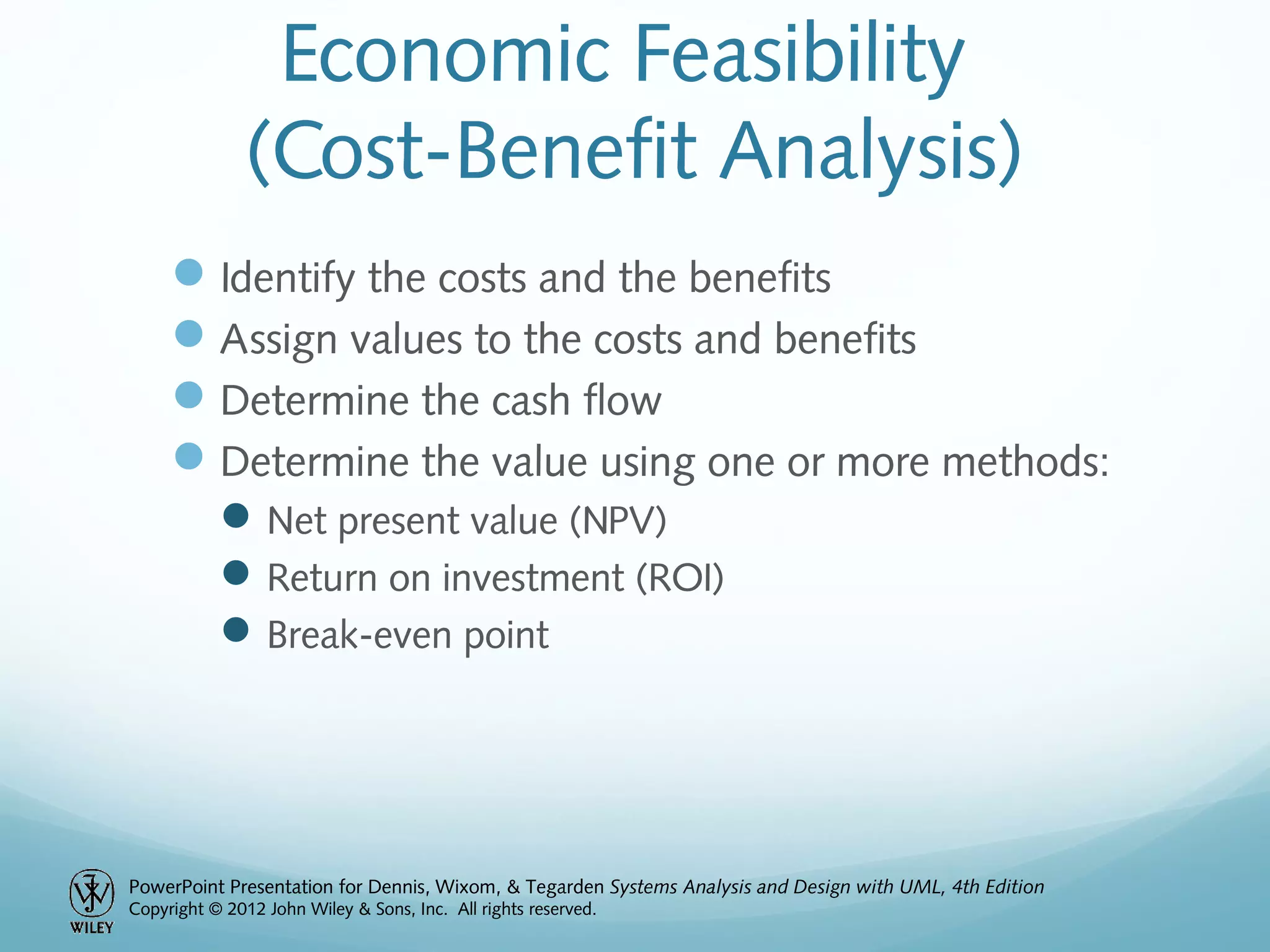
Economic Feasibility
(Cost-Benefit Analysis)
Identify the costs and the benefits
Assign values to the costs and benefits
Determine the cash flow
Determine the value using one or more methods:
Net present value (NPV)
Return on investment (ROI)
Break-even point
PowerPoint Presentation for Dennis, Wixom, & Tegarden Systems Analysis and Design with UML, 4th Edition
Copyright © 2012 John Wiley & Sons, Inc. All rights reserved.
Formulas for Determining
Value
PowerPoint Presentation for Dennis, Wixom, & Tegarden Systems Analysis and Design with UML, 4th Edition
Copyright © 2012 John Wiley & Sons, Inc. All rights reserved.
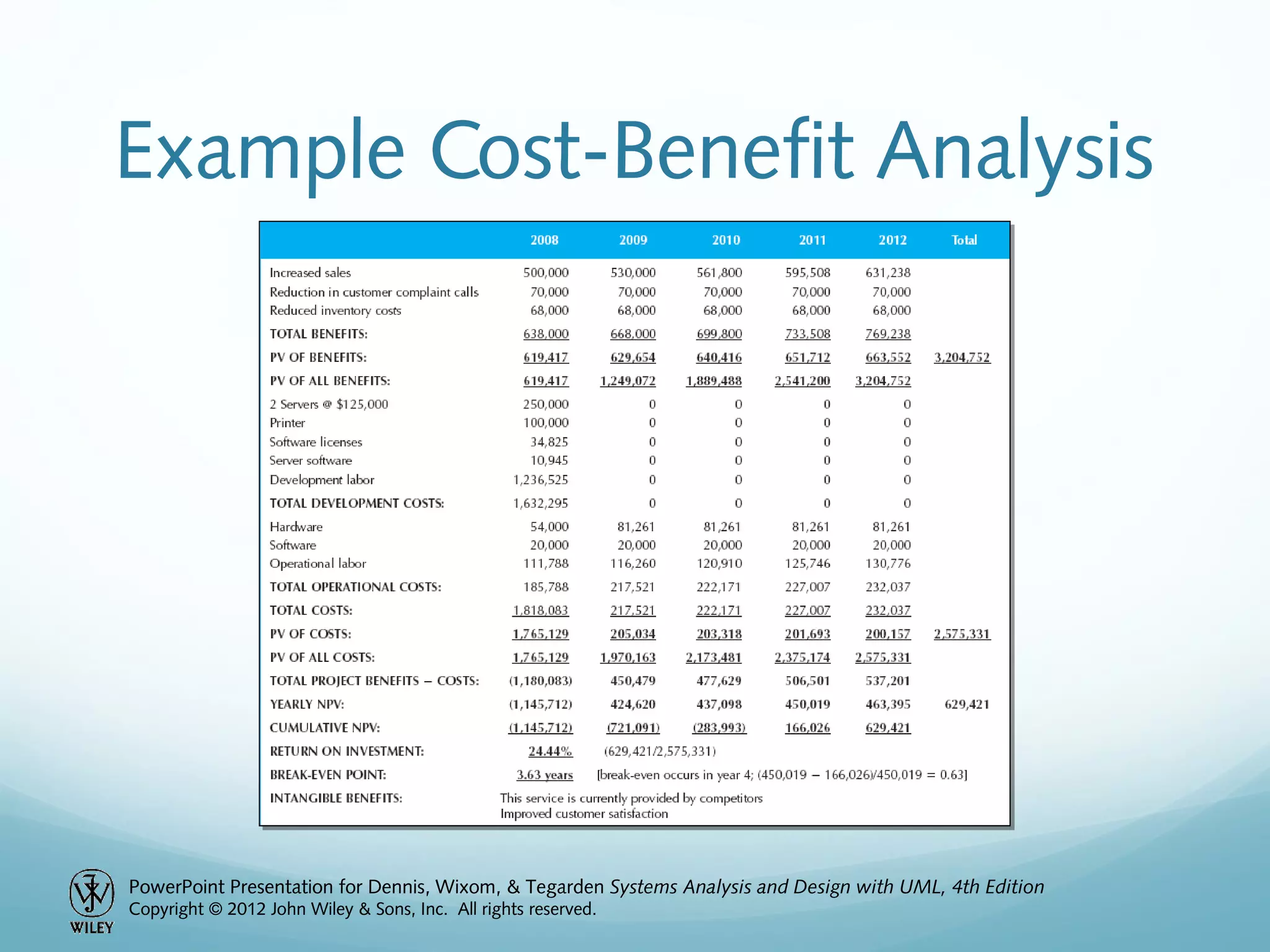
Example Cost-Benefit Analysis
PowerPoint Presentation for Dennis, Wixom, & Tegarden Systems Analysis and Design with UML, 4th Edition
Copyright © 2012 John Wiley & Sons, Inc. All rights reserved.
Example Break-Even Point
PowerPoint Presentation for Dennis, Wixom, & Tegarden Systems Analysis and Design with UML, 4th Edition
Copyright © 2012 John Wiley & Sons, Inc. All rights reserved.
Organizational Feasibility
Will the users accept the system?
Is the project strategically aligned with the business?
Conduct a stakeholder analysis
Project champion(s)
Organizational management
System users
Others
PowerPoint Presentation for Dennis, Wixom, & Tegarden Systems Analysis and Design with UML, 4th Edition
Copyright © 2012 John Wiley & Sons, Inc. All rights reserved.
Project Selection
Projects are approved, declined or delayed based
on value added vs. risks
Project portfolio management
Goals:
Maximize cost/benefit ratio
Maintain an optimal mix of projects based on:
 Risk
 Size, cost & length of time to complete
 Purpose, scope & business value
Limited resources require trade-offs
Selected projects enter the project management
process
PowerPoint Presentation for Dennis, Wixom, & Tegarden Systems Analysis and Design with UML, 4th Edition
Copyright © 2012 John Wiley & Sons, Inc. All rights reserved.
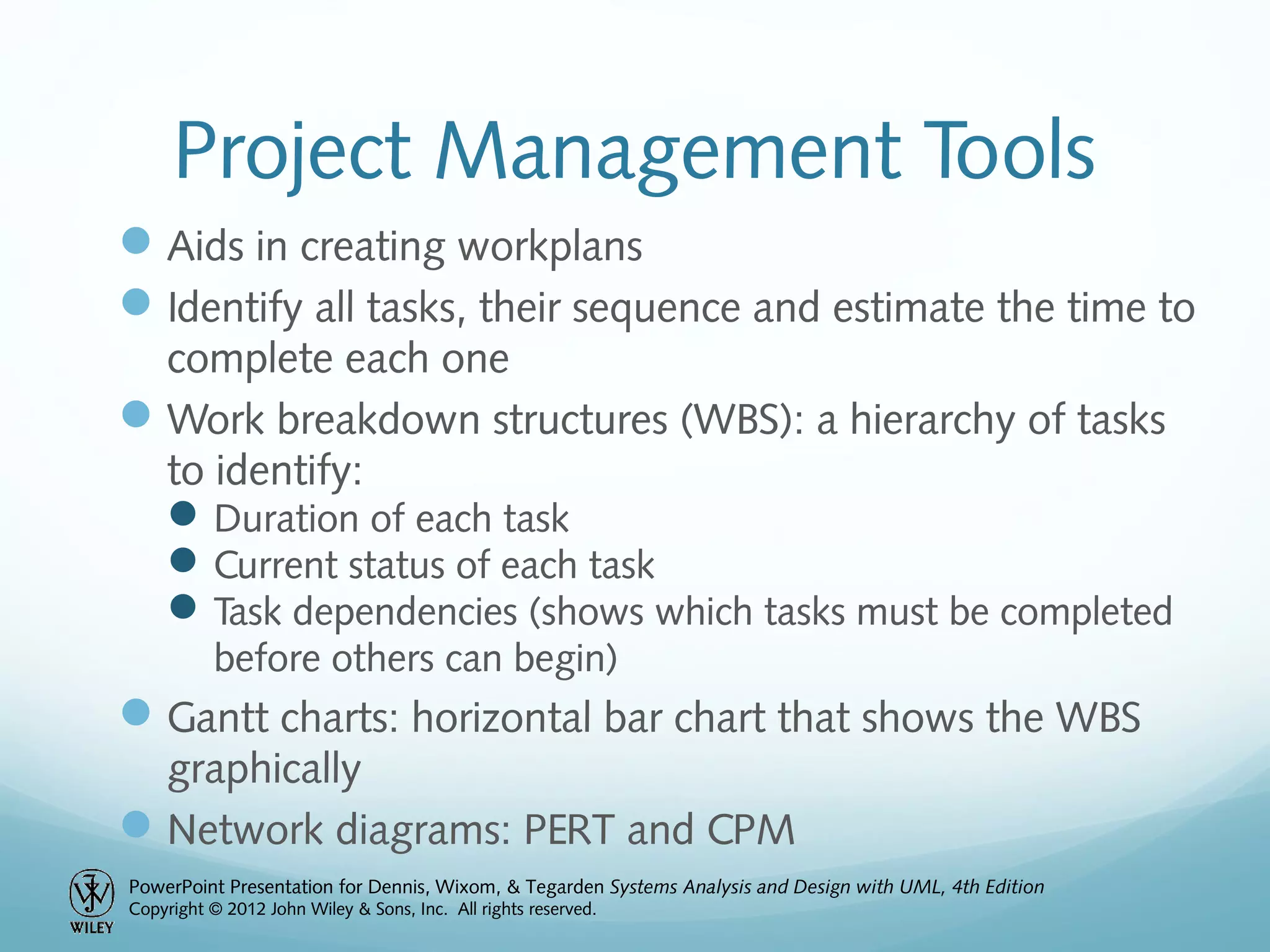
Project Management Tools
Aids in creating workplans
Identify all tasks, their sequence and estimate the time to
complete each one
Work breakdown structures (WBS): a hierarchy of tasks
to identify:
Duration of each task
Current status of each task
Task dependencies (shows which tasks must be completed
before others can begin)
Gantt charts: horizontal bar chart that shows the WBS
graphically
Network diagrams: PERT and CPM
PowerPoint Presentation for Dennis, Wixom, & Tegarden Systems Analysis and Design with UML, 4th Edition
Copyright © 2012 John Wiley & Sons, Inc. All rights reserved.
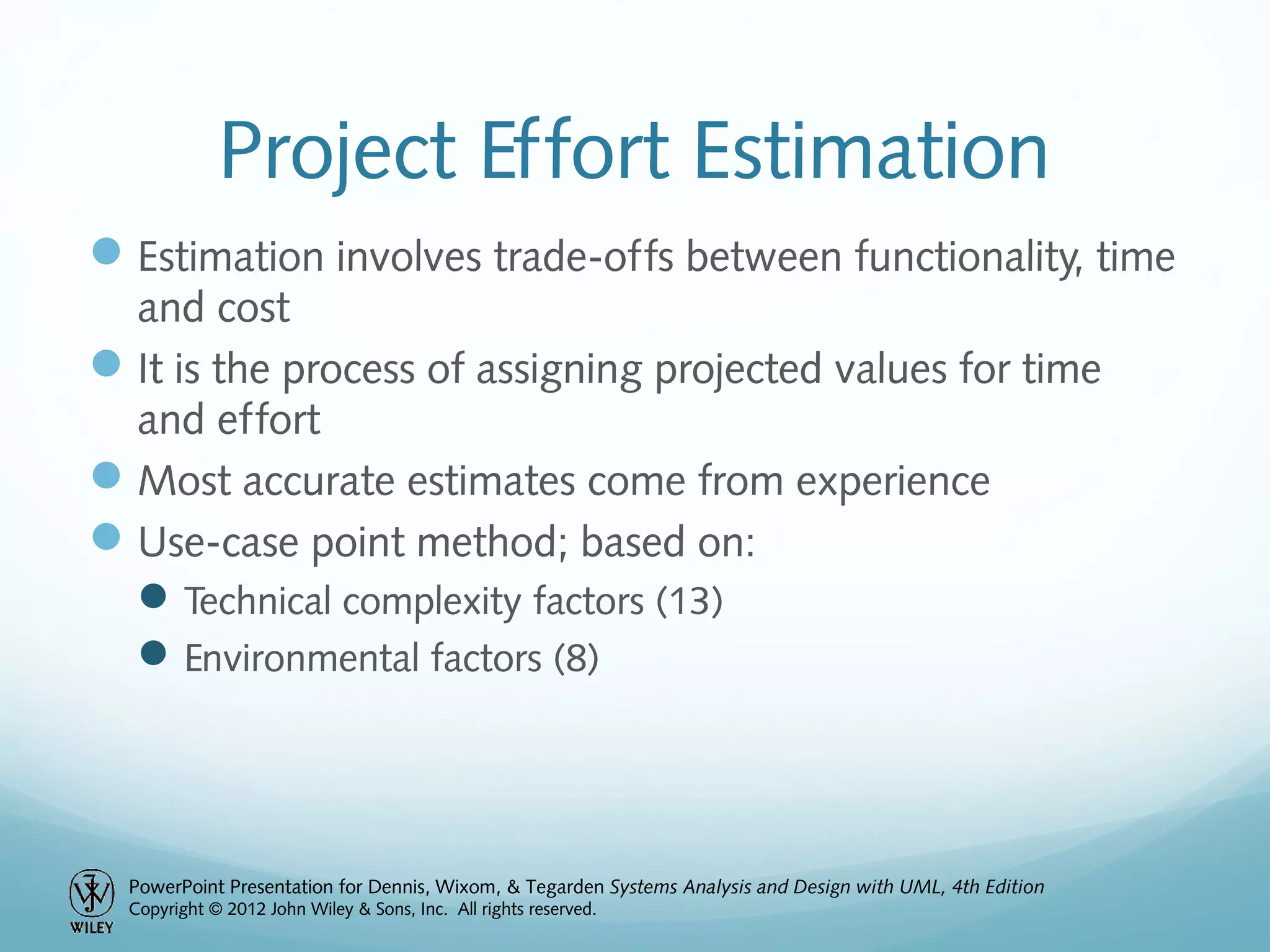
Project Effort Estimation
Estimation involves trade-offs between functionality, time
and cost
It is the process of assigning projected values for time
and effort
Most accurate estimates come from experience
Use-case point method; based on:
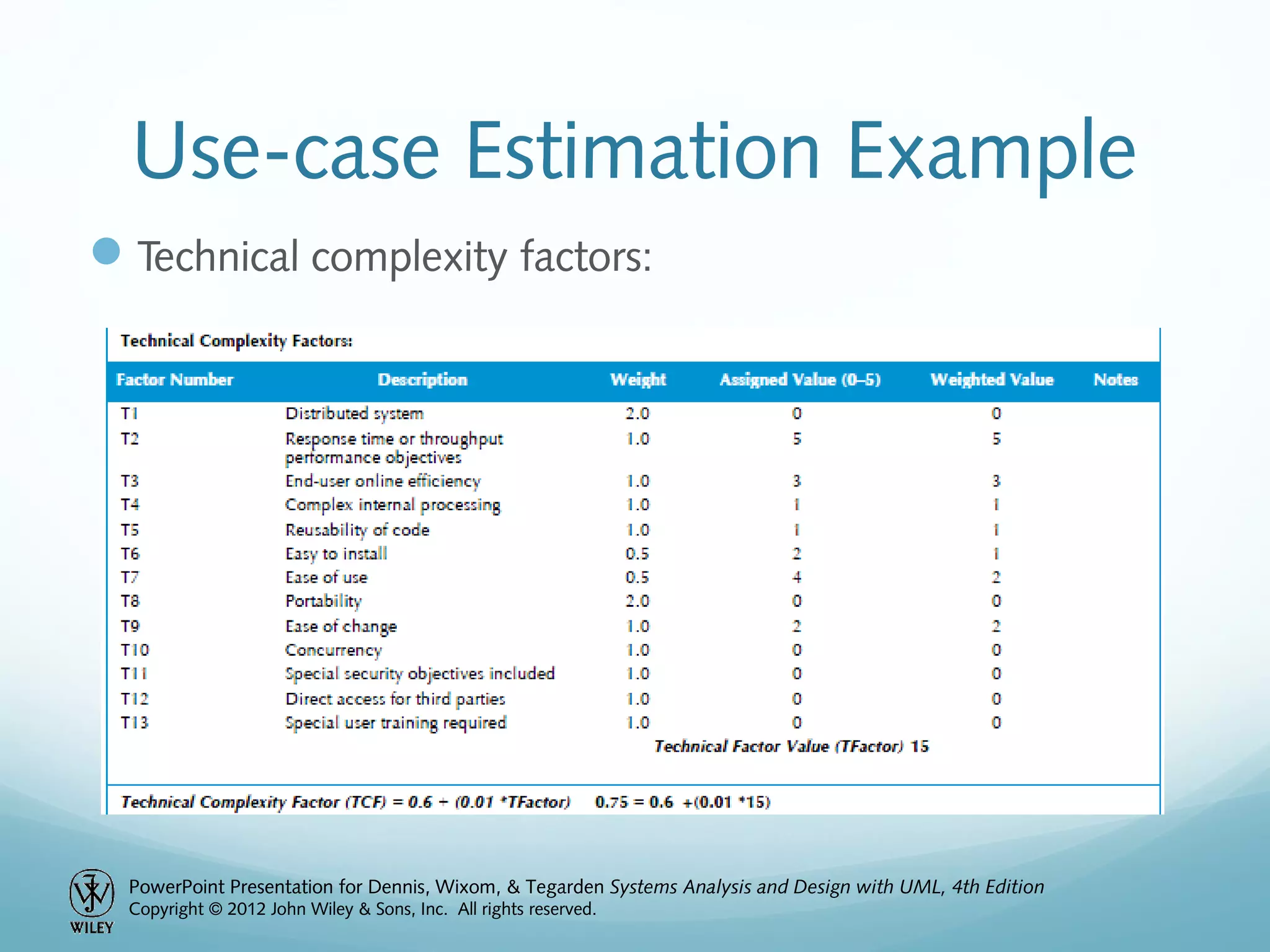
Technical complexity factors (13)
Environmental factors (8)
PowerPoint Presentation for Dennis, Wixom, & Tegarden Systems Analysis and Design with UML, 4th Edition
Copyright © 2012 John Wiley & Sons, Inc. All rights reserved.
Use-case Estimation Example
Actors & Use-cases:
PowerPoint Presentation for Dennis, Wixom, & Tegarden Systems Analysis and Design with UML, 4th Edition
Copyright © 2012 John Wiley & Sons, Inc. All rights reserved.
Use-case Estimation Example
Technical complexity factors:
PowerPoint Presentation for Dennis, Wixom, & Tegarden Systems Analysis and Design with UML, 4th Edition
Copyright © 2012 John Wiley & Sons, Inc. All rights reserved.
Use-case Estimation Example
Environmental factors & final estimate:
PowerPoint Presentation for Dennis, Wixom, & Tegarden Systems Analysis and Design with UML, 4th Edition
Copyright © 2012 John Wiley & Sons, Inc. All rights reserved.
Creating & Managing the
Workplan
Workplan: a dynamic and sequential list of all tasks
needed to complete a project
Approaches:
Modify existing or completed projects
Derive the tasks from the methodology being used
Unified Process:
Iterative & incremental
Workplan is also iterative & incremental
Tasks and time intervals follow the phases
Different tasks executed for each workflow
PowerPoint Presentation for Dennis, Wixom, & Tegarden Systems Analysis and Design with UML, 4th Edition
Copyright © 2012 John Wiley & Sons, Inc. All rights reserved.
Evolutionary
Work Breakdown Structures
Organized in a standard manner across all projects
Created in an incremental & iterative manner
Generality supports learning from past mistakes and
successes
Unified Process:
Workflows are the major divisions
Workflows are decomposed along the phases
Phases are decomposed along the required tasks
Tasks are added as each iteration is completed
PowerPoint Presentation for Dennis, Wixom, & Tegarden Systems Analysis and Design with UML, 4th Edition
Copyright © 2012 John Wiley & Sons, Inc. All rights reserved.
Scope Management
Scope “creep”
 Occurs after the project is underway
 Results from adding new requirements to the project
 Can have a deleterious effect on the schedule
 Project Manager is responsible to manage changes to reduce
scope creep
Techniques to manage the project scope:
 Identify all requirements at the outset
 Allow only those changes deemed absolutely necessary
 Carefully examine the impact of suggested changes
 Delay some changes for “future enhancements”
 Time boxing
PowerPoint Presentation for Dennis, Wixom, & Tegarden Systems Analysis and Design with UML, 4th Edition
Copyright © 2012 John Wiley & Sons, Inc. All rights reserved.
Staffing the Project
Goals:
Determine how many people are required
Match skill sets to required activities
Motivate the team to meet the objectives
Minimize conflicts
Deliverable—The staffing plan, which includes:
Number & kind of people assigned
Overall reporting structure
The project charter (describes the project’s objectives and
rules)
PowerPoint Presentation for Dennis, Wixom, & Tegarden Systems Analysis and Design with UML, 4th Edition
Copyright © 2012 John Wiley & Sons, Inc. All rights reserved.
Creating a “Jelled” Team
A team of people so strongly knit that the whole is
greater than the sum of its parts
Characteristics of a jelled team:
Very low turnover rate
Strong sense of identity
A feeling of eliteness
Team vs. individual ownership of the project
Team members enjoy their work
PowerPoint Presentation for Dennis, Wixom, & Tegarden Systems Analysis and Design with UML, 4th Edition
Copyright © 2012 John Wiley & Sons, Inc. All rights reserved.
The Staffing Plan
Calculate the number of people needed:
Lines of communication increase exponentially as people
are added to a project
Create a reporting structure for projects with large
numbers of people assigned
Form sub-teams as necessary
Assign the Project Manager, Functional lead & Technical
lead
Pay attention to technical and interpersonal skills
PowerPoint Presentation for Dennis, Wixom, & Tegarden Systems Analysis and Design with UML, 4th Edition
Copyright © 2012 John Wiley & Sons, Inc. All rights reserved.
Motivating People
Motivation is the greatest influence on performance
Monetary rewards usually do not motivate
Suggested motivating techniques:
20% time rule
Peer-to-peer recognition awards
Team ownership (refer to the team as “we”)
Allow members to focus on what interests them
Utilize equitable compensation
Encourage group ownership
Provide for autonomy, but trust the team to deliver
PowerPoint Presentation for Dennis, Wixom, & Tegarden Systems Analysis and Design with UML, 4th Edition
Copyright © 2012 John Wiley & Sons, Inc. All rights reserved.
Handling Conflict
Preventing or mitigating conflict:
 Cohesiveness has the greatest effect
 Clearly defining roles and holding team members accountable
 Establish work & communications rules in the project charter
Additional techniques:
 Clearly define plans for the project
 Make sure the team understands the importance of the project
 Develop detailed operating procedures
 Develop a project charter
 Develop a schedule of commitments in advance
 Forecast other priorities and their impact on the project
PowerPoint Presentation for Dennis, Wixom, & Tegarden Systems Analysis and Design with UML, 4th Edition
Copyright © 2012 John Wiley & Sons, Inc. All rights reserved.
Environment & Infrastructure
Management
Environment—Choose the right set of tools
Use appropriate CASE tools to:
 Increase productivity and centralize information (repository)
Utilize diagrams—more easily understood
Establish standards to reduce complexity
Infrastructure—Document the project appropriately
Store deliverables & communications in a project binder
Use Unified Process standard documents
Don’t put off documentation to the last minute
PowerPoint Presentation for Dennis, Wixom, & Tegarden Systems Analysis and Design with UML, 4th Edition
Copyright © 2012 John Wiley & Sons, Inc. All rights reserved.
Summary
Project Initiation
Feasibility Analysis
Project Selection
Traditional Project Management Tools
Estimating Project Effort
Create and manage the workplan
Staff the project
Manage the environment and infrastructure
work flows of the project

Projman

  • 1.
    PowerPoint Presentation forDennis, Wixom, & Tegarden Systems Analysis and Design with UML, 4th Edition Copyright © 2012 John Wiley & Sons, Inc. All rights reserved. Chapter 2: Project Management
  • 2.
    PowerPoint Presentation forDennis, Wixom, & Tegarden Systems Analysis and Design with UML, 4th Edition Copyright © 2012 John Wiley & Sons, Inc. All rights reserved. Learning Objectives Link information systems to business needs Learn how to create a system request Understand system feasibility Learn how to perform a feasibility analysis Understand how to select a project Become familiar with work breakdown structure, Gantt charts & network diagrams Become familiar with use-case driven effort estimation Learn how to create an interactive project workplan Learn how to manage the scope, refine estimates and manage the risk of a project Become familiar with how to staff a project Learn how the environment and infrastructure workflows interact with the project management workflow
  • 3.
    PowerPoint Presentation forDennis, Wixom, & Tegarden Systems Analysis and Design with UML, 4th Edition Copyright © 2012 John Wiley & Sons, Inc. All rights reserved. Introduction Project Management is the process of planning and controlling system development within a specified time at a minimum cost with the right functionality A project is a set of activities with a specified beginning and end point meant to create a system that brings value to the business Project Managers monitor and control all tasks and roles that need to be coordinated Inception phase: generate a system request based on a business need or opportunity Perform a feasibility analysis; revise the system request Approve or decline the project
  • 4.
    PowerPoint Presentation forDennis, Wixom, & Tegarden Systems Analysis and Design with UML, 4th Edition Copyright © 2012 John Wiley & Sons, Inc. All rights reserved. Project Identification Projects are driven by business needs Identified by business people Identified by IT people (better yet) identified jointly by business and IT The project sponsor believes in the system and wants to see it succeed Normally this is a business person Should have the authority to move it forward
  • 5.
    PowerPoint Presentation forDennis, Wixom, & Tegarden Systems Analysis and Design with UML, 4th Edition Copyright © 2012 John Wiley & Sons, Inc. All rights reserved. Business Value Tangible Value Can be quantified and measured directly Example: 2 percent reduction in operating costs Intangible Value We know it will add value & save time, but we may not be able to quantify or measure its benefits Example: improved customer service
  • 6.
    PowerPoint Presentation forDennis, Wixom, & Tegarden Systems Analysis and Design with UML, 4th Edition Copyright © 2012 John Wiley & Sons, Inc. All rights reserved. The System Request A document that describes the reasons for and the value added from building a new system Contains 5 elements: • Project sponsor: the primary point of contact for the project • Business need: the reason prompting the project • Business requirements: what the system will do • Business value: how will the organization benefit from the project • Special issues: Anything else that should be considered
  • 7.
    PowerPoint Presentation forDennis, Wixom, & Tegarden Systems Analysis and Design with UML, 4th Edition Copyright © 2012 John Wiley & Sons, Inc. All rights reserved. Feasibility Analysis Is this project feasible? What are the risks? Can these risks be overcome? Major components: Technical feasibility (Can we build it?) Economic feasibility (Should we build it?) Organizational feasibility (Will they use it?)
  • 8.
    PowerPoint Presentation forDennis, Wixom, & Tegarden Systems Analysis and Design with UML, 4th Edition Copyright © 2012 John Wiley & Sons, Inc. All rights reserved. Technical Feasibility Identify risks in the following areas: The functional area: Are analysts familiar with this portion of the business? The technology: Less familiarity generates more risk Project size: Large projects have more risk Compatibility: Difficult integration increases the risk
  • 9.
    PowerPoint Presentation forDennis, Wixom, & Tegarden Systems Analysis and Design with UML, 4th Edition Copyright © 2012 John Wiley & Sons, Inc. All rights reserved. Economic Feasibility (Cost-Benefit Analysis) Identify the costs and the benefits Assign values to the costs and benefits Determine the cash flow Determine the value using one or more methods: Net present value (NPV) Return on investment (ROI) Break-even point
  • 10.
    PowerPoint Presentation forDennis, Wixom, & Tegarden Systems Analysis and Design with UML, 4th Edition Copyright © 2012 John Wiley & Sons, Inc. All rights reserved. Formulas for Determining Value
  • 11.
    PowerPoint Presentation forDennis, Wixom, & Tegarden Systems Analysis and Design with UML, 4th Edition Copyright © 2012 John Wiley & Sons, Inc. All rights reserved. Example Cost-Benefit Analysis
  • 12.
    PowerPoint Presentation forDennis, Wixom, & Tegarden Systems Analysis and Design with UML, 4th Edition Copyright © 2012 John Wiley & Sons, Inc. All rights reserved. Example Break-Even Point
  • 13.
    PowerPoint Presentation forDennis, Wixom, & Tegarden Systems Analysis and Design with UML, 4th Edition Copyright © 2012 John Wiley & Sons, Inc. All rights reserved. Organizational Feasibility Will the users accept the system? Is the project strategically aligned with the business? Conduct a stakeholder analysis Project champion(s) Organizational management System users Others
  • 14.
    PowerPoint Presentation forDennis, Wixom, & Tegarden Systems Analysis and Design with UML, 4th Edition Copyright © 2012 John Wiley & Sons, Inc. All rights reserved. Project Selection Projects are approved, declined or delayed based on value added vs. risks Project portfolio management Goals: Maximize cost/benefit ratio Maintain an optimal mix of projects based on:  Risk  Size, cost & length of time to complete  Purpose, scope & business value Limited resources require trade-offs Selected projects enter the project management process
  • 15.
    PowerPoint Presentation forDennis, Wixom, & Tegarden Systems Analysis and Design with UML, 4th Edition Copyright © 2012 John Wiley & Sons, Inc. All rights reserved. Project Management Tools Aids in creating workplans Identify all tasks, their sequence and estimate the time to complete each one Work breakdown structures (WBS): a hierarchy of tasks to identify: Duration of each task Current status of each task Task dependencies (shows which tasks must be completed before others can begin) Gantt charts: horizontal bar chart that shows the WBS graphically Network diagrams: PERT and CPM
  • 16.
    PowerPoint Presentation forDennis, Wixom, & Tegarden Systems Analysis and Design with UML, 4th Edition Copyright © 2012 John Wiley & Sons, Inc. All rights reserved. Project Effort Estimation Estimation involves trade-offs between functionality, time and cost It is the process of assigning projected values for time and effort Most accurate estimates come from experience Use-case point method; based on: Technical complexity factors (13) Environmental factors (8)
  • 17.
    PowerPoint Presentation forDennis, Wixom, & Tegarden Systems Analysis and Design with UML, 4th Edition Copyright © 2012 John Wiley & Sons, Inc. All rights reserved. Use-case Estimation Example Actors & Use-cases:
  • 18.
    PowerPoint Presentation forDennis, Wixom, & Tegarden Systems Analysis and Design with UML, 4th Edition Copyright © 2012 John Wiley & Sons, Inc. All rights reserved. Use-case Estimation Example Technical complexity factors:
  • 19.
    PowerPoint Presentation forDennis, Wixom, & Tegarden Systems Analysis and Design with UML, 4th Edition Copyright © 2012 John Wiley & Sons, Inc. All rights reserved. Use-case Estimation Example Environmental factors & final estimate:
  • 20.
    PowerPoint Presentation forDennis, Wixom, & Tegarden Systems Analysis and Design with UML, 4th Edition Copyright © 2012 John Wiley & Sons, Inc. All rights reserved. Creating & Managing the Workplan Workplan: a dynamic and sequential list of all tasks needed to complete a project Approaches: Modify existing or completed projects Derive the tasks from the methodology being used Unified Process: Iterative & incremental Workplan is also iterative & incremental Tasks and time intervals follow the phases Different tasks executed for each workflow
  • 21.
    PowerPoint Presentation forDennis, Wixom, & Tegarden Systems Analysis and Design with UML, 4th Edition Copyright © 2012 John Wiley & Sons, Inc. All rights reserved. Evolutionary Work Breakdown Structures Organized in a standard manner across all projects Created in an incremental & iterative manner Generality supports learning from past mistakes and successes Unified Process: Workflows are the major divisions Workflows are decomposed along the phases Phases are decomposed along the required tasks Tasks are added as each iteration is completed
  • 22.
    PowerPoint Presentation forDennis, Wixom, & Tegarden Systems Analysis and Design with UML, 4th Edition Copyright © 2012 John Wiley & Sons, Inc. All rights reserved. Scope Management Scope “creep”  Occurs after the project is underway  Results from adding new requirements to the project  Can have a deleterious effect on the schedule  Project Manager is responsible to manage changes to reduce scope creep Techniques to manage the project scope:  Identify all requirements at the outset  Allow only those changes deemed absolutely necessary  Carefully examine the impact of suggested changes  Delay some changes for “future enhancements”  Time boxing
  • 23.
    PowerPoint Presentation forDennis, Wixom, & Tegarden Systems Analysis and Design with UML, 4th Edition Copyright © 2012 John Wiley & Sons, Inc. All rights reserved. Staffing the Project Goals: Determine how many people are required Match skill sets to required activities Motivate the team to meet the objectives Minimize conflicts Deliverable—The staffing plan, which includes: Number & kind of people assigned Overall reporting structure The project charter (describes the project’s objectives and rules)
  • 24.
    PowerPoint Presentation forDennis, Wixom, & Tegarden Systems Analysis and Design with UML, 4th Edition Copyright © 2012 John Wiley & Sons, Inc. All rights reserved. Creating a “Jelled” Team A team of people so strongly knit that the whole is greater than the sum of its parts Characteristics of a jelled team: Very low turnover rate Strong sense of identity A feeling of eliteness Team vs. individual ownership of the project Team members enjoy their work
  • 25.
    PowerPoint Presentation forDennis, Wixom, & Tegarden Systems Analysis and Design with UML, 4th Edition Copyright © 2012 John Wiley & Sons, Inc. All rights reserved. The Staffing Plan Calculate the number of people needed: Lines of communication increase exponentially as people are added to a project Create a reporting structure for projects with large numbers of people assigned Form sub-teams as necessary Assign the Project Manager, Functional lead & Technical lead Pay attention to technical and interpersonal skills
  • 26.
    PowerPoint Presentation forDennis, Wixom, & Tegarden Systems Analysis and Design with UML, 4th Edition Copyright © 2012 John Wiley & Sons, Inc. All rights reserved. Motivating People Motivation is the greatest influence on performance Monetary rewards usually do not motivate Suggested motivating techniques: 20% time rule Peer-to-peer recognition awards Team ownership (refer to the team as “we”) Allow members to focus on what interests them Utilize equitable compensation Encourage group ownership Provide for autonomy, but trust the team to deliver
  • 27.
    PowerPoint Presentation forDennis, Wixom, & Tegarden Systems Analysis and Design with UML, 4th Edition Copyright © 2012 John Wiley & Sons, Inc. All rights reserved. Handling Conflict Preventing or mitigating conflict:  Cohesiveness has the greatest effect  Clearly defining roles and holding team members accountable  Establish work & communications rules in the project charter Additional techniques:  Clearly define plans for the project  Make sure the team understands the importance of the project  Develop detailed operating procedures  Develop a project charter  Develop a schedule of commitments in advance  Forecast other priorities and their impact on the project
  • 28.
    PowerPoint Presentation forDennis, Wixom, & Tegarden Systems Analysis and Design with UML, 4th Edition Copyright © 2012 John Wiley & Sons, Inc. All rights reserved. Environment & Infrastructure Management Environment—Choose the right set of tools Use appropriate CASE tools to:  Increase productivity and centralize information (repository) Utilize diagrams—more easily understood Establish standards to reduce complexity Infrastructure—Document the project appropriately Store deliverables & communications in a project binder Use Unified Process standard documents Don’t put off documentation to the last minute
  • 29.
    PowerPoint Presentation forDennis, Wixom, & Tegarden Systems Analysis and Design with UML, 4th Edition Copyright © 2012 John Wiley & Sons, Inc. All rights reserved. Summary Project Initiation Feasibility Analysis Project Selection Traditional Project Management Tools Estimating Project Effort Create and manage the workplan Staff the project Manage the environment and infrastructure work flows of the project