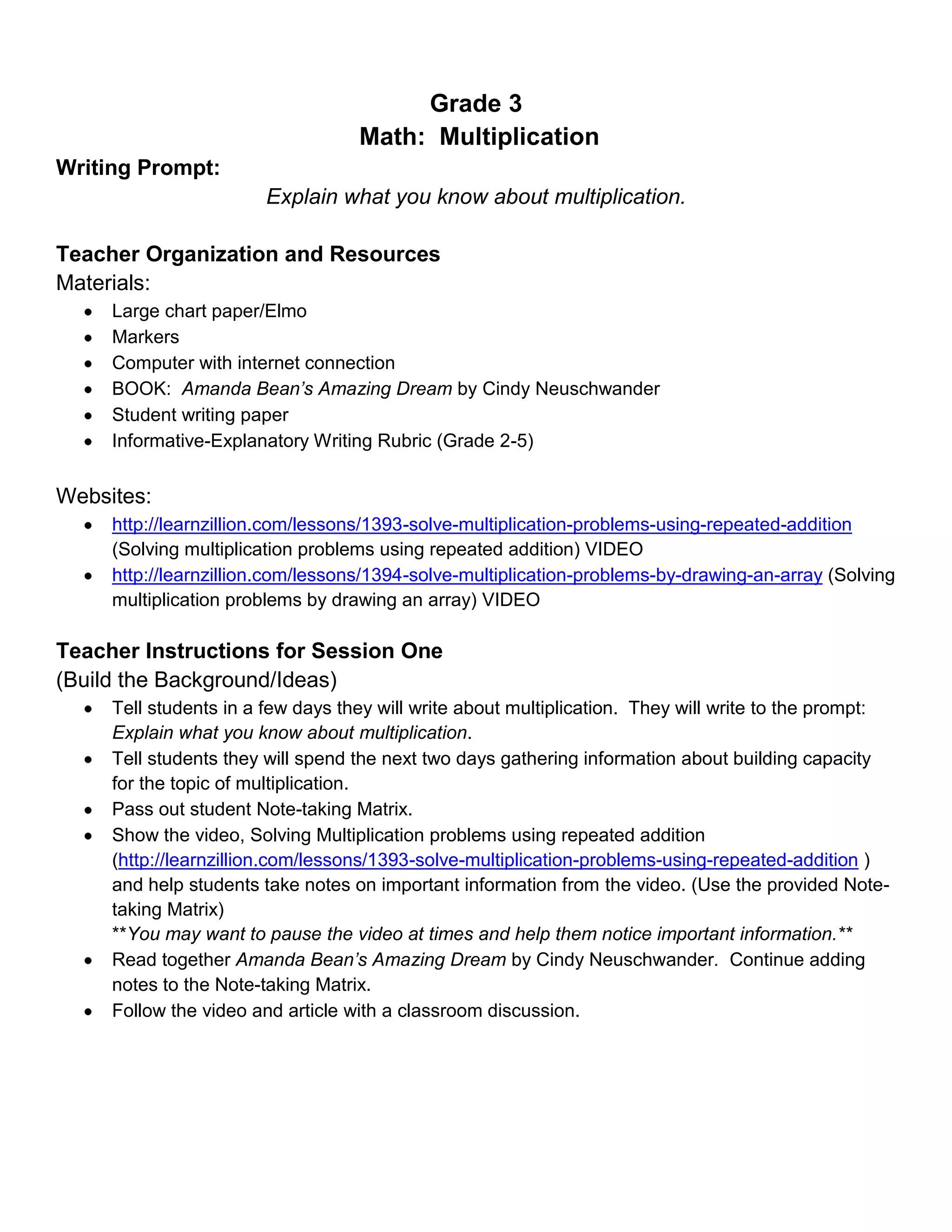
Grade 3
Math: Multiplication
Writing Prompt:
Explain what you know about multiplication.
Teacher Organization and Resources
Materials:
Large chart paper/Elmo
Markers
Computer with internet connection
BOOK: Amanda Bean’s Amazing Dream by Cindy Neuschwander
Student writing paper
Informative-Explanatory Writing Rubric (Grade 2-5)
Websites:
http://learnzillion.com/lessons/1393-solve-multiplication-problems-using-repeated-addition
(Solving multiplication problems using repeated addition) VIDEO
http://learnzillion.com/lessons/1394-solve-multiplication-problems-by-drawing-an-array (Solving
multiplication problems by drawing an array) VIDEO
Teacher Instructions for Session One
(Build the Background/Ideas)
Tell students in a few days they will write about multiplication. They will write to the prompt:
Explain what you know about multiplication.
Tell students they will spend the next two days gathering information about building capacity
for the topic of multiplication.
Pass out student Note-taking Matrix.
Show the video, Solving Multiplication problems using repeated addition
(http://learnzillion.com/lessons/1393-solve-multiplication-problems-using-repeated-addition )
and help students take notes on important information from the video. (Use the provided Note-
taking Matrix)
**You may want to pause the video at times and help them notice important information.**
Read together Amanda Bean’s Amazing Dream by Cindy Neuschwander. Continue adding
notes to the Note-taking Matrix.
Follow the video and article with a classroom discussion.
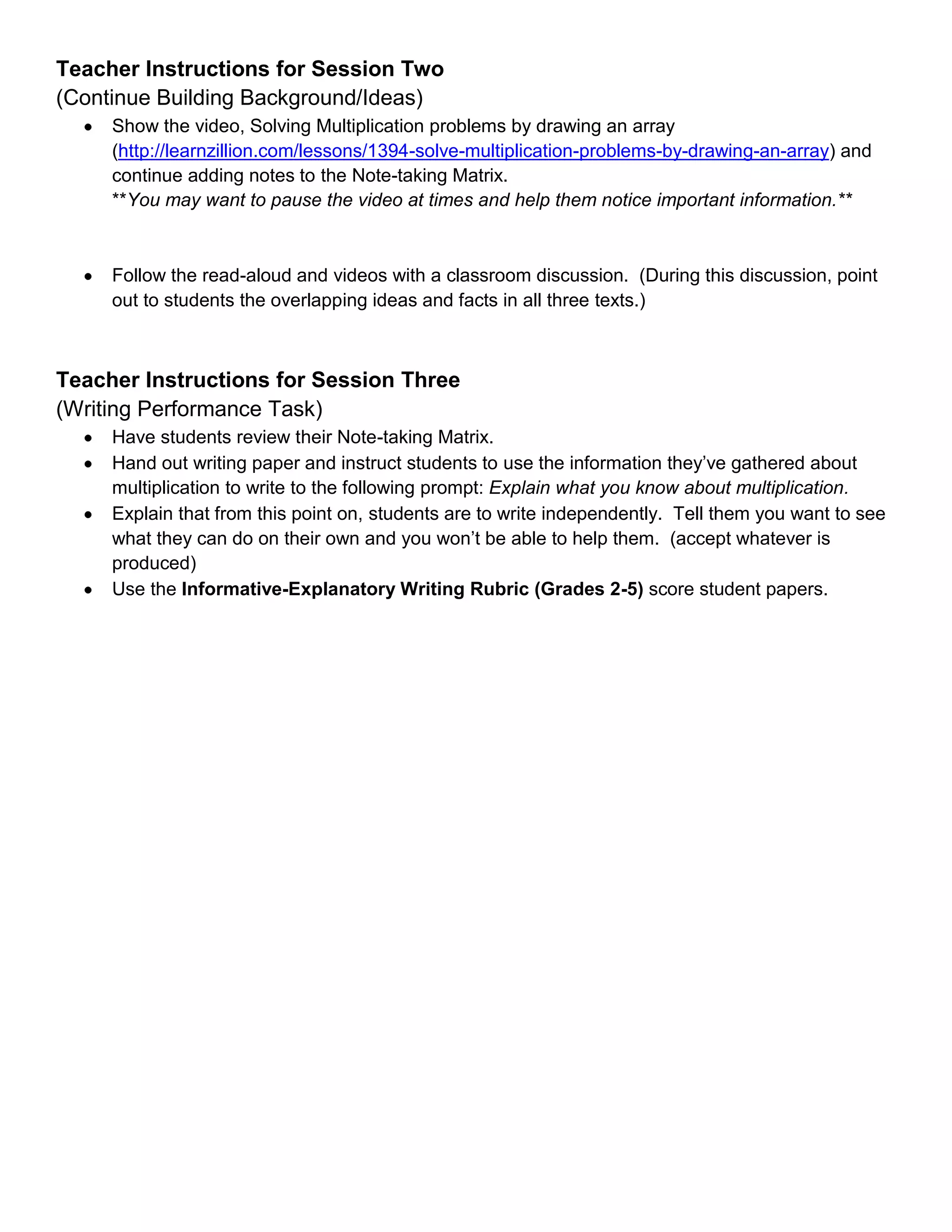
Teacher Instructions for Session Two
(Continue Building Background/Ideas)
Show the video, Solving Multiplication problems by drawing an array
(http://learnzillion.com/lessons/1394-solve-multiplication-problems-by-drawing-an-array) and
continue adding notes to the Note-taking Matrix.
**You may want to pause the video at times and help them notice important information.**
Follow the read-aloud and videos with a classroom discussion. (During this discussion, point
out to students the overlapping ideas and facts in all three texts.)
Teacher Instructions for Session Three
(Writing Performance Task)
Have students review their Note-taking Matrix.
Hand out writing paper and instruct students to use the information they’ve gathered about
multiplication to write to the following prompt: Explain what you know about multiplication.
Explain that from this point on, students are to write independently. Tell them you want to see
what they can do on their own and you won’t be able to help them. (accept whatever is
produced)
Use the Informative-Explanatory Writing Rubric (Grades 2-5) score student papers.
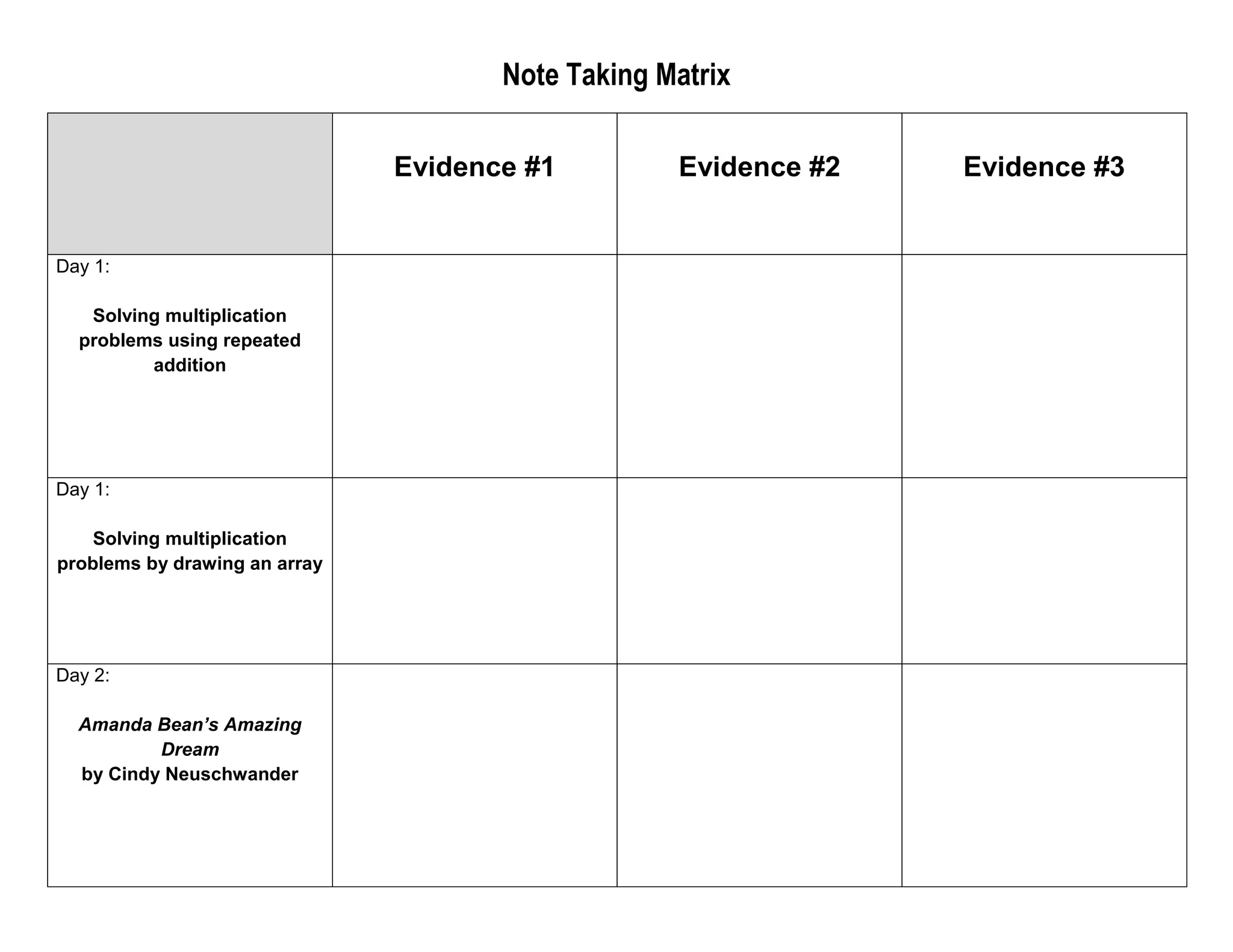
Note Taking Matrix
Evidence #1 Evidence #2 Evidence #3
Day 1:
Solving multiplication
problems using repeated
addition
Day 1:
Solving multiplication
problems by drawing an array
Day 2:
Amanda Bean’s Amazing
Dream
by Cindy Neuschwander
Additional Information:
________________________________________________________________________________
________________________________________________________________________________
________________________________________________________________________________
________________________________________________________________________________
________________________________________________________________________________
________________________________________________________________________________
________________________________________________________________________________
________________________________________________________________________________
________________________________________________________________________________
________________________________________________________________________________
________________________________________________________________________________
________________________________________________________________________________
________________________________________________________________________________
________________________________________________________________________________
________________________________________________________________________________
________________________________________________________________________________
________________________________________________________________________________
________________________________________________________________________________
________________________________________________________________________________
________________________________________________________________________________
________________________________________________________________________________
________________________________________________________________________________
________________________________________________________________________________
________________________________________________________________________________
________________________________________________________________________________
Name: ________________________ Date: _______
Writing Prompt: Explain what you know about multiplication.
________________________________________________________________________________
________________________________________________________________________________
________________________________________________________________________________
________________________________________________________________________________
________________________________________________________________________________
________________________________________________________________________________
________________________________________________________________________________
________________________________________________________________________________
________________________________________________________________________________
________________________________________________________________________________
________________________________________________________________________________
________________________________________________________________________________
________________________________________________________________________________
________________________________________________________________________________
________________________________________________________________________________
________________________________________________________________________________
________________________________________________________________________________
________________________________________________________________________________
________________________________________________________________________________
________________________________________________________________________________
________________________________________________________________________________
________________________________________________________________________________
________________________________________________________________________________
________________________________________________________________________________
Informative-Explanatory Writing Rubric (Grades 2-5)W
Statement of Purpose/Focus and Organization Development: Language and Elaboration of
Evidence Conventions
Statement of
Purpose/Focus
Organization Elaboration of Evidence Language and
Vocabulary
4 The response is fully sustained and
consistently and purposefully
focused:
controlling idea or main idea of
a topic is focused, clearly
stated, and strongly maintained
controlling idea or main idea of
a topic is introduced and
communicated clearly within
the context
The response has a clear and effective
organizational structure creating unity
and completeness:
use of a variety of transitional
strategies
logical progression of ideas
from beginning to end
effective introduction and
conclusion for audience and
purpose
The response provides thorough and
convincing support/evidence for the
controlling idea or main idea that
includes the effective use of sources,
facts, and details:
use of evidence from sources is
smoothly integrated,
comprehensive, and relevant
effective use of a variety of
elaborative techniques
The response clearly and
effectively expresses ideas,
using precise language:
use of academic and
domain-specific
vocabulary is clearly
appropriate for the
audience and purpose
The response demonstrates a
strong command of
conventions:
few, if any, errors are
present in usage and
sentence formation
effective and consistent
use of punctuation,
capitalization, and
spelling
3 The response is adequately
sustained and generally focused:
focus is clear and for the most
part maintained, though some
loosely related material may be
present
some context for the
controlling idea or main idea of
the
The response has an evident
organizational structure and a sense of
completeness, though there may be
minor flaws and some ideas may be
loosely connected:
adequate use of transitional
strategies with some variety
adequate progression of ideas from
beginning to end
adequate introduction and
conclusion
The response provides adequate
support/evidence for the controlling
idea or main idea that includes the use
of sources, facts, and details:
some evidence from sources is
integrated, though citations may
be general or imprecise
adequate use of some elaborative
techniques
The response adequately
expresses ideas, employing a
mix of precise with more
general language
use of domain-specific
vocabulary is generally
appropriate for the
audience and purpose
The response demonstrates
an adequate command of
conventions:
some errors in usage
and sentence formation
may be present, but no
systematic pattern of
errors is displayed
adequate use of
punctuation,
capitalization, and
spelling
2 The response is somewhat sustained
and may have a minor drift in focus:
may be clearly focused on the
controlling or main idea, but is
insufficiently sustained
controlling idea or main idea
may be unclear and somewhat
unfocused
The response has an inconsistent
organizational structure, and flaws are
evident:
inconsistent use of transitional
strategies with little variety
uneven progression of ideas
from beginning to end
conclusion and introduction, if
present, are weak
The response provides uneven, cursory
support/evidence for the controlling
idea or main idea that includes partial
or uneven use of sources, facts, and
details:
evidence from sources is
weakly integrated, and
citations, if present, are
uneven
weak or uneven use of
elaborative techniques
The response expresses ideas
unevenly, using simplistic
language:
use of domain-specific
vocabulary that may at
times be inappropriate
for the audience and
purpose
The response demonstrates a
partial command of
conventions:
frequent errors in usage
may obscure meaning
inconsistent use of
punctuation,
capitalization, and
spelling
1 The response may be related to the
topic but may provide little or no
focus:
may be very brief
may have a major drift
focus may be confusing or
ambiguous
The response has little or no discernible
organizational structure:
few or no transitional
strategies are evident
frequent extraneous ideas may
intrude
The response provides minimal
support/evidence for the controlling
idea or main idea that includes little or
no use of sources, facts, and details:
use of evidence from the source
material is minimal, absent, in
error, or irrelevant
The response expression of
ideas is vague, lacks clarity,
or is confusing:
uses limited language or
domain-specific
vocabulary
may have little sense of
audience and purpose
The response demonstrates a
lack of command of
conventions:
errors are frequent and
severe and meaning is
often obscure
0 A response gets no credit if it provides no evidence of the ability to [fill in with key language from the intended target].
Third grade math lesson

Third grade math lesson

  • 1.
    Grade 3 Math: Multiplication WritingPrompt: Explain what you know about multiplication. Teacher Organization and Resources Materials: Large chart paper/Elmo Markers Computer with internet connection BOOK: Amanda Bean’s Amazing Dream by Cindy Neuschwander Student writing paper Informative-Explanatory Writing Rubric (Grade 2-5) Websites: http://learnzillion.com/lessons/1393-solve-multiplication-problems-using-repeated-addition (Solving multiplication problems using repeated addition) VIDEO http://learnzillion.com/lessons/1394-solve-multiplication-problems-by-drawing-an-array (Solving multiplication problems by drawing an array) VIDEO Teacher Instructions for Session One (Build the Background/Ideas) Tell students in a few days they will write about multiplication. They will write to the prompt: Explain what you know about multiplication. Tell students they will spend the next two days gathering information about building capacity for the topic of multiplication. Pass out student Note-taking Matrix. Show the video, Solving Multiplication problems using repeated addition (http://learnzillion.com/lessons/1393-solve-multiplication-problems-using-repeated-addition ) and help students take notes on important information from the video. (Use the provided Note- taking Matrix) **You may want to pause the video at times and help them notice important information.** Read together Amanda Bean’s Amazing Dream by Cindy Neuschwander. Continue adding notes to the Note-taking Matrix. Follow the video and article with a classroom discussion.
  • 2.
    Teacher Instructions forSession Two (Continue Building Background/Ideas) Show the video, Solving Multiplication problems by drawing an array (http://learnzillion.com/lessons/1394-solve-multiplication-problems-by-drawing-an-array) and continue adding notes to the Note-taking Matrix. **You may want to pause the video at times and help them notice important information.** Follow the read-aloud and videos with a classroom discussion. (During this discussion, point out to students the overlapping ideas and facts in all three texts.) Teacher Instructions for Session Three (Writing Performance Task) Have students review their Note-taking Matrix. Hand out writing paper and instruct students to use the information they’ve gathered about multiplication to write to the following prompt: Explain what you know about multiplication. Explain that from this point on, students are to write independently. Tell them you want to see what they can do on their own and you won’t be able to help them. (accept whatever is produced) Use the Informative-Explanatory Writing Rubric (Grades 2-5) score student papers.
  • 3.
    Note Taking Matrix Evidence#1 Evidence #2 Evidence #3 Day 1: Solving multiplication problems using repeated addition Day 1: Solving multiplication problems by drawing an array Day 2: Amanda Bean’s Amazing Dream by Cindy Neuschwander
  • 4.
    Additional Information: ________________________________________________________________________________ ________________________________________________________________________________ ________________________________________________________________________________ ________________________________________________________________________________ ________________________________________________________________________________ ________________________________________________________________________________ ________________________________________________________________________________ ________________________________________________________________________________ ________________________________________________________________________________ ________________________________________________________________________________ ________________________________________________________________________________ ________________________________________________________________________________ ________________________________________________________________________________ ________________________________________________________________________________ ________________________________________________________________________________ ________________________________________________________________________________ ________________________________________________________________________________ ________________________________________________________________________________ ________________________________________________________________________________ ________________________________________________________________________________ ________________________________________________________________________________ ________________________________________________________________________________ ________________________________________________________________________________ ________________________________________________________________________________ ________________________________________________________________________________
  • 5.
    Name: ________________________ Date:_______ Writing Prompt: Explain what you know about multiplication. ________________________________________________________________________________ ________________________________________________________________________________ ________________________________________________________________________________ ________________________________________________________________________________ ________________________________________________________________________________ ________________________________________________________________________________ ________________________________________________________________________________ ________________________________________________________________________________ ________________________________________________________________________________ ________________________________________________________________________________ ________________________________________________________________________________ ________________________________________________________________________________ ________________________________________________________________________________ ________________________________________________________________________________ ________________________________________________________________________________ ________________________________________________________________________________ ________________________________________________________________________________ ________________________________________________________________________________ ________________________________________________________________________________ ________________________________________________________________________________ ________________________________________________________________________________ ________________________________________________________________________________ ________________________________________________________________________________ ________________________________________________________________________________
  • 6.
    Informative-Explanatory Writing Rubric(Grades 2-5)W Statement of Purpose/Focus and Organization Development: Language and Elaboration of Evidence Conventions Statement of Purpose/Focus Organization Elaboration of Evidence Language and Vocabulary 4 The response is fully sustained and consistently and purposefully focused: controlling idea or main idea of a topic is focused, clearly stated, and strongly maintained controlling idea or main idea of a topic is introduced and communicated clearly within the context The response has a clear and effective organizational structure creating unity and completeness: use of a variety of transitional strategies logical progression of ideas from beginning to end effective introduction and conclusion for audience and purpose The response provides thorough and convincing support/evidence for the controlling idea or main idea that includes the effective use of sources, facts, and details: use of evidence from sources is smoothly integrated, comprehensive, and relevant effective use of a variety of elaborative techniques The response clearly and effectively expresses ideas, using precise language: use of academic and domain-specific vocabulary is clearly appropriate for the audience and purpose The response demonstrates a strong command of conventions: few, if any, errors are present in usage and sentence formation effective and consistent use of punctuation, capitalization, and spelling 3 The response is adequately sustained and generally focused: focus is clear and for the most part maintained, though some loosely related material may be present some context for the controlling idea or main idea of the The response has an evident organizational structure and a sense of completeness, though there may be minor flaws and some ideas may be loosely connected: adequate use of transitional strategies with some variety adequate progression of ideas from beginning to end adequate introduction and conclusion The response provides adequate support/evidence for the controlling idea or main idea that includes the use of sources, facts, and details: some evidence from sources is integrated, though citations may be general or imprecise adequate use of some elaborative techniques The response adequately expresses ideas, employing a mix of precise with more general language use of domain-specific vocabulary is generally appropriate for the audience and purpose The response demonstrates an adequate command of conventions: some errors in usage and sentence formation may be present, but no systematic pattern of errors is displayed adequate use of punctuation, capitalization, and spelling 2 The response is somewhat sustained and may have a minor drift in focus: may be clearly focused on the controlling or main idea, but is insufficiently sustained controlling idea or main idea may be unclear and somewhat unfocused The response has an inconsistent organizational structure, and flaws are evident: inconsistent use of transitional strategies with little variety uneven progression of ideas from beginning to end conclusion and introduction, if present, are weak The response provides uneven, cursory support/evidence for the controlling idea or main idea that includes partial or uneven use of sources, facts, and details: evidence from sources is weakly integrated, and citations, if present, are uneven weak or uneven use of elaborative techniques The response expresses ideas unevenly, using simplistic language: use of domain-specific vocabulary that may at times be inappropriate for the audience and purpose The response demonstrates a partial command of conventions: frequent errors in usage may obscure meaning inconsistent use of punctuation, capitalization, and spelling 1 The response may be related to the topic but may provide little or no focus: may be very brief may have a major drift focus may be confusing or ambiguous The response has little or no discernible organizational structure: few or no transitional strategies are evident frequent extraneous ideas may intrude The response provides minimal support/evidence for the controlling idea or main idea that includes little or no use of sources, facts, and details: use of evidence from the source material is minimal, absent, in error, or irrelevant The response expression of ideas is vague, lacks clarity, or is confusing: uses limited language or domain-specific vocabulary may have little sense of audience and purpose The response demonstrates a lack of command of conventions: errors are frequent and severe and meaning is often obscure 0 A response gets no credit if it provides no evidence of the ability to [fill in with key language from the intended target].