1
2
3
•
•
•
•
•
•
•
4
•
•
•
•
•
5
•
•
•
1. Digital Humanities in the Library: Challenges and Opportunities for Subject Specialists. ©2015 by
The Association of College & Research Libraries, a division of the American Library Association.
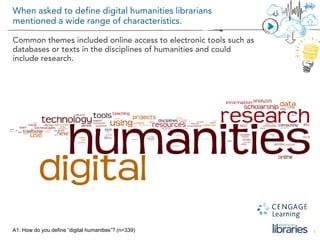
7A1: How do you define “digital humanities”? (n=339)
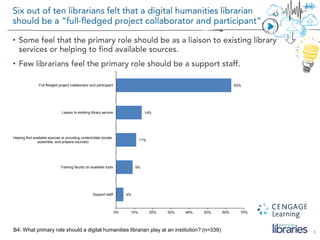
8B4: What primary role should a digital humanities librarian play at an institution? (n=339)
4%
9%
11%
14%
63%
0% 10% 20% 30% 40% 50% 60% 70%
Support staff
Training faculty on available tools
Helping find available sources or providing content/data (locate,
assemble, and prepare sources)
Liaison to existing library service
Full-fledged project collaborator and participant
•
•
9
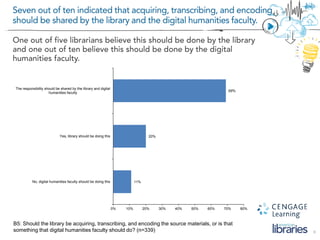
B5: Should the library be acquiring, transcribing, and encoding the source materials, or is that
something that digital humanities faculty should do? (n=339)
11%
20%
69%
0% 10% 20% 30% 40% 50% 60% 70% 80%
No, digital humanities faculty should be doing this
Yes, library should be doing this
The responsibility should be shared by the library and digital
humanities faculty
10
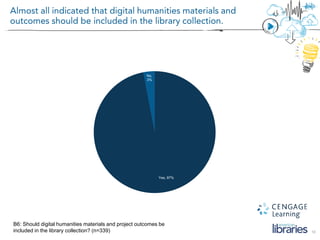
B6: Should digital humanities materials and project outcomes be
included in the library collection? (n=339)
Yes, 97%
No,
3%
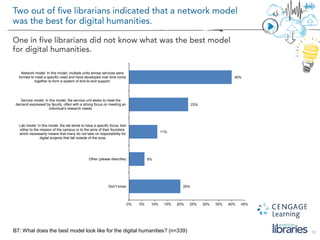
12B7: What does the best model look like for the digital humanities? (n=339)
20%
6%
11%
23%
40%
0% 5% 10% 15% 20% 25% 30% 35% 40% 45%
Don’t know
Other (please describe)
Lab model: In this model, the lab tends to have a specific focus, tied
either to the mission of the campus or to the aims of their founders,
which necessarily means that many do not take on responsibility for
digital projects that fall outside of the scop
Service model: In this model, the service unit seeks to meet the
demand expressed by faculty, often with a strong focus on meeting an
individual's research needs.
Network model: In this model, multiple units whose services were
formed to meet a specific need and have developed over time come
together to form a system of end-to-end support.
13
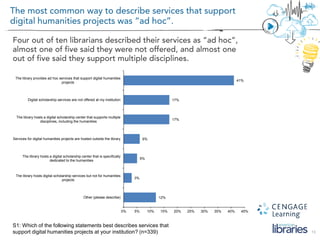
S1: Which of the following statements best describes services that
support digital humanities projects at your institution? (n=339)
12%
3%
5%
6%
17%
17%
41%
0% 5% 10% 15% 20% 25% 30% 35% 40% 45%
Other (please describe)
The library hosts digital scholarship services but not for humanities
projects
The library hosts a digital scholarship center that is specifically
dedicated to the humanities
Services for digital humanities projects are hosted outside the library
The library hosts a digital scholarship center that supports multiple
disciplines, including the humanities
Digital scholarship services are not offered at my institution
The library provides ad hoc services that support digital humanities
projects
14
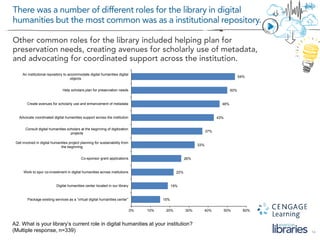
A2. What is your library’s current role in digital humanities at your institution?
(Multiple response, n=339)
15%
19%
22%
26%
33%
37%
43%
46%
50%
54%
0% 10% 20% 30% 40% 50% 60%
Package existing services as a “virtual digital humanities center”
Digital humanities center located in our library
Work to spur co-investment in digital humanities across institutions
Co-sponsor grant applications
Get involved in digital humanities project planning for sustainability from
the beginning
Consult digital humanities scholars at the beginning of digitization
projects
Advocate coordinated digital humanities support across the institution
Create avenues for scholarly use and enhancement of metadata
Help scholars plan for preservation needs
An institutional repository to accommodate digital humanities digital
objects
15
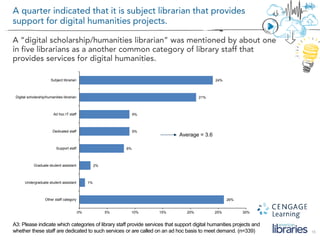
A3: Please indicate which categories of library staff provide services that support digital humanities projects and
whether these staff are dedicated to such services or are called on an ad hoc basis to meet demand. (n=339)
26%
1%
2%
8%
9%
9%
21%
24%
0% 5% 10% 15% 20% 25% 30%
Other staff category
Undergraduate student assistant
Graduate student assistant
Support staff
Dedicated staff
Ad hoc IT staff
Digital scholarship/humanities librarian
Subject librarian
Average = 3.6
16
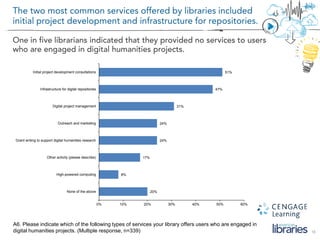
A6. Please indicate which of the following types of services your library offers users who are engaged in
digital humanities projects. (Multiple response, n=339)
20%
8%
17%
24%
24%
31%
47%
51%
0% 10% 20% 30% 40% 50% 60%
None of the above
High-powered computing
Other activity (please describe)
Grant writing to support digital humanities research
Outreach and marketing
Digital project management
Infrastructure for digital repositories
Initial project development consultations
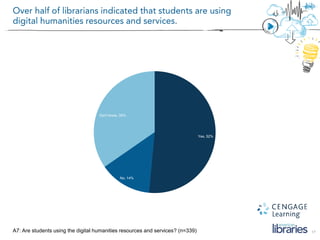
17A7: Are students using the digital humanities resources and services? (n=339)
Yes, 52%
No, 14%
Don't know, 35%
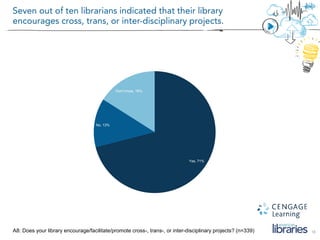
18A8: Does your library encourage/facilitate/promote cross-, trans-, or inter-disciplinary projects? (n=339)
Yes, 71%
No, 13%
Don't know, 16%
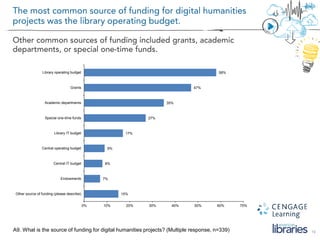
19A9. What is the source of funding for digital humanities projects? (Multiple response, n=339)
15%
7%
8%
9%
17%
27%
35%
47%
58%
0% 10% 20% 30% 40% 50% 60% 70%
Other source of funding (please describe)
Endowments
Central IT budget
Central operating budget
Library IT budget
Special one-time funds
Academic departments
Grants
Library operating budget
20
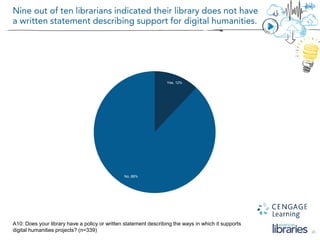
A10: Does your library have a policy or written statement describing the ways in which it supports
digital humanities projects? (n=339)
Yes, 12%
No, 88%
21
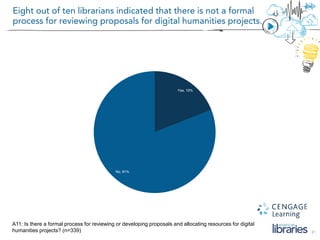
A11: Is there a formal process for reviewing or developing proposals and allocating resources for digital
humanities projects? (n=339)
Yes, 19%
No, 81%
23
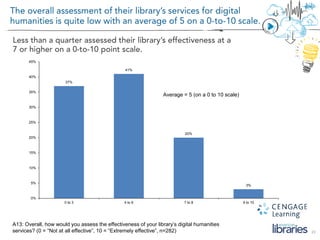
A13: Overall, how would you assess the effectiveness of your library’s digital humanities
services? (0 = “Not at all effective”, 10 = “Extremely effective”, n=282)
37%
41%
20%
3%
0%
5%
10%
15%
20%
25%
30%
35%
40%
45%
0 to 3 4 to 6 7 to 8 9 to 10
Average = 5 (on a 0 to 10 scale)
24
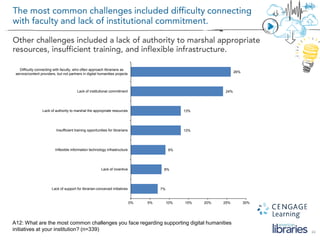
A12: What are the most common challenges you face regarding supporting digital humanities
initiatives at your institution? (n=339)
7%
8%
9%
13%
13%
24%
26%
0% 5% 10% 15% 20% 25% 30%
Lack of support for librarian-conceived initiatives
Lack of incentive
Inflexible information technology infrastructure
Insufficient training opportunities for librarians
Lack of authority to marshal the appropriate resources
Lack of institutional commitment
Difficulty connecting with faculty, who often approach librarians as
service/content providers, but not partners in digital humanities projects
25
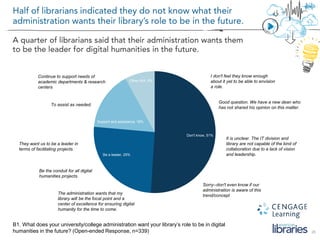
B1. What does your university/college administration want your library’s role to be in digital
humanities in the future? (Open-ended Response, n=339)
Don't know, 51%
Be a leader, 25%
Support and assistance, 16%
Other N/A, 8%
I don't feel they know enough
about it yet to be able to envision
a role.
Good question. We have a new dean who
has not shared his opinion on this matter.
It is unclear. The IT division and
library are not capable of the kind of
collaboration due to a lack of vision
and leadership.
Sorry--don't even know if our
administration is aware of this
trend/concept
They want us to be a leader in
terms of facilitating projects.
Be the conduit for all digital
humanities projects.
The administration wants that my
library will be the focal point and a
center of excellence for ensuring digital
humanity for the time to come.
Continue to support needs of
academic departments & research
centers
To assist as needed.
26
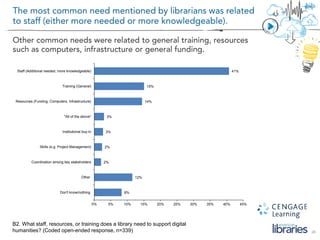
B2. What staff, resources, or training does a library need to support digital
humanities? (Coded open-ended response, n=339)
8%
12%
2%
2%
3%
3%
14%
15%
41%
0% 5% 10% 15% 20% 25% 30% 35% 40% 45%
Don't know/nothing
Other
Coordination among key stakeholders
Skills (e.g. Project Management)
Institutional buy-in
"All of the above"
Resources (Funding, Computers, Infrastructure)
Training (General)
Staff (Additional needed, more knowledgeable)
27
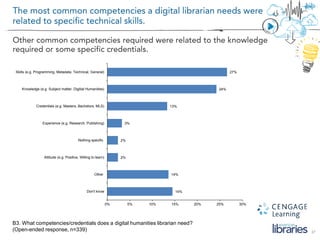
B3. What competencies/credentials does a digital humanities librarian need?
(Open-ended response, n=339)
14%
14%
2%
2%
3%
13%
24%
27%
0% 5% 10% 15% 20% 25% 30%
Don't know
Other
Attitude (e.g. Positive, Willing to learn)
Nothing specific
Experience (e.g. Research, Publishing)
Credentials (e.g. Masters, Bachelors, MLS)
Knowledge (e.g Subject matter, Digitial Humanities)
Skills (e.g. Programming, Metadata, Technical, General)
29
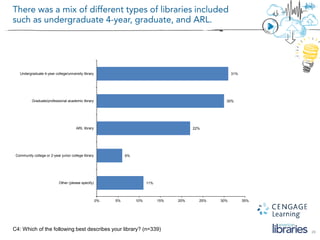
C4: Which of the following best describes your library? (n=339)
11%
6%
22%
30%
31%
0% 5% 10% 15% 20% 25% 30% 35%
Other (please specify)
Community college or 2-year junior college library
ARL library
Graduate/professional academic library
Undergraduate 4-year college/university library
30
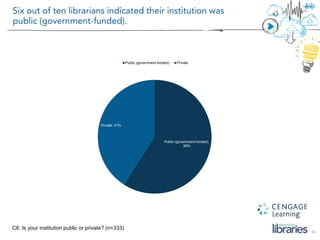
C6: Is your institution public or private? (n=333)
Public (government-funded),
59%
Private, 41%
Public (government-funded) Private
31
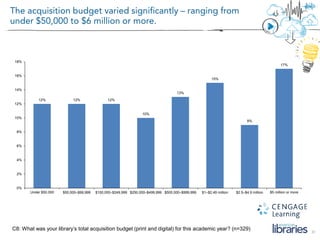
C8: What was your library’s total acquisition budget (print and digital) for this academic year? (n=329)
12% 12% 12%
10%
13%
15%
9%
17%
0%
2%
4%
6%
8%
10%
12%
14%
16%
18%
Under $50,000 $50,000–$99,999 $100,000–$249,999 $250,000–$499,999 $500,000–$999,999 $1–$2.49 million $2.5–$4.9 million $5 million or more
32
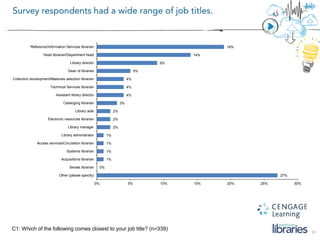
C1: Which of the following comes closest to your job title? (n=339)
27%
0%
1%
1%
1%
1%
2%
2%
2%
3%
4%
4%
4%
5%
9%
14%
19%
0% 5% 10% 15% 20% 25% 30%
Other (please specify)
Serials librarian
Acquisitions librarian
Systems librarian
Access services/Circulation librarian
Library administrator
Library manager
Electronic resources librarian
Library aide
Cataloging librarian
Assistant library director
Technical Services librarian
Collection development/Materials selection librarian
Dean of libraries
Library director
Head librarian/Department head
Reference/Information Services librarian
33
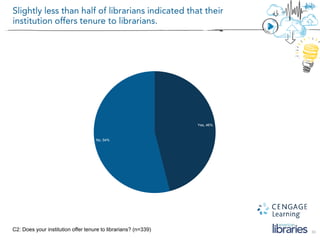
C2: Does your institution offer tenure to librarians? (n=339)
Yes, 46%
No, 54%
35
•
•
•
•
•

Digital humanities. Librarian Survey Results. DIC 2015

  • 1.
  • 2.
  • 3.
  • 4.
  • 5.
    5 • • • 1. Digital Humanitiesin the Library: Challenges and Opportunities for Subject Specialists. ©2015 by The Association of College & Research Libraries, a division of the American Library Association.
  • 7.
    7A1: How doyou define “digital humanities”? (n=339)
  • 8.
    8B4: What primaryrole should a digital humanities librarian play at an institution? (n=339) 4% 9% 11% 14% 63% 0% 10% 20% 30% 40% 50% 60% 70% Support staff Training faculty on available tools Helping find available sources or providing content/data (locate, assemble, and prepare sources) Liaison to existing library service Full-fledged project collaborator and participant • •
  • 9.
    9 B5: Should thelibrary be acquiring, transcribing, and encoding the source materials, or is that something that digital humanities faculty should do? (n=339) 11% 20% 69% 0% 10% 20% 30% 40% 50% 60% 70% 80% No, digital humanities faculty should be doing this Yes, library should be doing this The responsibility should be shared by the library and digital humanities faculty
  • 10.
    10 B6: Should digitalhumanities materials and project outcomes be included in the library collection? (n=339) Yes, 97% No, 3%
  • 12.
    12B7: What doesthe best model look like for the digital humanities? (n=339) 20% 6% 11% 23% 40% 0% 5% 10% 15% 20% 25% 30% 35% 40% 45% Don’t know Other (please describe) Lab model: In this model, the lab tends to have a specific focus, tied either to the mission of the campus or to the aims of their founders, which necessarily means that many do not take on responsibility for digital projects that fall outside of the scop Service model: In this model, the service unit seeks to meet the demand expressed by faculty, often with a strong focus on meeting an individual's research needs. Network model: In this model, multiple units whose services were formed to meet a specific need and have developed over time come together to form a system of end-to-end support.
  • 13.
    13 S1: Which ofthe following statements best describes services that support digital humanities projects at your institution? (n=339) 12% 3% 5% 6% 17% 17% 41% 0% 5% 10% 15% 20% 25% 30% 35% 40% 45% Other (please describe) The library hosts digital scholarship services but not for humanities projects The library hosts a digital scholarship center that is specifically dedicated to the humanities Services for digital humanities projects are hosted outside the library The library hosts a digital scholarship center that supports multiple disciplines, including the humanities Digital scholarship services are not offered at my institution The library provides ad hoc services that support digital humanities projects
  • 14.
    14 A2. What isyour library’s current role in digital humanities at your institution? (Multiple response, n=339) 15% 19% 22% 26% 33% 37% 43% 46% 50% 54% 0% 10% 20% 30% 40% 50% 60% Package existing services as a “virtual digital humanities center” Digital humanities center located in our library Work to spur co-investment in digital humanities across institutions Co-sponsor grant applications Get involved in digital humanities project planning for sustainability from the beginning Consult digital humanities scholars at the beginning of digitization projects Advocate coordinated digital humanities support across the institution Create avenues for scholarly use and enhancement of metadata Help scholars plan for preservation needs An institutional repository to accommodate digital humanities digital objects
  • 15.
    15 A3: Please indicatewhich categories of library staff provide services that support digital humanities projects and whether these staff are dedicated to such services or are called on an ad hoc basis to meet demand. (n=339) 26% 1% 2% 8% 9% 9% 21% 24% 0% 5% 10% 15% 20% 25% 30% Other staff category Undergraduate student assistant Graduate student assistant Support staff Dedicated staff Ad hoc IT staff Digital scholarship/humanities librarian Subject librarian Average = 3.6
  • 16.
    16 A6. Please indicatewhich of the following types of services your library offers users who are engaged in digital humanities projects. (Multiple response, n=339) 20% 8% 17% 24% 24% 31% 47% 51% 0% 10% 20% 30% 40% 50% 60% None of the above High-powered computing Other activity (please describe) Grant writing to support digital humanities research Outreach and marketing Digital project management Infrastructure for digital repositories Initial project development consultations
  • 17.
    17A7: Are studentsusing the digital humanities resources and services? (n=339) Yes, 52% No, 14% Don't know, 35%
  • 18.
    18A8: Does yourlibrary encourage/facilitate/promote cross-, trans-, or inter-disciplinary projects? (n=339) Yes, 71% No, 13% Don't know, 16%
  • 19.
    19A9. What isthe source of funding for digital humanities projects? (Multiple response, n=339) 15% 7% 8% 9% 17% 27% 35% 47% 58% 0% 10% 20% 30% 40% 50% 60% 70% Other source of funding (please describe) Endowments Central IT budget Central operating budget Library IT budget Special one-time funds Academic departments Grants Library operating budget
  • 20.
    20 A10: Does yourlibrary have a policy or written statement describing the ways in which it supports digital humanities projects? (n=339) Yes, 12% No, 88%
  • 21.
    21 A11: Is therea formal process for reviewing or developing proposals and allocating resources for digital humanities projects? (n=339) Yes, 19% No, 81%
  • 23.
    23 A13: Overall, howwould you assess the effectiveness of your library’s digital humanities services? (0 = “Not at all effective”, 10 = “Extremely effective”, n=282) 37% 41% 20% 3% 0% 5% 10% 15% 20% 25% 30% 35% 40% 45% 0 to 3 4 to 6 7 to 8 9 to 10 Average = 5 (on a 0 to 10 scale)
  • 24.
    24 A12: What arethe most common challenges you face regarding supporting digital humanities initiatives at your institution? (n=339) 7% 8% 9% 13% 13% 24% 26% 0% 5% 10% 15% 20% 25% 30% Lack of support for librarian-conceived initiatives Lack of incentive Inflexible information technology infrastructure Insufficient training opportunities for librarians Lack of authority to marshal the appropriate resources Lack of institutional commitment Difficulty connecting with faculty, who often approach librarians as service/content providers, but not partners in digital humanities projects
  • 25.
    25 B1. What doesyour university/college administration want your library’s role to be in digital humanities in the future? (Open-ended Response, n=339) Don't know, 51% Be a leader, 25% Support and assistance, 16% Other N/A, 8% I don't feel they know enough about it yet to be able to envision a role. Good question. We have a new dean who has not shared his opinion on this matter. It is unclear. The IT division and library are not capable of the kind of collaboration due to a lack of vision and leadership. Sorry--don't even know if our administration is aware of this trend/concept They want us to be a leader in terms of facilitating projects. Be the conduit for all digital humanities projects. The administration wants that my library will be the focal point and a center of excellence for ensuring digital humanity for the time to come. Continue to support needs of academic departments & research centers To assist as needed.
  • 26.
    26 B2. What staff,resources, or training does a library need to support digital humanities? (Coded open-ended response, n=339) 8% 12% 2% 2% 3% 3% 14% 15% 41% 0% 5% 10% 15% 20% 25% 30% 35% 40% 45% Don't know/nothing Other Coordination among key stakeholders Skills (e.g. Project Management) Institutional buy-in "All of the above" Resources (Funding, Computers, Infrastructure) Training (General) Staff (Additional needed, more knowledgeable)
  • 27.
    27 B3. What competencies/credentialsdoes a digital humanities librarian need? (Open-ended response, n=339) 14% 14% 2% 2% 3% 13% 24% 27% 0% 5% 10% 15% 20% 25% 30% Don't know Other Attitude (e.g. Positive, Willing to learn) Nothing specific Experience (e.g. Research, Publishing) Credentials (e.g. Masters, Bachelors, MLS) Knowledge (e.g Subject matter, Digitial Humanities) Skills (e.g. Programming, Metadata, Technical, General)
  • 29.
    29 C4: Which ofthe following best describes your library? (n=339) 11% 6% 22% 30% 31% 0% 5% 10% 15% 20% 25% 30% 35% Other (please specify) Community college or 2-year junior college library ARL library Graduate/professional academic library Undergraduate 4-year college/university library
  • 30.
    30 C6: Is yourinstitution public or private? (n=333) Public (government-funded), 59% Private, 41% Public (government-funded) Private
  • 31.
    31 C8: What wasyour library’s total acquisition budget (print and digital) for this academic year? (n=329) 12% 12% 12% 10% 13% 15% 9% 17% 0% 2% 4% 6% 8% 10% 12% 14% 16% 18% Under $50,000 $50,000–$99,999 $100,000–$249,999 $250,000–$499,999 $500,000–$999,999 $1–$2.49 million $2.5–$4.9 million $5 million or more
  • 32.
    32 C1: Which ofthe following comes closest to your job title? (n=339) 27% 0% 1% 1% 1% 1% 2% 2% 2% 3% 4% 4% 4% 5% 9% 14% 19% 0% 5% 10% 15% 20% 25% 30% Other (please specify) Serials librarian Acquisitions librarian Systems librarian Access services/Circulation librarian Library administrator Library manager Electronic resources librarian Library aide Cataloging librarian Assistant library director Technical Services librarian Collection development/Materials selection librarian Dean of libraries Library director Head librarian/Department head Reference/Information Services librarian
  • 33.
    33 C2: Does yourinstitution offer tenure to librarians? (n=339) Yes, 46% No, 54%
  • 35.