

Is the Future ofePortfolios in your pocket?Dr. Helen Barrettelectronicportfolios.orgTwitter: @eportfoliosSlideshare.net/eportfoliosAAEEBL Western ePortfolio ConferenceWestminster CollegeFebruary 28, 2011
Discuss!Engagement Factors?Social networks?ePortfolios?#11waaeebl2
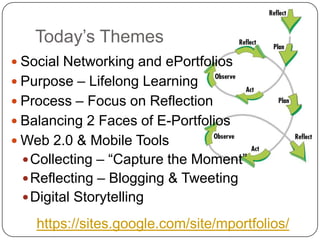
Today’s ThemesSocial Networking and ePortfoliosPurpose – Lifelong LearningProcess – Focus on ReflectionBalancing 2 Faces of E-PortfoliosWeb 2.0 & Mobile ToolsCollecting – “Capture the Moment”Reflecting – Blogging & TweetingDigital Storytellinghttps://sites.google.com/site/mportfolios/
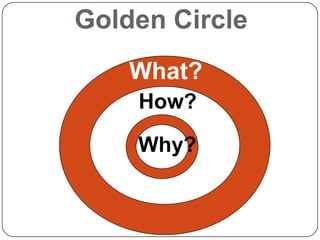
Golden Circle        What?How?Why?
WHAT?Audio • Video • Text • ImagesDigital RepositoryElectronic PortfolioMultimedia ArtifactsSocial Networks
PortfolioOne Word, Many Meanings
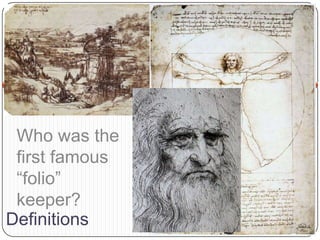
Who was the first famous “folio” keeper?Definitions
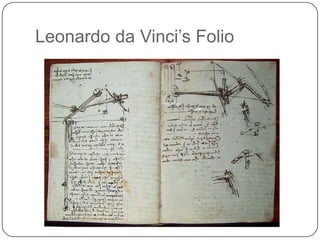
Leonardo da Vinci’s Folio
9Electronic Portfolios almost two decades (since 1991)used primarily in education to store documents reflect on learningfeedback for improvement showcase achievements for accountability or employment
10Social networking Last six years (or so)store documents and share experiences, showcase accomplishments, communicate and collaborate facilitate employment searches
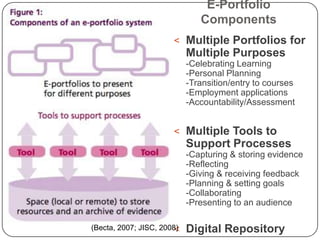
E-Portfolio Components Multiple Portfolios for Multiple Purposes-Celebrating Learning-Personal Planning-Transition/entry to courses-Employment applications-Accountability/Assessment
Multiple Tools to Support Processes-Capturing & storing evidence-Reflecting-Giving & receiving feedback-Planning & setting goals-Collaborating-Presenting to an audience
Digital Repository(Becta, 2007; JISC, 2008)
WHY?ReflectionAssessmentGuidanceIdentityLearningAccountabilityEmploymentShowcase
PurposeThe overarching purpose of portfolios is to create a sense of personal ownership over one’s accomplishments, because ownership engenders feelings of pride, responsibility, and dedication. (p.10)Paris, S & Ayres, L. (1994) Becoming Reflective Students and Teachers. American Psychological Association
Four key pillars of Lifelong Learning(Barbara Stäuble, Curtin University of Technology, Australia)http://lsn.curtin.edu.au/tlf/tlf2005/refereed/stauble.html
Knowing the learner (Self-awareness)Understanding prior knowledgeMotivation for and attitudes toward learningHelp learners understand themselvesSee their growth over time
Planning for learning (Self management)Setting goalsDevelop a plan to achieve these goals
Understanding how to learn (Meta-learning)Awareness of learners to different approaches to learningDeep vs. Surface Learning, Rote vs. Meaningful LearningDifferent Learning StylesHelp learners recognize successAccommodate approaches that are not successful
Evaluating learning (Self monitoring)Systematic analysis of learners’ performanceResponsibility to construct meaningBe reflective & think criticallyLearners construct meaning, monitor learning, evaluateown outcomes
Deep Learninginvolves reflection,is developmental,is integrative,is self-directive, andis lifelongCambridge (2004)
Temple at Delphi“Know Thyself”
Managing OneselfPeter Drucker, (2005) Best of Harvard Business Review“Success in the knowledge economy comes to those who know themselves – their strengths, their values, and how best they perform.”New Purpose: Use ePortfolios for managing knowledge workers' career developmentWhat are my strengths?How do I perform?What are my values?Where do I belong?What should I contribute?Responsibility for RelationshipsThe Second Half of your Life
5 Reasons Why Your Online Presence Will Replace Your Resume in 10 yearsSocial networking use is skyrocketing while email is plummetingYou can’t find jobs traditionally anymorePeople are managing their careers as entrepreneursThe traditional resume is now virtual and easy to buildJob seeker passion has become the deciding factor in employmenthttp://blogs.forbes.com/danschawbel/2011/02/21/5-reasons-why-your-online-presence-will-replace-your-resume-in-10-years/
Dan Schawbel, Forbes“personal branding guru”“Your online presence communicates, or should communicate, what you’re truly and genuinely passionate about… I firmly believe that you won’t be able to obtain and sustain a job without passion anymore.”http://blogs.forbes.com/danschawbel/2011/02/21/5-reasons-why-your-online-presence-will-replace-your-resume-in-10-years/
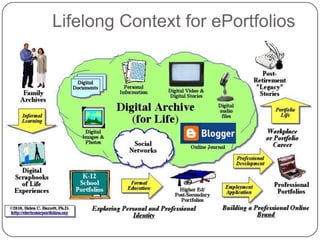
Lifelong Context for ePortfolios
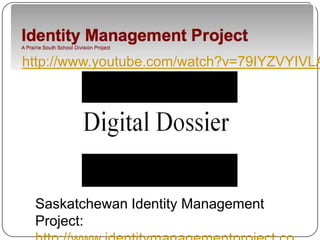
Digital Identity Managementhttp://www.youtube.com/watch?v=79IYZVYIVLASaskatchewan Identity Management Project: http://www.identitymanagementproject.com/
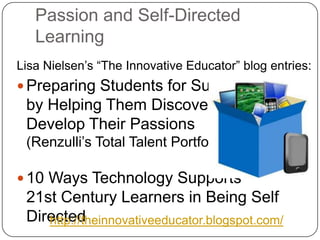
Passion and Self-Directed LearningLisa Nielsen’s “The Innovative Educator” blog entries:Preparing Students for Successby Helping Them Discover and Develop Their Passions (Renzulli’s Total Talent Portfolio)10 Ways Technology Supports21st Century Learners in Being Self Directedhttp://theinnovativeeducator.blogspot.com/
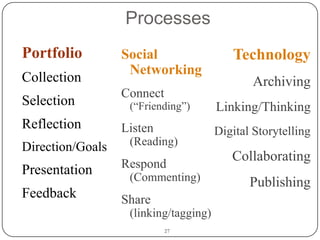
ProcessesPortfolioCollectionSelectionReflectionDirection/GoalsPresentationFeedbackTechnology  ArchivingLinking/ThinkingDigital Storytelling  Collaborating  PublishingSocial NetworkingConnect(“Friending”)Listen(Reading)Respond(Commenting)Share(linking/tagging)27
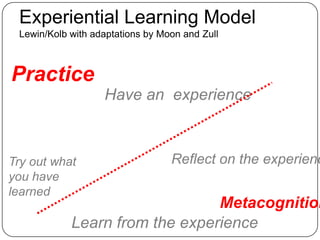
Experiential Learning ModelLewin/Kolb with adaptations by Moon and ZullPracticeHave an  experienceReflect on the experienceTry out what you have learnedMetacognitionLearn from the experience
Portfolio LearningExperienceFeelingReviewingRecording Organizing PlanningPublishing &Receiving FeedbackSharing &CollaboratingSelecting SynthesizingDialogueReflectingUnderstandingConceptualizing& Constructing MeaningFigure 2 A model of e-portfolio-based learning, adapted from Kolb (1984)JISC, 2008, Effective Practice with e-Portfolios, p. 9
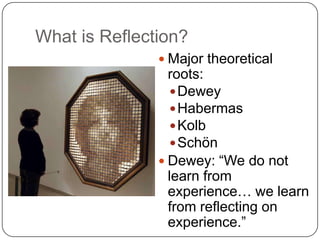
What is Reflection?Major theoretical roots: DeweyHabermasKolbSchönDewey: “We do not learn from experience… we learn from reflecting on experience.”
Jennifer Moon on ReflectionReflection is a form of mental processing – like a form of thinking – that we use to fulfill a purpose or to achieve some anticipated outcome.  It is applied to relatively complicated or unstructured ideas for which there is not an obvious solution and is largely based on the further processing of knowledge and understanding and possibly emotions that we already possess (based on Moon 1999)19992004
Moon on ReflectionOne of the defining characteristics of surface learning is that it does not involve reflection (p.123)
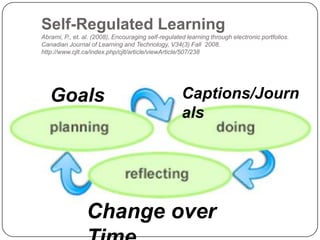
Self-Regulated LearningAbrami, P., et. al. (2008), Encouraging self-regulated learning through electronic portfolios. Canadian Journal of Learning and Technology, V34(3) Fall  2008. http://www.cjlt.ca/index.php/cjlt/article/viewArticle/507/238 GoalsCaptions/JournalsChange over Time
ePortfolios should be more Conversationthan PresentationBecause Conversation transforms!
35Similarities in ProcessMajor differences:extrinsic vs. intrinsic motivation Elements of  True (Intrinsic) Motivation:AutonomyMasteryPurpose
Successful websites = Type I ApproachPeople feel good about participating.
Give users autonomy.
Keep system as open as possible.- Clay Shirky36
Portfolios help learners find their Voice… and explore their Purpose and Passions through Choice!
HOW?WorkspaceToolsMobileShowcase“Capture the Moment”Appshttps://sites.google.com/site/mportfolios/
Why Mobile is a MustKids today are captivated by the personalization and socialization of online tools--the ability to build large networks of friends; share their thoughts, feelings, and goals; and communicate as they wish. …And not only is it possible, it's possible anytime and anywhere, via a plethora of devices and widely available cellular and WiFi networks.The upshot is, these digital natives now have in their hands the tools to shape their own education in once unimagined ways. They have the ability to interact with other learners at their convenience, with differences in time and place presenting no hurdle. They can research, on the spot, any topic of interest. And they can capture the moment, whether it's in a picture, a video, or a blog entry. -- Mary McCaffrey “Why Mobile is a Must” T.H.E. Journal http://thejournal.com/articles/2011/02/08/why-mobile-is-a-must.aspx
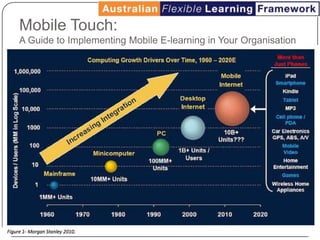
Mobile Touch: A Guide to Implementing Mobile E-learning in Your Organisation
2011 Horizon ReportTime-to-adoption:One Year or LessElectronic BooksMobiles (mentioned in last 3 years)Two to Three YearsAugmented Reality Game-Based Learning Four to Five YearsGesture-Based Computing Learning Analytics New Media Consortium http://www.nmc.org/
Mobile Year in Review 2010http://www.youtube.com/watch?v=6mCkbrYKQyI
Posted on ePortfolio Conversations Google Group:Question: How to collect evidence of informal learning rather than formal education. Response: "Start with SMS [on mobile phones] - it’s the morse codeof the presentgeneration...and it works.”
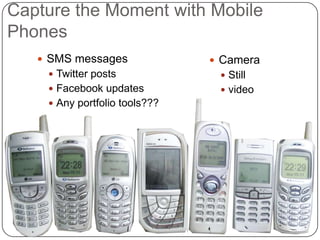
Capture the Moment with Mobile PhonesSMS messagesTwitter postsFacebook updatesAny portfolio tools???Camera Still video
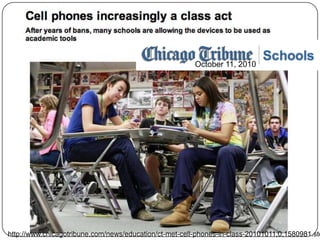
October 11, 2010http://www.chicagotribune.com/news/education/ct-met-cell-phones-in-class-20101011,0,1580981.story
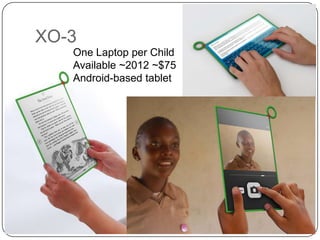
XO-3One Laptop per Child Available ~2012 ~$75 Android-based tablet
Using iOS Devices
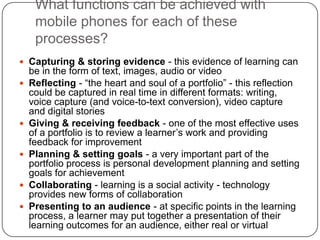
What functions can be achieved with mobile phones for each of these processes? Capturing & storing evidence - this evidence of learning can be in the form of text, images, audio or video Reflecting - “the heart and soul of a portfolio” - this reflection could be captured in real time in different formats: writing, voice capture (and voice-to-text conversion), video capture and digital storiesGiving & receiving feedback - one of the most effective uses of a portfolio is to review a learner’s work and providing feedback for improvementPlanning & setting goals - a very important part of the portfolio process is personal development planning and setting goals for achievementCollaborating - learning is a social activity - technology provides new forms of collaborationPresenting to an audience - at specific points in the learning process, a learner may put together a presentation of their learning outcomes for an audience, either real or virtual
Capturing and Storing EvidenceMobile PhonesSmart PhonesCamera can capture still images, videoRecord audio?Transmit to a website or upload to a computerCameras can capture images and videoApps to record audio uploaded to a website or uploaded to a computerAudio • Video Text • Images
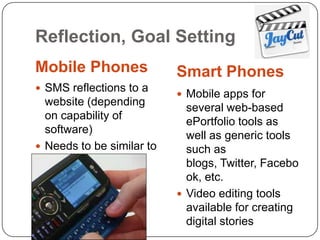
Reflection, Goal SettingMobile PhonesSmart PhonesSMS reflections to a website (depending on capability of software)Needs to be similar to Facebook updatesMobile apps for several web-based ePortfolio tools as well as generic tools such as blogs, Twitter, Facebook, etc.Video editing tools available for creating digital stories
Giving & receiving feedback, CollaborationMobile PhonesSmart PhonesNO Feedback? (Can mobile phones read websites to be able to provide feedback/comments?)one-to-one collaboration using SMSPost directly to web-based accounts, like Facebook and TwitterMobile web browsers should allow reading posts and online documents, and providing comments or co-authoringone-to-many collaboration using online communities and services, such as GoogleDocs or wikis
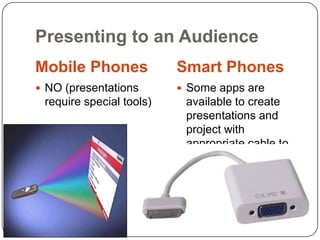
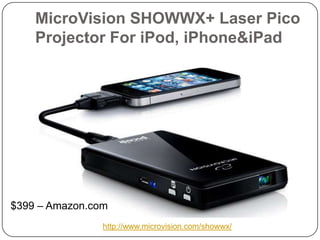
Presenting to an AudienceMobile PhonesSmart PhonesNO (presentations require special tools)Some apps are available to create presentations and project with appropriate cable to projector (iPad)
MicroVision SHOWWX+ Laser Pico Projector For iPod, iPhone & iPad$399 – Amazon.comhttp://www.microvision.com/showwx/
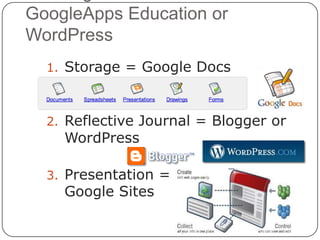
Creating an ePortfolio with GoogleApps Education or WordPressStorage = Google DocsReflective Journal = Blogger or WordPressPresentation =Google Sites
Level 1 Workspace: Collection of Artifacts in the Cloud
With iOS (iPod Touch, iPhone, iPad) Text    Images   Audio  VideoCapture the Moment
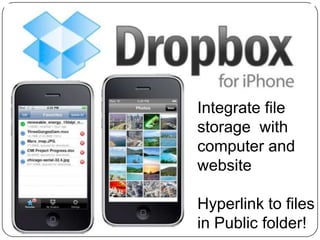
Integrate file storage  with computer and websiteHyperlink to files in Public folder!
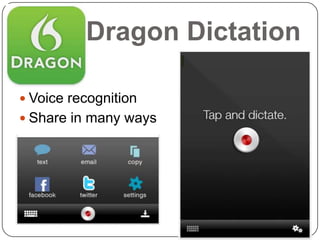
Dragon DictationVoice recognitionShare in many ways
EvernoteOne Account, Many DevicesCapture AnythingAccess AnywhereFind Things FastCapture something in one place -- access it from anotherWeb page accessEmailing your memoriesEmail notes, snapshots, and audio directly into your account. Emailed notes will go directly into your default notebook.
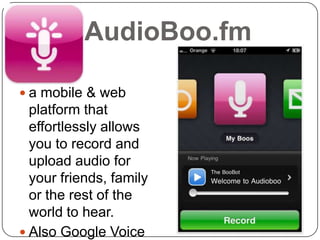
AudioBoo.fma mobile & web platform that effortlessly allows you to record and upload audio for your friends, family or the rest of the world to hear.Also Google Voice
JotNot Scanner Pro ($.99)Scan Multi-page documentsRemove Shadows & NoiseSave as PDFEmail, Fax and Share your ScansSend the image directly via email or upload it to cloud storage services including Evernote, Box.net, Dropbox, or Google Docs. (not with free version)
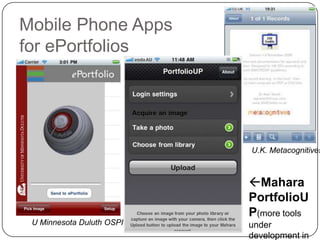
Mobile Phone Apps for ePortfoliosU.K. MetacognitivesMaharaPortfolioUP(more tools under development in N.Z)U Minnesota Duluth OSPI
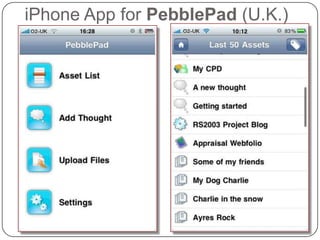
iPhone App for PebblePad (U.K.)
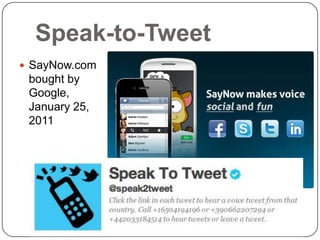
Speak-to-TweetSayNow.com bought by Google, January 25, 2011
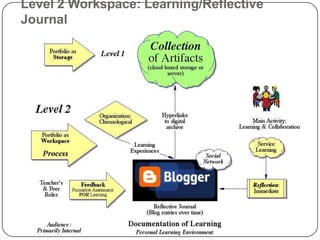
Level 2 Workspace: Learning/Reflective Journal
Blogging* by eMail*the act of sharing yourselfTumblrPosterousSet up account on websiteSend email to: myaccount.tumblr.comiPhone AppCall in your posts for audio post to blogCross-post to Facebook & TwitterJust email to post@posterous.com iPhone AppCross-post to Facebook & Twitter
More PebblePad Screens
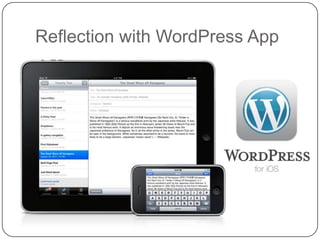
Reflection with WordPress App
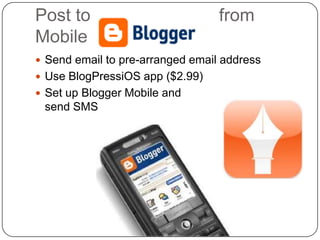
Post to                          from MobileSend email to pre-arranged email addressUse BlogPressiOS app ($2.99)Set up Blogger Mobile and send SMS
Level 3: Showcase PortfolioLevel 3: Primary Purpose: Showcase/Accountability
Learner-Centered Philosophy	"A portfolio tells a story. It is the story of knowing. Knowing about things... Knowing oneself... Knowing an audience... Portfolios are students' own stories of what they know, why they believe they know it, and why others should be of the same opinion.” (Paulson & Paulson,  1991, p.2)
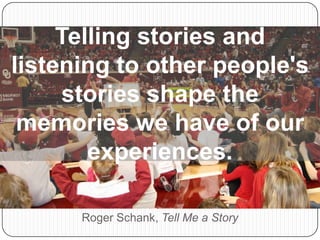
Telling stories and listening to other people's stories shape the memories we have of our experiences.Roger Schank, Tell Me a Story
Digital Storytelling ProcessCreate a 2-to-4 minute digital video clipFirst person narrative [begins with a written script ~ 400 words]Told in their own voice [record script]Illustrated (mostly) by still imagesMusic track to add emotional tone
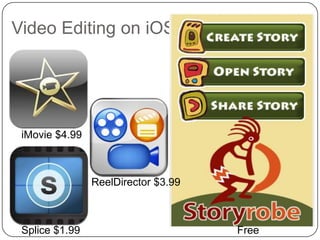
Video Editing on iOSiMovie $4.99ReelDirector $3.99Splice $1.99Free

AAEEBL SLC feb11

  • 1.
    Is the FutureofePortfolios in your pocket?Dr. Helen Barrettelectronicportfolios.orgTwitter: @eportfoliosSlideshare.net/eportfoliosAAEEBL Western ePortfolio ConferenceWestminster CollegeFebruary 28, 2011
  • 2.
  • 3.
    Today’s ThemesSocial Networkingand ePortfoliosPurpose – Lifelong LearningProcess – Focus on ReflectionBalancing 2 Faces of E-PortfoliosWeb 2.0 & Mobile ToolsCollecting – “Capture the Moment”Reflecting – Blogging & TweetingDigital Storytellinghttps://sites.google.com/site/mportfolios/
  • 4.
    Golden Circle What?How?Why?
  • 5.
    WHAT?Audio • Video• Text • ImagesDigital RepositoryElectronic PortfolioMultimedia ArtifactsSocial Networks
  • 6.
  • 7.
    Who was thefirst famous “folio” keeper?Definitions
  • 8.
  • 9.
    9Electronic Portfolios almosttwo decades (since 1991)used primarily in education to store documents reflect on learningfeedback for improvement showcase achievements for accountability or employment
  • 10.
    10Social networking Lastsix years (or so)store documents and share experiences, showcase accomplishments, communicate and collaborate facilitate employment searches
  • 11.
    E-Portfolio Components MultiplePortfolios for Multiple Purposes-Celebrating Learning-Personal Planning-Transition/entry to courses-Employment applications-Accountability/Assessment
  • 12.
    Multiple Tools toSupport Processes-Capturing & storing evidence-Reflecting-Giving & receiving feedback-Planning & setting goals-Collaborating-Presenting to an audience
  • 13.
  • 14.
  • 15.
    PurposeThe overarching purposeof portfolios is to create a sense of personal ownership over one’s accomplishments, because ownership engenders feelings of pride, responsibility, and dedication. (p.10)Paris, S & Ayres, L. (1994) Becoming Reflective Students and Teachers. American Psychological Association
  • 16.
    Four key pillarsof Lifelong Learning(Barbara Stäuble, Curtin University of Technology, Australia)http://lsn.curtin.edu.au/tlf/tlf2005/refereed/stauble.html
  • 17.
    Knowing the learner(Self-awareness)Understanding prior knowledgeMotivation for and attitudes toward learningHelp learners understand themselvesSee their growth over time
  • 18.
    Planning for learning(Self management)Setting goalsDevelop a plan to achieve these goals
  • 19.
    Understanding how tolearn (Meta-learning)Awareness of learners to different approaches to learningDeep vs. Surface Learning, Rote vs. Meaningful LearningDifferent Learning StylesHelp learners recognize successAccommodate approaches that are not successful
  • 20.
    Evaluating learning (Selfmonitoring)Systematic analysis of learners’ performanceResponsibility to construct meaningBe reflective & think criticallyLearners construct meaning, monitor learning, evaluateown outcomes
  • 21.
    Deep Learninginvolves reflection,isdevelopmental,is integrative,is self-directive, andis lifelongCambridge (2004)
  • 22.
  • 23.
    Managing OneselfPeter Drucker,(2005) Best of Harvard Business Review“Success in the knowledge economy comes to those who know themselves – their strengths, their values, and how best they perform.”New Purpose: Use ePortfolios for managing knowledge workers' career developmentWhat are my strengths?How do I perform?What are my values?Where do I belong?What should I contribute?Responsibility for RelationshipsThe Second Half of your Life
  • 24.
    5 Reasons WhyYour Online Presence Will Replace Your Resume in 10 yearsSocial networking use is skyrocketing while email is plummetingYou can’t find jobs traditionally anymorePeople are managing their careers as entrepreneursThe traditional resume is now virtual and easy to buildJob seeker passion has become the deciding factor in employmenthttp://blogs.forbes.com/danschawbel/2011/02/21/5-reasons-why-your-online-presence-will-replace-your-resume-in-10-years/
  • 25.
    Dan Schawbel, Forbes“personalbranding guru”“Your online presence communicates, or should communicate, what you’re truly and genuinely passionate about… I firmly believe that you won’t be able to obtain and sustain a job without passion anymore.”http://blogs.forbes.com/danschawbel/2011/02/21/5-reasons-why-your-online-presence-will-replace-your-resume-in-10-years/
  • 26.
  • 27.
    Digital Identity Managementhttp://www.youtube.com/watch?v=79IYZVYIVLASaskatchewanIdentity Management Project: http://www.identitymanagementproject.com/
  • 28.
    Passion and Self-DirectedLearningLisa Nielsen’s “The Innovative Educator” blog entries:Preparing Students for Successby Helping Them Discover and Develop Their Passions (Renzulli’s Total Talent Portfolio)10 Ways Technology Supports21st Century Learners in Being Self Directedhttp://theinnovativeeducator.blogspot.com/
  • 29.
    ProcessesPortfolioCollectionSelectionReflectionDirection/GoalsPresentationFeedbackTechnology ArchivingLinking/ThinkingDigitalStorytelling Collaborating PublishingSocial NetworkingConnect(“Friending”)Listen(Reading)Respond(Commenting)Share(linking/tagging)27
  • 30.
    Experiential Learning ModelLewin/Kolbwith adaptations by Moon and ZullPracticeHave an experienceReflect on the experienceTry out what you have learnedMetacognitionLearn from the experience
  • 31.
    Portfolio LearningExperienceFeelingReviewingRecording OrganizingPlanningPublishing &Receiving FeedbackSharing &CollaboratingSelecting SynthesizingDialogueReflectingUnderstandingConceptualizing& Constructing MeaningFigure 2 A model of e-portfolio-based learning, adapted from Kolb (1984)JISC, 2008, Effective Practice with e-Portfolios, p. 9
  • 32.
    What is Reflection?Majortheoretical roots: DeweyHabermasKolbSchönDewey: “We do not learn from experience… we learn from reflecting on experience.”
  • 33.
    Jennifer Moon onReflectionReflection is a form of mental processing – like a form of thinking – that we use to fulfill a purpose or to achieve some anticipated outcome. It is applied to relatively complicated or unstructured ideas for which there is not an obvious solution and is largely based on the further processing of knowledge and understanding and possibly emotions that we already possess (based on Moon 1999)19992004
  • 34.
    Moon on ReflectionOneof the defining characteristics of surface learning is that it does not involve reflection (p.123)
  • 35.
    Self-Regulated LearningAbrami, P.,et. al. (2008), Encouraging self-regulated learning through electronic portfolios. Canadian Journal of Learning and Technology, V34(3) Fall 2008. http://www.cjlt.ca/index.php/cjlt/article/viewArticle/507/238 GoalsCaptions/JournalsChange over Time
  • 36.
    ePortfolios should bemore Conversationthan PresentationBecause Conversation transforms!
  • 37.
    35Similarities in ProcessMajordifferences:extrinsic vs. intrinsic motivation Elements of True (Intrinsic) Motivation:AutonomyMasteryPurpose
  • 38.
    Successful websites =Type I ApproachPeople feel good about participating.
  • 39.
  • 40.
    Keep system asopen as possible.- Clay Shirky36
  • 41.
    Portfolios help learnersfind their Voice… and explore their Purpose and Passions through Choice!
  • 42.
  • 44.
    Why Mobile isa MustKids today are captivated by the personalization and socialization of online tools--the ability to build large networks of friends; share their thoughts, feelings, and goals; and communicate as they wish. …And not only is it possible, it's possible anytime and anywhere, via a plethora of devices and widely available cellular and WiFi networks.The upshot is, these digital natives now have in their hands the tools to shape their own education in once unimagined ways. They have the ability to interact with other learners at their convenience, with differences in time and place presenting no hurdle. They can research, on the spot, any topic of interest. And they can capture the moment, whether it's in a picture, a video, or a blog entry. -- Mary McCaffrey “Why Mobile is a Must” T.H.E. Journal http://thejournal.com/articles/2011/02/08/why-mobile-is-a-must.aspx
  • 45.
    Mobile Touch: AGuide to Implementing Mobile E-learning in Your Organisation
  • 46.
    2011 Horizon ReportTime-to-adoption:OneYear or LessElectronic BooksMobiles (mentioned in last 3 years)Two to Three YearsAugmented Reality Game-Based Learning Four to Five YearsGesture-Based Computing Learning Analytics New Media Consortium http://www.nmc.org/
  • 47.
    Mobile Year inReview 2010http://www.youtube.com/watch?v=6mCkbrYKQyI
  • 48.
    Posted on ePortfolioConversations Google Group:Question: How to collect evidence of informal learning rather than formal education. Response: "Start with SMS [on mobile phones] - it’s the morse codeof the presentgeneration...and it works.”
  • 49.
    Capture the Momentwith Mobile PhonesSMS messagesTwitter postsFacebook updatesAny portfolio tools???Camera Still video
  • 50.
  • 51.
    XO-3One Laptop perChild Available ~2012 ~$75 Android-based tablet
  • 53.
  • 54.
    What functions canbe achieved with mobile phones for each of these processes? Capturing & storing evidence - this evidence of learning can be in the form of text, images, audio or video Reflecting - “the heart and soul of a portfolio” - this reflection could be captured in real time in different formats: writing, voice capture (and voice-to-text conversion), video capture and digital storiesGiving & receiving feedback - one of the most effective uses of a portfolio is to review a learner’s work and providing feedback for improvementPlanning & setting goals - a very important part of the portfolio process is personal development planning and setting goals for achievementCollaborating - learning is a social activity - technology provides new forms of collaborationPresenting to an audience - at specific points in the learning process, a learner may put together a presentation of their learning outcomes for an audience, either real or virtual
  • 55.
    Capturing and StoringEvidenceMobile PhonesSmart PhonesCamera can capture still images, videoRecord audio?Transmit to a website or upload to a computerCameras can capture images and videoApps to record audio uploaded to a website or uploaded to a computerAudio • Video Text • Images
  • 56.
    Reflection, Goal SettingMobilePhonesSmart PhonesSMS reflections to a website (depending on capability of software)Needs to be similar to Facebook updatesMobile apps for several web-based ePortfolio tools as well as generic tools such as blogs, Twitter, Facebook, etc.Video editing tools available for creating digital stories
  • 57.
    Giving & receivingfeedback, CollaborationMobile PhonesSmart PhonesNO Feedback? (Can mobile phones read websites to be able to provide feedback/comments?)one-to-one collaboration using SMSPost directly to web-based accounts, like Facebook and TwitterMobile web browsers should allow reading posts and online documents, and providing comments or co-authoringone-to-many collaboration using online communities and services, such as GoogleDocs or wikis
  • 58.
    Presenting to anAudienceMobile PhonesSmart PhonesNO (presentations require special tools)Some apps are available to create presentations and project with appropriate cable to projector (iPad)
  • 59.
    MicroVision SHOWWX+ LaserPico Projector For iPod, iPhone & iPad$399 – Amazon.comhttp://www.microvision.com/showwx/
  • 60.
    Creating an ePortfoliowith GoogleApps Education or WordPressStorage = Google DocsReflective Journal = Blogger or WordPressPresentation =Google Sites
  • 61.
    Level 1 Workspace:Collection of Artifacts in the Cloud
  • 62.
    With iOS (iPodTouch, iPhone, iPad) Text Images Audio VideoCapture the Moment
  • 63.
    Integrate file storage with computer and websiteHyperlink to files in Public folder!
  • 64.
  • 65.
    EvernoteOne Account, ManyDevicesCapture AnythingAccess AnywhereFind Things FastCapture something in one place -- access it from anotherWeb page accessEmailing your memoriesEmail notes, snapshots, and audio directly into your account. Emailed notes will go directly into your default notebook.
  • 66.
    AudioBoo.fma mobile &web platform that effortlessly allows you to record and upload audio for your friends, family or the rest of the world to hear.Also Google Voice
  • 67.
    JotNot Scanner Pro($.99)Scan Multi-page documentsRemove Shadows & NoiseSave as PDFEmail, Fax and Share your ScansSend the image directly via email or upload it to cloud storage services including Evernote, Box.net, Dropbox, or Google Docs. (not with free version)
  • 68.
    Mobile Phone Appsfor ePortfoliosU.K. MetacognitivesMaharaPortfolioUP(more tools under development in N.Z)U Minnesota Duluth OSPI
  • 69.
    iPhone App forPebblePad (U.K.)
  • 71.
    Speak-to-TweetSayNow.com bought byGoogle, January 25, 2011
  • 72.
    Level 2 Workspace:Learning/Reflective Journal
  • 73.
    Blogging* by eMail*theact of sharing yourselfTumblrPosterousSet up account on websiteSend email to: myaccount.tumblr.comiPhone AppCall in your posts for audio post to blogCross-post to Facebook & TwitterJust email to post@posterous.com iPhone AppCross-post to Facebook & Twitter
  • 74.
  • 75.
  • 76.
    Post to from MobileSend email to pre-arranged email addressUse BlogPressiOS app ($2.99)Set up Blogger Mobile and send SMS
  • 77.
    Level 3: ShowcasePortfolioLevel 3: Primary Purpose: Showcase/Accountability
  • 78.
    Learner-Centered Philosophy "A portfoliotells a story. It is the story of knowing. Knowing about things... Knowing oneself... Knowing an audience... Portfolios are students' own stories of what they know, why they believe they know it, and why others should be of the same opinion.” (Paulson & Paulson, 1991, p.2)
  • 79.
    Telling stories andlistening to other people's stories shape the memories we have of our experiences.Roger Schank, Tell Me a Story
  • 80.
    Digital Storytelling ProcessCreatea 2-to-4 minute digital video clipFirst person narrative [begins with a written script ~ 400 words]Told in their own voice [record script]Illustrated (mostly) by still imagesMusic track to add emotional tone
  • 81.
    Video Editing oniOSiMovie $4.99ReelDirector $3.99Splice $1.99Free

Editor's Notes

  • #3 Simon Sinek, in his wonderful TED Talk, discusses How great leaders inspire action – talks about the Golden Circle. Leaders talk a lot about What and How, but really need to focus on Why.
  • #7 Adjectives to describe purpose
  • #21 Who knows what this means?
  • #22 Success in the knowledge economy comes to those who know themselves – their strengths, their values, and how best they perform.
  • #25 Portfolios in Formal Education: Exploring Personal and Professional IdentityBuilding a Professional Online Brand.
  • #26 Every student getting their own domain name. Building a positive digital identity.
  • #34 How do portfolios and reflection fit into the learning process?BEFORE - goal-setting (reflection in the future tense), DURING - immediate reflection (in the present tense), where students write (or dictate) the reason why they chose a specific artifact to include in their collectionAFTER - retrospective (in the past tense) where students look back over a collection of work and describe what they have learned and how they have changed over a period of time (in a Level 3 portfolio)
  • #35 “Portfolios should be less about tellingand more about talking!” Julie Hughes, University of Wolverhampton
  • #39 How do we implement ePortfolios in a manner that engages students and helps achieve the purposes?
  • #40 We have witnessed a revolution in mobile computing this year with the iPad. A new version will be announced on Wednesday. But most of the world has plain mobile phone.
  • #47 Look at the way that technology supports those processes: digitizing/archiving, hyper-linking/embedding, storytelling, collaborating, publishing, aggregating. We need to help students develop lifelong skills that will last after they graduate. If students are using "world ware" (tools in use it the world) then they are developing skills that can be applied in the "real world" outside of formal education. We should also look at how students are naturally using technology in their lives: social networking, mobile communications, capturing and storing images, audio and video, etc. We could build on the tools that students are already using... and look at the intrinsic motivation factors that drive the use of social networking, and apply those factors to the ePortfolio environment: autonomy, mastery and purpose (thanks to Dan Pink's book, Drive). We are looking at a future that is well integrated with mobile devices.
  • #49 7 languages: English, Catalan, Spanish. German, Russian, Catalan, Mandarin
  • #52 - this evidence of learning can be in the form of text, images, audio or video
  • #53 “the heart and soul of a portfolio” - this reflection could be captured in real time in different formats: writing, voice capture (and voice-to-text conversion), video capture and digital stories- a very important part of the portfolio process is personal development planning and setting goals for achievement
  • #54 one of the most effective uses of a portfolio is to review a learner’s work and providing feedback for improvement- learning is a social activity - technology provides new forms of collaboration
  • #55  - at specific points in the learning process, a learner may put together a presentation of their learning outcomes for an audience, either real or virtual
  • #57 Here is an example
  • #62 Grade 3-5 classroom in Portland using Evernote. Scanner wirelessly emails documents to each student’s Evernote account. Use of tags, software recognizes text in scanned docs.
  • #76 In TELL ME A STORY, Schank argues that storytelling is at the heart of intelligence. We think of storytelling primarily as entertainment, secondarily as a form of art, yet it also—and perhaps more fundamentally—has a cognitive function: Stories help us organize our experience and define our sense of ourselves.
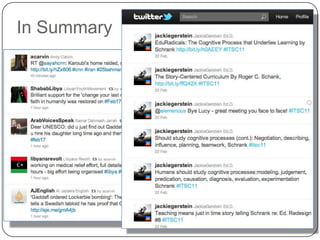
  • #78 Using the computing power we carry in our pockets can dramatically enhance student engagement in documenting and showcasing their own learning. And with other tablets emerging in the market, we have many opportunities for research and implementation.
  • #79 In summary, I’m not convinced that deep reflection can be represented in 140-160 characters of a tweet or SMS message. But this format can be an effective way to document process over time --to capture the moment-- and can later be aggregated and analyzed for deeper understanding. As a current example, the tweets that were coming out of Egypt prior to February 11 told a very compelling story of the revolution as it was happening (as curated and retweeted by PBS’s Andy Carvin [@acarvin] - an incredible service!). We have seen the power of digital media in social change; it can also be part of individual transformation through understanding oneself and showcasing achievements in reflective portfolios.