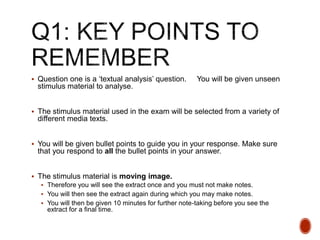

 Question one is a ‘textual analysis’ question. You will be given unseen
stimulus material to analyse.
 The stimulus material used in the exam will be selected from a variety of
different media texts.
 You will be given bullet points to guide you in your response. Make sure
that you respond to all the bullet points in your answer.
 The stimulus material is moving image.
 Therefore you will see the extract once and you must not make notes.
 You will then see the extract again during which you may make notes.
 You will then be given 10 minutes for further note-taking before you see the
extract for a final time.
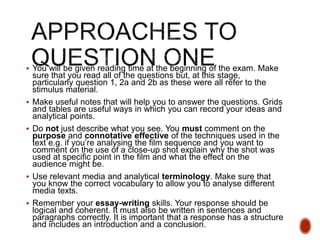
 You will be given reading time at the beginning of the exam. Make
sure that you read all of the questions but, at this stage,
particularly question 1, 2a and 2b as these were all refer to the
stimulus material.
 Make useful notes that will help you to answer the questions. Grids
and tables are useful ways in which you can record your ideas and
analytical points.
 Do not just describe what you see. You must comment on the
purpose and connotative effective of the techniques used in the
text e.g. if you’re analysing the film sequence and you want to
comment on the use of a close-up shot explain why the shot was
used at specific point in the film and what the effect on the
audience might be.
 Use relevant media and analytical terminology. Make sure that
you know the correct vocabulary to allow you to analyse different
media texts.
 Remember your essay-writing skills. Your response should be
logical and coherent. It must also be written in sentences and
paragraphs correctly. It is important that a response has a structure
and includes an introduction and a conclusion.
Listen to the The Breakfast Show on Radio One before
answering Question 1.
What could we talk about?
Radio is a tricky medium as we cannot discuss the visuals and
are limited to audio, technical, narrative and genre.
But how can we discuss genre and narrative?
Here are some key terms we can apply.
The role and purpose of radio has changed significantly over recent years. It
has been affected by advances in digital technology including the ability of
the audience to listen online, to download Podcasts to their mobile phones
and see radio programmes as they recorded through studio webcams.
The medium of radio consists of:
 The blind medium - it only involves the sense of hearing with no visual
images. In this sense it allows the audience to use their imagination.
 The companion medium – The radio format that offers the strong sense
of personal communication for the audience. It also offers interactive
opportunities-the audience can text and email programmes and get a
‘mention’ or a ‘shout out’ on the radio programme.
 The intimate medium – Radio is very personal. Encourage intimacy by
the use of the direct mode of address.
 The undemanding medium - allows the audience to do other things while
listening.
 Zoo format – This is a style of radio programme where there is a main
presenter but also others to contribute. The mode of address is informal
and there often jokes and chats between the participants. A radio
programme uses this format is Radio One’s Breakfast Show with Nick
Grimshaw.
 Magazine programme - this is a genre of radio programme that, like a
magazine, includes a range of features, for example music, chat, news,
gossip and interviews.
 Profile – with regard to radio stations, this means how they would be
defined. This may include their target audience, their aims and their ethos.
For example, the profile for Radio One is to:
 ‘entertain a broad range of young listeners with a distinctive mix of contemporary
music and speech. Its target audience is 15 to 29-year-olds and it should also
provide some programming for younger teenagers.
 It should offer new music, support emerging artists-especially those from the
UK- and provide a platform for live music. News documentaries and advice
campaign should cover areas relevant to the audience and provide a platform for
live music. News, documentaries and advice campaigns should cover areas of
relevance to young adults.’
 Stripping - a scheduling technique using radio and television
whereby the same programme is scheduled at the same time
every day
 Drive time programmes – programme that are scheduled
between 5 and 7pm and are designed for listeners who are
driving home.
 House style – for a radio programme this means the style of
the programme which may include: jingles, presenter mode of
address, content and music genres played.
 All radio programmes focus on the human voice, whether
speaking or singing. They also have a clear narrative structure
even when the programme appears on scripted and
improvised.
 Many programmes are presenter led and often audiences will
‘tune in’ because they like the style of a particular presenter,
which may have been established over a period of time. Chris
Moyles, until his recent resignation, commanded very high
listening figures mainly due to his particular style of
presentation.
 The zoo format is a particular style of a radio magazine
programme and tends to actively involve audiences and has a
broad reach due to the range of features included.
 Radio programmes can be divided into speech based in music
based. Most radio stations offer a schedule that includes a
range of genres although the profile of some radio stations for
example Radio One and Kerrang Radio is generally music
based. The profile of the radio station will dictate the type of
programme aired and will define the target audience who, as in
the case of television, will have expectations of what the radio
station will provide.
 The audience for registrations is often defined by the age of the
listener. Radio One tends to cater for a young audience who
are less interested in speech based radio, whereas Radio Four
focuses on speech based programmes and targets an older
demographic.
Because the conventions of speech based programmes include:
 Phone-ins – these are effective, cheap ways of involving the
listener. Jeremy Vine’s lunchtime radio programme on Radio Two
revolves around music, discussion and listeners phoning in to give
their opinions about current issues and events in the news.
 Discussions – a group of people sitting around discussing a
range of topics. This genre of programme is often a key part of
Radio Four’s schedule.
 Outside broadcasts – Mobile studios may visit different locations
and broadcast from there. Example, earlier this year Radio One
had a live broadcast from Hull where the shows DJs gain first-hand
accounts of the festival of those listening at home.
 Drama – Radio Four has a regular feature of The Afternoon
Play. Other drivers into the long running radio soap The
Archers.
 Programmes are generally stripped across the schedules
appeal to different audiences at different times of day.
 The programmes reflect the profile of the station. They are
speech-based and address a high brow audience. However
Radio Four does also air comedy programmes usually stripped
across the schedules at 6:30pm.
The majority of radio stations have music as the main focus. Most stations
ever music programmes specific times during the day related to what
listeners will be doing. For example, breakfast shows and drive time
programmes. The feature of music lead programmes include:
 Presenter-led programmes – this is the most popular form of stations like
radio one radio two. Here the personality of the presenter is as important
as the music and they will bring with them their fan base and the
programme will have a particular house style. He's programmes will have
a clear format and listenable know what to expect at specific times during
the programme.
 Zoo format - the main presenter will have a support team who will engage
in informal chat and gossip and give their opinions on a range of events
and issues of relevance to the target audience.
 Live concerts - this can be of popular performers or of orchestras (usually
aired on Radio Three).
 Session programmes - bands and artists are invited into the
studio and part of a regular programme would be devoted to the
performer playing live. The presenter will also have the
interview the performer; for example, Radio One’s Live Lounge.
 Music documentaries – programmes will be devoted to an
analysis of the output and life of a particular musician; for
example, after the death of Amy Winehouse there are several
radio documentaries made celebrating her brand of music.
 Personal choice programmes – for example desert island
discs on Radio Four, where celebrities choose their favourite
music.
How could we analyse The Breakfast Show on Radio One for
Question 1.
Consider:
 Audio and Technical Codes
 Genre codes
 Mode of address

WJEC MS1 Exam: Radio codes and conventions

  • 2.
     Question oneis a ‘textual analysis’ question. You will be given unseen stimulus material to analyse.  The stimulus material used in the exam will be selected from a variety of different media texts.  You will be given bullet points to guide you in your response. Make sure that you respond to all the bullet points in your answer.  The stimulus material is moving image.  Therefore you will see the extract once and you must not make notes.  You will then see the extract again during which you may make notes.  You will then be given 10 minutes for further note-taking before you see the extract for a final time.
  • 3.
     You willbe given reading time at the beginning of the exam. Make sure that you read all of the questions but, at this stage, particularly question 1, 2a and 2b as these were all refer to the stimulus material.  Make useful notes that will help you to answer the questions. Grids and tables are useful ways in which you can record your ideas and analytical points.  Do not just describe what you see. You must comment on the purpose and connotative effective of the techniques used in the text e.g. if you’re analysing the film sequence and you want to comment on the use of a close-up shot explain why the shot was used at specific point in the film and what the effect on the audience might be.  Use relevant media and analytical terminology. Make sure that you know the correct vocabulary to allow you to analyse different media texts.  Remember your essay-writing skills. Your response should be logical and coherent. It must also be written in sentences and paragraphs correctly. It is important that a response has a structure and includes an introduction and a conclusion.
  • 5.
    Listen to theThe Breakfast Show on Radio One before answering Question 1. What could we talk about? Radio is a tricky medium as we cannot discuss the visuals and are limited to audio, technical, narrative and genre. But how can we discuss genre and narrative? Here are some key terms we can apply.
  • 6.
    The role andpurpose of radio has changed significantly over recent years. It has been affected by advances in digital technology including the ability of the audience to listen online, to download Podcasts to their mobile phones and see radio programmes as they recorded through studio webcams. The medium of radio consists of:  The blind medium - it only involves the sense of hearing with no visual images. In this sense it allows the audience to use their imagination.  The companion medium – The radio format that offers the strong sense of personal communication for the audience. It also offers interactive opportunities-the audience can text and email programmes and get a ‘mention’ or a ‘shout out’ on the radio programme.  The intimate medium – Radio is very personal. Encourage intimacy by the use of the direct mode of address.  The undemanding medium - allows the audience to do other things while listening.
  • 7.
     Zoo format– This is a style of radio programme where there is a main presenter but also others to contribute. The mode of address is informal and there often jokes and chats between the participants. A radio programme uses this format is Radio One’s Breakfast Show with Nick Grimshaw.  Magazine programme - this is a genre of radio programme that, like a magazine, includes a range of features, for example music, chat, news, gossip and interviews.  Profile – with regard to radio stations, this means how they would be defined. This may include their target audience, their aims and their ethos. For example, the profile for Radio One is to:  ‘entertain a broad range of young listeners with a distinctive mix of contemporary music and speech. Its target audience is 15 to 29-year-olds and it should also provide some programming for younger teenagers.  It should offer new music, support emerging artists-especially those from the UK- and provide a platform for live music. News documentaries and advice campaign should cover areas relevant to the audience and provide a platform for live music. News, documentaries and advice campaigns should cover areas of relevance to young adults.’
  • 8.
     Stripping -a scheduling technique using radio and television whereby the same programme is scheduled at the same time every day  Drive time programmes – programme that are scheduled between 5 and 7pm and are designed for listeners who are driving home.  House style – for a radio programme this means the style of the programme which may include: jingles, presenter mode of address, content and music genres played.
  • 9.
     All radioprogrammes focus on the human voice, whether speaking or singing. They also have a clear narrative structure even when the programme appears on scripted and improvised.  Many programmes are presenter led and often audiences will ‘tune in’ because they like the style of a particular presenter, which may have been established over a period of time. Chris Moyles, until his recent resignation, commanded very high listening figures mainly due to his particular style of presentation.  The zoo format is a particular style of a radio magazine programme and tends to actively involve audiences and has a broad reach due to the range of features included.
  • 10.
     Radio programmescan be divided into speech based in music based. Most radio stations offer a schedule that includes a range of genres although the profile of some radio stations for example Radio One and Kerrang Radio is generally music based. The profile of the radio station will dictate the type of programme aired and will define the target audience who, as in the case of television, will have expectations of what the radio station will provide.  The audience for registrations is often defined by the age of the listener. Radio One tends to cater for a young audience who are less interested in speech based radio, whereas Radio Four focuses on speech based programmes and targets an older demographic.
  • 11.
    Because the conventionsof speech based programmes include:  Phone-ins – these are effective, cheap ways of involving the listener. Jeremy Vine’s lunchtime radio programme on Radio Two revolves around music, discussion and listeners phoning in to give their opinions about current issues and events in the news.  Discussions – a group of people sitting around discussing a range of topics. This genre of programme is often a key part of Radio Four’s schedule.  Outside broadcasts – Mobile studios may visit different locations and broadcast from there. Example, earlier this year Radio One had a live broadcast from Hull where the shows DJs gain first-hand accounts of the festival of those listening at home.
  • 12.
     Drama –Radio Four has a regular feature of The Afternoon Play. Other drivers into the long running radio soap The Archers.  Programmes are generally stripped across the schedules appeal to different audiences at different times of day.  The programmes reflect the profile of the station. They are speech-based and address a high brow audience. However Radio Four does also air comedy programmes usually stripped across the schedules at 6:30pm.
  • 13.
    The majority ofradio stations have music as the main focus. Most stations ever music programmes specific times during the day related to what listeners will be doing. For example, breakfast shows and drive time programmes. The feature of music lead programmes include:  Presenter-led programmes – this is the most popular form of stations like radio one radio two. Here the personality of the presenter is as important as the music and they will bring with them their fan base and the programme will have a particular house style. He's programmes will have a clear format and listenable know what to expect at specific times during the programme.  Zoo format - the main presenter will have a support team who will engage in informal chat and gossip and give their opinions on a range of events and issues of relevance to the target audience.  Live concerts - this can be of popular performers or of orchestras (usually aired on Radio Three).
  • 14.
     Session programmes- bands and artists are invited into the studio and part of a regular programme would be devoted to the performer playing live. The presenter will also have the interview the performer; for example, Radio One’s Live Lounge.  Music documentaries – programmes will be devoted to an analysis of the output and life of a particular musician; for example, after the death of Amy Winehouse there are several radio documentaries made celebrating her brand of music.  Personal choice programmes – for example desert island discs on Radio Four, where celebrities choose their favourite music.
  • 15.
    How could weanalyse The Breakfast Show on Radio One for Question 1. Consider:  Audio and Technical Codes  Genre codes  Mode of address