TV Drama Codes
and Conventions
Grace Pollington
Comparing the opening of two TV dramas
(soap-operas)
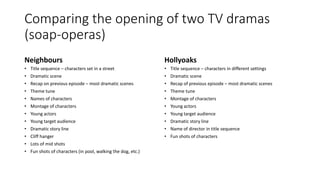
Neighbours
• Title sequence – characters set in a street
• Dramatic scene
• Recap on previous episode – most dramatic scenes
• Theme tune
• Names of characters
• Montage of characters
• Young actors
• Young target audience
• Dramatic story line
• Cliff hanger
• Lots of mid shots
• Fun shots of characters (in pool, walking the dog, etc.)
Hollyoaks
• Title sequence – characters in different settings
• Dramatic scene
• Recap of previous episode – most dramatic scenes
• Theme tune
• Montage of characters
• Young actors
• Young target audience
• Dramatic story line
• Name of director in title sequence
• Fun shots of characters
Comparing the opening sequence of two TV
Dramas
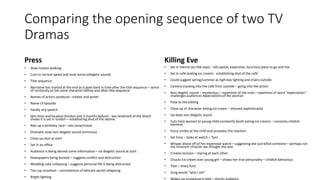
Press
• Slow motion walking
• Cuts to normal speed and loud voices (diegetic sound)
• Title sequence
• Narrative has started at the end as it goes back in time after the title sequence – sence
of continuity as the same character before and after title sequence
• Names of actors, producer, creater and writer
• Name of episode
• Hardly any speech
• Sets time and location (london and 3 months before) - key landmark of the Shard
shows it is set in london – establishing shot of the skyline.
• Rips up a birthday card – sets tone/mood
• Dramatic slow non-diegetic sound (ominous)
• Close up shot at start
• Set in an office
• Audience is being denied some information – no diegetic sound at start
• Newspapers being burned – suggests conflict and distruction
• Wedding cake collapsing – suggests personal life is being distructed
• Tea cup smashed – connotations of delicate world collapsing
• Bright lighting
Killing Eve
• Set in Vienna (as title says) - old capital, expensive, lucurious place to go and live
• Set in café (eating ice cream) - establishing shot of the café
• Could suggest spring/summer as hgih key lighting and chairs outside
• Camera tracking into the café from outside – going into the action
• Non-degetic sound – mysterious – repetition of the note – repetition of word "expectation" -
challenges audiences expectations of the woman
• Flow to the editing
• Close up of character eating ice cream – dressed sophisticated
• Up-beat non-diegetic sound
• Cuts from women to young child constantly (both eating ice cream) – connotes childish
element
• Force smiles at the child and provokes the reaction
• Set time – looks at watch – 7pm
• Whipes blood off of her expensive watch – suggesting she just killed someone – perhaps not
the innocent chracter we thought she was
• Creates tension – staring at each other
• Chucks ice cream over young girl – shows her true personality – childish behavious
• Title – sharp font
• Song words "who I am"
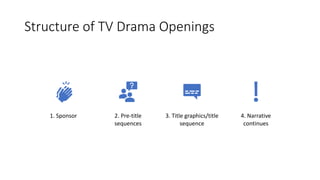
Structure of TV Drama Openings
1. Sponsor 2. Pre-title
sequences
3. Title graphics/title
sequence
4. Narrative
continues
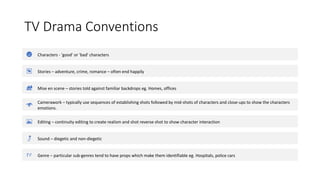
TV Drama Conventions
Characters - 'good' or 'bad' characters
Stories – adventure, crime, romance – often end happily
Mise en scene – stories told against familiar backdrops eg. Homes, offices
Camerawork – typically use sequences of establishing shots followed by mid-shots of characters and close-ups to show the characters
emotions.
Editing – continuity editing to create realism and shot reverse shot to show character interaction
Sound – diegetic and non-diegetic
Genre – particular sub-genres tend to have props which make them identifiable eg. Hospitals, police cars
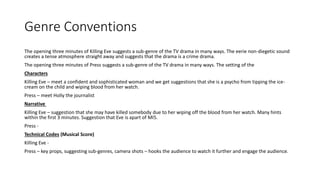
Genre Conventions
The opening three minutes of Killing Eve suggests a sub-genre of the TV drama in many ways. The eerie non-diegetic sound
creates a tense atmosphere straight away and suggests that the drama is a crime drama.
The opening three minutes of Press suggests a sub-genre of the TV drama in many ways. The setting of the
Characters
Killing Eve – meet a confident and sophisticated woman and we get suggestions that she is a psycho from tipping the ice-
cream on the child and wiping blood from her watch.
Press – meet Holly the journalist
Narrative
Killing Eve – suggestion that she may have killed somebody due to her wiping off the blood from her watch. Many hints
within the first 3 minutes. Suggestion that Eve is apart of MI5.
Press -
Technical Codes (Musical Score)
Killing Eve -
Press – key props, suggesting sub-genres, camera shots – hooks the audience to watch it further and engage the audience.
Challenging Genre
For example, Cloverfield, where the perspective is from the group of
young people. It is different from many other horror movies because it
uses a documentary style hand-held camera.
Intertextuality
• For example, Toy Story 2 uses intertextual references to Barbie and
Jurassic Park. Intertextuality is used for humorous reasons.
TV Drama
Analysis Task
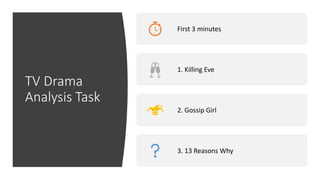
First 3 minutes
1. Killing Eve
2. Gossip Girl
3. 13 Reasons Why
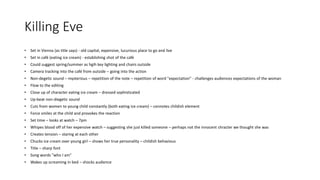
Killing Eve
• Set in Vienna (as title says) - old capital, expensive, lucurious place to go and live
• Set in café (eating ice cream) - establishing shot of the café
• Could suggest spring/summer as hgih key lighting and chairs outside
• Camera tracking into the café from outside – going into the action
• Non-degetic sound – mysterious – repetition of the note – repetition of word "expectation" - challenges audiences expectations of the woman
• Flow to the editing
• Close up of character eating ice cream – dressed sophisticated
• Up-beat non-diegetic sound
• Cuts from women to young child constantly (both eating ice cream) – connotes childish element
• Force smiles at the child and provokes the reaction
• Set time – looks at watch – 7pm
• Whipes blood off of her expensive watch – suggesting she just killed someone – perhaps not the innocent chracter we thought she was
• Creates tension – staring at each other
• Chucks ice cream over young girl – shows her true personality – childish behavious
• Title – sharp font
• Song words "who I am"
• Wakes up screaming in bed – shocks audience
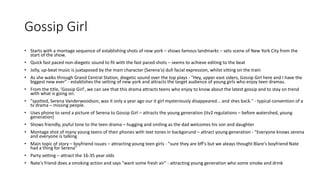
Gossip Girl
• Starts with a montage sequence of establishing shots of new york – shows famous landmarks – sets scene of New York City from the
start of the show.
• Quick fast paced non-diegetic sound to fit with the fast paced shots – seems to achieve editing to the beat
• Jolly, up-beat music is juxtaposed by the main character (Serena's) dull facial expression, whilst sitting on the train
• As she walks through Grand Central Station, diegetic sound over the top plays - "Hey, upper east siders, Gossip Girl here and I have the
biggest new ever" - establishes the setting of new york and attracts the target audience of young girls who enjoy teen dramas.
• From the title, 'Gossip Girl', we can see that this drama attracts teens who enjoy to know about the latest gossip and to stay on trend
with what is going on.
• "spotted, Serena Vanderwoodson, was it only a year ago our it girl mysteriously disappeared... and shes back." - typical convention of a
tv drama – missing people.
• Uses phone to send a picture of Serena to Gossip Girl – attracts the young generation (itv2 regulations – before watershed, young
generation)
• Shows friendly, joyful tone to the teen drama – hugging and smiling as the dad welcomes his son and daughter
• Montage shot of many young teens of their phones with text tones in backgorund – attract young generation - "Everyone knows serena
and everyone is talking
• Main topic of story – boyfriend issues – attracting young teen girls - "sure they are bff's but we aleays thought Blare's boyfriend Nate
had a thing for Serena"
• Party setting – attract the 16-35 year olds
• Nate's friend does a smoking action and says "want some fresh air" - attracting young generation who some smoke and drink
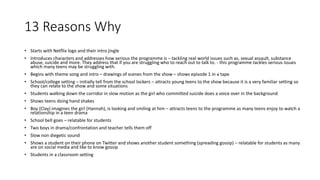
13 Reasons Why
• Starts with Netflix logo and their intro jingle
• Introduces characters and addresses how serious the programme is – tackling real world issues such as, sexual assault, substance
abuse, suicide and more. They address that if you are struggling who to reach out to talk to. - this programme tackles serious issues
which many teens may be struggling with.
• Begins with theme song and intro – drawings of scenes from the show – shows episode 1 in a tape
• School/college setting – initially tell from the school lockers – attracts young teens to the show because it is a very familiar setting so
they can relate to the show and some situations
• Students walking down the corridor in slow motion as the girl who committed suicide does a voice over in the background
• Shows teens doing hand shakes
• Boy (Clay) imagines the girl (Hannah), is looking and smiling at him – attracts teens to the programme as many teens enjoy to watch a
relationship in a teen drama
• School bell goes – relatable for students
• Two boys in drama/confrontation and teacher tells them off
• Slow non diegetic sound
• Shows a student on their phone on Twitter and shows another student something (spreading gossip) – relatable for students as many
are on social media and like to know gossip
• Students in a classroom setting
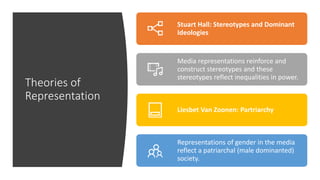
Theories of
Representation
Stuart Hall: Stereotypes and Dominant
Ideologies
Media representations reinforce and
construct stereotypes and these
stereotypes reflect inequalities in power.
Liesbet Van Zoonen: Partriarchy
Representations of gender in the media
reflect a patriarchal (male dominanted)
society.

TV Drama Codes and Conventions

  • 1.
    TV Drama Codes andConventions Grace Pollington
  • 2.
    Comparing the openingof two TV dramas (soap-operas) Neighbours • Title sequence – characters set in a street • Dramatic scene • Recap on previous episode – most dramatic scenes • Theme tune • Names of characters • Montage of characters • Young actors • Young target audience • Dramatic story line • Cliff hanger • Lots of mid shots • Fun shots of characters (in pool, walking the dog, etc.) Hollyoaks • Title sequence – characters in different settings • Dramatic scene • Recap of previous episode – most dramatic scenes • Theme tune • Montage of characters • Young actors • Young target audience • Dramatic story line • Name of director in title sequence • Fun shots of characters
  • 3.
    Comparing the openingsequence of two TV Dramas Press • Slow motion walking • Cuts to normal speed and loud voices (diegetic sound) • Title sequence • Narrative has started at the end as it goes back in time after the title sequence – sence of continuity as the same character before and after title sequence • Names of actors, producer, creater and writer • Name of episode • Hardly any speech • Sets time and location (london and 3 months before) - key landmark of the Shard shows it is set in london – establishing shot of the skyline. • Rips up a birthday card – sets tone/mood • Dramatic slow non-diegetic sound (ominous) • Close up shot at start • Set in an office • Audience is being denied some information – no diegetic sound at start • Newspapers being burned – suggests conflict and distruction • Wedding cake collapsing – suggests personal life is being distructed • Tea cup smashed – connotations of delicate world collapsing • Bright lighting Killing Eve • Set in Vienna (as title says) - old capital, expensive, lucurious place to go and live • Set in café (eating ice cream) - establishing shot of the café • Could suggest spring/summer as hgih key lighting and chairs outside • Camera tracking into the café from outside – going into the action • Non-degetic sound – mysterious – repetition of the note – repetition of word "expectation" - challenges audiences expectations of the woman • Flow to the editing • Close up of character eating ice cream – dressed sophisticated • Up-beat non-diegetic sound • Cuts from women to young child constantly (both eating ice cream) – connotes childish element • Force smiles at the child and provokes the reaction • Set time – looks at watch – 7pm • Whipes blood off of her expensive watch – suggesting she just killed someone – perhaps not the innocent chracter we thought she was • Creates tension – staring at each other • Chucks ice cream over young girl – shows her true personality – childish behavious • Title – sharp font • Song words "who I am"
  • 4.
    Structure of TVDrama Openings 1. Sponsor 2. Pre-title sequences 3. Title graphics/title sequence 4. Narrative continues
  • 5.
    TV Drama Conventions Characters- 'good' or 'bad' characters Stories – adventure, crime, romance – often end happily Mise en scene – stories told against familiar backdrops eg. Homes, offices Camerawork – typically use sequences of establishing shots followed by mid-shots of characters and close-ups to show the characters emotions. Editing – continuity editing to create realism and shot reverse shot to show character interaction Sound – diegetic and non-diegetic Genre – particular sub-genres tend to have props which make them identifiable eg. Hospitals, police cars
  • 6.
    Genre Conventions The openingthree minutes of Killing Eve suggests a sub-genre of the TV drama in many ways. The eerie non-diegetic sound creates a tense atmosphere straight away and suggests that the drama is a crime drama. The opening three minutes of Press suggests a sub-genre of the TV drama in many ways. The setting of the Characters Killing Eve – meet a confident and sophisticated woman and we get suggestions that she is a psycho from tipping the ice- cream on the child and wiping blood from her watch. Press – meet Holly the journalist Narrative Killing Eve – suggestion that she may have killed somebody due to her wiping off the blood from her watch. Many hints within the first 3 minutes. Suggestion that Eve is apart of MI5. Press - Technical Codes (Musical Score) Killing Eve - Press – key props, suggesting sub-genres, camera shots – hooks the audience to watch it further and engage the audience.
  • 7.
    Challenging Genre For example,Cloverfield, where the perspective is from the group of young people. It is different from many other horror movies because it uses a documentary style hand-held camera.
  • 8.
    Intertextuality • For example,Toy Story 2 uses intertextual references to Barbie and Jurassic Park. Intertextuality is used for humorous reasons.
  • 9.
    TV Drama Analysis Task First3 minutes 1. Killing Eve 2. Gossip Girl 3. 13 Reasons Why
  • 10.
    Killing Eve • Setin Vienna (as title says) - old capital, expensive, lucurious place to go and live • Set in café (eating ice cream) - establishing shot of the café • Could suggest spring/summer as hgih key lighting and chairs outside • Camera tracking into the café from outside – going into the action • Non-degetic sound – mysterious – repetition of the note – repetition of word "expectation" - challenges audiences expectations of the woman • Flow to the editing • Close up of character eating ice cream – dressed sophisticated • Up-beat non-diegetic sound • Cuts from women to young child constantly (both eating ice cream) – connotes childish element • Force smiles at the child and provokes the reaction • Set time – looks at watch – 7pm • Whipes blood off of her expensive watch – suggesting she just killed someone – perhaps not the innocent chracter we thought she was • Creates tension – staring at each other • Chucks ice cream over young girl – shows her true personality – childish behavious • Title – sharp font • Song words "who I am" • Wakes up screaming in bed – shocks audience
  • 11.
    Gossip Girl • Startswith a montage sequence of establishing shots of new york – shows famous landmarks – sets scene of New York City from the start of the show. • Quick fast paced non-diegetic sound to fit with the fast paced shots – seems to achieve editing to the beat • Jolly, up-beat music is juxtaposed by the main character (Serena's) dull facial expression, whilst sitting on the train • As she walks through Grand Central Station, diegetic sound over the top plays - "Hey, upper east siders, Gossip Girl here and I have the biggest new ever" - establishes the setting of new york and attracts the target audience of young girls who enjoy teen dramas. • From the title, 'Gossip Girl', we can see that this drama attracts teens who enjoy to know about the latest gossip and to stay on trend with what is going on. • "spotted, Serena Vanderwoodson, was it only a year ago our it girl mysteriously disappeared... and shes back." - typical convention of a tv drama – missing people. • Uses phone to send a picture of Serena to Gossip Girl – attracts the young generation (itv2 regulations – before watershed, young generation) • Shows friendly, joyful tone to the teen drama – hugging and smiling as the dad welcomes his son and daughter • Montage shot of many young teens of their phones with text tones in backgorund – attract young generation - "Everyone knows serena and everyone is talking • Main topic of story – boyfriend issues – attracting young teen girls - "sure they are bff's but we aleays thought Blare's boyfriend Nate had a thing for Serena" • Party setting – attract the 16-35 year olds • Nate's friend does a smoking action and says "want some fresh air" - attracting young generation who some smoke and drink
  • 12.
    13 Reasons Why •Starts with Netflix logo and their intro jingle • Introduces characters and addresses how serious the programme is – tackling real world issues such as, sexual assault, substance abuse, suicide and more. They address that if you are struggling who to reach out to talk to. - this programme tackles serious issues which many teens may be struggling with. • Begins with theme song and intro – drawings of scenes from the show – shows episode 1 in a tape • School/college setting – initially tell from the school lockers – attracts young teens to the show because it is a very familiar setting so they can relate to the show and some situations • Students walking down the corridor in slow motion as the girl who committed suicide does a voice over in the background • Shows teens doing hand shakes • Boy (Clay) imagines the girl (Hannah), is looking and smiling at him – attracts teens to the programme as many teens enjoy to watch a relationship in a teen drama • School bell goes – relatable for students • Two boys in drama/confrontation and teacher tells them off • Slow non diegetic sound • Shows a student on their phone on Twitter and shows another student something (spreading gossip) – relatable for students as many are on social media and like to know gossip • Students in a classroom setting
  • 13.
    Theories of Representation Stuart Hall:Stereotypes and Dominant Ideologies Media representations reinforce and construct stereotypes and these stereotypes reflect inequalities in power. Liesbet Van Zoonen: Partriarchy Representations of gender in the media reflect a patriarchal (male dominanted) society.