
Text	
  by	
  E.	
  Kissner	


Have	
  you	
  ever	
  wanted	
  to	
  go	
  to	
  Antarctica?	
  It’s	
  not	
  an	
  easy	
  trip.	
  
Antarctica	
  is	
  the	
  coldest,	
  windiest	
  place	
  on	
  earth.	
  But	
  for	
  the	
  brave	
  
people	
  who	
  go	
  there	
  each	
  year,	
  it	
  is	
  a	
  destination	
  like	
  no	
  other.	
  What	
  is	
  
it	
  like	
  to	
  go	
  to	
  this	
  cold	
  and	
  icy	
  continent?	


Getting	
  to	
  Antarctica	
  
First	
  of	
  all,	
  don’t	
  expect	
  
a	
  hotel	
  or	
  a	
  theme	
  park.	
  No	
  
one	
  really	
  lives	
  in	
  Antarctica.	
  
Many	
  countries	
  have	
  research	
  
stations	
  there,	
  but	
  the	
  
scientists	
  and	
  the	
  staff	
  
members	
  spend	
  only	
  a	
  few	
  
months	
  at	
  a	
  time	
  on	
  the	
  
frozen	
  land.	
  So	
  there	
  are	
  few	
  
tourist	
  attractions	
  besides	
  
penguins,	
  researchers,	
  and	
  
lots	
  and	
  lots	
  of	
  ice.	
  	
  
One	
  way	
  to	
  get	
  to	
  
Antarctica	
  is	
  by	
  boat.	
  The	
  
Southern	
  Ocean	
  is	
  rough	
  and	
  
choppy,	
  and	
  many	
  people	
  get	
  seasick.	
  The	
  waters	
  around	
  Antarctica	
  are	
  
filled	
  with	
  ice,	
  which	
  means	
  that	
  a	
  ship	
  has	
  to	
  be	
  very	
  strong!	
  The	
  
voyage	
  by	
  sea	
  may	
  take	
  as	
  long	
  as	
  one	
  week.	
  
People	
  have	
  traveled	
  around	
  Antarctica	
  by	
  airplane	
  since	
  1929.	
  
Some	
  planes	
  have	
  skis	
  on	
  the	
  bottom	
  so	
  that	
  they	
  can	
  land	
  on	
  the	
  ice.	
  In	
  
2008,	
  the	
  country	
  of	
  Australia	
  built	
  an	
  airport	
  in	
  Antarctica.	
  This	
  makes	
  
travel	
  much	
  easier	
  for	
  scientists	
  and	
  researchers!	
  But	
  this	
  airport	
  is	
  
open	
  for	
  only	
  a	
  few	
  months	
  each	
  year—October	
  through	
  May,	
  
Antarctica’s	
  warmest	
  months.	
  And	
  it’s	
  only	
  open	
  to	
  scientists	
  and	
  other	
  
staff.	
  	
  
Which	
  means	
  that	
  one	
  of	
  the	
  best	
  ways	
  to	
  get	
  to	
  Antarctica	
  is	
  to	
  
get	
  a	
  job	
  there!	
  Many	
  scientists	
  work	
  at	
  research	
  stations	
  across	
  the	
  
continent.	
  But	
  there	
  are	
  other	
  jobs	
  too.	
  Cooks,	
  doctors,	
  mechanics,	
  and	
  
plumbers	
  are	
  all	
  needed.	
  And	
  a	
  few	
  artists,	
  writers,	
  and	
  photographers	
  
are	
  invited	
  each	
  year	
  as	
  well.	
  
Ships	
  that	
  go	
  to	
  Antarctica	
  need	
  to	
  have	
  
strong	
  hulls.	
  This	
  ship,	
  the	
  Nathaniel	
  B.	
  
Palmer,	
  is	
  an	
  ice-­‐breaking	
  vessel.	
  It	
  can	
  
actually	
  break	
  the	
  ice	
  as	
  it	
  moves	
  through	
  
the	
  ocean	
  around	
  Antarctica!	
  
NOAA	
  photo	
  
Welcome to Antarctica
Text	
  by	
  E.	
  Kissner	


Where	
  to	
  stay	
  
If	
  there	
  are	
  no	
  hotels	
  or	
  houses,	
  where	
  do	
  people	
  live?	
  Each	
  
research	
  station	
  has	
  its	
  own	
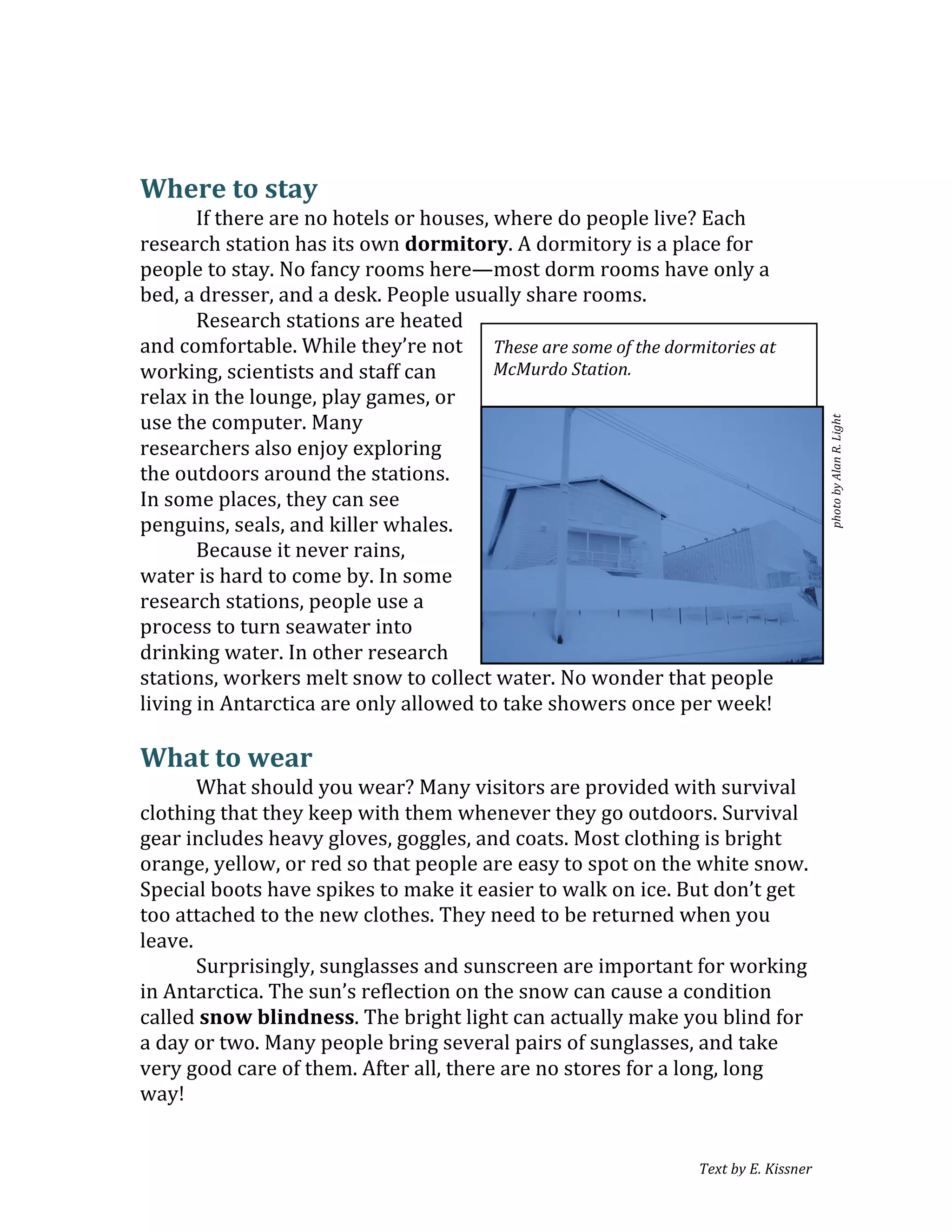
  dormitory.	
  A	
  dormitory	
  is	
  a	
  place	
  for	
  
people	
  to	
  stay.	
  No	
  fancy	
  rooms	
  here—most	
  dorm	
  rooms	
  have	
  only	
  a	
  
bed,	
  a	
  dresser,	
  and	
  a	
  desk.	
  People	
  usually	
  share	
  rooms.	
  
Research	
  stations	
  are	
  heated	
  
and	
  comfortable.	
  While	
  they’re	
  not	
  
working,	
  scientists	
  and	
  staff	
  can	
  
relax	
  in	
  the	
  lounge,	
  play	
  games,	
  or	
  
use	
  the	
  computer.	
  Many	
  
researchers	
  also	
  enjoy	
  exploring	
  
the	
  outdoors	
  around	
  the	
  stations.	
  
In	
  some	
  places,	
  they	
  can	
  see	
  
penguins,	
  seals,	
  and	
  killer	
  whales.	
  
Because	
  it	
  never	
  rains,	
  
water	
  is	
  hard	
  to	
  come	
  by.	
  In	
  some	
  
research	
  stations,	
  people	
  use	
  a	
  
process	
  to	
  turn	
  seawater	
  into	
  
drinking	
  water.	
  In	
  other	
  research	
  
stations,	
  workers	
  melt	
  snow	
  to	
  collect	
  water.	
  No	
  wonder	
  that	
  people	
  
living	
  in	
  Antarctica	
  are	
  only	
  allowed	
  to	
  take	
  showers	
  once	
  per	
  week!	


What	
  to	
  wear	
  
What	
  should	
  you	
  wear?	
  Many	
  visitors	
  are	
  provided	
  with	
  survival	
  
clothing	
  that	
  they	
  keep	
  with	
  them	
  whenever	
  they	
  go	
  outdoors.	
  Survival	
  
gear	
  includes	
  heavy	
  gloves,	
  goggles,	
  and	
  coats.	
  Most	
  clothing	
  is	
  bright	
  
orange,	
  yellow,	
  or	
  red	
  so	
  that	
  people	
  are	
  easy	
  to	
  spot	
  on	
  the	
  white	
  snow.	
  
Special	
  boots	
  have	
  spikes	
  to	
  make	
  it	
  easier	
  to	
  walk	
  on	
  ice.	
  But	
  don’t	
  get	
  
too	
  attached	
  to	
  the	
  new	
  clothes.	
  They	
  need	
  to	
  be	
  returned	
  when	
  you	
  
leave.	
  
Surprisingly,	
  sunglasses	
  and	
  sunscreen	
  are	
  important	
  for	
  working	
  
in	
  Antarctica.	
  The	
  sun’s	
  reflection	
  on	
  the	
  snow	
  can	
  cause	
  a	
  condition	
  
called	
  snow	
  blindness.	
  The	
  bright	
  light	
  can	
  actually	
  make	
  you	
  blind	
  for	
  
a	
  day	
  or	
  two.	
  Many	
  people	
  bring	
  several	
  pairs	
  of	
  sunglasses,	
  and	
  take	
  
very	
  good	
  care	
  of	
  them.	
  After	
  all,	
  there	
  are	
  no	
  stores	
  for	
  a	
  long,	
  long	
  
way!	
  
These	
  are	
  some	
  of	
  the	
  dormitories	
  at	
  
McMurdo	
  Station.	
  
photo	
  by	
  Alan	
  R.	
  Light	
  
Text	
  by	
  E.	
  Kissner	


What	
  to	
  do	
  
Researchers	
  in	
  Antarctica	
  are	
  there	
  to	
  study	
  many	
  subjects.	
  At	
  the	
  
coastal	
  research	
  stations,	
  scientists	
  are	
  learning	
  about	
  the	
  animals	
  of	
  
Antarctica,	
  such	
  as	
  penguins	
  
and	
  skuas.	
  Others	
  study	
  the	
  
ocean	
  to	
  learn	
  more	
  about	
  the	
  
odd	
  creatures	
  that	
  live	
  there.	
  
After	
  all,	
  where	
  else	
  can	
  you	
  
find	
  sea	
  spiders	
  and	
  
carnivorous	
  sponges?	
  
No	
  animals	
  live	
  at	
  the	
  
South	
  Pole,	
  far	
  away	
  from	
  the	
  
coast.	
  Scientists	
  there	
  study	
  
the	
  skies	
  instead.	
  Some	
  
research	
  our	
  atmosphere,	
  
while	
  others	
  use	
  powerful	
  
telescopes	
  to	
  study	
  the	
  sky.	
  
One	
  project,	
  called	
  Ice	
  Cube,	
  
uses	
  the	
  ice	
  of	
  Antarctica	
  to	
  
help	
  observe	
  tiny	
  particles	
  
called	
  neutrinos.	
  
At	
  all	
  of	
  the	
  research	
  stations,	
  scientists	
  are	
  monitoring	
  global	
  
temperatures.	
  Antarctica	
  seems	
  to	
  be	
  rapidly	
  warming	
  up.	
  By	
  watching	
  
the	
  skies	
  around	
  Antarctica,	
  scientists	
  can	
  learn	
  more	
  about	
  climate	
  
change.	


A	
  trip	
  to	
  Antarctica	
  can	
  be	
  difficult	
  and	
  cold.	
  For	
  the	
  scientists	
  and	
  
workers	
  who	
  have	
  been	
  there,	
  however,	
  Antarctica	
  is	
  an	
  amazing	
  place.	


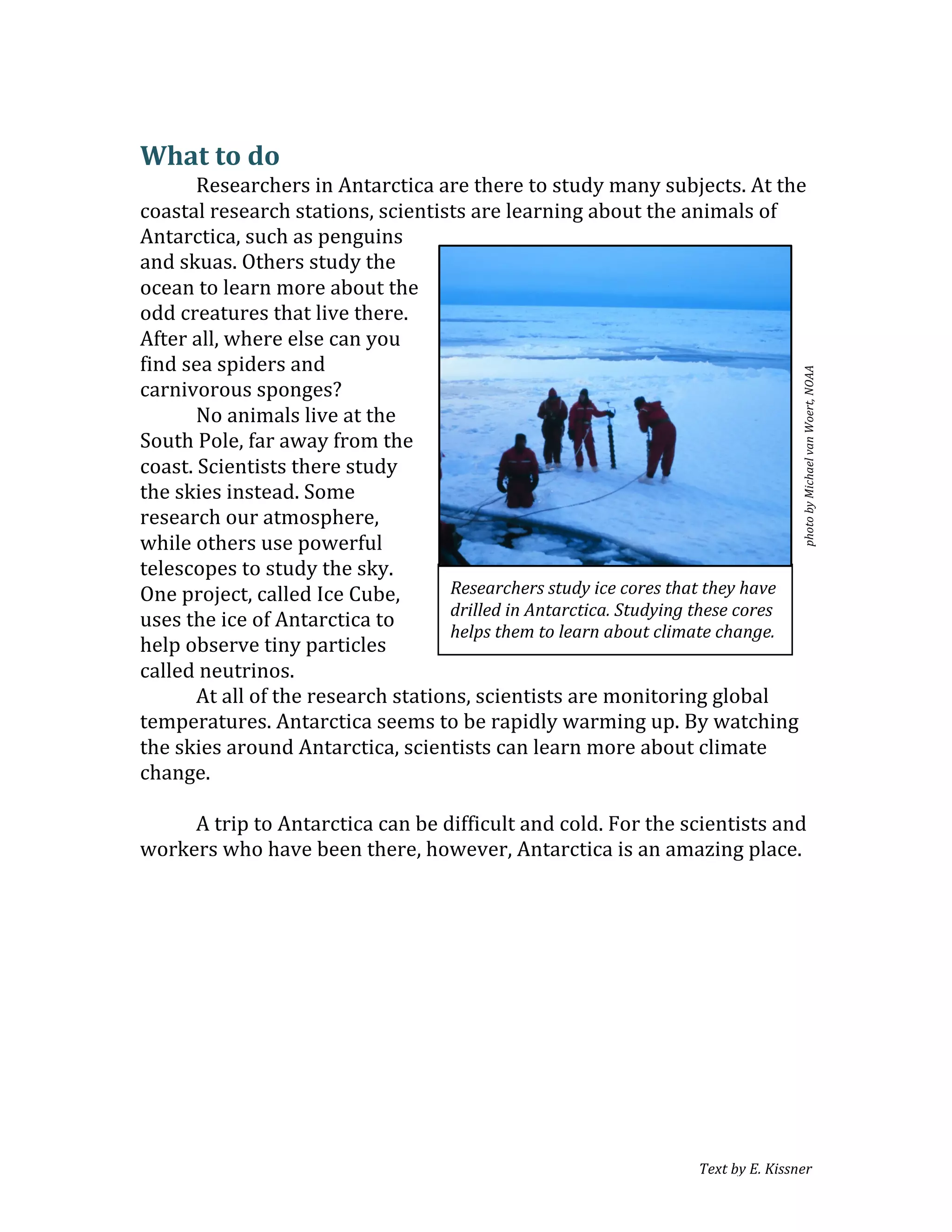
Researchers	
  study	
  ice	
  cores	
  that	
  they	
  have	
  
drilled	
  in	
  Antarctica.	
  Studying	
  these	
  cores	
  
helps	
  them	
  to	
  learn	
  about	
  climate	
  change.	
  
photo	
  by	
  Michael	
  van	
  Woert,	
  NOAA	
  	
  
Text	
  by	
  E.	
  Kissner	
  
More	
  informational	
  texts	
  by	
  Emily	
  Kissner	


I	
  write	
  low-­‐cost,	
  high-­‐interest	
  texts	
  for	
  classroom	
  use.	
  Here	
  are	
  some	
  
other	
  collections	
  of	
  my	
  work:	


Main	
  Ideas	
  and	
  Details	
  in	
  Nonfiction	
  Text	


Cause	
  and	
  Effect	
  Texts	
  for	
  Teaching	
  Text	
  Structure	


Description	
  Texts	
  for	
  Teaching	
  Text	
  Structure	


Compare	
  and	
  Contrast	
  Texts	
  for	
  Teaching	
  Text	
  Structure	


Problem	
  and	
  Solution	
  Texts	
  for	
  Teaching	
  Text	
  Structure	


Chronological	
  Order	
  Texts	
  for	
  Teaching	
  Text	
  Structure	


Reading	
  Intervention	


Emily’s	
  page	
  on	
  Frolyc	


Welcome to Antarctica: Informational Text

  • 1.
    Text  by  E.  Kissner     Have  you  ever  wanted  to  go  to  Antarctica?  It’s  not  an  easy  trip.   Antarctica  is  the  coldest,  windiest  place  on  earth.  But  for  the  brave   people  who  go  there  each  year,  it  is  a  destination  like  no  other.  What  is   it  like  to  go  to  this  cold  and  icy  continent?     Getting  to  Antarctica   First  of  all,  don’t  expect   a  hotel  or  a  theme  park.  No   one  really  lives  in  Antarctica.   Many  countries  have  research   stations  there,  but  the   scientists  and  the  staff   members  spend  only  a  few   months  at  a  time  on  the   frozen  land.  So  there  are  few   tourist  attractions  besides   penguins,  researchers,  and   lots  and  lots  of  ice.     One  way  to  get  to   Antarctica  is  by  boat.  The   Southern  Ocean  is  rough  and   choppy,  and  many  people  get  seasick.  The  waters  around  Antarctica  are   filled  with  ice,  which  means  that  a  ship  has  to  be  very  strong!  The   voyage  by  sea  may  take  as  long  as  one  week.   People  have  traveled  around  Antarctica  by  airplane  since  1929.   Some  planes  have  skis  on  the  bottom  so  that  they  can  land  on  the  ice.  In   2008,  the  country  of  Australia  built  an  airport  in  Antarctica.  This  makes   travel  much  easier  for  scientists  and  researchers!  But  this  airport  is   open  for  only  a  few  months  each  year—October  through  May,   Antarctica’s  warmest  months.  And  it’s  only  open  to  scientists  and  other   staff.     Which  means  that  one  of  the  best  ways  to  get  to  Antarctica  is  to   get  a  job  there!  Many  scientists  work  at  research  stations  across  the   continent.  But  there  are  other  jobs  too.  Cooks,  doctors,  mechanics,  and   plumbers  are  all  needed.  And  a  few  artists,  writers,  and  photographers   are  invited  each  year  as  well.   Ships  that  go  to  Antarctica  need  to  have   strong  hulls.  This  ship,  the  Nathaniel  B.   Palmer,  is  an  ice-­‐breaking  vessel.  It  can   actually  break  the  ice  as  it  moves  through   the  ocean  around  Antarctica!   NOAA  photo   Welcome to Antarctica
  • 2.
    Text  by  E.  Kissner       Where  to  stay   If  there  are  no  hotels  or  houses,  where  do  people  live?  Each   research  station  has  its  own  dormitory.  A  dormitory  is  a  place  for   people  to  stay.  No  fancy  rooms  here—most  dorm  rooms  have  only  a   bed,  a  dresser,  and  a  desk.  People  usually  share  rooms.   Research  stations  are  heated   and  comfortable.  While  they’re  not   working,  scientists  and  staff  can   relax  in  the  lounge,  play  games,  or   use  the  computer.  Many   researchers  also  enjoy  exploring   the  outdoors  around  the  stations.   In  some  places,  they  can  see   penguins,  seals,  and  killer  whales.   Because  it  never  rains,   water  is  hard  to  come  by.  In  some   research  stations,  people  use  a   process  to  turn  seawater  into   drinking  water.  In  other  research   stations,  workers  melt  snow  to  collect  water.  No  wonder  that  people   living  in  Antarctica  are  only  allowed  to  take  showers  once  per  week!     What  to  wear   What  should  you  wear?  Many  visitors  are  provided  with  survival   clothing  that  they  keep  with  them  whenever  they  go  outdoors.  Survival   gear  includes  heavy  gloves,  goggles,  and  coats.  Most  clothing  is  bright   orange,  yellow,  or  red  so  that  people  are  easy  to  spot  on  the  white  snow.   Special  boots  have  spikes  to  make  it  easier  to  walk  on  ice.  But  don’t  get   too  attached  to  the  new  clothes.  They  need  to  be  returned  when  you   leave.   Surprisingly,  sunglasses  and  sunscreen  are  important  for  working   in  Antarctica.  The  sun’s  reflection  on  the  snow  can  cause  a  condition   called  snow  blindness.  The  bright  light  can  actually  make  you  blind  for   a  day  or  two.  Many  people  bring  several  pairs  of  sunglasses,  and  take   very  good  care  of  them.  After  all,  there  are  no  stores  for  a  long,  long   way!   These  are  some  of  the  dormitories  at   McMurdo  Station.   photo  by  Alan  R.  Light  
  • 3.
    Text  by  E.  Kissner     What  to  do   Researchers  in  Antarctica  are  there  to  study  many  subjects.  At  the   coastal  research  stations,  scientists  are  learning  about  the  animals  of   Antarctica,  such  as  penguins   and  skuas.  Others  study  the   ocean  to  learn  more  about  the   odd  creatures  that  live  there.   After  all,  where  else  can  you   find  sea  spiders  and   carnivorous  sponges?   No  animals  live  at  the   South  Pole,  far  away  from  the   coast.  Scientists  there  study   the  skies  instead.  Some   research  our  atmosphere,   while  others  use  powerful   telescopes  to  study  the  sky.   One  project,  called  Ice  Cube,   uses  the  ice  of  Antarctica  to   help  observe  tiny  particles   called  neutrinos.   At  all  of  the  research  stations,  scientists  are  monitoring  global   temperatures.  Antarctica  seems  to  be  rapidly  warming  up.  By  watching   the  skies  around  Antarctica,  scientists  can  learn  more  about  climate   change.     A  trip  to  Antarctica  can  be  difficult  and  cold.  For  the  scientists  and   workers  who  have  been  there,  however,  Antarctica  is  an  amazing  place.     Researchers  study  ice  cores  that  they  have   drilled  in  Antarctica.  Studying  these  cores   helps  them  to  learn  about  climate  change.   photo  by  Michael  van  Woert,  NOAA    
  • 4.
    Text  by  E.  Kissner   More  informational  texts  by  Emily  Kissner     I  write  low-­‐cost,  high-­‐interest  texts  for  classroom  use.  Here  are  some   other  collections  of  my  work:     Main  Ideas  and  Details  in  Nonfiction  Text     Cause  and  Effect  Texts  for  Teaching  Text  Structure     Description  Texts  for  Teaching  Text  Structure     Compare  and  Contrast  Texts  for  Teaching  Text  Structure     Problem  and  Solution  Texts  for  Teaching  Text  Structure     Chronological  Order  Texts  for  Teaching  Text  Structure     Reading  Intervention       Emily’s  page  on  Frolyc