Principle of closed fracture
management
By: Ekhlass Ramadan
Norshan Jamal
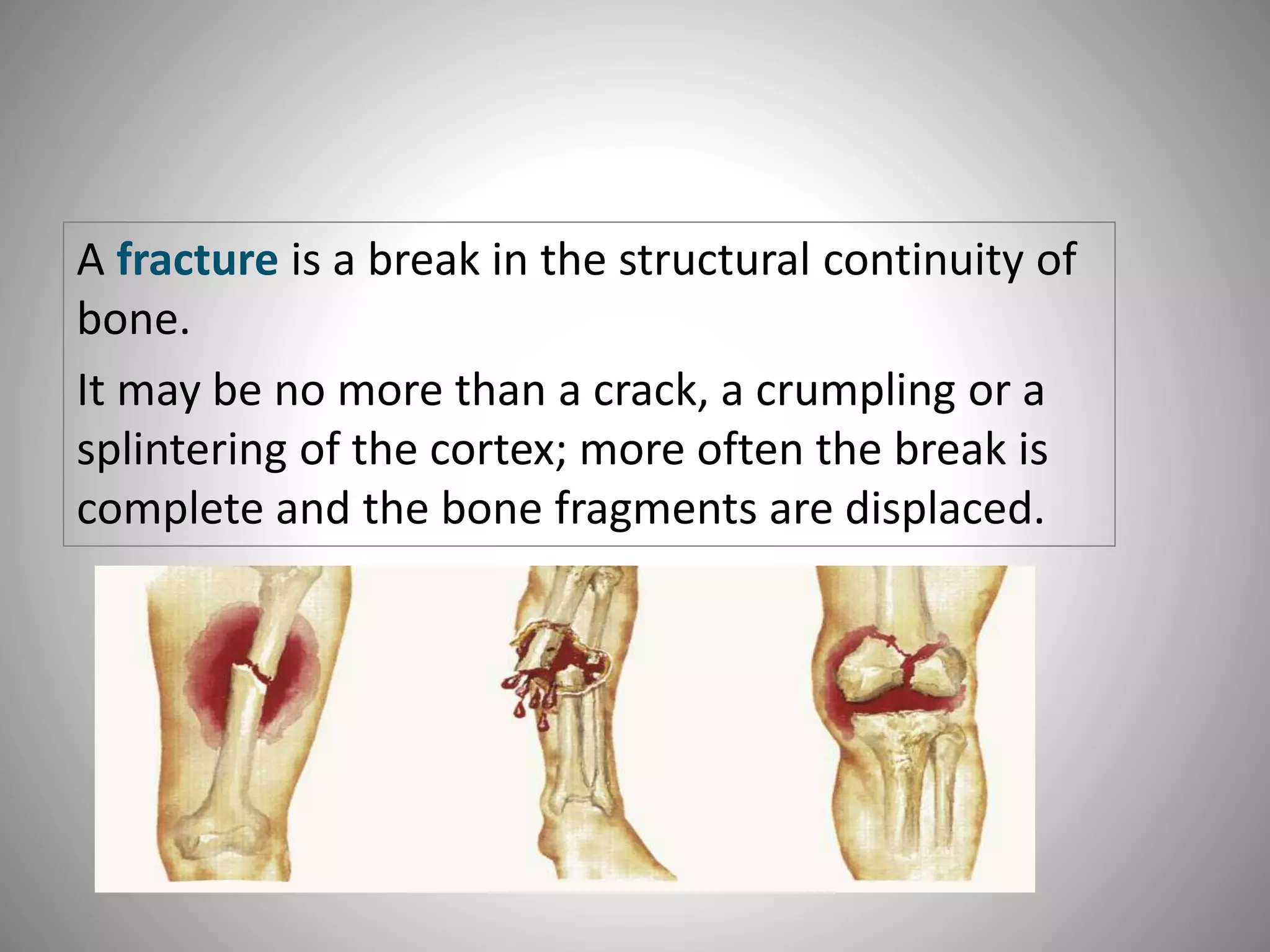
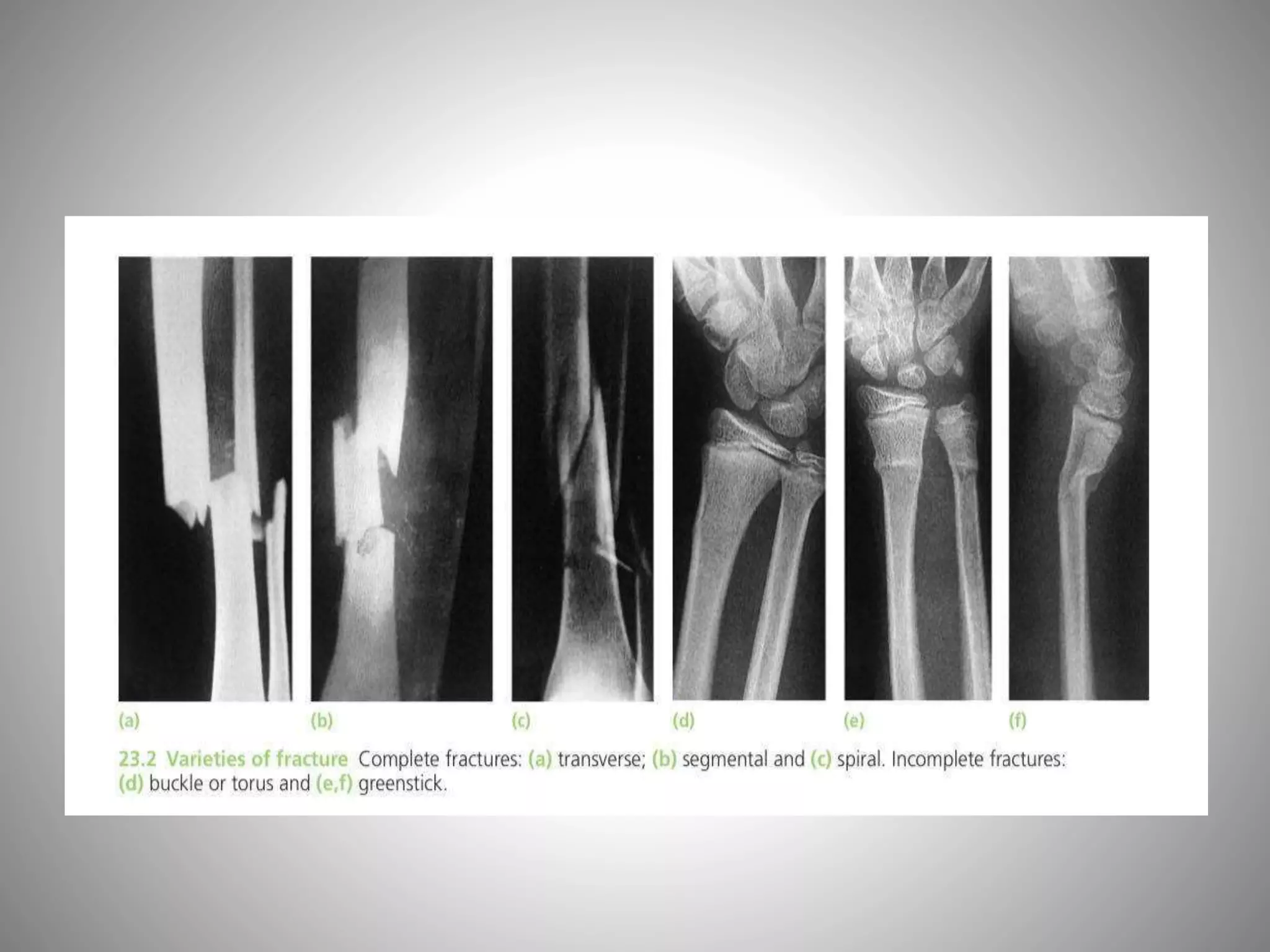
A fracture is a break in the structural continuity of
bone.
It may be no more than a crack, a crumpling or a
splintering of the cortex; more often the break is
complete and the bone fragments are displaced.
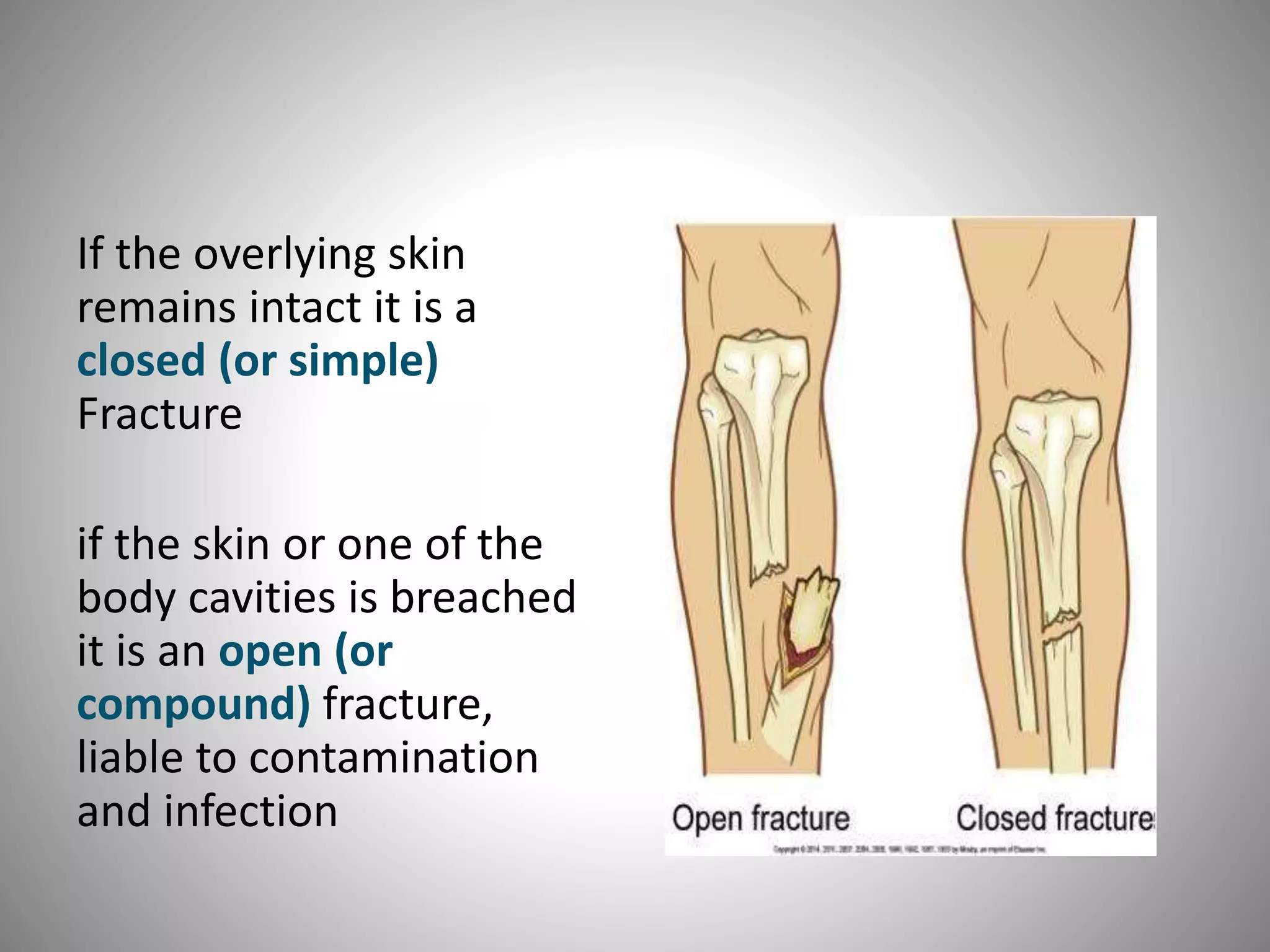
If the overlying skin
remains intact it is a
closed (or simple)
Fracture
if the skin or one of the
body cavities is breached
it is an open (or
compound) fracture,
liable to contamination
and infection
Diagnosis of fracture
1.History taking
2.Physical examination (general and local signs)
3.Investigations
Remember the role of two ))a.Xray
b.MRI
c.CT scan
d.Radioisotope scanning
Treatment of a fracture can be
considered in three phases
Phase I - Emergency care
Phase II - Definitive care
Phase III - Rehabilitation
Management of closed fracture
General treatment is the first
consideration:
treat the patient, not only the fracture
general treatment and resuscitation must
always take precedence
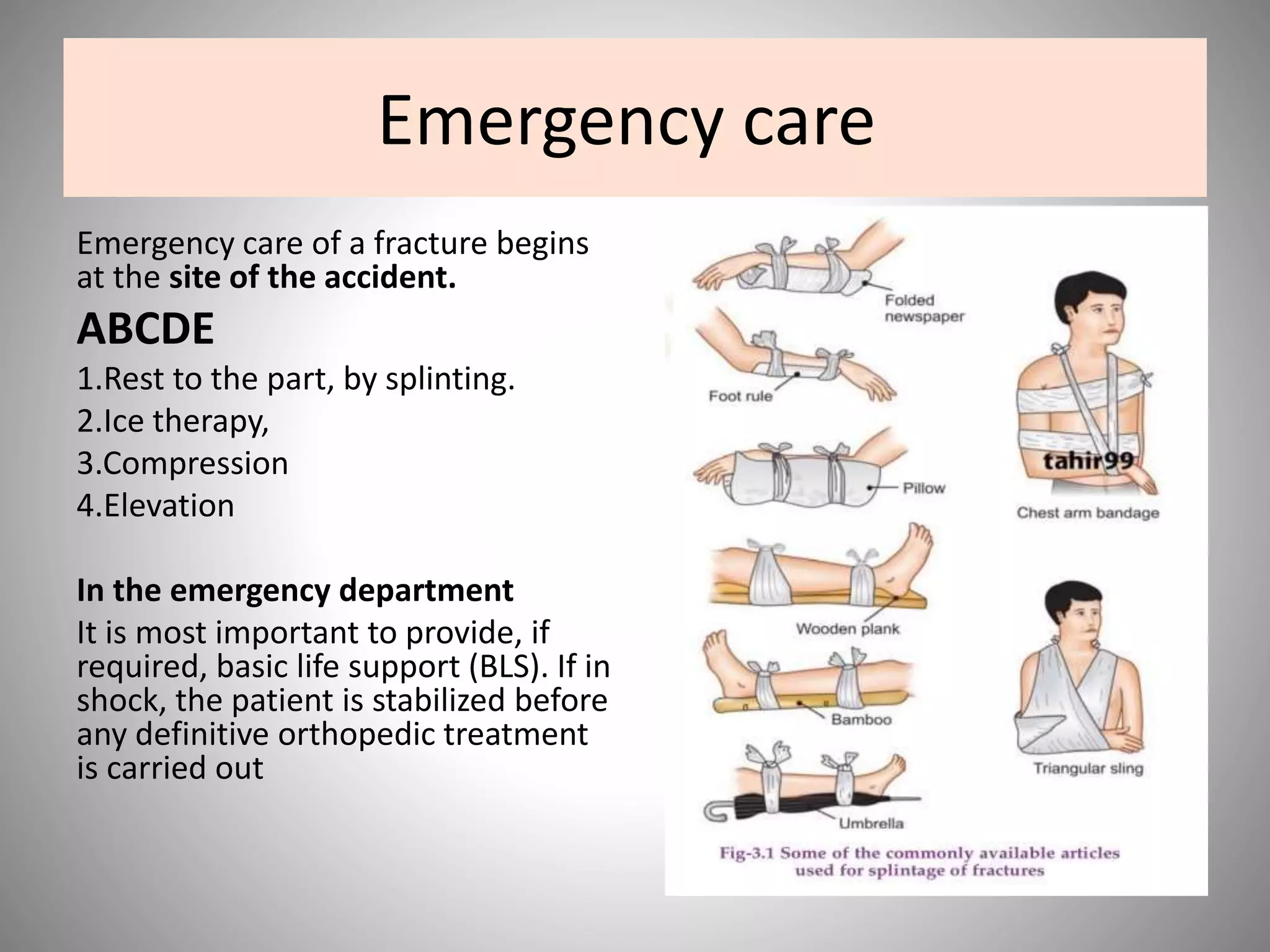
Emergency care
Emergency care of a fracture begins
at the site of the accident.
ABCDE
1.Rest to the part, by splinting.
2.Ice therapy,
3.Compression
4.Elevation
In the emergency department
It is most important to provide, if
required, basic life support (BLS). If in
shock, the patient is stabilized before
any definitive orthopedic treatment
is carried out
in addition to splintage, the patient should be
made comfortable by giving him intramuscular
analgesics.
It is only after the emergency care has been
given, and it is ensured that the patient is stable.
He should be sent for suitable radiological and
other investigation under supervision
Definitive care
Reduce Fracture reduction and fixation to restore
anatomical relationships
Preservation of blood supply to soft tissue and
bone by careful handling and gentle reduction
techniques
Hold important to maintain the bone in reduced
position
Exercise Early and safe mobilization of the part and
patient.
Reduction
swelling of the soft parts during the first 12
hours makes reduction increasingly difficult.
However, there are some situations in which
reduction is unnecessary:
1. when there is little or no displacement;
2. when displacement does not matter initially
(e.g. in fractures of the clavicle)
3. when reduction is unlikely to succeed (e.g.
with compression fractures of the vertebrae)
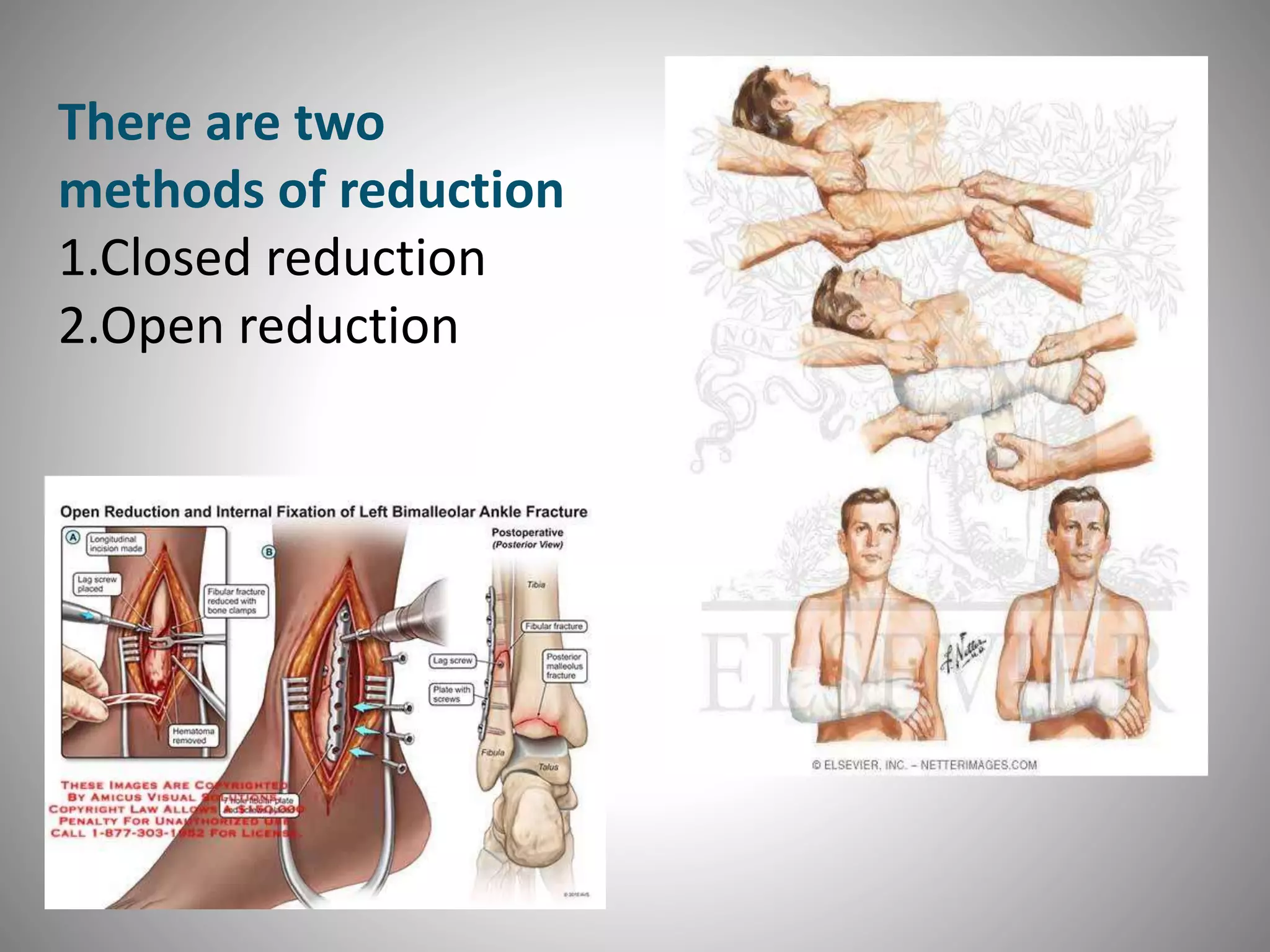
There are two
methods of reduction
1.Closed reduction
2.Open reduction
Closed reduction
In general, closed reduction is used for all minimally
displaced fractures, for most fractures in
children
for fractures that are not unstable after reduction
and can be held in some form of splint or cast.
Unstable fractures can also be reduced using closed
methods prior to stabilization with internal or
external fixation.
HOLD
The available methods of holding reduction are:
• Continuous traction
• Cast splintage
• Functional bracing
• Internal fixation
• External fixation
Continuous traction
1.Traction by gravity
2 .Skin traction
3 .Skeletal traction
Fixed traction
Balanced traction
Complication of traction
1.Circulatory embarrassment In children
especially, should never be used for children
over 12 kg in weight.
2.Nerve injury In older people, leg traction may
predispose to peroneal nerve injury and cause a
drop- foot
3.Pin site infection Pin sites must be kept clean
and should be checked daily
Cast splintage
Plaster of Paris is still
widely used as a splint,
especially for distal limb
fractures and for most
children’s fractures.
Complications of cast
1.Tight cast
2.pressure sore
3.skin abrasion and laceration
4.loose cast
Functional bracing
Segments of a cast are applied
only over the shafts of the bones,
leaving the joints free;
The splints are ‘functional’ in that
joint movements are much less
restricted than with conventional
casts.
Functional bracing is used most
widely for fractures of the femur
or tibia, but since the brace is not
very rigid, it is usually applied
only when the fracture is
beginning to unite, i.e. after 3–6
weeks of traction or conventional
plaster.
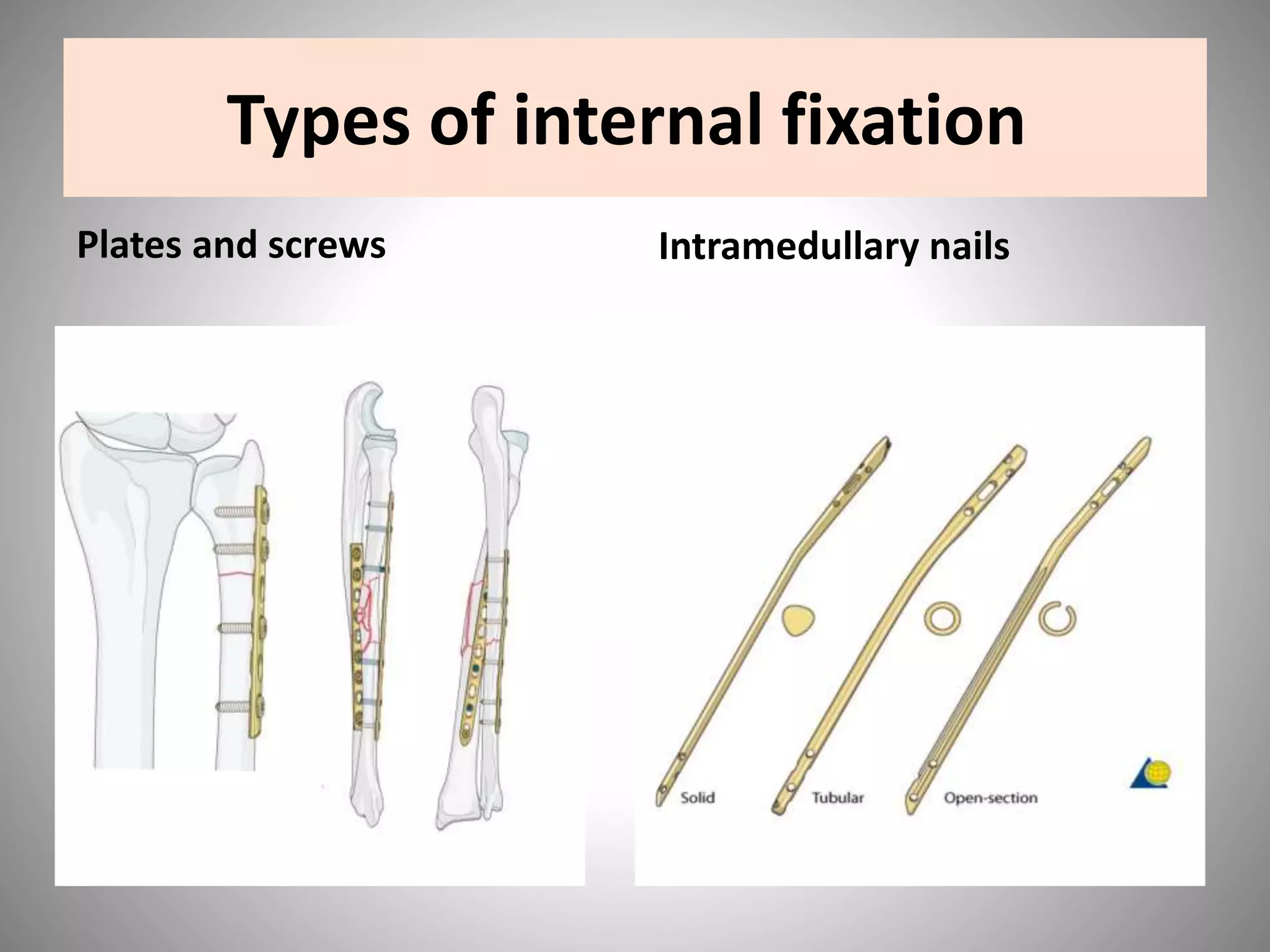
Internal fixation
Bone fragments may be
fixed with screws, a metal
plate held by screws, a
long intramedullary rod or
nail (with or without
locking screws),
circumferential bands or a
combination of these
methods.
Properly applied, internal
fixation holds a fracture
Indications
1. Fractures that cannot be reduced except by
operation.
2. Fractures that are inherently unstable and
prone to re-displace after reduction (e.g. mid-
shaft fractures of the forearm and some
displaced ankle
fractures).
3. Fractures that unite poorly and slowly,
principally fractures of the femoral neck.
4. Pathological fractures
5. Multiple fractures where early fixation (by
either internal or external fixation) reduces the
risk of general complications and late
multisystem organ failure.
6. Fractures in patients who present nursing
difficulties (paraplegics, those with multiple
injuries and the very elderly)
Types of internal fixation
Intrafragmentary screw Wires (transfixing, cerclage and
tension-band
Types of internal fixation
Plates and screws Intramedullary nails
Complications of internal fixation
1.infection
2.non union
3.implant failure
4.refracture
External fixation
A fracture may be held by
transfixing screws or
tensioned wires that pass
through the bone above and
below the fracture and are
attached to an external
frame.
This is especially applicable
to the tibia and pelvis, but
the method is also used for
fractures of the femur,
humerus, lower radius and
even bones of the hand
Indications
1. Fractures associated with severe soft-tissue damage
(including open fractures) or those that are contaminated
2. Fractures around joints that are potentially suitable for
internal fixation but the soft tissues are too swollen to

allow safe surgery
3. Patients with severe multiple injuries, especially if
there are bilateral femoral fractures, pelvic fractures with
severe bleeding.
4. Ununited fractures, which can be excised and
compressed
5. Infected fractures
Complications
1.Damage to soft-tissue structures
2.Overdistraction If there is no contact between
the fragments, union is unlikely.
3.Pin-track infection This is less likely with good
operative technique. Nevertheless, meticulous
pin-site care is essential
Exercise
More correctly, restore function – not only to the injured
parts but also to the patient as a whole.
The objectives are to reduce oedema,
preserve joint movement,
restore muscle power
and guide the patient back to normal activity
By :Prevention of oedema
Elevation
active exercise
assisted movement
functional activity
References
Apley’s System of Orthopedics and
Fracture
Essential orthopedics
management of closed fracture

management of closed fracture

  • 1.
    Principle of closedfracture management By: Ekhlass Ramadan Norshan Jamal
  • 2.
    A fracture isa break in the structural continuity of bone. It may be no more than a crack, a crumpling or a splintering of the cortex; more often the break is complete and the bone fragments are displaced.
  • 3.
    If the overlyingskin remains intact it is a closed (or simple) Fracture if the skin or one of the body cavities is breached it is an open (or compound) fracture, liable to contamination and infection
  • 4.
    Diagnosis of fracture 1.Historytaking 2.Physical examination (general and local signs) 3.Investigations Remember the role of two ))a.Xray b.MRI c.CT scan d.Radioisotope scanning
  • 6.
    Treatment of afracture can be considered in three phases Phase I - Emergency care Phase II - Definitive care Phase III - Rehabilitation
  • 7.
    Management of closedfracture General treatment is the first consideration: treat the patient, not only the fracture general treatment and resuscitation must always take precedence
  • 8.
    Emergency care Emergency careof a fracture begins at the site of the accident. ABCDE 1.Rest to the part, by splinting. 2.Ice therapy, 3.Compression 4.Elevation In the emergency department It is most important to provide, if required, basic life support (BLS). If in shock, the patient is stabilized before any definitive orthopedic treatment is carried out
  • 9.
    in addition tosplintage, the patient should be made comfortable by giving him intramuscular analgesics. It is only after the emergency care has been given, and it is ensured that the patient is stable. He should be sent for suitable radiological and other investigation under supervision
  • 10.
    Definitive care Reduce Fracturereduction and fixation to restore anatomical relationships Preservation of blood supply to soft tissue and bone by careful handling and gentle reduction techniques Hold important to maintain the bone in reduced position Exercise Early and safe mobilization of the part and patient.
  • 11.
    Reduction swelling of thesoft parts during the first 12 hours makes reduction increasingly difficult.
  • 12.
    However, there aresome situations in which reduction is unnecessary: 1. when there is little or no displacement; 2. when displacement does not matter initially (e.g. in fractures of the clavicle) 3. when reduction is unlikely to succeed (e.g. with compression fractures of the vertebrae)
  • 13.
    There are two methodsof reduction 1.Closed reduction 2.Open reduction
  • 14.
    Closed reduction In general,closed reduction is used for all minimally displaced fractures, for most fractures in children for fractures that are not unstable after reduction and can be held in some form of splint or cast. Unstable fractures can also be reduced using closed methods prior to stabilization with internal or external fixation.
  • 16.
    HOLD The available methodsof holding reduction are: • Continuous traction • Cast splintage • Functional bracing • Internal fixation • External fixation
  • 17.
    Continuous traction 1.Traction bygravity 2 .Skin traction 3 .Skeletal traction Fixed traction Balanced traction
  • 19.
    Complication of traction 1.Circulatoryembarrassment In children especially, should never be used for children over 12 kg in weight. 2.Nerve injury In older people, leg traction may predispose to peroneal nerve injury and cause a drop- foot 3.Pin site infection Pin sites must be kept clean and should be checked daily
  • 20.
    Cast splintage Plaster ofParis is still widely used as a splint, especially for distal limb fractures and for most children’s fractures.
  • 22.
    Complications of cast 1.Tightcast 2.pressure sore 3.skin abrasion and laceration 4.loose cast
  • 23.
    Functional bracing Segments ofa cast are applied only over the shafts of the bones, leaving the joints free; The splints are ‘functional’ in that joint movements are much less restricted than with conventional casts. Functional bracing is used most widely for fractures of the femur or tibia, but since the brace is not very rigid, it is usually applied only when the fracture is beginning to unite, i.e. after 3–6 weeks of traction or conventional plaster.
  • 24.
    Internal fixation Bone fragmentsmay be fixed with screws, a metal plate held by screws, a long intramedullary rod or nail (with or without locking screws), circumferential bands or a combination of these methods. Properly applied, internal fixation holds a fracture
  • 25.
    Indications 1. Fractures thatcannot be reduced except by operation. 2. Fractures that are inherently unstable and prone to re-displace after reduction (e.g. mid- shaft fractures of the forearm and some displaced ankle fractures). 3. Fractures that unite poorly and slowly, principally fractures of the femoral neck.
  • 26.
    4. Pathological fractures 5.Multiple fractures where early fixation (by either internal or external fixation) reduces the risk of general complications and late multisystem organ failure. 6. Fractures in patients who present nursing difficulties (paraplegics, those with multiple injuries and the very elderly)
  • 27.
    Types of internalfixation Intrafragmentary screw Wires (transfixing, cerclage and tension-band
  • 28.
    Types of internalfixation Plates and screws Intramedullary nails
  • 29.
    Complications of internalfixation 1.infection 2.non union 3.implant failure 4.refracture
  • 30.
    External fixation A fracturemay be held by transfixing screws or tensioned wires that pass through the bone above and below the fracture and are attached to an external frame. This is especially applicable to the tibia and pelvis, but the method is also used for fractures of the femur, humerus, lower radius and even bones of the hand
  • 31.
    Indications 1. Fractures associatedwith severe soft-tissue damage (including open fractures) or those that are contaminated 2. Fractures around joints that are potentially suitable for internal fixation but the soft tissues are too swollen to allow safe surgery 3. Patients with severe multiple injuries, especially if there are bilateral femoral fractures, pelvic fractures with severe bleeding. 4. Ununited fractures, which can be excised and compressed 5. Infected fractures
  • 32.
    Complications 1.Damage to soft-tissuestructures 2.Overdistraction If there is no contact between the fragments, union is unlikely. 3.Pin-track infection This is less likely with good operative technique. Nevertheless, meticulous pin-site care is essential
  • 33.
    Exercise More correctly, restorefunction – not only to the injured parts but also to the patient as a whole. The objectives are to reduce oedema, preserve joint movement, restore muscle power and guide the patient back to normal activity By :Prevention of oedema Elevation active exercise assisted movement functional activity
  • 34.
    References Apley’s System ofOrthopedics and Fracture Essential orthopedics