Biochemistry of saliva Objectives Describe the composition of saliva  Mention its functions Dr/ Ragaa Salama
Clinical Highlights Understanding of salivary mechanisms prerequisite for  effective treatment of salivary gland dysfunctions modulation of bacterial colonization development of artificial saliva Dr/ Ragaa Salama
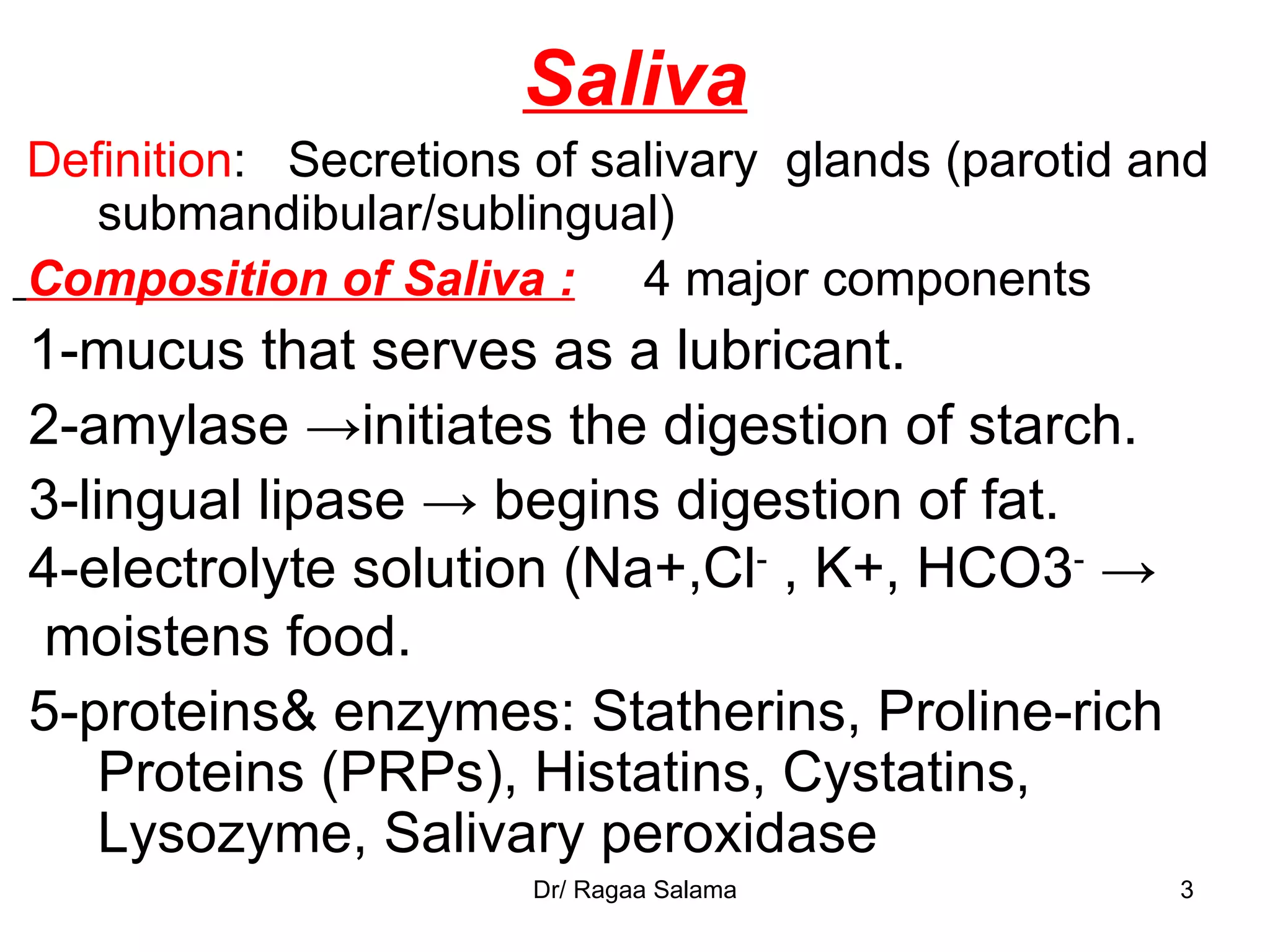
Saliva Definition :  Secretions of  salivary  glands  (parotid and submandibular/sublingual) Composition of Saliva :   4 major components 1-mucus that serves as a lubricant.  2-amylase ->initiates the digestion of starch.  3-lingual lipase -> begins digestion of fat.  4-electrolyte solution (Na+,Cl -  , K+, HCO3 -  ->  moistens food. 5-proteins& enzymes: Statherins, Proline-rich Proteins (PRPs), Histatins, Cystatins, Lysozyme, Salivary peroxidase  Dr/ Ragaa Salama
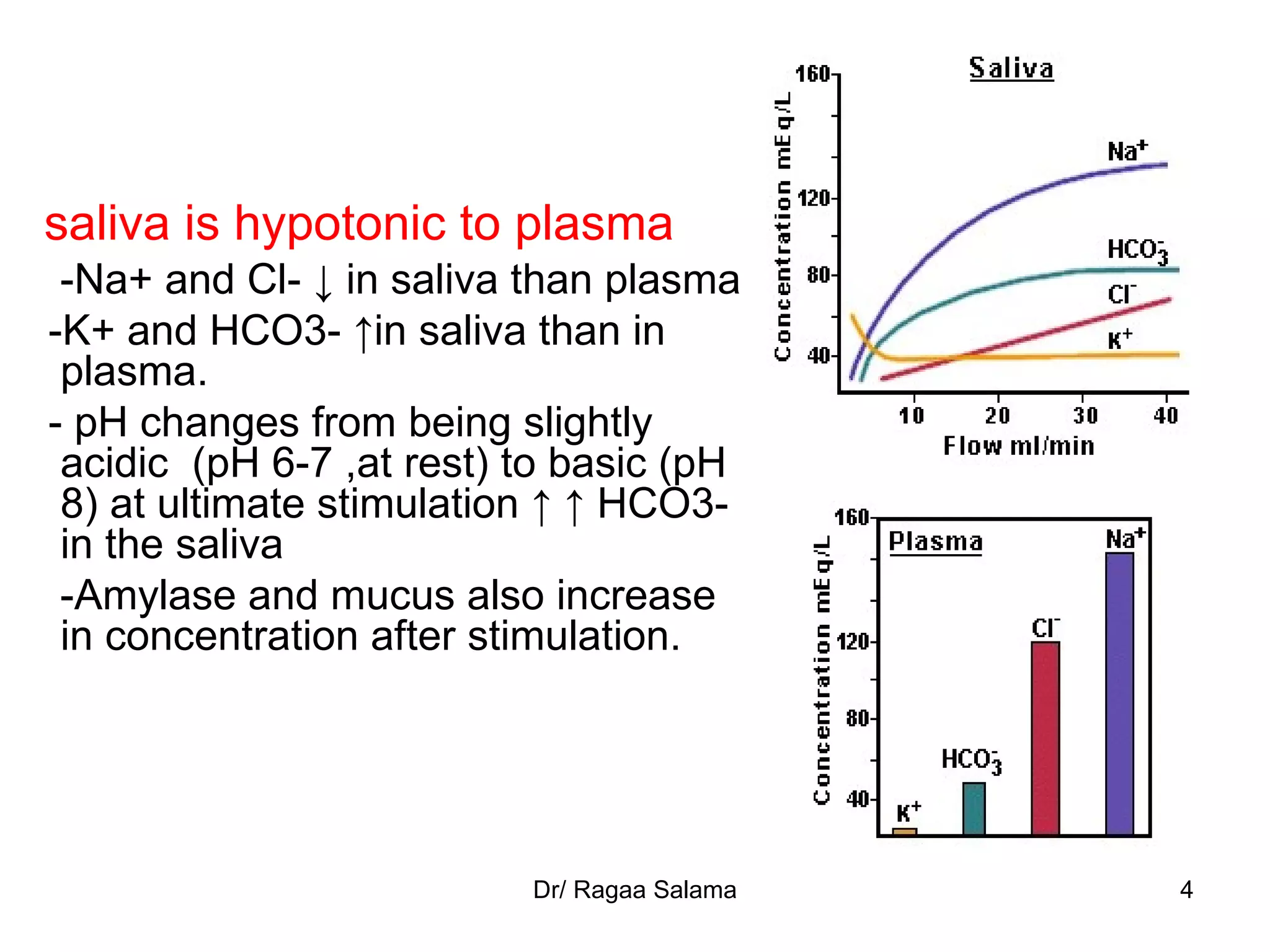
saliva is hypotonic to plasma -Na+ and Cl- ↓ in saliva than plasma -K+ and HCO3- ↑in saliva than in plasma.  - pH changes from being slightly acidic  (pH 6-7 ,at rest) to basic (pH 8) at ultimate stimulation ↑ ↑ HCO3- in the saliva -Amylase and mucus also increase in concentration after stimulation.  Dr/ Ragaa Salama
functions of saliva Dr/ Ragaa Salama Salivary Families Anti- Bacterial Buffering Digestion Mineral- ization Lubricat- ion &Visco- elasticity Tissue Coating Anti- Fungal Anti- Viral Carbonic anhydrases, Histatins Amylases, Mucins, Lipase Cystatins, Histatins, Proline- rich proteins, Statherins Mucins, Statherins Amylases, Cystatins, Mucins,  Proline-rich proteins, Statherins Histatins Cystatins, Mucins Amylases, Cystatins, Histatins, Mucins, Peroxidases
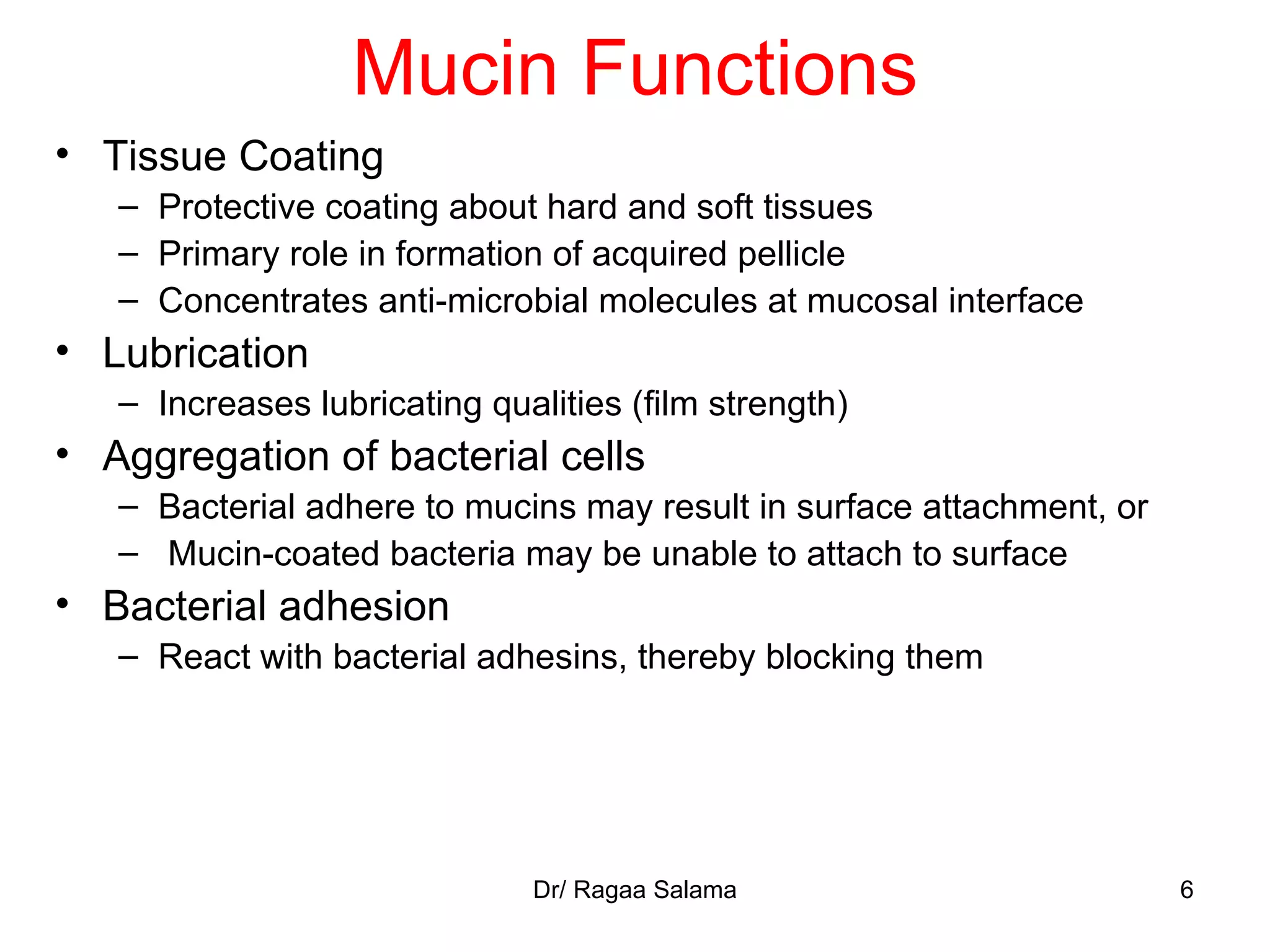
Mucin Functions Tissue Coating Protective coating about hard and soft tissues Primary role in formation of acquired pellicle Concentrates anti-microbial molecules at mucosal interface Lubrication Increases lubricating qualities (film strength) Aggregation of bacterial cells Bacterial adhere to mucins may result in surface attachment, or Mucin-coated bacteria may be unable to attach to surface Bacterial adhesion React with bacterial adhesins, thereby blocking them Dr/ Ragaa Salama
Amylases digestive function Hydrolyzes starches -> amylose ,amylopectin,Maltose ,glucose, in tears, serum, bronchial, and male and female urogenital secretions role in modulating bacterial adherence Dr/ Ragaa Salama
Lingual Lipase Secreted by von Ebner’s glands of tongue Involved in first phase of fat digestion Hydrolyzes medium- to long-chain triglycerides Important in digestion of milk fat in new-born highly hydrophobic enters fat globules Dr/ Ragaa Salama
Statherins Produced by acinar cells in salivary glands Statherins prevent precipitation or crystallization of supersaturated calcium phosphate in ductal saliva and oral fluid Lubricant. Dr/ Ragaa Salama
Proline-rich Proteins (PRPs) Inhibitors of calcium phosphate crystal growth Present in the initially formed enamel pellicle and in “mature” pellicles Acquired enamel pellicle is 0.1-1.0 µm thick layer of macromolecular material on the dental mineral surface Dr/ Ragaa Salama
Histatins A group of small histidine-rich proteins Potent inhibitors of  Candida albicans  growth Dr/ Ragaa Salama Cystatins Are inhibitors of cysteine-proteases protective against unwanted proteolysis  (bacterial proteases, lysed leukocytes) inhibit proteases in periodontal tissues effect on calcium phosphate precipitation
Lysozyme  (  LZ ) Present in numerous organs and most body fluids Oral LZ is derived from at least four sources major and minor salivary glands, phagocytic cells and gingival crevicular fluid (GCF) Biological function anti-microbial activity by: Inhibition of bacterial adhesion to tooth surfaces Inhibition of glucose uptake and acid production Muramidase activity (lysis of peptidoglycan layer) Dr/ Ragaa Salama
Salivary peroxidase systems Sialoperoxidase (SP, salivary peroxidase) Readily adsorbed to various surfaces of mouth enamel, salivary sediment, bacteria, dental plaque Myeloperoxidase (MP) From leukocytes entering via gingival crevice 15-20% of total peroxidase in whole saliva Dr/ Ragaa Salama
Regulation of oral microorganisms by SP/MP Dr/ Ragaa Salama Food Ingestion carbohydrates Stimulation Metabolism H + Recovery O 2 thiols Inhibition Salivary Glands SCN -  + H 2 O 2 OSCN - /HOSCN Autoinhibition spontaneous +SP Unstimulated bacteria Inhibited bacteria Active bacteria
Other anti-microbial activities of LZ Muramidase activity (lysis of peptidoglycan layer) Cationic-dependent activation of bacterial autolysins Aggregation of bacteria Inhibition of bacterial adhesion to tooth surfaces Inhibition of glucose uptake and acid production Dr/ Ragaa Salama
Anti-microbial activities of saliva Dr/ Ragaa Salama
thiocyanate ions  and another is several  proteolytic enzymes— most important, lysozyme— that (a) attack the bacteria, (b) aid the thiocyanate ions in entering the bacteria where these ions in turn become bactericidal, and (c) digest food particles, thus helping further to remove the bacterial metabolic support. protein antibodies that can destroy oral bacteria Dr/ Ragaa Salama

Composition Of Saliva 2010

  • 1.
    Biochemistry of salivaObjectives Describe the composition of saliva Mention its functions Dr/ Ragaa Salama
  • 2.
    Clinical Highlights Understandingof salivary mechanisms prerequisite for effective treatment of salivary gland dysfunctions modulation of bacterial colonization development of artificial saliva Dr/ Ragaa Salama
  • 3.
    Saliva Definition : Secretions of salivary glands (parotid and submandibular/sublingual) Composition of Saliva : 4 major components 1-mucus that serves as a lubricant. 2-amylase ->initiates the digestion of starch. 3-lingual lipase -> begins digestion of fat. 4-electrolyte solution (Na+,Cl - , K+, HCO3 - -> moistens food. 5-proteins& enzymes: Statherins, Proline-rich Proteins (PRPs), Histatins, Cystatins, Lysozyme, Salivary peroxidase Dr/ Ragaa Salama
  • 4.
    saliva is hypotonicto plasma -Na+ and Cl- ↓ in saliva than plasma -K+ and HCO3- ↑in saliva than in plasma. - pH changes from being slightly acidic (pH 6-7 ,at rest) to basic (pH 8) at ultimate stimulation ↑ ↑ HCO3- in the saliva -Amylase and mucus also increase in concentration after stimulation. Dr/ Ragaa Salama
  • 5.
    functions of salivaDr/ Ragaa Salama Salivary Families Anti- Bacterial Buffering Digestion Mineral- ization Lubricat- ion &Visco- elasticity Tissue Coating Anti- Fungal Anti- Viral Carbonic anhydrases, Histatins Amylases, Mucins, Lipase Cystatins, Histatins, Proline- rich proteins, Statherins Mucins, Statherins Amylases, Cystatins, Mucins, Proline-rich proteins, Statherins Histatins Cystatins, Mucins Amylases, Cystatins, Histatins, Mucins, Peroxidases
  • 6.
    Mucin Functions TissueCoating Protective coating about hard and soft tissues Primary role in formation of acquired pellicle Concentrates anti-microbial molecules at mucosal interface Lubrication Increases lubricating qualities (film strength) Aggregation of bacterial cells Bacterial adhere to mucins may result in surface attachment, or Mucin-coated bacteria may be unable to attach to surface Bacterial adhesion React with bacterial adhesins, thereby blocking them Dr/ Ragaa Salama
  • 7.
    Amylases digestive functionHydrolyzes starches -> amylose ,amylopectin,Maltose ,glucose, in tears, serum, bronchial, and male and female urogenital secretions role in modulating bacterial adherence Dr/ Ragaa Salama
  • 8.
    Lingual Lipase Secretedby von Ebner’s glands of tongue Involved in first phase of fat digestion Hydrolyzes medium- to long-chain triglycerides Important in digestion of milk fat in new-born highly hydrophobic enters fat globules Dr/ Ragaa Salama
  • 9.
    Statherins Produced byacinar cells in salivary glands Statherins prevent precipitation or crystallization of supersaturated calcium phosphate in ductal saliva and oral fluid Lubricant. Dr/ Ragaa Salama
  • 10.
    Proline-rich Proteins (PRPs)Inhibitors of calcium phosphate crystal growth Present in the initially formed enamel pellicle and in “mature” pellicles Acquired enamel pellicle is 0.1-1.0 µm thick layer of macromolecular material on the dental mineral surface Dr/ Ragaa Salama
  • 11.
    Histatins A groupof small histidine-rich proteins Potent inhibitors of Candida albicans growth Dr/ Ragaa Salama Cystatins Are inhibitors of cysteine-proteases protective against unwanted proteolysis (bacterial proteases, lysed leukocytes) inhibit proteases in periodontal tissues effect on calcium phosphate precipitation
  • 12.
    Lysozyme ( LZ ) Present in numerous organs and most body fluids Oral LZ is derived from at least four sources major and minor salivary glands, phagocytic cells and gingival crevicular fluid (GCF) Biological function anti-microbial activity by: Inhibition of bacterial adhesion to tooth surfaces Inhibition of glucose uptake and acid production Muramidase activity (lysis of peptidoglycan layer) Dr/ Ragaa Salama
  • 13.
    Salivary peroxidase systemsSialoperoxidase (SP, salivary peroxidase) Readily adsorbed to various surfaces of mouth enamel, salivary sediment, bacteria, dental plaque Myeloperoxidase (MP) From leukocytes entering via gingival crevice 15-20% of total peroxidase in whole saliva Dr/ Ragaa Salama
  • 14.
    Regulation of oralmicroorganisms by SP/MP Dr/ Ragaa Salama Food Ingestion carbohydrates Stimulation Metabolism H + Recovery O 2 thiols Inhibition Salivary Glands SCN - + H 2 O 2 OSCN - /HOSCN Autoinhibition spontaneous +SP Unstimulated bacteria Inhibited bacteria Active bacteria
  • 15.
    Other anti-microbial activitiesof LZ Muramidase activity (lysis of peptidoglycan layer) Cationic-dependent activation of bacterial autolysins Aggregation of bacteria Inhibition of bacterial adhesion to tooth surfaces Inhibition of glucose uptake and acid production Dr/ Ragaa Salama
  • 16.
    Anti-microbial activities ofsaliva Dr/ Ragaa Salama
  • 17.
    thiocyanate ions and another is several proteolytic enzymes— most important, lysozyme— that (a) attack the bacteria, (b) aid the thiocyanate ions in entering the bacteria where these ions in turn become bactericidal, and (c) digest food particles, thus helping further to remove the bacterial metabolic support. protein antibodies that can destroy oral bacteria Dr/ Ragaa Salama