Urinary Diversion
Indication,Type,Complication
Dr Swati Shah
Pelvic (Uro & Gynec) and Robotic
Oncosurgeon
MS, DNB
Indications of permanent urinary diversion
• When the bladder has to be removed
• When the sphincters of the bladder & the detrusor muscle
damaged or have lost their normal neurological control
• When there is irremovable obstruction in the bladder
• Ectopic vesicae
• Incurable vesicovagina fistula
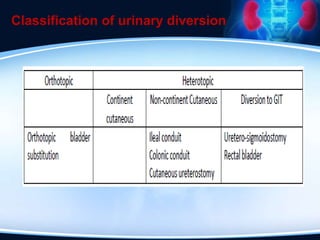
Classification of urinary diversion
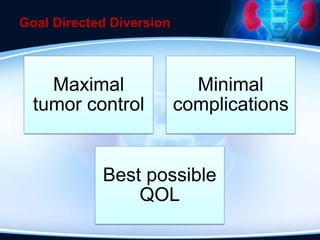
Goal Directed Diversion
Maximal
tumor control
Minimal
complications
Best possible
QOL
Ideal Urinary Diversion
Undisturbed body image
Natural micturation
Continence
Safe upper urinary tract
Pre-procedure counselling
Selection based on Clinical factors
Inform and honest discussion
Long and short term risks and benefits
Intergroup talk
Possibility of change in diversion method
Stoma therapist
Factors influencing complication
• Patient Factors
– Performance Status/ Co-morbidities
– Patient /Caretaker compliance to CISC
– Mobility
– Previous RT
– Renal function
– Liver function
– Body Habitus/BMI
• Bowel/Technical Factors
– Type of intestinal segment used
– Length of intestinal segment
– Continent vs Continuously draining
– Method/ extent of detubularization
– Capacity
– Compliance
– Reflux or non-refluxing uretero-intestinal anastomosis
– Type of diversion chosen
– Contact time with urine
Which Gastrointestinal segments?
• Stomach
• Jejunum
• Ileum
• Colon
• Appendix
STOMACH
• Blood supply
– Usually use fundus
– Either left or right gastroepiploic artery with the omentum left behind as
support
• Indications:
– Borderline RFT
– Inflammatory bowel disease
• Advantage:
– Less permeable to urine solute & acidify urine with net HCL loss, less
acidosis be more suitable for impair RFT
– Locate at epigastrium with less affect by RT
– Lower incidence of bacteriuria
– Reduced mucus production - stone formation
– Thick muscular backing - easier antireflux ureteroenteric anastomosis
Disadvantage
• Stomach complication (early)
– Gastric retention due to atony of the stomach or edema of the
anastomosis
– Hemorrhage (anastomotic site)
– Hiccups (gastric distention)
– Pancreatitis (intraoperative injury)
– Duodenal leakage
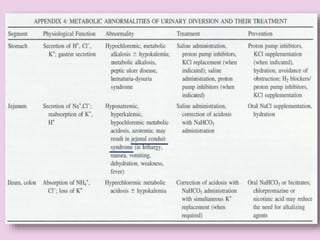
• Hypokalemic Hypochloremic metabolic alkalosis
– Excessive secretion of HCL & absorption of HCO3
– Treatment: H2 blocker
• Hematuria-dysuria syndrome - overcome with composite
urinary reservoir
• Hypergastrinemia - increase acid secretion
• Post-gastrectomy syndrome
– Malnutrition:
• small capacity, rapid gastric emptying, rapid intestinal
transit
• Fe def: acid convert Fe3+ to Fe 2+ (ferrous)
• B12 det: lack of intrinsic factor
– Dumping syndrome:
• Early (30min): gastric emptying to small bowel -
osmotic load - dizziness, palpitation
• Late : rapid swing in insulin secretion - hypoglycemia
– Diarrhoea:
• rapid gastric emptying & hyperosmoler load in small
bowel
– Bilious vomiting :
• Loss of pylorous - reflux of duodenal contents
ILEUM
• Advantage:
– Can be reconfigured as low-pressure reservoir
– Abundant supply, mobile with constant blood supply
• Disadvantage:
– Hypokalemic, Hyperchloremic metabolic acidosis
• Secret NaHCO3 & absorp NH4Cl
• NH4Cl NH3 + HCL
• Hypo K due to renal lekage, osmotic diuresis & gut loss
– Post op Intestinal obstruction - 10% (vs colon 4%)
– Impaired Vit B12 and Bile acid absorption (if >60 cm resected)
– Increased oxalate absorption - stone formation
– Acidosis - Osteoporosis and osteomalacia
– Bacteriuria + recurrent UTI
– Impair RFT
– Risk of malignancy (Nitrite + amine= carcinogen)
• Treatment of metabolic complications of Ileum
• Alkalizing agent:
– NaHCO3 900mg TDS
– Polycitra (K+/Na+ citrate in citric acid solution)
• K supplement after acidosis corrected
• Chlorpromazine 25mg TDS (inhibit Cl transport)
• Ileocaecal valve
– Controlled transport of ileal content into colon
– Rapid bowel propulsion soft stools, diarrhoea, malabsorption
– Decrease Vit B (32%)
– Decrease folic acid (11%)
– Metabolic acidosis (30%)
– Increase risk of renal and gall bladder stones
COLON
• Advantage:
– Redundant sigmoid (easy to brought down)
– Larger diameter
– Less Vit B12 and bile salt absorption problem
– results in fewer nutritional problems
– incidence of postoperative bowel obstruction with colon is 4%, less
than that occurring with ileum.
– An antireflux ureterointestinal anastomosis by the submucosal
tunnel technique is easier to perform with use of colon
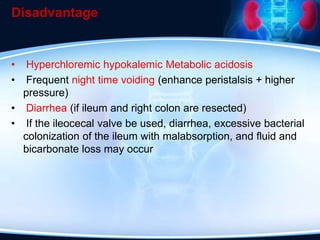
Disadvantage
• Hyperchloremic hypokalemic Metabolic acidosis
• Frequent night time voiding (enhance peristalsis + higher
pressure)
• Diarrhea (if ileum and right colon are resected)
• If the ileocecal valve be used, diarrhea, excessive bacterial
colonization of the ileum with malabsorption, and fluid and
bicarbonate loss may occur
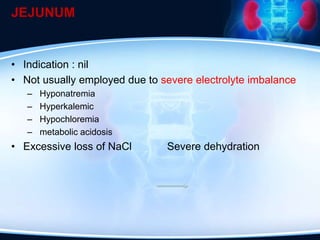
JEJUNUM
• Indication : nil
• Not usually employed due to severe electrolyte imbalance
– Hyponatremia
– Hyperkalemic
– Hypochloremia
– metabolic acidosis
• Excessive loss of NaCl Severe dehydration
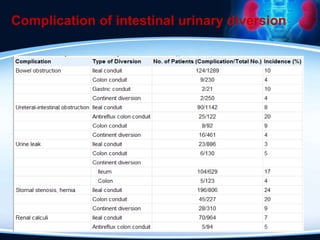
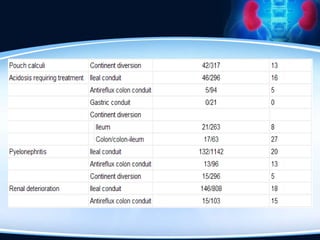
Complication of intestinal urinary diversion
OTHER PROBLEMS
• Altered sensorium
– Increase NH4 absorption
– Mg deficiency
– Treatment: Lactulose 10mg BD , neomycin 1gm TDS
• Altered drug metabolism:
– Those excreted unchanged in kidney and absorbed by GI tract
• Bone disease
– Due to metabolic acidosis
– Demineralization (long-term) osteomalacia
– Reduced growth (young patients)
– Increased fracture rate
– Pain in weight-bearing joints
– Treatment: Correct acidosis, Ca supplement, Vit D
Trans Uretero Uretero cutaneostomy
• Indications:
– After palliative cystectomy in elderly frail patient
– Temporary diversion
– Diversion for fistula or hemorrhage
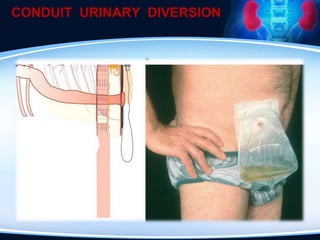
CONDUIT URINARY DIVERSION
The Ideal Candidate
• Serum creatinine < 2 mg/dL
• Urine pH of 5.8 or less after an ammonium chloride
load
• Urine osmolality of 600 mOsm / kg or greater in
response to water deprivation
• GFR > 35 mL / min
• Minimal protein in the urine
Types of conduits
• Small bowel -- Jejunum or ileum
• Large bowel -- Colonic or ileocaecal
• Each type of conduit specific Indications
Advantages
Complications
Ileal Conduit
• Portion of distal ileum
• Simplest type of conduit diversion ; Fewest intraoperative and
immediate postoperative complications.
• Avoided in
– Short bowel syndrome,
– Inflammatory small bowel disease,
– Extensive irradiation for Pelvic malignant neoplasm.
• Complications:
– Early ( 48%) -- Urinary tract infections, Pyelonephritis,
Uretero-ileal leakage
– Late (24%) -- Stomal complications
Functional and / or Morphological changes of the
upper urinary tract in up to 30% .
Jejunal Conduit
• Advantage : Avoids irradiated bowel and ureter
– Extensive irradiation involving ileum
– Severe adhesions of the ileum and absence of the large bowel
– Absent colon with inflammatory disease of the distal small bowel
• Contraindications
Severe bowel nutritional disorders
Presence of another acceptable segment
• Low rate of acceptance-- Electrolyte abnormalities
Renal calculi
Parastomal hernia
Pyelonephritis
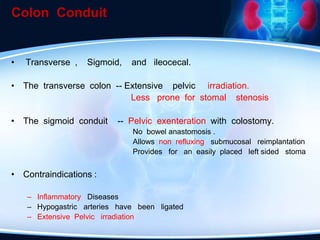
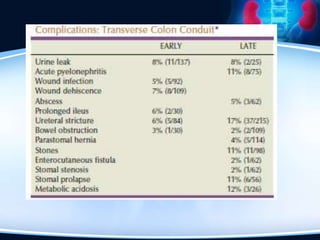
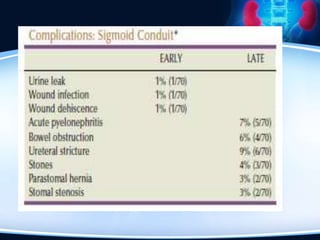
Colon Conduit
• Transverse , Sigmoid, and ileocecal.
• The transverse colon -- Extensive pelvic irradiation.
Less prone for stomal stenosis
• The sigmoid conduit -- Pelvic exenteration with colostomy.
No bowel anastomosis .
Allows non refluxing submucosal reimplantation
Provides for an easily placed left sided stoma
• Contraindications :
– Inflammatory Diseases
– Hypogastric arteries have been ligated
– Extensive Pelvic irradiation
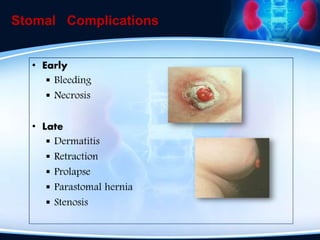
Stomal Complications
Cutaneous Continent
Urinary Diversion
Indications and Patient selection
• Cystourethrectomy when preservation of the sphincter
and urethra are not possible
Positive urethral biopsies
Positive intraoperative surgical margins.
• Incontinent patient - Urethral sphincter incompetence.
• Motivated , compliant with manual dexterity to
perform self-catheterization
Indications and Patient selection
• Avoided in
– Quadriplegic individuals
– Very frail or mentally impaired
– Impaired Renal and hepatic function
– Previous irradiation
– Inflammatory bowel diseases
Rectal Bladder Urinary diversion
Ureterosigmoidostomy
Folded rectosigmoid bladder
Continent Cathetersiation Pouches
Continent ileal reservior (kock pouches)
Gastric pouch
Principles for lower urinary tract reconstruction
1. A reservoir in which to store urine in low pressure
2. A conduit through which the urine is conducted to the
surface
3. A continence mechanism
Skinner
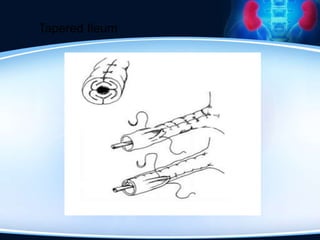
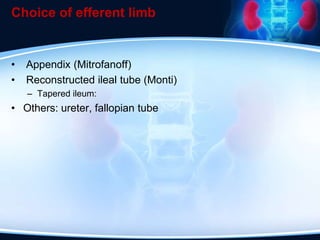
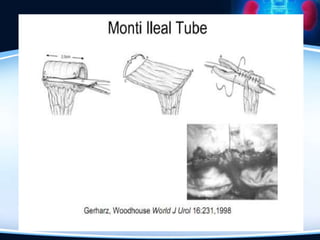
Choice of efferent limb
• Appendix (Mitrofanoff)
• Reconstructed ileal tube (Monti)
– Tapered ileum:
• Others: ureter, fallopian tube
Tapered Ileum
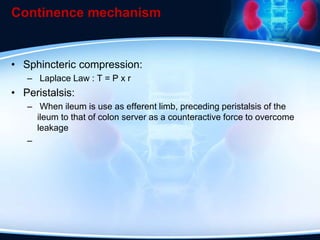
Continence mechanism
• Sphincteric compression:
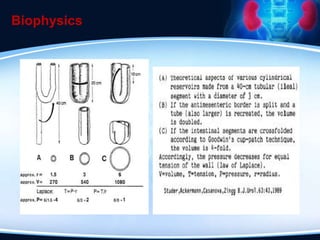
– Laplace Law : T = P x r
• Peristalsis:
– When ileum is use as efferent limb, preceding peristalsis of the
ileum to that of colon server as a counteractive force to overcome
leakage
–
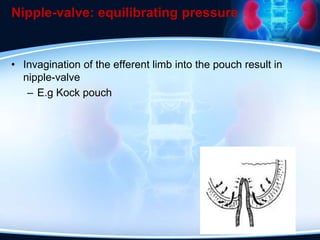
Nipple-valve: equilibrating pressure
• Invagination of the efferent limb into the pouch result in
nipple-valve
– E.g Kock pouch
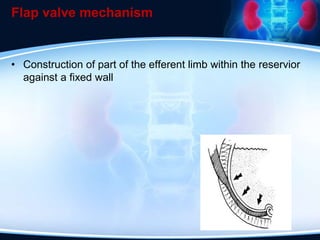
Flap valve mechanism
• Construction of part of the efferent limb within the reservior
against a fixed wall
ORTHOTOPIC NEOBLADDER
• A form of substitutional cystoplasty
• No oncological difference from conduit
• Consideration:
– EUS must be intact
– Local tumor recurrence: 11% (25% if prostate involvement)
– To rule out cancer infiltration:
• Pre-op cystoscopy+ bx of BN/ Prostatic urethra
• Intra-op FS of resected margin or BN (F)
– CIS & multifocal disease, T & LN stage are not a CI
• Advantage
– No need for cutaneous stoma or collecting device
– Urinary continence rely on intact external sphincter
– Voiding by increase intraabdominal pressure (valsalva’s maneuver)
+ relaxation of pelvic floor muscle
– Most retain urinary continence, void to complete without the need of
CISC
– Improve self image and reduce psychological truma
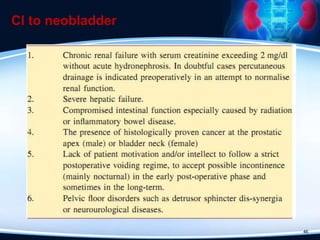
CI to neobladder
46
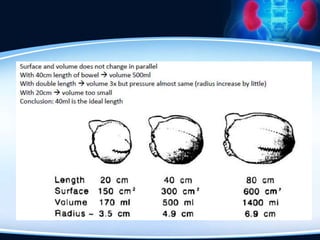
Biophysics
Methods to improve continence
• Preservation of rhabdosphincter:
– Avoid excessive apical dissection
– Avoid unnecessary suture btw DVC & sphincter
• Dissection of pelvic floor:
– Preserve branch of pundendal nerve below endopelvic fascia
– Preserve muscuolofacial support of the pelvic floor
• Nerve sparing:
– Preservation of pelvic nerve and inferior hypogastric nerve plexus
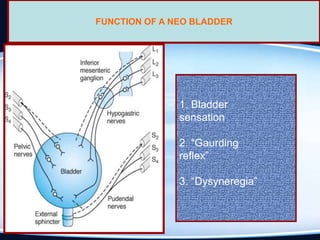
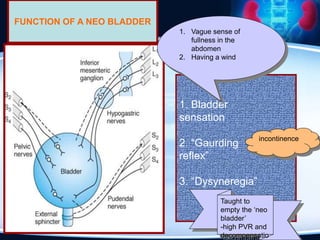
1. Bladder
sensation
2. “Gaurding
reflex”
3. “Dysyneregia”
FUNCTION OF A NEO BLADDER
1. Bladder
sensation
2. “Gaurding
reflex”
3. “Dysyneregia”
FUNCTION OF A NEO BLADDER
1. Vague sense of
fullness in the
abdomen
2. Having a wind
Taught to
empty the ‘neo
bladder’
-high PVR and
decompensatio
incontinence
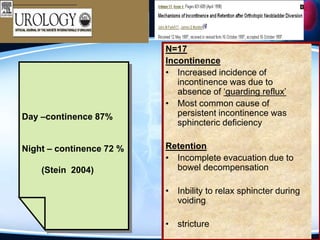
N=17
Incontinence
• Increased incidence of
incontinence was due to
absence of ‘guarding reflux’
• Most common cause of
persistent incontinence was
sphincteric deficiency
Retention
• Incomplete evacuation due to
bowel decompensation
• Inbility to relax sphincter during
voiding
• stricture
Day –continence 87%
Night – continence 72 %
(Stein 2004)
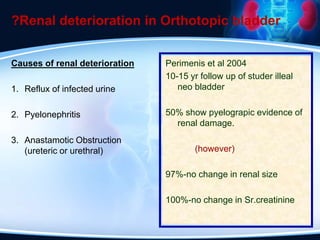
?Renal deterioration in Orthotopic bladder
Causes of renal deterioration
1. Reflux of infected urine
2. Pyelonephritis
3. Anastamotic Obstruction
(ureteric or urethral)
Perimenis et al 2004
10-15 yr follow up of studer illeal
neo bladder
50% show pyelograpic evidence of
renal damage.
(however)
97%-no change in renal size
100%-no change in Sr.creatinine
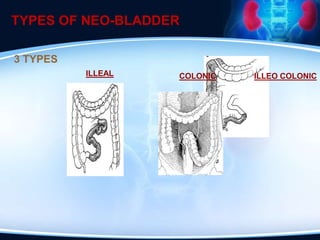
TYPES OF NEO-BLADDER
ILLEAL ILLEO COLONIC
COLONIC
3 TYPES
ILEUM vs COLON
Ileum is found to be superior to colon
1. Better functional results
2. Better adaptability and less absorption of urinary
constiuents in long run.
3. Natural tendency for tumor occurrence less than colon
4. No increased incidence of malignancy due to diversion
N.B: The incidence of colonic tumors increase by a
thousand fold with a induction period of 20 years in
sigmoid.
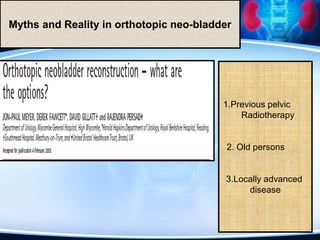
1.Previous pelvic
Radiotherapy
2. Old persons
3.Locally advanced
disease
Myths and Reality in orthotopic neo-bladder
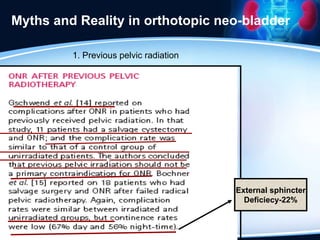
1. Previous pelvic radiation
External sphincter
Deficiecy-22%
Myths and Reality in orthotopic neo-bladder
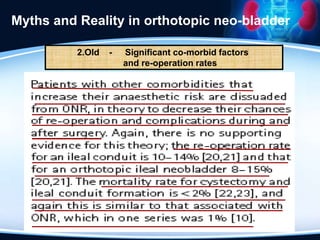
2.Old - Significant co-morbid factors
and re-operation rates
Myths and Reality in orthotopic neo-bladder
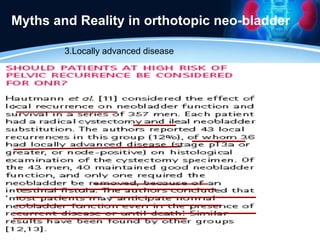
3.Locally advanced disease
Urinary diversion

Urinary diversion

  • 1.
    Urinary Diversion Indication,Type,Complication Dr SwatiShah Pelvic (Uro & Gynec) and Robotic Oncosurgeon MS, DNB
  • 2.
    Indications of permanenturinary diversion • When the bladder has to be removed • When the sphincters of the bladder & the detrusor muscle damaged or have lost their normal neurological control • When there is irremovable obstruction in the bladder • Ectopic vesicae • Incurable vesicovagina fistula
  • 3.
  • 4.
    Goal Directed Diversion Maximal tumorcontrol Minimal complications Best possible QOL
  • 5.
    Ideal Urinary Diversion Undisturbedbody image Natural micturation Continence Safe upper urinary tract
  • 6.
    Pre-procedure counselling Selection basedon Clinical factors Inform and honest discussion Long and short term risks and benefits Intergroup talk Possibility of change in diversion method Stoma therapist
  • 7.
    Factors influencing complication •Patient Factors – Performance Status/ Co-morbidities – Patient /Caretaker compliance to CISC – Mobility – Previous RT – Renal function – Liver function – Body Habitus/BMI
  • 8.
    • Bowel/Technical Factors –Type of intestinal segment used – Length of intestinal segment – Continent vs Continuously draining – Method/ extent of detubularization – Capacity – Compliance – Reflux or non-refluxing uretero-intestinal anastomosis – Type of diversion chosen – Contact time with urine
  • 9.
    Which Gastrointestinal segments? •Stomach • Jejunum • Ileum • Colon • Appendix
  • 10.
    STOMACH • Blood supply –Usually use fundus – Either left or right gastroepiploic artery with the omentum left behind as support • Indications: – Borderline RFT – Inflammatory bowel disease • Advantage: – Less permeable to urine solute & acidify urine with net HCL loss, less acidosis be more suitable for impair RFT – Locate at epigastrium with less affect by RT – Lower incidence of bacteriuria – Reduced mucus production - stone formation – Thick muscular backing - easier antireflux ureteroenteric anastomosis
  • 11.
    Disadvantage • Stomach complication(early) – Gastric retention due to atony of the stomach or edema of the anastomosis – Hemorrhage (anastomotic site) – Hiccups (gastric distention) – Pancreatitis (intraoperative injury) – Duodenal leakage • Hypokalemic Hypochloremic metabolic alkalosis – Excessive secretion of HCL & absorption of HCO3 – Treatment: H2 blocker • Hematuria-dysuria syndrome - overcome with composite urinary reservoir • Hypergastrinemia - increase acid secretion
  • 12.
    • Post-gastrectomy syndrome –Malnutrition: • small capacity, rapid gastric emptying, rapid intestinal transit • Fe def: acid convert Fe3+ to Fe 2+ (ferrous) • B12 det: lack of intrinsic factor – Dumping syndrome: • Early (30min): gastric emptying to small bowel - osmotic load - dizziness, palpitation • Late : rapid swing in insulin secretion - hypoglycemia – Diarrhoea: • rapid gastric emptying & hyperosmoler load in small bowel – Bilious vomiting : • Loss of pylorous - reflux of duodenal contents
  • 13.
    ILEUM • Advantage: – Canbe reconfigured as low-pressure reservoir – Abundant supply, mobile with constant blood supply • Disadvantage: – Hypokalemic, Hyperchloremic metabolic acidosis • Secret NaHCO3 & absorp NH4Cl • NH4Cl NH3 + HCL • Hypo K due to renal lekage, osmotic diuresis & gut loss – Post op Intestinal obstruction - 10% (vs colon 4%) – Impaired Vit B12 and Bile acid absorption (if >60 cm resected) – Increased oxalate absorption - stone formation – Acidosis - Osteoporosis and osteomalacia – Bacteriuria + recurrent UTI – Impair RFT – Risk of malignancy (Nitrite + amine= carcinogen)
  • 14.
    • Treatment ofmetabolic complications of Ileum • Alkalizing agent: – NaHCO3 900mg TDS – Polycitra (K+/Na+ citrate in citric acid solution) • K supplement after acidosis corrected • Chlorpromazine 25mg TDS (inhibit Cl transport)
  • 15.
    • Ileocaecal valve –Controlled transport of ileal content into colon – Rapid bowel propulsion soft stools, diarrhoea, malabsorption – Decrease Vit B (32%) – Decrease folic acid (11%) – Metabolic acidosis (30%) – Increase risk of renal and gall bladder stones
  • 16.
    COLON • Advantage: – Redundantsigmoid (easy to brought down) – Larger diameter – Less Vit B12 and bile salt absorption problem – results in fewer nutritional problems – incidence of postoperative bowel obstruction with colon is 4%, less than that occurring with ileum. – An antireflux ureterointestinal anastomosis by the submucosal tunnel technique is easier to perform with use of colon
  • 17.
    Disadvantage • Hyperchloremic hypokalemicMetabolic acidosis • Frequent night time voiding (enhance peristalsis + higher pressure) • Diarrhea (if ileum and right colon are resected) • If the ileocecal valve be used, diarrhea, excessive bacterial colonization of the ileum with malabsorption, and fluid and bicarbonate loss may occur
  • 18.
    JEJUNUM • Indication :nil • Not usually employed due to severe electrolyte imbalance – Hyponatremia – Hyperkalemic – Hypochloremia – metabolic acidosis • Excessive loss of NaCl Severe dehydration
  • 20.
    Complication of intestinalurinary diversion
  • 22.
    OTHER PROBLEMS • Alteredsensorium – Increase NH4 absorption – Mg deficiency – Treatment: Lactulose 10mg BD , neomycin 1gm TDS • Altered drug metabolism: – Those excreted unchanged in kidney and absorbed by GI tract • Bone disease – Due to metabolic acidosis – Demineralization (long-term) osteomalacia – Reduced growth (young patients) – Increased fracture rate – Pain in weight-bearing joints – Treatment: Correct acidosis, Ca supplement, Vit D
  • 23.
    Trans Uretero Ureterocutaneostomy • Indications: – After palliative cystectomy in elderly frail patient – Temporary diversion – Diversion for fistula or hemorrhage
  • 24.
  • 25.
    The Ideal Candidate •Serum creatinine < 2 mg/dL • Urine pH of 5.8 or less after an ammonium chloride load • Urine osmolality of 600 mOsm / kg or greater in response to water deprivation • GFR > 35 mL / min • Minimal protein in the urine
  • 26.
    Types of conduits •Small bowel -- Jejunum or ileum • Large bowel -- Colonic or ileocaecal • Each type of conduit specific Indications Advantages Complications
  • 27.
    Ileal Conduit • Portionof distal ileum • Simplest type of conduit diversion ; Fewest intraoperative and immediate postoperative complications. • Avoided in – Short bowel syndrome, – Inflammatory small bowel disease, – Extensive irradiation for Pelvic malignant neoplasm. • Complications: – Early ( 48%) -- Urinary tract infections, Pyelonephritis, Uretero-ileal leakage – Late (24%) -- Stomal complications Functional and / or Morphological changes of the upper urinary tract in up to 30% .
  • 28.
    Jejunal Conduit • Advantage: Avoids irradiated bowel and ureter – Extensive irradiation involving ileum – Severe adhesions of the ileum and absence of the large bowel – Absent colon with inflammatory disease of the distal small bowel • Contraindications Severe bowel nutritional disorders Presence of another acceptable segment • Low rate of acceptance-- Electrolyte abnormalities Renal calculi Parastomal hernia Pyelonephritis
  • 29.
    Colon Conduit • Transverse, Sigmoid, and ileocecal. • The transverse colon -- Extensive pelvic irradiation. Less prone for stomal stenosis • The sigmoid conduit -- Pelvic exenteration with colostomy. No bowel anastomosis . Allows non refluxing submucosal reimplantation Provides for an easily placed left sided stoma • Contraindications : – Inflammatory Diseases – Hypogastric arteries have been ligated – Extensive Pelvic irradiation
  • 32.
  • 33.
  • 34.
    Indications and Patientselection • Cystourethrectomy when preservation of the sphincter and urethra are not possible Positive urethral biopsies Positive intraoperative surgical margins. • Incontinent patient - Urethral sphincter incompetence. • Motivated , compliant with manual dexterity to perform self-catheterization
  • 35.
    Indications and Patientselection • Avoided in – Quadriplegic individuals – Very frail or mentally impaired – Impaired Renal and hepatic function – Previous irradiation – Inflammatory bowel diseases
  • 36.
    Rectal Bladder Urinarydiversion Ureterosigmoidostomy Folded rectosigmoid bladder Continent Cathetersiation Pouches Continent ileal reservior (kock pouches) Gastric pouch
  • 37.
    Principles for lowerurinary tract reconstruction 1. A reservoir in which to store urine in low pressure 2. A conduit through which the urine is conducted to the surface 3. A continence mechanism Skinner
  • 38.
    Choice of efferentlimb • Appendix (Mitrofanoff) • Reconstructed ileal tube (Monti) – Tapered ileum: • Others: ureter, fallopian tube
  • 40.
  • 41.
    Continence mechanism • Sphinctericcompression: – Laplace Law : T = P x r • Peristalsis: – When ileum is use as efferent limb, preceding peristalsis of the ileum to that of colon server as a counteractive force to overcome leakage –
  • 42.
    Nipple-valve: equilibrating pressure •Invagination of the efferent limb into the pouch result in nipple-valve – E.g Kock pouch
  • 43.
    Flap valve mechanism •Construction of part of the efferent limb within the reservior against a fixed wall
  • 44.
    ORTHOTOPIC NEOBLADDER • Aform of substitutional cystoplasty • No oncological difference from conduit • Consideration: – EUS must be intact – Local tumor recurrence: 11% (25% if prostate involvement) – To rule out cancer infiltration: • Pre-op cystoscopy+ bx of BN/ Prostatic urethra • Intra-op FS of resected margin or BN (F) – CIS & multifocal disease, T & LN stage are not a CI
  • 45.
    • Advantage – Noneed for cutaneous stoma or collecting device – Urinary continence rely on intact external sphincter – Voiding by increase intraabdominal pressure (valsalva’s maneuver) + relaxation of pelvic floor muscle – Most retain urinary continence, void to complete without the need of CISC – Improve self image and reduce psychological truma
  • 46.
  • 47.
  • 49.
    Methods to improvecontinence • Preservation of rhabdosphincter: – Avoid excessive apical dissection – Avoid unnecessary suture btw DVC & sphincter • Dissection of pelvic floor: – Preserve branch of pundendal nerve below endopelvic fascia – Preserve muscuolofacial support of the pelvic floor • Nerve sparing: – Preservation of pelvic nerve and inferior hypogastric nerve plexus
  • 50.
    1. Bladder sensation 2. “Gaurding reflex” 3.“Dysyneregia” FUNCTION OF A NEO BLADDER
  • 51.
    1. Bladder sensation 2. “Gaurding reflex” 3.“Dysyneregia” FUNCTION OF A NEO BLADDER 1. Vague sense of fullness in the abdomen 2. Having a wind Taught to empty the ‘neo bladder’ -high PVR and decompensatio incontinence
  • 52.
    N=17 Incontinence • Increased incidenceof incontinence was due to absence of ‘guarding reflux’ • Most common cause of persistent incontinence was sphincteric deficiency Retention • Incomplete evacuation due to bowel decompensation • Inbility to relax sphincter during voiding • stricture Day –continence 87% Night – continence 72 % (Stein 2004)
  • 53.
    ?Renal deterioration inOrthotopic bladder Causes of renal deterioration 1. Reflux of infected urine 2. Pyelonephritis 3. Anastamotic Obstruction (ureteric or urethral) Perimenis et al 2004 10-15 yr follow up of studer illeal neo bladder 50% show pyelograpic evidence of renal damage. (however) 97%-no change in renal size 100%-no change in Sr.creatinine
  • 54.
    TYPES OF NEO-BLADDER ILLEALILLEO COLONIC COLONIC 3 TYPES
  • 55.
    ILEUM vs COLON Ileumis found to be superior to colon 1. Better functional results 2. Better adaptability and less absorption of urinary constiuents in long run. 3. Natural tendency for tumor occurrence less than colon 4. No increased incidence of malignancy due to diversion N.B: The incidence of colonic tumors increase by a thousand fold with a induction period of 20 years in sigmoid.
  • 56.
    1.Previous pelvic Radiotherapy 2. Oldpersons 3.Locally advanced disease Myths and Reality in orthotopic neo-bladder
  • 57.
    Myths and Realityin orthotopic neo-bladder 1. Previous pelvic radiation External sphincter Deficiecy-22%
  • 58.
    Myths and Realityin orthotopic neo-bladder 2.Old - Significant co-morbid factors and re-operation rates
  • 59.
    Myths and Realityin orthotopic neo-bladder 3.Locally advanced disease