RCS 6080
Medical andPsychosocial Aspects
of Rehabilitation Counseling
Ostomy Surgeries
2.
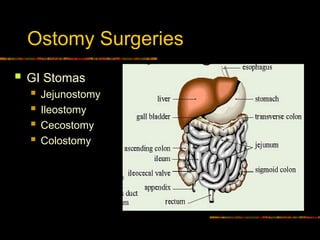
Ostomy Surgeries
Numerousmedical conditions, including
congenital defects, trauma, inflammatory bowel
disease (IBD),and bowel and bladder cancer,
can be treated by ostomy surgeries
These surgeries close the normal route of
elimination of bodily wastes and create a new
opening (stoma)
Colostomy
Colostomy: Asurgically created opening in
the abdominal wall through which digested
food passes.
Temporary colostomy
Permanent colostomy
Reasons for surgery: Cancer, diverticultis
trauma, imperforate anus
Vocational impact – restrict heavy lifting
5.
Ileostomy
A surgicallycreated opening in the abdominal
wall through which digested food passes. The
Ileum (the lowest part of the small intestine) is
brought through the abdominal wall to form a
stoma. A Ileostomy is performed when a
disease or injured colon cannot be treated
successfully.
Vocational implication – restrict heavy lifting.
6.
Jejunostomy
Can beused for either feeding or removal of
stool, depending on if the stoma is at the
beginning or end of the Jejunum.
Feeding: A tube is placed into the jejunum versus
the stomach (gastrostomy). People with a
jejunostomy can eat and drink by mouth. The device
is an “insurance” mechanism for nutrition. It can be
temporary or permanent.
Stool removal: in certain instances a jejunostomy is
conducted similarly to the Ileostomy. Again, this
usually temporary.
7.
Cecostomy
A tubethat goes through the skin into the
beginning of the large intestine to help remove
gas or feces by injecting a solution (antegrade
enema) that flushes the gas and stool out of the
rectum.
Can be temporary or permanent.
8.
Urinary Stomas
Whena urinary stoma is created, the urine does not go to the
bladder. The urine is rerouted through an opening on the
abdomen (stoma) created by a surgeon.
Vesicostomy:
An opening in the bladder created to connect the bladder to an
opening on the lower abdomen.
Ureterostomy:
The ureter (or ureters) is attached to the skin’s surface through a
small opening in the abdomen.
Ileal conduit:
A small section of the ileum (small intestine) is used to create a
passage for the urine to exit the body. This section of the small
intestine, called a conduit, is attached to the abdominal wall to
create a stoma. The urine flows from the kidneys, through the
ureters, and out the stoma
9.
Psychosocial/Vocational
implications
Vocational Implications
Ostomy surgery itself does not present obstacles to
most vocational functioning – underlying disease
process may influence RTW
Changes in body image
Economic costs of living with an ostomy can be
considerable when complications from the stoma or
disease process develop
Provide information and education to the person in a
manner that relays a message of acceptance
10.
Additional Resources and
Informationfrom the Web
United Ostomy Association (www.uoa.org)
International Ostomy Association (www.
ostomyinternational.org)
World Ostomy Resource (www.powerup
.com.au/~takkenb/OstomySites.htm)
Crohn’s Colitis Foundation of America (www.
ccfa.org)
Oley Foundation (www.oley.org)



![Basics of Stoma and Management care[1].pptx](https://cdn.slidesharecdn.com/ss_thumbnails/basicsofstomaandmanagement1-250417022629-8799f789-thumbnail.jpg?width=640&height=640&fit=bounds)


![5 Head injury (1)[1]_425974386d4d442b6ce092649f8d5b41.pptx](https://cdn.slidesharecdn.com/ss_thumbnails/5headinjury11425974386d4d442b6ce092649f8d5b41-250319190324-4867f9fb-thumbnail.jpg?width=640&height=640&fit=bounds)

![5 Head injury (1)[1]_425974386d4d442b6ce092649f8d5b41.pptx](https://cdn.slidesharecdn.com/ss_thumbnails/5headinjury11425974386d4d442b6ce092649f8d5b41-250318200004-e6284666-thumbnail.jpg?width=640&height=640&fit=bounds)


