ELIMINATION
URINARY ELIMINATION
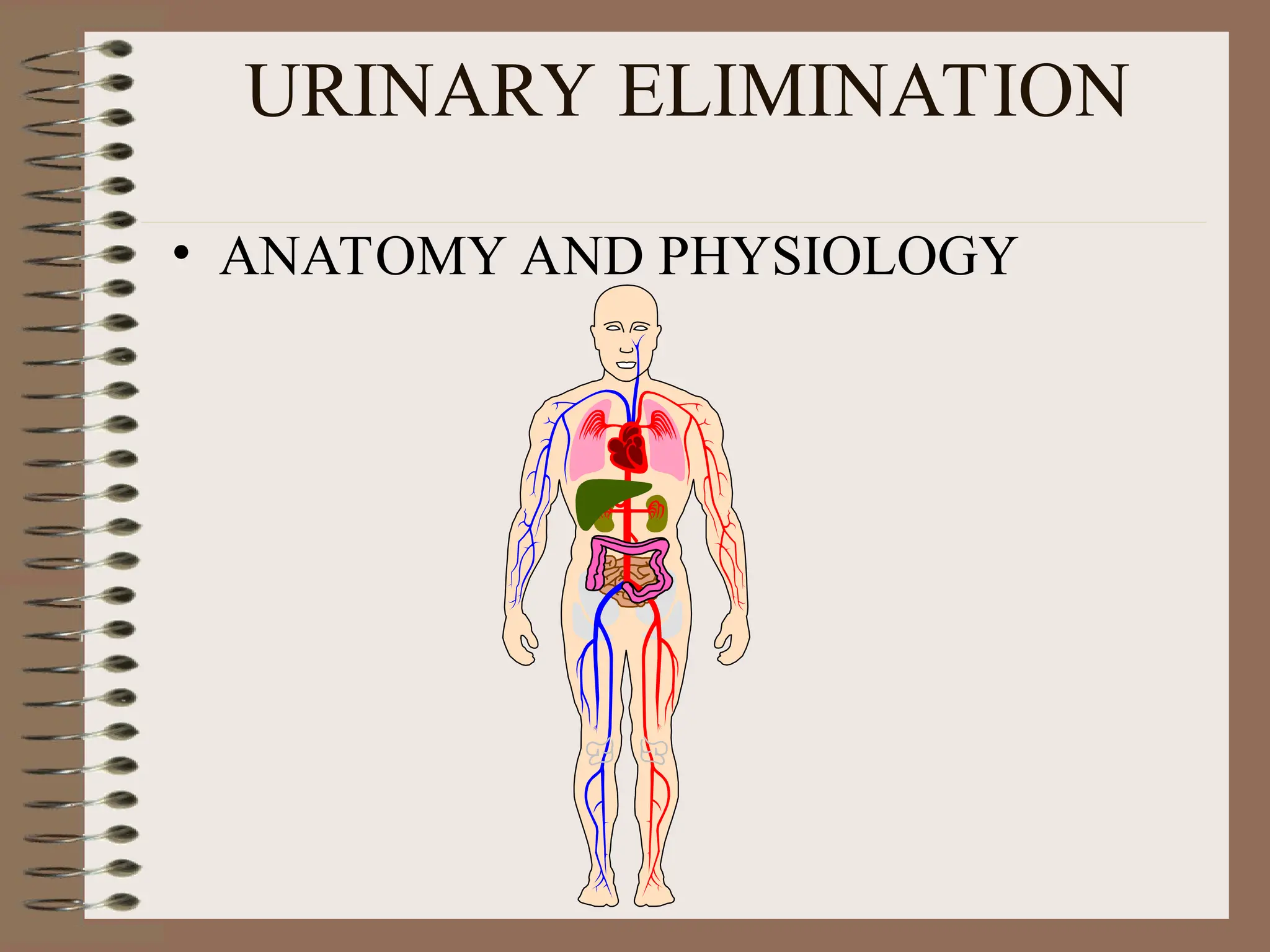
• ANATOMY AND PHYSIOLOGY
ANATOMY
• FEMALE STRUCTURES
• MALE STRUCTURES
URINE
• 96% WATER
• 4% SOLUTES
– ORGANIC SOLUTES
• UREA*
• AMMONIA
• CREATININE
• URIC ACID
– INORGANIC SOLUTES
• SODIUM (Na)
• CHLORIDE (Cl)
• MAGNESIUM (Mg)
• PHOSPHORUS (Phos)
• SODIUM CHLORIDE (NaCl)*
FACTORS AFFECTING
URINARY ELIMINATION
• Fluid
• Diet
• Response to urge
• Stress
• Psychosocial factors
• Activity
• Pathological conditions
• Medications
• Developmental level
• Medical Diagnosis or Surgery
ALTERATIONS IN URINARY
ELIMINATION
• Urinary Retention
• Urinary Incontinence
– functional
– reflex
– stress
– total
– urge
• Enuresis
– nocturnal enuresis
– diurnal enuresis
ALTERATIONS CONT.
• Nocturia
• Frequency
• Urgency
• Dysuria
• Hesitancy
• Polyuria
• Suppression
– anuria
– oliguria
DIAGNOSTIC TEST
• Culture and sensitivity
• KUB
• IVP
• Cystoscopy
• Blood test
– BUN (7-18 mg/dl)
– Creatinine (.6-1.2 mg/dl)
• Urinalysis (type of specimens)
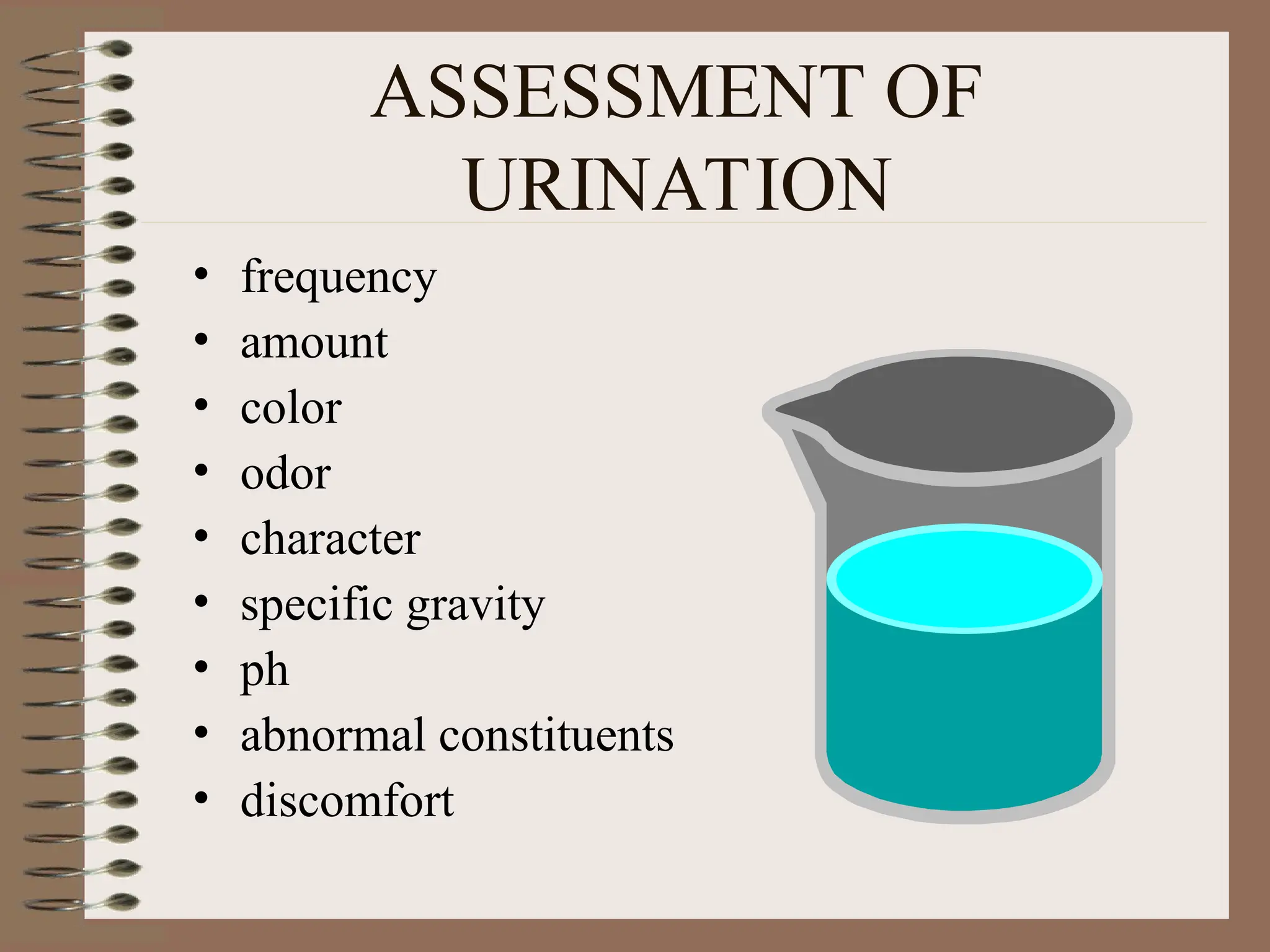
ASSESSMENT OF
URINATION
• frequency
• amount
• color
• odor
• character
• specific gravity
• ph
• abnormal constituents
• discomfort
NURSING INTERVENTIONS
TO PROMOTE U. E.
• intake & output
• position
• hygiene
• privacy
• sitz
• catheterize
• medications
• kegel’s exercise
CATHETERIZATION
• STRAIGHT
• RETENTION OR FOLEY
• QUICK CATH
• LUMENS
– SINGLE-STRAIGHT
– DOUBLE-RETENTION
– TRIPLE-IRRIGATION
SIZE OF CATHETERS
• RANGE FROM # 8-24
• CHILD # 8-10
• FEMALE # 14-16
• MALE # 16-18
• TURP # 22-24
• BALLOONS 5-30 cc
Nursing Interventions
• Insertion of catheters
• Maintenance of caths
• Specimens from caths
• Removing catheters
• Irrigation procedure
• Residual urine
• Suprapubic catheters
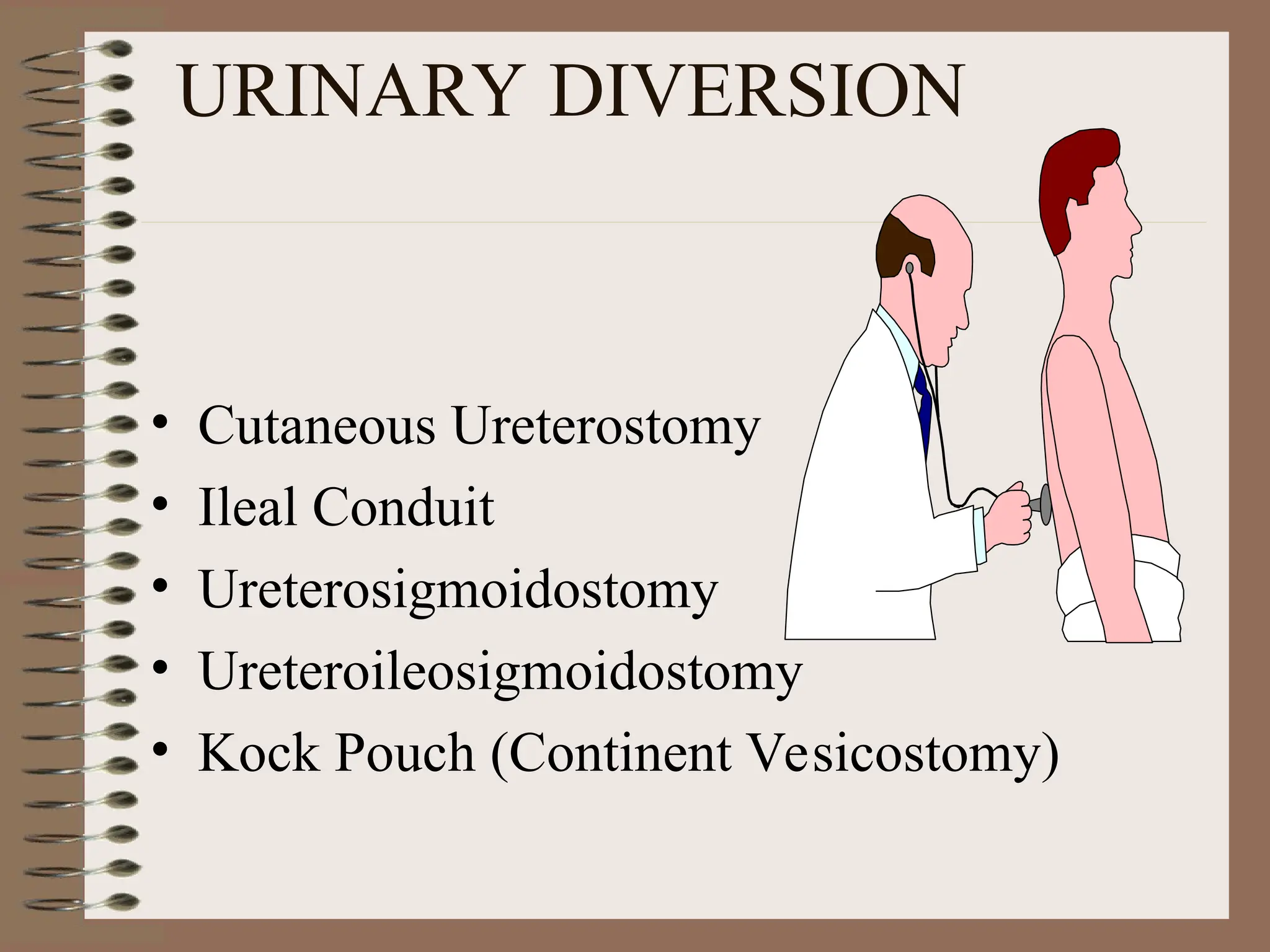
URINARY DIVERSION
• Cutaneous Ureterostomy
• Ileal Conduit
• Ureterosigmoidostomy
• Ureteroileosigmoidostomy
• Kock Pouch (Continent Vesicostomy)
NURSING DIAGNOSES
• ALTERED URINARY ELIMINATION
• INCONTINENCE
• URINARY RETENTION
• PAIN
• BODY IMAGE DISTURBANCE
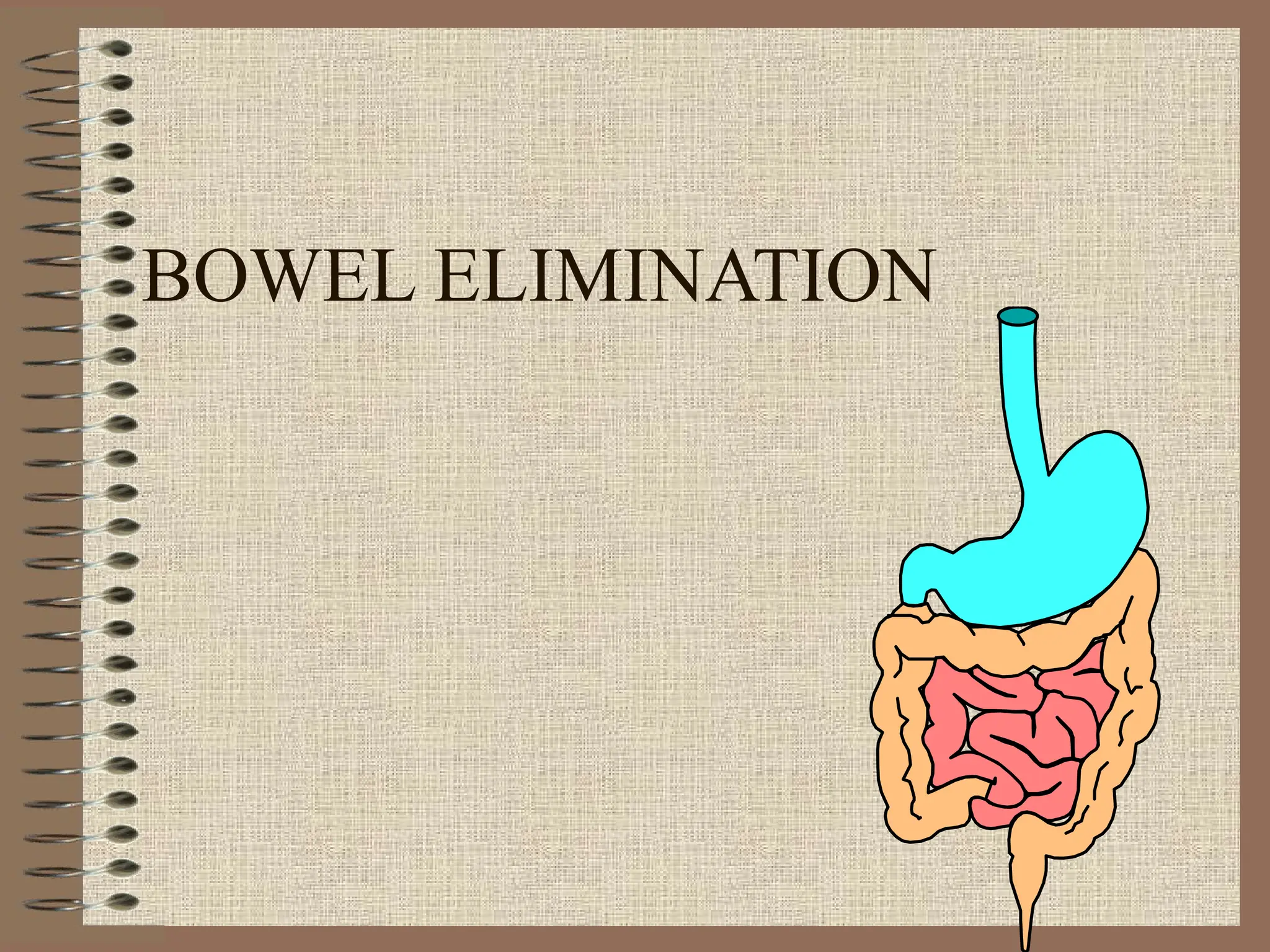
BOWEL ELIMINATION
ANATOMY
• Small intestine (ileum)
• Ileocecal valve
• Cecum
• Ascending
• Transverse
• Descending
• Sigmoid
• Rectum
• Anus
PHYSIOLOGY
• Peristalsis
• Water absorption
• Storage
• Secretion of mucus
DEFECATION
• Parasympathetic reflex
• Defecation reflex
• Assessment of stool
– pattern
– color
– consistency/shape
– blood
– Odor
• Bowel Diversions
– Stoma, drainage, skin condition
FACTORS AFFECTING BE
• Age
• Diet / Fluids
• Exercise
• Stress
• Schedule
• Medications
• Environment
• Anesthesia/Surgery
• Diagnostic Test
• Pathology
• Irritants
• Pain
ALTERED BE
• Constipation
• Fecal
Impaction
• Diarrhea
• Incontinence
• Flatulence
• Hemorrhoids
DIAGNOSTIC TEST
• Guaiac test
• Hematest
• Hemoccult
• Proctoscopy
• Proctosignoidoscopy
• Colonoscopy
PHYSICAL ASSESSMENT
• Inspection
– Four quadrants
– Nine regions
• Auscultation
• Percussion
• Palpation
MEDICATIONS
• Cathartics (laxative)
– Bulk forming
– Lubricant
– Wetting agent
– Stimulant/irritant
– Saline
• Suppository
• Enema
– Cleansing
– Hypertonic
– Oil
– Carminative
– Return Flow
– Cooling
– Medication
ENEMA ADMINISTRATION
• PROCEDURE
– HIGH VS. LOW
– AGE
– POSITION
• SOLUTIONS
– HYPOTONIC
– HYPERTONIC
– ISOTONIC
– VOLUME CONSIDERATION
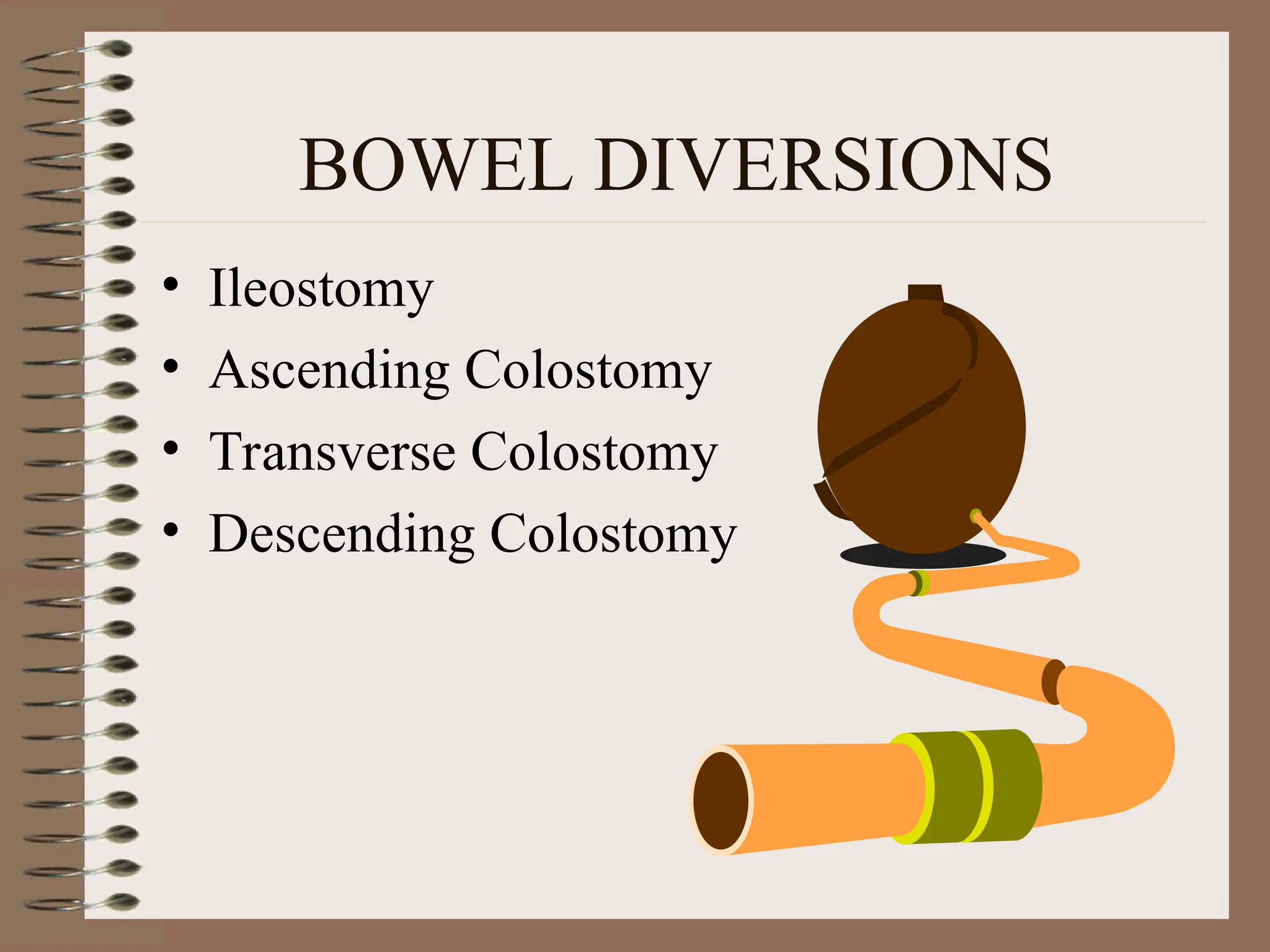
BOWEL DIVERSIONS
• Ileostomy
• Ascending Colostomy
• Transverse Colostomy
• Descending Colostomy
TYPES OF CONSTRUCTION
• Loop
• Double Barrel
• End
• Temporary
• Permanent
NURSING INTERVENTIONS
• Psychological needs
• Nutritional needs
• Hygiene needs
• Maintenance
• Teaching
SPECIMEN COLLECTION
• Urine
– Midstream
– Sterile/Culture
– 24 hour
– Drug
• Stool
– Blood/Parasite
• Technique
• Documentation
NURSING DIAGNOSES
• CONSTIPATION
• DIARRHEA
• INCONTINENCE
• ALTERED ELIMINATION
• BODY IMAGE DISTURBANCE
THE END!!!

Research methodology and data analysis to decision

Editor's Notes

  • #16 Preoccupied with bowel elimination Essential for health, rid waste Feces is 75% water and 25% solid
  • #17 Colon is 4-5 feet in length Approx. 1500 ml of chyme reaches the colon every 24 hours, with only 100 ml reaching rectum. Rectum infant 1-1.5” Toddler 2” {preschool 3” School age 4” Adult 4-6” Anus Internal sphincter-involuntary ANS External sphincter-voluntary-skeletal motor nerves
  • #18 Peristalsis-mixing & moving of chyme in one direction. occurs several times per day, after meals 30 minutes stimulated by 2 reflexes gastrocolic reflex duodenocolic reflex (when stomach & duodenum are distended with food. Absorption of water & electrolytes (cl & na) Excretion of K & bicarb ions Water absorption-proximal end Storage-distal end Secretes mucus to protect intestinal wall from acids & bacteria. (Increase mucus when stressed)
  • #19 Parasympathetic reflex-nerve fibers of rectum are stimulated, signals are transmitted to spinal cord, then to descending, sigmoid & rectum. Causes increased peristalsis, relax internal sphincter, and defection reflex occurs. Defecation reflex- stool enters rectum, person Has urge to have BM, finds facility, relaxes external sphincter, BM. If ignore the urge, constipation.
  • #20 AGE-young unable to control until NMS develops Elderly-weak, atony musculature, slow peristalsis, dry feces. Also unable to control external sphincter, urgency DIET- Bulk in necessary to stimulate peristalsis & provide volume. Regular eating time leads to bowel regularity FLUID 1500-2000 per day. EXERCISE Contract abdominal muscles & pelvic muscle to tim. peristalsis Immobility decreased colonic motility STRESS Diarrhea with anxiety,constipation with depression SCHEDULE LIFE STYLE-TOO BUSY FOR ELIMINATION MEDS-Narcotics, depressants, antidiarrhea; laxatives, antibiotics ENVIRONMENT-Lack privacy in hospital ANNESTHESIA/SURGERY-Handling intestines-Paralytic ileum for 24-48 hours.. General anesthesia block parasympathetic impulses to colon. DIAGNOSTIC TEST/PROCEDURES Barium PATHOLOGY- cancer, ulcerative colitis, Crohn’s disease irritants- spicy foods PAIN post-op rectal surgery, postpartum
  • #21 CONSTIPATION R/T Dec int. motility, altered pattern or schedule Laxative abuse, change in diet, <bulk,<fluids, Medications (narcotics), <exercise, age,disease=bowel obstruction. Nursing Interventions >bulk, fluids, exercise, schedule, privacy Meds.(Cathartics) 2 types-laxative and purgative Metamucil(Bulk) Minerol oil(softener) Castor Oil (chemical irrit) Colace (wetting agent) MOM(saline-draws water) Suppositories (stimulate flatus and peristalsis) Enemas FECAL IMPACTION (seepage of watery stool around hard stool, N&V, abdominal distention, may palpate with digital exam) Remove impaction 2.Oil retention enema followed by cleansing enema 3.Caution with heart patient, vagal nerve stimulation decrease heart rate DIARRHEA(watery stool, inc. peristalsis, dangerous children and elderly. Caused by diet, irritants, spices, infection, stress, drugs, disease (Crohns, celiacs, ulcerative colitis) Replace fluids as ordered, rectal care, antispasmotics, antidiarrhea (Lomotil) INCONTINENCE (feces/flatus caused by nm dis.,spinal cord injury, Bowel Train. FLATULENCE (excessive flatus caused by air, constipation, meds, anxiety, diet, surgery Nursing Interventions.: Correct diet, increase mobility, rectal tube, NG tube, Return flow enema(Harris Flush enema) HEMORROIDS-Distended veins in rectum, internal and external Caused by straining, pregnancy, obesity, increased rectal pressure Treatment-astringents-Witch Hazel soaks to decrease swelling, Anesthetics for pain
  • #22 Blood in stool turn blue if positive Proctoscopy-rectum Proctosigmoidoscopy-rectum, sigmoid Colonoscopy-colon
  • #23 QUADRANTS REGIONS Epigastric left & right hypochondriac umbilical left & right lumbar suprapubic hypogastric left & right inguinal or iliac. INSPECTION-contour-flat, round, scaphoid symmetry peristalsis pulsation's AUSCULTATION audible EVERY 5-20 SEC OVER 4 QUAD. audible hyperactive - q 3 sec,. hypoactive 1/min Inaudible- no bowel sounds after 3-5 min. Paralytic ileus, analgesics, anesthesia, narcotics inactivity, electrolyte imbalance (Decreased potassium) Borborygmi - increased BS (enteritis or partial obstruction of small intestine) PERCUSSION PALPATION for mass/tenderness Abdominal wall mass can be felt when abdomen contracted Abdominal mass can not be felt when abdomen contracted.
  • #24 CATHARTICS(laxatives) Danger of abuse Bulk forming (Metamucil)increased fluid, gas or bulk Lubricant (Minerol Oil, Haley’s MO) softens Wetting Agent (Colace) draws water into stool Stimulant-Chemical irritant (Castor oil, cascara,dulcolax) rapid expulsion Saline(Epson Salt, MOM, MgCitrate) pulls fluid into colon SUPPOSITORIES Soften, release gas, stimulate peristalsis. Insert beyond sphincter, effective within 30 min usually ENEMAS-act by distending, irritating, lubricating rectum and sigmoid Purposes-cleanse, treat constipation, remove flatus, stimulate peristalsis, lower temp., meds Cleansing=Tap Water (hypotonic is dangerous with CHF and Children) SSE acts as irritant, 5-30ml soap in 1000 water Saline acts as irritant (NaCL) Hypertonic-draws fluid from cir.into colon. Use only 120ml, hold 5-7 min.(Fleets) OIL-Retention enema (minerol oil) 3-4 oz. To lubricate dry feces, follow with cleansing. May hold for 2 hours. Will not distend rectum Carminative remove flatus Return Flow “Harris Flush” irrigate with 100-200(in and out) position on right side Cooling for fever Medications (Kaexcelate enema given to remove K when K is high) PROCEDURE on left side with container 12-18” above hips. “High Enema” is given at 18” above hips. Lower container and clamp tube is cramps. Chart result Amt of solution- Adult 750-100, child 500 or< with age, 250 or less with infant SPECIMENS 1” or 15-30 cc liquid stool. To lab immediately
  • #26 ILEOSTOMY Drains constantly, liquid, can not be regulated, contains enzymes which irritate the skin, little odor ASCENDING COLOSTOMY Drains liquid constantly, can not be regulated, some enzymes, foul odor TRANSVERSE COLOSTOMY Less liquid, mushy, more water absorption by colon, usually no control, foul odor DESCENDING COLOSTOMY More solid due to more water absorption, normal stool consistency, can be regulated. Most desirable
  • #27 Loop-one stoma, lop of bowel is brought out onto abdomen and held in place by a rubber coated glass rod until abdominal incision heals. 2-3 days post op, the loop is incised making 2 openings into colon. Emergency surgery performed due to gun shot wounds, etc. Double Barrel-2 stomas Proximal stoma functional, irrigated Distal stoma is non functional, mucus End Colostomy 1 stoma Proximal end, Distal end is either resected (removed) or closed off with suture “Hartmann pouch” Temporary-injury or inflammation Permanent- disease such as cancer
  • #28 Psychological-Watch body language. Adjust to surgery as well as disease Nutritional- Teach low residue diet, avoid gas forming foods, cause foul odor. Such as cheese, onion, cucumber, cabbage, brussel sprouts, corn, garlic, Parsley and yoguart decrease odor. Ileostomy pt need low cellulose. Foods with cellulose expand and opening with ileostomy is smaller. Foods such as grains, corn, celery Need extra sodium, water, potassium with liquid stools. Loose fld and electrolytes. Foods high in potassium include tea, boulion, banana, potato, spinach,tomato, fish Hygiene Stoma/Skin care= Keep clean and dry. Good fitting stoma blanket Use deodorizer in bag and in room when changing bag. Maintanence Irrigation takes about 1 hour. Irrigate to regulate output. Assess stoma for color, should be pink like the lining of your mouth. Use warm tap water for irrigation. Position irrigation fluid 12-18” above stoma. Use 250 cc initial irrigation, increasing gradually to up to 750-1000 daily. Dilate stoma with fingers, lubricate tip of tubing, use stoma guard, insert 3-5” into stoma. Open up tubing and irrigate. Massage abdomen and wait till emptying occurs.May walk about in room. Place end of irrigation bag across toilet for drainage. Wash irrigation sleave, document results.