TUNING FORK
TEST
Moderator-Dr.Narayana Swamy
Presenter-Dr.Razal M Sherif
Tuning Fork
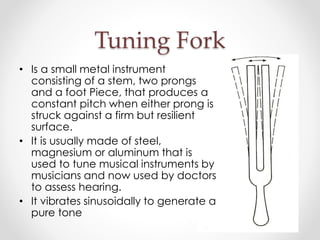
• Is a small metal instrument
consisting of a stem, two prongs
and a foot Piece, that produces a
constant pitch when either prong is
struck against a firm but resilient
surface.
• It is usually made of steel,
magnesium or aluminum that is
used to tune musical instruments by
musicians and now used by doctors
to assess hearing.
• It vibrates sinusoidally to generate a
pure tone
Tuning Fork Test
• Used to differentiate between conductive and
sensorineural hearing loss.
• Test is performed with different types of frequency
like 128,256,512, 1024,2048 Hz. Routine practices
256Hz,512 Hz,1024Hz are used.
• Larger forks vibrate at slower frequency.
• Tuning fork is activated by striking against
examiner's elbow, heel of hand and placed 2cm
away from EAC for Air conduction and on mastoid
for Bone conduction.
Air Conduction (AC)
• Vibrating tuning fork is placed vertically in line with
the meatus about 2 cm away from the EAC
opening.
• The sound waves transmitted through TM –Middle
ear ossicles-Inner ear –Auditory Nerve –Auditory
Cortex.
• Both Conductive mechanism and Cochlea are
tested
Bone Conduction (BC)
• Foot plate of Vibrating tuning fork is placed on the
mastoid bone.
• Cochlea is stimulated directly by the vibrations
conducted through the Skull.
• BC measures only the cochlear functions.
• Normally AC will be more than BC
Principles of Tuning Fork Tests
• Conductive Hearing loss (CHL)
o Sounds delivered to the ear via AC will be decreased
o If the sound is delivered to the ear via BC, bypassing
the OE & ME, then the sound will be heard normally
assuming there is no disorder.
• Sensory Hearing Loss (SNHL)
o Sounds delivered to the ear via BC will be deceased.
Types
• Rinne Test
• Weber Test
• ABC test
• Schwabach Test
• Gelle’s Test
• Bing Test
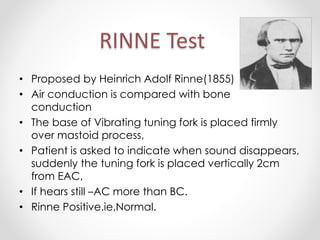
RINNE Test
• Proposed by Heinrich Adolf Rinne(1855)
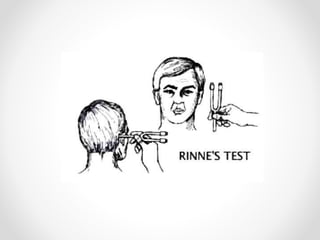
• Air conduction is compared with bone
conduction
• The base of Vibrating tuning fork is placed firmly
over mastoid process,
• Patient is asked to indicate when sound disappears,
suddenly the tuning fork is placed vertically 2cm
from EAC,
• If hears still –AC more than BC.
• Rinne Positive.ie,Normal.
Inference
• Rinne Positive
o Air Conduction >Bone Conduction=Normal or SNHL
• Rinne Negative
o Bone Conduction >Air Conduction =Conductive hearing
Loss
• False Negative Rinne
o Air conduction absent, but responds to bone conduction
o Response of bone conduction is due to transcranial
transmission from opposite ear
o Seen in UNILATERAL SENSORY HEARING LOSS.
Modified Rinne
• For routine purpose ,the patient is asked to
compare the sound intensities of tuning fork, while
placing in front of the ear and over the mastoid
process.
WEBER Test
• Proposed by Ernst Heinrich Weber.
• A test of lateralization
• A vibrating tuning fork is placed in the middle of
forehead or the vertex asked in which ear the
sound is heard.
• Normally, heard equally in both ears.
• Lateralized to the worst ear in conductive hearing
loss and better in Sensory neural loss ear.
• Sound travels directly to the cochlea through bone.
WEBER Test
• Based on “Stenger Principle”:
o If two tones are identical except they are
different in loudness, are introduced
simultaneously into both ears, only the louder
tone will be perceived
o Two ears, one has poorer BC sensitivity, when the
tone is being produced to both ears with equal
energy, the tone will be perceived softer or will
not be perceived at all in the poor ear.
Inference
• If the tone lateralizes to the poorer ear
• CHL in the poor ear
• If the tone lateralizes to the better/good ear:
• The cochlea with the best hearing sensitivity will detect the
signal
• SNHL in the poor ear
• If the sound is detected in the midline position:
• Normal hearing
• or equal amounts of the same type of HL in both ears (CHL,
SNHL)
SCHWABACH Test
• Once popular but no longer is in use.
• It compares pts. hearing sensitivity with that of an examiner
(assuming that he/she has a normal hearing).
• The fork is set into vibration, stem is placed alternately against
the mastoid process of the pt. and the examiner. Here meatus
is not closed.
• Vibratory energy of the tines of fork decreases overtime,
making the tone softer
• Pt. should indicate whether the tone is heard or not each time
• When the pt. no longer hears the tone, examiner immediately
places the stem behind his or her own ear and using a watch,
notes the number of seconds the tone is audible after the pt.
stops hearing it
Inference
• Normal Schwabach:
o Both pt. & examiner stop hearing the tone at
approximately the same time
• Pt. has normal BC
• Diminished Schwabach:
o Pt. stop hearing the sound much sooner than the examiner
• Pt. BC is impaired/SNHL
Absolute Bone Conduction(ABC)
• Modification of Schwabach test.
• Patients bone conduction is compared with that of
the examiner (assuming that he/she has a normal
hearing).
• EAC is occluded, by pressing the tragus inwards,to
prevent ambient noise entering through AC route.
• Inference
o Normal –Bone conduction of patient is equal to
examiner
o In SNHL ABC is reduced in comparison to examiner.
GELLE’s Test
• Test of bone conduction.
• Examines the effect of increased air pressure in ear
canal.
• Performed by vibrating fork on the mastoid
• By Increasing the pressure in the EAC with a Siegel's
speculum, it pushes the TM and ossicles inwards,
raises the intralabyrinthine pressure and causes
immobility of basilar membrane and decreased
hearing, but no change in hearing when ossicles
are fixed.
GELLE’s Test
• Inference
o Negative-When ossicular chain is fixed in case of
Otosclerosis or disconnected
o Positive –Normal case and SNHL
• This test is replaced with Tympanometry.
BING’s Test
• Proposed by Albert Bing
• It is test of Bone Conduction.
• Examines the effect of Occlusion of ear canal on
hearing.
• Vibrating tuning fork is placed on the mastoid while
examiner alternatively closes and open the ear
canal by pressing tragus inward.
• Inference
o Normal or SNHL hears louder when canal is occluded and
softer when the canal is open-BING POSITIVE
o CHL patients will appreciate no change.-BING NEGATIVE
Tuning Fork Tests For
Malingering
• Stenger’s test:
o This is based on “Stenger’s phenomenon”, when a listener is
presented with the same type of sound in both ears he will hear a
single sound, that too only in the ear which it is
louder. Procedure: Two tuning forks with frequency of 512 Hz are
kept equidistantly from both ears, one should be able to hear
equally well in either side. In malingering say i.e. left ear, even if
the tuning fork is moved too close to the left ear, the patient
denies that he is hearing in the right side also.
• Teal’s test:
o In this test a vibrating tuning fork is applied over the mastoid process
of the so called deaf ear, the patient accepts to hear it. Then the
patient is blind folded and with a non vibrating fork on the mastoid
process, the malingering patient claim’s to hear the sound.
• Chimani Mooss test:
o A variation of Weber’s test. Normally in Weber’s test the
patient hears the best in the occluded ear. In ,malingering
the patient will not accept to hear better in the occluded
ear.
Tuning Fork Tests For
Malingering
THANK YOU

Tuning fork test

  • 1.
  • 2.
    Tuning Fork • Isa small metal instrument consisting of a stem, two prongs and a foot Piece, that produces a constant pitch when either prong is struck against a firm but resilient surface. • It is usually made of steel, magnesium or aluminum that is used to tune musical instruments by musicians and now used by doctors to assess hearing. • It vibrates sinusoidally to generate a pure tone
  • 3.
    Tuning Fork Test •Used to differentiate between conductive and sensorineural hearing loss. • Test is performed with different types of frequency like 128,256,512, 1024,2048 Hz. Routine practices 256Hz,512 Hz,1024Hz are used. • Larger forks vibrate at slower frequency. • Tuning fork is activated by striking against examiner's elbow, heel of hand and placed 2cm away from EAC for Air conduction and on mastoid for Bone conduction.
  • 4.
    Air Conduction (AC) •Vibrating tuning fork is placed vertically in line with the meatus about 2 cm away from the EAC opening. • The sound waves transmitted through TM –Middle ear ossicles-Inner ear –Auditory Nerve –Auditory Cortex. • Both Conductive mechanism and Cochlea are tested
  • 5.
    Bone Conduction (BC) •Foot plate of Vibrating tuning fork is placed on the mastoid bone. • Cochlea is stimulated directly by the vibrations conducted through the Skull. • BC measures only the cochlear functions. • Normally AC will be more than BC
  • 7.
    Principles of TuningFork Tests • Conductive Hearing loss (CHL) o Sounds delivered to the ear via AC will be decreased o If the sound is delivered to the ear via BC, bypassing the OE & ME, then the sound will be heard normally assuming there is no disorder. • Sensory Hearing Loss (SNHL) o Sounds delivered to the ear via BC will be deceased.
  • 8.
    Types • Rinne Test •Weber Test • ABC test • Schwabach Test • Gelle’s Test • Bing Test
  • 9.
    RINNE Test • Proposedby Heinrich Adolf Rinne(1855) • Air conduction is compared with bone conduction • The base of Vibrating tuning fork is placed firmly over mastoid process, • Patient is asked to indicate when sound disappears, suddenly the tuning fork is placed vertically 2cm from EAC, • If hears still –AC more than BC. • Rinne Positive.ie,Normal.
  • 11.
    Inference • Rinne Positive oAir Conduction >Bone Conduction=Normal or SNHL • Rinne Negative o Bone Conduction >Air Conduction =Conductive hearing Loss • False Negative Rinne o Air conduction absent, but responds to bone conduction o Response of bone conduction is due to transcranial transmission from opposite ear o Seen in UNILATERAL SENSORY HEARING LOSS.
  • 12.
    Modified Rinne • Forroutine purpose ,the patient is asked to compare the sound intensities of tuning fork, while placing in front of the ear and over the mastoid process.
  • 13.
    WEBER Test • Proposedby Ernst Heinrich Weber. • A test of lateralization • A vibrating tuning fork is placed in the middle of forehead or the vertex asked in which ear the sound is heard. • Normally, heard equally in both ears. • Lateralized to the worst ear in conductive hearing loss and better in Sensory neural loss ear. • Sound travels directly to the cochlea through bone.
  • 14.
    WEBER Test • Basedon “Stenger Principle”: o If two tones are identical except they are different in loudness, are introduced simultaneously into both ears, only the louder tone will be perceived o Two ears, one has poorer BC sensitivity, when the tone is being produced to both ears with equal energy, the tone will be perceived softer or will not be perceived at all in the poor ear.
  • 15.
    Inference • If thetone lateralizes to the poorer ear • CHL in the poor ear • If the tone lateralizes to the better/good ear: • The cochlea with the best hearing sensitivity will detect the signal • SNHL in the poor ear • If the sound is detected in the midline position: • Normal hearing • or equal amounts of the same type of HL in both ears (CHL, SNHL)
  • 16.
    SCHWABACH Test • Oncepopular but no longer is in use. • It compares pts. hearing sensitivity with that of an examiner (assuming that he/she has a normal hearing). • The fork is set into vibration, stem is placed alternately against the mastoid process of the pt. and the examiner. Here meatus is not closed. • Vibratory energy of the tines of fork decreases overtime, making the tone softer • Pt. should indicate whether the tone is heard or not each time • When the pt. no longer hears the tone, examiner immediately places the stem behind his or her own ear and using a watch, notes the number of seconds the tone is audible after the pt. stops hearing it
  • 17.
    Inference • Normal Schwabach: oBoth pt. & examiner stop hearing the tone at approximately the same time • Pt. has normal BC • Diminished Schwabach: o Pt. stop hearing the sound much sooner than the examiner • Pt. BC is impaired/SNHL
  • 18.
    Absolute Bone Conduction(ABC) •Modification of Schwabach test. • Patients bone conduction is compared with that of the examiner (assuming that he/she has a normal hearing). • EAC is occluded, by pressing the tragus inwards,to prevent ambient noise entering through AC route. • Inference o Normal –Bone conduction of patient is equal to examiner o In SNHL ABC is reduced in comparison to examiner.
  • 19.
    GELLE’s Test • Testof bone conduction. • Examines the effect of increased air pressure in ear canal. • Performed by vibrating fork on the mastoid • By Increasing the pressure in the EAC with a Siegel's speculum, it pushes the TM and ossicles inwards, raises the intralabyrinthine pressure and causes immobility of basilar membrane and decreased hearing, but no change in hearing when ossicles are fixed.
  • 20.
    GELLE’s Test • Inference oNegative-When ossicular chain is fixed in case of Otosclerosis or disconnected o Positive –Normal case and SNHL • This test is replaced with Tympanometry.
  • 21.
    BING’s Test • Proposedby Albert Bing • It is test of Bone Conduction. • Examines the effect of Occlusion of ear canal on hearing. • Vibrating tuning fork is placed on the mastoid while examiner alternatively closes and open the ear canal by pressing tragus inward. • Inference o Normal or SNHL hears louder when canal is occluded and softer when the canal is open-BING POSITIVE o CHL patients will appreciate no change.-BING NEGATIVE
  • 22.
    Tuning Fork TestsFor Malingering • Stenger’s test: o This is based on “Stenger’s phenomenon”, when a listener is presented with the same type of sound in both ears he will hear a single sound, that too only in the ear which it is louder. Procedure: Two tuning forks with frequency of 512 Hz are kept equidistantly from both ears, one should be able to hear equally well in either side. In malingering say i.e. left ear, even if the tuning fork is moved too close to the left ear, the patient denies that he is hearing in the right side also. • Teal’s test: o In this test a vibrating tuning fork is applied over the mastoid process of the so called deaf ear, the patient accepts to hear it. Then the patient is blind folded and with a non vibrating fork on the mastoid process, the malingering patient claim’s to hear the sound.
  • 23.
    • Chimani Moosstest: o A variation of Weber’s test. Normally in Weber’s test the patient hears the best in the occluded ear. In ,malingering the patient will not accept to hear better in the occluded ear. Tuning Fork Tests For Malingering
  • 24.