AP Language Terms
Rhetorical Device- ABSOLUTE
• A word free from limitations or qualifications
(“best,” “all,” “unique,” “perfect”)
Syntax- Absolute Phrases
When a participle and the noun that comes
before it together forms an independent phrase,
the structure is often called an absolute phrase.
Example
Weather permitting we shall meet in the
evening.
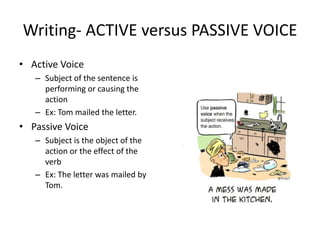
Writing- ACTIVE versus PASSIVE VOICE
• Active Voice
– Subject of the sentence is
performing or causing the
action
– Ex: Tom mailed the letter.
• Passive Voice
– Subject is the object of the
action or the effect of the
verb
– Ex: The letter was mailed by
Tom.
Reading- ADAGE
• A familiar proverb or wise saying
Example
One man's trash is another's treasure.
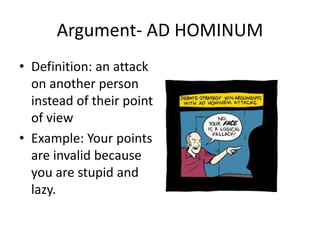
Argument- AD HOMINUM
• Definition: an attack
on another person
instead of their point
of view
• Example: Your points
are invalid because
you are stupid and
lazy.
Reading- Allegory
• A form of extended metaphor in
which objects and persons in a
narrative, either in prose or
verse, are equated with meanings
that lie outside the narrative
itself. Many works contain
allegories or are allegorical in
part, but not many are entirely
allegorical.
•Example
Faith is like a stony uphill climb: a
single stumble might send you
sprawling but belief and steadfastness
will see you to the very top.
Rhetorical Device- ALLITERATION
• The repetition of initial sounds in successive or
neighboring words.
• Consonance- the recurrence of similar sounds,
especially consonants, in close proximity (chiefly
as used in prosody).
• Assonance- Assonance takes place when two or
more words close to one another repeat the
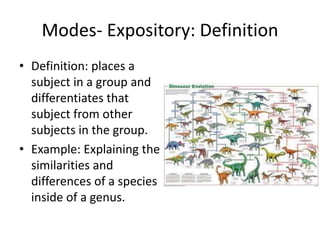
same vowel sound but start with different
consonant sounds.
Rhetorical Device- ALLUSION
• A reference to something literary,
mythological, or historical that the author
assumes the reader will recognize.
Reading- AMBIGUITY
• Definition:
Something that has a
confusing or uncertain
meaning, the meaning can
not be determined
• Example:
The passerby helps dog
bite victim.
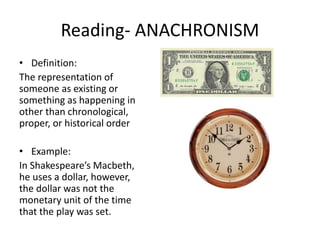
Reading- ANACHRONISM
• Definition:
The representation of
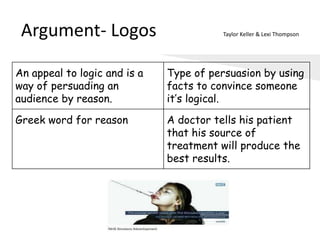
someone as existing or
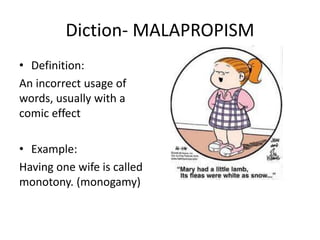
something as happening in
other than chronological,
proper, or historical order
• Example:
In Shakespeare’s Macbeth,
he uses a dollar, however,
the dollar was not the
monetary unit of the time
that the play was set.
Syntax- Anadiplosis
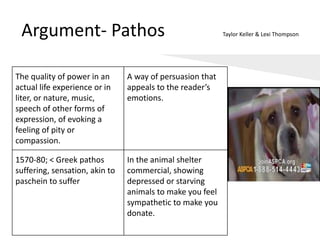
•Definition: A rhetorical trope formed by repeating the
last word of one phrase, clause or sentence near the
beginning of the next.
•Example:
“The mountains look on Marathon – And Marathon
looks on the sea…” From The Isles of Greece by Lord.
Rhetorical Device- ANALOGY
Dictionary Definition: (n) a
similarity between like
features of two things, on
which comparison may be
used.
Class Definition:
Comparison of two like
things.
Origin: Latin Example: I see no analogy
between your problem and
mine.
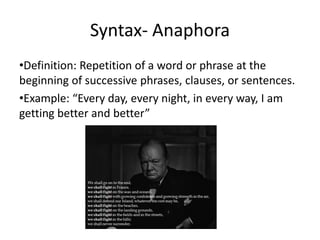
Syntax- Anaphora
•Definition: Repetition of a word or phrase at the
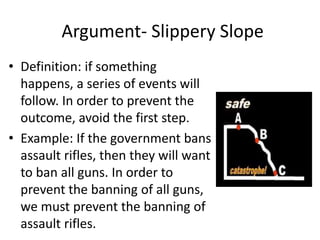
beginning of successive phrases, clauses, or sentences.
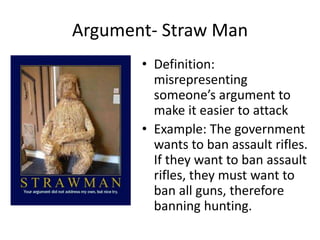
•Example: “Every day, every night, in every way, I am
getting better and better”
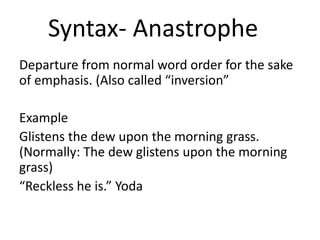
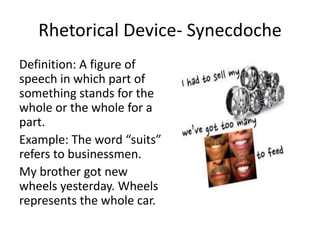
Syntax- Anastrophe
Departure from normal word order for the sake
of emphasis. (Also called “inversion”
Example
Glistens the dew upon the morning grass.
(Normally: The dew glistens upon the morning
grass)
“Reckless he is.” Yoda
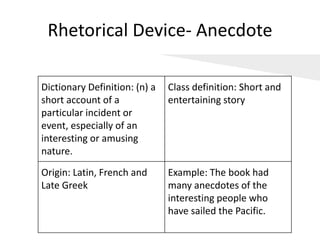
Rhetorical Device- Anecdote
Dictionary Definition: (n) a
short account of a
particular incident or
event, especially of an
interesting or amusing
nature.
Class definition: Short and
entertaining story
Origin: Latin, French and
Late Greek
Example: The book had
many anecdotes of the
interesting people who
have sailed the Pacific.
Syntax- ANTECEDENT
• The word, phrase, or clause to which a
pronoun refers
Example: When Chief Seattle spoke in the town
square, he expected Governor Stevens to
consider the message of the speech.
Seattle = he
Rhetorical Device- ANTITHESIS
• A statement in which two opposing words are
balanced
• “Setting foot on the moon may be a small step
for a man but a giant step for mankind.”
• (Small step, giant step)
Syntax- Antimetabole
Repetition of words, in successive clauses, in
reverse grammatical order.
(This figure is sometimes known as chiasmus).
Examples
When the going gets tough, the tough get going.
Ask not what your country can do for you; ask what
you can do for your country. —John F. Kennedy
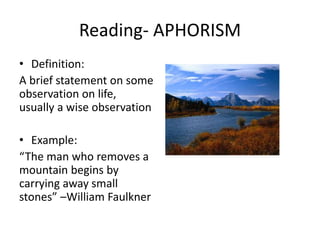
Reading- APHORISM
• Definition:
A brief statement on some
observation on life,
usually a wise observation
• Example:
“The man who removes a
mountain begins by
carrying away small
stones” –William Faulkner
Syntax- Apposition
Apposition: placing side by side two co-ordinate
elements, the second of which serves as an
explanation or modification of the first.
Example
Men of this kind--soldiers of fortune, pool hall
habitues, gigolos, beachcombers--waste their
time on trivialities.
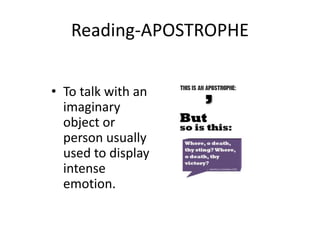
• To talk with an
imaginary
object or
person usually
used to display
intense
emotion.
Reading-APOSTROPHE
Reading- ARCHETYPE
• A detail, image, or character type that occurs
frequently in literature and myth and is
thought to appeal in a universal way to the
unconscious and evoke a response.
Examples: Brave soldier, tree of Life, nurturing
new mom, trickster fox, flood story, temptress
Argument- ARGUMENT
• A statement of the meaning, the claim, or
main point of a literary work or essay
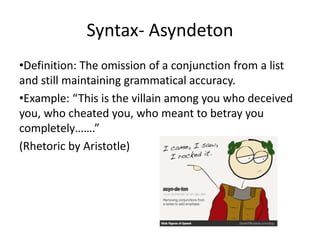
Syntax- Asyndeton
•Definition: The omission of a conjunction from a list
and still maintaining grammatical accuracy.
•Example: “This is the villain among you who deceived
you, who cheated you, who meant to betray you
completely…….”
(Rhetoric by Aristotle)
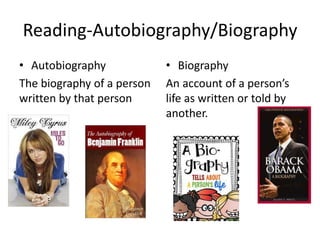
Reading-Autobiography/Biography
• Autobiography
The biography of a person
written by that person
• Biography
An account of a person’s
life as written or told by
another.
Syntax- BALANCED SENTENCE
• A sentence in which words, phrases, or clauses
are set off against each other to emphasize a
contrast
• Unbalanced: She doesn’t like washing
clothes or housework.
• Balanced: She doesn’t like washing
clothes or doing housework.
Syntax- BASIC ORDER
• Subject + verb + object
• Ex: I like pie.
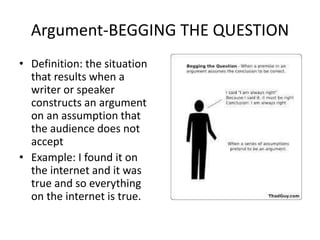
Argument-BEGGING THE QUESTION
• Definition: the situation
that results when a
writer or speaker
constructs an argument
on an assumption that
the audience does not
accept
• Example: I found it on
the internet and it was
true and so everything
on the internet is true.
Syntax- CHIASMUS
• A statement consisting of two parallel parts in
which the second part is structurally reversed
• Example- Susan walked in, and out rushed
Mary.
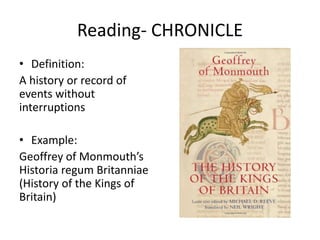
Reading- CHRONICLE
• Definition:
A history or record of
events without
interruptions
• Example:
Geoffrey of Monmouth’s
Historia regum Britanniae
(History of the Kings of
Britain)
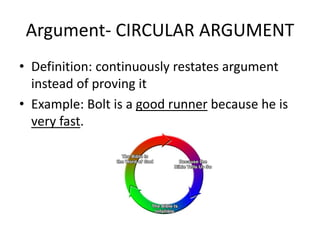
Argument- CIRCULAR ARGUMENT
• Definition: continuously restates argument
instead of proving it
• Example: Bolt is a good runner because he is
very fast.
Diction- CLICHÉ
• An expression that has been overused to the
extent that its freshness has worn off.
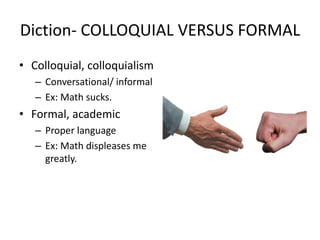
Diction- COLLOQUIAL VERSUS FORMAL
• Colloquial, colloquialism
– Conversational/ informal
– Ex: Math sucks.
• Formal, academic
– Proper language
– Ex: Math displeases me
greatly.
Syntax- Climax Sentence
Generally, the arrangement of words, phrases, or
clauses in an order of increasing importance, often
in parallel structure. More specifically, climax is the
repetition of the last word of one clause or
sentence at the beginning of the next, through
several clauses or sentences (= anadiplosis)
Examples
Miss America was not so much interested in serving
herself as she was eager to serve her family, her
community, and her nation.
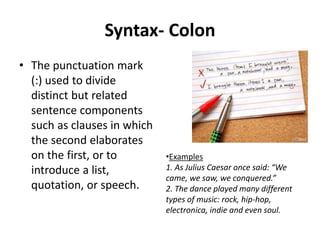
Syntax- Colon
• The punctuation mark
(:) used to divide
distinct but related
sentence components
such as clauses in which
the second elaborates
on the first, or to
introduce a list,
quotation, or speech.
•Examples
1. As Julius Caesar once said: “We
came, we saw, we conquered.”
2. The dance played many different
types of music: rock, hip-hop,
electronica, indie and even soul.
Syntax- Complex
•Definition: Contains an independent clause and one or
more dependent clauses
•Example: While the afternoon was hot, the pool water
kept us cool.
+ +
Syntax- Compound-Complex
• Definition: Contains one or more independent
clauses and one dependent clause.
• Example: We decided that the movie was too violent,
but our children, who like to watch scary movies,
thought we were wrong.
+ +
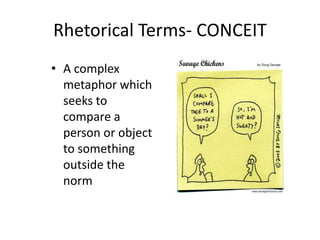
• A complex
metaphor which
seeks to
compare a
person or object
to something
outside the
norm
Rhetorical Terms- CONCEIT
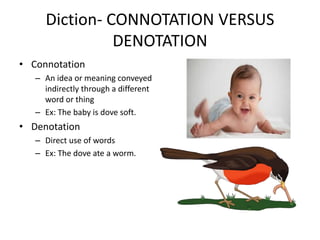
Diction- CONNOTATION VERSUS
DENOTATION
• Connotation
– An idea or meaning conveyed
indirectly through a different
word or thing
– Ex: The baby is dove soft.
• Denotation
– Direct use of words
– Ex: The dove ate a worm.
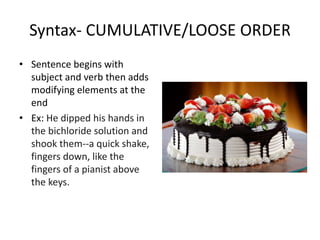
Syntax- CUMULATIVE/LOOSE ORDER
• Sentence begins with
subject and verb then adds
modifying elements at the
end
• Ex: He dipped his hands in
the bichloride solution and
shook them--a quick shake,
fingers down, like the
fingers of a pianist above
the keys.
Syntax- Dashes
• A punctuation mark (—)
used to indicate a sudden
break in thought, to set
off parenthetical material
Examples
1. The Ames Sentinel—
dated May 1, 2013—
arrived in June.
2. Joe — and his trusty
mutt — was always
welcome.
3. You are the friend—the
only friend—who offered
to help me.
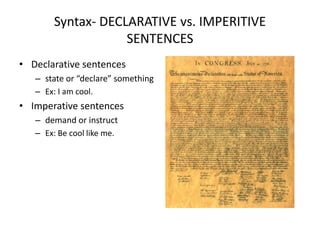
Syntax- DECLARATIVE vs. IMPERITIVE
SENTENCES
• Declarative sentences
– state or “declare” something
– Ex: I am cool.
• Imperative sentences
– demand or instruct
– Ex: Be cool like me.
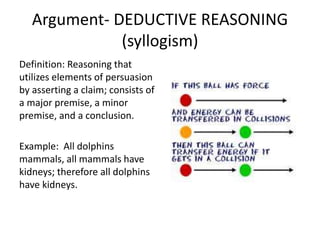
Argument- DEDUCTIVE REASONING
(syllogism)
Definition: Reasoning that
utilizes elements of persuasion
by asserting a claim; consists of
a major premise, a minor
premise, and a conclusion.
Example: All dolphins
mammals, all mammals have
kidneys; therefore all dolphins
have kidneys.
Diction- DIALECT
• A variety of speech characterized by its own
particular grammar or pronunciation, often
associated with a particular geographical
region
Diction- DICTION
• The word choices used by a writer.
• Remember- Writers don’t USE diction.
• Mark Twain’s regional diction evoked the
dialect of Missouri and Mississippi River folk.
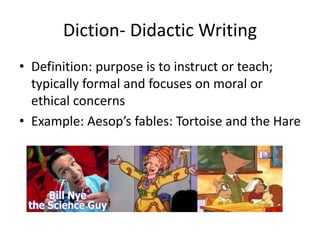
Diction- Didactic Writing
• Definition: purpose is to instruct or teach;
typically formal and focuses on moral or
ethical concerns
• Example: Aesop’s fables: Tortoise and the Hare
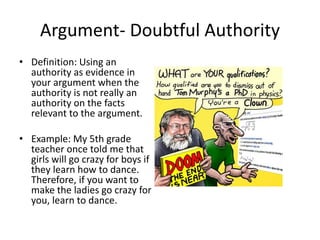
Argument- Doubtful Authority
• Definition: Using an
authority as evidence in
your argument when the
authority is not really an
authority on the facts
relevant to the argument.
• Example: My 5th grade
teacher once told me that
girls will go crazy for boys if
they learn how to dance.
Therefore, if you want to
make the ladies go crazy for
you, learn to dance.
Diction- Dissonance
• Harsh, inharmonious, or discordant sounds
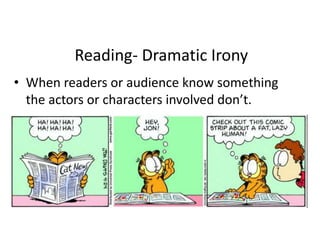
• When readers or audience know something
the actors or characters involved don’t.
Reading- Dramatic Irony
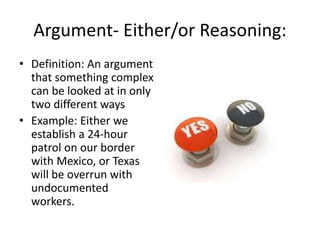
Argument- Either/or Reasoning:
• Definition: An argument
that something complex
can be looked at in only
two different ways
• Example: Either we
establish a 24-hour
patrol on our border
with Mexico, or Texas
will be overrun with
undocumented
workers.
Syntax- Ellipsis
• Definition: Three dots (…) used when an author is
intentionally omitting a word, phrase, or extended
piece of text (in a quote) without changing the
meaning. Placed at the end of a sentence it can
create a feeling of longing
• Examples: “Bohr used the analogy of parallel
stairways …” (Smith 55).
Syntax-Epistrophe
•Definition: The repetition of the same word or
words at the end of successive phrases, clauses,
or sentences. Counterpart to anaphora.
•Example: “Where now? Who now? When
now?”
(The Unnamable by Samuel Beckett)
Reading- EPIPHANY
• A moment of sudden revelation or insight
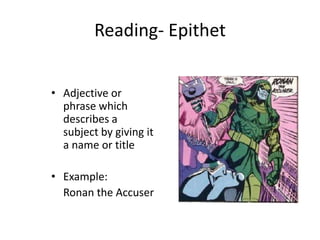
• Adjective or
phrase which
describes a
subject by giving it
a name or title
• Example:
Ronan the Accuser
Reading- Epithet
Argument- Ethos Taylor Keller & Lexi Thompson
The moral element in
dramatic literature that
determines a character’s
actions rather than their
thought or emotion.
Works with persuasion by
using the credibility or
appealing to your ethics
The term ethos comes from
Aristotle’s work meaning
“ingredients of persuasion”
or “appeals” for the correct
way to persuade.
When reading a medical
article, people tend to
believe it more if written by
a well experienced doctor.
Modes- Expository: Analysis
• Definition: discussion of a subject based on
content and style
• Example: A movie review
Diction- EUPHEMISM
• An indirect, less offensive way of saying
something that is considered unpleasant
• Janitor= sanitation engineer
• Toilet= bathroom, restroom, powder room
• To die= to pass, to sleep
Modes- Expository: Definition
• Definition: places a
subject in a group and
differentiates that
subject from other
subjects in the group.
• Example: Explaining the
similarities and
differences of a species
inside of a genus.
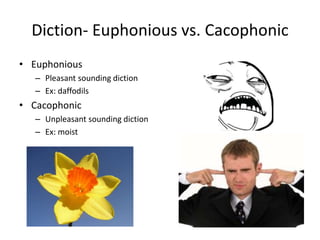
Diction- Euphonious vs. Cacophonic
• Euphonious
– Pleasant sounding diction
– Ex: daffodils
• Cacophonic
– Unpleasant sounding diction
– Ex: moist
Argument-False Analogy
• Definition: Comparing
two things that are
irrelevant and do not
pose a valid comparison
• Examples: Employees
are like nails. Just as
nails must be hit in the
head in order to make
them work, so must
employees.
Diction- EXPLETIVE
• An interjection to lend emphasis; sometimes,
profanity
Rhetorical Device- Figurative Language
• Language employing one or more figures of
speech (simile, metaphor, imagery, etc.)
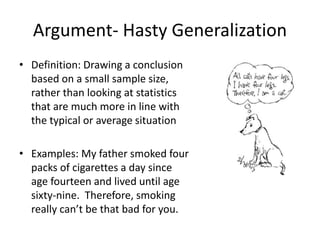
Argument- Hasty Generalization
• Definition: Drawing a conclusion
based on a small sample size,
rather than looking at statistics
that are much more in line with
the typical or average situation
• Examples: My father smoked four
packs of cigarettes a day since
age fourteen and lived until age
sixty-nine. Therefore, smoking
really can’t be that bad for you.
Syntax- Inverted Order
• Placing an adjective after
the noun it qualifies, a verb
before its subject, or a noun
before its preposition
• Ex: What a beautiful picture
it is!
Reading- Hubris
• Excessive pride
• Often, a character’s undoing or downfall is
due to hubris.
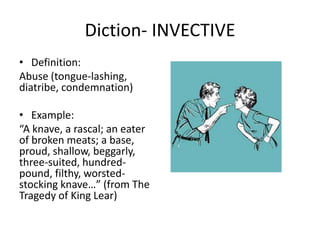
Diction- INVECTIVE
• Definition:
Abuse (tongue-lashing,
diatribe, condemnation)
• Example:
“A knave, a rascal; an eater
of broken meats; a base,
proud, shallow, beggarly,
three-suited, hundred-
pound, filthy, worsted-
stocking knave…” (from The
Tragedy of King Lear)
Rhetorical Device- Hyperbole
• Intentional exaggeration to create an effect
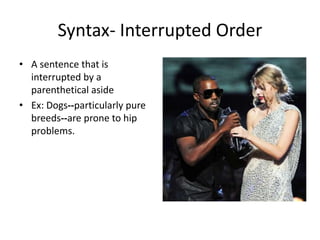
Syntax- Interrupted Order
• A sentence that is
interrupted by a
parenthetical aside
• Ex: Dogs--particularly pure
breeds--are prone to hip
problems.
Rhetorical Device- Hypothetical or
Rhetorical Question
• A question not meant for immediate answer
but to frame an argument, hypothesis,
conjecture or supposition
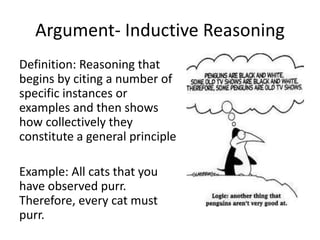
Argument- Inductive Reasoning
Definition: Reasoning that
begins by citing a number of
specific instances or
examples and then shows
how collectively they
constitute a general principle
Example: All cats that you
have observed purr.
Therefore, every cat must
purr.
Rhetorical Device- Imagery
• The use of figures of speech to create vivid
images that appeal to one of the senses
Argument- Implication
• A suggestion an author or speaker makes
(implies) without stating it directly.
• Note: the author/sender implies; the
reader/audience infers.
Diction- INVECTIVE
• An intensely vehement, highly emotional
verbal attack
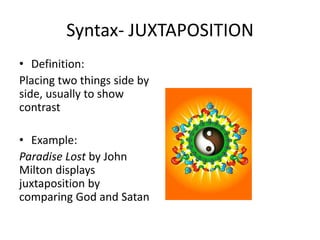
Syntax- JUXTAPOSITION
• Definition:
Placing two things side by
side, usually to show
contrast
• Example:
Paradise Lost by John
Milton displays
juxtaposition by
comparing God and Satan
Rhetorical Device- Litotes
• A type of understatement in which an ideas is
expressed by negating its opposite
• Example: Describing a horrific scene by saying,
“It was not a pretty picture.”
Argument- Logos Taylor Keller & Lexi Thompson
An appeal to logic and is a
way of persuading an
audience by reason.
Type of persuasion by using
facts to convince someone
it’s logical.
Greek word for reason A doctor tells his patient
that his source of
treatment will produce the
best results.
Diction- MALAPROPISM
• Definition:
An incorrect usage of
words, usually with a
comic effect
• Example:
Having one wife is called
monotony. (monogamy)
Rhetorical Device- Metaphor
• A direct comparison of two different things
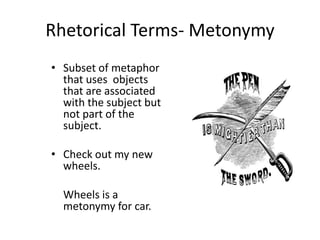
• Subset of metaphor
that uses objects
that are associated
with the subject but
not part of the
subject.
• Check out my new
wheels.
Wheels is a
metonymy for car.
Rhetorical Terms- Metonymy
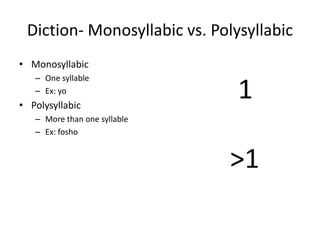
Diction- Monosyllabic vs. Polysyllabic
• Monosyllabic
– One syllable
– Ex: yo
• Polysyllabic
– More than one syllable
– Ex: fosho
1
>1
Reading- MOOD
• The atmosphere of a written piece. Mood
drives the overall tone and shifts in tone.
Reading- MOTIF
• A standard theme, element, dramatic
situation that recurs in various works
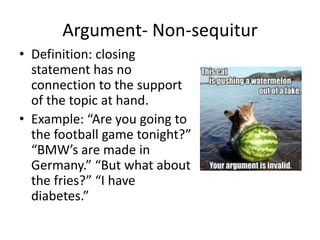
Argument- Non-sequitur
• Definition: closing
statement has no
connection to the support
of the topic at hand.
• Example: “Are you going to
the football game tonight?”
“BMW’s are made in
Germany.” “But what about
the fries?” “I have
diabetes.”
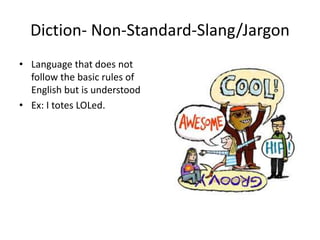
Diction- Non-Standard-Slang/Jargon
• Language that does not
follow the basic rules of
English but is understood
• Ex: I totes LOLed.
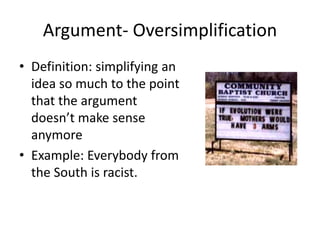
Argument- Oversimplification
• Definition: simplifying an
idea so much to the point
that the argument
doesn’t make sense
anymore
• Example: Everybody from
the South is racist.
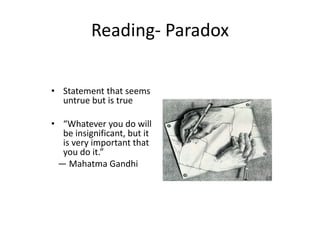
• Statement that seems
untrue but is true
• “Whatever you do will
be insignificant, but it
is very important that
you do it.”
― Mahatma Gandhi
Reading- Paradox
Argument- Pathos Taylor Keller & Lexi Thompson
The quality of power in an
actual life experience or in
liter, or nature, music,
speech of other forms of
expression, of evoking a
feeling of pity or
compassion.
A way of persuasion that
appeals to the reader’s
emotions.
1570-80; < Greek pathos
suffering, sensation, akin to
paschein to suffer
In the animal shelter
commercial, showing
depressed or starving
animals to make you feel
sympathetic to make you
donate.
Syntax- Parallelism-Balanced vs.
Parallelism-Antithesis vs. Parallelism-
Chiasmus• Balanced
– Similar ideas listed in a
sentence with repetitive
beginnings
– Ex: I came, I saw, I conquered
• Antithesis
– Contrasting two similar ideas
used to emphasize one part
– Ex: Grendel kills people;
Beowulf saves them.
• Chiasmus
– Where the second part is a
mirror of the first part
– Ex: Ask not what your country
can do for you – ask what you
can do for your country
Reading- Parenthetical Aside
• Consists of a word,
phrase, or whole
sentence inserted as an
aside in the middle of
another sentence. Often
punctuated with dashes
on each side
• Example
The mythographer Joseph
Campbell--who visited this
campus in the 1980s, by the
way--is perhaps best known
for his book The Hero with a
Thousand Faces.
Argument- Pathos
• An appeal to emotion- nostalgia, sympathy,
pity, etc.
• When the author makes a personal
connection to the reader
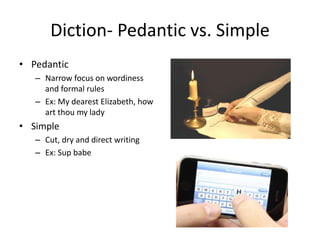
Diction- Pedantic vs. Simple
• Pedantic
– Narrow focus on wordiness
and formal rules
– Ex: My dearest Elizabeth, how
art thou my lady
• Simple
– Cut, dry and direct writing
– Ex: Sup babe
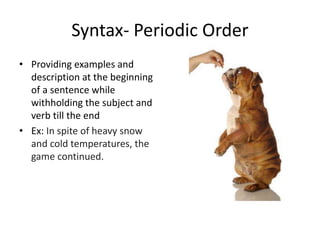
Syntax- Periodic Order
• Providing examples and
description at the beginning
of a sentence while
withholding the subject and
verb till the end
• Ex: In spite of heavy snow
and cold temperatures, the
game continued.
Reading- Plot
• Introduction
• Rising Action
• Climax
• Falling Action
• Resolution
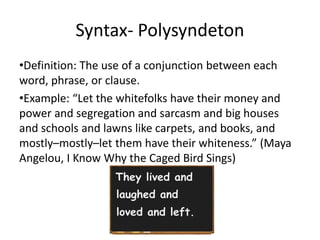
Syntax- Polysyndeton
•Definition: The use of a conjunction between each
word, phrase, or clause.
•Example: “Let the whitefolks have their money and
power and segregation and sarcasm and big houses
and schools and lawns like carpets, and books, and
mostly–mostly–let them have their whiteness.” (Maya
Angelou, I Know Why the Caged Bird Sings)
Syntax-Polyptoton
-
Repeating a word, but in a different form. Using
a cognate (root) of a given word in close
proximity.
Example
With eager feeding food doth choke the
feeder.
—John of Gaunt in Shakespeare's Richard II
2.1.37
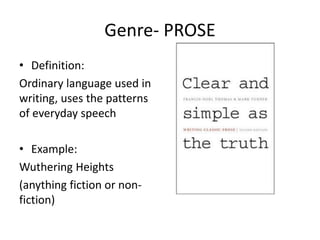
Genre- PROSE
• Definition:
Ordinary language used in
writing, uses the patterns
of everyday speech
• Example:
Wuthering Heights
(anything fiction or non-
fiction)
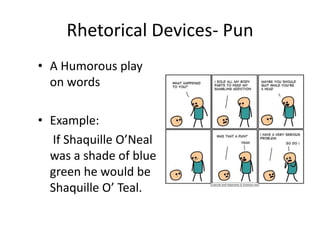
• A Humorous play
on words
• Example:
If Shaquille O’Neal
was a shade of blue
green he would be
Shaquille O’ Teal.
Rhetorical Devices- Pun
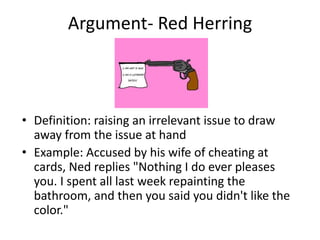
Argument- Red Herring
• Definition: raising an irrelevant issue to draw
away from the issue at hand
• Example: Accused by his wife of cheating at
cards, Ned replies "Nothing I do ever pleases
you. I spent all last week repainting the
bathroom, and then you said you didn't like the
color."
Rhetorical Device- Rhetoric
• The art of presenting ideas in a clear, effective,
and persuasive manner
• Rhetorical devices are literary techniques used
to heighten the effectiveness of expression or
purpose.
Reading- Romantic/romantic
• Romantic- a genre of American or British
literature that stressed emotion, imagination,
and individualism. Common subjects were
nature and spirituality.
• romantic- expressing caring feelings toward
someone.
Rhetorical Device- Sarcasm
• Harsh, cutting language or tone intended to
ridicule
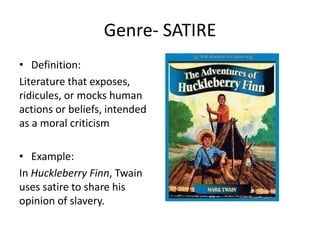
Genre- SATIRE
• Definition:
Literature that exposes,
ridicules, or mocks human
actions or beliefs, intended
as a moral criticism
• Example:
In Huckleberry Finn, Twain
uses satire to share his
opinion of slavery.
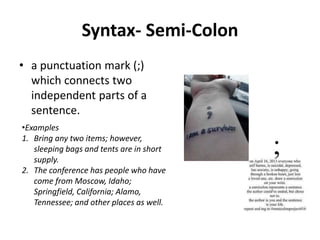
Syntax- Semi-Colon
• a punctuation mark (;)
which connects two
independent parts of a
sentence.
•Examples
1. Bring any two items; however,
sleeping bags and tents are in short
supply.
2. The conference has people who have
come from Moscow, Idaho;
Springfield, California; Alamo,
Tennessee; and other places as well.
Syntax- Sentence Structure
• Simple
– Definition: An independent clause with
one subject and one predicate (consists
of a verb)
– Example: The boy walked down the
dreary lane.
• Compound
– Definition: Two or more independent
clauses that are connected by a conjunction.
– Example: The boy walked down the dreary
lane and clutched a picture of his mom close
to his heart.
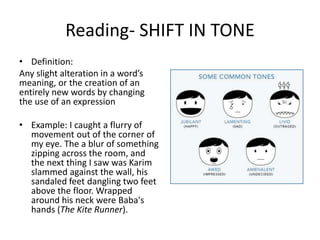
Reading- SHIFT IN TONE
• Definition:
Any slight alteration in a word’s
meaning, or the creation of an
entirely new words by changing
the use of an expression
• Example: I caught a flurry of
movement out of the corner of
my eye. The a blur of something
zipping across the room, and
the next thing I saw was Karim
slammed against the wall, his
sandaled feet dangling two feet
above the floor. Wrapped
around his neck were Baba's
hands (The Kite Runner).
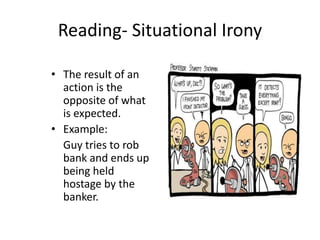
• The result of an
action is the
opposite of what
is expected.
• Example:
Guy tries to rob
bank and ends up
being held
hostage by the
banker.
Reading- Situational Irony
Argument- Slippery Slope
• Definition: if something
happens, a series of events will
follow. In order to prevent the
outcome, avoid the first step.
• Example: If the government bans
assault rifles, then they will want
to ban all guns. In order to
prevent the banning of all guns,
we must prevent the banning of
assault rifles.
Argument- Straw Man
• Definition:
misrepresenting
someone’s argument to
make it easier to attack
• Example: The government
wants to ban assault rifles.
If they want to ban assault
rifles, they must want to
ban all guns, therefore
banning hunting.
Genre- STREAM-OF-CONSCIOUSNESS
• Definition:
A style where the character’s thoughts and
feelings in a continuous, uninterrupted flow
• Example:
from Virginia Woolf’s novel To The Lighthouse
(1927):
“Raising her eyebrows at the discrepancy —
that was what she was thinking, this was what
she was doing — ladling out soup — she felt,
more and more strongly, outside that eddy; or
as if a shade had fallen, and, robbed of colour,
she saw things truly.”
Rhetorical Device- Synecdoche
Definition: A figure of
speech in which part of
something stands for the
whole or the whole for a
part.
Example: The word “suits”
refers to businessmen.
My brother got new
wheels yesterday. Wheels
represents the whole car.
Syntax- SYLLEPSIS
• A construction in which one word is used in
two different senses
• Example: After he threw the ball, he threw a
fit.
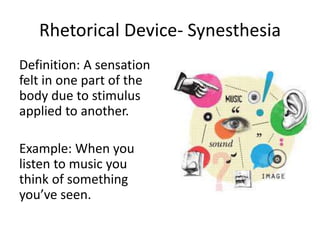
Rhetorical Device- Synesthesia
Definition: A sensation
felt in one part of the
body due to stimulus
applied to another.
Example: When you
listen to music you
think of something
you’ve seen.
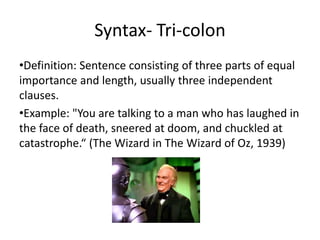
Syntax- Tri-colon
•Definition: Sentence consisting of three parts of equal
importance and length, usually three independent
clauses.
•Example: "You are talking to a man who has laughed in
the face of death, sneered at doom, and chuckled at
catastrophe.“ (The Wizard in The Wizard of Oz, 1939)
Rhetorical Device- Triad
The expression of related thoughts in a group of
three almost always using the same grammatical
form.
Examples
Declaration of Independence: “We mutually pledge
to each other our lives, our fortunes, and our
sacred honor.”
Franklin Roosevelt: “I see one-third of our nation ill-
housed, ill-clad, and ill-nourished.”
Abraham Lincoln: “The government of the people,
by the people, for the people….
SYNTAX- Syntax
• The manner in which words are arranged in
sentences.
• Includes grammar, punctuation, capitalization,
sentence variety and sentence type.
Diction- Tautology
• Needless repetition which adds no meaning or
understanding
• Examples: widow woman, free gift
Reading- THEME
• Central idea of a work
Reading- TONE
• The attitude of a writer, usually implied,
towards the subject or the audience
Diction- trite
• Overused and hackneyed
• Clichéd
(Note the “d” at the end of clichéd. Something is
clichéd, not cliché.)
Rhetorical Device- UNDERSTATEMENT
• The deliberate representation of something as
lesser in magnitude than it actually is; a
deliberate under-emphasis.
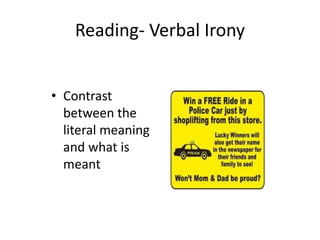
• Contrast
between the
literal meaning
and what is
meant
Reading- Verbal Irony
Diction- VERNACULAR
• The everyday speech of a particular country or
region, often involving nonstandard usage
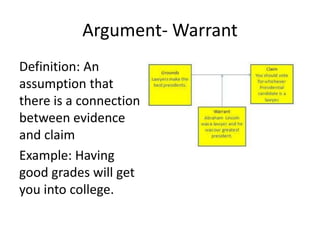
Argument- Warrant
Definition: An
assumption that
there is a connection
between evidence
and claim
Example: Having
good grades will get
you into college.
By Mr. Woodall and Ms. Wolfes’
AP Language students
Kennesaw Mountain High School 2014
Some definitions are from Applied
Practice 2008

Ap lang terms 2014 2015

  • 1.
  • 2.
    Rhetorical Device- ABSOLUTE •A word free from limitations or qualifications (“best,” “all,” “unique,” “perfect”)
  • 3.
    Syntax- Absolute Phrases Whena participle and the noun that comes before it together forms an independent phrase, the structure is often called an absolute phrase. Example Weather permitting we shall meet in the evening.
  • 4.
    Writing- ACTIVE versusPASSIVE VOICE • Active Voice – Subject of the sentence is performing or causing the action – Ex: Tom mailed the letter. • Passive Voice – Subject is the object of the action or the effect of the verb – Ex: The letter was mailed by Tom.
  • 5.
    Reading- ADAGE • Afamiliar proverb or wise saying Example One man's trash is another's treasure.
  • 6.
    Argument- AD HOMINUM •Definition: an attack on another person instead of their point of view • Example: Your points are invalid because you are stupid and lazy.
  • 7.
    Reading- Allegory • Aform of extended metaphor in which objects and persons in a narrative, either in prose or verse, are equated with meanings that lie outside the narrative itself. Many works contain allegories or are allegorical in part, but not many are entirely allegorical. •Example Faith is like a stony uphill climb: a single stumble might send you sprawling but belief and steadfastness will see you to the very top.
  • 8.
    Rhetorical Device- ALLITERATION •The repetition of initial sounds in successive or neighboring words. • Consonance- the recurrence of similar sounds, especially consonants, in close proximity (chiefly as used in prosody). • Assonance- Assonance takes place when two or more words close to one another repeat the same vowel sound but start with different consonant sounds.
  • 9.
    Rhetorical Device- ALLUSION •A reference to something literary, mythological, or historical that the author assumes the reader will recognize.
  • 10.
    Reading- AMBIGUITY • Definition: Somethingthat has a confusing or uncertain meaning, the meaning can not be determined • Example: The passerby helps dog bite victim.
  • 11.
    Reading- ANACHRONISM • Definition: Therepresentation of someone as existing or something as happening in other than chronological, proper, or historical order • Example: In Shakespeare’s Macbeth, he uses a dollar, however, the dollar was not the monetary unit of the time that the play was set.
  • 12.
    Syntax- Anadiplosis •Definition: Arhetorical trope formed by repeating the last word of one phrase, clause or sentence near the beginning of the next. •Example: “The mountains look on Marathon – And Marathon looks on the sea…” From The Isles of Greece by Lord.
  • 13.
    Rhetorical Device- ANALOGY DictionaryDefinition: (n) a similarity between like features of two things, on which comparison may be used. Class Definition: Comparison of two like things. Origin: Latin Example: I see no analogy between your problem and mine.
  • 14.
    Syntax- Anaphora •Definition: Repetitionof a word or phrase at the beginning of successive phrases, clauses, or sentences. •Example: “Every day, every night, in every way, I am getting better and better”
  • 15.
    Syntax- Anastrophe Departure fromnormal word order for the sake of emphasis. (Also called “inversion” Example Glistens the dew upon the morning grass. (Normally: The dew glistens upon the morning grass) “Reckless he is.” Yoda
  • 16.
    Rhetorical Device- Anecdote DictionaryDefinition: (n) a short account of a particular incident or event, especially of an interesting or amusing nature. Class definition: Short and entertaining story Origin: Latin, French and Late Greek Example: The book had many anecdotes of the interesting people who have sailed the Pacific.
  • 17.
    Syntax- ANTECEDENT • Theword, phrase, or clause to which a pronoun refers Example: When Chief Seattle spoke in the town square, he expected Governor Stevens to consider the message of the speech. Seattle = he
  • 18.
    Rhetorical Device- ANTITHESIS •A statement in which two opposing words are balanced • “Setting foot on the moon may be a small step for a man but a giant step for mankind.” • (Small step, giant step)
  • 19.
    Syntax- Antimetabole Repetition ofwords, in successive clauses, in reverse grammatical order. (This figure is sometimes known as chiasmus). Examples When the going gets tough, the tough get going. Ask not what your country can do for you; ask what you can do for your country. —John F. Kennedy
  • 20.
    Reading- APHORISM • Definition: Abrief statement on some observation on life, usually a wise observation • Example: “The man who removes a mountain begins by carrying away small stones” –William Faulkner
  • 21.
    Syntax- Apposition Apposition: placingside by side two co-ordinate elements, the second of which serves as an explanation or modification of the first. Example Men of this kind--soldiers of fortune, pool hall habitues, gigolos, beachcombers--waste their time on trivialities.
  • 22.
    • To talkwith an imaginary object or person usually used to display intense emotion. Reading-APOSTROPHE
  • 23.
    Reading- ARCHETYPE • Adetail, image, or character type that occurs frequently in literature and myth and is thought to appeal in a universal way to the unconscious and evoke a response. Examples: Brave soldier, tree of Life, nurturing new mom, trickster fox, flood story, temptress
  • 24.
    Argument- ARGUMENT • Astatement of the meaning, the claim, or main point of a literary work or essay
  • 25.
    Syntax- Asyndeton •Definition: Theomission of a conjunction from a list and still maintaining grammatical accuracy. •Example: “This is the villain among you who deceived you, who cheated you, who meant to betray you completely…….” (Rhetoric by Aristotle)
  • 26.
    Reading-Autobiography/Biography • Autobiography The biographyof a person written by that person • Biography An account of a person’s life as written or told by another.
  • 27.
    Syntax- BALANCED SENTENCE •A sentence in which words, phrases, or clauses are set off against each other to emphasize a contrast • Unbalanced: She doesn’t like washing clothes or housework. • Balanced: She doesn’t like washing clothes or doing housework.
  • 28.
    Syntax- BASIC ORDER •Subject + verb + object • Ex: I like pie.
  • 29.
    Argument-BEGGING THE QUESTION •Definition: the situation that results when a writer or speaker constructs an argument on an assumption that the audience does not accept • Example: I found it on the internet and it was true and so everything on the internet is true.
  • 30.
    Syntax- CHIASMUS • Astatement consisting of two parallel parts in which the second part is structurally reversed • Example- Susan walked in, and out rushed Mary.
  • 31.
    Reading- CHRONICLE • Definition: Ahistory or record of events without interruptions • Example: Geoffrey of Monmouth’s Historia regum Britanniae (History of the Kings of Britain)
  • 32.
    Argument- CIRCULAR ARGUMENT •Definition: continuously restates argument instead of proving it • Example: Bolt is a good runner because he is very fast.
  • 33.
    Diction- CLICHÉ • Anexpression that has been overused to the extent that its freshness has worn off.
  • 34.
    Diction- COLLOQUIAL VERSUSFORMAL • Colloquial, colloquialism – Conversational/ informal – Ex: Math sucks. • Formal, academic – Proper language – Ex: Math displeases me greatly.
  • 35.
    Syntax- Climax Sentence Generally,the arrangement of words, phrases, or clauses in an order of increasing importance, often in parallel structure. More specifically, climax is the repetition of the last word of one clause or sentence at the beginning of the next, through several clauses or sentences (= anadiplosis) Examples Miss America was not so much interested in serving herself as she was eager to serve her family, her community, and her nation.
  • 36.
    Syntax- Colon • Thepunctuation mark (:) used to divide distinct but related sentence components such as clauses in which the second elaborates on the first, or to introduce a list, quotation, or speech. •Examples 1. As Julius Caesar once said: “We came, we saw, we conquered.” 2. The dance played many different types of music: rock, hip-hop, electronica, indie and even soul.
  • 37.
    Syntax- Complex •Definition: Containsan independent clause and one or more dependent clauses •Example: While the afternoon was hot, the pool water kept us cool. + +
  • 38.
    Syntax- Compound-Complex • Definition:Contains one or more independent clauses and one dependent clause. • Example: We decided that the movie was too violent, but our children, who like to watch scary movies, thought we were wrong. + +
  • 39.
    • A complex metaphorwhich seeks to compare a person or object to something outside the norm Rhetorical Terms- CONCEIT
  • 40.
    Diction- CONNOTATION VERSUS DENOTATION •Connotation – An idea or meaning conveyed indirectly through a different word or thing – Ex: The baby is dove soft. • Denotation – Direct use of words – Ex: The dove ate a worm.
  • 41.
    Syntax- CUMULATIVE/LOOSE ORDER •Sentence begins with subject and verb then adds modifying elements at the end • Ex: He dipped his hands in the bichloride solution and shook them--a quick shake, fingers down, like the fingers of a pianist above the keys.
  • 42.
    Syntax- Dashes • Apunctuation mark (—) used to indicate a sudden break in thought, to set off parenthetical material Examples 1. The Ames Sentinel— dated May 1, 2013— arrived in June. 2. Joe — and his trusty mutt — was always welcome. 3. You are the friend—the only friend—who offered to help me.
  • 43.
    Syntax- DECLARATIVE vs.IMPERITIVE SENTENCES • Declarative sentences – state or “declare” something – Ex: I am cool. • Imperative sentences – demand or instruct – Ex: Be cool like me.
  • 44.
    Argument- DEDUCTIVE REASONING (syllogism) Definition:Reasoning that utilizes elements of persuasion by asserting a claim; consists of a major premise, a minor premise, and a conclusion. Example: All dolphins mammals, all mammals have kidneys; therefore all dolphins have kidneys.
  • 45.
    Diction- DIALECT • Avariety of speech characterized by its own particular grammar or pronunciation, often associated with a particular geographical region
  • 46.
    Diction- DICTION • Theword choices used by a writer. • Remember- Writers don’t USE diction. • Mark Twain’s regional diction evoked the dialect of Missouri and Mississippi River folk.
  • 47.
    Diction- Didactic Writing •Definition: purpose is to instruct or teach; typically formal and focuses on moral or ethical concerns • Example: Aesop’s fables: Tortoise and the Hare
  • 48.
    Argument- Doubtful Authority •Definition: Using an authority as evidence in your argument when the authority is not really an authority on the facts relevant to the argument. • Example: My 5th grade teacher once told me that girls will go crazy for boys if they learn how to dance. Therefore, if you want to make the ladies go crazy for you, learn to dance.
  • 49.
    Diction- Dissonance • Harsh,inharmonious, or discordant sounds
  • 50.
    • When readersor audience know something the actors or characters involved don’t. Reading- Dramatic Irony
  • 51.
    Argument- Either/or Reasoning: •Definition: An argument that something complex can be looked at in only two different ways • Example: Either we establish a 24-hour patrol on our border with Mexico, or Texas will be overrun with undocumented workers.
  • 52.
    Syntax- Ellipsis • Definition:Three dots (…) used when an author is intentionally omitting a word, phrase, or extended piece of text (in a quote) without changing the meaning. Placed at the end of a sentence it can create a feeling of longing • Examples: “Bohr used the analogy of parallel stairways …” (Smith 55).
  • 53.
    Syntax-Epistrophe •Definition: The repetitionof the same word or words at the end of successive phrases, clauses, or sentences. Counterpart to anaphora. •Example: “Where now? Who now? When now?” (The Unnamable by Samuel Beckett)
  • 54.
    Reading- EPIPHANY • Amoment of sudden revelation or insight
  • 55.
    • Adjective or phrasewhich describes a subject by giving it a name or title • Example: Ronan the Accuser Reading- Epithet
  • 56.
    Argument- Ethos TaylorKeller & Lexi Thompson The moral element in dramatic literature that determines a character’s actions rather than their thought or emotion. Works with persuasion by using the credibility or appealing to your ethics The term ethos comes from Aristotle’s work meaning “ingredients of persuasion” or “appeals” for the correct way to persuade. When reading a medical article, people tend to believe it more if written by a well experienced doctor.
  • 57.
    Modes- Expository: Analysis •Definition: discussion of a subject based on content and style • Example: A movie review
  • 58.
    Diction- EUPHEMISM • Anindirect, less offensive way of saying something that is considered unpleasant • Janitor= sanitation engineer • Toilet= bathroom, restroom, powder room • To die= to pass, to sleep
  • 59.
    Modes- Expository: Definition •Definition: places a subject in a group and differentiates that subject from other subjects in the group. • Example: Explaining the similarities and differences of a species inside of a genus.
  • 60.
    Diction- Euphonious vs.Cacophonic • Euphonious – Pleasant sounding diction – Ex: daffodils • Cacophonic – Unpleasant sounding diction – Ex: moist
  • 61.
    Argument-False Analogy • Definition:Comparing two things that are irrelevant and do not pose a valid comparison • Examples: Employees are like nails. Just as nails must be hit in the head in order to make them work, so must employees.
  • 62.
    Diction- EXPLETIVE • Aninterjection to lend emphasis; sometimes, profanity
  • 63.
    Rhetorical Device- FigurativeLanguage • Language employing one or more figures of speech (simile, metaphor, imagery, etc.)
  • 64.
    Argument- Hasty Generalization •Definition: Drawing a conclusion based on a small sample size, rather than looking at statistics that are much more in line with the typical or average situation • Examples: My father smoked four packs of cigarettes a day since age fourteen and lived until age sixty-nine. Therefore, smoking really can’t be that bad for you.
  • 65.
    Syntax- Inverted Order •Placing an adjective after the noun it qualifies, a verb before its subject, or a noun before its preposition • Ex: What a beautiful picture it is!
  • 66.
    Reading- Hubris • Excessivepride • Often, a character’s undoing or downfall is due to hubris.
  • 67.
    Diction- INVECTIVE • Definition: Abuse(tongue-lashing, diatribe, condemnation) • Example: “A knave, a rascal; an eater of broken meats; a base, proud, shallow, beggarly, three-suited, hundred- pound, filthy, worsted- stocking knave…” (from The Tragedy of King Lear)
  • 68.
    Rhetorical Device- Hyperbole •Intentional exaggeration to create an effect
  • 69.
    Syntax- Interrupted Order •A sentence that is interrupted by a parenthetical aside • Ex: Dogs--particularly pure breeds--are prone to hip problems.
  • 70.
    Rhetorical Device- Hypotheticalor Rhetorical Question • A question not meant for immediate answer but to frame an argument, hypothesis, conjecture or supposition
  • 71.
    Argument- Inductive Reasoning Definition:Reasoning that begins by citing a number of specific instances or examples and then shows how collectively they constitute a general principle Example: All cats that you have observed purr. Therefore, every cat must purr.
  • 72.
    Rhetorical Device- Imagery •The use of figures of speech to create vivid images that appeal to one of the senses
  • 73.
    Argument- Implication • Asuggestion an author or speaker makes (implies) without stating it directly. • Note: the author/sender implies; the reader/audience infers.
  • 74.
    Diction- INVECTIVE • Anintensely vehement, highly emotional verbal attack
  • 75.
    Syntax- JUXTAPOSITION • Definition: Placingtwo things side by side, usually to show contrast • Example: Paradise Lost by John Milton displays juxtaposition by comparing God and Satan
  • 76.
    Rhetorical Device- Litotes •A type of understatement in which an ideas is expressed by negating its opposite • Example: Describing a horrific scene by saying, “It was not a pretty picture.”
  • 77.
    Argument- Logos TaylorKeller & Lexi Thompson An appeal to logic and is a way of persuading an audience by reason. Type of persuasion by using facts to convince someone it’s logical. Greek word for reason A doctor tells his patient that his source of treatment will produce the best results.
  • 78.
    Diction- MALAPROPISM • Definition: Anincorrect usage of words, usually with a comic effect • Example: Having one wife is called monotony. (monogamy)
  • 79.
    Rhetorical Device- Metaphor •A direct comparison of two different things
  • 80.
    • Subset ofmetaphor that uses objects that are associated with the subject but not part of the subject. • Check out my new wheels. Wheels is a metonymy for car. Rhetorical Terms- Metonymy
  • 81.
    Diction- Monosyllabic vs.Polysyllabic • Monosyllabic – One syllable – Ex: yo • Polysyllabic – More than one syllable – Ex: fosho 1 >1
  • 82.
    Reading- MOOD • Theatmosphere of a written piece. Mood drives the overall tone and shifts in tone.
  • 83.
    Reading- MOTIF • Astandard theme, element, dramatic situation that recurs in various works
  • 84.
    Argument- Non-sequitur • Definition:closing statement has no connection to the support of the topic at hand. • Example: “Are you going to the football game tonight?” “BMW’s are made in Germany.” “But what about the fries?” “I have diabetes.”
  • 85.
    Diction- Non-Standard-Slang/Jargon • Languagethat does not follow the basic rules of English but is understood • Ex: I totes LOLed.
  • 86.
    Argument- Oversimplification • Definition:simplifying an idea so much to the point that the argument doesn’t make sense anymore • Example: Everybody from the South is racist.
  • 87.
    • Statement thatseems untrue but is true • “Whatever you do will be insignificant, but it is very important that you do it.” ― Mahatma Gandhi Reading- Paradox
  • 88.
    Argument- Pathos TaylorKeller & Lexi Thompson The quality of power in an actual life experience or in liter, or nature, music, speech of other forms of expression, of evoking a feeling of pity or compassion. A way of persuasion that appeals to the reader’s emotions. 1570-80; < Greek pathos suffering, sensation, akin to paschein to suffer In the animal shelter commercial, showing depressed or starving animals to make you feel sympathetic to make you donate.
  • 89.
    Syntax- Parallelism-Balanced vs. Parallelism-Antithesisvs. Parallelism- Chiasmus• Balanced – Similar ideas listed in a sentence with repetitive beginnings – Ex: I came, I saw, I conquered • Antithesis – Contrasting two similar ideas used to emphasize one part – Ex: Grendel kills people; Beowulf saves them. • Chiasmus – Where the second part is a mirror of the first part – Ex: Ask not what your country can do for you – ask what you can do for your country
  • 90.
    Reading- Parenthetical Aside •Consists of a word, phrase, or whole sentence inserted as an aside in the middle of another sentence. Often punctuated with dashes on each side • Example The mythographer Joseph Campbell--who visited this campus in the 1980s, by the way--is perhaps best known for his book The Hero with a Thousand Faces.
  • 91.
    Argument- Pathos • Anappeal to emotion- nostalgia, sympathy, pity, etc. • When the author makes a personal connection to the reader
  • 92.
    Diction- Pedantic vs.Simple • Pedantic – Narrow focus on wordiness and formal rules – Ex: My dearest Elizabeth, how art thou my lady • Simple – Cut, dry and direct writing – Ex: Sup babe
  • 93.
    Syntax- Periodic Order •Providing examples and description at the beginning of a sentence while withholding the subject and verb till the end • Ex: In spite of heavy snow and cold temperatures, the game continued.
  • 94.
    Reading- Plot • Introduction •Rising Action • Climax • Falling Action • Resolution
  • 95.
    Syntax- Polysyndeton •Definition: Theuse of a conjunction between each word, phrase, or clause. •Example: “Let the whitefolks have their money and power and segregation and sarcasm and big houses and schools and lawns like carpets, and books, and mostly–mostly–let them have their whiteness.” (Maya Angelou, I Know Why the Caged Bird Sings)
  • 96.
    Syntax-Polyptoton - Repeating a word,but in a different form. Using a cognate (root) of a given word in close proximity. Example With eager feeding food doth choke the feeder. —John of Gaunt in Shakespeare's Richard II 2.1.37
  • 97.
    Genre- PROSE • Definition: Ordinarylanguage used in writing, uses the patterns of everyday speech • Example: Wuthering Heights (anything fiction or non- fiction)
  • 98.
    • A Humorousplay on words • Example: If Shaquille O’Neal was a shade of blue green he would be Shaquille O’ Teal. Rhetorical Devices- Pun
  • 99.
    Argument- Red Herring •Definition: raising an irrelevant issue to draw away from the issue at hand • Example: Accused by his wife of cheating at cards, Ned replies "Nothing I do ever pleases you. I spent all last week repainting the bathroom, and then you said you didn't like the color."
  • 100.
    Rhetorical Device- Rhetoric •The art of presenting ideas in a clear, effective, and persuasive manner • Rhetorical devices are literary techniques used to heighten the effectiveness of expression or purpose.
  • 101.
    Reading- Romantic/romantic • Romantic-a genre of American or British literature that stressed emotion, imagination, and individualism. Common subjects were nature and spirituality. • romantic- expressing caring feelings toward someone.
  • 102.
    Rhetorical Device- Sarcasm •Harsh, cutting language or tone intended to ridicule
  • 103.
    Genre- SATIRE • Definition: Literaturethat exposes, ridicules, or mocks human actions or beliefs, intended as a moral criticism • Example: In Huckleberry Finn, Twain uses satire to share his opinion of slavery.
  • 104.
    Syntax- Semi-Colon • apunctuation mark (;) which connects two independent parts of a sentence. •Examples 1. Bring any two items; however, sleeping bags and tents are in short supply. 2. The conference has people who have come from Moscow, Idaho; Springfield, California; Alamo, Tennessee; and other places as well.
  • 105.
    Syntax- Sentence Structure •Simple – Definition: An independent clause with one subject and one predicate (consists of a verb) – Example: The boy walked down the dreary lane. • Compound – Definition: Two or more independent clauses that are connected by a conjunction. – Example: The boy walked down the dreary lane and clutched a picture of his mom close to his heart.
  • 106.
    Reading- SHIFT INTONE • Definition: Any slight alteration in a word’s meaning, or the creation of an entirely new words by changing the use of an expression • Example: I caught a flurry of movement out of the corner of my eye. The a blur of something zipping across the room, and the next thing I saw was Karim slammed against the wall, his sandaled feet dangling two feet above the floor. Wrapped around his neck were Baba's hands (The Kite Runner).
  • 107.
    • The resultof an action is the opposite of what is expected. • Example: Guy tries to rob bank and ends up being held hostage by the banker. Reading- Situational Irony
  • 108.
    Argument- Slippery Slope •Definition: if something happens, a series of events will follow. In order to prevent the outcome, avoid the first step. • Example: If the government bans assault rifles, then they will want to ban all guns. In order to prevent the banning of all guns, we must prevent the banning of assault rifles.
  • 109.
    Argument- Straw Man •Definition: misrepresenting someone’s argument to make it easier to attack • Example: The government wants to ban assault rifles. If they want to ban assault rifles, they must want to ban all guns, therefore banning hunting.
  • 110.
    Genre- STREAM-OF-CONSCIOUSNESS • Definition: Astyle where the character’s thoughts and feelings in a continuous, uninterrupted flow • Example: from Virginia Woolf’s novel To The Lighthouse (1927): “Raising her eyebrows at the discrepancy — that was what she was thinking, this was what she was doing — ladling out soup — she felt, more and more strongly, outside that eddy; or as if a shade had fallen, and, robbed of colour, she saw things truly.”
  • 111.
    Rhetorical Device- Synecdoche Definition:A figure of speech in which part of something stands for the whole or the whole for a part. Example: The word “suits” refers to businessmen. My brother got new wheels yesterday. Wheels represents the whole car.
  • 112.
    Syntax- SYLLEPSIS • Aconstruction in which one word is used in two different senses • Example: After he threw the ball, he threw a fit.
  • 113.
    Rhetorical Device- Synesthesia Definition:A sensation felt in one part of the body due to stimulus applied to another. Example: When you listen to music you think of something you’ve seen.
  • 114.
    Syntax- Tri-colon •Definition: Sentenceconsisting of three parts of equal importance and length, usually three independent clauses. •Example: "You are talking to a man who has laughed in the face of death, sneered at doom, and chuckled at catastrophe.“ (The Wizard in The Wizard of Oz, 1939)
  • 115.
    Rhetorical Device- Triad Theexpression of related thoughts in a group of three almost always using the same grammatical form. Examples Declaration of Independence: “We mutually pledge to each other our lives, our fortunes, and our sacred honor.” Franklin Roosevelt: “I see one-third of our nation ill- housed, ill-clad, and ill-nourished.” Abraham Lincoln: “The government of the people, by the people, for the people….
  • 116.
    SYNTAX- Syntax • Themanner in which words are arranged in sentences. • Includes grammar, punctuation, capitalization, sentence variety and sentence type.
  • 117.
    Diction- Tautology • Needlessrepetition which adds no meaning or understanding • Examples: widow woman, free gift
  • 118.
  • 119.
    Reading- TONE • Theattitude of a writer, usually implied, towards the subject or the audience
  • 120.
    Diction- trite • Overusedand hackneyed • Clichéd (Note the “d” at the end of clichéd. Something is clichéd, not cliché.)
  • 121.
    Rhetorical Device- UNDERSTATEMENT •The deliberate representation of something as lesser in magnitude than it actually is; a deliberate under-emphasis.
  • 122.
    • Contrast between the literalmeaning and what is meant Reading- Verbal Irony
  • 123.
    Diction- VERNACULAR • Theeveryday speech of a particular country or region, often involving nonstandard usage
  • 124.
    Argument- Warrant Definition: An assumptionthat there is a connection between evidence and claim Example: Having good grades will get you into college.
  • 125.
    By Mr. Woodalland Ms. Wolfes’ AP Language students Kennesaw Mountain High School 2014 Some definitions are from Applied Practice 2008