


Theories, Principles and
Practices of
Service-Learning
Divino L. Cantal Jr.
Faculty of Media Studies
College of Arts and Sciences
Trinity University of Asia
(Presented during the CUAC Summer 2013 Conference on S-L,
25-27 June 2013. Trinity University of Asia, Quezon City, Philippines
Why Embrace Service-Learning?
HAVE
Service-Learning serves as a bridge that narrows the
gap between those who have and who have not.
What is Service-Learning?
•a union of public and community service with structured
and intentional learning (Howard Berry, 1990)
•knowing and doing (Linda Chisholm, 1990)
•a method that enhances what is taught in school by
extending student learning beyond the classroom and
into the community and helps foster a sense of caring for
others (National Service Act of 1990)
What is Service-Learning?
•An academic study and community service designed and intended
to illustrate and reinforce knowledge learned in the classroom
through the process of critical thought and self-reflection (Butterfly
Effect, Lingnan University 2012)
•an experiential learning, a process of social educational exchange
between the learners and the people they serve.
Types of Services Rendered
A voluntary work in a local
community or non-
governmental agencies
usually done in personal
apostolic work, though
maybe connected with
academic instruction, this is
not a requirement of the
course.
Community Outreach Program
Types of Services Rendered
Internship or Practicum
Service performed by
students in the industry or
field of their specialization
where they test the validity of
their classroom theories in
actual professional practice.
Types of Services Rendered
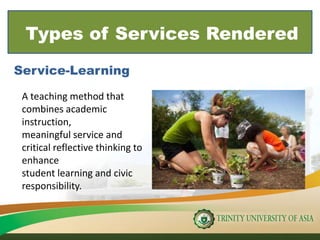
Service-Learning
A teaching method that
combines academic
instruction,
meaningful service and
critical reflective thinking to
enhance
student learning and civic
responsibility.
Differentiation of Services
•Service-learning is a credit-bearing educational experience
meeting the community needs.
•The community needs are related to the course materials of
the students.
•Service-learning, unlike practicum and internship, is not
testing skills in the context of professional education
•Drives reciprocity between the academy and the community;
each sharing and respecting expertise.
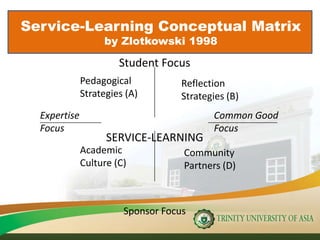
Service-Learning Conceptual Matrix
by Zlotkowski 1998
Student Focus
SERVICE-LEARNING
Sponsor Focus
Expertise
Focus
Common Good
Focus
Pedagogical
Strategies (A)
Reflection
Strategies (B)
Academic
Culture (C)
Community
Partners (D)
The design of SL varies from discipline to discipline.
Must consider the following:
1. objectives of the community service activity to be introduced
2. kind of community service most appropriate to the goals of
the course, the level of student expertise available and the needs
of community partner
3. the course format most appropriate for the learning and
community service goals
Pedagogical Strategies :
a design and implementation of course-
specific strategies
Reflection strategies:
a means to evaluate,
value the experiences of the connection of
classroom learning and community service
Service-learning provides a multilayered understanding of the
lesson on hand…
What students reflect on results not just greater mastery of the
course but also leads to expanded appreciation of the contextual
and social significance of the discipline in question.
This enhances the sense of civic responsibility of the students.
Academic Culture:
refers to structural readjustments in
education
Reintegration of faculty roles
Through S-L, the faculty can get involve into the interweaving of
the educational functions: teaching, research and service.
Reassessing assessment and recognition
As a pedagogy, S-L is concerned with not only transmitting
knowledge but in the transformation of all
involved in the process.
Validating new curricular collaboration
S-L promotes new opportunities for integration of
disciplines, leading to curricular collaboration
Community Partnership:
refers to matching of service activity to
academic needs
Identify service agencies or community groups appropriate for
course-based student involvement
Cultivate relations that call for significant investment time
and effort beyond achieving specific tasks.
Develop interdependency : Community becomes involve in
the academe’s goal to generate and communicate
knowledge and on the other hand the academe
becomes involved in the community’s obligation to meet
essential human needs
Transform academic engagement from a responsible action to
a moral obligation
Academic Service-Learning
•One way of articulating
Christian dimension
•Gives life to the mission
“to serve others”
Academic Service-Learning
•Uniting the three-
pronged thrust of
higher education.
INSTRUCTION
RESEARCH
COMMUNITY
SERVICE
Academic Service-Learning
•Methodology for
curricular and co-
curricular programs
•Utilizes community
involvement
component
Academic Service-Learning
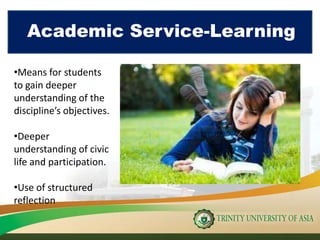
•Means for students
to gain deeper
understanding of the
discipline’s objectives.
•Deeper
understanding of civic
life and participation.
•Use of structured
reflection
Service-Learning Assumptions
•S-L is a pedagogy
•S-L is a strategy
•S-L complements educational reform
•S-L is academy
Five Pillars of Service-Learning
1.Preparation
2.Engagement or Service
3.Reflection
4.Reciprocity
5.Public Dissemination or Celebration
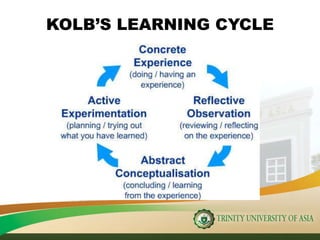
KOLB’S LEARNING CYCLE
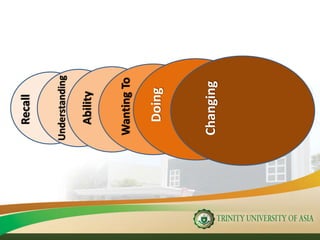
Recall
Understanding
Ability
WantingTo
Doing
Changing
Approaches and Variations
“no one specific approach”
Institutional course offerings
Department programs integrated into courses
As a methodology in the teaching of course
Specific programs such as educational tours and
field trips
Modes of Delivery
Teacher-initiated
Staff-mediated
Community partner/ agency-driven
Theological Bases of S-L
Christian Faith
•Jesus came to serve and
not to be served
(Mark 10:45)
•To believe in Jesus as Christian is to
serve Jesus by serving people.
Christians believe that Jesus Christ is
with us when we serve people and
work for the poor, the sick and
the oppressed.
Theological Bases of S-L
Islam
“ if you publish your freewill offerings, it is excellent; but if you
conceal them, and give them to the poor, that is better for you
and will acquit you of your evil deeds; God is aware of the
things you do.”
Sura 2:271
Islam recognizes the reason for
generosity, rather than
generosity alone.
Theological Bases of S-L
Essence of the Human Being (Hinduism)
•The Human souls (atman) are all connected to each other and
ultimately to the divine (Brahman).
•If we are interconnected, we are ultimately linked to the divine,
then there can be no cause for injustice or cruelty
(himsa). There will be ahimsa (non-violence).
•The essence of humanity is “to give” . It is one of the three
commandments of the Deity in the Great Forest:
•Be controlled, give, and be merciful.
•Giving is the gift of the essence of humanity from our atman, the
innermost gift, which is quintessentially divine.
Theological Bases of S-L
Buddhism
BUDDHIST morality is built
upon the ideas of universal
love and compassion that
involve service to individual
and to the society.
The Parable of the
Spoon
One day a man said to
God,
“God, I would like to know
what Heaven and Hell are
like.”
God showed the man two
doors.
Inside the first one, in the middle of the room, was a large
round table with a large pot of stew. It smelled delicious
and made the man’s mouth water, but the people sitting
around the table were thin and sickly.
They appeared to be famished. They were holding
spoons with very long handles and each found it
possible to reach into the pot of stew and take a
spoonful, but because the handle was longer than
their arms, they could not get the spoons back into
their mouths.
The man shuddered at the sight of their misery and
suffering. God said, "You have seen Hell."
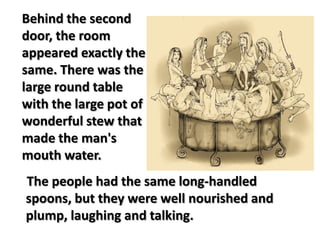
The people had the same long-handled
spoons, but they were well nourished and
plump, laughing and talking.
Behind the second
door, the room
appeared exactly the
same. There was the
large round table
with the large pot of
wonderful stew that
made the man's
mouth water.
The man said, "I don't
understand."
God smiled. �It is
simple,� he said,
�Love only requires
one skill. These
people learned early
to feed one another.
Those who are
hungry are greedy
people, and they
think only of
themselves.
Thank you very much!
Maraming Salamat po!
DIVINO L. CANTAL JR.
Faculty of Media Studies, CAS
Trinity University of Asia, Philippines
+639177996817
+63-2-7022882 local 312
dlcantaljr@yahoo.com

Service-Learning Principles, Theories and Practices

  • 1.
    Theories, Principles and Practicesof Service-Learning Divino L. Cantal Jr. Faculty of Media Studies College of Arts and Sciences Trinity University of Asia (Presented during the CUAC Summer 2013 Conference on S-L, 25-27 June 2013. Trinity University of Asia, Quezon City, Philippines
  • 3.
    Why Embrace Service-Learning? HAVE Service-Learningserves as a bridge that narrows the gap between those who have and who have not.
  • 4.
    What is Service-Learning? •aunion of public and community service with structured and intentional learning (Howard Berry, 1990) •knowing and doing (Linda Chisholm, 1990) •a method that enhances what is taught in school by extending student learning beyond the classroom and into the community and helps foster a sense of caring for others (National Service Act of 1990)
  • 5.
    What is Service-Learning? •Anacademic study and community service designed and intended to illustrate and reinforce knowledge learned in the classroom through the process of critical thought and self-reflection (Butterfly Effect, Lingnan University 2012) •an experiential learning, a process of social educational exchange between the learners and the people they serve.
  • 6.
    Types of ServicesRendered A voluntary work in a local community or non- governmental agencies usually done in personal apostolic work, though maybe connected with academic instruction, this is not a requirement of the course. Community Outreach Program
  • 7.
    Types of ServicesRendered Internship or Practicum Service performed by students in the industry or field of their specialization where they test the validity of their classroom theories in actual professional practice.
  • 8.
    Types of ServicesRendered Service-Learning A teaching method that combines academic instruction, meaningful service and critical reflective thinking to enhance student learning and civic responsibility.
  • 9.
    Differentiation of Services •Service-learningis a credit-bearing educational experience meeting the community needs. •The community needs are related to the course materials of the students. •Service-learning, unlike practicum and internship, is not testing skills in the context of professional education •Drives reciprocity between the academy and the community; each sharing and respecting expertise.
  • 10.
    Service-Learning Conceptual Matrix byZlotkowski 1998 Student Focus SERVICE-LEARNING Sponsor Focus Expertise Focus Common Good Focus Pedagogical Strategies (A) Reflection Strategies (B) Academic Culture (C) Community Partners (D)
  • 11.
    The design ofSL varies from discipline to discipline. Must consider the following: 1. objectives of the community service activity to be introduced 2. kind of community service most appropriate to the goals of the course, the level of student expertise available and the needs of community partner 3. the course format most appropriate for the learning and community service goals Pedagogical Strategies : a design and implementation of course- specific strategies
  • 12.
    Reflection strategies: a meansto evaluate, value the experiences of the connection of classroom learning and community service Service-learning provides a multilayered understanding of the lesson on hand… What students reflect on results not just greater mastery of the course but also leads to expanded appreciation of the contextual and social significance of the discipline in question. This enhances the sense of civic responsibility of the students.
  • 13.
    Academic Culture: refers tostructural readjustments in education Reintegration of faculty roles Through S-L, the faculty can get involve into the interweaving of the educational functions: teaching, research and service. Reassessing assessment and recognition As a pedagogy, S-L is concerned with not only transmitting knowledge but in the transformation of all involved in the process. Validating new curricular collaboration S-L promotes new opportunities for integration of disciplines, leading to curricular collaboration
  • 14.
    Community Partnership: refers tomatching of service activity to academic needs Identify service agencies or community groups appropriate for course-based student involvement Cultivate relations that call for significant investment time and effort beyond achieving specific tasks. Develop interdependency : Community becomes involve in the academe’s goal to generate and communicate knowledge and on the other hand the academe becomes involved in the community’s obligation to meet essential human needs Transform academic engagement from a responsible action to a moral obligation
  • 15.
    Academic Service-Learning •One wayof articulating Christian dimension •Gives life to the mission “to serve others”
  • 16.
    Academic Service-Learning •Uniting thethree- pronged thrust of higher education. INSTRUCTION RESEARCH COMMUNITY SERVICE
  • 17.
    Academic Service-Learning •Methodology for curricularand co- curricular programs •Utilizes community involvement component
  • 18.
    Academic Service-Learning •Means forstudents to gain deeper understanding of the discipline’s objectives. •Deeper understanding of civic life and participation. •Use of structured reflection
  • 19.
    Service-Learning Assumptions •S-L isa pedagogy •S-L is a strategy •S-L complements educational reform •S-L is academy
  • 20.
    Five Pillars ofService-Learning 1.Preparation 2.Engagement or Service 3.Reflection 4.Reciprocity 5.Public Dissemination or Celebration
  • 21.
  • 22.
  • 23.
    Approaches and Variations “noone specific approach” Institutional course offerings Department programs integrated into courses As a methodology in the teaching of course Specific programs such as educational tours and field trips
  • 24.
  • 25.
    Theological Bases ofS-L Christian Faith •Jesus came to serve and not to be served (Mark 10:45) •To believe in Jesus as Christian is to serve Jesus by serving people. Christians believe that Jesus Christ is with us when we serve people and work for the poor, the sick and the oppressed.
  • 26.
    Theological Bases ofS-L Islam “ if you publish your freewill offerings, it is excellent; but if you conceal them, and give them to the poor, that is better for you and will acquit you of your evil deeds; God is aware of the things you do.” Sura 2:271 Islam recognizes the reason for generosity, rather than generosity alone.
  • 27.
    Theological Bases ofS-L Essence of the Human Being (Hinduism) •The Human souls (atman) are all connected to each other and ultimately to the divine (Brahman). •If we are interconnected, we are ultimately linked to the divine, then there can be no cause for injustice or cruelty (himsa). There will be ahimsa (non-violence). •The essence of humanity is “to give” . It is one of the three commandments of the Deity in the Great Forest: •Be controlled, give, and be merciful. •Giving is the gift of the essence of humanity from our atman, the innermost gift, which is quintessentially divine.
  • 28.
    Theological Bases ofS-L Buddhism BUDDHIST morality is built upon the ideas of universal love and compassion that involve service to individual and to the society.
  • 29.
    The Parable ofthe Spoon
  • 30.
    One day aman said to God, “God, I would like to know what Heaven and Hell are like.” God showed the man two doors.
  • 31.
    Inside the firstone, in the middle of the room, was a large round table with a large pot of stew. It smelled delicious and made the man’s mouth water, but the people sitting around the table were thin and sickly.
  • 32.
    They appeared tobe famished. They were holding spoons with very long handles and each found it possible to reach into the pot of stew and take a spoonful, but because the handle was longer than their arms, they could not get the spoons back into their mouths. The man shuddered at the sight of their misery and suffering. God said, "You have seen Hell."
  • 34.
    The people hadthe same long-handled spoons, but they were well nourished and plump, laughing and talking. Behind the second door, the room appeared exactly the same. There was the large round table with the large pot of wonderful stew that made the man's mouth water.
  • 36.
    The man said,"I don't understand." God smiled. �It is simple,� he said, �Love only requires one skill. These people learned early to feed one another. Those who are hungry are greedy people, and they think only of themselves.
  • 37.
    Thank you verymuch! Maraming Salamat po! DIVINO L. CANTAL JR. Faculty of Media Studies, CAS Trinity University of Asia, Philippines +639177996817 +63-2-7022882 local 312 dlcantaljr@yahoo.com